"A New York Treasure" --Village Voice

Daily Archives: June 30, 2009

Seattle Mariners

Seattle Mariners

2009 Record: 39-36 (.520)
2009 Pythagorean Record: 36-39 (.480)

2008 Record: 61-101 (.377)
2008 Pythagorean Record: 67-95 (.414)

Manager: Don Wakamatsu
General Manager: Jack Zduriencik

Home Ballpark (Park Factors): Safeco Field (96/97)

Who’s Replacing Whom:

  • Russell Branyan replaces Raul Ibañez
  • Ken Griffey Jr. replaces Richie Sexson and Jose Vidro
  • Franklin Gutierrez replaces Jeremy Reed and Willie Bloomquist
  • Rob Johnson (minors) replaces Jeff Clement (minors)
  • Chris Woodward is filling in for Adrian Beltre (DL)
  • Ronny Cedeño is filling in for Yuniesky Betancourt (DL)
  • Mike Sweeney replaces Bryan LaHair (minors)
  • Josh Wilson replaces Miguel Cairo
  • Mike Carp replaces Willie Bloomquist
  • Ryan Langerhans replaces Brad Wilkerson and others
  • Garrett Olson is filling in for Erik Bedard (DL)
  • Jason Vargas is filling in for Carlos Silva (DL)
  • Brandon Morrow is taking over the starts of Ryan Feierabend (DL) and R.A. Dickey
  • David Aardsma replaces J.J. Putz
  • Sean White replaces Sean Green
  • Chris Jakubauskas replaces Rowland-Smith’s relief innings

25-man Roster:

1B – Russell Branyan (L)
2B – Jose Lopez (R)
SS – Ronny Cedeño (R)
3B – Chris Woodward (R)
C – Kenji Johjima (R)
RF – Ichiro Suzuki (L)
CF – Franklin Gutierrez (R)
LF – Wladimir Balentien (R)
DH – Ken Griffey Jr. (L)

Bench:

R – Mike Sweeney (1B)
R – Josh Wilson (IF)
L – Mike Carp (1B/OF)
L – Ryan Langerhans (OF)
R – Rob Johnson (C)

Rotation:

R – Felix Hernandez
L – Garrett Olson
R – Brandon Morrow
L – Jarrod Washburn
L – Jason Vargas

Bullpen:

R – David Aardsma
R – Mark Lowe
R – Miguel Batista
R – Sean White
R – Chris Jakubauskas
R – Roy Corcoran

15-day DL: 3B – Adrian Beltre (bone spurs in shoulder), SS – Yuniesky Betancourt (hamstring), LHP – Erik Bedard (shoulder inflammation), RHP – Shawn Kelley (oblique strain)

60-day DL: LF – Endy Chavez (ACL), RHP – Carlos Silva (labrum, rotator cuff), LHP Cesar Jimenez (shoulder and biceps tendonitis), LHP – Ryan Feierabend (TJ)

Typical Lineup:

L – Ichiro Suzuki (RF)
L – Russell Branyan (1B)
L – Ken Griffey Jr. (DH)
R – Jose Lopez (2B)
R – Franklin Gutierrez (CF)
R – Kenji Johjima (C)
R – Wladimir Balentein (LF)
R – Ronny Cedeño (SS)
R – Chris Woodward (3B)

(more…)

Now Batting for the Yankees, Eric Hinske

Eric Hinske ROY 2003 ToppsThe Yankees acquired a left-handed bench bat today, picking up 2002 Rookie of the Year Eric Hinske from the Pirates for minor leaguers Casey Erickson and Eric Fryer. The move comes on the same day that Xavier Nady is visiting Dr. Lewis Yocum to determine if he does indeed need a second Tommy John surgery.

Hinske is a decent addition to the bench, but before we get to how he fits on the team, lets take a quick look at what the Yankees gave up to get him.

Eric Fryer was the catcher/outfielder obtained from the Brewers for lefty Chase Wright. A tenth-round pick out of Ohio State in 2007, the righty-hitting Fryer, now 23, was hitting .250/.333/.344 with 11 steals in 16 attempts for High-A Tampa, spending most of his time in left field. This is just his third professional season

Pitcher Casey Erickson is also right-handed, 23, and a former tenth-round pick (the Yankees’ in 2006). He’s bounced between starting and relieving in his brief professional career. Though he made a strong showing in short-season Staten Island’s rotation last year (2.76 ERA, 4.6 K/BB), he has pitched primarily in relief for Charleston of the Sally League this year. A groundballer in his first full-season in a full-season league at age 23, he’s nothing special, particularly in the Yankees’ pitching-rich organization.

That’s not much to lose, a pair of 23-year-old A-ballers with very little projection, one a mid-round draft pick and another the bounty for a player who had been designated for assignment. That’s certainly a price worth paying for an immediate upgrade to the major league team’s 25-man roster.

So, is Hinske an upgrade? An if so, how much of one? That partially depends on who he replaces on the roster, which we likely won’t know until just before game time tonight. Here’s my guess.

With Jose Molina set to return from his quad strain, the Yankees are likely on the verge of sending both Francisco Cervelli and Ramiro Peña down to Triple-A to get regular playing time. Cervelli and Peña are both 23, and neither has played a game at Triple-A. Cervelli may yet prove to be a viable starting catcher in the major leagues, but will need more development time to achieve that potential. Peña still seems more like a reserve infielder to me, but the Yankees will never find out if he could be more without letting him play every day at Triple-A.

As much of a revelation as Cervelli has been, he’s still only hitting a Molina-like .269/.290/.343 and has made just eight starts in the last month. Peña’s line is a near match at .267/.308/.349, and he’s started just five games in the last month. In Peña’s case, that line is simultaneously impressively and alarmingly close to his career minor league line of .258/.316/.319.

Replacing Peña, Hinske will be a clear upgrade at the plate. He arrives in New York hitting .255/.373/.368 on the season and is coming off  a season in which he hit 20 home runs for the AL Champion Rays. Hinske’s worst major league season came for the Red Sox in 2007, and even that .204/.317/.398 would be an upgrade on Peña, as would Hinske’s career line of .254/.337/.436. The one catch is that the left-handed Hinske flat-out cannot hit left-handed pitching (.221/.298/.363 career), though even that line rivals what Peña has done at the plate in the major leagues. The flip side of that split, of course, is that Hinske’s career line against right-handed pitching  is a solidly league-average .264/.347/.456.

The acquisition of Hinske is above all else a smart solution to the Yankees’ need to have an extra infielder on hand to back up Alex Rodriguez. Hinske isn’t a great defender, but he can play the four corners (third, first, left and right) well enough to spot start against right-handed pitching. Though he’s played just 21 games at third base over the last four seasons, only 11 of which have been starts, he hasn’t made an error in any of them.

Playing for his fourth AL East team, Hinske is familiar with the pitchers in the league and the division and unlikely to suffer from a return to the harder league, where he spent his entire career prior to this year. The only real complaint I have about the move is that Hinske is left-handed. Yes, pairing the lefty-swinging Hinske with the right-handed Cody Ransom will allow Joe Girardi to play matchups at third base on Rodriguez’s weekly days off, but the only other exclusively right-handed hitters on the team are Derek Jeter and Alex Rodriguez, leaving Hinske little value as a pinch-hitter when Ransom’s not in the game. A right-handed bench bat could be used to hit for Brett Gardner or Hideki Matsui against a tough lefty. I suppose Hinske could also hit for Molina after his return, but since such a move would require inserting Jorge Posada for defense, there’s no reason not to simply use Posada’s superior bat in those circumstances.

Nonetheless, Hinske is a valuable and versitile reserve. He’s also been on the last two American League pennant winners. Here’s hoping he extends that streak with the Yankees.


Card Corner: Dr. Strangeglove

Stuart

Quick now, how many current Yankees have nicknames? “A-Rod” for Alex Rodriguez and “Tex” for Mark Teixeira don’t count; those simply involve the shortening of last names for the sake of convenience. In terms of legitimate nicknames, Hideki Matsui has been known as “Godzilla” going back to his days in Japan. Chien-Ming Wang used to be called “Tiger” in the minor leagues, but the moniker has never caught on in the big leagues. Then there’s Alfredo Aceves, who is known as “Ace,” and Melky Cabrera, sometimes called the “Melkman,” but they’re not exactly the most creative of nicknames. And that’s about it.

The Yankees are pretty typical in this regard these days. Nicknaming has become a lost art in the contemporary game, partly for reasons of political correctness and partly because we’ve just become damn lazy. At one time, nicknames were a huge part of the game’s subculture, largely because of the influence of headline and beat writers at newspapers and local team broadcasters. The 1960s represented one of the golden eras for nicknames. It is in that decade that we find one of the most creative and fitting nicknames of all time, even if it did have to belong to a Red Sox first baseman.

By the summer of 1964, Dick Stuart had firmly established a reputation as one of the worst defensive players in the major leagues. Although he was the starting first baseman for the Sox, Stuart couldn’t do anything well with the glove. (That’s probably why Topps showed him with a bat in his 1964 card.) With hands of gypsum, dime-like range, and generally poor instincts, Stuart achieved the Triple Crown of fielding ineptitude. By most accounts, he was also indifferent to the defensive game, so he never motivated himself to improve. Now I never actually saw Stuart play, but I’ve heard so many stories of his lack of defensive prowess that some of them have to be true.

With such anecdotal and statistical evidence (he reached double figures in errors eight times), it’s safe to say that Stuart was historically bad when it came to the business of guarding first base. So it was quite appropriate that in 1964 one of his teammates fitted him with the nickname of “Dr. Strangeglove.” The creation of such a name relied heavily on Hollywood; the Peter Sellers black comedy, Dr. Strangelove: Or How I Learned To Stop Worrying and Love the Bomb, had just been released in theaters on January 29. By placing the letter “g” between the “e” and the “l” in Strangelove, the unknown Red Sox teammate had devised a pithy play on words while tapping the popular culture of the day. The timing could not have been better, considering that Stuart had made 29 errors the previous season, a simply remarkable achievement for someone playing first base.

Stuart’s haphazard fielding had nothing to do with the movie’s plot, in which an insane general tries to initiate nuclear holocaust while politicians do their best—ineptly, I might add—to save the world. The supremely talented Sellers played three roles in the film, including the title role of “Dr. Strangelove,” an important scientist in Nazi Germany. Stuart was similarly schizophrenic to the versatile Sellers; as poor a fielder as Stuart was, he was often a feared slugger, once hitting a career-high 42 bombs for the Red Sox.

Not surprisingly, the creative moniker of Dr. Strangeglove took hold quickly and never let up, becoming almost mandatory whenever Stuart’s real name was uttered. When another 1964 film, Goldfinger, achieved a level of mass popularity, a few folks tried to attach the nickname “Stonefingers” to Stuart, but that label never really caught on.

All in all, Stonefingers is pretty good, but Dr. Strangeglove is just great. Is it the best nickname of all time? I’ll leave that up to you, the reader, to decide.

Nouyrican Nourishment

Got Flava?

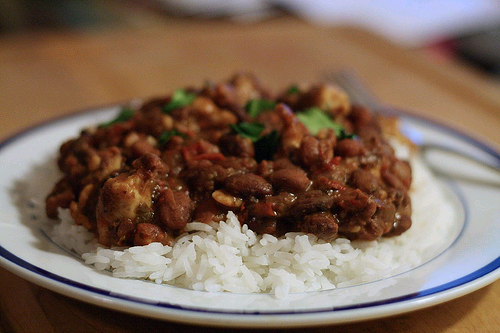
rice and beans

There was a terrific little piece by Sam Sifton in the Times magazine last weekend on rice and beans, Boricua style:

A restaurant kitchen can be a kind of mother, too. This is particularly true in New York, where so many eat out so often. Indeed, for many of those born in New York — and there are more than 2.4 million of these natives in the state, according to census data run through the computers of Andrew A. Beveridge, a professor of sociology at Queens College — Puerto Rican rice and beans have little to do with blood relationships. Rice and beans are instead a shared and familiar experience, offered to all alongside dishes of roast pork or baked chicken (sweet beneath its crispy skin), dense and hearty mofongo, buttered toast, fried plantains and yuca.

Of course, rice and beans are served across Latin America, in different variations, with different beans, for different reasons. You will find superior platters of them in Brazil, in the Dominican Republic, across Mexico. The best of New York’s are literally Nuyorican, a word that arose to describe the Puerto Rican diaspora in New York, the almost 10 percent of the city that has its familial roots in the commonwealth but sees its children bloom on the concrete of the South Bronx, East Harlem, along Columbia Street in Brooklyn.

Nuyorican restaurant rice and beans are food for flame-haired detectives coming off the day shift and chalk-hued art kids jittery and lost amid the salsa beats, for tired high-school teachers, for back-office fellows off the clock. They are the taste of comic-opera hangovers, honest hunger, game-day excess, hard work. They are an authentic taste of a New York that real-estate developers and change can never diminish.

Here is the recipe. I’m all over this. Once again, I don’t know the scientific explanation but bacon makes it better.

Yankee Panky: Channeling Todd Drew

In his short time here at the Banter, Todd Drew made an indelible impact on all of us. Amid Alex’s range, Cliff’s statistical acumen, Bruce’s historical perspective, Emma’s sense of humor and the combination of media coverage from Diane and me, Todd, through his storytelling, demonstrated his love for baseball and this community by portraying the human side of Yankee fans.

From the tee shirts and hats and other assorted team paraphernalia worn by the transients, I noticed a number of Yankee fans on the 1, 2 and 3 trains when I was in New York City Monday. I haven’t been in the city much since changing jobs, so I was actually looking forward to the long subway ride to Columbia and then up to Manhattan College for a couple of workshops I was doing with clients at both institutions. As the train bounded out from underground between the Columbia campus at 116th Street and 125th Street and back down again quickly, and then into the light once more as the route exited Washington Heights and entered Inwood, I found myself thinking about Todd and his daily posts, many of which featured an interview with a Yankee fan on a subway and thought, “Todd was pretty brave to write from this perspective every day.”

The people he met every day on his way to work, or en route to the Stadium shaped his writing. Todd subscribed to a basic tenet of feature writing: everyone has a story to tell. He understood that we were all connected, sometimes in a similar way to how the subway lines connect people in the Big City. These strangers’ stories were his stories, and he was kind enough to share them.

Me? I’m not inclined to strike up a conversation with a stranger on a train and glean stories from there. I’m more of a situational observer. I view the panoramic and drill down based on the information I process.

On my way back downtown, I sat silently reading the Tom Verducci / Joe Torre tome, “The Yankee Years,” occasionally looking up to people-watch, mostly keeping to myself. As is usually the case when I travel by train, I get very tense and hope that either of the following situations does not occur: 1) a person sitting 5-10 feet from me is playing their iPod so that I can hear it through their headphones (after all, it’s not called an “everybodyPod), or 2) someone or a group of people in my car behaves obnoxiously, compelling me to get up and move to another car.

Today was different, though. Maybe it was because I’m not in the city every day anymore. I hadn’t taken the time to really notice the people, the surroundings, or wonder what was going on in their little insular planets before. Maybe it was because I was venturing to places that I hadn’t been on the 1 line and I wanted to learn something that I could eventually use in a conversation.

Before switching trains at 96th Street, a little girl was telling her father that she had fun and that she didn’t want to sit down because she was sweaty but “her bum wasn’t wet.” That killed me. One stop later, a family wasn’t prepared to get off the train, got to the doors about a second too late and the subway doors nearly scissored a mother’s baby carriage. A cursing match between the mother and the conductor ensued. While that was going on, another family entered the car and sat across from me: a mother, her son–who was probably about 7–and her daughter, probably age 4 or 5. Looking at the girl, it was like I was viewing my own daughter in five years. Similar shaped face, long, light brown hair, pink dress and sandals. And this girl was named Maddie, like mine. I immediately imagined riding a subway with my daughter, maybe on our way to the Museum of Natural History or some place like that, with her looking at the signs and asking questions as this other Maddie was doing with her mom.

The mother and her two children got off at 34th Street like I did, and from there we went our separate ways: them to the street, where a bus would take them one stop to the steps of their apartment building and me to the Long Island Rail Road concourse of Penn Station. A couple of glances were exchanged, but no words. I didn’t get to tell the mother about the similarities between her Maddie and mine. I don’t regret not saying anything, but it would have been nice to make conversation and see where it went. If he was in a similar position, Todd would have probably taken that leap and turned it into a 400-word piece.

The best feature writers immerse themselves in the environment and absorb the energy. Todd was able to do that and put you right there on the train with him. This one time, I wanted him on the train with me. I think he’d appreciate the ride.

News of the Day – 6/30/09

Today’s news is powered by the trailer to the Scrabble documentary “Word Wars” (Yes, I know everyone in the trailer quite well. No, I don’t get any face time in the movie.):

Here’s a little Yankee trivia question to start the date: Paul Zuvella (mentioned later on in the column) is the last name alphabetically in the Yankees’ all-time player register.  Who is the first? (answer at bottom of column)

  • The Post’s Joel Sherman is quite certain of the best player he’s ever seen:

. . . (Mariano) Rivera has played just barely more than 1,000 innings in his whole career. And I know he has played mainly one inning at a time. And I also know I am biased because I have seen pretty much every pitch of that career. I was, for example, in the park on May 17, 1996 when he recorded his first major league save and again Sunday night when he reached 500 as I write about in this column.

But I actually don’t consider seeing so much of Rivera’s work a bias as much as a privilege. I have loved watching someone so great at what he does so often. Rivera has everything you would want in the best player you have seen checklist: He is a genius as a player. He has been incredibly consistent at that genius. That genius extends into the postseason. He has been incredibly durable. He elevates the play of those around him.

[My take: In this era of steroids, videotape and maple bats, Rivera is a wonder.]

All indications are that the Yankees will not carry three catchers because of the way their roster is constructed right now, so it will probably mean that Cervelli will have to go down to Triple-A when Molina is ready to return.

There’s no shame in that. He’s 23 and, while he’s enjoyed some success in the big leagues, there is more development that can take place. He should head down and feel good about what he accomplished, but it wasn’t like he was going to steal the job. Molina is a legitimate big league backup catcher and the Yankees are paying him well to do that.

[My take: Much as many of us have baseball crushes on Frankie, its probably best for him to get regular ABs at the Triple-A level rather than ride the pine in NY.]

(more…)

feed Share on Facebook Share on Twitter Share via email
"This ain't football. We do this every day."
--Earl Weaver