Ever have “The Luther”?

That’s a burger with bacon on a doughnut. It’s named about Luther Vandross.
I have not tried one. I gotta admit the truth: I ascared.
[Photo Credit: Scene by Laurie]



Ever have “The Luther”?
That’s a burger with bacon on a doughnut. It’s named about Luther Vandross.
I have not tried one. I gotta admit the truth: I ascared.
[Photo Credit: Scene by Laurie]
Postscript
By John Schulian

I look in the mirror and see the faces I have worn. I see the kid with a baseball cap snugged on his head, and the newspaper reporter who grew a beard to look older, and the TV writer who shaved his beard to look younger. The only face I don’t see – the only face I refuse to see – is the one on my driver’s license. I look like someone Winslow Homer might have painted. Though I insist it is nothing more than the product of a bad day at the DMV, I know I will see that face in the mirror, too. But not just yet. Not as long as writing can arm me with a crucifix to ward off the vampire that is old age.
I won’t be so bold as to say writing keeps me young. If it did, I wouldn’t curse technology or struggle to remember the names of new bands or look away in embarrassment when I’m caught staring at women one-third my age. But writing gives me purpose and fills my head with the notion that there are still things to be accomplished: essays and short stories, one novel completed, another taking shape in my imagination alongside a screenplay. Somewhere around here I’ve even got a verse and a chorus written for a country song. Maybe I’ll take my guitar down from the wall and finish it someday. It will be just three chords, but what was good enough for Hank Williams is good enough for me.
This is how I always imagined life on the other side of the rainbow. Writers don’t throw retirement parties. They write, and hope their words find their way before the public. Some will, some won’t. I understand the vagaries of the process. I just need to score often enough to let whoever is out there counting know that I’m still kicking. Otherwise, I might have to answer in the affirmative the next time someone asks if I’m retired. For the moment, however, I’m proud to say hell no.
I may have lost a step or two, but that’s far different than being ready for a sedate game of shuffleboard before I sit down to the early bird special. It’s those codgers I see at the doctor’s office who are retired. I’m just a lad of 66. When Red Smith was this age, he was reviving his career at the New York Times and five years away from winning a Pulitzer Prize. Red wanted to die at his typewriter, the way his hero Grantland Rice did, and damned if he didn’t come within three days of doing it.
I wouldn’t consider changing my position on retirement unless I knew I could go out with the high style that Sheik Caputo did at the railroad. The Sheik has been part of my life since I was 13, as a neighbor, a baseball coach, a proponent of pepperoni and cold beer, and, most of all, a cherished friend. He worked as a Union Pacific machinist for 30 years, crawling inside filthy steam engines and never making as much as two bucks an hour. The day he turned 60, he showed up at the Salt Lake City yards at 7 a.m., just like always, and the foreman said, “Hey, Caputo, you’re eligible to retire.”
“Right now?”
“Yeah, if you want to.”
“Goodbye,” Sheik Caputo said, and headed for the golf course.
But there is only one Sheik, and he is 96 and still getting mileage out of that story. I’m happy just to pass it along, which probably underscores the difference between the way he and I look at retirement. He was ready for it, maybe beyond ready, because he had a job he hated. I, on the other hand, am one of the lucky ones. I love my life as a writer, so why would I want to put it behind me? Writing is the one thing I could do with any success. I couldn’t pound a nail straight or sell you a pair of shoes, and I never wanted to revisit a job I had sweeping out a ballpark after the crowd was gone, wading through peanut shells and hotdog wrappers and breathing the smell of spilled beer. I was spared the heartbreak of trying to teach kids who didn’t love reading as much as I do for the deceptively simple reason that I could write a story, be it fact or fiction. Because people would pay me for those stories, I never was a high school coach beset by parents who make more of their kids than they are. I knew the life I wanted, and I got to live it.
Now I am in the process of seeing out what else is out there. I began my search in earnest when I wrote the first two sentences of a hard-boiled novel that had been in my mind for years: “Too bad Barry was from Santa Barbara. Suki would have told him her real name if he’d been local.” Barry is a wandering husband who’s too slick for his own good and Suki is working her way through college in L.A.’s sex trade. In time they will cross paths with a boxer whose career went sideways when he killed a man in the ring. He cares about nothing, least of all his life, until he meets the girl, and then he cares too much, in the way only a noir hero can. Someone out there might be aware of all that if my novel, “A Better Goodbye,” had been published. But the manuscript languishes beside a tall stack of rejection letters.
Still, I reveled in everything about the process from the three-page-a-day discipline to the constant rewriting, and I cling to the hope that my novel will yet be published. A small press has made noises about it, but whether that happens or not, I have another novel in mind and I don’t think I can stop myself from writing it. It’s as if I’m trying to live the life of a starving writer without the risk of going hungry.
I write my fiction in bursts in a time when most literary agents will tell you fiction isn’t selling. But I am fueled by blind faith and the confidence I’ve gained from having two short stories published, one in the Prague Revue (yes, that Prague), the other on a now-defunct website called Thuglit.com. Neither paid anything, but I did receive a Thuglit T-shirt that I treasure too highly to wear. More important I gained just enough swagger to wonder why the hell my best short story has yet to be published. Nothing to do but keep sending it out, I guess.
I beat my head against a different kind of wall when I taught for a semester at my alma mater, the University of Utah, in fall 2004. The wall was constructed in part of the innocence and naivete that reminded me of myself at that age, but there was something more than that at work. There was an unsettling preoccupation with getting a degree instead of an education and, even worse, a lack of basic writing skill. One class in particular – Literary Journalism, of all things – was a wasteland that symbolized for me the parlous state of the language in this age of email happy faces and LOLs. If it weren’t for the hungry minds who made my Art of Storytelling class a joy, I might have staggered off the academic battlefield jabbering like a chimp. Of course my young scholars might tell you I was too demanding. They thought my “Always honest, seldom kind” policy was hilarious only when it didn’t apply to them. Since then, I’ve apologized to the Humanities Department’s guiding lights for being too tough only to be told I should have been tougher. I assume they would have established a bail fund for me.
If I have done anything right as I adapt to geezerhood, it is put books together. Two are collections of my sportswriting, “Sometimes They Even Shook Your Hand” and “Twilight of the Long-ball Gods,” and I will leave it to someone else to speak good or ill of them. But you will find pieces of my heart in the other three books that bear my name. When I edited “The John Lardner Reader,” I was doing more than reviving the work of a brilliant and acerbically funny sportswriter out of print for half a century. I was thanking him and all the other press box legends whose work I’d studied – Red Smith, W.C. Heinz, and Jimmy Cannon in particular – for lighting the way for me.
Editing “At the Fights,” a collection of classic boxing writing, proved even more personal because I was working with George Kimball, who stared death in the eye every step of the way. He was as heroic as any prizefighter memorialized in either that book or “The Fighter Still Remains,” the slender volume of boxing poetry and song lyrics that we spun out of it. There were many things that helped keep George alive so he could feel the love and admiration wash over him at the publication party in New York, but I’ll never stop believing it was “At the Fights” itself that gave him the will to battle cancer for the full 12 rounds. Not once did I hear him complain or wallow in self-pity. The book was always foremost in his mind, just the way George is now in mine, four months after his death at 67.

I wish he’d been here the other day when the cable guy walked into my office and saw a blow-up of the cover for “At the Fights.” “I read that book,” he said, and proceeded to tell me what is in it. It was one of those moments that prove both the breadth of the book’s appeal and the populist nature of sportswriting in general. It was, in other words, what George and I hoped for all along. I even know the song that should have been playing in the background. It’s “Too Many Memories,” by the late Stephen Bruton, and there’s a line in it that says: “What makes you grow old is replacing hope with regret.” I think about those lyrics a lot, their wisdom and humanity and how right they are for me at this time of life. I think about them especially now, as I tell you this: Goodbye but don’t call me gone.
Sunday was Marathon Day. My wife Amelia was running so we went full out with t-shirts, posters and banners. At 124th St and 1st Ave, my older son sat on my shoulders and we yelled out to every runner we could while we waited for her to pass. The runners were psyched to get cheers, but when they came from the squeaky voice of a four year-old, their smiles were double wide. It’s a special day in New York, but I’ll let our runner explain how it feels from inside the ropes:
I am proud to live in New York City every day, but today showed me why ten times over. The support and enthusiam from EVERYONE, in EVERY Borough was just mind blowing and made me so proud to be a New Yorker!!!!
A helluva town.


This week only you can watch “Style Wars,” the classic hip hop documentary over at pitchfork tv.
Don’t sleep.

November is trophy season in major league baseball. The most anticipated awards, like the MVP and Cy Young, come later in the month, but for fans already suffering from withdrawal, the most immediate baseball fix comes in the form of silver and gold. Although the Gold Glove and Silver Slugger aren’t taken that seriously (after all, the two awards are basically a marketing gimmick for Rawlings and Hillerich & Bradsby, respectively), the selections, which this year were announced live on ESPN and the MLB Network, still generate considerable reaction. Unfortunately, particularly in the case of the Gold Glove, most of it seems to be negative.
This year, the Gold Glove selections were not as controversial (mostly thanks to Derek Jeter not winning one). In fact, five of the well respected Fielding Bible Award winners were also awarded with a Gold Glove. However, there were some glaring omissions, the most obvious being Yankees’ left fielder Brett Gardner. By just about every measure, Gardner was not only the best left fielder in the game, but he also ranked among the best outfielders. According to the Field Bible, the Yankees’ speedster tied centerfielder Austin Jackson, who was also denied a Gold Glove, for the most defensive runs saved at 22. That’s an extraordinary total for the center of the diamond, but for a corner position, it’s off the charts. Gardner also topped major league outfielders with a UZR/150 of 29.5, almost doubling the total of Jacoby Ellsbury, who finished a distant second among qualified candidates. Although UZR is a much less reliable metric, the extent to which Gardner led all others was significant. Unfortunately for the Yankees’ left fielder, the Gold Glove voters weren’t that impressed.
The Yankees had two other Gold Glove candidates make it to the “final three” (a new feature of the award) at each position, but Robinson Cano and Mark Teixeira were bested by their Red Sox counterparts. Unlike Gardner’s snub, however, the omission of Cano and Teixeira were well within reason. As a result, one year after tying a franchise record with three Gold Gloves, the Yankees were shutout for only the fifth time since 1982. Although it’s probably no consolation to Gardner, what the Yankees missed out in gold, they made up for in silver. Both Cano and Curtis Granderson were among the A.L.’s recipients of the Silver Slugger, which honors the best offensive player at each position.
Silver and Gold: Yankees’ Award Winners, Total by Year

Source: mlb.com
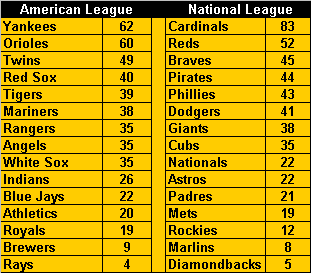
Since the Gold Glove was first awarded in 1957, the Yankees have had the second most honorees, behind only the St. Louis Cardinals, who enjoy a comfortable lead over the field with an impressive 83 trophies. At the other end of the spectrum is the Milwaukee Brewers, which makes the team’s traditional ball-in-glove logo somewhat ironic. Since joining the majors as the Seattle Pilots in 1969, the Brewers have had only nine Gold Glove winners, all coming while the franchise was in the American League.
Most Gold Glove Awards, Sorted by League
Source: mlb.com
For perspective, 16 individual players won more Gold Gloves than the entire Brewers’ franchise, including Greg Maddux, who won twice as many. No other player in history has been honored more often than the future Hall of Famer pitcher, who, in addition to racking up over 300 wins, managed to take home 18 Gold Gloves. Among position players, the most gilded glove belonged to Brooks Robinson, who won 16 at third base. The most decorated Yankees player was Don Mattingly. The Captain won nine Gold Gloves at first base during his time in pinstripes, almost doubling the franchise’s next highest total of five, which is shared by Ron Guidry, Derek Jeter, Bobby Richardson and Dave Winfield.
Most Gold Glove Awards by Position, Yankees and All-Time

Source: mlb.com
The Silver Slugger is usually overshadowed by the Gold Glove, but in recent years has started to gain more exposure, including a dedicated announcement show that aired on the MLB Network. Unlike its defensive counterpart, the Silver Slugger involves more than just subjective peer review. Rather, it is based on a combination of statistics as well as the general impressions of managers and coaches. Because of this more balanced approach, the Silver Slugger selections are seldom as controversial. Then again, part of the reason for that may be the relative indifference expressed toward the award.
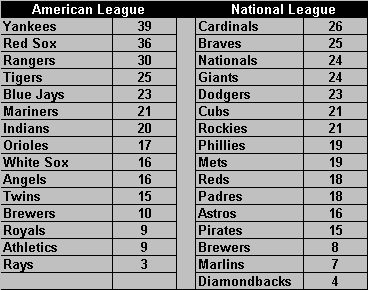
Even if the Silver Slugger doesn’t carry much cachet, it’s still an honor to be named the best offensive player at a particular position. Since it was given out in 1980, the Yankees have had 39 players deemed worthy of that distinction, more than any other team. Meanwhile, among teams in existence during the entire tenure of the award, the Athletics and Royals ranks dead last with only nine.
Most Silver Sluggers, Sorted by League
Source: baseball-almanac.com
Barry Bonds holds a number of high profile records, so it shouldn’t come as a surprise that he is also the owner of the most Silver Sluggers with 12. Not too far behind are Mike Piazza and Alex Rodriguez, who each have 10. However, Arod has the further distinction of winning his at third base (3) and shortstop (7), making him the only player to win multiple awards at two different defensive positions. In addition to Rodriguez, 11 other players have won at least one Silver Slugger at two defensive positions (not including DH and with no differentiation for the outfield), including Albert Pujols and Miguel Cabrera, who are the only players to be honored at three places on the diamond.
Most Silver Slugger Awards by Position, Yankees and All-Time

Source: baseball-almanac.com
Even though many baseball fans claim not to care about the Gold Glove and Silver Slugger, both awards have endured for a significant period and, by doing so, become a part of the game’s historical record. Despite this, some will probably still accuse me of digging too deeply into a mundane topic, or mining too hard for content in the off season. That’s probably true, but it doesn’t mean a review of baseball’s metallurgical record is completely without merit. For example, if someone can answer how the 1985 Yankees managed to win seven combined Gold Gloves and Silver Sluggers without a winning the division, it will have all been worthwhile.
Man, look at this beautiful thing that I found over at Nicole Franzen’s blog.
[Photo Credit: UK Expert]

From Joe Sports Fan, Ron Washington talks to his team before Game 7 of the Whirled Serious:
Ron Washington’s Game 7 Clubhouse Speech from JoeSportsFan.com on Vimeo.
I don’t know from college football but one of my favorite books is about the college game–John Ed Bradley’s memoir, “It Never Rains in Tiger Stadium.” If you haven’t read it, put it on your holiday wish list, you won’t be sorry.
Tonight, there’s a big game between LSU and Alabama. I won’t be watching but when I check the score I’ll be thinking of John Ed, hoping the Tigers make him happy.

Serious Eats presents: 30 Sandwiches We Loved This Year in NYC.

Dig this fine-looking thing from Rubirosa.
By Jon DeRosa
Just like most other genres these days, successful horror movies spawn franchises. The studios have indulged lengthy strolls down Elm Street and at one point, seemed to have taken great care to make sure there was a fresh installment of “Friday the 13th” every time the calendar dictated.
I’ve never seen any of them, but does the number of times people wanted to sit through the same basic story to be scared in the same basic way tell us something of ourselves as a species? I’ll leave that for someone who watched those movies to decide.

In fact, to be a successful horror movie franchise, the film doesn’t even have to be a true horror movie. Both “The Evil Dead” and the “Scream” movies are horror-movie derivitives, distilling or reducing the elements of horror movies and packaging them up with laughs for a new twist.
“The Evil Dead” is a horror movie that has mostly discarded plot, writing, acting, sound, editing, cinematagrophy, and lighting. All that is left is gore, suspense and comedy. It’s poorly made but still spectacular – I challenge you to look away during a screening. The efforts appear earnest, and it’s hard to believe the people responsible for “The Evil Dead” (Sam Raimi and Rob Tapert) would someday create the best super hero fight on film (Raimi’s Doc Ock vs Spiderman on a skyscraper) and torment our hero John Schulian (Tapert).
That’s not to say the movie just a bucket of corn syrup dyed red and an eerie score. There’s a lovely moment where Ash, played by cult hero Bruce Campbell, holds a gift for his girlfriend, Linda, and pretends to be asleep. Linda wants to to grab the gift, but she suspects he’s faking. The camera catches just their eyes as she looks between him and the gift and Ash takes occasional peeks to see if his ruse is working. And then of course when Linda dies, Ash tries to bury her before she can turn into a zombie-monster. He’s too late, but she fakes him out with the same game, pretending to be dead while he digs her grave, sneaking peeks to see if her ruse is working.
When he slices her head off with the shovel, there’s an extra pang between the chuckles. The movie rightly has a devoted following for it’s knack of being bad in just the right ways. And now a remake? I wonder…

On the other side of the same coin are the “Scream” movies. These films are loaded with everything modern Hollywood does best, and then polished to a sheen. The derivative nature of “Scream” lies within the plot of the film as the psychotic killers and the hapless victims of the film are themsleves horror film fanatics. They know how horror movies work inside and out, and when they find themselves inside one, they keep track of what is happening like play-by-play commentators at a sporting event.
Most of them still die, but it’s a lot funnier when the victim does something stupid a few minutes after she discussed the universal stupidity of female horror movie victims.
Like Alex, I don’t seek out a lot of horror movies. However, consuming American popular culture for over thirty years ingrains horror movie formulae in the brain. So it doesn’t take an expert in scary movies to enjoy seeing them turned in on themselves in ingenious ways. And with all the laughs “Scream” and “The Evil Dead” bring to the table, suspense is such a potent ingredient that even these horror-comedies will take you to the edge of your seat before you’re rolling in the aisles.

By Bruce Markusen
This is the only Topps card that shows Matty Alou as a Yankee. Upon first look, most fans are struck by the enormity of the Yankees’ “NY” logo. But it’s not the actual Yankee logo; it’s been airbrushed onto the photograph, along with the Yankee pinstripes and the navy blue cap. The artist who did the airbrushing simply overestimated the size of the interlocking “NY.”
In the actual photograph that Topps used, Alou is wearing the colors of the A’s, with the Oakland Alameda County Coliseum providing the backdrop. Alou spent the latter half of the 1972 season with the A’s, and played a subtle role in helping Oakland win its first world championship, before being purged by Charlie Finley in a cost-cutting maneuver. Without any photos of Alou in Yankee pinstripes, the people at Topps opted for the old airbrushing route.
All these memories of this card come back to me with the news of Alou’s death. He passed away on Thursday at the age of 72, apparently from the effects of diabetes. This is particularly hard news for me because Matty Alou was one of my favorite players. Though he only played part of one season with the Yankees, he was a guy who left me with a boatload of memories from various points throughout his career.
Why did I like Alou so much? I think part of it has to do with his unconventional hitting style. He used a very unorthodox style at the plate–he swung a heavy bat, often hit off his front foot, and blooped a lot of singles to the opposite field–all of which made him intriguing. Ted Williams, the most scientific hitter in history, used to say that Alou broke every rule of batting, but somehow managed to succeed. And unlike Williams, Alou was an extremely aggressive hitter who didn’t walk all that much. But the man could hit singles with the best of them. Alou batted for a very high average, which coupled with his base stealing ability and the speed that allowed him to go first to third, made him a useful player.
Alou began his career with the Giants, where he had the privilege to play in the same outfield with his older brother Felipe and his younger brother Jesus. But Matty never found his way in San Francisco. It was not until he was traded to the Pirates, where he worked with manager Harry “The Hat” Walker on his hitting. The Hat completely retooled Alou’s approach, and to his credit, Alou openly accepted the advice.
The results were undeniable. In 1966, Alou batted .342 to lead the National League. In his next three seasons, he batted .338, .332, and .331. That represents one of the great four-year stretches a hitter has ever experienced. Alou was also a very good center fielder with range and a plus arm, making him a fairly complete package in Pittsburgh. All that he lacked was power.
By the time that Alou joined the Yankees in 1973, he was no longer the same player. Injuries robbed him of his arm strength, while slowing bat speed erased his abilities as a .330 hitter. But the Yankees felt he could help fill a void in right field. The Yankees were set in the other outfield spots–Roy White played left and Bobby Murcer starred in center–but right field had become a problem. Alou stabilized the position somewhat, though he lacked the arm or the ideal amount of power that once expects from a right fielder. He also made 40 appearances at first base, something he had done previously with the Cardinals. At five feet, nine inches, Alou looked odd playing first base; he could have used a phone book to stand on first base and corral high throws from Gene Michael and Graig Nettles.
Alou hit well for the Yankees, batting .296 with an on-base percentage of nearly .340. If the Yankees remained in contention, Alou would have lasted the entire season in New York. But the Yankees fell out of the pennant race, convincing them to try a late-season youth movement. So they sold Felipe Alou to the Brewers and sold 34-year-old Matty to the Cardinals, ridding themselves of two expensive contracts in the process. And that was it for Matty Alou in pinstripes.
As it turned out, Alou did not have much left in his hitting tank. He batted only .198 for the Padres in 1974, but he did not want to call it quits. So he headed to the Japanese Leagues, where he put in three seasons before retiring.
Alou was still playing in the Far East by the time the Yankees became good again and won back-to-pennants in 1976 and ‘77. Like so many of my favorite old players, like Johnny Callison and Walt “No-Neck” Williams and Jim Ray Hart, he did not last long enough to see the glory years in pinstripes.
But at least fun players like Matty Alou made those lean years of the early 1970s a little more bearable for a Yankee fan like me. For that, I will be ever grateful to Matty Alou. Rest in peace, Matty.

We’re still working on fixing some of the bugs but if you see something that doesn’t look right, please let us know.
Thanks!

Some of you guys might have some trouble resetting your password this morning. If that is the case, be sure and check your spam folder for the reset e-mail. That should do the trick. Anyhow, thanks for putting up with us.
T.G.I.F.

We’re taking care of some technical business today so the site will be frozen for new posts and comments starting at 5 p.m. eastern standard time. We should be back up in a few hours, maybe more–know never know how these things go.
You’ll have to reset your passwords. Sorry for the hassle. Bear with us. Thanks.
 “The Kiss,” By Auguste Rodin (1882)