
“Still Life with Jars” by Jan Bogaerts (1936)



“Still Life with Jars” by Jan Bogaerts (1936)

My grandparents lived across the street from the Museum of Natural History. They were older grandparents, not the kind to get down on the floor and play with my sister, brother and me. When in doubt, they took us to the Museum. We went so often that for years I never returned. It just reminded me of being bored out of my skull. But when I was in my twenties I went back and remembered just how cool the place is. I haven’t been in awhile but am down to go again.
[Picture by Bags]

Marcella’s Roasted Belgian Endive recipe.
[Photo Credit: Ralph Smith for The New York Times. Food stylist: Michelle Gatton]

Yeah, I don’t expect Hiroki to return either. His time with the Yanks will be short whether he comes back or not but he’s been a pleasure to root for.
[Photo Credit: Aaron Josefczyk/Reuters]

Thanks to Up North Trips for mentioning that this record was released on this date in 1994.

“Anemones with a Black Mirror” by Henri Matisse (1918-19)

I started Bronx Banter on this date in 2002. And we’re still served fresh daily.
Much love to everyone who falls through and hangs out.
Thanks, guys.

Winter is coming.

Peter Schjeldahl has a kind word for Norman Rockwell:
Rockwell’s populous American mythos is ever more to be valued as the shared beliefs that used to gird it devolve into hellish divisions. His lodestar was Charles Dickens, naturalized to New England towns and to suburbs anywhere. And he drew and painted angelically, with subtle technical ingenuity, involving layered colors, that is still underappreciated. I took instruction on this point from de Kooning, who opened a book to a reproduction, handed me a magnifying glass, and made me peruse Rockwell’s minuscule but almost fiercely animated painterly touch. “See?” said de Kooning. “Abstract Expressionism!” Solomon reports that de Kooning remarked of Rockwell’s astonishing imitation of a Pollock drip painting, being viewed by a fancy gent in “The Connoisseur” (1962), “Square inch by square inch, it’s better than Jackson!” I agree, though the pastiche is unpersuasive overall. Rockwell had labored mightily to get the Pollock look right, not as a parody but in homage. He said, “If I were young, I would paint that way myself.” Never anti-modernist, he was always in awe of Picasso.
But—or really and—Rockwell was an obsessive-compulsive, anxiety-riddled, miserable hypochondriac, as at least two of his three schoolteacher wives and his three emotionally stunted children could testify. He didn’t behave badly so much as he hardly behaved at all, outside his studios in, successively, New Rochelle, New York; Arlington, Vermont; and Stockbridge, Massachusetts. His psychoanalyst—no less than the renowned developmental psychologist and pioneer of psychobiography Erik Erikson—is said to have remarked that Rockwell funneled all his happiness into his art. Solomon plumbs a suspicion (almost de rigueur in biography-writing lately) of homosexuality. Her verdict: temperamentally so, but moot in one who was puritanically shy of intimacy. I can almost imagine Edmund Wilson, whose “The Wound and the Bow” (1941) theorized a link between psychic trauma and creative genius, adding a chapter for Rockwell. (Wilson’s leadoff essay is about Dickens.) Certainly, there can be few more extreme endorsements of W.B. Yeats’s chilly dictum, “The intellect of man is forced to choose / Perfection of the life, or of the work.”

My man Diebenkorn photographed by Fred Lyon.
Hey, welcome back to Where & When; where you are not alone in your struggle to find the truth when you have the proof… yeah, I know, but it’s late so…
Work is getting tougher by the day, not to mention colder, so I warn you now of inconsistencies in publishing the game, but if you are really interested in hosting an episode, drop me a line along with a challenge you would like to present and we’ll hook you up with a guest spot. These are a lot of fun and the conversation is pretty clever among our regulars, plus there’s (fictional) root beer and cream sodas, which is a plus for any endorphins!
Welp, here is the newest challenge, and I think you’ll like the drama involved in this one:

I really wish I could present a larger picture that also contained a full snap of this building. There’s quite a bit of significance attached to it, starting with the fact that the Yankees were involved at some point. How’s that, you ask? You’ll have to tell me and the rest of the readers, and while you’re at it, tell us the name of the building, the address and when it was built. Bonus if you happen to know some other significant events or nouns involved with this building. There’s a lot to tell, so I hope you have enough time to find out and spill. A snifter of Zuberfizz for the first with the correct answers, and a tankard of Baumeister fr the subsequent entries. Post your answers in the comments and I will be checking in throughout the day. Have at it! And no peeking at the photo credit; it’s okay if you come across it during your independent research, but don’t click on the link below. >;)
[Photo Credit: Ephemeral New York]
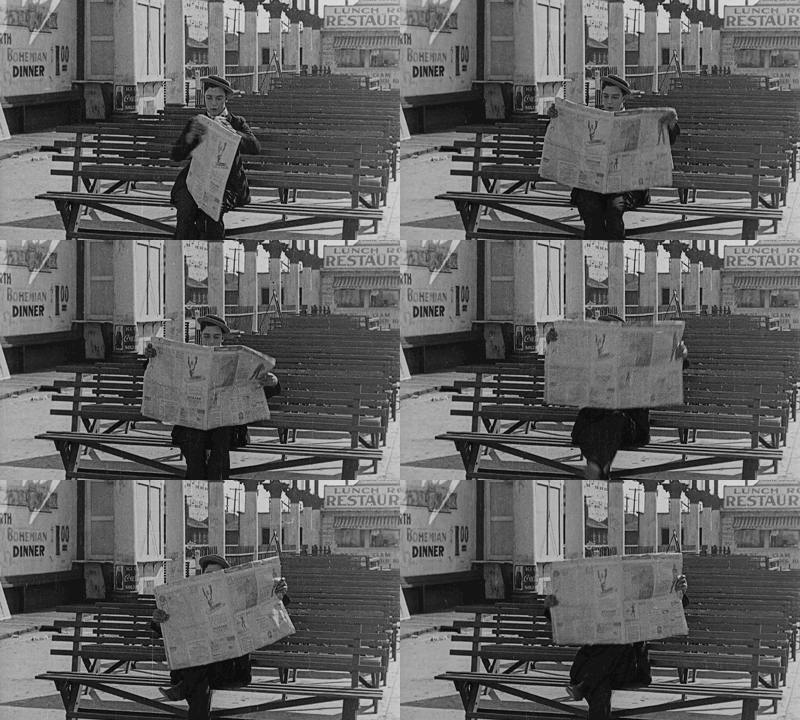
Hey, there’s a new mayor. If you’ve read too much about it you might feel like our man Buster here.

Back for another edition. And we’re talking about the noun here…
What’s the difference between a jerk off and a jag off?