

Friday
April 10, 2026
Since 2002


Blog Archives
Golden State Warriors

The Yanks are in San Diego this weekend. Hey, our pal Grandy is back! And C.C. gets to hit. That should be fun. He’s due for a good start, too.
Brett Gardner CF
Derek Jeter SS
Robinson Cano 2B
Lyle Overbay 1B
Curtis Granderson LF
Ichiro Suzuki RF
Eduardo Nunez 3B
Chris Stewart C
CC Sabathia LHP
Never mind the sunset:
Let’s Go Yank-ees!
[Photo Via: Foulest]
Thurman Munson In Sun and Shade

Today is the 34th anniversary of Thurman Munson’s death. Dip over to The Stacks and read Michael Paterniti’s memorable 1999 Esquire appreciation of the Yankee captain:
I give you Thurman Munson in the eighth inning of a meaningless baseball game, in a half-empty stadium in a bad Yankee year during a fourteen-season Yankee drought, and Thurman Munson is running, arms pumping, busting his way from second to third like he’s taking Omaha Beach, sliding down in a cloud of luminous, Saharan dust, then up on two feet, clapping his hands, turtling his head once around, spitting diamonds of saliva: Safe.
I give you Thurman Munson getting beaned in the head by a Nolan Ryan fastball and then beaned in the head by a Dick Drago fastball—and then spiked for good measure at home plate by a 250-pound colossus named George Scott, as he’s been spiked before, blood spurting everywhere, and the mustachioed catcher they call Squatty Body/Jelly Belly/Bulldog/Pigpen refusing to leave the game, hunching in the runway to the dugout at Yankee Stadium in full battle gear, being stitched up and then hauling himself back on the field again.
I give you Thurman Munson in the hostile cities of America—in Detroit and Oakland, Chicago and Kansas City, Boston and Baltimore—on the radio, on television, in the newspapers, in person, his body scarred and pale, bones broken and healed, arms and legs flickering with bruises that come and go like purple lights under his skin, a man crouched behind home plate or swinging on-deck, jabbering incessantly, playing a game.
Heads Up, Cause We Droppin’ Some…

The making of “Come Clean.” Man, this record was unlike anything that came before it. I still bump it all the time.
[Photo Credit: _janekim via This Isn’t Happiness]

Beat of the Day

Mornin’:
Taster’s Cherce

Honestly YUM gives us a classic: The BLT.
Morning Art

“Le Bain,” By Pierre Bonnard (1925)
Black Friday…or Maybe Monday

With suspensions rumored to come down today, William Rhoden writes that Bud Selig’s bullying almost makes Alex Rodriuez a sympathetic figure:
According to people briefed on the negotiations between Rodriguez and Major League Baseball, Selig has discussed several options, ranging from a lifetime ban to a suspension that would begin this season and end after next season. Rodriguez has never been known as a player who cares about anyone besides himself. But if there were ever a time for A-Rod — and the once-powerful players association — to step up and fight the impending suspension, that time is now. Rodriguez should challenge the credibility of the evidence. If Major League Baseball has compelling evidence, force the league to show it.
There are no vials of evidence. There are no eyewitnesses to Rodriguez’s alleged performance-enhancing drug use. Investigators have the word of two questionable characters connected to Biogenesis, one of whom, the former owner, Anthony Bosch, once impersonated a doctor. Investigators may indeed have compelling evidence — phone records, shipping receipts, e-mails. If they do, A-Rod and the players association should force those investigators to reveal what they have gathered.
This exhaustive investigation is less about A-Rod and performance-enhancing drugs than about power and control. Major League Baseball is attempting to impose its will on high-profile players by possibly circumventing due process to make an example of them.
[Photo Credit: STEVE NESIUS/STEVEN J. NESIUS PHOTOGRAPHY]
BGS: Morgan Freeman Takes Off
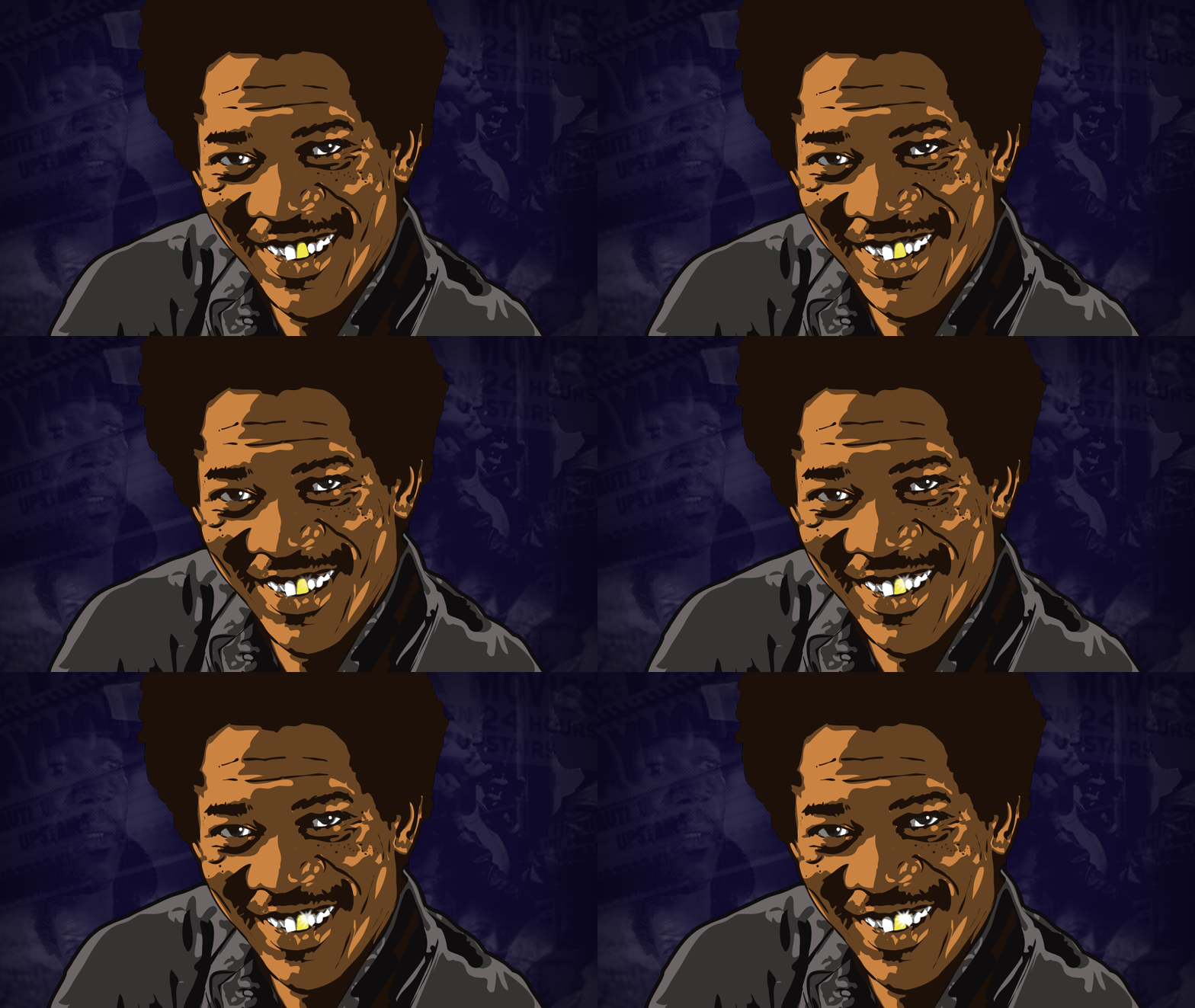
Here’s another gem by Ross Wetzsteon. Originally published in the March 14, 1988, issue of New York magazine. Reprinted here with permission of the author’s widow, Laura Ross. Illustration by Sam Woolley.
Flying. He’d wanted to fly since he was 16. Sitting at his desk in high school in Greenwood, Mississippi, he fantasized that it was a P-51 Mustang, F-86 Sabre jet. He didn’t want to be a pilot, he wanted to be a flier. A pilot just drives—the flyer flies.
And now, five years later, Morgan Freeman is sitting in the cockpit of a jet fighter at last, the Plexiglass bubble secure, the nose falling away in front, the wings swept back, the joystick between his legs. Taxi to the head of the runway, get his clearance from the control tower, let loose the engine, sore into the sky!
Okay, it’s just a T-33 jet trainer parked beside a hanger and he’s only an airman-second-class radar mechanic who’s gotten permission to sit in the cockpit for a few minutes, but this is what he’s dreamed of since he enlisted in the Air Force. Hand on the throttle, eyes scanning the sky, he lets his mind fall into a rapturous reverie—chasing the clouds, dipping his wings from side to side, nosing into a steep dive and pulling out in a swooping arc.
But something’s wrong. After a couple of minutes, he realizes he can’t find the thrill he anticipated. It isn’t there. Instead of fantasizing, he starts thinking. Maybe this isn’t what he wants after all. Maybe he only wanted it because of the movies he’d seen. For one thing, anything he shoots will stay shot. Ten minutes pass. Fifteen. The dream is fading. No, this isn’t what he wants it all. After 20 minutes, he unstraps himself, pushes back the bubble, gets out of the cockpit, leaps to the ground, and walks away—not just from the plane but from the whole idea, from war, military life, jet fighters, all of it. He’s made a decision. If it’s all about movies, he’ll become an actor instead.
Thirty years later, in her New Yorker review of Street Smart, Pauline Kael asks, “Is Morgan Freeman the greatest American actor?” and it’s clear from her rave that it’s a rhetorical question. At Christmas time, he wins awards from the National Society of Film Critics and the New York and Los Angeles film critics as Best Supporting Actor for his performance as a pimp in Street Smart. In February, he’s nominated for an Oscar—against all odds, since only an electric performance could survive such a forgettable film. A street-smart pimp? The same Morgan Freeman who just finished a nearly yearlong run as an elderly, unlettered southern chauffeur in the Off-Broadway hit Driving Miss Daisy (a performance that won him his third Obie in eight years)? The same Morgan Freeman who’s a surefire Tony nominee for his performance as a charismatic Pentecostal preacher in The Gospel at Colonus, the long-awaited Lee Breuer-Bob Telson musical that had cheering, ecstatic audiences standing on their seats at the Brooklyn Academy of Music Next Wave Festival in 1983, then in Houston, Washington, Philadelphia, Paris, Atlanta, Barcelona, and opens on Broadway March 24?
And this is only one year. Morgan Freeman has played a wise old wino in The Mighty Gents on Broadway, an idealistic upper-middle-class architect on the soap Another World, a death-row prisoner in the film Brubaker. He’s danced with Michael Kidd at the 1964 World’s Fair, sung with Pearl Bailey in the all-black Hello, Dolly! He could be seen romping on The Electric Company, then as a stately Coriolanus at the Delacorte.
“When professionals talk range,” says a director, “the names you hear most often are Robert De Niro, Meryl Streep, and Morgan Freeman. It’s that indefinable quality only the greatest actors have to completely submerge themselves in radically different roles, to make you think in each one of them, ‘He was born to play that.’ A lot of actors have that authority in one or two or even three roles, but Morgan has it in everything he does.” It’s the kind of talent that often wins accolades within the profession long before it wins public recognition, and only this year has the world finally realized what Freeman has known for 30 years—that he made the right decision when he walked away from that cockpit.
Oscars, Obies, Tonys—Morgan Freeman is grateful for the recognition, but it also makes him uneasy. “It’s like some sorta Miss America contest,” he says in a half-exasperated, half-baffled tone. “‘Most this,’ ‘Best that’—all this schmagoo about winners.” He’s rubbing the clown white out of his hair with a towel after one of this final performances in Driving Miss Daisy. “If Jack Nicholson, Nick Nolte, and Bill Hurt are all up for the same award—with absolutely different characterizations—you’re going to tell me one of them is the best?”
At the Obie ceremonies last May, Freeman told a story. “Years ago, I was nominated for a Tony award for The Mighty Gents. Oh, ah, gee whiz—I was so executed! So I got my tuxedo and I went to the ceremony, and of course I didn’t win. Now, to be big about it, you know, you say ”kay.’ But I was crushed. I didn’t like feeling crushed, so I would prefer not to have been involved in it at all. If you’re going to give me an award, fine—just give it to me. But don’tnominate me for it. Because what they’re telling you is ‘You’ve been nominated, but you didn’t win.’ Terrific. Who wants to hear that?”

But wouldn’t an Oscar make a big difference in his career?
Freeman runs a comb through his hair, pats the left side of his head, then the right—he has facial bones that even Katharine Hepburn would envy, but not a trace of narcissism. “In a way, I’m kind of contradicting what I said, because sure I’m interested in getting the nomination, but frankly I don’t care if I win or not.” For one thing, getting the nomination will help him land the film of Miss Daisy. “I would commit crimes for that. But otherwise, I don’t want to get involved. It’s just that the whole system is carrying me along,” he says, spreading his hands, palms upraised, in a gesture of helplessness. “If your luck holds, it might lead to more work. But conversely, if it doesn’t, you might not even be in the business. Believe me, I know something about that.”
He’s bundled up now, heading out for dinner. He eats only one meal a day since he turned 50 (last June) and “my metabolism suddenly came to a screeching halt.” If awards don’t make much sense to him, bring up “range” and he immediately says, “That’s what I’m here for. I never quite made it as a ‘matinee idol’ or ‘leading man'”—the irony in his voice is more self-deprecating than sarcastic—”but I’ve always wanted to play the most interesting roles, and they’re not necessarily the leading roles. I prefer character roles. I want to get as far away from myself as possible. That’s the whole point of acting for me.”
Walking along 42nd Street, Morgan Freeman talks about the performances he most admires—not the Orson Welles of Citizen Kane but the Orson Welles of Touch of Evil; not the Laurence Olivier of Hamlet but the Laurence Olivier of Khartoum. He stops on the sidewalk, raises his right hand to his forehead in a snappy salute. “Now, that’s the level of performance you strive for.”
Like Freeman’s performance in Street Smart. Vicious yet charming, scary yet seductive, menacing yet amiable, the kind of guy who can hold a gun to your throat, then slowly smile, pat you on the cheek, and say, “Come on. I’ll buy you a cuppa coffee.” Freeman’s Fast Black has all the oxymorons you’d expect in a routinely first-rate portrayal of a pimp. But he takes them to a level deeper, playing a man so tautly in control he could snap into psychosis at any second, a man, most of all, who knows that a large part of being a successful pimp is being a gifted actor.
In one of the most chilling scenes in movie history, he grabs the prostitute played by Kathy Baker, slams her against a wall, and lays a broken scissor blade on her cheek, half an inch from her eyes. “I’m gonna take one eye. Just one,” he tells her. “You have to tell me which one—left or right?” Back and forth flash the scissors. Left? Right? Left? Right? Choose. And when he finally terrorized her into choosing, he slowly withdraws the scissors, turns them upside down, and peers through the handles as if they were eyeglasses, with a sly, get-my-point grin. Laurence Olivier himself could raise his right hand to his forehead in a snappy salute.
“What is a pimp?” Freeman asks, gesturing randomly at the passersby on 42nd Street. “Can you walk along here and pick one out? The way they usually play ’em in movies, you can. That’s just a caricature. No one I’ve ever seen in movies has done a person I know.”
He’s a regular at the restaurant; all the waiters greet him with first-name smiles. The owner rushes over, puts his arm around Freeman’s shoulder, guides him to the best table. There’s friendship in the greetings, not effusiveness, yet there’s a slightly wary reserve in his response. He speaks warmly with a hint of a drawl in his voice, but at the same time his eyes are sharply observant, some part of him remains distant, withdrawn, private. It’s as if he enjoys being known, liked, respected, but senses it could all change in a second—and if it does, he’ll be ready.
How does he “research” a part like Fast Black? He said something about people he’s known?
He’s silent for 20 seconds, 30, as if he hasn’t heard the question—it’s a trait his friends know well, the long, deadpan pause is always followed by that warm, slightly quizzical smile. “Nothing like that. All that happened was the costume designer called and said she wanted to go shopping with me. Fine. Whatever you say. I figure we’ll be going to 42nd Street, see. But then she says, ‘I want to take you to Saks Fifth Avenue,’ and as soon as she said that, my mind was galvanized! So we went shopping at Saks. The Giorgio Armani stuff was too sedate, but we were sure at the right store! ‘Cause being a pimp, it’s all about looking’ good.
“I’m not much for talking about acting,” he continues. “I’ve been called an intuitive actor, and I guess that’s right. I go with what I feel. It doesn’t do me any good to intellectualize it. Take Fast Black. He’s a real frightening guy: he’s made it into an art form—intimidating people, then slacking off—but talking about it that way didn’t help me. It was just getting into his clothes—that’s when I started putting the character in place.

“Sure technique has something to do with it, knowing when to underplay, when to overplay. When you first see Fast Black, for instance, he’s just a guy in a car having a conversation. Don’t get all animated, don’t ‘act.’ Then that scene on the basketball court, that the time to go over the top.” He looked at home driving the lane. Did he ever play basketball? Freeman draws back, puts on an “I can’t believe what I just heard” expression, raises both hands in a gesture of mock astonishment, and says in a playfully stern void, “Now, what the hell kinda question’s that to ask a man who’s tall and black?”
What about the scissors scene, though—the scene that could win him an Oscar? It seemed very thought out. “But the whole scene is Kathy’s,” Freeman says. “I’m getting all this noise becauseshe made that scene.” The reason for his modesty, of course, is that he’s judging the scene only as a matter of onscreen technique. What he can’t judge is the off-screen character that made it possible.
“Don’t underestimate trust,” says Street Smart‘s director, Jerry Schatzberg. “Actors can go out of control—I’ve seen it happen, especially in a role like that. One of the actors we auditioned got so deeply into the part that he accidentally sliced off part of his finger. So when we were finally shooting the scene with Morgan, it was frightening just to be there.”
“The people who were watching us were so frightened, they were standing flat against the walls,” says Kathy Baker. “But I trusted Morgan so much, I could give myself over to it completely. Kathy Baker wasn’t afraid, so I was free to let the character be totally scared out of her mind. Another thing about Morgan: Originally, we were shooting that scene on his face, but after a couple of takes he said, ‘No, no, this isn’t my scene, this is Kathy’s scene,’ and he reached out and put his hand over my face—‘This is where it’s happening’—and that’s the way it is in the film. How many actors would do that?”
“Well, sure,” Freeman says with a dismissive wave of the hand. “I work best when I feel I can have ideas and express ’em. Sometimes I get in trouble when I open my big mouth, but it can be a very creative part of the process when people are receptive. It was like . . . like . . . dancing’.”
He danced in Miss Daisy, too, the story of the initial unease and growing affection between an elderly Jewish widow and her black chauffeur. “Dana Ivey and me, we’re both from the South. We know things,” Morgan Freeman says wryly. “That dance they do down there, that dance between blacks and whites, that southern charm.” Gentleness, faith, patience—they come as naturally to the chauffeur as raging cynicism, and finger-poppin’ swagger came to the pimp.
“I went to see a play at Playwrights Horizons,” Freeman says, “and I started reading the notices on the bulletin board. One of ’em was a synopsis of this play called Driving Miss Daisy that sounded real interesting. I ‘member thinking, ‘Damn, who do I gotta see to do a play ’round here?’ A couple of months later, I got a call. Would I be interested in doing a play at Playwright Horizons? Turns out it’s the same play. Damn right I’m interested! But when I get the script, I go, ‘This is great,’ ‘Gee whiz,’ and all that. ‘But this play calls for an older man.’ But they tell me, ‘We’re going for quality rather than age,’ and my head, it explodes four or five times its normal size.
“So then I want to know who’s playing Daisy,” he continues. “I don’t want to be onstage with an actress twenty years older than me; that won’t work at all. But when I hear it’s Dana Ivey—well, man, oh, man, I think, ‘This is gonna be two actors up there.'”
What was up there, in fact, was an acting feast. And a rapport that, like most of Freeman’s working relationships, extends beyond the stage. “Of course, everyone knows he’s one of our very greatest talents,” says Ivey, as if in a hurry to get the obvious out of the way, “but what only his friends know is what a beautiful, sweet giving person he is. Morgan’s a mahatma, a Great Soul, with a capital G and a capital S.”
Great Soul—it could be a capsule review of his performance in The Gospel at Colonus. “When I stepped onstage at my first run-through in Minneapolis back in ’83,” says Freeman, “and I spoke the first words” (his voice drops an octave: it could resonate to the rafters, a voice rivaled only by James Earl Jones’s), “‘Think no longer that your are in command here,’ when I said that first line and heard the members of the choir going, ‘Amen!’ behind me, I said to myself, ‘Oh, shit, Morgan, this is gonna knock ’em dead!’ And then that joyous music broke out, and all that incredible singing’, and all kinds of Jesus noises goin’ on, it just wrung me. . . . ” He’s so moved by the memory he can’t finish the sentence. “I’ve been in a lotta shows in my life,” he says finally, “and I’ve thought a lot of ’em were pretty good, but this is a masterpiece.”
Gospel at Colonus, the tale of Oedipus’s final days as a Pentecostal church service, links Hellenic myth and black gospel music, Sophoclean tragedy and call-and-response exaltation, Greek catharsis and biblical ecstasy. As the minister who orchestrates the passions of the churchgoers with the intonations, cadences, and modulations of the great gospel preachers—now plunging into despair, now seized by rapture—Morgan Freeman has a serene dignity that defines, once and for all, the concept of stage presence. And in a stunning coup de theatre, he takes center stage after the show-stopping “Lift Him Up,” sung by Carolyn Johnson-White of Brooklyn’s Institutional Radio Choir with beatific frenzy—what actor would dare follow such a performance?—and not only holds the audience with his concluding sermon but lifts them yet another plateau higher. Hallelujah!
“I’d been outta work for two years,” says Freeman, “when I get this call from Lee Breuer. I’d never heard of Lee Breuer, but we sit in my kitchen for a couple of hours while he explains his ideas. He wants to do a Greek tragedy, but not with the classical European approach. We have our own classics here in America—gospel music, for instance.” Freeman is in the dialect mode he often affects with a slightly ironic edge, portraying himself as the country cousin in the city.
“So Lee is sittin’ there, rattlin’ away,” he goes on, “and he is one highly ‘lectual dude. I don’t know what hell he’s talking’ ’bout. Who is this guy? But he’s piqued my interest, ‘specially that bit ’bout European classicism. Then I find out Clarence Fountain and the Five Blind Boys of Alabama are going to play Oedipus—are you kiddin’! And these fabulous old gospel singers, they’re going to be in it, too. ‘Wow, golly, gee whiz.’ I’m goin’, ‘What’s this guy doin’? Then he tells me, ‘I need a star to glue it all together,’ and I say, ‘I’m no star,’ and he says, ‘Well, I’m going to make you a star.'”
Morgan Freeman pauses, does a bug-eyed double take. “Me? A star? I got two words for you: ‘Hah. Hah.'”
But a few weeks later, he heard Bob Telson’s music and “suddenly felt goose bumps, chills, little bits a hair standing’ up all over my body.” He pauses, drops the dialect, says solemnly, “Then, that first run-through in Minneapolis. I wanted to call everyone, right then. I wanted to get on the phone and tell everyone I know, ‘Man, this is what theater is all about.'”
Once more, Freeman is modest about his own contribution. His preaching style, for instance: “I was raised as a Methodist, but I event to Pentecostal services sometimes, and there’s no way I can do that as well as they can. Drivin’ the congregation into a frenzy? Quotin’ the Bible?”
This is not false modesty, though, because Morgan Freeman will make claims when he thinks it’s his due. “Lee’s fabulous conceptually,” he says, “but he’s also very receptive to creative input. He took a lot of my suggestions.” One major example: “I told him he shouldn’t allow too many places where the audience applauds every time they want to, we’re talking’ ’bout swollen hands—and by intermission.”
“I consider Morgan my assistant director,” says Breuer. “If I have the ability to conceptualize, he has the ability to know what the moment demands. He added professionalism without adding slickness. He provided a plumb line to direct and vital contact with the audience, which is another way of saying he helped me get rid of some of my artsy-fartsy instincts.”
Breuer pauses for a moment. “We had a little conversation early on. It was the best piece of directing I ever gave him. ‘You’re no longer a character actor,’ I told him. ‘You’ve got it all to become a star. And to do this right, you have to think of yourself as a star. You have to feel that no one else onstage is worth looking at.’ I think he thought of himself as a star for the first time. He should—everybody else does.”
Freeman is still uneasy about the notion—he’s still a “play’s the thing” actor. “People don’t usually go to the theater expecting spiritual uplift or redemption,” Freeman says, shifting the focus from himself to Gospel, “but this show gives them something they’ve been missing that they didn’t even know they’ve been missing, the experience of soul.”
It’s long past midnight now, but it’s early evening for Morgan Freeman. He likes to stay up until four, five in the morning—he cherishes that pre-dawn privacy. When he reaches his large Upper West Side apartment, his second wife, costume designer Myrna Colley-Lee, is already asleep, as is the grandchild who’s living with them. (How old is she? “‘Bout 30,” he said, “all wrapped in a 6-year old package.”) A couple of bikes lean against the wall in the hallway, a couple of dozen hats hang from a rack, the walls are covered with pictures of sailboats—not a sound in the apartment except his cat Ebony, purring in his lap.
Freeman boots up his computer (“He’s a Gemini, part show-off and part loner,” his wife says). Now it’s time for the solitude of writing. He has ideas for stories, novels, movies, but mostly he writes commentaries on current events, a series of dialect dialogues featuring Sol and C.C.—Solomon and Concerned Citizen. (“Ever’body gon’ need he’p from ever’body if we specks to survive on dis planet,” Sol says in one. “Quicker we all see dat, de better off we’s all gon’ be.”)
Tonight, though, he’s working on a piece about a recent trip down South, when he visited an elderly black man who knew his great-grandmother and grandmother at the beginning of this century. “These people, these ancients, were mine,” he types. “My people. They had meaning and substance. They endured. They continue to endure.” Morgan Freeman is proud to call himself a self-made man, but not too proud to understand that even a self-made man has roots.
Morgan Freeman had an unsettled childhood, born in Memphis in 1937, living in Charleston, Mississippi, with his grandmother until she died when he was six, off to Chicago with his mother, back to Greenwood, Mississippi, a brief period in Nashville—all the while the man he coldly refers to as his “biological father” . . . Morgan Freeman enters another of his minute-long pauses. “You really want to know all this? To tell the truth, I don’t like to talk about it.” It doesn’t seem to be a question of race so much as a difficult family situation. Freeman will probably write about it sometime, between him and his PC.
His first exposure to acting was at the age of eight—Fast Black got his start as Little Boy Blue—but he didn’t get hooked until the seventh grade, when he was literally flung onstage. “It all started with a girl named Barbara,” he says, “the class princess, as nice as you please. I wanted to get her attention, so one day I pulled a chair out from under her. Sure enough, I got attention. The teacher grabbed me by the nape of the neck, lifted me onto my toes, and marched me down the hall. I thought for sure I was gonna be ‘xpelled.
“But he opens the door and flings me into this room, and there’s this English teacher and he asks me, ‘You ever done any actin’?’ Well, under the circumstances, I’m quick to say yes. Turns out there’s these dramatic tournaments—every school does a play—and the winner goes to the state finals. Well, we do this play ’bout a family with a wounded son just home from the war—I play his kid brother. We win the district championship, we win the state championship, and dadgummit, I’m chosen as best actor. All ’cause I pull this chair out from under Barbara.”
His head-in-the-clouds phase interrupted the budding actor’s career, but ever since he walked away from that cockpit, he’s wanted his feet on the boards. The ex-airman went to Los Angeles, looked up Paramount in the phone book, and took a bus to the studio to ask for a job, only to discover, among the first questions on the application, something about familiarity with office machinery. It wasn’t his last rude awakening—he’d had one almost every year since.
“It’s all been back and forth between trying to get a part and having to get a j-o-b.” He worked as a clerk at L.A. City College, then enrolled in its theater department—”I was walking’ in tall cotton!” But when he left school and drove to New York, the only work he could find was a telegrapher. Back to the West Coast, this time to San Francisco, living on day-old doughnuts, ending up in a musical-repertory company, losing that job when he refused to play an Indian inLittle Mary Sunshine who waves an American flag—”You gonna tell me an Indian is gonna tothat?” Back to New York, knocking around, an extra in The Pawnbroker, another j-o-b, this time in the garment district. Maybe he’d have better luck as a dancer. And he did at first, successfully auditioning for the Aquacade at the 1965 World’s Fair—”the World Something or Other Extravaganza.” Where could he go but up? A $49-a-week counterman at Nedick’s in Penn Station, that’s where.
But he hung in, entered his Hello, Dolly!-Electric Company-Mights Gents phase, and, in 1978, won the Clarence Derwent Award for promising newcomers. “‘Newcomer,'” he says with a resigned laugh, “after twenty years.” And then that Tony nomination—”‘Ho, boy, welcome to success at last. I’m going to kick tail all over the place. Now the phone is never gonna stop ringing’!’ But the door slammed shut, just like that. All this attention and then I didn’t work for two full years. I’d taken success for granted and then—kablooey. I’ll never make that mistake again.”
Morgan Freeman gives himself some of the blame. “I kinda let my mouth run off. I felt compelled to tell people what was wrong with their ideas. I guess word got around that I was a troublemaker. One movie I was up for, “Any other black people in this movie?’ I asked them. They all looked at one another. ‘We don’t believe so,’ they said, ‘We never thought of it in racial terms.’ Well, that was a lie right there—I mean, they were casting me as an orderly—and the whole thing turned to shit on the spot.
“Another movie, I was getting a little tense about this, ya know, and when they asked me what I thought of the script, I said, ‘Yeah, well, there are twelve characters in this movie, nine white scientists and three blacks—a cook, a mechanic, and something else, I forget. What do youthink I think?’ Needless to say, I didn’t get the part.”
Troublemaker, maybe. Militant, no. “I’m so tired of hearing about the under class, about slavery. Racism isn’t new. It’s not something this country invented. ‘Aw, they won’t let us eat in this restaurant,’ but they’re no lining us up against the wall and mowing us down, either. What they’re doing in South Africa—now that’s racism. Give me a choice, and I’ll take this racism right here.”
Doesn’t this attitude get him in trouble with some of his black friends? “Naw, they’re all tired of hearing it, too. We just want to get on with the business of doing something about it. And remember our past, too. There’s a whole other kind of wonderful history of black people in this country, every kind of hero you can imagine, and the fact that nobody knows anything about it is the greatest pity of all.”
That’s one of the things he’s going to write about someday. And he’s considering a movie script about black cowboys. “I know who this country belongs to,” he says, with more determination than anger. “You can’t disenfranchise me. You’ve just gotta know how to fight.”
He’ll fight when he has to—he’ll fight to do the movie of Miss Daisy, to play Petruchio in The Taming of the Shrew—but he still has that serene vision of soaring, though in a boat, not in a plane.
“When I see sailboats,” Freeman says, “it’s like seeing a bird—those white wings.” He has his own sloop, a 30-footer named Lenora II, after his grandmother. He has sailed from the Keys to Nova Scotia, and now he has his eye on a Gale Force 9, a blue-water cruiser—$150,000 “with all the hoohaw on it”—and if Gospel‘s a smash. . . .
“You ever been on the ocean?” he asks in a kind of reverie. “The birds out there, big fat gulls called shearwaters, they have these pressure-sensitive wing tips, they fly right on the water, they touch the waves—it’s the ultimate turn-on.” More than acting? “Acting’s very fulfilling, but sailing satisfies another need, a need of the soul. People need peace in their lives—grace—and that’s where it is for me.” His voice is rapturous now. “Once I hoist sail and the wind blows, I take flight. That’s how I fly now—on my own wings.”
Ross Wetzsteon was a journalist, critic, and editor in New York City for 35 years. From 1966 until his death in 1998, he worked at the The Village Voice as a contributor and editor, and for several years as its editor-in-chief. During his tenure at the Voice, Wetzsteon oversaw coverage of everything from politics to sports, but his abiding interest was the theater. For 28 years, he was the chairman of the Village Voice Obie Committee, responsible for bestowing awards for excellence on Off- and Off-Off Broadway artists and writers. Wetzsteon also contributed articles to New York Magazine, Men’s Journal, Playboy, The New York Times, Inside Sports,Conde Nast Traveler, Mademoiselle, and many other publications. He edited several anthologies, including The Obie Winners in 1980 and The Best of Off Broadway in 1984. He also wrote the preface to a collection of playwright Sam Shepard’s works, Fool for Love and Other Plays, and he was the author of Republic of Dreams: Greenwich Village: The American Bohemia, 1910-1960. He died in 1998.
Stacked

This looks cool, a documentary about Larry McMurty’s book auction last summer.
[Photo Credit: Fort Worth Star-Telegram/Associated Press]
Beat of the Day

Mood altering.
{Photo Via:

No Funny Stuff

Today’s Alex Rodriguez mishegoss is brought to you by Jonathan Mahler, Buck Showalter, and what the hell, Jeff Pearlman.
Morning Art

Photograph by Ivan Sigal via MPD.
New York Minute

Another dope New York City picture by Steven Siegel: Williamsburg Bridge walkway, NY Streetscapes, via Snowce.


Million Dollar Movie

From the July-August 1991 issue of Film Comment, here’s a portion of Gavin Smith’s interview with Danny Aiello. They talk Spike, Woody and Fort Apache, the Bronx.
Danny Aiello: Me and Spike—we’re an unlikely duo, you know: liberal, conservative, midget. We’re great friends. I think Spike wanted me because he knew of my political beliefs…
Q: What was your basic idea for Sal? Something to do with him being a father to the people in the neighborhood?
DA: Yeah. I wrote that stuff. When I first saw the script, I said to Spike, “Why is this guy in the fuckin’ neighborhood? Why is he there? I mean, this is stupid. If you want to, you could go to Vietnam and make money too.”I had to resolve in my own mind, he was there because he wanted to be there. Because he liked the people there. Because he can’t be there to make money—in an area where you cannot get insurance, okay? I told Spike, we needed something in the picture saying that you can’t get insurance. Spike didn’t want to put that in. So at the end of the picture I also wrote the last monologue where I look at [Mookie] and he says, “What are you worried about? You’re going to get the fuckin’ money back from insurance.” And that’s not true. You don’t get insurance there. The premiums are just too high.
So I came back, and I said, “This ain’t about money. This is about, I built this fuckin’ place with my bare hands—every fuckin’ screw . . .”—this is what I wrote. I wanted to say “I don’t get insurance,” but I had to say something else.
Five minutes before we shot the scene between me and [John] Turturro, I wrote it. And he agreed with it. “Where am I going? I’ve been here for 25 years. You see these people, you see the kids? These people grew up on my pizza—yeah, you laugh, but I’m proud of that.” Now, I said this is too fuckin’ corny, no one’s going to believe it. But they did and it made him a full-bodied, complex fuckin’ character.
Q: Do you feel more drawn towards trying to find the vulnerability in the characters that you play now? You’ve played a lot of strong, violent guys.

DA: I have that in my life, it’s prevalent. I think it shows. But in the violent guys I play, always I’ve let an ounce of vulnerability come through. It may be very subliminal. I’ve often had black people come over to me and say, “Man, Fort Apache, The Bronx, yeah!” Now, remember what I did in that picture.
Q: You threw a black kid off a roof.
DA: I was an evil fuckin’ guy. But for some reason people loved the character. Now, I’m a little pissed off about that, because two big scenes were cut out of the movie showing that he was a sick guy. A scene with me and Paul Newman, where we almost had a fight early on, I throw a punch at him, I’m drunk, I miss him, I fall down the floor, and he goes to pick me up. I say, “Get your fuckin’ hands off me.” He says, “Come on, I’ll take you to the car.” He said, “You’re gonna crack up the car.” I said, “Who gives a fuck? Nobody gives a fuck.” And I walk out staggering.
Then the scene in which we see where he lived, in a dump all by himself, he lost his family, he had no children. The guy was suicidal. Instead, they knocked out these scenes, and what did you see? Me arbitrarily go up to the roof and throw a kid off. Never showed the sickness beforehand.
Directors, they look at the composite, and they’re not concerned with the explanation of the individual character. The actor goes from A to Z, only to have the middle of the alphabet cut out. I mean, that’s a terrible fuckin’ thing to go through.
Q: What’s it like working with Woody Allen? Youve done it three times, a play and two movies.

DA: Woody’s great. I love Woody. My big disappointment with Woody is that he didn’t give meBroadway Danny Rose. I was supposed to be the singer, the guy he represented. [Woody] said, “You’re my ace in the hole, Danny. If no one gets it, you got it.”My heart was broke when I didn’t get it. He screen tested every conceivable singer, and I was told everyone wanted me to do it—Bobby Greenhut, Gordon Willis. But you don’t tell Woody anything. He chose this guy [Nick Apollo Forte], and Woody later told me that he chose him because he was the guy. The guy was never an actor—he came with his own material, he had an album of Italian songs. And the guy was terrific. Everybody thinks I played that character.
Q: What do you notice about Allen as a director?
DA: I think when he casts you, he’s directed you. He knows who he’s got. And his directing is very minimal. He is an intellectual, but he speaks in the smallest, most understood verbal tones: Be a little less angry, be a little more angry; be a little less happy, be a little more happy; take the edge off the anger.
Q: And you’re fine with that.
DA: Yeah, I’m fine with that. I don’t think I did my best work with Woody. I think if there’s self-intimidation, with me it probably happened with Woody more than anyone else.

Q: What do you mean?
DA: I expected so much of myself working with Woody, I never felt totally free. I put too much on myself. If you were to ask Woody, Woody used to look at me and say, “When you shoot a 70 it’s a hundred for most people.” But I never understood that. I always wanted to give Woody more. And whenever I left the set there with Woody, I always thought, I have a lot more to give that I didn’t give.
Q: How about with Spike Lee? I’ve heard that actors have a lot of trouble communicating with him. Somebody who worked with him said he heard that the only actor who wasn’t intimidated by Lee was you.

DA: I must tell you no man has ever been more open to me than Spike. Totally free. Spike is a technical director, I think, more than a head-to-head director. Spike lets you go.
One disagreement Spike and I had, and it took place in front of a lot of people, with about three-quarters of the movie complete: the scene in which I break the radio. They wanted Radio Raheem to grab me by the neck and slide me down the counter with bottles bouncing off my head, and how did I know this was going to happen? They had a storyboard in front of me. And when I saw it, I grabbed it and I said, “Come here. I won’t do that.” He said, “What do you mean?” I said, “I don’t do that shit.” He said, “What are you talking about, Danny?” I said, “My fuckin’ character has integrity. You’re going to do a scene that’s been done a million times in cowboy pictures with someone being dragged down the bar with bottles. That’s wrong, it don’t work, it’s comedy time in the Rockies at a time that we don’t need comedy. This is a devastating moment in the picture. I won’t do that.”
The A.D., a great fuckin’ guy, saw what was happening and got everyone out of there and just left me and Spike there. So I said, “Spike, before I do that, I’ll walk off this picture. That’s how I feel about how you’re making a fool out of the character by doing that. I just won’t let it happen. First of all, if that was in the script at the beginning, that would have been a deal-breaker. I would have said, “I don’t do that.” So we talked and we talked, and then it turned out to be exactly what I wanted it to be, and ultimately what Spike wanted it to be. Drag me over the counter onto the floor—which was my son Danny, he’s the stunt man who did that. It worked better. It kept the tenseness of the moment.
Q: Was the action of smashing the ghetto blaster hard to justify?
DA: Yeah, the work happened to justify the act—I’ve always wanted to smash one. Very few people that I know in the city of New York have not at some time or other wanted to smash one of those fuckin’ things. So it didn’t take too much to raise my dander.
But right in the scene itself I had all that I needed. First of all, there were words used that were not scripted. Giancarlo Esposito called me a guinea bastard. When he called me that, I looked at him, I said, “What did you say, you nigger motherfucker?” That wasn’t scripted either. What we did was we got into street shit. I called him a black motherfucker; he said, “You guinea fuck.” And all of that was real. I’m saying real. We were shouting at the top of our lungs—and we didn’t shout in control. On the stage, if you shout, you’re totally in control. We were shouting out of control. I was losing my voice at times, which to me was great. That’s what I wanted to do. I wanted to let it go.

Spike was in the corner jerkin’ off, he knew that I’m an actor and I wouldn’t back up. He knew when he hired me that I could be in Bed Stuy and it ain’t gonna make a bit of fuckin’ difference, if someone calls me a guinea I’m gonna call him a nigger. That’s how I am. And he knew this. He’s smart. Well, what happened is, we’re in Bed Stuy—it’s an Uzi neighborhood, it’s fuckin’ drugs all over the street. This is bad. All the bodegas have bars. Patrons are not allowed in. That’s why you can’t get insurance there. Anyway, there’s about 400 people rimming the area while I’m yelling “You black mother”—they’re all outside. “You nigger cocksucker”—and they’re going, “Yeaahhh!” They’re screaming. Because the thing about these people is, individually or collectively, they admire strength. They admire fuckin’ balls. And they know that you’re the outnumbered one, and for you to rise above that fear, they admire that. This is who they are. They say, “Holy shit, this is the fuckin’ movies.” There was a lot of reaction. But right after the scene, we all hugged.
Q: They probably loved you for telling the truth.
DA: That’s right. If I became white bread and began to use softer words, it don’t mean shit. If I just said “black bastard” what would that have been? When I said “you nigger motherfucker” I was reducing myself to the language of those street people, which is what they do. It’s right for [Sal] to use that language. I thought he was a fair man. Even if he was unfair, he was unfair to everybody. He was unfair to his sons, and he treated Mookie probably better than he treated his own sons.

And another thing—about the pictures on the wall: I believe that as Danny Aiello. You don’t tell me who the fuck to put on my wall. That’s my house. To put the blacks on the wall would have made the character a bullshit character, it wouldn’t have made the character complex, it would have made him a placating phony fuckin’ ginzo. As a black person going there and seeing this man with his heroes, I would sit there and say, “This fucking guy is an honest man.” It was about a sense of freedom to put up in your place who you want.
Hollywood Ending

Kuroda and Kershaw were both terrific last night. Kuroda gave up 5 hits, a walk and struck out 8 in 7 innings; Kershaw gave up 5 hits, didn’t walk anyone and struck out 5 over 8 innings. And so the game was tied in the 9th when Lyle Overbay got a pinch-hit single and then Mark Ellis and Yasiel Puig screwed the pooch on a fly ball allowing 2 more runs to score.
That was more than enough for Mo who got a couple of strikeouts and a ground ball as the Yanks said goodbye to Hollywood.
Final Score: Yanks 3, Dodgers 0.
Chad Jennings, as always, has the notes.
[Photo Credit: Dimelo]
Hello, I Must Be Going

Sure, our boy Hiroki’s going tonight. Trouble is so is Clayton Kershaw.
Brett Gardner CF
Derek Jeter SS
Robinson Cano 2B
Alfonso Soriano LF
Vernon Wells RF
Brent Lillibridge 1B
Jayson Nix 3B
Chris Stewart C
Hiroki Kuroda RHP
Never mind the odds:
Let’s Go Yank-ees!
[Photo Via: Gruesome Twosome]


"This ain't football. We do this every day."
--Earl Weaver
--Earl Weaver