Over at How To Be a Retronaut, check out this gallery of lesbian pulp fiction (1935-’58):





Justin Verlander is the AL MVP.
No real surprise, here. The two candidates from Boston were sunk when their team choked away a playoff spot; Curtis Granderson didn’t have the numbers to overwhelm the field, and the same goes for Miguel Cabrera; Jose Bautista was the best player in the league but an unpopular pick with many writers because his team wasn’t in the playoff hunt, which left Verlander. It was a pick-’em vote and it went to the pitcher.
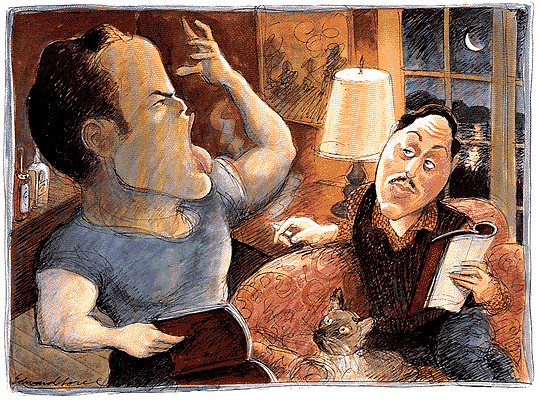
He adored New York City. He idolised it all out of proportion.
Great shot of Yankee Stadium in this sequence.

There is a good, long article by Meghan Cox Gurdon in the Wall Street Journal on Tintin:
There are really no humdrum pages in the adventures, which is a reminder of their origin as weekly comic strips. To keep the attention of young readers, Hergé crammed his stories with conflict and sight gags, with explosions and pratfalls and jets and cars and rampaging animals. This energetic pacing, sustained over 60-odd pages in book form, manages to make the experience of reading Tintin both prolonged and quick. It also speaks to the narrative taste of young readers, who love action and do not require the emotional psychodrama or character development adults so enjoy.
There are other reasons that Tintin has resonated with so many readers for so long. Through his international exploits—in pre-revolutionary Shanghai, the jungles of Peru, a faux Eastern European police state, even the surface of the moon 20 years before Neil Armstrong got there—Tintin shows young readers that the world in all its complexity is theirs to bestride.
The resonance with children can’t be exaggerated. When you are young and your hero crash-lands in the Sahara or treks through the snows of Tibet, you do, too. The Himalayas and North Africa then become, in an elusive yet significant way, “yours,” part of your personal geography. When your hero outwits assassins, solves riddles and escapes execution by firing squad, you do, too. And when your hero, in pursuit of a baddie after dark, steps on a rake and knocks himself out (with comical stars circling his head to show it) or finds himself duped into drinking an intoxicating aperitif, you too experience his concussion and befuddlement.
My grandfather loved Tintin and read the books to my mother when she was a kid. My mother read them to us, and I read them with my grandfather, and also my aunts and uncles in Belgium. And now, my mother reads it with my niece and nephew.
The Tintin adventures originally appeared in magazine form, but were later compiled in hardcover editions. I loved those books, they were sturdy, and felt more important than the flimsy-looking American comics that were printed on cheap paper. These books were made to last, the colors were bright, and of course, Herge’s compositions were formal, meticulous, and strong.
For more on Herge, click here.

The Giants play the Eagles tonight. In honor of this old rivalry, check out our pal John Schulian’s classic portrait of Chuck Bednarik:
He really was the last of a breed. For 58 1/2 minutes in the NFL’s 1960 championship game, he held his ground in the middle of Philly’s Franklin Field, a force of nature determined to postpone the christening of the Green Bay Packers’ dynasty. “I didn’t run down on kickoffs, that’s all,” Bednarik says. The rest of that frosty Dec. 26, on both offense and defense, he played with the passion that crested when he wrestled Packer fullback Jim Taylor to the ground one last time and held him there until the final gun punctuated the Eagles’ 17-13 victory.
Philadelphia hasn’t ruled pro football in the 33 years since then, and pro football hasn’t produced a player with the combination of talent, hunger and opportunity to duplicate what Bednarik did. It is a far different game now, of course, its complexities seeming to increase exponentially every year, but the athletes playing it are so much bigger and faster than Bednarik and his contemporaries that surely someone with the ability to go both ways must dwell among them.
Two-sport athletes are something else again, physical marvels driven by boundless egos. Yet neither Bo Jackson nor Deion Sanders, for all their storied shuttling between football and baseball, ever played what Bednarik calls “the whole schmear.” And don’t try to make a case for Sanders by bringing up the turn he took at wide receiver last season. Bednarik has heard that kind of noise before.
“This writer in St. Louis calls me a few years back and starts talking about some guy out there, some wide receiver,” he says, making no attempt to hide his disdain for both the position and the player. “Yeah, Roy Green, that was his name. This writer’s talking about how the guy would catch passes and then go in on the Cardinals’ umbrella defense, and I tell him, ‘Don’t give me that b.s. You’ve got to play every down.’ “
“Concrete Charlie,” is also featured in Schulian’s recent collection: Sometimes They Even Shook Your Hand.

[Photo Credit: Alexander Burch]
If you’re a Yankee fan who’s never heard of Mickey Scott, I cannot fault you for that. I remember Mickey Scott, but not as a Yankee. It was only after his death in late October that I realized his connection to the Yankee franchise, not to mention his ties to central New York.
Scott did not follow the traditional path to the major leagues. He was born in Weimar, Germany, to a military family that eventually settled in New York state. Scott grew up in Newburgh, located about 60 miles north of New York City. In 1965, the year of the first amateur draft, the Yankees took Scott on the 17th round out of Newburgh Free Academy. Given the rough winter weather in much of upstate New York, relatively few major leaguers have come out of the state from locations north of the city. But the Yankees liked Scott’s live left-handed arm enough to counteract any concerns they had about the small sample size of Scott’s work.
The skinny southpaw quickly showed the Yankees that he had enough stuff and experience to pitch professionally. He pitched brilliantly at two stops in 1965, before putting in a full season at Single-A Binghamton in 1966. He won a league-leading 15 of 20 decisions for the Triplets, held NY-Penn League opponents to a 2.75 ERA, and led the league in strikeouts.
With his career on the verge of a breakthrough, the realities of the late-1960s put up a roadblock. Scott missed all of the 1967 season while serving the military during Vietnam. Like most of the Vietnam vets, he didn’t receive much credit or applause when he returned to civilian life.
Undeterred by the setback, Scott came back to pitch in 1968, returning once again to Binghamton. But the Triplets had now moved up to Double-A status as a member of the Eastern League, so Scott’s return to Binghamton actually represented an impressive jump for the 20-year-old lefthander. Scott lowered his ERA to 2.58 while allowing only 83 hits in 115 innings. Though not overpowering, Scott convinced the Yankees he was now a legitimate prospect.
The following summer, the 21-year-old Scott moved up to Triple-A Syracuse, another location in upstate New York. It was an impressive ascension for a 17th-round draft pick. Like a lot of young lefthanders, Scott struggled with his first taste of Triple-A hitters. Now deeming him expendable, the Yankees traded Scott to the White Sox for Pete Ward, a combination first baseman/third baseman with some lefty power. Ward would last one unproductive season in the Bronx before calling it a career, while Scott would never pitch a game for the ChiSox.
In September of 1970, the Sox traded Scott to the Orioles. The Orioles switched him to the bullpen, where he used a devastating change-up to become the lefty relief ace for the Rochester Red Wings. He also became popular with teammates, who appreciated his upbeat nature and keen sense of humors. In 1972, Scott would finally make his big league debut for the pitching-rich O’s. Scott pitched well in 15 games, kicking off a journeyman career that would last five seasons and include stops in Montreal and California. Used mostly as a relief pitcher, Scott put up a 3.72 ERA in 172 innings.
Scott never pitched a regular season game for the Yankees, but that would not prevent an eventual reunion with the franchise. Appreciating his attitude and work ethic, the Yankees hired Scott to fill a number of duties, including a role throwing batting practice at Yankee Stadium. He threw BP to such notables as Thurman Munson, Reggie Jackson, Roy White and Graig Nettles.
When not in the Bronx, Scott returned to his residence in Binghamton, a place that became so special to him that he settled on it as his permanent home. He opened up a bar called “Mickey’s Mound,” where the personable and outgoing left-hander often regaled visitors with stories of his life in both the majors and the minors. During the 1980s, Billy Martin moved near the Binghamton area and frequently visited Mickey’s Mound. There Martin and Mickey became good friends.
Though Scott no longer owned the bar, he seemed to be enjoying retirement in Binghamton. He kept himself in good shape, regularly visiting a local gym to keep his weight and conditioning under control. On October 30 of this year, Scott called his mother from his home in Binghamton and told her that he was heading outside to rake some leaves, a common fall chore in upstate New York. Scott never returned to the house. While on his front lawn, he suffered a heart attack. His body was found by two women who happened to be walking by. Scott was 64.
I didn’t know that Mickey Scott lived in Binghamton or had a bar there until I read stories reporting his death. As a resident of Cooperstown, I live only about an hour’s drive from Binghamton. I wish I had known about Mickey’s Mound back in the 1990s; I would have enjoyed saddling up to the bar, ordering a ginger ale, and hearing a few stories from Mickey Scott himself.
Sadly, I never had the chance. But I know that others did. And I would love nothing more than to hear some of those stories about Mickey Scott.
Bruce Markusen writes “Cooperstown Confidential” for The Hardball Times.

The offseason awards season hasn’t been very kind to the Yankees so far. Ivan Nova and C.C. Sabathia, the team’s respective candidates for the Rookie of the Year and Cy Young, both finished a distant fourth in the voting, but at least that was one slot ahead of manager Joe Girardi, who placed fifth in Manager of the Year balloting. With only MVP left to consider, and Curtis Granderson considered somewhat of a long shot, chances are the Yankees will wind up empty handed.
Yankees’ Historical Award Totals
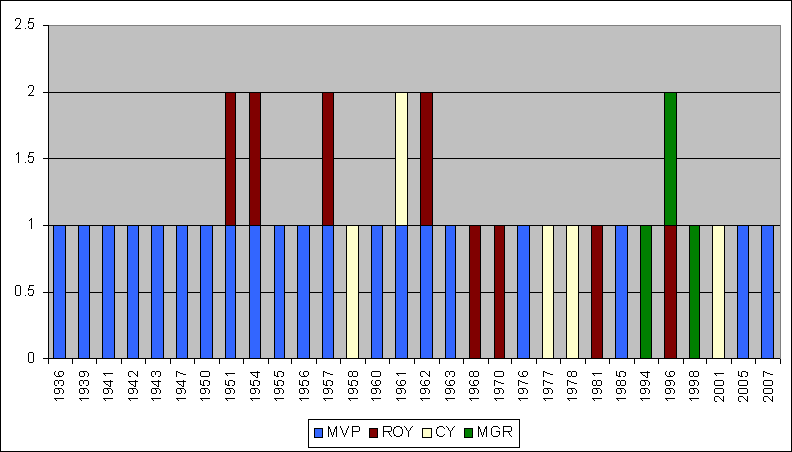
Note: MVP first awarded in 1931; RoY in 1947 (one award until 1949); CY in 1956 (one award until 1967); MoY in 1983
Source: mlb.com
To go along with all of the franchise’s other accolades, the Yankees have had more MVPs than any other team, and also rank among the leaders for all of the other major awards. However, since 1985, only seven awards have been handed out to the pinstripes, and three of those were to the manager. Many Bronx Bomber fans probably view this as evidence of bias against the team within the ranks of the BBWAA, but it might also speak to how well rounded the Yankees have been over the last two decades.
Top Major Award Winners, by Franchise
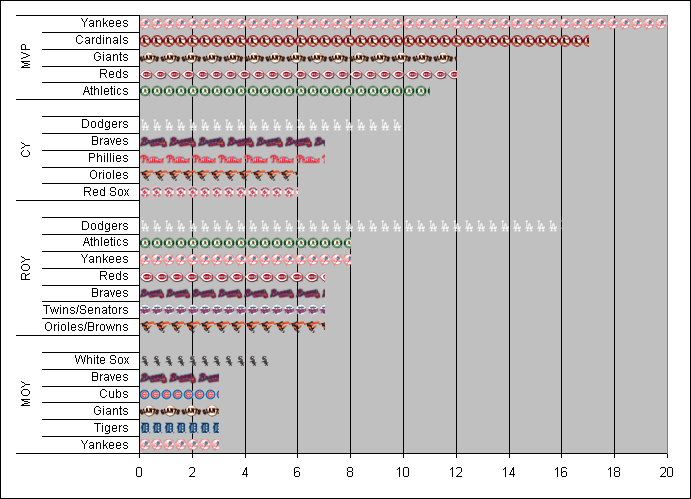
Source: mlb.com
Since the award was first bestowed upon Jackie Robinson in 1947, the Rookie of the Year has become synonymous with the Dodgers. With four honorees while in Brooklyn and 12 while in Los Angeles, the Dodgers have consistently churned out talented youngsters. The franchise’s 16 Rookie of the Year trophies not only equal the combined total of the next two teams, but also include two stretches of at least four consecutive winners, each of which alone would sum to more awards than the individual totals for 18 other teams. What makes the Dodgers’ RoY dominance even more impressive is the award requires a new winner every season, so having one or two great players doesn’t account for the lion’s share of a team’s total.
Along with the Athletics, the Yankees lead the American League with eight Rookie of the Year winners, but Derek Jeter has been the franchise’s only honoree since Dave Righetti won the award in 1981. Jesus Montero has a good chance to break that drought in 2012, assuming the Yankees are able to find him a position. In the almost 40 years since the DH was created, only the Royals’ Bob Hammelin, who bested Manny Ramirez, has won the Rookie of Year by taking most his at bats as a designated hitter. At this point, that seems to be the Yankees’ plan for Montero, so in order for him to win the honor next season, he’ll have to buck that historical trend.
Rookie of the Year Winners, by Position and League
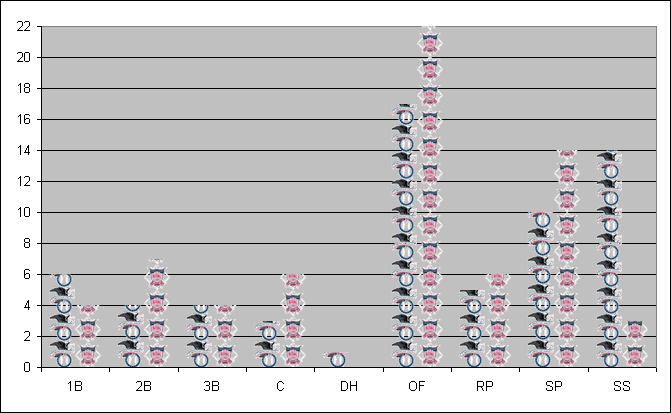
Note: Players considered only at the position they played the most.
Source: mlb.com
Manager of the Year is perhaps the most nebulous of the four major awards. Apparently, a successful manager is not only judged by the performance of his team, but by the lack of payroll allotted to it. That’s unfortunate for Joe Girardi now, but, when he became the only MoY to win the award with a losing record while with the Marlins in 2006, it was Willie Randolph who was left to lament.
Although the MoY is the most recent of the major awards, it rivals the RoY in terms of broad distribution. Only the Mets and Brewers have never had a manager win the honor (the Diamondbacks are the only team without a RoY), meaning more teams have had MoY designees than the Cy Young and MVP (25 teams each), both of which have been around much longer.
This year, both MoY selections made a bit of history. In the A.L., Joe Maddon became the 12th manager to win the award at least twice, while in the N.L., Kirk Gibson joined an even more select fraternity. Along with his 1988 MVP, Gibson’s MoY award makes him only the four person to win both trophies, joining Joe Torre, Frank Robinson and Don Baylor.
Multiple Manager of the Year Winners

Source: mlb.com
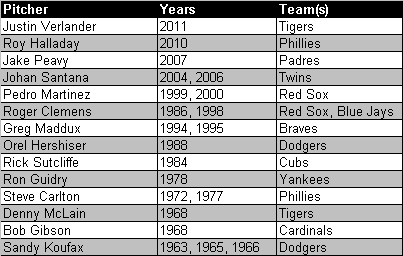
To no one’s surprise, Justin Verlander was unanimously selected as Cy Young in the American League, making him only the 14th different pitcher (and 21st selection) to be so honored. Verlander was also the first Tigers’ starting pitcher to win the award since Denny McLain won it consecutively in 1968 and 1969. Among the pitchers Verlander beat out for the award was C.C. Sabathia, who finished a distant fourth (the big lefty has finished no lower than fourth in the balloting during all three of his seasons in pinstripes). Although Sabathia didn’t seem to get much serious consideration for the top of the ballot, it’s worth noting that fangraph’s version of WAR actually had the Yankees’ ace leading the American League.
In the National League, Clayton Kershaw was named Cy Young, becoming the youngest pitcher to win the award since a 20-year old Dwight Gooden in 1985 and adding to the Dodgers’ major league leading total of 10 honorees. In order to win the award, Kershaw had to beat out reigning Cy Young Roy Halladay, who led the National League in both versions of WAR. Perhaps the electorate has grown a little weary of honoring Halladay, but even so, it’s hard to argue with Kershaw credentials.
Unanimous Cy Young Award Winners
Source: mlb.com
This year’s MVP vote in the American League could be among the closest ever. In addition to prominent candidates from most of the contending teams, Jose Bautista had another phenomenal season, so there is no lack of deserving winners. However, most of the attention has revolved around whether Verlander could, or should, win both the MVP and the Cy Young.
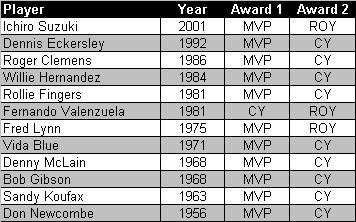
In the 55 years of concurrent history between the two awards, nine pitchers have been named both Cy Young and MVP, and of that total, three of the last four have been relief pitches. So, needless to say, the BBWAA has been at least a little reluctant to give the MVP to a player who takes the field less than 40 times per season. But, was Verlander’s 2011 campaign strong enough to mitigate that reticence?
Players Who Have Won Two Major Awards in One Season
Source: mlb.com
Regardless of where you come down on the Pitcher-as-MVP debate, Verlander stands on the verge of an even more select accomplishment. Should the Tigers’ right hander add to his trophy case next week, he’ll join Don Newcombe as the only player to be honored as a RoY, Cy Young, and MVP. The Newk, who was voted the top rookie in both leagues for 1949, was named MVP and Cy Young five seasons later in 1956 (he missed three years to his service in the Korean War). If Verlander is similarly honored, he will have taken the same path to join Newcombe.
In the National League, the MVP race seems to be a two horse race, with Ryan Braun having the edge over Matt Kemp because of the relative success of his team. If the two players do finish 1-2, it would be appropriate for several reasons, not the least of which is both men recently signed mega-contract extensions that will pay them over $20 million per season into the next decade. Needless to say, the Brewers and Dodgers will be hoping this isn’t the last time Braun and Kemp find themselves atop the MVP balloting.
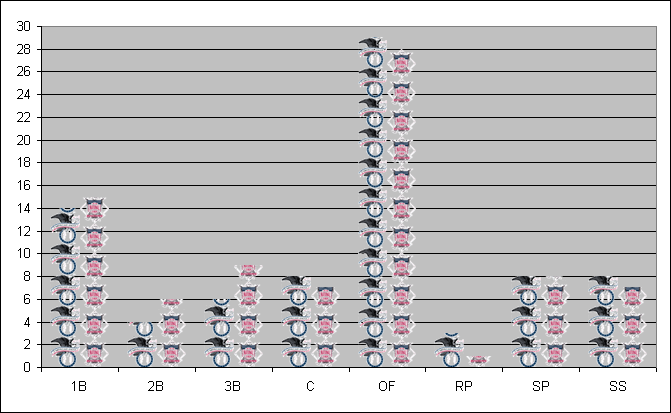
MVP Winners, by Position and League
Note: Players considered only at the position they played the most.
Source: mlb.com
The baseball awards season not only provides a cap on the current year, but also the perfect segue into the Hot Stove. Before too long, fans will be digesting their team’s winter acquisitions and projecting which players are poised for a break-out season. Among that group could be next year’s major award winners, but those future Cy Youngs, RoYs and MVPs will have to wait. The spotlight still belongs to this year’s Boys of November.

After next season the Houston Astros will play in the American League West. Two extra teams will be added to the playoffs in 2013, as well.

Sunday and Monday on American Masters:
Watch Woody Allen: A Documentary on PBS. See more from AMERICAN MASTERS.

Richard Hoffer is one of the best writers to ever cover sports in this country, first at the L.A. Times and then at Sports Illustrated. His prose is graceful and precise, he’s understated and funny.
Here is he on Joe Frazier and Muhammad Ali in the current issue of SI:
It was no wonder Joe Frazier was so bitter. He was made to seem the foil, a mere accomplice in mythology, consigned to a supporting role in Muhammad Ali’s extravagant, ego-driven drama. It is a harsh truth that if you participate in the most exciting rivalry of a century, it does you little good even to win one of its three bouts. The verdict of history is decisive, and it is permanent, and men like Frazier, who stumble at the precipice, are forever remaindered on the heap of losers, their vinegary claims to justice lost in the courts of public opinion. It was no wonder, then, that when Ali lit the Olympic torch in 1996, his trembling hands viewed as a physical artifact of heroism by an adoring world, Frazier allowed that if he’d had his way, he’d have pitched Ali into the fire.
…In 1975—Ali now 33, Frazier 31—they met again in the near-death experience that would ever after be known as the Thrilla in Manila. Ali was even crueler in his prefight taunts, exploiting the fact that gorilla rhymed with the venue. Frazier, by turns mystified and hurt, was provoked beyond the requirements of the bout. While Ali would always say he was only boosting the box office, Frazier could never accept any explanation for attacks that might affect his children’s impression of him. “Look at my beautiful kids,” he’d say. “How can I be a gorilla?”
But not even animus could account for what happened that morning in the Philippines. It was such a violent affair—recklessness tilting it first Ali’s way, then Frazier’s way and then Ali’s again—that it seemed less a boxing match than an exploration of man’s capacities, a test of his will to win or at least survive. But once it turned Ali’s way again in the 12th round, too much had gone before for yet another reversal. There wasn’t anything left in either man. Before the 15th and final round Frazier’s trainer, Eddie Futch, called it quits, saving his fighter from certain ruin, even as Ali was instructing his corner to cut his gloves off. It was victory, but by attrition.
Ali called it “the closest thing to dying I know of,” and he didn’t know the half of it. Their careers were essentially over that day, their 41 rounds of shared agony making any further discoveries in the ring unnecessary, or even possible. Frazier lost a rematch to Foreman and called it quits. Ali managed to dominate the game for several years more, but only on the basis of his personality—he was spent. Even then he was beginning a slow and ironic decline, Parkinson’s eventually rendering him rigid and mute, the final price for all those wars.
Ali’s respect for Frazier was enormous, and he apologized for his name-calling on several occasions. “I couldn’t have done what I did without him,” he once said.
Frazier repaid the compliment: “We were gladiators. I didn’t ask no favors of him, and he didn’t ask none of me.” They recognized that their destinies were entwined, that neither would have achieved his greatness without the other. But Ali could afford to concede the point, being the most popular athlete, even personality, in the world. Frazier, who spent the rest of his life living above his gym in Philadelphia, did not have the comfort of the world’s goodwill—he lived in an age that would reward style over substance every time—and so maintained his half of the blood feud as vigorously as possible, even seeming to take a grim satisfaction in Ali’s poor health, proof of who really won that day in Manila.
That a feel-good reconciliation would elude the two men who shaped such a magnificent rivalry is apt. Even if they were more like brothers than foes—who else could understand the kind of pride that forced them through those three battles?—fighters like them could never really enjoy a cease-fire, could never drop their hands, as if they alone knew what man was truly capable of.

Some baseball stuff.
Over at Fox Sports, Ken Rosenthal weighs in on the search for a new manager in Boston.
Meanwhile: a look at the Mets’ new uniforms; Eric Chavez wants to play next year; Ben Kabak on Yu Darvish; Steven Goldman on Ivan Nova, and William J on Joe Girardi’s lack of support for Manager of the Year.
[Photo Credit: Oyl in Tokyo]

Michael Popek, better known around these parts as “unmoderated,” runs a used and rare bookstore in upstate New York. Several years ago he started a fascinating blog called Forgotten Bookmarks. Now, he is the author a book devoted to the forgotten bookmarks he finds along the way.
Michael has written pieces on this subject for the Times Union, the Huff Post, and the Wall Street Journal. Recently, he took a few minutes out to chat about his blog and the new book. Dig:

Bronx Banter: Are all of the images that are in the book ones that also appeared on the blog?
Michael Popek: I don’t remember the exact ratio, but I believe that 60 percent of the items in the book are exclusive and haven’t appeared online. I wanted to reward the loyal readers with lots of fresh material and at the same time give new fans a look at some of the best stuff from the site.

BB: How did you choose which ones were fit for the book?
MP: It wasn’t easy deciding what to choose; when I was working on the manuscript, there were more than 600 entries on the blog and I had a collection of more than 1,000 unpublished items. I tried to pick the strangest, the funniest, the most poignant; items that might make a reader think about the time and place, the history of the bookmark. I also wanted to offer a good variety, so I tried to keep an even number of photos, letters, postcards, notes, etc. In the end, a few items had to be dropped because of copyright issues, but I don’t think any of those items take away from the entire collection.

BB: Do you save the books, along with their bookmarks? Or do you still sell the books and save the bookmarks?
MP: I save all of the bookmarks, and many of the books. As a bookseller, however, the nicer titles need to be on the shelves so I can’t afford to keep them around forever.
BB: When my dad died I went through most of his books and found random things–a voter registration card from 1977, a dry cleaning bill from the 1960s. You can let your mind wander and try to piece together a story from these fragments even though the randomness means that it can’t really tell you about someone. Have you built stories in your mind from your found bookmarks?
MP: Absolutely, I think all of us do – it’s part of the fascination with found items. It’s easiest with the old letters I find, my mind immediately creates a voice, like I would if I was reading a novel. I can instantly picture the letter writer’s face, the way they position their hand as they write, the items on their desk, the weather outside their window – I can’t help it.

BB: There is an element of voyeurism in found items. Have you ever felt uncomfortable with something you’ve found in a book?
MP: One of the most interesting things I found was just too personal to post online. It was a suicide note from the 1930s, and although there were no names or places mentioned, the emotion was too much. Being this kind of voyeur is often a lot of fun, but that’s something I wish I hadn’t seen.
BB: Wow, that’s heavy, man. On the other hand, have you sound something so intimate that you found it to be beautiful?
MP: I can think of one in particular. It was a break-up letter, found in “While Waiting,” a pregnancy book. It started out:
Dear Aeneas,
I cannot believe what a slime you are. What I ever saw in you in beyond me. Sarah’s mind must be warped – I love her but how she managed to spend 2 years with a manipulative sadist like you is incredible (yes she told me.)
BB: How did you arrive at the format for the book, a small, handsome hardcover, as opposed to a glossy picture book?
MP: That was up to the publishers, for the most part. I had stated in my book proposal that I wanted to produce something that was vivid and in full color.
BB: I think the design of the book is ideal. I think a big, glossy book would spoil the flavor of these hidden treasures.
MP: I think producing a big coffee-table book might have been a bit risky for a first-time author like, those volumes cost a lot of money to print. In the end, I’m very happy with the way it turned out, the pages really come to life.

BB: As a bookseller I’m sure you spend most of your time looking through collections of books. How deep has the bookmark project seeped itself into that process? Do you feel disappointed when you come across books that are “clean,” and does your heart skip a beat when you initially see a bookmark?
MP: It has completely changed the way I sort through books. I cannot let one go without checking every page for lost treasures. It has certainly reduced my sorting efficiency, but I think it’s worth it. The feeling I get when I find something good and juicy is as exciting as it was when I first started this treasure hunt.
BB: It reminds me of the feeling you got as a kid opening up a pack of baseball cards. Guess it’s more like a box of Cracker Jack, waiting for the surprise, right?
MP: Nah, I like the baseball cards metaphor better. You may get a Mattingly, you may get a Dale Berra – but in the end, at least you got some gum, or in my case, a book. All the Cracker Jack prizes were awful.

BB: I like the idea of a treasure hunt. I was talking to my cousin the other night. He grew up in L.A. and now lives in New York and when we first started hanging out in the ’80s, he’d come to town and I’d take him to used bookstores. He never goes to them anymore, not that there are many left. Nowadays, I don’t go to them as much as I used to, heck, I buy my books from you. But one of the charms of your book is that it brings back the accidental pleasures of hunting. Can you talk about that and how vital your business is these days?
MP: As long as there are books still around, there’s going to be someone like me selling them. Sure, the digital revolution in publishing is underway and showing no signs of slowing down, but that’s OK. E-readers can’t replace a signed copy. There are no first edition e-books. And most importantly, you can’t buy a used digital copy – yet. I’ve done my best to adapt to the new marketplace, and the shop has done pretty well. I always like to think about the success of the good record shops still around, and they give me hope for used book shops everywhere. They are both about the hunt, the browse, the discovery. Digging through the shelves is a lot like digging through the stacks, you may have wandered in looking for some Dionne Warwick, but you walk out with some Elvis Costello.
BB: I love Baseball-Reference.com, it’s an amazing tool, but you lose something from opening up the encyclopedia and finding names by mistake. I find the same thing with reading newspapers on-line. You don’t run across a stray article in the same way. I have a friend who runs a record shop and they don’t do very much business on line–consciously–and the store is a meeting place for a community of record heads. Do you have anything like that at your store? I assume you do a majority of your business on-line now.

MP: The local paper ran a story about it, since then there have been a lot of people in asking to see some of the stuff. Before that story, I don’t think there were a lot of local readers. I’ve had a few of fans of the blog make their way into the shop, one from as far away as California, but to be fair, in was in the area for a family wedding. Most of our sales do come from online venues, but I like to think that our success there allows keeping an open brick and mortar store. I really enjoy interacting with customers, and there is the collection of usual suspects that come in every few days. I have seen a few friendships blossom from encounters here; two older guys coming in looking for Vietnam books end up discussing their service days.

Forgotten Books can be ordered here.
And when you find yourself looking for any out-of-print books, check out Michael’s store. And tell him I sent ya.