

Monday
February 23, 2026
Since 2002


Category: Pop Culture


The Mother of Invention

I never liked Madonna’s records or her acting. Watching her being interviewed is painful. And as a sex symbol I’ve only occasionally been drawn to her. I’m not turned on by the women-pretending-to-have-balls schtick, at least not in her case. So when she was in her prime, I didn’t dig her.
That said, I admire her for sticking around so long and for all that she’s accomplished as a pop icon. And I learned some more about appreciating her after reading this 2002 GQ article by Jennifer Egan:
For Madonna, it’s fantasy only; even when her moves have looked self destructive, she’s always emerged unscathed. To be loved as a celebrity, she once said, “You need to disappear, run out of steam, run out of ideas…You need to have a drinking or a drug problem. You have to go in and out of rehabs so people can feel sorry for you. Or you need to kill yourself, basically.” But Madonna has avoided all of that: no rehabs or suicide attempts, no arrests or collapses or devouring lawsuits or serial divorces or appalling plastic surgery — scandals, yes, but always of her own making and always, finally, to her own advantage. Sometime very early on, Madonna learned a different way to subvert her rage and quell the fear and pain that are usually handmaidens to an ambition as ravenous as hers: hard work. “I ultimately end up making my own work,” she has said. “I don’t sit around waiting for other people to give it to me. I’ve had to do this to ensure myself constant employment.”
Morton’s account of Madonna’s early performing years is a litany of wrong turns (including the fact that her first single, “Everybody,” was marketed as the work of a black artist) that could have terminally discouraged a less tenacious and resourceful performer. But no matter what went wrong, Madonna always had a next move. She kept producing good material by playing to her own strengths and finding people to compensate for her weaknesses. This ability to create year after year in the face of loud and persistent nay-saying is the single thing that has ensured Madonna’s ongoing success. I can only admire it.
Now comes the point where the writer is supposed to indulge in a bit of prognostication: what’s next? I could do this–ruminate sagely over the staying power of her marriage to a macho guy ten years younger or tsk that those tank tops might not cut it when she’s 50. But by defying twenty years’ worth of such speculations, Madonna has made a lot of smart people look like dummies. So I’ll pass. Better to admit that I have no idea what she’ll do, except that I can’t imagine her stopping. There’s pleasure in not knowing–especially when term limits on fame seem shorter than ever and the surprises we get from celebrities are rarely pleasant. Madonna hasn’t exhausted us because we haven’t exhausted her, which is another way of saying that she hasn’t exhausted herself.
[Photo Credit Via Village9991]
In Living Color

LeRoy Neiman died yesterday. He was 91.
“Dying for Art’s Sake,” is an essay Pete Dexter wrote about Neiman for Esquire in July, 1984. It is reprinted here with permission from the author.

LeRoy Neiman has just been murdered in Milwaukee.
The clipping came in the morning mail—he thinks it was from Milwaukee—a review of his new book of paintings and sketches. “I don’t know why people aren’t nice,” he says. I am talking to him on the phone now. “Are you nice? Listen, there have been thousands of pictures taken of me. I’m a reasonably good-looking human being, aren’t I? Why would an editor want to use a picture where I have an hors d’oeuvre sticking out of my cheek? I wouldn’t do that to him. I always make things look their best…”
“That’s Milwaukee for you,” I admit.
“No, that was a newspaper. The guy in Milwaukee was very clever. He quoted every bad thing anybody ever said about me, but didn’t really say anything himself…Hotel room paintings. What’s wrong with paintings in hotel rooms? A lot of my paintings are in hotel rooms, so what? Art is where you find it. Oh, and they criticized my chin. Did I tell you that? They said I had a weak chin.”
“In Milwaukee?”
“No, in the newspaper. If you’re feeling nice, perhaps it would be amusing to visit, but I don’t need criticism. So if you’re not nice…”
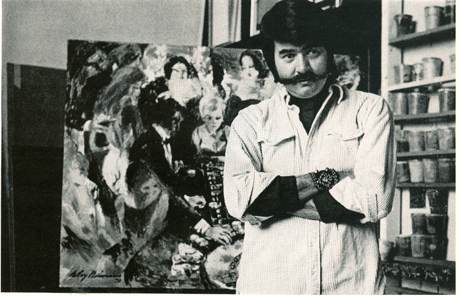
I tell LeRoy I will try to write nice, but I can’t promise. He invites me up to his place in New York anyway. The place in New York is most of the third floor of a large apartment building across the street from Central Park. There is an efficient-looking woman with the purest features I ever saw—one of those noses that looks like somebody took two weeks to get the flare in the nostrils right—who seems to run things for him, jars of paint and brushes all over the place, walls covered with painting and prints and sketches, most of them of athletes. There is a giant oil representation of a Las Vegas crap table learning against the far wall, done almost entirely in red. Floors, background, faces, clothes.
I haven’t done a lot of painting myself, unless you count water towers, but I recognize a work in progress. I figure he does all the blues next, then the yellows or whites. I figure, what he’s got there is a primer coat.

“That’s not finished, is it?” I say.
LeRoy seems pleased I have intuited that.
“No,” he says. “I haven’t decided what to do with it yet.”
“Well,” I say, “I think you’ve about done what you can with the red.”
The phone rings then, and the woman answers it. “LeRoy,” she says, “I’m sorry to interrupt…”
The call is about appearing in a movie. He takes it in the vestibule, but the acoustics in the place are terrific, and I can hear what he says at least as well as whoever is on the other end. Better, probably, because he keeps having to repeat himself for the other end.

“Yes,” he says, “a thousand a day and expenses…”
He wants a thousand dollars a day instead of a straight fee for the job because it might rain wherever the job is, and he doesn’t want to be sitting around somewhere getting wet for nothing.
He comes back into the studio and I compliment his acoustics. “This place is better than Lincoln Center,” I say.
LeRoy looks around the room, probably misunderstanding what I have said. “I’ve got an apartment on the ninth floor too,” he says. “But I never go up there. There’s furniture and a beautiful view, but it depresses me. And I’ve got a house in Great Gorge, New Jersey, but I haven’t been there in four years. I love the place, I just don’t like to be inside it. I have to keep it, though, you’ve got to have a house in the country.”

It is the pictures of the athletes that have made all this possible. They showed up first in Playboy magazine, which started running LeRoy’s stuff back in the Fifties. Then Roone Arledge of ABC Sports put them on television and turned LeRoy’s work into the most recognizable art in this country. Nobody is exactly sure why.
Eventually, of course, LeRoy became as famous as his pictures. He wore his white hats and trained his moustache to grow almost to his ears, and he had fascinating cigars.
I don’t know how he does it, but LeRoy’s cigars are always two minutes old. He carries them in the left side of his mouth, and they are always long and dark with half an inch of cold ash at the end. Then some wiseass editor in Milwaukee runs a picture of him eating hors d’oeuvres.
And you wonder why artists are moody?
II
“I like being outrageous,” he says. “It is the worst possible thing for my income and standing in the art community, but I don’t care. Why should I behave myself now, after all these years?”

I ask LeRoy what kind of misbehaving he means. Does he give sheep for wedding presents? Has he gotten drunk at parties and tired to deliver babies? He shakes his head no.
“I don’t actually do anything,” he says, “except be conspicuous. It keeps me revved up.”
The phone rings again. The woman answers it. “LeRoy,” she says, “I’m sorry to interrupt…” This time it’s some Brazilians, wanting him to come to a party at Regine’s.
“Everybody always wants things from me,” he says after he has hung up.

The Brazilians, it turns out—at least these Brazilians—are economically advantaged people. LeRoy says they wear the best clothes and drink at the best clubs and introduce all the new trends.
“They amuse me,” he says, “but I am not one of them. I am part of their scene—the same three hundred people show up everywhere around the world—but I’m not a member. I never judge them, I am never shocked by their conduct.” He sees I don’t understand. “A lot of them steal,” he says.
That’s the same way it is with LeRoy and athletes. “I don’t get too close to them personally,” he says. And this reminds him of the safari with Hef.
Hef is Hugh Hefner, who owns Playboy. He is one of the three people LeRoy names when I ask who his friends are. The other two are artists he sees once every two or three years.

“It was while we were in Africa,” he says, “that I noticed the natives were always jumping. Any little noise, they’d jump. They watched each other every minute. Hef and I and four other guys and six chicks went around the world to break in the new plane. You know, a pleasure trip. But in Africa, I saw these jumpy natives and realized that danger makes you aware. That’s how I am, too. Aware, observant. Nothing can sneak up from behind. That allows you to be outrageous.”
“You see, you come to a moment sometimes when you know you shouldn’t do something but you take the chance and do it anyway. The moment occurs in sports, it occurs in art. That’s the moment of creation, taking the chance. And sometimes it comes out fine, and sometimes you get murdered.”

I notice, however, that his paintings aren’t about the moment, they depict the population of a best-possible world.
“I like things to their best,” he says. “I like beautiful things, like chandeliers. But I think, for instance, you can say as much about war by painting the enthusiastic young soldiers marching off as you can by showing the dismembered bodies.”
I ask, “Where is the chance in that?”
LeRoy leans closer. “Have you ever heard of Mad Dog Vachon?” he says. “Andre the Giant? They’re wrestlers. Very big people, and very crude. A person I know called and asked if I would come to Ottawa, Canada, and sketch wrestling. They were doing a telecast, and wanted me at ringside to give it credibility.”

“So I flew to Montreal and we took a limousine—you’ve got to insist on a limo and the best room or else they’ll take advantage of you—and we drove about one hundred miles to the arena. I had a chick with me—a magnificent animal—and they put us right at ringside.
“The man who arranged for me to be there had told me that Mad Dog would point at me and call me names as part of the show. After the wrestlers were introduced, Mad Dog pretended to suddenly notice me sitting there, and he yelled, ‘I want that man removed. I want to see what he’s drawing.’
“I turned to the chick and said, ‘He’s really good.’ Then Mad Dog reached through the ropes and grabbed my leather drawing pad. I take it everywhere, and nobody is allowed to do that. I tried to pull it back. I said, ‘All right, that’s enough. These are my sketches,’ but Mad Dog pulled the pad and me with it right out of my seat, and then he crumpled up all my drawings.”
And you wonder why artists are so moody.
LeRoy says, “I yelled at him then that he had gone too far. He picked me up over his head and began whirling me around and around, the crowd went crazy, and then he finally threw me on the floor. That’s how wrestlers take criticism. I picked up my things and told the woman I was with that they had gone too far. We went back to the dressing room to complain, and after a while Mad Dog came in and said, ‘I didn’t do nothin’.’ Unbelievably crude.
“Then we went back to the limousine and two of the wrestlers followed us out and asked for a ride back to Montreal. One of them sat on the set with us, the other one sat on the jump seat. Huge, bruised men. We got about halfway to Montreal and one of them said, ‘We got to stop and eat.’
“I said I wanted to get back to Montreal. They said no, we had to stop. I refused. They seemed very civilized until we went by the truck stop and one them looked outside and said, ‘You remember the night we cleaned that place out?’…”
LeRoy sits quietly, in the middle of the memory. “I don’t associate with crude people,” he says after a while. “I came from a broken home and poverty, and I don’t want to be around that now. I am a working man’s artist, but I don’t know any working me. I champion their cause, but I don’t have any of them I talk to.”
“Why not?” I ask.
He shakes his head. “I don’t have to,” he says. “I’m an artist, and I can do what I want.”

[Mad Dog Vachon picture by Hieram Weintraub]

Dropping it All Over
Via the most-amazing site, Kottke, check out this bit of hipness from John Boswell and Fred Rogers:
You Gotta Watch Your Back

Maxim has an oral history of “The Wire.” A must-read for groupies of the show.
I Get High Off Your Love I Don’t Know How to Behave

I was the assistant film editor on a forgettable gangster movie called “Belly.” It featured Nas and DMX and was directed by Hype (aka Harold) Williams. D’Angelo came in to watch a screening once at 1600 Broadway. He and a few pals excused themselves to smoke L’s in the stairway while the projectionist threaded the movie.
D’Angelo was a big deal at the time. Then he fell off. Check out this profile of the gifted singer by Amy Wallace over at GQ:
Shame, guilt, repentance—D’Angelo knows them well. To say that he was raised religious doesn’t begin to capture it. He’s the son and the grandson of Pentecostal preachers. To D’Angelo, good and evil are not abstract concepts but tangible forces he reckons with every day. In his life and in his music, he has always felt the tension between the sacred and the profane, the darkness and the light.
“You know what they say about Lucifer, right, before he was cast out?” D’Angelo asks me now. “Every angel has their specialty, and his was praise. They say that he could play every instrument with one finger and that the music was just awesome. And he was exceptionally beautiful, Lucifer—as an angel, he was.”
But after he descended into hell, Lucifer was fearsome, he tells me. “There’s forces that are going on that I don’t think a lot of motherfuckers that make music today are aware of,” he says. “It’s deep. I’ve felt it. I’ve felt other forces pulling at me.” He stubs out his cigarette and leans toward me, taking my hand. “This is a very powerful medium that we are involved in,” he says gravely. “I learned at an early age that what we were doing in the choir was just as important as the preacher. It was a ministry in itself. We could stir the pot, you know? The stage is our pulpit, and you can use all of that energy and that music and the lights and the colors and the sound. But you know, you’ve got to be careful.”
[Photo Credit: Gregory Harris/GQ]
Father Knows Best

Chris Jones profiles Bruce Jenner in the latest issue of Esquire:
Bruce Jenner has taken it upon himself to rescue his ridiculous extended clan by doing what none of its other members will ever do: He has elected to lose. The person in the house who has most earned his fame has chosen to accept the least of it. “I’m done with competition,” he says. He says that in response to a question about his helicopters, whether he might fly them in the professional events that have been cropping up around the country, but he means it about everything. Jenner has made decisions, now, here, during his own second life. He has made up his mind once again. His singlet is in storage because he wants it to be. He’s the one who locked his medal away in the safe.
“Going through what I went through,” he says, “being that obsessed, is not what I would consider a good, well-rounded life. You’re selfish with your time. You’re selfish with your thoughts. You don’t have to grow up. All you’re concerned with is scoring points.”
Jenner has learned that perfection comes in many forms. He has learned that a private mastery is just as satisfying as a public one. He has learned that a curse isn’t a curse if it’s a choice. And he has learned that there may be no greater love a father can give his children than to accept that his life really didn’t begin until theirs did.







Stacked

Check out this story by Jessica Bennett on the New York Times morgue over at Storyboard.
[Photo Via: The Five]
What’s the Rumpus?

Kudos to Rolling Stone who reprinted Jonathan Cott’s 1976 profile of Maurice Sendak:
In the Night Kitchen, one of Sendak’s greatest works, shows little Mickey falling naked through the night into the Oliver Hardy bakers’ dough, kneading and pounding it into a Hap Harrigan plane, flying over the city, diving into a giant milk bottle, then sliding back into his bed to sleep. It is a work that pays extraordinary homage to Sendak’s early aesthetic influences – especially to Winsor McCay – to the cheap, full-color children’s books of the period, as well as to the feelings about New York City he had as a little boy.
“When I was a child,” he told Virginia Haviland, “there was an advertisement which I remember very clearly. It was for the Sunshine bakers, and it read: ‘We Bake While You Sleep!’ It seemed to me the most sadistic thing in the world, because all I wanted to do was stay up and watch… it seemed so absurdly cruel and arbitrary for them to do it while I slept. And also for them to think I would think that that was terrific stuff on their part, and would eat their product on top of that. It bothered me a good deal, and I remember I used to save the coupons showing the three fat little Sunshine bakers going off to this magic place at night, wherever it was, to have their fun, while I had to go to bed. This book was a sort of vendetta book to get back at them and to say that I am now old enough to stay up at night and know what’s happening in the Night Kitchen!
“Another thing is: I lived in Brooklyn, and to travel to Manhattan was a big deal, even though it was so close. I couldn’t go by myself, and I counted a good deal on my elder sister. She took my brother and me to Radio City Music Hall, or the Roxy, or some such place. Now, the point of going to New York was that you ate in New York. Somehow to me New York represented eating. And eating in a very fashionable, elegant, superlatively mysterious place like Longchamps. You got dressed up, you went uptown – it was night when you got there and there were lots of windows blinking – and you went straight to a place to eat. It was one of the most exciting things of my childhood. Cross the bridge and see the city approaching, get there and have your dinner, then go to a movie and come home. So, again, In the Night Kitchen is a kind of homage to New York City, the city I loved so much and still love.”
I love this bit:
Maurice’s sister Natalie gave him his first book, The Prince and the Pauper. “A ritual began with that book,” Sendak once told Virginia Haviland, “which I recall very clearly. The first thing was to set it up on the tablel and stare at it for a long time. Not because I was impressed with Mark Twain; it was just such a beautiful object. Then came the smelling of it… it was printed on particularly fine paper, unlike the Disney books I had gotten previous to that. The Prince and the Paper – Pauper – smelled good and it also had a shiny laminated cover. I flipped over that. I remember trying to bite into it, which I don’t imagine is what my sister intended when she bought the book for me. But the last thing I did with the book was to read it. It was all right. But I think it started then, my passion for books and bookmaking. There’s so much more to a book than just the reading. I’ve seen children touch books, fondle books, smell books, and it’s all the reason in the world why books should be beautifully produced.”
Give the article a read. It’s terrific and well worth your time.
Tools of the Trade

Check out this article in the L.A. Times by Martha Groves about typewriter enthusiast Steve Soboroff.
[Photo Credit: Francine Orr/Los Angeles Times]
Stolen Kisses

Kiss FM, 98.7 on your radio dial, is going away. Dag. Memories of DJ Red Alert.
Ego Trip has 12 radio promos to jog your memory.
[Image via: UB Massive]
Forgive Some Sinner

Last year Esquire reprinted this terrific 1984 profile of William Donald Schaefer by Richard Ben Cramer.
It’s well worth your time.
Archival Footage

The New Yorker has opened the archives for these pieces on LBJ by Robert Caro.
Dig in.
[Photo Credit: George Tames/The New York Times via The Lively Morgue]
I Must Admit I Felt a Little Uneasy When She Bent Down to Tie the Laces of My Shoe

This Sunday gives a reason to troop out to Williamsburg as Classic Album Sundays makes it’s US debut.

[Featured Image via Lucid and Mysterious]
Innervisions

From the wonderful site, Letters of Note, here is a letter that Hellen Keller wrote in January, 1932. After a visit to the Empire State Building she described what she saw and heard:
Frankly, I was so entranced “seeing” that I did not think about the sight. If there was a subconscious thought of it, it was in the nature of gratitude to God for having given the blind seeing minds. As I now recall the view I had from the Empire Tower, I am convinced that, until we have looked into darkness, we cannot know what a divine thing vision is.
…What did I “see and hear” from the Empire Tower? As I stood there ‘twixt earth and sky, I saw a romantic structure wrought by human brains and hands that is to the burning eye of the sun a rival luminary. I saw it stand erect and serene in the midst of storm and the tumult of elemental commotion. I heard the hammer of Thor ring when the shaft began to rise upward. I saw the unconquerable steel, the flash of testing flames, the sword-like rivets. I heard the steam drills in pandemonium. I saw countless skilled workers welding together that mighty symmetry. I looked upon the marvel of frail, yet indomitable hands that lifted the tower to its dominating height.
Let cynics and supersensitive souls say what they will about American materialism and machine civilization. Beneath the surface are poetry, mysticism and inspiration that the Empire Building somehow symbolizes. In that giant shaft I see a groping toward beauty and spiritual vision. I am one of those who see and yet believe.


"This ain't football. We do this every day."
--Earl Weaver
--Earl Weaver