"A New York Treasure" --Village Voice
Category: Sportswriting

One, Singular Sensation

Joe Pos on Ichiro!

Ichiro’s singles percentage is higher than Ozzie Smith’s. It’s higher than Jason Kendall’s (yes, it is). It’s higher than that of Luis Aparicio, Bert Campaneris, Bill Buckner and Kenny Lofton. It’s not the all-time mark — other very good hitters such as Richie Ashburn, Stuffy McInnis and Lloyd Waner have higher singles percentages. But in fact, those are probably the ONLY three good hitters who have higher singles percentages — maybe Maury Wills, depending on how good a hitter you think he was.

So, what’s wrong with a single? Nothing. But it ain’t a double. Ichiro’s .430 slugging percentage is certainly low for a .331 hitter, especially in today’s big-hitting era. Jef Cirillo slugged .430. Hal Morris slugged .433.

So, mainly what Ichiro gives you are lots of singles — line drives, hard grounders up the middle, bloops, bleeders through the infield, high-choppers. Are these aesthetically pleasing? Absolutely. Are these valuable? You bet. Are these more valuable than walks? Yes, of course, well, somewhat. But do a barrage of singles without many walks put Ichiro in the luxury line of hitters with Albert Pujols or Miguel Cabrera or Josh Hamilton or Robinson Cano or those sorts of guys?

I’d have to say no.

Aw, Shucks

Future Hall of Famer and all-around Nice Guy Jim Thome is profiled by Joe Posnanski this week in SI. Dig in.

Woman Walks Into a Bar…

Three cheers to Jim Bouton, whose classic book, Ball Four, turns 40 (Jay Jaffe had a great post to mark the event over at the Pinstriped Bible last week).

Last weekend, Bouton was honored by the  Baseball Reliquary in California. According to Tom Hoffarth:

When asked how the title “Ball Four” came into being, Bouton explained Saturday how he and editor Leonard Shecter were at the Lion’s Head Tavern in New York, the famous literary bar near Columbia University, having just turned in the finished product into the publisher:

“We went to have a drink to celebrate this piece of cardboard we had just turned in, and we’re thinking, ‘Now what are we going to call the damn thing?’

“We were talking about the need to have a downbeat title. This isn’t a story about how somebody just won the World Series. It’s about struggling, about difficulty. What’s the toughest thing for a pitcher — a knuckleball pitcher in particular — it’s to get the damn ball over the plate. It’s walking guys ….

“So we’re talking about all this, and there was a lady sitting at the bar. She was very drunk. And she was listening to our conversation. And at some point, she leans over and says, ‘Whyyyyy don’t you caaaaall it Baaaaallllll Foooouuuuurrrrrrr?’

“And we said, ‘nawwwww.’

“Finally we couldn’t come up with anything. And I was walking Shecter back to his hotel before I went home to New Jersey, and then Shecter says, ‘You know, Ball Four isn’t a bad title.’ So we owe it all to this woman at the bar.”

Bronx Banter Interview: Glenn Stout

To celebrate the publication of the 20th edition of The Best American Sports Writing, I sat down with series editor Glenn Stout. Dig our chat.

Bronx Banter: How many pieces do you read each year, and how do you find all the stuff?

Glenn Stout: I can’t answer this any more specifically than to say “many thousands.”  I don’t waste time counting. But understand, a lot of what I read I only read until I say to myself “This is not going to make the book,” so I stop. Suffice to say that I read enough of every submission, and enough of every significant story in every publication I receive, that I don’t stay up nights worrying if I read enough. Almost without even thinking about it anymore, I read a couple hours a day. It’s like feeding the dogs or working out – part of the fabric of the day.

I find things by looking and by being easy to find myself and by trying to make it clear to every writer that he or she is encouraged to submit material. Several hundred magazines and newspapers are sent requests for submissions and/or complimentary subscriptions.  I subscribe to a healthy number of publications myself, a few good friends, like yourself, and even readers, recommend stories to me, and I send out a mass e-mail request to a mailing list I’ve put together over the years. I also read some blogs and check some message boards to see if there are any stories people are talking about. But most importantly, I just keep my eyes open. A story like one by Pam Belluck in the New York Times a few years ago – “How to Catch Fish in Vermont,” wasn’t a submission, and didn’t appear in the sports section of the Times. I stumbled upon Belluck’s story while looking for something else. The same thing happened this year when I found Eric Nusbaum’s story “Death of Pitcher” from his blog, pitchersandpoets.com. I was looking for something for Fenway 1912, my book on the first season of Fenway Park which will come out next year, and I stumbled on his story. There are probably eight or ten stories each year that get sent to the Guest Editor that I “find” accidentally. But they are “on purpose accidental” because I leave myself open to finding them. I’ll steal a magazine from a doctor’s office if there is a story in it that might be good for the book.

BB: Has the process changed at all over the years?

GS: The biggest change is that 20 years ago all my browsing took place in hard copy. I worked at the Boston Public Library then and had access to where the past years’ magazines and newspapers were kept. I’d go in the occasional Saturday and spend the whole day reading. Now, with the internet, coupled with the fact I no longer have direct access to what, until recently, was one of the world’s greatest public libraries, means I spend much more time online. But I don’t think the flow rate of the word river has changed all that much.

BB: Are there certain kinds of stories that are more likely to make it? Magazine profiles, newspaper columns?

GS: I don’t think so, but other people do. I’ve gone back and checked and the stories I set aside each year for further reading break down about 60% – 40% between magazines and other long form formats and newspapers (which includes weeklies and the handful of Sunday supplements still published). Although these days, of course, with so many newspapers cutting space, cutting back, and/or closing, I’ve noticed a drop in submissions from newspapers and their writers, and there are clearly fewer “take-outs” being written. Since it is impossible to browse hundreds of daily newspapers, newspaper writing is probably more dependent on submissions than work from magazines that can send me subscriptions. And I have to say, newspapers and newspaper writers are, for some reason I’ve never been able to figure out, hesitant to make submissions. There are some major, major newspapers that have never responded to a request for material. I can’t consider what I don’t see. And even when papers do make submissions, there have been times we’ve picked a story that the writer submitted and the paper did not. What they submit is often very telling. One very well thought of sports editor at a major paper never sent me material from his staff – but submitted his own very pedestrian work every year.

I’ll admit that longer form pieces probably have a bit of an edge – extra space is a gift to a writer — but that’s also part of the media of putting a book together. Longer form stories hold together better in a book. Obviously, there are some kinds of stories that I personally don’t care for, but in every batch of material I send to the Guest Editor, I always include a few stories that I might not like at all, but understand that someone else might.

BB: There aren’t very many accounts of single games or events. Is that by design? Do you find that the art–and of necessity–of game recaps has been devalued with the rise of technology?

GS: Very few games stories and column – I find – provide the information needed to stand alone a year or more later when the book comes out. Often there just isn’t enough context in the story, and they often depend on a great deal of assumed knowledge. That may be understandable when the story was first written, but can no longer be assumed a year or more later. And some are just plain dated. This isn’t a contest for the writers, but a book for the readers, and if a story doesn’t give the reader enough, or is dated by changing events, it’s not going in the book no matter how well written it might be. And stylistically, few game stories or columns today are written with much real form – there is a lot of radio banter and one-liners masquerading as writing. I’m not sure that technology is the reason for that, but when considering game stories, I think that when the computer allowed writers the freedom to do constant updates and re-writes, and writers became accustomed to doing so, many stopped writing stories that actually told a story.

(more…)

Welcome to My Nightmare

Pat Jordan loves to trash the Yankees because he knows I’m so easy to wind up. He could not care less about the fortunes of any team in any sport other than his beloved Miami Hurricanes (and since I could not care less about college football, giving it back to him is less than fun). So we talk about the Yankees and he gets his digs in.

Last night he goes, “Hey Al, what are you going to do when Carl Pavano goes 2-0 in the playoffs against you guys? Hey, didn’t Pavano once pitch for the Yankees?”

Roars with laughter. “What? He win like three games in five years? Hey, Al isn’t he going for his 17th win tonight?” More laughter.

I tell him that Pavano winning two games agains the Yankees in the playoffs is my worst nightmare. Not even losing to the Twins–how can you be hard-on against the Twins?–just Pavano, who bilked the Yankees out of $40 million and is now pitching well while sporting the worst mustache of the decade.

“Tell you what, Al,” Pat said. “I’ll clean and polish my Glock 9mm and load the clip with hollow point bullets so you can come down here put it in your mouth and pull the fuggin trigger after Pavano beats the Yankees.”

More roaring.

[Photo Credit: Nam Y. Huh/AP]

Naked in New York

I don’t know too much about Susan Orlean though I really enjoyed  a profile she once wrote on Felipe Lopez. She appears to be a gifted, dedicated writer. I do know that she has a blog at the New Yorker and it’s worth checking out.

From a recent post:

There is nothing at all novel about the peculiar, ambient intimacy of social media if you have spent any time living in New York City. Life in Manhattan is like living inside a gigantic Twitter stream. What you get to know about people you don’t know simply by accidental adjacency is astonishing. For a few years, a guy who lived in the building across the street from me practiced piano every day in the nude. He had double-height windows in his apartment and had positioned the piano to take advantage of the nice western exposure, and would plop himself down every afternoon and begin his etudes wearing not one stitch of clothes. I had an unobstructed view of him from my living room. I wouldn’t have recognized him on the street and I didn’t know his name, but I knew him, or at least knew his body, and knew this odd habit of his. To put it in social-media terms, it was as if @weirdneighbor were tweeting, “I like playing piano in the nude. Whatever.” Because of the slant of the sun and the size of my windows, I don’t think he could see me, so our relationship, as it were, was less like Facebook, where the exchange is mutual, and more like Twitter: in other words, I was “following” him, but he wasn’t following me.

[Night Windows, By Edward Hopper (1928)]

Top of the Heap

The Best American Sports Writing turns 20 this year. Peter Gammons is the guest editor and the book will be available in a few weeks. As always, it’s a must-read for anyone who cares about good writing.

To celebrate, here’s an excerpt from the forward by series editor Glenn Stout (I’ll have a Q&A with Glenn up shortly).

Dig:

Twenty years ago, in the foreword to the inaugural edition of this book, I repeated an anecdote I heard Tim Horgan, long time sports columnist for The Boston Herald, tell at his retirement dinner. He said that when he was approached by aspiring students of sportswriting he always asked why he or she wanted to write about sports for a living. Invariably the students would respond to Horgan by saying, “Because I love sports.”

“Wrong,” Horgan would admonish. “You have to love the writing.”

I have never forgotten those words. They are the reason, as I explained in that first edition, why this book is called The Best American Sports Writing, two words, and not The Best American Sportswriting, the compound word, which would be a different collection entirely. First and foremost this is and has always been a book for those who love writing. That the writing is about sports is, of course, not insignificant, but my goal has always been to seek out stories that are so well written that the subject matter hardly matters, stories readers will enjoy, not simply because of the topic, but, just as a non-athlete can enjoy the artistry of an athlete, because of the artistry displayed by the writer,

A great deal has changed since I began the work of this book twenty years ago, both for me personally and in the field of sports writing. When I began serving this book as series editor, I had just turned thirty years old and lived in an apartment in Boston’s South End and freelanced while working as a librarian at the Boston Public Library. Over the ensuing twenty years BASW world headquarters have moved, first to a house in the suburbs and now to Vermont, hidden in the fields and woods alongside Lake Champlain near the Canadian border. I have married, buried both my parents and watched my daughter grow up amid the clutter of this book for each of her fourteen years. Eighteen years ago I quit my job and have been a full time writer ever since. I rehabbed an old rotator cuff tear, started playing baseball again, pitched in over-30 baseball leagues for ten years, and retired once more. I have coached girls softball and Little League, learned to ski and snorkel and kayak and skate, make my own beer, maple syrup and applesauce, given dozens of talks, visited scores of schools, written hundreds of columns and features, over forty juvenile books, a full dozen adult titles and edited several other anthologies. I’ve made some friends I’ll have for the rest of my life, and lost track of some because, quite frankly, the curse that every writer lives with is that every hour and minute we spend doing what we love are also hours and minutes we spend away from those who we care about. I easily spend six or eight hours almost every day writing (I usually have to ask my daughter, to her amusement, what day of the week it is), and hours more each day reading, usually for this book, sometimes while sitting on an exercise bike, or on the porch, or at the kitchen table eating, or in my chair watching a ballgame. The work of this book never ends, but has surrounded me for so long I sometimes barely notice.

In an earlier edition of the book I told the story about how I came to be selected to serve as Series Editor, something for which I am forever grateful and still a bit mystified, because, to be honest, I did not know how to do this when I started. I cannot imagine that anyone would know how to do this, really. Like the act of writing, this is a “learn by doing” experience.

My first editor, undoubtedly trying to impress me with the magnitude of my task, told me that the series editor for another Best American title kept file cards of publications and dutifully checked them off each time they arrived, notated the cards in regard to their contents, and that I should do the same. I bought a big box of file cards and dutifully began creating a similar card file system.

Then I looked at the pile of material waiting to be read and decided that anything that got in the way of reading should probably be ignored, and tossed the cards. I have kept things simple and never used any kind of grading or ranking system for the stories I read over beyond this: stories I want to read again go in one pile. Stories I don’t go into another, and when that much larger pile topples over, those stories either get recycled or go into my woodstove. As the deadline approaches I keep going over the “read again” pile until it gets small enough to send to the guest editor.

Of course, any changes in my life pale when compared with the changes that have taken place in writing and journalism. Twenty years ago – before anyone had ever called me “sir” – I had just made the transition from writing features and other freelance assignments in long-hand and then going into work early to type them out on an electric typewriter. I was beginning to work on a Magnavox Videowriter, a first generation word processor that, to a non-typist like myself (I use my thumb and two fingers on each hand and type at the speed of my mind, which is not very fast) seemed absolutely magical. When I was selected to edit this annual collection it came with the caveat that I had to buy a computer. It cost most of my advance and now my wristwatch probably contains more computing power.

Writers for newspapers and magazines were making – or had just made – a similar transition to computers, and there was, of course, no such thing as the online world which has changed almost everything everywhere, but few places more so than the commercial worlds of newspaper, magazine and book publishing. There is no point to hash over the obvious here, but anyone involved in any of these businesses knows that everything has changed, and in the last few years of economic recession, not for the better. There are, unquestionably, fewer print outlets for writing than there were twenty years ago, and space in those that remain has become more precious. The online universe, which did not even exist, now offers outlets to everyone, ranging from purely commercial platforms, to the virtually non commercial world of the blog. This is both a bad thing, because the best writing is generally done by professionals, and a good thing, because the best writing is not always done by professionals. Quality, not bylines, matter.

It has never been easy to earn a living as a writer, and it is particularly difficult now, but it probably never been easier to write. Resources are instantly accessible. In an hour I can research what used to take me weeks to do. But those same resources are now also at the fingertips of the reader, who does not always want or even appreciate the care and talent it takes to turn raw facts into fine writing.

In these pages we argue otherwise, because the only thing that has not changed over the last twenty years is the most important thing of all – the quality of the writing. I am amused that every three or four years some magazine (or, now, website) sees fit to run a story that bemoans the “death of sportswriting,” or some similar, “get off of my lawn” nonsense, and then sends it to me for consideration in next years’ edition.

Although I agree that a great deal has died over the last two decades, and perhaps a small portion of that compound word “sportswriting” has reached an end, I am something of a historian of both genres and believe that rumors of the demise of either are highly exaggerated. While I have yet to meet the writer who has become better at his or her craft by going on television or the radio, there always have been and continue to be great writers who value the written word above all others. But the notion of some kind of “Golden Age” of either sportswriting or sports writing is simply the kind of selective nostalgia that still prefers Mom’s meatloaf to any other.
From my chair sports writing seems to be doing quite well. The reason, of course, is the writer. Despite the conveyor belt of change, both in technology and the marketplace, that has been rocketing past, the writers who have appeared in this book and who I read each year have neither cowered in fear before the word and nor been frozen into silence.

Quite the opposite. Many of us who retain faith in the page probably write more and better than before. It’s in the blood, and despite all the logical arguments that can be made against pursuing writing of any kind as an avocation, at the end of each year I end up with a box of about two hundred stories that I want to read again, stories that I worry over as the pile gets smaller and the decisions more difficult, just as I did twenty years ago. At the end of the process, I still seem to find seventy stories or so that I feel are worthy of being sent to the guest editor. Unless they have collectively chosen to lie, each has had a difficult time selecting the twenty to twenty five stories that eventually appear in this book, not because they can’t find enough stories, but because they have a hard time paring the number of stories down to a manageable size.

Now I am the one who regularly gets phone calls or letters or emails from aspiring writers who call me “sir” and approach me in much the same way they approached Tim Horgan. I tell them the same thing he did; you have to love the writing. That, among all else, has not changed and I do not think it ever will.


Foreword” by Glenn Stout from THE BEST AMERICAN SPORTS WRITING 2010. Copyright © 2010 by Houghton Mifflin Harcourt Publishing Company. Used by permission of Houghton Mifflin Harcourt Publishing Company. All rights reserved.

For more on BASW, peep Glenn’s website.

Rules of the Game

Is Bill James losing it? Check out this rambling essay for Slate and you tell me.

Large and in Charge

Nicholas Dawidoff has a long profile on Rex Ryan in this week’s New York Times Magazine. For those of you who, you know, dig the pigskin:

Late spring in Florham Park, N.J., under a cloudless sky on a bright green lawn lined for football. It’s too hot, there’s only one lonely shade tree, and Rex Ryan’s latest diet isn’t working out. The New York Jets’ head coach is up over 345 again. Across the way from Ryan is his most valued employee, the magnificent cornerback Darrelle Revis, who is so “frustrated” about his salary that he sometimes seems undone. Living in Ryan’s attic back at the house is Ryan’s best friend since his Oklahoma youth, Jeff Weeks, the Jets’ outside linebackers coach, who is going through a divorce. Down on the farm in Kentucky, Ryan’s father, the pioneering defensive coach Buddy Ryan, has been ill with diverticulitis, while out in Cleveland, Ryan’s twin brother, Rob, is coordinating the defense for Browns Coach Eric Mangini, who had Ryan’s job until he was fired for what holdover Jets delicately call “negativity.” That, at least, will never be Ryan’s problem. “How great is this!” he cries, looking around. “My life is perfect.”

Jets practices are all planned to the minute long before they take place, with the formal responsibilities delegated to the various positional coaches, as well as to the team’s offensive coordinator, Brian Schottenheimer, and its defensive coordinator, Mike Pettine. As these worthies exhort their charges, it’s easy to imagine them all astride wheeling horses on some military parade ground, hardening their regiments for the long campaigns of autumn. Ryan is left to do exactly what he pleases, which almost always amounts to meandering from group to group, being enthusiastic. Wherever he wanders, Ryan is hard to miss. An immense man whose thick foothills of neck and haunch swell into a spectacular butte at the midsection, he possesses a personal geography that, from first-and-10 distance, assumes a form that follows his function — Ryan looks like nothing more than an extra-large football.

Order in the Court

Good looking to Eric Nusbaum for hipping his readers to Reeves Wiedeman’s coverage of the US Open for the New Yorker. Wiedeman is doing a wonderful job blogging the tournament. Dig…

“I. Have. Striven. For. Genius. All. My. Life. But I have known failure.”

Pat Jordan is 69 years old and still writing. He jokingly refers to himself as the “Last Knight of the Freelance,” and it’s true, he’s the last guy of his generation to still make a living as a freelance magazine writer. He writes for the dough but he also writes because that’s what he does, that’s who he is–he wouldn’t know what to do with himself if he wasn’t working.

Jordan takes on another old pro, William Shatner in a profile that appears in this week’s New York Times Magazine:

Shatner was interviewed once by a snarky British talk-show host, who showed scenes from Shatner’s TV cop show, “T. J. Hooker,” and asked, “What do you think about your acting?” Shatner replied: “Oh, I was terrible. How could I have played it that way?” Outside Starbucks, Shatner said to me: “If someone criticizes my acting, they may be right. Sometimes you shouldn’t work so hard” to entertain. Then, softly, he said: “I never thought of myself as a great actor, like Olivier. I was a working actor. I entertained people and always tried to be terrific at whatever it was.” His problem and his salvation. He played so many different roles that “people couldn’t define me like they could De Niro. I took whatever work came my way to pay the bills, even if it wasn’t a decent role.” His motto was “Work equals work,” which destroyed any hope he had of being taken seriously as an actor but also brought him longevity, wealth and fame. “I was always grubbing,” he said. “But I was saying the words somewhere.” He leaned toward me and said, with mock import, “I love to evoke the bones and meat and thoughts of characters.” He put his hand on my knee, squeezed gently, then said with breathless intimacy: “I said this one line for Priceline 20 times. I struggled to get the nuance. My silence reverberated in the ether.” His face was close to mine, as if imparting a great secret. “If you add a car and a hotel room, you will get an even better price from Priceline.com.” I nodded. “See! You got it!” Then, matter-of-factly, he straightened up and emphasized how much satisfaction that one line gave him. “A pro takes the job knowing it’s not a great role, just a paying job. But every word has music in it. My satisfaction is trying to reach that music.”

The Laws of Jeteronomy

Joe Pos drops science:

You know the deal. Jeter’s contract with the Yankees is up at the end of the year. Both sides understand that they HAVE no choice but to work out a deal. The Yankees cannot possibly let perhaps the most beloved Yankee of them all go somewhere else and get his 3,000th hit and retire to another place’s cheers and under another team’s cap. Can’t happen. And Derek Jeter cannot possibly go play for the Rockies or the Brewers or the Red Sox or the Mets, it’s simply unimaginable for the man who still has the voice of Bob Sheppard introduce him. Can’t happen.

So the Yankees have to keep him, and Jeter has to stay, and both sides fully understand. But it is also becoming more and more clear by the day that Derek Jeter is declining pretty rapidly as a player.

Representin' BK to the Fullest

New Gelf Varsity Letters reading in Brooklyn tonight. Dig…

On the DL

Sorry about this folks, but the Banter is taking the day off on the count of I’m sick at home. I twisted my lower back over the weekend and am in no position to be doing much of anything.

To keep you busy with baseball news, don’t forget to check out these spots:

Baseball Think Factory, Hardball Talk, The Pinstriped Bible, River Ave Blues and Was Watching.

Oh yeah, and check out this piece by Glenn Stout on Josh Beckett’s historically bad season:

How bad has Josh Beckett been? Using ERA and a minimum of fourteen starts as a measure, every other pitcher in Red Sox history – with one notable exception – has been NABAB – Not As Bad As Beckett. Matt Young in 1991? Sixteen Starts and a 5.18 ERA, but Not As Bad As Beckett. Danny Darwin in 1994? Thirteen starts and 6.30 – NABAB. Frank Castillo in 2002? NABAB. Ramon Martinez in 2000, Jerry Casale in 1960, Gordon Rhodes in 1935, Frank Heimach in 1926? You can look ‘em up, NABABs all. Even the immortal Joe Harris, who went 2-21 for the 1906 Red Sox, was NABAB – his ERA was a sparkling 3.52, a number Josh Beckett and Theo Epstein would both kill for. And the list goes on and on and on and on.

Somehow this historic achievement has gone unnoticed. In a season best defined by the disabled list it has been easy to overlook Beckett’s expressionless appearances on the mound. Then again, they’ve often been so brief he’s been easy to miss. The fact is even with all the injuries, if Josh Beckett was pitching like an average starting pitcher, rather than a historically bad one, the Red Sox would be making plans for October.

We’ll have a game thread up tonight for the game…

[Picture by Bags]

In the Name of the Father

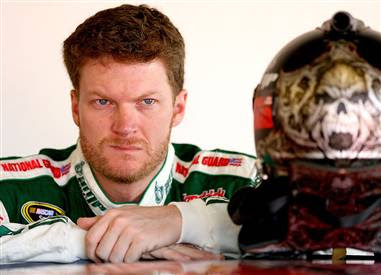
Good piece by Pat Jordan on Dale Earnhardt, Jr in the New York Times Magazine this week:

Earnhardt and I were sitting on the sofa talking; his publicist sat on another sofa. We talked for two hours, while his publicist fidgeted, casting expectant glances at us. Earnhardt said nobody calls him Junior or Little E anymore, except his fans. “That’s off my back,” he said. He looked down at his hands while he talked. When I asked him why he races, he said: “I didn’t want to work for a living. What the hell am I gonna do with my life as Dale Earnhardt’s son if I don’t race? I was a mechanic in Dad’s dealership at 18, and those were some of my happiest days. But my name was Dale Earnhardt Jr., man. Working as a mechanic would’ve been a real pain. People saying: ‘What happened to you? You’re Dale Earnhardt’s son.’ ”

…What has been the hardest thing for him to deal with in his career?

He stared at his hands and said: “All my life I’ve been the smaller measure of the man. When my Dad died, I wanted to honor him. But I wanted to distance myself from him too. I wanted to get out from under being Dale Earnhardt’s son.”

Bet a Million

Here’s Vic Ziegel, from the introduction to his collection Sunday Punch: Raspberries, Strawberries, Steinbrenner & Tysons–a Famed Sports Columnist Takes His Best Shot at Sports’ Big Shots:

Many of the pieces contained here were written in the press boxes, very close to deadline, with the stranger next to me typing a lot quicker. When sportswriters describe other sportswriters, good is high praise, quick is the ultimate. (The two words, quikc and good, make the work sound almost lewd. Me? I never got it for free and I never will.) The deadline is the problem, the enemy. It is there, at the same time, every night. You stand still and it comes closer. You can’t fake it out because it doesn’t move. It grows shorter and towers over you. It doesn’t understand that you want a better word than fast to describe a baserunner. Very fast is very bad. Fleet is out. Swift, nimble, speedy. No, no, no. Fast is starting to look better. There’s coffee spilled on my notes, you know in your heart that the press lounge has run out of beer, and now the stranger is on the telephone telling someone named Sweetie that he’s on the way.

On those days I write in the Daily News‘ sports department, and the ax of a deadline isn’t about to drop immediately, when you might think I have words enough and time, it suddenly becomes important to play chicken with the blade. So I shmooze with the guys in the office, go downstairs for another cup of cardboard coffee, call home, anybody’s home, until I have finally arrived at the moment I dread: the sports editor standing over me and saying, “Where is it?” (This is what you answer, kids. You say five minutes. And not to worry. If you miss once, nothing happens. If you miss too many times, they make you sports editor.)

And here’s John Schulian remembering his friend.

It was Vic Ziegel who once began a story with these immortal words: “The game is never over until the last man is out, the New York Post learned late last night.” If I had a nickel for every baseball writer who has paraphrased or just plain stolen that sentence, I might be able to afford a box seat at a Yankee game.

But those 19 words, no matter how often they appeared in one form or another under someone else’s byline, would always belong to Vic. He took a cliché and, with one deft addition, told his readers that he had written about a game, not the end of the world. Better still, he was setting the stage for a story filled with fun and whimsy. It would also be wise and free of self-importance, because those were trademarks of Vic’s work, too. Most of all, though, his story was going to make people laugh.

Making people laugh was what Vic did best until he died the other day, at 72, and turned my smile, and the smiles of everybody else that knew him, upside down. At the old Dorothy Schiff Post, he tickled funny bones by writing a sports advice column he called “Dear Flabby.” When Red Smith invited him to go to the horse races in some exotic, Ali-inspired locale -– oh, did Vic love the horses -– the next thing he knew, Red had written a column featuring a character named “Bet a Million” Ziegel.

And then there was a story that never made print, the one Vic told on himself about his turn as a hockey writer. The old one had left the Post, and when the new one couldn’t start for a couple of weeks, Vic volunteered the fill in even though hockey left him cold. Somehow he survived. He was such a team guy, in fact, that he even escorted the new man to the first game he covered. Soon after the puck was dropped, the new man began waxing rhapsodic about the action in the crease.

“The crease?” Vic Ziegel, hockey expert, said. “What’s the crease?”

As the story comes back to me, I can hear him laughing. Not loudly -– there was nothing loud about him -– but with the joy he got from telling a funny story well. And if he was the punch line, so what? We’re all punch lines at one point or another in our lives.

He and I might have qualified in that regard when we wrote for P.M. papers–Vic the Post, me the Chicago Daily News–and still struggled to make our deadlines. It was funny for everybody except us and the desk men who were waiting to slap headlines on our copy as dawn came creeping. For all I know, that was how our friendship was born: We were the last two guys in the pressroom. The only thing I can tell you for sure, though, is that we met at the Muhammad Ali-Alfredo Evangelista fight outside Washington, D.C., in 1977, and we became friends, just like that.

It was one more stunning development in the year and a half or so that saw me go from cityside reporter in Baltimore to sportswriter at the Washington Post to columnist in Chicago. Here was Vic, whose work in the New York Post had been making me laugh since the first time I picked up the paper, in 1968, and he was giving me his phone number and calling me “pal” and treating me as if I belonged in the kind of company he kept in Manhattan. He had worked with Leonard Shecter, Larry Merchant, Pete Hamill, and Murray Kempton, and I’d read in the Village Voice that he hung out at the ultimate writers’ bar, the Lion’s Head. Now he was my friend — how cool was that?

There was a grace and good-heartedness about Vic that never wavered throughout the 33 years I knew him. He took me to the Lion’s Head for my first visit, and made a point of introducing me to Hamill and Joel Oppenheimer and Joe Flaherty, towering figures in the pecking order in my head.

When I was married and my wife and I visited New York, Vic and his wife, the pluperfect Roberta, hosted a brunch in our honor at their apartment, and who should show up but Wilfred Sheed, another writing hero. Vic knew the Italian restaurants I should eat at, and the movies I should see (especially if they were film noir), and the old jazz I should be aware of, by Bix Beiderbecke and Jellyroll Morton. I’m partial to country music myself, but one rainy night Vic picked me up to go to dinner and then abruptly pulled his car to a stop on a side street so I could listen to what he thought was the perfect blending of our sensibilities: Jimmie Rodgers, the Singing Brakeman, backed by Louis Armstrong. If a goy from Salt Lake City may say such a thing, he was the ultimate mensch.

There are people who knew Vic longer than I did, and there are people who knew him better, but I consider myself lucky to have spent the time I did reading him and hanging out with him. The last time was after last year’s Breeders’ Cup at Santa Anita. He stayed for a couple of days in the room where I keep my crime novels and a jukebox that I’m ashamed to say has only one jazz CD on it, Miles Davis’ “Kind of Blue.” He had aged and he seemed less sure of himself physically, but if he had been diagnosed with the cancer that ultimately killed him, he never breathed a word of it. He wanted to talk, to laugh, to eat, and when I suggested that we watch The Friends of Eddie Coyle, he was up for that, too. He took the sofa, I took the easy chair, and we were both sound asleep before we got 20 minutes into the movie. It’s what old guys do. Then they say goodbye and hope they’ll see each other again.

When Vic was back in New York, he told me about the health problems that had begun to dog him, though still with no mention of cancer. But I’m not sure I ever told him about the anthology of boxing writing that George Kimball, another old friend, and I are putting together. I should have, because he’s in the book with a blissfully funny story he wrote for Inside Sports 30 years ago about the devoutly unfunny Roberto Duran. The story opens with Vic’s description of two chinchillas, Ralph and Steve, who live in a window cage in New York’s fur district. Now nobody will ever open another boxing story with chinchillas named Ralph and Steve, damn it.

[Photo Credit: NY Daily News, Corbis]

O Brother, Where Art Thou?

Here’s Pat Jordan at his best. A first-person essay on his relationship with his brother:

My brother doesn’t know where I live. He doesn’t know who my friends are. He doesn’t know I have two new puppies. He doesn’t know I am talking again to my daughter after 20 years. He doesn’t know if Susan is still well and free from cancer. He doesn’t know if I am well or sick, working or not, vigorous or an old man. I know nothing about him either. I have not talked to him in three years. I have not seen him in five. I have seen him only three times in the last 12 years, at my house in Florida in 2000, at our mother’s funeral in 2002, and at my father’s funeral in 2005. He doesn’t know what I look like now, at 69, whether I have gained or lost weight, whether I have lost my hair like Dad, or still have it like him. But I know what he looks like because he has never aged. He looked old when he was young, but when he got old he looked the same. He’s 83 now. With short hair like Brillo, a long horsey face, and small eyes (his friends called him “Moose”). A tall, sturdily built man with a vise-like handshake that made me wince, his reminder that he would always be stronger than me, like a solid oak unbending in the wind, while I would always be a sapling whipped by the wind until uprooted.

At my mother’s funeral in 2002, my father, my brother, and I greeted mourners in the back of the church in our hometown of Fairfield, Conn. My brother, 6’4″, wore his Ivy League suit from J. Press Clothiers in New Haven, and his wing-tipped cordovan shoes, as sturdy as Dutch clogs. My father, 5’6″, at 92, wore his navy blazer with brass buttons and his regimentally striped tie. I, 6’1″, wore my black leather sport jacket, jeans, and work boots. I had long gray hair and a white beard. My father looked at me and said, “You look like a bum.” My brother said, “Leave the kid alone, Dad. He came all this way.” My brother always defended me to my father. That’s why he always called me “the kid.” It was a sign of affection. To him, I would always be “the kid”; it was his way of excusing my behavior among adults. And whether my brother realized it or not, it was a way to diminish me. Which was the problem, one of them anyway, which is also why, at 69, I have reconciled myself to the possibility that I will never see my brother again.

Speed the Plow

With Father’s Day fast-approaching, consider Will Leitch’s smoothly-written memoir, Are We Winning? It’s a brisk and funny read. Will is really in his element here, flourishing. Ya heard?

And while we’re talking fathers and sons, do yourself a favor and check out this post by Glenn Stout:

Most of my memories of my father are somehow wrapped around a baseball – playing catch, him taking me to games or watching me pitch. It was the one way we really connected. But in high school I tore my rotator cuff and had to stop playing. We didn’t have as much to talk about after that.

Almost twenty years later my shoulder healed and I joined an adult league, one in Boston and later, another in Worcester County, where I then lived. For three or four years I was in both leagues and played fifty, sixty games each summer, usually pitching and playing first or third.

I’d call home every week and for the first time since I was a kid my conversations with my father were wrapped around baseball again. I sent him the ball after I won my first game since I was sixteen years old, and a t-shirt I got for making the league all-star team. I was as proud of each as of any book I’ve ever written, and so was he.

Fine work by Glenn, as usual.

Class Act

Ron Fimrite, one of the signature voices at Sports Illustrated (he was at the magazine for more than thirty years) passed away late last week of pancreatic cancer. He was 79. Fimrite worked the baseball beat for SI as well as anyone ever has, and from what I understand he was an old smoothie to boot, a real stand-up guy.

Here’s a short selection of some of his memorable work at SI:

On Ralph Branca and Bobby Thomson.

On Pete Rose.

On Hank Aaron’s 715th home run.

On Jackie Jensen.

And finally, peep this bonus piece on Harry Caray:

In the face of…adulation, Harry exhibits a generosity of spirit common only to those who know they deserve the best. He stops to chat and sign autographs. His manner is engaging, familiar: “Hiya, sweetheart…. Whaddya say, pal?” Earlier in the evening, Harry had hit a couple of spots, and in each he was accorded the sort of welcome John Travolta might receive should he appear in the girls’ locker room of a small-town junior high school. “Hey, Harry!” “You’re the greatest, Harry.” “Hey, Harry, say hello to the people of the world.” This had been a day like any other in his life, which is to say, utterly chaotic, a continuing test of his pluck and durability.

Harry had arisen brightly that morning after a revivifying four hours of sleep. He placed a call to Jon Matlack, the Texas Ranger pitcher, identifying himself as Brad Corbett to the hotel operator when informed that Mr. Matlack was not in his room. It is Harry’s conviction that even baseball players will return telephone calls if the caller is someone of recognizable financial clout, and Corbett is the principal owner of the Texas baseball team. Harry wanted to discuss with Matlack some intemperate remarks the pitcher had made to the press, to the effect that Harry should be “killed” or, at minimum, have “his lights punched out” for saying on the air that the tumultuous booing Matlack’s teammate, Richie Zisk, had received from Chicago fans was richly merited.

Zisk, a White Sox player last year, had himself been critical of Chicago fans, a sin in Harry’s eyes comparable to denouncing the game itself. Matlack returned the call and Harry said he would see him in the visitors’ clubhouse at Comiskey Park that evening. There Harry found Matlack to be more contrite than murderous. Zisk was less conciliatory, but he concluded a protracted harangue ambiguously by insisting, “You say anything you want, Harry. O.K.?” Harry, ever unflappable, agreed he would do just that. When the crowd booed Zisk even more ferociously that night, Harry apologized, in a way. “There must be something wrong with your television sets,” he advised his listeners.

Texas Two-Step, Part Deuce: The Ballad of Crew Slammer

Jimmy Cannon: Sportswriter.

Riding the Harper’s Magazine bandwagon today. They’ve earned it. Just published a terrific collection called Rules of the Game: The Best Sports Writing from Harper’s Magazine. Lots of good stuff in there including Pete Axthelm’s memorable essay The City Game (which became an excellent book), Pat Jordan on the shady baseball prospect Toe Nash, another good baseball essay by Rich Cohen, and a spot-on piece on sports writing by the critic Wilfrid Sheed, a guy who is real hit or miss for me.. Also work from Mark Twain, John R. Tunis, Shirley Jackson, Tom Wolfe, and George Plimpton. It’s the goods.

Harper’s has also made Gary Cartwright’s memorable recollection of his days at the Fort-Worth Press (included in the book), Confessions of a Washed-Up Sportswriter, available for us all on the Internet. Whoopee!

Here we have a first-hand account of Shrake and Jenkins, Blackie Sherrod and the Forth-Worth Press in the Fifties:

I did not know it at the time, but The Press sports staff was ten years ahead of the game. In 1955 The Press was perfecting what most, but not yet all, sports staffs believe they have just created: a competitive art form. Significant television competition was years away, but already The Press was rebelling against the stiff, bleak who/what/when/where architecture of its predecessors, exposing myths, demanding to know why, and treating why as the only question. It was funny about 1961 when Newsweek devoted its press section to the wry progressive sports editor of Newsday, Jack Mann. Newsday hired good, creative writers. They worked as a unit, pruning cliches from wire copy, pepping up hard news by tracing angles all over the country, barreling over dogma where they confronted it. Was Yogi Berra a lovable gnome, like it said in Sporting News? Did he sit around reading comic books and eating bananas? Or was he a noncommunicative boor whose funniest line was, “How the hell would I know?” Newsday, the magazine pointed out, demanded an answer.

There was no way for Newsweek to know it, but sports editor Blackie Sherrod had been preaching a better anarchy at The Press in 1950. Sherrod surrounded himself with such men as Dan Jenkins and Bud Shrake, now well-known and excellent writers at Sports Illustrated, not to mention the irresponsible Crew Slammer. He let them write from the gut.

Cartwright recalls the early days with great fondness but he doesn’t romanticize the sports writing profession:

…Let me make one thing plain: most sportswriters have no business in journalism. They are misfits looking for a soft life. The worst sportswriters are frustrated athletes, or compulsive sports fans, or both. The best are frustrated writers trapped by circumstances. Westbrook Pegler called sportswriters “historians of trivia,” but Pegler learned his craft by writing sport. Scotty Reston, Heywood Broun, Damon Runyon, Ring Lardner, and Paul Gallico wrote about sport. Winston Churchill covered cricket during the Boer War. TheNew York Times‘ John Kieran was a sportswriter, but he was much more. When students at Yale protested that a sportswriter had been invited to address them, Kieran delivered his speech in Latin.

Sportswriting should be a young man’s profession, No one improves after eight or ten years, but the assignments get juicier and the way out less attractive. After eight or ten years there is nothing else to say. Every word in every style has been set in print, every variation from discovery to death explored. The ritual goes on, and the mind bends under it. Ask a baseball writer what’s new and he’ll quote you the record book. Baseball writers are old men, regardless of age.

…There is no spectacle in sport more delightful than witnessing members of the Baseball Writers Association, who invented the box score, trampling each other at the buffet table. The first time I actually saw Dick Young, the New York Daily News‘ very good baseball writer, he was smearing deviled egg on the sleeve of Arthur Daley’s sport coat and discussing Casey Stengel’s grammar. Ben Hogan was rude and gruff but he impressed me when I learned that the caviar at his annual press party cost $45 a jar. Tony Lema had a genius for public relations at least as great as his genius for golf. Champagne Tony! I covered his funeral. It was an assignment that I did not want, but I was there, thinking that it may be years before I taste champagne again. They served some on the flight home. Bear Bryant used to insist that the way to handle a sportswriter was with a fifth of Scotch. Sportswriters deplored this attitude, but no one ever thought to sue Bear Bryant.

This was the title piece of Cartwright’s collection of his best work, Confessions of a Washed-Up Sportswriter (including Various Digressions about Sex, Crime, and Other Hobbies). If you can ever find a copy of that on the cheap, get it, it also features a wonderful piece on Candy Barr, the famous Texas stripper, and a vicious story about dog fighting that would make the dudes at Deadspin moist. Cartwright regarded it as the best piece he ever wrote even though it was rejected by Playboy, Sports Illustrated and Esquire. It was his favorite, anyway. Probably worth signing up for Texas Monthly (it’s free) for the Cartwright archive alone.

Kudos to Harper’s here. They are doing a real mitzvah and other publications like Rolling StoneEsquire, GQ, and The New Yorker could take notice and make some of the gems from their vaults available to us on occasion. Share the wealth, just a little taste, good Internet karma and all that. A little love goes a long way.

[Life picture of Jimmy Cannon via A Continuous Lean]

feed Share on Facebook Share on Twitter Share via email
"This ain't football. We do this every day."
--Earl Weaver