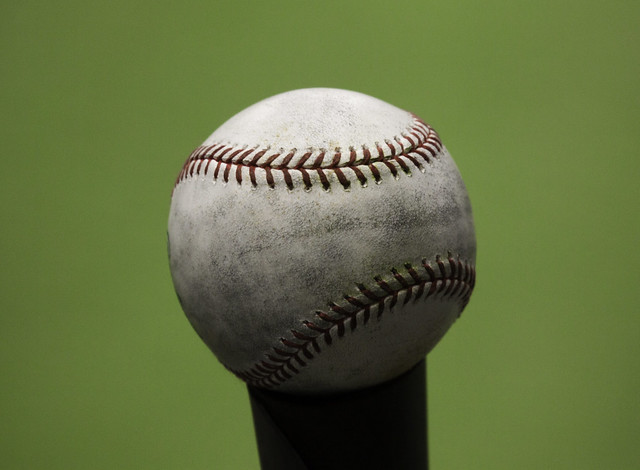
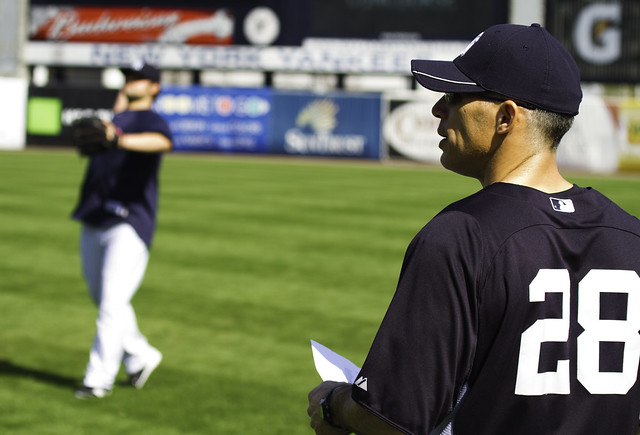
Our man William has a terrific post on the history of Yankees spring training.

Don’t miss it.

[Pictures by Lynn Matsuoka]



Our man William has a terrific post on the history of Yankees spring training.
Don’t miss it.
[Pictures by Lynn Matsuoka]

Mark Teixeira, who told reporters the other day that he plans to be “buried in pinstripes” does not want to start the season slowly, as he has done for the past two years. According to a piece by Ben Shpigel in the Times:
“To me,” the hitting coach Kevin Long said, “it’s taken him too long in the past to get going.”
…According to Long, Teixeira told him, “I’ve probably taken for granted my hitting is always going to be there.”
“I told K-Long, give me some tough love if you need to,” Teixeira said.
It says here that Teixeira will have a good start this time around. Fearless prediction, I know, but hoop, there it is.
[Photo Credit: NJ.com]

In the Times, Ben Shpigel profiles Manny Banuelos:
Most young pitchers, Newman said, have a good fastball but must develop a feel for the craft. With Banuelos, it was the opposite. Based on a recommendation from Lee Sigman, their scout in Mexico, the Yankees in March 2008 paid $450,000 to the Sultanes de Monterey for a package of four players highlighted by the former reliever Alfredo Aceves and Banuelos, whose command and savvy as a 17-year-old intrigued them more than his velocity.
That is what Greg Pavlick, his pitching coach last year at Class A Tampa, noticed about Banuelos when he saw him for the first time, in a rookie league game that summer in nearby Clearwater. Pavlick, a Mets coach during their championship season of 1986, worked with the 18-year-old Dwight Gooden and said Banuelos was one of a few young pitchers he has encountered who had a similar presence.
“Certain guys just stand out,” Pavlick said. “It’s like a hitter who has power. Fans pay to watch that. If you have a guy who can get on the mound and pitch like Manny, they’ll come watch him, too.”
I’m ready…
Over at Baseball Prospectus, Kevin Goldstein runs down the Yanks’ Top 11 prospects. Here’s some tidbits on the big names:
1. Jesus Montero, C
The Good: . . . plus-plus power and hitting ability. . . . excellent bat speed, fantastic hands, quick wrists, and immense strength . . . drive balls out of any part of the park while maintaining a high batting average. . . . continued improvement in his approach . . .
The Bad: . . . remains a well below-average catcher . . . just isn’t designed to play to position. . . . poor receiver who handcuffs balls. . . trouble blocking pitches in the dirt, . . . arm strength mitigated by the amount of time it takes his immense frame to get out of a crouch and release the ball. . . .
2. Manny Banuelos, LHP
The Good: . . . added significant velocity in 2010, with a fastball that suddenly was sitting at 92-94 mph while touching 96. His changeup is a true plus offering with excellent fade and deception . . . consistency with it rarely found in a pitcher so young. . . . a good curve, . . . extremely easy mechanics and clean arm action that combine to provide above-average command and control.
The Bad: . . . curveball can be inconsistent, and he clearly loses feel for the pitch at times. . . . small frame is cause for some concern, and he has yet to throw more than 109 innings in a season, so his ability to handle a big-league workload is unproven.
4. Dellin Betances, RHP
The Good: . . . fastball sits in the low to mid-90s, consistently touches 97 mph, features some natural tailing action, and that’s not even his best pitch, power curveball . . . comes in hard and then falls off the table. . . . made some progress with a changeup, . . . delivery is much cleaner than the one from his pre-surgery days.
The Bad: . . . only pitched 85 1/3 innings last year, has thrown less than 300 in his five years as a pro, and he needs to prove that he can maintain his stuff over a full season. His changeup is still highly inconsistent, as he can lose feel on it and overthrow. He has put significant bulk on his frame over the past three years, and conditioning could be an issue down the road.
7. Andrew Brackman, RHP
The Good: . . . fastball generally sits in the low 90s, touches 96 mph, and his height adds considerable downward plane to the pitch, leading to plenty of ground balls. His curve was once a fringy offering, but he’s refined it into an easy plus offering by focusing more on spin than velocity. . . scouts noted a much more consistent delivery.
The Bad: . . . had starts where his heat sat at 90-92, and others where he rarely went below 94, and still had some occasional struggles with finding the strike zone. His changeup remains a below-average pitch, as he telegraphs it with notably different arm action.
Mariano Rivera reported to camp yesterday and spoke to the press. Chad Jennings has a thorough recap:
Mariano Rivera left home yesterday, doing what Andy Pettitte couldn’t bring himself to do this winter.
“It’s hard,” Rivera said. “One of my kids was, the little one was attached to my hip, crying. It’s hard. A lot of people don’t see that, that part of the game. You have to leave your family. Even though you’re going to see them, being detached from your family is hard.”
It seems Rivera never seriously considered retirement this offseason, but he admitted that leaving home “gets harder and harder,” and now that his oldest son is 17, Rivera realizes he’s “missed a lot of things.”
“Baseball is not everything,” Rivera said. “That’s what we do, yeah, but there’s still life after baseball. There will come a time when you have to make a decision, even though you still have the abilities to play. That comes within yourself. If you don’t feel it in your heart, you don’t feel it in yourself no more, it’s time to say goodbye because, why are you going to do it if you don’t have the desire to do it? That’s why I thank God for Andy, and I respect him because he just didn’t have the desire to do it no more.”
As always, it will be a pleasure to watch the man work.

Chuck Tanner never played for or managed the Yankees, but that really shouldn’t matter. He was one of those special people in baseball who just made you feel better about yourself, even if you were only around him for a few minutes. Tanner died last week at the age of 82, leaving behind a legacy of general cheerfulness and highly competent managing.
About a dozen years ago, I had a chance to meet Tanner and Oliver at a university symposium about integration in baseball. Both men played important roles for those culturally diverse Pirates teams, allowing them to share their experiences with the college students and academics in attendance. When it came to coaching and managing black athletes, Tanner offered plenty of credibility. More than any manager, he found a way to get through to Dick Allen where other skippers had failed. He also had good relationships with African-American and Latino players in Pittsburgh, from Oliver and Manny Sanguillen to Willie Stargell and Bill Madlock. His ability to deal well with athletes of all ethnicities was exemplified by a 1979 world championship team, a unified group tied together by the hit Sister Sledge song, “We are Family.”
After we participated in the panel, I had the distinct pleasure of dining with Tanner and Oliver. It didn’t take long to realize that Tanner’s persona of perpetual optimism was no deceptive façade. He took as much interest in me as I did in him, even though I had never managed a world champion or played in a major league game. As much as anyone I’ve ever met, Tanner genuinely exuded positive vibes–and seemingly did so every minute of the day. It was not difficult to see why so many of his players proclaimed him as the best and most enjoyable manager they had ever experienced.
Tanner knew the game, too. The job that he did leading the 1972 White Sox remains one of the great managerial accomplishments of the past 40 years. Other than Dick Allen, the knuckleballing Wilbur Wood, and a young Terry Forster, the White Sox had little frontline talent, but they somehow managed to keep pace with the vastly superior Oakland A’s for much of that summer. Tanner knew that he didn’t have much pitching depth that season, so he used a four-man rotation that sometimes morphed into a three-man affair. Wood, ex-Yankee Stan Bahnsen, and journeyman Tom Bradley each made over 40 starts, all of them pitching well enough to keep the Sox and their low-scoring offense in most games that season.
Tanner knew something about relief pitching, as well. He was the man who made the decision to convert Goose Gossage to the bullpen, a maneuver that resulted in a Hall of Fame career. Later on, when Tanner moved on to the Pirates, he masterfully mixed and matched his bullpen arms. He exhibited a great feel for when and where to use his relievers, whether it was Jim Bibby or Enrique Romo pitching in long relief, ex-Yankee Grant Jackson working as a situational left-hander, or Kent Tekulve filling the role as closer.
In between managing stints in Chicago and Pittsburgh, Tanner did intriguing work in Oakland. He managed the A’s for only season, but he left his mark in a distinctive way. An aggressive manager who loved the running game, Tanner realized he had speed to burn with the ‘76 A’s. Giving green lights to practically his entire roster, Tanner watched the A’s steal 341 bases, a major league record for the post-deadball era. Tanner skillfully used Matt “The Scat” Alexander and Larry Lintz as designated pinch runners, while coaxing career best base stealing seasons from Billy North (75 steals), Don Baylor (52) and even the -footed Sal Bando (20 steals). Having lost Reggie Jackson in a spring training deal and having to wade through Charlie Finley’s ill-fated player sales of Joe Rudi, Vida Blue, and Rollie Fingers, Tanner somehow kept the A’s in contention before they fell a few lengths short of Whitey Herzog’s Royals.

Today I bring you one Gus Godbold (photo unavailable).
Sounds pretty badass, but not much is known about Godbold – he played from 1948 to 1950 for minor league Philadelphia As teams in Moultrie (?), Tarboro (?!) and Fayetteville, batting .270 for his career.
From an old Forbes magazine post by our man Michael Popek:

And if you’ve never popped by Forgotten Bookmarks, get-to-steppin’.
Say what you want about Joba Chamberlain’s weight, at least he seems (thus far) to have learned his lesson regarding driving under the influence. Slipping back into destructive behavior this spring, though, is Miguel Cabrera, who got arrested last night on DUI charges and then some. Per the TCPalm, when police arrived:
Cabrera, of Boca Raton, grabbed a bottle of James Buchanan’s Scotch Whiskey and started drinking.
…Cabrera, whose eyes were bloodshot and speech “heavily slurred,” was handcuffed and walked towards a patrol vehicle before being told to get in the vehicle.
“Do you know who I am, you don’t know anything about my problems,” Miguel Cabrera is quoted as saying.
A deputy reported Cabrera was put in handcuffs after not following orders. Cabrera also “kept running out in the road with his hands up.”
A deputy asked Cabrera to get his a patrol vehicle, and he said, “(Expletive) you.”…
Yikes. And this mug shot is not at all reassuring:

I’ve had a special fondness for Cabrera ever since 2006, when in the 10th inning of a game against Baltimore, he swung at an intentional walk pitch that wasn’t far enough outside and knocked a single into center field, leading to a Marlins win. It was just an awesome moment, and while I’m sure it’s happened at some point before in baseball’s long history, I’d never seen it before, and was delighted. I don’t know how long this video will be up (since MLB still doesn’t understand how to interact with fans online and insists on removing every 3-second clip of free advertising anyone puts up), but here it is for now:
Anyway, needless to say his epic screw-up in 2009 took some of the shine off, but it’s sad to see such a fun player careening off the rails. (Probably unnecessary disclaimer: of course, from a human standpoint, it’s sad no matter who it is.)
Meanwhile, over in Dodgers camp, a somewhat different kind of freakout: a day after his agent said that reliever Ronald Belisario might not be able to play in the US this year because of visa issues, Belisario says the delay is simply the result of a lost passport. From the LA Times Dodgers’ blog:
Ronald Belisario told a Venezuelan newspaper that he lost his passport and that he should be able to report to camp soon after obtaining a new one.
But that’s news to Belisario’s agent, Paul Kinzer, who said on Wednesday that his client will probably miss the entire season because of his inability to gain legal entry into the United States.
“That would be news to me,” Kinzer said. “I hope that’s true.”
Kinzer said he has lost touch with the hard-throwing reliever, who hasn’t reported to camp on time for the third consecutive spring.
“He’s gone kind of quiet,” Kinzer said. “I haven’t heard from him in a few weeks.”
That’s just… really weird. Missing passport or no – being late to camp (again, and just a year after treatment for substance abuse) and not even checking in with your agent is a sign that something is very off.
So, it’s been kind of a rough first week of spring training so far for a few teams. Maybe baseball needs to develop a more aggressive substance abuse program for its players, or tougher rules about getting help, counseling, or rehab after incidents like this. And maybe let’s ease off Joba’s extra 15 pounds, at least until we see how he pitches. There are problems and then there are problems.

C.C. Sabathia reported to camp lighter; Joba Chamberlain is heavier. My favorite headline today comes from the Times of all places: Heftier Chamberlain Arrives with Thud at Yankees Camp:
Asked Wednesday morning for his impression of Chamberlain, General Manager Brian Cashman said: “He’s heavier. Let’s just leave it at that.”
Told that Chamberlain has said he packed on muscle, Cashman said: “He’s obviously heavier. That’s as much as I’ll say.”
…“You think about it as a manager, you think about what it says,” Manager Joe Girardi said. “As I said, Joba is going to be pretty much evaluated on how he pitches. That’s the bottom line. We’ve been very pleased in what we’ve seen so far.”
The Wall Street Journal asks: Is This the Fattest Yankee Team Ever?

On my way to the grocery store yesterday I stopped and tilted my nose in the air like I was a dog. It was warm in the sun and I thought I smelled it–the distinct odor of spring, which can only mean one thing: “Baseball.” It is the smell of soil, carried through the breeze. Eh, I think I might have been straining.
This morning, however, there it was again. Sure, this is a false spring we’ve got on our hands this week in New York (it is supposed to reach 50 degrees today), but I’ll take it.
Couple of Yankee notes fuh ya:
Brain Cashman has some tough love for Joba Chamberlain and Keith Olbermann is even tougher on Derek Jeter.
Update: Oh, and some cool news in the Yankee blogosphere–the Yankeeist and Yankee U have merged to form The Yankee Analysts. Be sure to drop by and check ’em out. I’m sure they’ll be doing some fine work this season.
[Picture by Richard Diebenkorn]
Okay, so I don’t entirely mean that headline. As usual, I’ve been looking forward to spring training since late November. In fact, I always have to stop myself from needlessly capitalizing it — Spring Training — because it seems like it ought to be some kind of official holiday, like Christmas or Independence Day.

So it’s not that I’m not happy that, starting this weekend, we’ll get something vaguely resembling real baseball news. It’s just that I don’t actually want spring training — I want real baseball. Spring training is a plate of carrot sticks and celery when you’re craving a huge hamburger and fries. It’s fine at first, but hardly a long-term substitute.
Sure, the first few days are blissful. Photos of Mariano Rivera and Jorge Posada loosening up, stretching hamstrings and that sort of thing. Noting that someone got skinny and someone else fully enjoyed the holidays. Seeing all those shiny pitching prospects practically glowing with promise, before the real world tarnishes them. Seeing that, somewhere, skies are blue and the sun is shining, and the whole world isn’t like New York, covered in filthy gray slush. Yes, there is hope… yes, baseball is coming.
But: still not for six weeks. That’s the thing. Once you’ve looked at the sunny photos for a few days, and then a few weeks later once you’ve watched a few games, which are a pale imitation of real games in that no one really gives a hoot about them and the teams play accordingly, spring training is pretty much a six-week dry hump. If a player does well in spring training, it doesn’t mean he’ll do well in the regular season, so you can’t fully enjoy it. If he plays badly, you worry anyway even though, again, it doesn’t mean a thing. It’s good to see prospects you don’t normally get to see on television, but it’s no substitute for genuine baseball where the score is important, or at least as important as a baseball score ever is.
Of course, the good news there is that six weeks isn’t really such a long time. And I guess that’s why I still look forward to spring training… we’re not out of the dark yet, but it’s the light at the end of the tunnel.

Here’s some Yankeeness for you fiends out there:
Over at River Avenue Blues, Joe P links to a Wallace Mathews piece on Kevin Long.
And at IATMS, here’s a note via Buster Olney that C.C. Sabathia has lost 30 lbs.
Joba Chamberlain, on the other hand, has reportedly put on some weight. Check out this great Yankee weigh-in by Steve Goldman. And while you are there, dig the Aceves Challenge by Jay Jaffe.
[Picture by Bags]

Pitchers and catchers don’t officially report for a few days still, but Russell Martin and Jesus Montero are already working out in Florida. Here’s John Harper, writing in the Daily News about the kid Montero:
Baseball America editor Jim Callis, who ranks minor-league prospects based on seeing them himself and talking to more scouts and minor-league evaluators than just about anyone, says he would have a hard time dealing Montero.
“To me he’s the best all-around hitter in the minor leagues,” Callis said recently. “He might be another Mike Piazza, the way he hits for average and power. I’ll be shocked if he doesn’t have a great career as a hitter.”
…But can Montero catch? Callis says the answer might be a matter of how much a team is willing to sacrifice defense for offense at the position.
“It’s not like he’s a total butcher back there,” Callis said. “He has a strong arm, but his transfer when he throws is slow, and he’s not the best receiver in the world. He’s not real athletic, but he has worked hard to become more flexible behind the plate.
“Overall he’s a little below average defensively, and I’m not sold that in five years Montero will be a catcher.
Yeah, the Yanks have issues with their starting rotation but there is plenty to be excited about and it starts with the Jesus.

I must admit that I never warmed up to Dave Winfield as a Yankee. Initially, I was excited when the Yankees signed him as a free agent during the winter of 1980-81. With an aging core of position players, the Yankees desperately needed a relatively young and athletic outfielder like Winfield. They also lacked thump from the right side of the plate; with Winfield now available to complement Reggie Jackson in the middle of the batting order, the Yankees appeared to have a thunderous righty-lefty combination.
Almost immediately, the New York media tried to sour the fan base on Winfield. I remember Mike Lupica, a poison pen if there ever was one, lamenting that the Yankees had spent millions of dollars on a “singles hitter” like Winfield. Admittedly, Winfield hit only 13 home runs in his first summer as a Yankee, the strike-shortened campaign of 1981. At times, Winfield looked more like a line-driver hitter than a pure power hitter. I think Winfield would have hit more home runs if not for the fact that he hit the ball so hard, with such incredible overspin. When Winfield connected with a pitch firmly, he hit searing line drives that tended to reach the outfield and then dip. For some reason, his swing lacked the lift of a classic power hitter.
Still, Lupica’s assessment of “singles hitter” was borderline ludicrous. Winfield had just come off a 20-homer season in San Diego. In 1982, his second season in the Bronx, Winfield would hit 37 home runs. By the time his career ended in 1995, he would compile 465 home runs and a lifetime slugging percentage of .475. Singles hitter, my eye. Perhaps Mr. Lupica would like to revise that description.
I’m not sure why I paid so much attention to Lupica, and all the other naysayers in the New York media who tried to belittle Winfield’s ability. Of course, I was all of 16 years old at the time, an impressionable teenager who took the words of older baseball experts too closely to heart. Still, their words seemed to carry more resonance in the fall of 1981, after Winfield endured a brutal World Series, gathering one hit in a disappointing six-game loss to the Dodgers. George Steinbrenner certainly bought into the perception, dubbing Winfield “Mr. May.”
With the seeds of postseason futility sown, I began to view Winfield as something of a disappointment as a hitter, and a failure in the clutch. First off, I was frustrated by Winfield’s log-cutting approach to hitting. Starting with a discernible hitch, he took a ridiculously large swing, unfurling his long arms toward the ball in such an exaggerated way, almost like a cartoon character in an old Bugs Bunny clip. (One frame of that gargantuan swing can be seen on his 1985 Topps card, which is probably the best of all the Winfield cards.) Too many times, his bat ended up hurtling down the third base line, threatening the livelihood of the poor third base coach, or the fans watching from the box seats near the dugout. The bat-throwing underscored the criticism of his hitting in the clutch. Unlike Jackson, Winfield rarely seemed to deliver that late-inning, game-turning blow that could transform a Yankee loss into an unlikely win. To this day, I have trouble remembering any landmark home runs, or even extra-base hits, that Winfield delivered for the Yankees.
Just for fun, I decided to take a look at the “clutch” statistics for Winfield’s career. With two outs and runners in scoring position, he batted a mediocre .255 with a pedestrian .431 slugging percentage. In late and close situations, he hit a bit better, .266 with a slugging percentage of .444. In tie games, his numbers improved to .271 and .455. All in all, the numbers show Winfield to be a mediocre player in the clutch, not as good as his usual performance, a little better than what I might have thought, and hardly Herculean.
Beyond his playing ability, Winfield could raise eyebrows through his demeanor. Trying too hard to sound cool and hip, he came across as arrogant in interviews. Cocky and confident, he walked with an exaggerated strut that looked like a Hollywood caricature. When a Yankee beat writer asked him to attend a charity event, Winfield agreed, but only after coming up with enough demands to make a diva proud. If anything, Winfield was out of touch with the common man.
None of this means that Winfield damaged the Yankees. On balance, he helped the franchise, albeit during the frustrating decade of the 1980s. He was durable, almost always playing 140 or more games a season. He was consistent, four times slugging .500 or better in pinstripes, and six times reaching the 100-RBI mark. Clutch or not, the man always played hard, running out every ground ball with a World Series passion, taking out middle infielders on double play balls, and chasing full bore after every fly ball that he could reach in left and right field.
When Winfield came up for Hall of Fame election, I did not hesitate to offer my own imaginary vote. I would have immediately put a check next to his name on the ballot. The man put up Hall of Fame numbers, and did so for a long time, his big league career lasting 22 seasons. He was a gifted and hard-working five-tool athlete who hit with power, stole bases, and played a wonderful right field.
He might have been a little hard to root for on a personal level, but if Winfield were in his prime today, I’d gladly add him to the Yankees’ starting lineup. David Mark Winfield could play right field for a winning team any day of the week.
Bruce Markusen writes “Cooperstown Confidential” for The Hardball Times.
According to reports, the Yanks have signed Freddy Garcia to a minor league deal.


The other day I mused offhandedly about how cool it would be to own a baseball team, and also how completely impossible. And that made me think of minor-league or independent-league team ownership, which is still kind of a possibility for mere mortals – and which, these days, has a lot more room for quirk. Given the choice between two clubs, as a general rule of thumb, you’re probably better off joining the one that doesn’t require Bud Selig’s approval.
Back in the fall I read Neal Karlen’s Slouching Towards Fargo, which is an affectionate portrait of the St. Paul Saints circa 1996 and 1997, an independent Northern League team owned in part by Bill Veeck’s son Mike (decades after his Disco Demolition Night debacle) that boasts a pig delivering baseballs to the mound, a nun in the stands offering massages, appearances by part-owner Bill Murray, sumo-wrestling contests for opposing managers between innings, and much more. “Fun Is Good,” is the Saints’ motto, and it’s refreshing to watch a team that doesn’t take itself too seriously. (Bless the Yankees, but you know it would do them good to lighten up once in a while). Daryl Strawberry, who redeemed himself with the Saints shortly before joining the Yankees and salvaging his career, serves as something of a focal point in the book, representing the Saints’ function as a haven of second- and third-chances for baseball types and locals; there are also draft holdouts, washups, career minor leaguers and female pitcher Ila Borders. The Saints have room for just about everyone.
Author Neal Karlen also tries to tell the story of his own sort of redemption, as he was initially sent to Saint Paul by Rolling Stone’s Jann Wenner to dig up mud and write a story eviscerating Bill Murray and Strawberry. But there’s little suspense or originality in the story of how he ultimately grows a conscience once away from the big city. This part of the book was less successful, for me – partly because Karlen’s writing (and, to be fair, editing – the book is very unevenly paced) is not up to the standards of his material, and partly because his view of cynical and immoral New York City media types vs. big-hearted Midwesterners struck me as overly pat. He frequently brings up petty grudges against other writers or media-world denizens, and he’s too on-the-nose when writing about how baseball and the Saints will heal us all; it’s a theme that would have benefited from subtlety. Still, Karlen does a good job of chronicling the fascinating collection of individuals who cluster around the Saints, a haven for nonconformists, and whatever his flaws as a writer, they don’t prevent the charm of the team itself from coming through loud and clear.