
Hooray for Hollywood! A Certain Cinema is the bomb.




The title of this post was inspired by Eduardo Nunez, who can play any position on the field, not that you’d want him to. It also applies to CC Sabathia, who, I learned from YES, had locked up with the resident lefty Hulk over in Tampa, David Price, five times previously and not yet delivered a win for the Yanks. Despite E-Nunez gifting two runs to the Rays by botching two routine plays in the first two innings, the Yankees were all over David Price from the word “go” and CC Sabathia clamped down like a too-tight Ace bandage over eight excellent innings for a 5-3 win and a series victory.

What does Eduardo Nunez do well? He’s 24 years old. He can steal a base. He can stand anywhere on the diamond you ask him to and, if the ball is hit in his general vicinity, he might block it with some part of his body and throw it somewhere within the stadium in which he is playing. For some reason, this skill set is the lynchpin of Joe Girardi’s roster management strategy.
Most of the outfield is hurt? Don’t call up a Minor Leaguer, Nunez can stand out there. We have an old and injury prone left side of the infield? Start Nunez as often as possible. The legendary closer broke his knee? Is Nunez already in the game? Damn. Call up a reserve outfielder, I guess. Is this really what the Yankees have become? A team so shitty that Eduardo Nunez and his null set is vital? I don’t believe it.
But I digress. I considered writing about Mariano Rivera again tonight. About how his sudden absence has changed my outlook on the Yanks. Less childish. Less emotional. Less passionate. Then Eduardo Nunez booted an easy inning-ending grounder in the first and I shouted at the TV, “Get him off the field, he’s terrible!”
“What does “terrible” mean?”
Oh, shit, the kids are still up and they heard that. Backtrack and apologize or give them the hard truth that Eduardo Nunez sucks at baseball, relatively speaking? Backtrack. I have to get these kids through Little League, after all.
Anyway, somehow bedtime got extended until the Yanks tied it up at 2-2, so they went to sleep with fresh memories of Curtis Granderson homers. Better than sugar plums if you ask me.
Price sure looked like he had all his stuff, but the Yanks weren’t fooled very often. Granderson homered and blasted another to the warning track. Alex had great swings and two hits. Cano saw him better than anyone, with three hits and the telling blow, a two-run jack. Last night, the Yankees scored one run off of Jeff Neimann and were lucky to get it. Tonight they scored five off David Price and seemed a good bounce away from getting ten. Go figure.
In the six innings without a Nunez error, Sabathia permitted four base runners and held the Rays scoreless. His final line was eight innings, two unearned runs, seven hits, one walk, and ten strikeouts. I think he was better than that line indicates, if that’s possible. CC Sabathia is quite possibly the one thing the Yanks got right this winter. And it’s a big one. Next time we’re bitching about Pineda, Montero and Ibanez, let’s be sure to throw CC on the scales.
Let’s also give Joe Girardi some credit for a smart move tonight. He took Nunez out for a defensive replacement. In the sixth inning.
Photo by Mike Stobe/AP

And that goes for David Price, too.
Bad news for Brett Gardner who will have another MRI.
Derek Jeter SS
Nick Swisher RF
Robinson Cano 2B
Alex Rodriguez DH
Mark Teixeira 1B
Curtis Granderson CF
Andruw Jones LF
Eduardo Nunez 3B
Chris Stewart C
Never mind last night’s loss: Let’s Go Yank-ees!
[Painting by Paul Lempa]

A walk is as good as a hit. Even though some traditionalists might view such a statement as sabermetric hokum, that sentiment has been expressed by coaches from little league to the majors for who knows how many years. Of course, that doesn’t necessarily make it true. In many cases, a hit is much more valuable than a base on balls, but in terms of preserving precious outs, both are equally effective.
With the Rays in town, it’s the perfect time to examine the relationship between batting average and on-base percentage. Over the first two games of the current series at Yankee Stadium, the first two hitters in the Tampa lineup have been Ben Zobrist and Carlos Pena, whose relatively low batting averages make them seem like an unlikely pair to feature in the first two slots. Leave it to Joe Maddon to think outside the box, but, in this instance, his strategy isn’t very unorthodox. You see, Zobrist and Pena have two of the highest on-base percentages on the team.
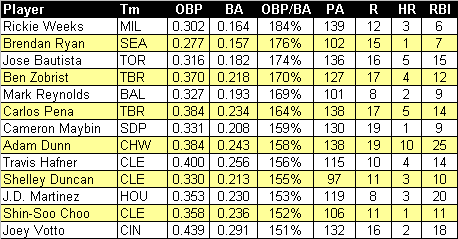
Having a high on-base percentage despite a low batting average isn’t very common, but in Zobrist and Pena, the Rays have two of the top three hitters in terms of the differential between both rates (Zobrist is first at .152 and Pena is third at .150; Dodgers’ AJ Ellis is second at .151). Both hitters also rank among only 13 qualified batters who currently have an on-base percentage at least 150% greater than their batting average, so teams facing the Rays might be lulled into a false sense of security if they only focus on the latter.
Hitters with OBP to BA Ratios of At Least 150%, Qualified Batters in 2012
Source: Baseball-reference.com
With an on-base percentage that is 184% of his batting average, Brewers’ second baseman Rickie Weeks has managed to salvage some value from the disappointingly slow start to his 2012 season. Like most of the members of the list above, his high ratio is mostly the result of having a subpar batting average. However, there is one standout. Reds’ All Star first baseman Joey Votto has piggybacked on a very respectable batting average of .291 with an on-base percentage that ranks fifth in the National League, which is par for the course for the former MVP, whose career ratio is 130% (.406 OBP vs. 312 BA).
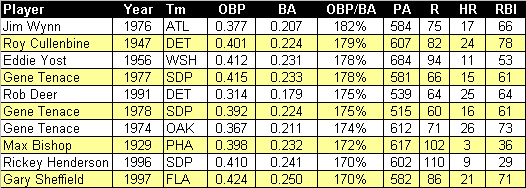
If Weeks maintains his current rates, he’d break the current on-base versus batting average differential record of 182% (based on qualified seasons), which was set by Braves’ outfielder Jimmy Wynn in 1976. That season, the Toy Cannon only hit .207, but, thanks to a league leading 127 walks, still finished in the top-10 in on-base percentage. In total, 175 players have had a qualified season with an OBP/BA ratio of at least 150%, but none has been more impressive than Barry Bonds’ 2004 campaign. That season, the homerun champion won the batting title with a .362 average and still managed to post a high multiple by reaching base in a remarkable 61% of all plate appearances.
10 Highest OBP to BA Ratios, Qualified Seasons since 1901
Source: Baseball-reference.com
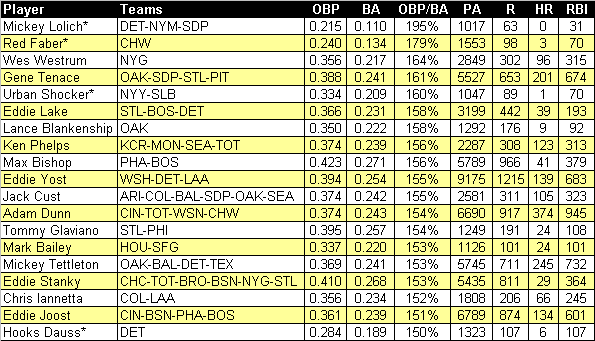
It’s hard enough for a hitter to reach base at a high multiple to his batting average in a single season, much less for an entire career. However, 19 players with at least 1,000 plate appearances have managed to turn the trick, and chief among them was Mickey Lolich. In his 16 major league seasons, which spanned the advent of the DH rule, the former Tigers, Mets, and Padres pitcher ended his batting career with more walks than base hits (105 to 90). As a result, Lolich’s on-base percentage was nearly double his batting average, a discrepancy that easily ranks as the widest in baseball history.
Hitters with Career OBP to BA Ratios of At Least 150%, 1901
*Indicates pitchers.
Note: Based on a minimum of 1,000 plate appearances.
Source: Baseball-reference.com
Among position players, West Westrum’s 164% multiple ranks as the largest differential, but the most impressive divergence probably belongs to Gene Tenace, whose on-base percentage was 161% higher than his batting average in over 5,500 plate appearances. Tenace, a catcher/first baseman whom some regard as a borderline Hall of Famer, ended his career with a very impressive OPS+ of 136, making him a prime example of a hitter capable of providing significant value over and beyond his relatively low batting average.
What about the other end of the spectrum? For a look at those hitters whose ability to reach base rests solely on their bats, join me for a companion piece over at the Captain’s Blog.

I know I’ve brought the Gookie up before but it’s worth mentioning again.
From “Harpo Speaks!”:
The man who first inspired me to become an actor was a guy called Gookie. Gookie had nothing to do with the theatre. He rolled cigars in the window of a cigar store on Lexington Avenue.
This was the store with card games and bookmaking in the back room, the nearest thing to a social club in our neighborhood. It was Frenchie’s home away from home and, along with the poolroom, Chico’s too. Since gambling was never the obsession with me that it was with Chico, I didn’t spend much time in the back room. Where I had the most fun was on the street, in front of the store.
Gookie worked at a low table, facing the Avenue through the window. He was a lumpy little man with a complexion like the leaves he used for cigar wrappers, as if he’d turned that color from overexposure to tobacco. He always wore a dirty, striped shirt without a collar, and leather cuffs and elastic armbands. Whether he was at his table in the window or running errands for the cardplayers, Gookie was forever grunting and muttering to himself. He never smiled.
Gookie was funny enough to look at when he wasn’t working, but when he got up to full speed rolling cigars he was something to see. It was a marvel how fast his stubby fingers could move. And when he got going good he was completely lost in his work, so absorbed that he had no idea what a comic face he was making. His tongue lolled out in a fat roll, his cheeks puffed out, and his eyes popped out and crossed themselves.
I used to stand there and practice imitating Gookie’s look for fifteen, twenty minutes at a time, using the window glass as a mirror. He was too hypnotized by his own work to notice me. Then one day I decided I had him down perfect–tongue, cheeks, eyes, the whole bit.
I rapped on the window. When he looked up I yelled, “Gookie! Gookie!” and made the face. It must have been pretty good because he got sore as hell and began shaking his fist and cursing at me. I threw him the face again. I stuck my thumbs in my ears and waggled my fingers, and this really got him. Gookie barreled out of the store and chased me down the Avenue. It wasn’t hard to outrun such a pudgy little guy. But I’ll give Gookie credit. He never gave up on trying to catch me whenever I did the face through the window.
It got to be a regular show. Sometimes the guy behind the cigar store counter would tip off the cardplayers that I was giving Gookie the works out front. When they watched the performance from the back-room door and he heard them laughing, Gookie would get madder than ever.
For the first time, at the age of twelve, I had a reputation. Even Chico began to respect me. Chico liked to show me off when somebody new turned up in the poolroom. He would tell the stranger, “Shake hands with my brother here. He’s the smartest kid in the neighborhood.” When the guy put out his hand I’d throw him a Gookie. It always broke up the poolroom.
I didn’t know it, but I was becoming an actor. A character was being born in front of the cigar-store window, the character who was eventually to take me a long ways from the streets of the East side.
Over the years, in every comedy act or movie I ever worked in, I’ve “thrown a Gookie” at least once. It wasn’t always planned, especially in our early vaudeville days. If we felt the audience slipping away, fidgeting and scraping their feet through our jokes, Groucho or Chico would whisper in panic, “Ssssssssssst! Throw me a Gookie!” The fact that it seldom failed to get a laugh is quite a tribute to the original possessor of the face.
The little cigar roller was possibly the best straight man I ever had. He was certainly the straightest straight man. If Gookie had broken up or even smiled just once, my first act would have been a flop and the rest of my life might not have been much to write a book about.

Pass the mustard. This one is too much fun.

I once worked with a post-production coordinator whose husband did the sound for this movie. They didn’t use stock sound effects libraries back then. The screech of the train at the end came from the shower curtain dragged closed in the sound man’s bathroom. Also, you know the woman hostage on the train with the two kids? Her daughter babysat for my twin sister and me when we lived at 875 West End Avenue.
[Photo Credi: The Lively Morgue]

This place is mad expensive but it’s fun to check out next time you’re in Curry Hill. Seriously.
[Photo Credit: Robyn Lee]
David Robertson hadn’t given up a run since last September. He was due for a beatin’.

Then again, Jack Curry reminds us that Mariano Rivera blew3 of his first 6 save opportunities back in 1997.

If the only baseball you’ve watched over the past fifteen years has involved the Yankees, it’s possible you’ve come to believe what some will tell you — the closer is the most overrated position in baseball. Those last three outs are really no different than the first three outs. Far too much glory and farther too much money are heaped upon those few soles lucky enough to have been weeded out of the starting pitching pool and thrust into the last spot in the bullpen. Any pitcher, after all, could get those last three outs. If the only baseball you’ve watched over the past fifteen years has involved the Yankees and Mariano Rivera, it’s possible you think those last three outs are easy.
They aren’t. At least not always.
On Wednesday night the Yankees scored a run in the top of the first inning when Derek Jeter notched his 50th hit of the season and scored all the way from first a few minutes later on Robinson Canó’s double to left field. That 1-0 lead stuck for a long time, thanks mainly to an impressive start by Yankee rookie David Phelps.
Phelps got off to a rough start, giving up a leadoff double to Ben Zobrist and backing that up with a walk to Carlos Peña. He’d eventually issue another walk to Luke Scott to load the bases with two outs. He recovered to get Will Rhymes to ground out to second to end the inning, and then settled into a groove, setting down nine of the next ten batters to cruise into the fifth.
Baseball is a funny thing. If everything we read back in 2007 had come true, Joba Chamberlain and Phil Hughes, the one-time jewels of the Yankee farm system, would have about 150 wins between the two of them by now. Sure, Phelps was the team’s Minor League Pitcher of the Year in 2010, but he hasn’t generated nearly the hype of countless other Yankee prospects. Still, it looks like he might stick around, even if his spot in the rotation is given to Andy Pettitte. His control is good, and his money pitch — a Maddux-like fastball that starts at a left-hander’s hip before darting back over the inside corner — seems perfectly designed to neutralize the scariest hitters he’ll face in Yankee Stadium.
With two outs in the fifth and still clinging to that 1-0 lead, Phelps looked to be in position to grab his first major league win. But with his pitch count climbing into the eighties, a walk to Peña, another to B.J. Upton, and Joe Girardi’s itchy trigger finger all conspired against him, and Phelps found himself walking off the mound an out too early.
Boone Logan quelled the rally by striking out Matt Joyce, then set down two more in the sixth before passing the baton to Cory Wade, who saw the game through the seventh. Things got a bit interesting in the eighth, thanks to a leadoff walk issued by Rafael Soriano and a throwing error by Canó, by Soriano wriggled free and passed the game to David Robertson in the ninth inning.
Robertson’s statistics coming into the inning were obscene. He hadn’t allowed a run since the end of last August, and he had struck out 23 hitters in just 13 innings in 2012. Sure, he had struggled a bit the night before, but this was the Hammer of Thor. Now that he had worked his way through his jitters, he’d surely get back to doing what the Hammer does — pounding the strike zone and blowing away any and all overmatched hitters who dared oppose him. These last three outs, after all, are no different than the three in the eighth.
All of this zipped through my head as Robertson came to a set and readied for his first pitch to Sean Rodríguez. Fifty-five seconds later the Rays had runners on second and third with no one out. Rodríguez singled to left on the first pitch of the inning, and Brandon Allen echoed that with a single of his own to right on Robertson’s second pitch. (Nick Swisher’s ill-advised attempt to nail Rodríguez at third was nowhere near the cutoff man, and Allen was able to take second.) Robertson was probably as stunned as anyone else, and he promptly walked Zobrist on four straight pitches to load the bases and bring the dangerous Carlos Peña to the plate.
Robertson’s teammates call him Houdini for his uncanny ability to squirm free of jams like this one; in his career fifty batters have faced him with the bases loaded and twenty-five of them have struck out. Peña became the twenty-sixth of fifty-one, and suddenly it seemed possible. On a 1-1 count to Upton, Robertson dropped a pitch that may or may not have (but probably didn’t) dance across the outside corner. It was the type of pitch that many umpires would honor, but Jim Reynolds had been squeezing pitchers on both sides all night, and he saw this as a ball. If Robertson had gotten that pitch, you can bet he would have pumped a 1-2 fastball up in Upton’s eyes, and you can bet that Upton would’ve swung right through it for strike three. But at 2-1, justifiably fearful of extending to 3-1 with the bases loaded, Robertson was forced deeper into the meat of the strike zone with his fourth pitch. Upton didn’t get all of it, but he got enough to float a fly ball to medium right. Swisher made one of the best throws I’ve ever seen him make, but Rodríguez slid in just ahead of Russell Martin’s tag. The game was tied, and the save was blown.
A few minutes later Matt Joyce hit a three-run home run to right (spraining his ankle on the swing and falling down at home plate), and the game was over. Rays 4, Yankees 1.
Should we worry about Mr. Robertson? Hardly.
[Photo Credit: Kathy Willens/AP Photo]

Derek Jeter SS
Curtis Granderson CF
Alex Rodriguez 3B
Robinson Cano 2B
Mark Teixeira 1B
Nick Swisher RF
Raul Ibanez DH
Russell Martin C
Dewayne Wise LF
Phelps goes again. Plus, Chad Jennings has the latest on Mo.
[Photo Credit: MCNY]

Andy Pettitte is on his way but he’s not what the Yanks need writes Tyler Kepner in the Times:
Rays Manager Joe Maddon credited Ron Porterfield, the team’s head athletic trainer, for his pitchers’ durability, but Hellickson said he assumed all teams had the same kind of programs. Cashman said the pressure of New York makes the comparison unfair.
“I know they have a lot younger guys, but Pineda’s young and he just went down,” Cashman said. “I know the innings here are more stressful than the innings there, no doubt about that. Throwing 100 pitches in New York versus 100 pitches in Tampa are two different stresses. The stress level’s radically different on each pitch.”
Maddon said Cashman’s theory was worth considering. In a cosmic way, he could have added, the Rays deserve a benefit from playing before small crowds in an outdated home ballpark. In any case, Maddon said, the starters are essential to their model.
“Without that pitching, all the other wonderful stuff that we are, I don’t think really works nearly as effectively,” Maddon said. “It all starts with the starting pitching. That particular group and that part of our team really permits us to do all the other things well.”
While you are there, check out Hunter Atkins’s story about Joe Maddon–the King of Shifts.
[Photo Via Rays Renegade]

You’ve had a long day and seen hundreds or maybe thousands of people, faces that you’ve barely registered. You are tired and distracted and then, alone on a subway platform there’s a woman. She’s dolled-up, a vision.
Yes, life is good.
[Picture by Ramin Talaie via the New York Times; thanks to This Isn’t Happiness (again and again)]

My dear, my dear, my dear you do not know me very well but let me tell you of the feelings I have for you.
[Photo Via: The Complications You Could Do Without]

[Drawing of the Dominican Dandy posted at Josh Powell’s tumblr site; found via Pitchers n Poets]