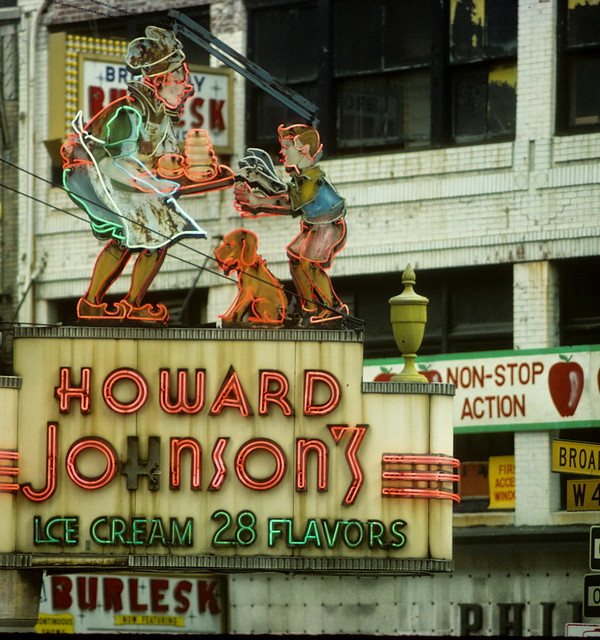
Saw me mudda last weekend in Vermont. She came over to the in-law’s and brought two apple pies. Dag, were they ever good.




Saw me mudda last weekend in Vermont. She came over to the in-law’s and brought two apple pies. Dag, were they ever good.

Top 10, 20, or Top 100 lists are superficial and dopey. In the right hands, however, they can also be a ton of fun. Especially when the author embraces the silliness of it all, like Bill James does over at Grantland in his list of the 100 best pitchers’ duels of 2011 (“My list of the 100 best pitchers’ duels of 2011 is better than your list, for one reason and one reason only. You don’t have any list.”).
Dig in.

Here’s a selection of some of Jack’s Greatest Hits, the temper-temper blowups. They are obvious, and perhaps uninspired, highlight reel selections, yet still damned entertaining.
Easy Rider:
Five Easy Pieces:
Carnal Knowledge:
The Last Detail:
Chinatown:
Here’s the ballgame scene in Cuckoo’s Nest.
The Shining:
Terms of Endearment:

Coming close to the dead of winter. Not much doing for the Yanks as they wait to finalize the Pineda-Montero trade. Here’s a throwaway piece by Alvaro Morales at ESPN featuring Alex Rodriguez. Over at River Ave Blues, Ben Kabak makes a brief (and flimsy) case for Johnny Damon. And at It’s About the Money, Stupid, Chip Buck has an informative Q&A with Jim Callis of Baseball America.
Otherwise, it’s cool and quiet round here. Snow coming tonight.


Check out this fun gallery of sports posters from the 1980s over at SI.com.

Kenny Easley was my man.


“My Daddy’s Gun,” Print by Emory Douglas

Jack Nicholson is stuck in Cuckoo’s Nest/Shinning mode for most of Bob Rafelson’s turgid 1981 remake of The Postman Always Rings Twice. His character, an ex-con in his mid-forties, was 24 in James M. Cain’s novel. Here, he feels underdeveloped and it’s hard to tell if the guy is sinister, a sap, or a heel. It is as if the actor and director never got a handle on who they wanted the character to be.

What’s compelling about Nicholson’s performance is that he doesn’t chew the scenery. He may fall back on his familiar screen persona but he’s restrained, too. Best of all, he’s generous and lets Jessica Lange dominate the movie.

The sexual charge between Nicholson and Lange is undeniable.

She is tough and it is refreshing to see a woman play a femme fatal and not look like a waif. Early on, she shoots Nicholson a look while she pours wine for her husband that’s enough to stop any man–or woman–dead in their tracks.

You can see why she’d drive a person to do crazy things. The pulp is drained out of this version (written by David Mamet, shot by Sven Nykvist)–it’s not nearly as appealing as the John Garfield original–but the electricity generated by Lange keeps you watching, and her sex scenes with Nicholson are savage and hard to forget.
For more, check out this article by Patrick McGilligan in American Film: The Postman Rings Again
Mid-’90s Gem.

There was a cool photo gallery of Steven Siegel’s photography yesterday at The Gothamist.

Picture by Carole Bremaud

There is a long piece by David Kamp on the late Lucian Freud over at Vanity Fair:
Freud’s was not one of those postscript deaths, the final headline in a life that had long ago ceased to matter or progress. It was an interruption—the ultimate inconvenience for a man who still had plenty of work to do and plenty of people who wanted to see his work. The restaurateur Jeremy King, who was more than a hundred sittings into an uncompleted etching when Freud died—having already sat for a painting completed in 2007—recalls that the artist “never came to terms with the fact that he was slowing down. He constantly said, ‘What’s wrong with me?’ And I’d say, ‘Well, Lucian, you’re actually much more active than any other 68-year-old I know, let alone 88.’ And the moment he lifted his hands, most of his ailments seemed to melt away. The concentration and the adrenaline pushed him through.”
From his mid-60s onward, the pinochle years for most men his age, Freud had been enjoying a fruitful and vigorous late period. This wasn’t a function of critical recognition, though it happened to be in this period that critical favor finally smiled upon him, with Time’s Robert Hughes judging him “the best realist painter alive,” a sobriquet that stuck. Nor was it a matter of commercial success, though it was in 2008 that Freud’s Benefits Supervisor Sleeping (1995) fetched the highest-ever auction price for a painting by a living artist, selling at Christie’s to the Russian petrogarch Roman Abramovich for $33.6 million.
Freud simply did great work as an old man, some of his greatest. “In a sense, I think he knew this was his last big push at making some remarkable works. I could just see that he was really ambitious, pushing as hard as he could,” says the naked man in that final painting, David Dawson, the artist’s longtime assistant and the owner of Eli, the whippet star of several late paintings. (Freud had bestowed the dog upon Dawson as a Christmas present in 2000.) When Dawson started working for Freud, 20 years ago, the artist was in the middle of a series of nudes of the drag performer and demimonde fixture Leigh Bowery. Bowery was a huge man, lengthwise and girthwise, with a bald, oblong head—a lot to work with in terms of topography, physiognomy, and epidermal hectarage. Yet Freud went bigger still, painting Bowery larger than life-size. Freud had his canvases extended northward, eastward, and westward as it suited him; often, he would work the upper reaches of a painting from atop a set of portable steps.
Worth checking out.

Saveur gives us a recipe for Mugua Ji (sweet and sour chicken stir fry).

Who will DH? Joe Pawlikowski, Howard Megdal and Craig Calcaterra have some thoughts.

[Photo Credit: Egor Shapovalov via Gas Station]

Over at Baseball: Past and Present, Graham Womack interviews Robert Creamer:
Who’s the greatest baseball player you covered?
Creamer: Willie Mays. Period.
I seem to remember that Bill James, using his fabulous, desiccated statistics, demonstrated that Mickey Mantle, who was Willie’s almost exact contemporary, was actually the better player, and I’m not equipped to argue with Bill, although I’ll try. And there are DiMaggio, Williams, Musial, Barry Bonds, Albert Pujols, Alex Rodriguez – no, wait. I didn’t cover DiMaggio, who retired after the 1951 season — I didn’t start with Sports Illustrated until 1954. But that’s still a pretty impressive collection of players to put Willie on top of.
I saw Mays play a lot. My father and I were in the moderate crowd at the Polo Grounds in May 1951 when Willie played his first game for the Giants. My father was only a mild baseball fan, although he told me his favorite ballplayer when he was a kid in New York back at the beginning of the 20th century was a bearded outfielder for the Giants named George Van Haltren, which indicates a certain degree of baseball intensity. In any case he and I drove down from Tuckahoe to the Polo Grounds, bought tickets (which you could do then) and sat in the lower stands between home and first base. Willie had broken in a few days earlier in Philadelphia where he went 0 for 12 in three games. He was batting third which if it seems a high spot for a brand-new rookie seemed a proper spot to take a look at a rookie who had been batting something like .477 in the minors.
The top of the first took some of the fun out of the game right away. Warren Spahn was pitching for the Boston Braves and in the top of the first Bob Elliott hit a three-run homer for Boston, which took a lot of the starch out of the Giant fans. If Spahn was on, and had a three-run lead already, we didn’t have a prayer. Spahn set the first two Giants down in order and here came Willie, our fabulous new rookie. I forget what the count went to — a ball and a strike, something like that. Spahn threw the next pitch and Willie hit it on a line high and deep to left center field. I cannot recall if it hit the wooden façade high in left field or went over the roof and out of the park. All I remember is the electric excitement that shot through the park at the sound and sight of our precious rookie in his first at-bat in New York hitting a tremendous home run off the great Spahn. “He’s real!” was the feeling. “He’s real!”

[Photo Credit: When in doubt, laugh]

Hey yo, remember that New Year’s Resolution? I say, to hell with it. Serious Eats brings the ruckus.