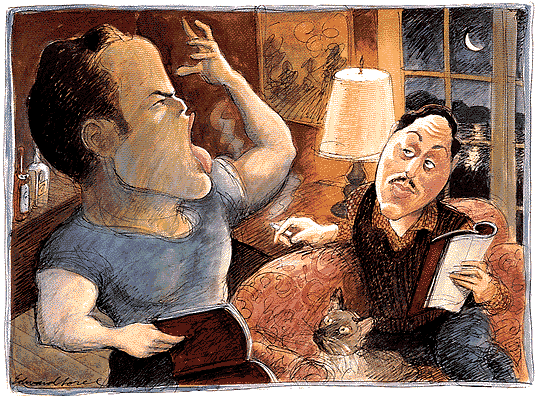
He adored New York City. He idolised it all out of proportion.
Great shot of Yankee Stadium in this sequence.



He adored New York City. He idolised it all out of proportion.
Great shot of Yankee Stadium in this sequence.

There is a good, long article by Meghan Cox Gurdon in the Wall Street Journal on Tintin:
There are really no humdrum pages in the adventures, which is a reminder of their origin as weekly comic strips. To keep the attention of young readers, Hergé crammed his stories with conflict and sight gags, with explosions and pratfalls and jets and cars and rampaging animals. This energetic pacing, sustained over 60-odd pages in book form, manages to make the experience of reading Tintin both prolonged and quick. It also speaks to the narrative taste of young readers, who love action and do not require the emotional psychodrama or character development adults so enjoy.
There are other reasons that Tintin has resonated with so many readers for so long. Through his international exploits—in pre-revolutionary Shanghai, the jungles of Peru, a faux Eastern European police state, even the surface of the moon 20 years before Neil Armstrong got there—Tintin shows young readers that the world in all its complexity is theirs to bestride.
The resonance with children can’t be exaggerated. When you are young and your hero crash-lands in the Sahara or treks through the snows of Tibet, you do, too. The Himalayas and North Africa then become, in an elusive yet significant way, “yours,” part of your personal geography. When your hero outwits assassins, solves riddles and escapes execution by firing squad, you do, too. And when your hero, in pursuit of a baddie after dark, steps on a rake and knocks himself out (with comical stars circling his head to show it) or finds himself duped into drinking an intoxicating aperitif, you too experience his concussion and befuddlement.
My grandfather loved Tintin and read the books to my mother when she was a kid. My mother read them to us, and I read them with my grandfather, and also my aunts and uncles in Belgium. And now, my mother reads it with my niece and nephew.
The Tintin adventures originally appeared in magazine form, but were later compiled in hardcover editions. I loved those books, they were sturdy, and felt more important than the flimsy-looking American comics that were printed on cheap paper. These books were made to last, the colors were bright, and of course, Herge’s compositions were formal, meticulous, and strong.
For more on Herge, click here.
Early Talking Heads:
;
Later On:

Meanwhile, uptown, the Dominican boys don’t mess around. Last weekend, there they were, still playing baseball.


The Giants play the Eagles tonight. In honor of this old rivalry, check out our pal John Schulian’s classic portrait of Chuck Bednarik:
He really was the last of a breed. For 58 1/2 minutes in the NFL’s 1960 championship game, he held his ground in the middle of Philly’s Franklin Field, a force of nature determined to postpone the christening of the Green Bay Packers’ dynasty. “I didn’t run down on kickoffs, that’s all,” Bednarik says. The rest of that frosty Dec. 26, on both offense and defense, he played with the passion that crested when he wrestled Packer fullback Jim Taylor to the ground one last time and held him there until the final gun punctuated the Eagles’ 17-13 victory.
Philadelphia hasn’t ruled pro football in the 33 years since then, and pro football hasn’t produced a player with the combination of talent, hunger and opportunity to duplicate what Bednarik did. It is a far different game now, of course, its complexities seeming to increase exponentially every year, but the athletes playing it are so much bigger and faster than Bednarik and his contemporaries that surely someone with the ability to go both ways must dwell among them.
Two-sport athletes are something else again, physical marvels driven by boundless egos. Yet neither Bo Jackson nor Deion Sanders, for all their storied shuttling between football and baseball, ever played what Bednarik calls “the whole schmear.” And don’t try to make a case for Sanders by bringing up the turn he took at wide receiver last season. Bednarik has heard that kind of noise before.
“This writer in St. Louis calls me a few years back and starts talking about some guy out there, some wide receiver,” he says, making no attempt to hide his disdain for both the position and the player. “Yeah, Roy Green, that was his name. This writer’s talking about how the guy would catch passes and then go in on the Cardinals’ umbrella defense, and I tell him, ‘Don’t give me that b.s. You’ve got to play every down.’ “
“Concrete Charlie,” is also featured in Schulian’s recent collection: Sometimes They Even Shook Your Hand.

[Photo Credit: Alexander Burch]

Not long ago I was thinking about the first crush I had on a TV or movie star. Linda Carter, Bo Derek, and Catherine Bach all came to mind. Valerie Bertinelli, Ann Jillian, and Deborah Harry, too. Then it hit me: It was Julie Newmar as Catwoman. I used to watch Batman in syndication during the afternoon. Must have been four or five years old. Catwoman was always messing with Batman’s head, dressed in that tight outfit, getting all close to him and whispering in his ear, ready to pounce. Yup, Julie Newmar was dangerous, the first sex symbol I fell in lust with.
I’m forever messing up pears. I just can’t get a handle on them. So many different varieties and consistencies. I like them raw and I liked them cooked but it’s going to be awhile before I figure out how to cook them properly. Hell, I can’t seem to buy the right ones to eat just like that.

That said, this looks tasty. I like the idea of the vanilla.
Long live Smitten Kitchen.

Drawing by Egon Schiele
And…

“Study for Lewdness from the Beethoven Frieze,” By Gustav Klimt (1898)

The local was running behind schedule this morning so the conductor announced that after 72nd Street the 1 train was going express to Times Square, bypassing my stop in the process. I got off at 72nd and took one step to the side of the door onto the platform. My left foot was maybe six inches away from the ledge and I had to look away as the train pulled out of the station so I wouldn’t get dizzy. Then, as we waited for the next train to approach, I looked back at the faces huddled behind me and then shifted my weight on my back leg, away from the tracks. I was less than a foot away from disaster but not sensible enough to lose my spot.
[Photo Credit: Rob Brulinski]

After next season the Houston Astros will play in the American League West. Two extra teams will be added to the playoffs in 2013, as well.

Sunday and Monday on American Masters:
Watch Woody Allen: A Documentary on PBS. See more from AMERICAN MASTERS.

Richard Hoffer is one of the best writers to ever cover sports in this country, first at the L.A. Times and then at Sports Illustrated. His prose is graceful and precise, he’s understated and funny.
Here is he on Joe Frazier and Muhammad Ali in the current issue of SI:
It was no wonder Joe Frazier was so bitter. He was made to seem the foil, a mere accomplice in mythology, consigned to a supporting role in Muhammad Ali’s extravagant, ego-driven drama. It is a harsh truth that if you participate in the most exciting rivalry of a century, it does you little good even to win one of its three bouts. The verdict of history is decisive, and it is permanent, and men like Frazier, who stumble at the precipice, are forever remaindered on the heap of losers, their vinegary claims to justice lost in the courts of public opinion. It was no wonder, then, that when Ali lit the Olympic torch in 1996, his trembling hands viewed as a physical artifact of heroism by an adoring world, Frazier allowed that if he’d had his way, he’d have pitched Ali into the fire.
…In 1975—Ali now 33, Frazier 31—they met again in the near-death experience that would ever after be known as the Thrilla in Manila. Ali was even crueler in his prefight taunts, exploiting the fact that gorilla rhymed with the venue. Frazier, by turns mystified and hurt, was provoked beyond the requirements of the bout. While Ali would always say he was only boosting the box office, Frazier could never accept any explanation for attacks that might affect his children’s impression of him. “Look at my beautiful kids,” he’d say. “How can I be a gorilla?”
But not even animus could account for what happened that morning in the Philippines. It was such a violent affair—recklessness tilting it first Ali’s way, then Frazier’s way and then Ali’s again—that it seemed less a boxing match than an exploration of man’s capacities, a test of his will to win or at least survive. But once it turned Ali’s way again in the 12th round, too much had gone before for yet another reversal. There wasn’t anything left in either man. Before the 15th and final round Frazier’s trainer, Eddie Futch, called it quits, saving his fighter from certain ruin, even as Ali was instructing his corner to cut his gloves off. It was victory, but by attrition.
Ali called it “the closest thing to dying I know of,” and he didn’t know the half of it. Their careers were essentially over that day, their 41 rounds of shared agony making any further discoveries in the ring unnecessary, or even possible. Frazier lost a rematch to Foreman and called it quits. Ali managed to dominate the game for several years more, but only on the basis of his personality—he was spent. Even then he was beginning a slow and ironic decline, Parkinson’s eventually rendering him rigid and mute, the final price for all those wars.
Ali’s respect for Frazier was enormous, and he apologized for his name-calling on several occasions. “I couldn’t have done what I did without him,” he once said.
Frazier repaid the compliment: “We were gladiators. I didn’t ask no favors of him, and he didn’t ask none of me.” They recognized that their destinies were entwined, that neither would have achieved his greatness without the other. But Ali could afford to concede the point, being the most popular athlete, even personality, in the world. Frazier, who spent the rest of his life living above his gym in Philadelphia, did not have the comfort of the world’s goodwill—he lived in an age that would reward style over substance every time—and so maintained his half of the blood feud as vigorously as possible, even seeming to take a grim satisfaction in Ali’s poor health, proof of who really won that day in Manila.
That a feel-good reconciliation would elude the two men who shaped such a magnificent rivalry is apt. Even if they were more like brothers than foes—who else could understand the kind of pride that forced them through those three battles?—fighters like them could never really enjoy a cease-fire, could never drop their hands, as if they alone knew what man was truly capable of.

Some baseball stuff.
Over at Fox Sports, Ken Rosenthal weighs in on the search for a new manager in Boston.
Meanwhile: a look at the Mets’ new uniforms; Eric Chavez wants to play next year; Ben Kabak on Yu Darvish; Steven Goldman on Ivan Nova, and William J on Joe Girardi’s lack of support for Manager of the Year.
[Photo Credit: Oyl in Tokyo]
[Photo Credit: N.Y. Times]