
Today’s Alex Rodriguez mishegoss is brought to you by Jonathan Mahler, Buck Showalter, and what the hell, Jeff Pearlman.



Today’s Alex Rodriguez mishegoss is brought to you by Jonathan Mahler, Buck Showalter, and what the hell, Jeff Pearlman.

From the July-August 1991 issue of Film Comment, here’s a portion of Gavin Smith’s interview with Danny Aiello. They talk Spike, Woody and Fort Apache, the Bronx.
Danny Aiello: Me and Spike—we’re an unlikely duo, you know: liberal, conservative, midget. We’re great friends. I think Spike wanted me because he knew of my political beliefs…
Q: What was your basic idea for Sal? Something to do with him being a father to the people in the neighborhood?
DA: Yeah. I wrote that stuff. When I first saw the script, I said to Spike, “Why is this guy in the fuckin’ neighborhood? Why is he there? I mean, this is stupid. If you want to, you could go to Vietnam and make money too.”I had to resolve in my own mind, he was there because he wanted to be there. Because he liked the people there. Because he can’t be there to make money—in an area where you cannot get insurance, okay? I told Spike, we needed something in the picture saying that you can’t get insurance. Spike didn’t want to put that in. So at the end of the picture I also wrote the last monologue where I look at [Mookie] and he says, “What are you worried about? You’re going to get the fuckin’ money back from insurance.” And that’s not true. You don’t get insurance there. The premiums are just too high.
So I came back, and I said, “This ain’t about money. This is about, I built this fuckin’ place with my bare hands—every fuckin’ screw . . .”—this is what I wrote. I wanted to say “I don’t get insurance,” but I had to say something else.
Five minutes before we shot the scene between me and [John] Turturro, I wrote it. And he agreed with it. “Where am I going? I’ve been here for 25 years. You see these people, you see the kids? These people grew up on my pizza—yeah, you laugh, but I’m proud of that.” Now, I said this is too fuckin’ corny, no one’s going to believe it. But they did and it made him a full-bodied, complex fuckin’ character.
Q: Do you feel more drawn towards trying to find the vulnerability in the characters that you play now? You’ve played a lot of strong, violent guys.

DA: I have that in my life, it’s prevalent. I think it shows. But in the violent guys I play, always I’ve let an ounce of vulnerability come through. It may be very subliminal. I’ve often had black people come over to me and say, “Man, Fort Apache, The Bronx, yeah!” Now, remember what I did in that picture.
Q: You threw a black kid off a roof.
DA: I was an evil fuckin’ guy. But for some reason people loved the character. Now, I’m a little pissed off about that, because two big scenes were cut out of the movie showing that he was a sick guy. A scene with me and Paul Newman, where we almost had a fight early on, I throw a punch at him, I’m drunk, I miss him, I fall down the floor, and he goes to pick me up. I say, “Get your fuckin’ hands off me.” He says, “Come on, I’ll take you to the car.” He said, “You’re gonna crack up the car.” I said, “Who gives a fuck? Nobody gives a fuck.” And I walk out staggering.
Then the scene in which we see where he lived, in a dump all by himself, he lost his family, he had no children. The guy was suicidal. Instead, they knocked out these scenes, and what did you see? Me arbitrarily go up to the roof and throw a kid off. Never showed the sickness beforehand.
Directors, they look at the composite, and they’re not concerned with the explanation of the individual character. The actor goes from A to Z, only to have the middle of the alphabet cut out. I mean, that’s a terrible fuckin’ thing to go through.
Q: What’s it like working with Woody Allen? Youve done it three times, a play and two movies.

DA: Woody’s great. I love Woody. My big disappointment with Woody is that he didn’t give meBroadway Danny Rose. I was supposed to be the singer, the guy he represented. [Woody] said, “You’re my ace in the hole, Danny. If no one gets it, you got it.”My heart was broke when I didn’t get it. He screen tested every conceivable singer, and I was told everyone wanted me to do it—Bobby Greenhut, Gordon Willis. But you don’t tell Woody anything. He chose this guy [Nick Apollo Forte], and Woody later told me that he chose him because he was the guy. The guy was never an actor—he came with his own material, he had an album of Italian songs. And the guy was terrific. Everybody thinks I played that character.
Q: What do you notice about Allen as a director?
DA: I think when he casts you, he’s directed you. He knows who he’s got. And his directing is very minimal. He is an intellectual, but he speaks in the smallest, most understood verbal tones: Be a little less angry, be a little more angry; be a little less happy, be a little more happy; take the edge off the anger.
Q: And you’re fine with that.
DA: Yeah, I’m fine with that. I don’t think I did my best work with Woody. I think if there’s self-intimidation, with me it probably happened with Woody more than anyone else.

Q: What do you mean?
DA: I expected so much of myself working with Woody, I never felt totally free. I put too much on myself. If you were to ask Woody, Woody used to look at me and say, “When you shoot a 70 it’s a hundred for most people.” But I never understood that. I always wanted to give Woody more. And whenever I left the set there with Woody, I always thought, I have a lot more to give that I didn’t give.
Q: How about with Spike Lee? I’ve heard that actors have a lot of trouble communicating with him. Somebody who worked with him said he heard that the only actor who wasn’t intimidated by Lee was you.

DA: I must tell you no man has ever been more open to me than Spike. Totally free. Spike is a technical director, I think, more than a head-to-head director. Spike lets you go.
One disagreement Spike and I had, and it took place in front of a lot of people, with about three-quarters of the movie complete: the scene in which I break the radio. They wanted Radio Raheem to grab me by the neck and slide me down the counter with bottles bouncing off my head, and how did I know this was going to happen? They had a storyboard in front of me. And when I saw it, I grabbed it and I said, “Come here. I won’t do that.” He said, “What do you mean?” I said, “I don’t do that shit.” He said, “What are you talking about, Danny?” I said, “My fuckin’ character has integrity. You’re going to do a scene that’s been done a million times in cowboy pictures with someone being dragged down the bar with bottles. That’s wrong, it don’t work, it’s comedy time in the Rockies at a time that we don’t need comedy. This is a devastating moment in the picture. I won’t do that.”
The A.D., a great fuckin’ guy, saw what was happening and got everyone out of there and just left me and Spike there. So I said, “Spike, before I do that, I’ll walk off this picture. That’s how I feel about how you’re making a fool out of the character by doing that. I just won’t let it happen. First of all, if that was in the script at the beginning, that would have been a deal-breaker. I would have said, “I don’t do that.” So we talked and we talked, and then it turned out to be exactly what I wanted it to be, and ultimately what Spike wanted it to be. Drag me over the counter onto the floor—which was my son Danny, he’s the stunt man who did that. It worked better. It kept the tenseness of the moment.
Q: Was the action of smashing the ghetto blaster hard to justify?
DA: Yeah, the work happened to justify the act—I’ve always wanted to smash one. Very few people that I know in the city of New York have not at some time or other wanted to smash one of those fuckin’ things. So it didn’t take too much to raise my dander.
But right in the scene itself I had all that I needed. First of all, there were words used that were not scripted. Giancarlo Esposito called me a guinea bastard. When he called me that, I looked at him, I said, “What did you say, you nigger motherfucker?” That wasn’t scripted either. What we did was we got into street shit. I called him a black motherfucker; he said, “You guinea fuck.” And all of that was real. I’m saying real. We were shouting at the top of our lungs—and we didn’t shout in control. On the stage, if you shout, you’re totally in control. We were shouting out of control. I was losing my voice at times, which to me was great. That’s what I wanted to do. I wanted to let it go.

Spike was in the corner jerkin’ off, he knew that I’m an actor and I wouldn’t back up. He knew when he hired me that I could be in Bed Stuy and it ain’t gonna make a bit of fuckin’ difference, if someone calls me a guinea I’m gonna call him a nigger. That’s how I am. And he knew this. He’s smart. Well, what happened is, we’re in Bed Stuy—it’s an Uzi neighborhood, it’s fuckin’ drugs all over the street. This is bad. All the bodegas have bars. Patrons are not allowed in. That’s why you can’t get insurance there. Anyway, there’s about 400 people rimming the area while I’m yelling “You black mother”—they’re all outside. “You nigger cocksucker”—and they’re going, “Yeaahhh!” They’re screaming. Because the thing about these people is, individually or collectively, they admire strength. They admire fuckin’ balls. And they know that you’re the outnumbered one, and for you to rise above that fear, they admire that. This is who they are. They say, “Holy shit, this is the fuckin’ movies.” There was a lot of reaction. But right after the scene, we all hugged.
Q: They probably loved you for telling the truth.
DA: That’s right. If I became white bread and began to use softer words, it don’t mean shit. If I just said “black bastard” what would that have been? When I said “you nigger motherfucker” I was reducing myself to the language of those street people, which is what they do. It’s right for [Sal] to use that language. I thought he was a fair man. Even if he was unfair, he was unfair to everybody. He was unfair to his sons, and he treated Mookie probably better than he treated his own sons.

And another thing—about the pictures on the wall: I believe that as Danny Aiello. You don’t tell me who the fuck to put on my wall. That’s my house. To put the blacks on the wall would have made the character a bullshit character, it wouldn’t have made the character complex, it would have made him a placating phony fuckin’ ginzo. As a black person going there and seeing this man with his heroes, I would sit there and say, “This fucking guy is an honest man.” It was about a sense of freedom to put up in your place who you want.

Kuroda and Kershaw were both terrific last night. Kuroda gave up 5 hits, a walk and struck out 8 in 7 innings; Kershaw gave up 5 hits, didn’t walk anyone and struck out 5 over 8 innings. And so the game was tied in the 9th when Lyle Overbay got a pinch-hit single and then Mark Ellis and Yasiel Puig screwed the pooch on a fly ball allowing 2 more runs to score.
That was more than enough for Mo who got a couple of strikeouts and a ground ball as the Yanks said goodbye to Hollywood.
Final Score: Yanks 3, Dodgers 0.
Chad Jennings, as always, has the notes.
[Photo Credit: Dimelo]

Sure, our boy Hiroki’s going tonight. Trouble is so is Clayton Kershaw.
Brett Gardner CF
Derek Jeter SS
Robinson Cano 2B
Alfonso Soriano LF
Vernon Wells RF
Brent Lillibridge 1B
Jayson Nix 3B
Chris Stewart C
Hiroki Kuroda RHP
Never mind the odds:
Let’s Go Yank-ees!
[Photo Via: Gruesome Twosome]

The trade deadline approaches.

Alex Rodriguez is the subject of Scott Price’s SI cover story this week:
Rodriguez, once seen as baseabll’s great clean hope, is now viewed as hopelessly dirty.
Others have come back from such stigma: Mark McGwire is the hitting coach for the Dodgers; Jason Giambi and Andy Pettitte, old teammates and admitted users of PEDS, are treated these days as elder statesmen. Rodriguez figures to be different–and knows it–but last week maintained the front of a blissed-out Candide. He insissted that he doesn’t wonder, Why me?
“I never say that,” Rodriguez said. “But maybe there are a couple of chapters where I can become that person again. I’m not giving up. I have tremendous faith, and hopefully there’s a couple more chapters to this book. And hopefully there’s a happy ending somewhere. I have faith.
And:
Asked, last week, if he understood Cashman’s famously profane rip, Rodriguez shot back, “Do you understand it?”
Yes. Because Cashman knows; Rodriguez’s gift, his unprecedented completeness, was never really his; it’s called a gift for reason. Sports is a collective of time as well as talent. Six generations of baseball players and fans, billions of dollars worth of stadia and TV time, an infinity of minor and major leageurs working for untold lifetimes–all of it combined to create the game, the numbers, the interest and the hothouse environment in which Alex Rodriguez was going to be the best.
People care so much about sports greatness because, deep down, they know that it’s a reflection; something there belongs to them. We gave Rodriguez his chance. We urged him not to waste it. Cashman knows, better than anyone: We hate when we make so big a mistake.
Here’s more from Price at SI.com.

If you stayed up late you saw more of the same from the Yanks: good pitching, no hitting. In fact, you didn’t have to stay up too late. The game was played in less than 3 hours and the Dodgers won 3-2 when Mark Ellis singled with 2 men out in the 9th against Shawn Kelly.
Five hits in all for the Yanks, who resemble the old Dodger teams in that they can pitch they just don’t score much.
[Photo Credit: Richard Mackson, USA TODAY Sports]

Brett Gardner CF
Derek Jeter SS
Robinson Cano 2B
Alfonso Soriano LF
Lyle Overbay 1B
Ichiro Suzuki RF
Jayson Nix 3B
Chris Stewart C
Andy Pettitte LHP
It’s Andy in L.A.
Never mind Alex Rodriguez vs. The World:
Let’s Go Yank-ees!
[Photo Via: It’s a Long Season]

More Mo–this one from Ben Bolch in the L.A. Times:
Dodgers outfielder Carl Crawford uses just any old bat when he faces Mariano Rivera. The more rickety and age-worn, the better.
He knows there’s a good chance his bat — and his at-bat — will be doomed by what many consider the most devastating pitch in baseball.
Rivera’s cut fastball, or cutter, is often the only pitch hitters see when facing the New York Yankees closer. It’s a pitch that he throws almost exclusively, its late movement as it approaches the plate shattering bats and hitters’ hearts alike.
Why waste good wood on that?
“I don’t use the same bat that I’ve been playing good with because chances are real high” it’s going to get broken, Crawford said with a chuckle. “So I just take an old, cheap bat that I don’t really care about and try to stay as short as possible” with the swing.

Jeremy Markovich delivers a powerful story on the death of Dick Trickle at SB Nation Longform. Beautifully written and the graphic people at SB Nation created an impressive layout too. Worth your time:
Sometime after 10:30 on a Thursday morning in May, after he’d had his cup of coffee, Dick Trickle snuck out of the house. His wife didn’t see him go. He eased his 20-year-old Ford pickup out on the road and headed toward Boger City, N.C., 10 minutes away. He drove down Highway 150, a two-lane road that cuts through farm fields and stands of trees and humble country homes that dot the Piedmont west of Charlotte, just outside the reach of its suburban sprawl. Trickle pulled into a graveyard across the street from a Citgo station. He drove around to the back. It was sunny. The wind blew gently from the west. Just after noon, he dialed 911. The dispatcher asked for his address.
“Uh, the Forest Lawn, uh, Cemetery on 150,” he said, his voice calm. The dispatcher asked for his name. He didn’t give it.
“On the backside of it, on the back by a ‘93 pickup, there’s gonna be a dead body,” he said.
“OK,” the woman said, deadpan.
“Suicide,” he said. “Suicide.”
“Are you there?”
“I’m the one.”
“OK, listen to me, sir, listen to me.”
“Yes, it’ll be 150, Forest Lawn Cemetery, in the back by a Ford pickup.”
“OK, sir, sir, let me get some help to you.”
Click.

From Will Harris’ Q&A with Elliot Gould over at the A.V. Club:
The Long Goodbye (1973)—“Philip Marlowe”
EG: As I was growing up, I would go to see film-noir films, the detective stories, and I thought Humphrey Bogart was the greatest. David Picker, who was running United Artists at the time, gave me Leigh Brackett’s script adapting Raymond Chandler’s The Long Goodbye and asked me to read it, so I read it. I was looking for a job at the time and… let’s say that finding a job wasn’t easy at that time, though I don’t know if it’s ever easy. There was another director who was going to be doing it, but he couldn’t see me in it. Then David Picker gave the material to Robert Altman, and Altman called me from Ireland, where he was finishing Images with Susannah York. Bob said to me, “What do you think?” I said, “I’ve always wanted to play that guy,” meaning Philip Marlowe. And Robert Altman said to me, “You are that guy.” So that was the beginning of that.
AVC: There’s been talk for some time of you teaming with Alan Rudolph to produce a sequel to The Long Goodbye.
EG: Yeah, I started to work on a sequel. I think I’ve basically read or narrated the books on tape of all of Raymond Chandler’s work, and I discovered “The Curtain,” which was written before there was a Philip Marlowe. The Chandler estate worked with me when I was more involved in it, although I’ll never give up on it. For as long as I can, I’ll try to work on getting a sequel to The Long Goodbye. I had a treatment developed and gave it to Bob Altman, and we started to talk about it, but then Bob passed away. But Alan Rudolph was the second assistant on The Long Goodbye, and Alan wrote quite an excellent first draft. But I haven’t been able to finance it.
The estate had given me permission at the time—this was just a few years ago—to change the name of the character, because the private eye was called Ted Carmady. It was written by Chandler before he wrote The Big Sleep, but you could see where The Big Sleep came from. In the story, there’s a 10-year-old son of the character that Bacall played in The Big Sleep, and the son is the killer. That’s what attracted me to it. It would take place now, and the character of Philip Marlowe is now a much older man, like me, but he still has the same values. It’s something that could conceivably work if it’s free to express itself the way I feel it and see it, but whether it’ll ever happen remains to be seen. But I’m just eternally grateful for Robert Altman and David Picker giving me the opportunity to participate in The Long Goodbye and play Philip Marlowe.

The clock is ticking on Alex Rodriguez and his showdown vs Major League Baseball. Here’s the latest from the Daily News, the Associated Press and ESPN.

Sometimes being from the Old School doesn’t work. Rough day for the former Yank, Tino Martinez.
Sm
The Yankees honored Hideki Matsui before the game today and then Derek Jeter made like Derek Jeter and hit the first pitch he saw from Matt Moore over the wall in right field for a home run.

It was the first time a Yankee had homered since the All-Star break, the first time a right-handed Yankee batter homered since Christ was a cowboy.
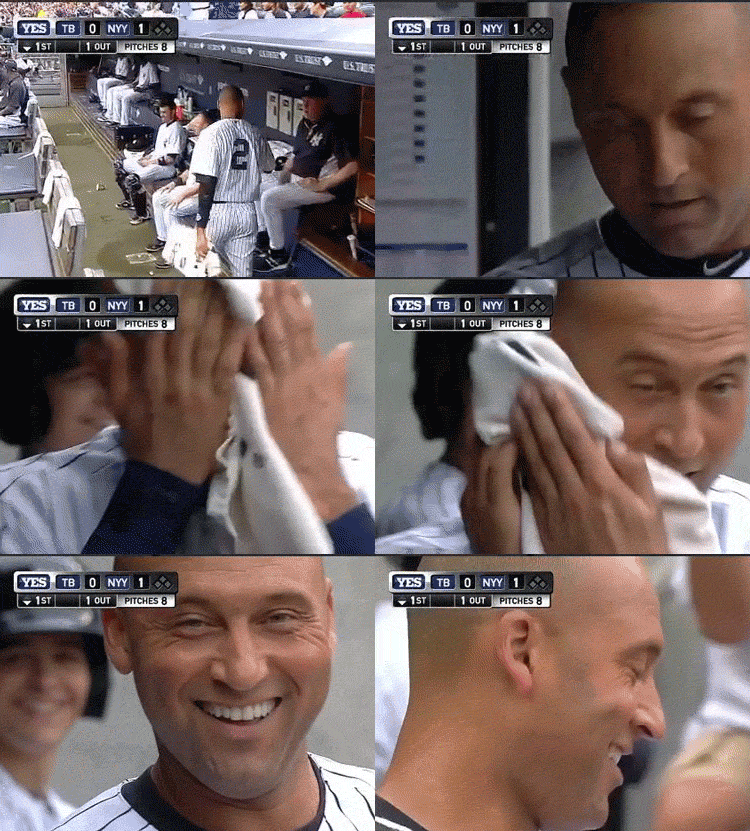
By the end of the first the Yanks had a 3-0 lead. But then Phil Hughes made like Phil Hughes and he gave it away. Not once, but twice, both on impressive home runs by Wil Myers. The first, a 3-run job, came off a hanging slider that Myers hit it deep into the left field seats. Second one came off a fastball that Myers punched well over the wall in right.
Not to be outdone, Alfonso Soriano hit a 2-run homer–of the cheap-o right field seats variety. He got 4 of the Yankees’ 12 hits (Jeter had 2) including the game-winner in the 9th, a clean single up the middle. He didn’t whack any of them except his homer but hey, 4 hits be 4 hits, right?
So Jeter returns and is a stud, Soriano has a big day, our man Hideki is celebrated. A nifty win on a cool day in the Bronx. Should be mentioned that the Yanks don’t win this game without the stellar work by the bullpen. Preston Claiborne got six straight outs and then Boone Logan, David Robertson and Mariano Rivera each pitched a scoreless frame.
Final Score: Yanks 6, Rays 5.

Thanks, Yanks.
[Photo Credit: Brad Penner; Kathy Willens]