"A New York Treasure" --Village Voice
Category: 1: Featured

June 22, 1941: Game 35

It took a while, but in the sixth inning DiMaggio stepped up to the plate and killed two birds with one stone as he sent a home run to right, bringing his personal hitting streak to thirty-five games and stretching the Yankee home run streak to a major-league record eighteen games in a row. The homer gave his team a brief lead, but the Yanks would need a two-out ninth-inning rally (which included a DiMaggio double) to earn a 5-4 win.

Color By Numbers: Going Streaking

The Yankees hope to start a new winning streak against the Mets at Citi Field.

The Yankees entered yesterday’s off day in unfamiliar territory: on a losing a streak. It had been almost a full month since the Yankees last lost consecutive games, so you can bet the Bronx Bombers will be chomping at the bit to get back in the win column tonight at CitiField.

Over the first three months of the season, the Yankees have had seven stretches featuring consecutive losses, but none has lasted longer than three games (three have been two games and four have been three games). Even when they weren’t playing particularly well, the Yankees managed to avoid the kind of long losing streak that can put a team deep in the hole. As a result, the Yankees recent hot stretch has allowed them to build a lead instead of chip away at a deficit.

Distribution of Yankees’ Losing Streaks, Since 1918

Note: Includes all streaks of three or more losses.
Source: Baseball-reference.com

The last time the Yankees avoided a losing streak of at least four games was 1980. Probably one of the most overlooked teams in franchise history, Dick Howser’s club won 103 games that year, but all was forgotten when they were swept by the Royals in the ALCS. Ironically, the Yankees had only lost three games in a row on three occasions during the regular season, just once more than the lowest total in franchise history. Unfortunately for Howser, the team’s fourth three-game losing streak came at an inopportune time as it not only denied him a chance to manage in the World Series, but also wound up costing his job.

It’s a good thing the Yankees have avoided losing streaks in June because, over the first two months of the season, they were on pace to rank near the bottom in terms of both the number of losing stretches and games contained therein. Since 1918, 26 different Yankees’ teams have finished the year with four or fewer losing streaks of at least three games, which puts this season’s current total in perspective. Pro-rated over the entire season, the 2012 Yankees would still fall toward the bottom quintile in both catgeories, which illustrates the extent to which the team sputtered in April and May.

Yankees’ Top-10 and Bottom-10 Total Streak Losses, Since 1918

Note: Totals are the sum of losses that are a part of distinct losing streaks of three or more games in one season.
Source: Baseball-reference.com

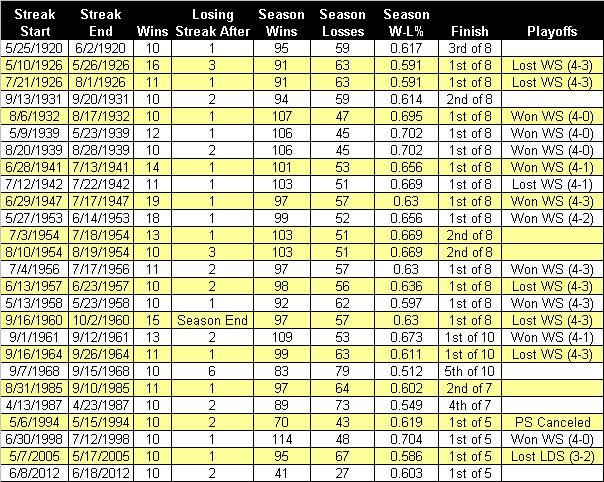
Tomorrow night against the Mets, the Yankees will be seeking to avoid another three-game losing streak. After winning at least 10 in a row for only the 26th time in franchise history, the last thing the Yankees want to do is start ceding some of the ground they gained by following up that stretch with a string of losing. Over the years, the Yankees have done a good job of avoiding a winning streak hangover, so history seems to be in their favor. Not only has the team gone 14-11 after having a long winning streak snapped (one streak came at the end of the season), but on only three occasions did the Bronx Bombers lose three or more games in a row.  Is that a good omen heading into the Subway Series? Perhaps, but having Andy Pettitte on the mound doesn’t hurt either.

Yankees’ Season Record in Years with and Number of Losses Immediately Following a 10-Game Winning Streak, Since 1918

Source: Baseball-reference.com

Another good sign is the amount of success enjoyed by Yankees’ teams that have won at least 10 games in a row during a season. The 23 different Bronx Bomber ballclubs to record such a lengthy stretch of winning (three teams had two 10-plus game winnings streaks in one season) have posted a combined winning percentage of .628, and all but six wound up finishing the year in first place (four of which still won at least 94 games). The only real outlier in the group was the 1968 team, which won 10 in a row in September. Unfortunately, it was too little too late as the winning streak only pulled the Yankees to within 16 games of first place. Besides, even had they been closer in the standings, losing six in a row and nine of 10 immediately thereafter would have been the final nail anyway. At the very least, the 10-game winning streak helped the 1968 club finish above .500, thereby avoiding a share of the franchise record of four consecutive losing seasons.

Even the very best baseball teams lose 30%-40% of their games, but the ones who enjoy the most success seem to spread them out evenly over the season. Although the long stretches are the ones that gain the most notoriety, streaks of three and four games can really take a toll. The 2012 Yankees probably won’t become the fourth team in franchise history to have two 10-game winning streaks in one season, but if they can avoid those smaller losing streaks, another division title could be in the offing.

June 21, 1941: Game 34

DiMaggio came to bat in the first inning and got jammed, but managed to muscle a single over the head of Detroit first baseman Rudy York, extending his streak to thirty-four straight. That total matched George McQuinn’s streak from 1938; all that remained was Ty Cobb’s 1911 streak of forty games and Sisler’s record forty-one. The other streak continued as well, as Phil Rizzuto (Holy Cow!) knocked one out to left. The Yankees had homered for seventeen games in a row, tying the major league record. None of this was enough to earn a win on this first day of summer, however, as the Tigers posted a 7-2 victory.

Always Be Closing

The Heat look to win it all tonight. OCK aims to take the series back home.

I’d love to see the Thunder pull one out here but my money is on the Heat.

In Living Color

LeRoy Neiman died yesterday. He was 91.

“Dying for Art’s Sake,” is an essay Pete Dexter wrote about Neiman for Esquire in July, 1984. It is reprinted here with permission from the author.

LeRoy Neiman has just been murdered in Milwaukee.

The clipping came in the morning mail—he thinks it was from Milwaukee—a review of his new book of paintings and sketches. “I don’t know why people aren’t nice,” he says. I am talking to him on the phone now. “Are you nice? Listen, there have been thousands of pictures taken of me. I’m a reasonably good-looking human being, aren’t I? Why would an editor want to use a picture where I have an hors d’oeuvre sticking out of my cheek? I wouldn’t do that to him. I always make things look their best…”

“That’s Milwaukee for you,” I admit.

“No, that was a newspaper. The guy in Milwaukee was very clever. He quoted every bad thing anybody ever said about me, but didn’t really say anything himself…Hotel room paintings. What’s wrong with paintings in hotel rooms? A lot of my paintings are in hotel rooms, so what? Art is where you find it. Oh, and they criticized my chin. Did I tell you that? They said I had a weak chin.”

“In Milwaukee?”

“No, in the newspaper. If you’re feeling nice, perhaps it would be amusing to visit, but I don’t need criticism. So if you’re not nice…”
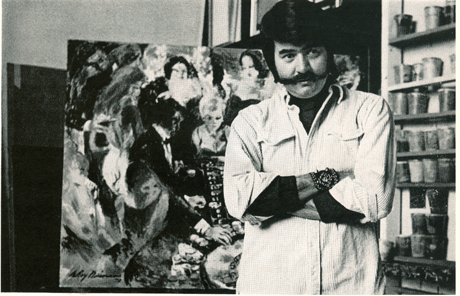
I tell LeRoy I will try to write nice, but I can’t promise. He invites me up to his place in New York anyway. The place in New York is most of the third floor of a large apartment building across the street from Central Park. There is an efficient-looking woman with the purest features I ever saw—one of those noses that looks like somebody took two weeks to get the flare in the nostrils right—who seems to run things for him, jars of paint and brushes all over the place, walls covered with painting and prints and sketches, most of them of athletes. There is a giant oil representation of a Las Vegas crap table learning against the far wall, done almost entirely in red. Floors, background, faces, clothes.

I haven’t done a lot of painting myself, unless you count water towers, but I recognize a work in progress. I figure he does all the blues next, then the yellows or whites. I figure, what he’s got there is a primer coat.

“That’s not finished, is it?” I say.

LeRoy seems pleased I have intuited that.

“No,” he says. “I haven’t decided what to do with it yet.”

“Well,” I say, “I think you’ve about done what you can with the red.”

The phone rings then, and the woman answers it. “LeRoy,” she says, “I’m sorry to interrupt…”

The call is about appearing in a movie. He takes it in the vestibule, but the acoustics in the place are terrific, and I can hear what he says at least as well as whoever is on the other end. Better, probably, because he keeps having to repeat himself for the other end.

“Yes,” he says, “a thousand a day and expenses…”

He wants a thousand dollars a day instead of a straight fee for the job because it might rain wherever the job is, and he doesn’t want to be sitting around somewhere getting wet for nothing.

He comes back into the studio and I compliment his acoustics. “This place is better than Lincoln Center,” I say.

LeRoy looks around the room, probably misunderstanding what I have said. “I’ve got an apartment on the ninth floor too,” he says. “But I never go up there. There’s furniture and a beautiful view, but it depresses me. And I’ve got a house in Great Gorge, New Jersey, but I haven’t been there in four years. I love the place, I just don’t like to be inside it. I have to keep it, though, you’ve got to have a house in the country.”

It is the pictures of the athletes that have made all this possible. They showed up first in Playboy magazine, which started running LeRoy’s stuff back in the Fifties. Then Roone Arledge of ABC Sports put them on television and turned LeRoy’s work into the most recognizable art in this country. Nobody is exactly sure why.

Eventually, of course, LeRoy became as famous as his pictures. He wore his white hats and trained his moustache to grow almost to his ears, and he had fascinating cigars.
I don’t know how he does it, but LeRoy’s cigars are always two minutes old. He carries them in the left side of his mouth, and they are always long and dark with half an inch of cold ash at the end. Then some wiseass editor in Milwaukee runs a picture of him eating hors d’oeuvres.

And you wonder why artists are moody?

II

“I like being outrageous,” he says. “It is the worst possible thing for my income and standing in the art community, but I don’t care. Why should I behave myself now, after all these years?”

I ask LeRoy what kind of misbehaving he means. Does he give sheep for wedding presents? Has he gotten drunk at parties and tired to deliver babies? He shakes his head no.

“I don’t actually do anything,” he says, “except be conspicuous. It keeps me revved up.”

The phone rings again. The woman answers it. “LeRoy,” she says, “I’m sorry to interrupt…” This time it’s some Brazilians, wanting him to come to a party at Regine’s.

“Everybody always wants things from me,” he says after he has hung up.

The Brazilians, it turns out—at least these Brazilians—are economically advantaged people. LeRoy says they wear the best clothes and drink at the best clubs and introduce all the new trends.

“They amuse me,” he says, “but I am not one of them. I am part of their scene—the same three hundred people show up everywhere around the world—but I’m not a member. I never judge them, I am never shocked by their conduct.” He sees I don’t understand. “A lot of them steal,” he says.

That’s the same way it is with LeRoy and athletes. “I don’t get too close to them personally,” he says. And this reminds him of the safari with Hef.

Hef is Hugh Hefner, who owns Playboy. He is one of the three people LeRoy names when I ask who his friends are. The other two are artists he sees once every two or three years.

“It was while we were in Africa,” he says, “that I noticed the natives were always jumping. Any little noise, they’d jump. They watched each other every minute. Hef and I and four other guys and six chicks went around the world to break in the new plane. You know, a pleasure trip. But in Africa, I saw these jumpy natives and realized that danger makes you aware. That’s how I am, too. Aware, observant. Nothing can sneak up from behind. That allows you to be outrageous.”

“You see, you come to a moment sometimes when you know you shouldn’t do something but you take the chance and do it anyway. The moment occurs in sports, it occurs in art. That’s the moment of creation, taking the chance. And sometimes it comes out fine, and sometimes you get murdered.”

I notice, however, that his paintings aren’t about the moment, they depict the population of a best-possible world.

“I like things to their best,” he says. “I like beautiful things, like chandeliers. But I think, for instance, you can say as much about war by painting the enthusiastic young soldiers marching off as you can by showing the dismembered bodies.”

I ask, “Where is the chance in that?”

LeRoy leans closer. “Have you ever heard of Mad Dog Vachon?” he says. “Andre the Giant? They’re wrestlers. Very big people, and very crude. A person I know called and asked if I would come to Ottawa, Canada, and sketch wrestling. They were doing a telecast, and wanted me at ringside to give it credibility.”

“So I flew to Montreal and we took a limousine—you’ve got to insist on a limo and the best room or else they’ll take advantage of you—and we drove about one hundred miles to the arena. I had a chick with me—a magnificent animal—and they put us right at ringside.

“The man who arranged for me to be there had told me that Mad Dog would point at me and call me names as part of the show. After the wrestlers were introduced, Mad Dog pretended to suddenly notice me sitting there, and he yelled, ‘I want that man removed. I want to see what he’s drawing.’

“I turned to the chick and said, ‘He’s really good.’ Then Mad Dog reached through the ropes and grabbed my leather drawing pad. I take it everywhere, and nobody is allowed to do that. I tried to pull it back. I said, ‘All right, that’s enough. These are my sketches,’ but Mad Dog pulled the pad and me with it right out of my seat, and then he crumpled up all my drawings.”

And you wonder why artists are so moody.

LeRoy says, “I yelled at him then that he had gone too far. He picked me up over his head and began whirling me around and around, the crowd went crazy, and then he finally threw me on the floor. That’s how wrestlers take criticism. I picked up my things and told the woman I was with that they had gone too far. We went back to the dressing room to complain, and after a while Mad Dog came in and said, ‘I didn’t do nothin’.’ Unbelievably crude.

“Then we went back to the limousine and two of the wrestlers followed us out and asked for a ride back to Montreal. One of them sat on the set with us, the other one sat on the jump seat. Huge, bruised men. We got about halfway to Montreal and one of them said, ‘We got to stop and eat.’

“I said I wanted to get back to Montreal. They said no, we had to stop. I refused. They seemed very civilized until we went by the truck stop and one them looked outside and said, ‘You remember the night we cleaned that place out?’…”

LeRoy sits quietly, in the middle of the memory. “I don’t associate with crude people,” he says after a while. “I came from a broken home and poverty, and I don’t want to be around that now. I am a working man’s artist, but I don’t know any working me. I champion their cause, but I don’t have any of them I talk to.”

“Why not?” I ask.

He shakes his head. “I don’t have to,” he says. “I’m an artist, and I can do what I want.”

[Mad Dog Vachon picture by Hieram Weintraub]


Vat Are You Hollerin’?


Nice piece by Scott Cacciola in today’s Wall Street Journal on Mario Chalmers: The Most-Yelled-At-Man in the NBA:

Ronnie Chalmers, Mario’s father, spent 22 years in the Air Force and coached Mario’s high-school basketball team in Anchorage, Alaska. “I wouldn’t say I was strict, but I had boundaries,” he said. When Self hired Ronnie to be his director of basketball operations, Mario got it even worse. “I was tough on him,” Self said. “I didn’t want guys to think he was the teacher’s pet.”

It turned out to be good preparation. Ever since James signed with Miami before the start of last season, Chalmers has been getting the full treatment. In the Heat’s Game 7 victory over the Boston Celtics in the Eastern Conference Finals, Chalmers appeared to miss a couple of open teammates on one possession. James leaned into him during a timeout and breathed fire. Chalmers turned his back to him, inserted his mouth guard and walked toward the court.

James and Wade both say they wouldn’t be so hard on Chalmers if they didn’t think he could handle it—and none of it is personal, James said—but Chalmers has defended himself more this season. “If I feel I’m doing something to the best of my abilities and they don’t feel that way, I have to voice my opinion,” he said.

For what it’s worth, Wade said he likes it when Chalmers fights back. “He actually thinks he’s the best player on this team,” Wade said. “That’s a gift and a curse.”

Million Dollar Movie


Head on over to the New York Times and check out Joel Lovell’s fascinating profile of Kennth Lonergan’s thwarted masterpiece:

Think back on the last time you saw Kenneth Lonergan’s 2000 film, “You Can Count On Me.” Do you remember how good it was? The intellectual and emotional complexity of the script? Those remarkable performances by Mark Ruffalo and Laura Linney? That scene — to choose one among many — between Terry (Ruffalo) and his 8-year-old nephew, Rudy (Rory Culkin), in which the drunk Terry sits next to Rudy’s bed late at night, smoking a cigarette and telling Rudy why his dad is such a jerk and why the town he lives in sucks so much? (“Fortunately for you, though, your mom is like, the greatest. So you had some bad luck, and you had some good luck.”) It was a modest story of a brother and sister whose parents die when they’re kids and whose lives are blown in different directions and who, years later, come to some almost-peace about what they can and can’t be for each other. But there was such intense realness about it, the way people really talk, the way lives are actually lived, that was unlike anything else on screen, radical almost, in its attention to the genuine messiness of human lives.

You may have wondered why Lonergan never made another movie. Or you may know that he did: a film called “Margaret,” which might be even better than “You Can Count On Me.” The cast included Anna Paquin and Matt Damon and Mark Ruffalo and Matthew Broderick. Among its several credited producers were a couple highly respected Hollywood veterans: Scott Rudin and Sydney Pollack. So when Lonergan began shooting the film in 2005, after taking two years to write the screenplay, “Margaret” had a lot going for it. When it was finally released six years later, in late 2011 — after a brutal and bitter editing process; a failed attempt by no less a cinematic eminence than Martin Scorsese to save the project; and the filing of three lawsuits — several serious film people called it a masterpiece. And almost no one saw it.

Beyond the matter of who breached what agreements, though, the question that has loomed over the film is what happened to Lonergan. How did the guy who wrote and directed “You Can Count On Me” — and who, moreover, has been arguably the most important American playwright of the last 20 years — get so lost in the forest of his own film? And if the process was as acrimonious as it is said to have been, what did that do to him, personally and creatively? How does an artist recover from that? Does he recover at all?

I have not seen “Margaret” but loved “You Can Count on Me.” I plan to watch the director’s cut DVD of “Margaret” this summer.

Auteur, Auteur!

Andrew Sarris, one of our most valued film critics, died yesterday at 83. I was never a great fan of his writing though I admire his book “The American Cinema.” Our good pal, Matt B, was a great admirer of Sarris’ work however, and he was not alone.

Rest in peace.

[Featured Image by Fred R. Conrad/New York Times]

The Saddest Words of Tongue and Pen…

If you just look at the score, you’ll think the game wasn’t close. If you just watch the highlights, you’ll think the game was played in a time machine set for April of 2009 when every pop fly seemed like it floated into the seats. But if you skipped work and took in every pitch — or if you’ve got the entire summer off, like me — you know the truth. This was a close game, and there were exactly four moments that decided the outcome. Each moment fell in favor of the Braves; things might have turned out differently if even one had gone the Yankees’ way.

Moment #1: Top of the first, two outs. Michael Bourn on first base.
Bourn is one of the fastest men in the major leagues, and has stolen more than 250 bases in his career. Even though he plays in the other league, I’m guessing his name came up in the pitchers meeting this week. Still, Phil Hughes ignored him, and with two outs Bourn was able to take four steps towards second before Hughes even moved. It might’ve been the easiest steal of Bourn’s life. Four pitches later, Dan Uggla singled to left, easily scoring Bourn. If Hughes had paid attention to Bourn when he was still on first, that run wouldn’t have scored.

Moment #2: Top of the first, two outs. Dan Uggla on first base.
Hughes has been so good recently that some people (okay, me) have been thinking that maybe — just maybe — he might still live up to all that hype that’s evaporated over the past couple years. But even as good as he’s been, he still hasn’t been able to get past his home run issues. Facing Freddie Freeman immediately after yielding the Uggla single, Hughes peered in and located Russell Martin’s target, low and inside. I know you have to pitch inside, even in Yankee Stadium, even when you serve up gopher balls like heated towels on a first class flight, but it makes me nervous every time I see a Yankee catcher slide over to the first base side of the plate. Sure enough, the fast ball that was meant to be just a touch inside floated out over the heart of the plate and was quickly deposited into the right field seats. Braves 3, Yankees 0.

Moment #3: Bottom of the seventh, one out. Runners on first and third.
We’ve skipped over several home runs, all solo shots. In order: Derek Jeter in the first, Martín Prado in the third, Jason Heyward in the fourth, David Ross in the fifth, Eric Chávez in the fifth, and Alex Rodríguez and Robinson Canó, both in the sixth. All of that brought the score to 6-4, Braves, when Curtis Granderson singled to right to score Martin and push Jeter to third. The Yankees trailed by only a run, and Rodríguez was headed to the plate. I think it says a lot about the 2012 version of A-Rod that whenever he comes up in situations like this,  instead of hoping for a home run or base hit — or even a sacrifice fly — I find myself hoping he avoids the worst-case scenario. The camera zoomed in on him as he dug his cleats into the dirt and rocked back on his heels before coiling in anticipation of Chad Durbin’s first pitch. I took the opportunity to have a quick chat with him. “Please don’t ground into a double play,” I said. “Please.” He hammered Durbin’s second pitch to short for a made-t0-order 6-4-3 double play.

A strikeout or popout would’ve passed the baton to Canó; a fly ball would’ve tied the game; a base hit would’ve tied the game and upped the ante. A home run? That’s the old A-Rod. (Well, actually this is the old A-Rod, and we’d better get used to it.)

Moment #4: Top of the eighth, one out. Runners on first and third.
Still trailing 6-5 (see Moment #3, above), Freeman rifled a ground ball directly at first baseman Eric Chávez. The ball came up on Chávez a bit, and it bounced away from him. He recovered to make the out at first, but the run scored from third. Had Chávez fielded the ball cleanly and started a 3-6-3 DP, the inning would be over. (I know I’m not supposed to, but I just assumed the double play.) Heyward came up next and launched his second homer of the day, a no-doubter into the seats in right. Twenty minutes earlier the Yankees looked ready to tie the game at six; now they trailed 9-5, and nothing else mattered. Final score: Braves 10, Yankees 5.

The good news, of course, is that thanks to their torrid June, the Yankees still sit comfortably atop the standings in the American League East. We could worry about their failure to hit with runners in scoring position, but no one else would shed a tear. We could lament the end of a streak which saw Yankee starters pitch at least six innings in nineteen straight games, but we wouldn’t get any pity.

Here’s the bottom line. Even though yesterday’s recap had a funereal theme and this one focused on what might have been, we just might be talking about the best team in baseball. And that’s never a bad thing.

[Photo Credit: Al Bello/Getty Images]

Steam Heat

Phil Hughes looks to keep rollin’ on a hot summer afternoon in the Bronx.

So why do I have a hunch he’s going to get smacked around?

Derek Jeter DH
Curtis Granderson CF
Alex Rodriguez 3B
Robinson Cano 2B
Nick Swisher RF
Raul Ibanez LF
Eric Chavez 1B
Russell Martin C
Jayson Nix SS

Never mind my misgivings: Let’s Go Yank-ees!

[Photo Credit: Markus Hartel]

Million Dollar Movie

Check out this piece of inspiration from the Swedish artist, Anders Ramsell:

June 20, 1941: Game 33

The Detroit Tigers came to New York for a three-game series and were greeted rudely by the Bronx Bombers, who crushed Detroit pitching and came away with a 14-4 win. Tommy Henrich hit a high drive into the right field seats in the first inning, keeping the Yankee home run streak alive at sixteen games, and DiMaggio singled immediately after to keep his own string going. He would add three more hits, two singles and a double, to give himself a nice 4 for 5 afternoon. With seven hits in two days, DiMaggio’s season average was up to .354, good enough for fifth in the league but still far behind Ted Williams, who led the galaxy at .420. DiMaggio had now moved to within eight games of Sisler’s mark, still believed to be the all-time record, and he seemed to be paying attention. Much later, DiMaggio would look back at this game as pivotal: “I didn’t get warm about this thing until the 33rd game.” As summer arrived in the Bronx, he’d get warmer still.

Shall We Gather at River Avenue?

Gather ’round family, friends and fans. Tonight we bear witness to the passing of a winning streak. It lived a long, rich life. It just turned ten games old yesterday as a matter of fact. It lasted longer than any of us could have hoped when it started.

It’s natural to think about the things that could have been done differently to extend its time here on earth. To beat your chest and moan about the two separate runners thrown out at home plate. Both were good sends by the third base coach; both runners were clearly out. To gnash our teeth about the Braves knack for the two-out RBI. To pity the unfortunate Hiroki Kuroda who pitched well enough to win on some nights. To wail about the unfair quality of closer Craig Kimbrel’s filthy arsenal.

All of this is natural and healthy. But while it’s proper to mourn the loss of something great, it’s also necessary to celebrate the greatness. Do not wallow in the sad, helpless, final moments of the streak, but rather revel in the wonderful, improbable events that led to this point.

Phil Hughes, given up for useless by every cognizant Yankee fan not related to him, has been outstanding. Ivan Nova, previously the undeserved beneficiary of massive run support, is now earning his victories and then some. A bullpen missing its heart, soul and right shoe has answered every bell with aplomb. And a lineup that has been better at creating opportunities than it has been at cashing them in, found a way to get it done ten games in a row.

Eleven games ago we didn’t really know what the 2012 Yankees could be. Now we know they just might be the best team in baseball. That’s a lot to digest.

So we send the winning streak to a better place. Give it one good cry and then dry your eyes, because after every loss there’s a chance that the next winning streak will start with the very next game. The next one might not be ten games long, it might not be five. But enjoy it, whatever it is.


Keep On Truckin’

Swish is back as Kuroda looks to give the Yanks another strong performance.

Derek Jeter SS
Curtis Granderson CF
Alex Rodriguez DH
Robinson Cano 2B
Mark Teixeira 1B
Raul Ibanez LF
Nick Swisher RF
Eric Chavez 3B
Russell Martin C

Never mind counting: Let’s Go Yank-ees!

June 19, 1941: Game 32

DiMaggio avoided any drama by singling in the first inning, bringing the streak to thirty-two games in a row. Apparently relaxed, he went on to collect another single in the fifth and a homerun in the eighth. These efforts, along with a grand slam by Charlie “King Kong” Keller (that’s Keller in the photo above), led to a much needed Yankee victory as they salvaged the finale of the their three-game set with the White Sox, winning 7-2. Thirty-two straight for DiMag, fifteen for Yankee home run hitters, and a home run in three straight games for Keller. Not bad at all.

Bring that Beat Back

Class is in session.

Testing One, Two (Is This Thing On?)

I’m going to be at Gelf’s Varsity Letters Speaking Series in Brooklyn this Thursday with Rob Fleder and Steve Rushin. Come on out if you are around.

Meanwhile, check out the Q&A I did over at Gelf.

Summertime, and the Livin’s Easy

Your calendar might tell you that the first day of summer is later this week, but for me it was Monday. I got out of bed at around 10:30, had a casual lunch, ran a few errands, then tried out the shiny new grill my wife got me for Father’s Day the day before. Let me tell you this with certainty — there are few things better than grilling some burgers while watching the Yanks during the late afternoon of a California summer day. (And if you’re interested, aside from the burgers the full meal included corn on the cob, fries, and a salad with the most incredible white peach balsamic vinegar for dressing.)

The only thing that could’ve made all this better, of course, was a Yankee victory — and that’s just what they delivered, cruising to their tenth straight win.

After suffering a three-game sweep at the hands of the Yankees only ten minutes ago, the Braves came out determined to turn the tables and open the series with a win. Speedster Michael Bourne opened with a triple to left center, then scored on a ground out to give Atlanta an early 1-0 lead off Yankee starter CC Sabathia, and they’d add another run in the fifth to double their lead to two.

Mike Minor, meanwhile, was holding the Yankees down but good. There was a walk to Alex Rodríguez to open the second, but A-Rod was immediately erased on a 4-6-3 double play, and that was it. Minor had faced only twelve batters through the first four innings, but the Yankee bats came to life in the fifth.

A-Rod opened the inning with a line drive single to center and advanced to second on a wild pitch. Robinson Canó followed that with a walk, and two batters later Russell Martin rifled a ground-rule double down the left field line to score A-Rod and put runners at second and third with one out. After a walk to Jayson Nix and a popout from Chris Stewart, Derek Jeter came to the plate with the bases loaded and two out and his team needing a base hit to take the lead. The Captain delivered, bouncing a grounder back up the middle to score two and move the score to 3-2.

Mark Teixeira homered to left in the next inning to push the lead to 4-2, Jeter came up with another two-out RBI with another grounder through the box in the seventh, and Canó finished the Yankee scoring with a bomb into the monuments in dead center field in the eighth. Yankees 6, Braves 2.

The story of the game, though, was Sabathia. After the game he would say that the starters had all been going so well that he didn’t want to be the one to end the streak. He might’ve given up a few things early on, but once he got the lead and smelled the victory, the Big Man was on his game. In the final four innings he allowed only a single base hit while striking out six. It was Sabathia’s first complete game of the year, and according to ESPN’s Game Score stat, it was his best outing of the season.

Ten wins in a row for the Yank, a two and half game lead in the American League East, and just half a game behind the Dodgers for the best record in baseball. Life is good.

[Photo Credit: Al Bello/Getty Images]

Back in the Boogie Down

It’s C.C. vs. last week’s hard luck loser, Mike Minor.

Derek Jeter SS
Curtis Granderson CF
Mark Teixeira 1B
Alex Rodriguez 3B
Robinson Cano 2B
Andruw Jones RF
Russell Martin DH
Jayson Nix LF
Chris Stewart C

Never mind complacency: Let’s Go Yank-ees!

[Uncredited Photo]

feed Share on Facebook Share on Twitter Share via email
"This ain't football. We do this every day."
--Earl Weaver