
Lots of NBA today. Yanks tonight.
[Photo Via: Life is What We Make It]



Ah yes, yes, y’all.

When Mark Teixeira hit a long home run to left field in the first inning I figured the Yanks would make it a short night for Bruce Chen. It was a two-run shot and the longest homer I recall seeing Teixeira hitting from the right side since he’s been in New York.
But, Nooooooooo.
Chen settled in, the Royals scored a couple of runs against C.C. in the bottom of the first, and it remained 2-2 until two outs in the top of the seventh when Eduardo Nunez–yes, that Eduardo Nunez–broke the tie with an RBI triple. Chris Stewart–yup, that Chris Stewart–added an RBI and then Derek Jeter–indeed, that Derek Jeter (he of the .404 batting average)–ripped a two-run homer to end Chen’s night the way it was intended.

Final Score: Yanks 6, Royals 2.
[Photo Credit: Minda Haas]

Derek Jeter SS
Curtis Granderson CF
Mark Teixeira 1B
Alex Rodriguez DH
Robinson Cano 2B
Andruw Jones RF
Jayson Nix LF
Eduardo Nunez 3B
Chris Stewart C
It’s been a long day. Be good to see them play ball tonight.
Git ’em C.C.
Never mind the Xanax: Let’s Go Yank-ees!
[Photo Credit: Ben Moulden]

For most of us, death will not announce itself with a blare of trumpets or a roar of cannons. It will come silently, one the soft paws of a cat. It will insinuate itself, rubbing against our ankle in the midst of an ordinary moment. An uneventful dinner. A drive home from work. A sofa pushed across a floor. A slight bend to retrieve a morning newspaper tossed into a bush. And then, a faint cry, an exhale of breath, a muffled slump.
Pat Jordan, “A Ridiculous Will”
All that remained in Mariano Rivera’s incomparable career as the finest short-inning closer in baseball history was an ending. Last night Rivera fell to the ground on the warning track in Kansas City before the game. He shagged fly balls, something he’s done his entire career–teammates and reporters have always said he’d be a smooth outfielder. He sprinted after a ball and jumped as he reached the warning track. Then he was on his back, his mouth open in pain.
But that isn’t the image that replayed in my mind this morning. What I remember most is watching Rivera being driven off the field in a cart and the smile on his face. Maybe he was embarrassed or maybe he wanted to reassure his teammates that he was okay. Or perhaps Rivera, a spiritual man who has always attributed the events in his career– from his accidental discovery on the cut fastball to losing the seventh game of the World Series–to an act of God believed this was just meant to be and who was he to question it? As if he’d been secretly waiting and now he had an answer.
Things fall apart. For everyone.
The loss for Yankee fans, and the team, isn’t just about Rivera’s production. It is emotional and aesthetic. Even looking at Rivera’s statistics, a parade of type-o’s, has an aesthetic beauty to it. When we talk about Rivera’s pitching motion, his mulish imperturbability, his athletic grace under pressure, we think of artists not ball players: Buster Keaton, Fred Astaire, Al Hirschfeld. His career was a reminded that athletic excellence is closer to art than science.

His career might be over. If so, the last out Rivera recorded was a ground ball to Derek Jeter which was turned into a 6-4-3 double play to end the game against the Orioles on Monday night. Rivera may decide to rehab his knee and pitch again. Nobody would blame him if he walked away. He has nothing left to prove. It is our loss. The beauty part of Rivera’s greatness is that he made us appreciate every performance, every pitch, in a way that kept us in the moment, aware that what we were watching was special.
And so I’ll remember the smile on his face as he was carted off the field. It was a smile of acceptance. And it made me feel better the way he always does. That peaceful, easy feeling. Knowing that he could be seriously hurt, that his season or his career could be over, only reinforced my gratitude. He’s given me more pleasure than any other athlete. For that, I can only give thanks.

The Yankees lost to the Royals in Kansas City on Thursday night, falling 4-3 to a team that hadn’t previously won a single game at home. Young lefty Danny Duffy was in control for much of the night, dominating most Yankee hitters with his 98 MPH fastball and an assortment of curves, sliders, and changeups. (It should be noted, however, that Derek Jeter picked up four more hits, raising his average to .404 overall and a ridiculous .576 against lefties.)
Jeter’s fourth hit was a single to lead off the ninth inning, and when Curtis Granderson followed with a walk to put runners at first and second with no one out and the 3-4-5 hitters due, Kansas City’s one-run lead seemed about to melt. But Mark Teixeira promptly grounded into a 4-6-3 double play, leaving the game to Alex Rodríguez. A-Rod swung through Jonathan Broxton’s first pitch for strike one, then took a pitch that was low and inside and should’ve evened the count at 1-1. Home plate umpire Vic Carapazza saw it as a strike, and suddenly A-Rod was in an oh-two hole. He reacted about as strongly as you’ll ever see a batter react after strike two, taking a step or two towards the umpire with both arms outstretched wide in disbelief. A player of lesser stature would surely have been tossed, but to Carapazza’s credit, he let Alex have his say, perhaps because he knew he had missed the call.
Rodríguez stepped back in the box and dug deep, fouling off three straight pitches before taking three balls to work the count full. He took a mighty swing at the ninth pitch of the at bat, but only managed to dribble it weakly down the third base line. Third baseman Mike Moustakas rushed in, plucked the ball from the grass with his bare hand, and fired to first to get A-Rod by half a step and end the game.
By now, though, you know that none of that matters. While shagging fly balls in the outfield during batting practice before the game, Mariano Rivera twisted his knee and fell to the ground in obvious pain. Waiting his turn in the cage almost four hundred feet away, A-Rod spoke for Yankee fans everywhere when he said, “Oh, my god! Oh, my god! He’s hurt!” Manager Joe Girardi raced to where Mariano lay on the warning track, and moments later he and bullpen coach Mike Harkey were hoisting the greatest closer of all time — and by at least one measure, the greatest pitcher of all time — onto a cart that would drive him off into the sunset, perhaps forever.
The true extent of Rivera’s injury wouldn’t be revealed until after the game, but the specter of disaster loomed over the entire evening. At one point Ken Singleton reported that it was simply a twisted knee and said something about how Girardi would have to do without him for a few days. Anyone who had seen the play (you can watch it here) knew it was much worse.
Within minutes after the final out, Rivera himself confirmed the worst. He had torn his ACL and his meniscus. The exact course of action won’t be known until Rivera flies back to New York and meets with team doctors, but one thing is for sure: he won’t pitch again in 2012, and since this season had long been rumored to be his last, there’s no guarantee that he’ll want to return for 2013, nor is it clear that he’ll even be able to pitch next year. When asked if he thought he would pitch again, an emotional Rivera gave a sobering answer: “At this point, I don’t know. At this point, I don’t know. We have to face this first.”
And now I have to face it. Throughout the game as we were all wondering what the news would be, I didn’t once consider how Rivera’s loss might affect the team. I didn’t wonder who the new closer would be, and I didn’t worry about the team’s playoff chances. All I could think about was whether or not I would ever see Rivera pitch again.
What I’m about to say wouldn’t make sense to people who aren’t sports fans, but I’m guessing that anyone who reads this will understand. Mariano Rivera, Derek Jeter, Andy Pettitte, and Jorge Posada have been fixtures in my life for so long that they’ve transcended sport and become more than just baseball players. They have been the Mt. Rushmore of these Yankees, the faces of the franchise.
With Rivera specifically, it won’t just be during the final three outs of the ninth inning that I’ll miss him. I’ll miss those moments when the camera catches him tutoring a young reliever and modeling the grip of his cutter, a magician opening his bag of tricks. I’ll miss the naps he’d sometimes take in the middle innings. I’ll miss his measured reactions to wins, his stoic confidence in defeat. Without question, I’ll miss the man more than the player.
Sometimes, it’s not about baseball.
[Photo Credit: AP Photo/YES Network]

The kid Phelps gets the start tonight in Kansas City. First of four against the Royals. Chad Jennings has the lowdown.
Derek Jeter DH
Curtis Granderson CF
Mark Teixeira 1B
Alex Rodriguez 3B
Robinson Cano 2B
Andruw Jones RF
Eduardo Nunez SS
Russell Martin C
Jayson Nix LF
Never mind the butterflies, son: Let’s Go Yank-ees!
[Photo Credit: Marvin E. Newman]

Don Mattingly by Dave Choate.

Photo: Getty Images
Ivan Nova’s luck finally ran out. For the first time since June 3, 2011, the Yankees’ right hander was tagged with a loss, snapping a streak of 15 straight victories, which ranks as the 17th longest stretch since 1918. Because of the outcome, Nova’s streak of 20 games without a loss also game to an end, leaving him two behind Whitey Ford for the franchise record (Roger Clemens’ stretch of 30 games with the Blue Jays and Yankees from 1998 to 1999 is the all-time record).
Longest Streaks Without a Loss by a Starter, Since 1918
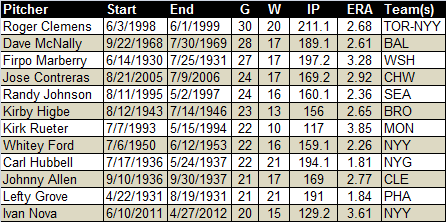
Note: 12 other pitchers are tied with Nova at 20.
Source: Baseball-reference.com
In fairness to Nova, his streak wasn’t all about luck. During the 20 games in which he went without a loss, the righty posted a respectable ERA of 3.61 to go along with an average Game Score of 53.7. However, those figures usually don’t add up to such a long winning streak. Of course, that’s because one very important statistic has been left out of the equation. During Nova’s streak, the Yankees offense scored 139 runs, or nearly seven per game. As a result, Nova was able to avoid being saddled with a loss in nine games in which his Game Score was below 50, including two that were below 25.
Just like his winning streak, Ivan Nova’s early career has been a contradiction. In his first 23 starts, the right hander posted an impressive 9-4 record, but it was supported by very questionable peripherals. However, after returning from a mid-season demotion, Nova was a very different pitcher. Thanks to an increased use of his slider, the 24 year-old bolstered his Rookie of the Year credentials by not only going 8-0, but doing so with much more impressive underlying statistics.
Over the first five games of 2012, Nova’s development has seemingly taken two different tracks. On the one hand, he has continued to improve his strikeout and walk rates, which should bode well for overall performance. However, those trends have come at a price because the right hander has also experienced a very significant spike in the number of hits and home runs allowed. To this point, the negatives have outweighed the positives, at least based upon Nova’s ERA and average Game Score.
A Tale of Three Pitchers: A Segmented Look at Nova’s Career

Source: Baseball-reference.com
So, what are we to make of Nova? On the one hand, his improved ability to generate strikeouts and avoid issuing free passes seems very promising. Considering his astoundingly high BABIP (batting average on balls in play) of .398, it also seems as if Nova has been the victim of bad luck (and perhaps bad defense). At least that’s what measures like xFIP suggest. According to that metric, which takes into account peripherals as well as a normalized HR rate to predict a pitcher’s future performance, Nova’s inflated ERA of 5.58 should be more like 3.83. The Yankees would probably sign up for that without a second thought.
But, can we just dismiss all of the hits and homers that Nova has surrendered? Although his BABIP is abnormally high, it’s worth noting that the number of line drives and fly balls hit off Nova have increased (from 47.3% combined in 2011 to 55.8% in 2012), which might explain why he has allowed so many more extra base hits. However, that doesn’t explain why he has transformed from a groundball pitcher to one who allows so many batted balls to be hit in the air. One possible answer could be that Nova is throwing too many strikes, particularly early in the count. Although that theory is supported by the high OPS against Nova in first pitch, 0-1, 1-0, and 1-1 counts, a sample of only five starts makes it far from conclusive.
Ivan Nova’s Performance in Various Counts, 2012
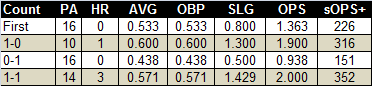
Note: sOPS+ compares a split to the adjusted average for the league. A reading above 100 for a pitcher is considered below average.
Source: Baseball-reference.com
Who is the real Ivan Nova and what role has luck played in his early career? His success has seemed to be a byproduct of good fortune, while his struggles appear rooted in bad luck, making it impossible to get a good handle on exactly what kind of pitcher he has been, not to mention will be. So, despite his impressive winning percentage, Nova remains one of the many question marks in the Yankees’ rotation, which, this year, hasn’t been lucky or good. At this point, I’ll settle for either.

Check out this article in the L.A. Times by Martha Groves about typewriter enthusiast Steve Soboroff.
[Photo Credit: Francine Orr/Los Angeles Times]

Our pal Eric Nusbaum says goodbye to his car:
When I say I drove my car for the last time, I mean that my car will never be driven again by anybody. It has a blown head gasket. (A head gasket is what prevents coolant and oil from leaking into the engine’s cylinders.) Fluids pouring into the engine have damaged it to the point of no sane return. In other words, the car would be more expensive to repair than it’s actually worth. My mechanic—his shop is actually called My Mechanic—all but refused to fix it. Replacing the gasket itself would cost about $1,500. And that would only be an appetizer to the ensuing main course of engine damage. For context, the Kelley Blue Book Value on the Legend in “fair condition” was $2,781. What about cars in poor condition? “Kelley Blue Book does not provide values for cars that meet this criteria.”
This was a long time coming. In the last two years, I’ve spent about a thousand dollars repairing cylinders, brakes, and other assorted parts. Meanwhile, much has been left in semi-intentional disrepair. The bumper was only about three-fourths attached. The driver-side window hadn’t shut properly since 2007; when I took the car over 40, air would stream in and whistle in my ear. Much of this is typical of Acura Legends, I’ve learned recently. They drive great, but their engines are set in such a way that makes them difficult to access, and costly to repair. Thousands upon thousands of words have been written in online forums about the regularity with which they blow their head gaskets.
I got my license when I was sixteen. My mother, a mechanic’s daughter, made sure I learned to drive a stick shift. I like driving fine but I’m 40-years-old and I’ve never owned a car. City living and all.

Gatti-Ward, Virginia Woolf? It’s all there in this intriguing piece by Sergio De La Pava over at Triple Canopy.
[Photograph By Devin Yalkin]
After skipping the latest Phlobafest last night, I was determined to catch most of Ivan Nova’s performance tonight. He’s the flip side of the aching disappointment attached to Phloba – surprising success. Sadly, Nova’s not that great either.

He’s good when he keeps the ball in the park and works his magic escaping jams of his own creation. The ball left the park tonight, and as his pitch count ran north of 100, all those men on base began to score. The Yankee offense did next to nothing against Jake Arrieta and lost the rubber game of the series 5-0 to the Orioles.
Jake Arrieta deserves the game ball for this one. He threw hard fastballs on the corners and mixed in breaking balls when needed. But the well-placed fastball was enough. The Yankees hit few balls hard and never threatened. Arrieta went eight strong innings, a career high.
Nova kept the Yanks in the game for six innings, but he was always in trouble. As he lost control of the game in the seventh inning, the thin ice of the Yankee bullpen finally fell through. With injuries to two starting outfielders, the Yankees decided to go with a short bullpen this week and it cost them a chance to steal the victory tonight. Who can fault Girardi with leaving Nova out there to put the game out of reach when he was carrying only 13 pitchers? Hopefully everyone will be healthy by the weekend so he can restock his arms.
The good news is that when Eric Chavez had an unexpected head injury in the middle of the game, there was another player waiting there on the bench that could fill in for him. That’s the kind of circumstance a professional manager must be prepared for and fans like us would overlook. The thirteen man staff might have forced Girardi to stretch Nova, but he would have looked even sillier if he had to forfeit the game when one of his starters got hurt.
I think the Yankees will win their fair share of games this season, and probably contend for the postseason. But with this starting pitching it’s hard to imagine what a winning streak might look like. Phil Hughes throwing a gem? Arod carrying the team over a three-game set? Those things seem impossible these days. Even worse, Cano and Teixeira are making Alex look dangerous. The pitching is so weak after Sabathia and somehow, in the absence of Gardner and Swisher, the lineup scored three runs in an entire series against the Orioles. When the Yankees are rolling they find three-run homers in seat cushions.
The Yankees are currently built like a .500 team: a fantastic bullpen, a creaky, streaky lineup and a rotation so top-heavy, if it was a human pyramid, the bottom layer would be crushed to death. The lineup should improve with health and a little patience. The rotation, though, I don’t see it. Andy Pettitte has done a lot of wonderful things for the Yankees, but would turning this starting staff into a postseason threat be his most impressive?
Photos by Kathy Willens & Jim McIsaac/ AP

The rain will hang around tonight. Hopefully, they get this one in–and yes, that’swhatshesaid:
1. Jeter SS
2. Granderson CF
3. A-Rod DH
4. Cano 2B
5. Tex 1B
6. Ibanez RF
7. Chavez 3B
8. Jones LF
9. Martin C
Never mind the umbrellas: Let’s Go Yank-ees!

According to this report, Junior Seau is dead at 43. Police are investigating this case as an apparent suicide.
My God, this is sad.
[Photo Credit: Sasha Kurmaz]

Head on over to Grantland for a long appreciation of the Chipmunks by Bryan Curtis. Nice to see Shecter, Merchant, Isaacs, Vecsey and company celebrated.

The only problem I have with the piece is how Jimmy Cannon is portrayed. It’s not that Curtis is inaccurate in saying that Cannon was tired and bitter by the mid-’60s, or that he was the foil that the Chipmunks needed (too bad there is no mention of Dick Young). Curtis lampoons Cannon’s writing style but I wish it was balanced with a sense of how good Cannon was in his prime. Cannon is seen here as he’s most often remembered these days–an out-of-touch old timer who had become a parody of himself. That’s a shame because while Cannon was sentimental to a fault when he was bad, he was terrific, one of the very best, when he was good.
[Picture by Bags]

Speaking of Robert Towne, I’m also a fan of his L.A. noir, “Tequila Sunrise.” Another love triangle. Friendship, loyalty, double-crossing.

And more crackling dialogue like this bit between Mel Gibson and Michelle Pfieffer:
Dale McKussic: Nobody wants me to quit. You know, don’t quit. Don’t get caught. Stay on top long enough for us to knock you off. I mean, that’s the motto around here. Nobody wants me to quit. The cops want to bust me. The Colombians want my connections. My wife, she wants my money. Her lawyer agrees and mine likes getting paid to argue with him. Nobody wants me to quit. I haven’t even mentioned my customers here. You know they don’t want me to quit.
Jo Ann: That is completely paranoid.
Dale McKussic: Hey, I’m just talking here. I’m not trying to convince you of a goddamn thing. And I may be paranoid, but then again nobody wants me to quit.

The Kurt Russell role was reportedly written with Pat Riley in mind. Alec Baldwin was considered for the part too before it went to Russell.

Here’s P. Kael’s blurb from the New Yorker:
You have to be able to enjoy trashy shamelessness to enjoy old Hollywood and to enjoy this picture. Robert Towne, who wrote and directed, is soaked in the perfume of 30s and 40s Hollywood romanticism. This is a lusciously silly movie; it has an amorous shine. The three talented stars are smashing: Mel Gibson is a former drug dealer who longs for a decent, respectable life and is trying to succeed in the irrigation business. Kurt Russell is his friend who’s the head of the narcotics squad in LA County. And Michelle Pfeiffer is the woman they both love. The crime plot often seems to be stalled, and by rational standards the stars’ triangular shuffle is flimsy and stupid, but by romantic standards the whole thing is delectable. With Raul Julia, who has a big, likable, rumbling presence as a scoundrel, J.T. Walsh as a quintessential flatfoot, Ann Magnuson, Arliss Howard, Ayre Gross, and, in a bit as a judge, Budd Boetticher. The golden cinematography is by Conrad Hall; the aggressively offensive score is by Dave Grusin. Warners.
Man, this was Pfieffer at her peak.


Gibson too. And the movie features one of the all-time cameos by Raul Julia. Damn was he ever good.

Fine work–as usual–from J.T. Walsh as the putz, and Arliss Howard as the snake.
Conrad Hall was the dp:
American Cinematographer reported that:
While Hall wanted the night scenes to be black and dark he wanted at the same time for the daylight scenes to be blindingly bright, like California beaches… ‘We wanted California to look hot so that the audience could feel the glow of light that the beach creates,’ Hall maintained. ‘I felt at first that the colors were too bright for the California beaches. By overexposing them some more in the printing, I was able to pale them out. I’m not sure that California will look as hot as I might have liked, but at the same time I know that it won’t look so clean and well saturated either.’ [37]
When the pair recced the coastal locations, Hall said,
“The whole area down there is unclipped. It was very beautiful yet unattractive at the same time. It comes from people not mowing their lawns. I’m talking about things like weeds growing through the cracks in the sidewalk. That kind of thing. The people down there concentrate on other things they find more important. They aren’t concerned with forcing something to look beautiful.” [38]
Hall explains the rationale behind the decision to employ the Color Contrast Enhancement process in American Cinematographer as follows :
“The CCE process is wonderful because it allowed us to see into the shadows. By putting black into the picture, it gave the print more contrast without destroying the clarity. By picking up the silver iodides, the process eliminates whatever grey coating there is over the shadows. You can now see whatever was visible in the black before it was covered over by the grey. We did a lot of tests with the CCE process and found that it could correct things that we couldn’t do in the timing. For example, the ending of the picture takes place at night in the fog. Unfortunately we found out that fog turns out to be sort of a blue color at night. If you take the blue out of it in the timing you are liable to hurt the skin tones. I wanted the fog to look romantic and this meant it needed to be white. The tests we did with the CCE process were absolutely stunning because the fog came out white –exactly what we wanted. For me, the CCE process improved the visual impact of the film at least 30 per cent.”
I received an email last week from a former teammate I hadn’t heard from in years. He was letting the old team know that our high school was celebrating the twentieth anniversary of our first Bergen County championship before the varsity game on Saturday. I looked at the word “twentieth” and for a moment wondered what team he could be talking about. I thought our 1992 team was the first to win Counties, but surely that wasn’t…shit, that was twenty years ago.
We showed up at the field on Saturday and most of the guys look like they could put on a uniform and get through seven innings without a nurse. The two decades took a toll in other ways though. There was less hair on display than a shoddy Brazilian bikini wax. It was the first time I’d seen my teammates since they became husbands and dads and it was a trip to see the changes in one fell swoop.
We’ve transitioned from teenagers to middle-agers along different paths but wherever and whenever it happened, our collective youth had vanished. Maybe some people held on longer than others, but after twenty years, nobody was spared. And that brings us to Phil Hughes who, it occurs to me now, has used up all his youth.

That’s the depressing part of Phloba’s (I am fusing Phil and Joba into the most disappointing word I can fashion, I might have broken that out last year, I don’t remember) breakdown. It would be fun to root for a Cy Young candidate or an All-Star (wait he was an All-Star?) but what we’re really lamenting injury after injury and sputtering pitch after pitch is the creeping shadow of time claiming Phloba’s youth. Whatever Phloba becomes now, it becomes as a man (as men?) with the burden of failure and the destruction of promise.
I knew I had to recap this game tonight, but I had a tough flight from Chicago backed up by dragging my ass around a basketball court and now a precarious time in which I try to make sure the coach seat and the boxing out don’t conspire to throw my back out when I sleep. When I saw Hughes was pitching, I didn’t even bother to record the game. I figured he’d be at best mediocre while giving up dongs left and right. If he was brilliant, I could suck it up and catch the replay.
No sucking it up was required.
My flight was delayed because of weather and I really hoped the game would be cancelled. I remember that’s how I used to feel when I young. I was so nervous for the games, I always hoped for rain. This time it was for strategic purposes – I didn’t want Phil Hughes to have to throw a pitch.
No such luck. The Yankees lost to the Orioles 7-1 in a game I’m glad to say that I missed entirely. I didn’t want to see Hughes let up homers. I didn’t want to see Eduardo Nunez massacre another position on the diamond. I didn’t want to see an offensive highlight package in which Arod’s bunt single, which led to no runs, featured prominently.

Hughes was better than last time, maybe the best he’s been all season, but it was nothing worth celebrating. And now he’s just another day older.
Photos by Al Bello / AP