"A New York Treasure" --Village Voice
Category: Bronx Banter

Legacy

I first remember hearing rap records in the summer of 1983. I was 12 and went to summer camp at the YMCA on the upper west side. Buffalo Gals and Sucker MC’s. I also recall spending a lot of time hating Synchronicity, the hit record by the Police (though I did like their four previous records), and rolling my eyes at Thriller, the Michael Jackson album that just would not go away. On every bus trip we took, Thriller dominated.

One of my counselors, a teenage girl from uptown, was bemused when I told her that I didn’t like Michael. It was as if I told her that I didn’t like breathing. I was into the Kinks at the time. It wasn’t until years later that I came to appreciate that record and how great is sounds–that I allowed myself to enjoy it. Oddly enough, I’ve always had more affection for Off the Wall and some of the Jackson 5 stuff, which is far more infused with my early childhood memories.

michael2

I have not been swept up in public reaction to Jackson’s death but I have reflected on his career, and just how monumental a figure he was for my generation. His influence was massive and he was a terrific entertainer. I get a sense of mass relief in the outpouring of affection he’s received this week. It became almost impossible to adore him when he was still alive. Now that he’s gone, it is safe to embrace his music and, at least for the moment, avoid the strange reality that was his life.

Over at his wonderful blog, Soul Sides, writer/dj Oliver Wang has done a tremendous job since Jackson died last week. Head on over and scroll down for all of the posts. Here is one that contains a great M-J-5 mix and these words of wisdom:

Anyone who has every DJed any party, anywhere knows that when everything else fails, you can always put on some MJ and it’s like Insta-Party. As a fellow DJ wrote, “MJ has always been the most “guaranteed go-to” artist for DJs in the history of DJs.” True that.

The thing is…it’s so easy to get the party started with MJ, it’s like an unfair advantage over the audience. It’s so easy that I’ve usually avoided playing anything too obvious by MJ simply because…it’s too easy.

And I was thinking: who else comes close to having that kind of power? The only artist even in the conversation is Prince but even then, we’re talking about Purple Rain-era Prince mostly whereas with MJ, you can drop everything from “I Want You Back” (1970) to “Don’t Stop ‘Til You Get Enough” (1979) to “Billie Jean” (1982) to “Smooth Criminal” (1987) and it’s on like Donkey Kong.

Some records are just sure-shots–Tell Me Something Good and Use Me come to mind–and Michael had more than his fair share, didn’t he?


Life’s a Pitch and then You Buy

billymays2

In the latest issue of Playboy, Pat Jordan profiles Billy Mays, the famous TV pitchman who died just a few days ago. It’s a snapshot of a profile but a fun, quick read.

Mays is the most famous pitchman in the world. His pitches are seen on TV in 57 foreign countries and dubbed in Chinese, Japanese, French, Italian, German, whatever. The media call him ubiq-uitous, with his swept-back black hair and full black beard he touches up “by drinking only dark whiskey”—da-dum! You’ve seen him on TV, leaping out of the screen at three A.M., just before you doze off, snap- ping you awake with his screeching voice. “Hi, I’m Billy Mays, here for OxiClean!” or KaBOOM!, Mighty Putty, Hercules Hook, Awesome Auger, Zorbeez, whatever. Mays sells them all: gadgets that stick harder than any glue, dig up weeds, hold up a 50-pound gilt-framed mirror (assuming you have a 50-pound gilt-framed mirror)—so many gadgets you never thought you needed, never even thought existed until Mays went into his pitch. A 30-second pitch, never more than two minutes—a short con—screaming at you, “Watch this! I get so excited! I gotta tell you something! Buy it right now!” So you call the toll-free number, give a strange voice your credit-card information and then get a package in the mail, stare at its con tents—a gadget, a product—and wonder, Why did I buy this? But what the hell, it was only $19.95. It’s always $19.95. That’s Mays’s secret.

“It’s gotta be under $20,” Mays says. He shrugs. “I don’t know. That’s the magic number.” It also has to be an unknown item that can’t be purchased in a store, that can be seen and purchased only on TV and that appeals to a mass audience of do-it-yourselfers. Mays gets his satisfaction from sheer quantity. “I want to sell billions of things,” he says. And he has, which has made him rich (three Bentleys, million-dollar homes) and famous. There are websites devoted to either loving or hating Billy Mays. He shrugs again and says, “There’s a fine line between love and hate.” One website is dedicated to fans who want to have his baby, though most of those fans are gay men who like so-called hairy bears. They call him “one of the hottest bears on the market” and beg to be able to “boff that bear.” His haters refer to him as “an asinine piece of shit,” “a public nuisance” and an asshole. One fan says Billy Mays is his idol because he’s “so obnoxious that he’s cool” and can sell “dick to a dyke,” tap water from your own sink. A $5 bill for four easy payments of $19.95, plus shipping and handling.

“It’s all about trust,” says Mays. “I stay true to the pitch. I’m not a salesman. A salesman sells a product; a pitchman sells himself. I make people believe they have to own it.” He smiles and says, “Life’s a pitch, then you buy.”

Har Har Hardy Har Har

The noise I make the most often when watching the Yankees is “T’uccch.” It is a sound of disgust. Last night in the second inning, with men on first and second and nobody out, Hideki Matsui hit a soft ground ball to third. I was on the couch watching the game; the wife was in the kitchen.

“Uch, double play,” I said when I first saw the ground ball.  “No, single play, wait, error, dude, run scores…

Pause.

Deadpan voice from the kitchen: “Is that your final answer?”

Alice-Kramden-Honeymooners_l

M’ooooh, yer a good one.

Card Corner: Dr. Strangeglove

Stuart

Quick now, how many current Yankees have nicknames? “A-Rod” for Alex Rodriguez and “Tex” for Mark Teixeira don’t count; those simply involve the shortening of last names for the sake of convenience. In terms of legitimate nicknames, Hideki Matsui has been known as “Godzilla” going back to his days in Japan. Chien-Ming Wang used to be called “Tiger” in the minor leagues, but the moniker has never caught on in the big leagues. Then there’s Alfredo Aceves, who is known as “Ace,” and Melky Cabrera, sometimes called the “Melkman,” but they’re not exactly the most creative of nicknames. And that’s about it.

The Yankees are pretty typical in this regard these days. Nicknaming has become a lost art in the contemporary game, partly for reasons of political correctness and partly because we’ve just become damn lazy. At one time, nicknames were a huge part of the game’s subculture, largely because of the influence of headline and beat writers at newspapers and local team broadcasters. The 1960s represented one of the golden eras for nicknames. It is in that decade that we find one of the most creative and fitting nicknames of all time, even if it did have to belong to a Red Sox first baseman.

By the summer of 1964, Dick Stuart had firmly established a reputation as one of the worst defensive players in the major leagues. Although he was the starting first baseman for the Sox, Stuart couldn’t do anything well with the glove. (That’s probably why Topps showed him with a bat in his 1964 card.) With hands of gypsum, dime-like range, and generally poor instincts, Stuart achieved the Triple Crown of fielding ineptitude. By most accounts, he was also indifferent to the defensive game, so he never motivated himself to improve. Now I never actually saw Stuart play, but I’ve heard so many stories of his lack of defensive prowess that some of them have to be true.

With such anecdotal and statistical evidence (he reached double figures in errors eight times), it’s safe to say that Stuart was historically bad when it came to the business of guarding first base. So it was quite appropriate that in 1964 one of his teammates fitted him with the nickname of “Dr. Strangeglove.” The creation of such a name relied heavily on Hollywood; the Peter Sellers black comedy, Dr. Strangelove: Or How I Learned To Stop Worrying and Love the Bomb, had just been released in theaters on January 29. By placing the letter “g” between the “e” and the “l” in Strangelove, the unknown Red Sox teammate had devised a pithy play on words while tapping the popular culture of the day. The timing could not have been better, considering that Stuart had made 29 errors the previous season, a simply remarkable achievement for someone playing first base.

Stuart’s haphazard fielding had nothing to do with the movie’s plot, in which an insane general tries to initiate nuclear holocaust while politicians do their best—ineptly, I might add—to save the world. The supremely talented Sellers played three roles in the film, including the title role of “Dr. Strangelove,” an important scientist in Nazi Germany. Stuart was similarly schizophrenic to the versatile Sellers; as poor a fielder as Stuart was, he was often a feared slugger, once hitting a career-high 42 bombs for the Red Sox.

Not surprisingly, the creative moniker of Dr. Strangeglove took hold quickly and never let up, becoming almost mandatory whenever Stuart’s real name was uttered. When another 1964 film, Goldfinger, achieved a level of mass popularity, a few folks tried to attach the nickname “Stonefingers” to Stuart, but that label never really caught on.

All in all, Stonefingers is pretty good, but Dr. Strangeglove is just great. Is it the best nickname of all time? I’ll leave that up to you, the reader, to decide.

Nouyrican Nourishment

Got Flava?

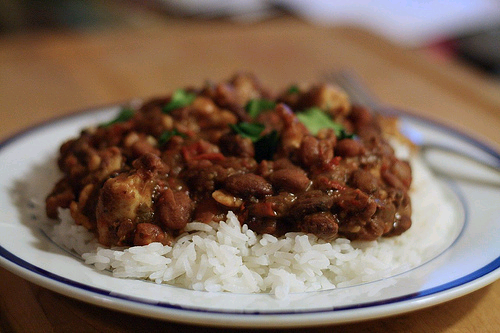
rice and beans

There was a terrific little piece by Sam Sifton in the Times magazine last weekend on rice and beans, Boricua style:

A restaurant kitchen can be a kind of mother, too. This is particularly true in New York, where so many eat out so often. Indeed, for many of those born in New York — and there are more than 2.4 million of these natives in the state, according to census data run through the computers of Andrew A. Beveridge, a professor of sociology at Queens College — Puerto Rican rice and beans have little to do with blood relationships. Rice and beans are instead a shared and familiar experience, offered to all alongside dishes of roast pork or baked chicken (sweet beneath its crispy skin), dense and hearty mofongo, buttered toast, fried plantains and yuca.

Of course, rice and beans are served across Latin America, in different variations, with different beans, for different reasons. You will find superior platters of them in Brazil, in the Dominican Republic, across Mexico. The best of New York’s are literally Nuyorican, a word that arose to describe the Puerto Rican diaspora in New York, the almost 10 percent of the city that has its familial roots in the commonwealth but sees its children bloom on the concrete of the South Bronx, East Harlem, along Columbia Street in Brooklyn.

Nuyorican restaurant rice and beans are food for flame-haired detectives coming off the day shift and chalk-hued art kids jittery and lost amid the salsa beats, for tired high-school teachers, for back-office fellows off the clock. They are the taste of comic-opera hangovers, honest hunger, game-day excess, hard work. They are an authentic taste of a New York that real-estate developers and change can never diminish.

Here is the recipe. I’m all over this. Once again, I don’t know the scientific explanation but bacon makes it better.

Yankee Panky: Channeling Todd Drew

In his short time here at the Banter, Todd Drew made an indelible impact on all of us. Amid Alex’s range, Cliff’s statistical acumen, Bruce’s historical perspective, Emma’s sense of humor and the combination of media coverage from Diane and me, Todd, through his storytelling, demonstrated his love for baseball and this community by portraying the human side of Yankee fans.

From the tee shirts and hats and other assorted team paraphernalia worn by the transients, I noticed a number of Yankee fans on the 1, 2 and 3 trains when I was in New York City Monday. I haven’t been in the city much since changing jobs, so I was actually looking forward to the long subway ride to Columbia and then up to Manhattan College for a couple of workshops I was doing with clients at both institutions. As the train bounded out from underground between the Columbia campus at 116th Street and 125th Street and back down again quickly, and then into the light once more as the route exited Washington Heights and entered Inwood, I found myself thinking about Todd and his daily posts, many of which featured an interview with a Yankee fan on a subway and thought, “Todd was pretty brave to write from this perspective every day.”

The people he met every day on his way to work, or en route to the Stadium shaped his writing. Todd subscribed to a basic tenet of feature writing: everyone has a story to tell. He understood that we were all connected, sometimes in a similar way to how the subway lines connect people in the Big City. These strangers’ stories were his stories, and he was kind enough to share them.

Me? I’m not inclined to strike up a conversation with a stranger on a train and glean stories from there. I’m more of a situational observer. I view the panoramic and drill down based on the information I process.

On my way back downtown, I sat silently reading the Tom Verducci / Joe Torre tome, “The Yankee Years,” occasionally looking up to people-watch, mostly keeping to myself. As is usually the case when I travel by train, I get very tense and hope that either of the following situations does not occur: 1) a person sitting 5-10 feet from me is playing their iPod so that I can hear it through their headphones (after all, it’s not called an “everybodyPod), or 2) someone or a group of people in my car behaves obnoxiously, compelling me to get up and move to another car.

Today was different, though. Maybe it was because I’m not in the city every day anymore. I hadn’t taken the time to really notice the people, the surroundings, or wonder what was going on in their little insular planets before. Maybe it was because I was venturing to places that I hadn’t been on the 1 line and I wanted to learn something that I could eventually use in a conversation.

Before switching trains at 96th Street, a little girl was telling her father that she had fun and that she didn’t want to sit down because she was sweaty but “her bum wasn’t wet.” That killed me. One stop later, a family wasn’t prepared to get off the train, got to the doors about a second too late and the subway doors nearly scissored a mother’s baby carriage. A cursing match between the mother and the conductor ensued. While that was going on, another family entered the car and sat across from me: a mother, her son–who was probably about 7–and her daughter, probably age 4 or 5. Looking at the girl, it was like I was viewing my own daughter in five years. Similar shaped face, long, light brown hair, pink dress and sandals. And this girl was named Maddie, like mine. I immediately imagined riding a subway with my daughter, maybe on our way to the Museum of Natural History or some place like that, with her looking at the signs and asking questions as this other Maddie was doing with her mom.

The mother and her two children got off at 34th Street like I did, and from there we went our separate ways: them to the street, where a bus would take them one stop to the steps of their apartment building and me to the Long Island Rail Road concourse of Penn Station. A couple of glances were exchanged, but no words. I didn’t get to tell the mother about the similarities between her Maddie and mine. I don’t regret not saying anything, but it would have been nice to make conversation and see where it went. If he was in a similar position, Todd would have probably taken that leap and turned it into a 400-word piece.

The best feature writers immerse themselves in the environment and absorb the energy. Todd was able to do that and put you right there on the train with him. This one time, I wanted him on the train with me. I think he’d appreciate the ride.

You Must be Dreamin’

Okay, let’s indulge in some fantasy. It’s an off-day, good time to play Walter Mitty.

robbery

If you could perform one single feat on a baseball field, what would it be? Would you hit a home run, steal home, leg out a triple, break-up a double-play, strike a hitter out (swinging or looking), nail a runner trying to score, or would you leap over the outfield fence to rob a hitter of a home run?

Which one of these?  Or perhaps you’ve got something else in mind.  Do tell.

The Heart of Baseball

Saturday in the Park.

607

Inwood, that is.

597

Farmer’s Market.

574

Cherries, n everything.

5631

And baseball.

616

There’s always baseball in Inwood.

621

And everybody loves baseball, right?

610

I’m Gonna Be (500 Saves)

Man, I wish I’d been there in person for this one.

“I just wanna do my job and let someone else talk about myself,” said Mariano Rivera after his 500th career save and first-ever RBI. Happy to oblige.

The Yankees won 4-2 tonight, and though they probably should have scored more – given that the Mets handed them nine walks and an error in the last four innings alone – it ended on a high note, so I won’t be complaining, or even bothering to question the questionable moves from Joe Girardi tonight (I’m sure a few  commenters will be happy to pick up my slack).

The Mets were patching things together pretty well for a while there, considering three of their four best hitters are out of the picture, and that the roles of John Maine and Ollie Perez are being played by Tim Redding and tonight’s starter, Livan Hernandez, the oldest 34-year-old in the game. Hernandez was not half bad tonight, in fact, and I enjoy watching his smoke and mirrors, but it wasn’t enough – at the moment the Mets’ lineup is too depleted, and their defense too sloppy. Meanwhile the Yankees seem to be getting their act together, though only time will tell. The end result was a three-game sweep, and to add insult to injury, tonight’s insurance run came courtesy of the fearsome plate discipline of Mariano Rivera, in his third career at-bad.

The Yankees scored three in the first inning, thanks in large part to yet more defensive blundering from the Mets. Derek Jeter doubled, and Nick Swisher hit into a fielder’s choice, but the fielder chose poorly. Mark Teixeira doubled, and eventually Jorge Posada got him home with a sacrifice fly. That was all the Yankees could muster, dispite numerous opportunities, until Mo’s appearance in the ninth.

Chien-Ming Wang, abetted by some nifty fielding, gave up two runs in the second but kept his cool and held on into the sixth. Phils Coke and Hughes were excellent again in relief, but Brian Bruney was not, prompting Rivera to make another 8th inning appearance. You know, every year since 2006 or so, Torre and Girardi have claimed they aren’t going to do that, and they always do anyway – not that I blame them for changing their minds. How could you resist? If I were a manager (god forbid) and I had Mariano Rivera at my disposal, I imagine my hand would start twitching towards the bullpen phone sometime around the third inning most nights.

In the top of the ninth, the Yankees tried to use Francisco Cervelli as a pinch-hitting decoy, but it was clear that Rivera was never coming out of a 3-2 game in the ninth inning. Mo limbered up and rolled his shoulders as he walked to the plate with – of course – the bases loaded, facing Francisco Rodriguez with two outs. If you have to have a pitcher up in that spot, I guess at least you want to have a guy who doesn’t rattle.

I think Mariano Rivera’s at-bats may be the most thoroughly entertained I have ever seen a Yankee dugout. Anyway, thecoaches presumably told Mo not to swing again, but he had no intention of following that advice this time, either. He took one very healthy hack on a 2-2 count and fouled the pitch back – but other than that he laid off, working the count full and then, remarkably, walking.

Be nice to your Mets fan friends tomorrow, gang. They’ve been through enough already.

Rivera closed out the game afterwards with a minimum of fuss for his 500th save, and while I think most everyone reading the Banter would agree that the save is a deeply flawed statistic, this is really just another opportunity to reflect on how freakishly awesome Mariano has been, is now, and hopefully will continue to be – for at least a  while longer. You can’t really overhype Mo, and that’s saying something.

It Starts with One

bowl

Chien-Ming Wang is 0-6. He’s improving but hasn’t pitched well enough to earn a win yet. With the Mets on their heels, it would be nice to end the weekend on a high. Though you never know what that wily-old Livan Hernandez has in store. Saw dude throw a 3-2 curveball, a 65 mph curveball, to Prince Albert Pujols last week and strike the great man out swinging. He doesn’t lack for courage.

Nevermind the announcers, Let’s Go Yan-Kees!

Good Things Happen when the Wife Goes to the Ladies Room

citi2

Sitting close to the action on Saturday night at Citifield (“I’m Still Calling it Shea,” read a t-shit), Emily and I were surrounded by Mets fans. We didn’t wear any colors. “We’re undercover,” my wife said to me. And so we were. I kept score (a scorecard costs five bucks; they go for twice as much in the Bronx) but had a mitt on my left hand in case a line drive came our way. No such luck.

The Yanks held a 1-0 lead into the sixth. The wife excused herself and went to the ladies’ room. (She was in the bathroom when Aaron Boone hit that dinger in ’03 and ever since I send her in when absolutely necessary.) Mark Teixeira doubled on Tim Redding’s 99th pitch of the night, and his next three pitches were hit as well: single (Alex Rodriguez), double (Robinson Cano), and home run (Jorge Posada).

AJ Burnett, meanwhile, allowed just one hit and three walks while striking out ten in seven innings of work. He mowed ’em down, as you’d expected against the Mets’ depleted line-up.

There was no blood orange sky but it was cool, pleasant night. Most of the Mets fans in our section had cleared out by the eighth inning. Em and I could have danced all night as the song goes. So we soaked it all in and went home heppy kets.

citi3

Final Score: Yanks 5, Mets 0.

Red Skies (Again?)

empire-state

I’m taking Emily to her first ball game of the season. Maybe we’ll get wet. Maybe not. Either way, we’re going to have a good time. AJ’s been better lately. Still waiting to see him put a string of good starts together before I get too excited. He should be commanding tonight. Let’s see if he’s up to it.

So…Let’s Go Yan-Kees already. Keep it movin’ boys!

Something Wicked This Way Comes

It’s been raining in New York for at least a month. Weeks and weeks of rain. Last night we had a sunset to show for it. It was gnarled and fantastic, dramatic and beautiful. It was also a hex on the Mets as they made three errors in one inning. 

Here’s a great shot from the New York Times.

skies

It was sunny this morning but the clouds are moving fast and the weatherman says 30% chance of rain. 

Hopefully we’ll get another purtee sunset.

Observations From Cooperstown: A Short Conversation With Pags

Defying the odds and emerging as the epitome of the most workmanlike Yankee of the 1980s, Mike Pagliarulo played in pinstripes from 1984 to 1989. In 1987, he led the team in home runs, an impressive achievement considering the presence of more highly touted teammates like Don Mattingly and Dave Winfield.

Pagliarulo’s Yankee career ended in 1989, when he was traded to the San Diego Padres for right-hander Walt Terrell. During his days in San Diego, Pags clashed with Padre icon Tony Gwynn, but he revitalized his career as a Minnesota Twin, playing a complementary role in the team’s 1991 world championship. During that classic World Series win over the Braves, Pagliarulo slugged .545 and earned his first and only championship ring.

On Sunday, I had the chance to talk with Pagliarulo during his visit to Cooperstown to participate in the first Hall of Fame Classic. Before the popular Pags took the field and banged out two hits, including a game-winning double at Doubleday Field, he discussed his current career path, his most memorable highlight as a Yankee, and his pride in watching his son succeed in college.

Markusen: Mike, let’s talk to you about what you are doing now. I know you’re involved with scouting and player evaluation and doing a lot of analysis, which is kind of an interesting transition for a former major league player. How did all that come about?

Pagliarulo: Well, what we’re doing now is that we have a consulting company. We use a lot of former players and former front office executives who can help analyze and evaluate talent, so that we can help the industry determine the value of actual skill and performance on the field. It’s hard for them to do that now. Whereas the market determines the [financial] value, we try to determine the value of the performance, which is something we’ve been doing successfully for many years.

It basically is the stuff that we did when we were on the bench playing. So we each work with some different sciences to try to put that into data. We’re trying to create some scientific methods so that people can understand a little bit more clearly. I think it would help development [of players] and help reduce injuries and help in understanding the value of skill.

Markusen: You were known as an overachieving ballplayer who got the most of your ability. A lot of people didn’t even think you would make the major leagues and you proved them wrong. Do you think you have a special eye for that kind of young talent, the overachiever?

Pagliarulo: Young talent is extremely difficult to evaluate. And no, I have a lot to learn about that. But I do have a good eye for talent at the major league level. And that’s where it all starts. If you can evaluate there, then you can help the younger generation, you can help the foundation of the industry, you can talk to them. You can talk to [young talent evaluators] about that, by using the language—it helps if everybody speaks the same language in determining value of players. I think that’s the best way to do it. It helps everybody when you’re all on the same page.

Markusen: Looking back at your career, you’re best remembered as a Yankee, but also as a Padre and as a member of a World Series team with the Twin. What was the No. 1 highlight for you? Was it playing in the Series, or was it something else?

Pagliarulo: My No. 1 highlight was my first old-timers day [as an active player] at Yankee Stadium, when Mickey Mantle put me in a headlock and wrestled me to the ground. I couldn’t believe that he would even talk to me, let alone make me feel like I was part of the family. That’s probably the day that I most remember in baseball.

And Mr. Steinbrenner has always given me great opportunities. More recently, the thing I’m most proud of, why I played baseball, is that my son is able to graduate college. That opportunity was given to me by the Yankees. I’m sincerely thankful and appreciate every bit of opportunity that I’ve had. That’s making the most of it when you put your kids through college.

Markusen: Looking back at those Yankee years, they were very tumultuous; there was a lot of turnover, a lot of close finishes in the AL East. As you look back, was there one guy in particular, a teammate of yours, that was especially colorful or offbeat, somebody that you still think a lot about today?

Pagliarulo: Oh, I think about a lot of them. There isn’t just one. If there was just one, we didn’t have much of a team. It was a group of guys, the scouts, the minor league coaches, the managers, the ownership; it was many, many things. A difficult question, but a very good question.

Markusen: The best years of your life?

Pagliarulo: The best years of my life? Realizing all the benefits that the opportunity in the major leagues has brought me, the best [moment] is my kid graduating college.

Markusen: Mike, I appreciate it very much.

Bruce Markusen, who writes Cooperstown Confidential for The Hardball Times, considers Mike Pagliarulo his favorite Yankee from the 1980s.

Yankee Panky: Battle of Wills – Q&A on CC

The Yankees announced that CC Sabathia came through his bullpen session OK and that he will in fact pitch Friday night, as scheduled, against the Mets at Citi Field. Is this a good thing? Putting your Fantasy Baseball emotions aside for a moment, are the Yankees sacrificing their long-term investment by pushing Sabathia to the mound in the short term?

These questions all fall into the recent debates of management (and yes, this includes Joe Girardi) and its handling of the high-priced stars. With that in mind, I went to the injury expert, Baseball Prospectus’s Will Carroll, to get the skinny on biceps strains and to pick his brain on how he would deal with the big lefty.

NOTE: This interview took place Wednesday morning, hours before the bullpen session.

Will Weiss: I’m seeing conflicting info between what Sabathia and (GM Brian) Cashman are telling the New York press corps (what else is new?). What do you see as the potential short- and long-term ramifications of this injury? … If you were on the Yankees’ training staff, what would you recommend? Me, I’m protecting the 8-year, $161 million investment and shutting him down until after the All-Star break.

Will Carroll: What’s Cashman saying? I’d shadow him and be ultra-cautious, but shutting him down for three starts? I’d have to know there’s some kind of serious injury before doing that in as tight a race as this is.

WW: Cashman’s not saying anything except, “Let’s see how he feels and evaluate him after his bullpen session.” He’s taking the cautious approach.

WC: Smart. I always feel good when I agree with Cash.

The thing about Sabathia is he’s very confident, but that can be shaken. When he injured his arm back in ‘04, he freaked. It was good for him, but took him a long time to get that swagger back. I think you have to listen to him.

WW: How does a biceps injury, even stiffness, affect his success, given he’s a big powerful guy who’s thrown a lot of pitches? His mechanics are good. What causes this type of strain?

WC: Could be any number of things. Could be a cramp, electrolyte imbalance, might have tightened up or not loosened up due to a million factors. The key is it wasn’t sore after his last start and from what I understand, he wasn’t complaining about it in pre-game, so it’s most likely the start of a strain or cramp.

WW: How cautious should you typically be in this situation?

WC: Reasonably, but again, you have to deal with him as a person. Do you trust he’s telling you how it feels truthfully? Is he consistent in strength tests? Is there inflammation?

Will’s questions, as well as any questions the rest of us have, will be answered soon enough.

Don’t Stop ‘Til You Get Enough

It’s funny how things work. A couple of years ago I had a brief correspondence with Sadat X, one of my favorite all-time emcees, who was serving a stint in Rikers on a gun possession charge. I sent him my Curt Flood book, The Courting of Marcus Dupree and dozens of magazine articles. We exchanged a half-dozen letters. Though we didn’t keep in touch when he got out it was a cool connection.

This week a writing assignment came up and I had a need to get in touch with Sadat. I asked a friend who owns a record shop who knows Lord Finesse (a regular customer) who is good friends with X. Finesse came in to buy records today, gave my man Sadat’s number which was then e-mailed to me.

I got home this evening and called X. “Yo man, of course I remember you,” he said. “You just caught me bugging out over here, it’s all over the news and the Internet: Michael Jackson is dead.”

And that’s how I heard the news, just hours after the sad report that Farrah Fawcett died. I wasn’t jolted but not shocked. Michael Jackson was the biggest pop idol of my youth; he did not live life like he wanted to grow old. It’s almost as if he committed a long, public suicide for years. It was painful and absurd. He was seminal, an icon, a wonderful entertainer who was so deeply disturbed that he became a freak show. I felt even worse for Fawcett who has been sick for a long time. Still, they are both out of pain, and that has to count for something.

michael

Sadat was great with me and pleased to help. When we finished talking, I called a bunch of people to talk about Michael and then went walked down to Broadway and 233, across the street from the I-HOP, to the Uptown Sports Complex, which is owned by a high school pal of one of Bronx Banter’s own–Dimelo. Small World, man. I hung out around the cages and took-in the place, the clanking sound of bats hitting balls echoing around me. The Yankee game was on the flat screen TV. I missed Alex Rodriguez’s first inning jack, but caught his RBI base hit in the third, and saw the Yanks jump out to a big lead. I also stayed long enough to see Andy Pettitte cough most of it away.

When I left, I popped up the block, across the Major Deegan and checked out a Kingsbridge Little League under the lights. Then, on my way home, I followed the game on my blackberry. I refreshed the gameday page every 15 seconds, and passed by a bar on 238th street when Rodriguez drove in two more runs with a bases loaded single. Don’t Stop ‘Til You Get Enough was playing on the stereo. It was hot and muggy but a shiver ran down my spine.

The Yanks held on and won a barn-burner, 11-7, taking the series and returning to New York on a high note. A nice win on a mournful summer night.

Afternoon Chuckle

This is how I react when my wife takes away the remote control while I’m watching a game:

It’s Money that Matters

Hey, another reason why the Internet rocks.

screenplay_yki5

Here is Steven Zaillian’s script for Moneyball.

Have at it.

Strike a Pose

Every day, we see familiar poses and gestures on a baseball field–a batter’s ticks (the way he leans on his bat in the on-deck circle), a pitcher’s wind-up, the way a runner leads off first base. I especially enjoy watching the loose physical comradery and affection players display on the bench, like when Derek Jeter absent-mindedly drapped his arm around Tony Pena last night.  

Recently, I’ve been paying attention to the gestures that are less obvious but still common. As a kid, for instance, I loved the way Graig Nettles extended his right leg and swept the dirt in front of him, almost like a dancer, before each pitch was delivered.

graig-nettles

The pose that has captured my imagination of late is when Francisco Cervelli stands up and fires the ball to third base after a strike out. He stands from his crouch and leans back on his right leg, left leg bent and raised in the air, arm cocked back. He pauses for a split second, exaggerating the move which looks almost like the Heisman pose.  But it is not defensive  in nature, just the opposite–it is a celebratory act of aggresion.  

It only lasts a brief moment and it is a non-play–the entire around-the-horn routine is a terrific non-play really. But Cervelli performs it with great relish. A few weeks ago, I caught Joe Girardi tell Michael Kay that Cervelli has actually burned Alex Rodriguez’s hand several times throwing the ball so hard down to third after a strike out.

What are some of your favorite routine poses or gestures?

The Yankees Lo-… Wait, What?

Hey, the Yankees stopped sucking for a few innings! It was probably because I wasn’t watching. I caught up thanks to the miracle of Tivo, though, and much to my pleasant surprise, saw the Yankees beat the Braves 8-4, behind a solid Joba Chamberlain start and some timely (well, a week or two late, but you know what I mean) second-half hitting.

Despite some hard-hit balls, the Yankees had settled into their comfortable routine of doing nothing against National League pitching – in fact, two Braves pitchers were teaming up for a perfect game through five. Then suddenly, in the sixth inning, the Yanks got some of those run thingies we’ve been hearing so much about. The first one came when… wait, this can’t be right. Francisco Cervelli hit a home run?

Cervelli’s solo shot, his first in the bigs, tied the game at 1-1. Rookies usually try to act all cool and nonchalant in this scenario, but Cervelli was obviously pumped. His homer came immediately after Brett Gardner got picked off first base on a truly lousy call, and Joe Girardi got thrown out for arguing. I don’t necessarily buy that this move “fired up the team,” but hey, can’t hurt to try, right?  Jeter and Damon followed with singles, Teixeira was sorta-intentionally walked, and A-Rod struck… whoops, sorry, force of habit. A-Rod hit a two-run single: 3-1 Yanks.

The game stayed close for a few innings, but New York clung to the lead. After Joba lost it a bit in the 7th, Phil Coke, a shaky Brian Bruney, and one Mariano Rivera kept things under control (with Mo striking out all four batters he faced, and lining out to center field, awesomely, amid much fanfare). And the Yankee hitters pursued an exciting new strategy which involved tacking on additional runs in order to give their team a cushion. Yeah, it’s different, but I think they may be on to something.

“Everybody is happy,” said Cervelli after the game, “everybody wants to play baseball. So things happen.”

As a side note, one of my favorite things about interleague play (though not so much this year, thus far) is watching the facial expressions of NL batters who haven’t previously faced Mariano Rivera. Ah. Believe the hype, fellas, even now.

Despite the sarcastic tone of this post, I should say that I don’t think the Yankees are in such a dire position just yet. After all they’re still tied for the Wild Card, it’s still only June, they’re due for a few wins against the Red Sox, and we’ve already seen this year that they’re capable of going on a big run.

They probably shouldn’t wait any longer to do it, though.

feed Share on Facebook Share on Twitter Share via email
"This ain't football. We do this every day."
--Earl Weaver