Dig:
The Miller Lite ad in the middle of the 5th was one of my favorites:



Dig:
The Miller Lite ad in the middle of the 5th was one of my favorites:

Our man William’s got it going on. Man, this brings back good memories.

After 13 seasons, Melvin Mora has decided to retire from baseball. The announcement, which was made last week, went largely unnoticed, but that’s not really much of a surprise. After all, most people probably didn’t even realize he was still playing (in 2011, Mora played 42 games for the Arizona Diamondbacks before being released at the end of June).
Never a superstar, Mora did have a very productive career, compiling 26.5 Wins Above Replacement and producing an OPS+ of 105, which isn’t too bad for a player who filled in at seven different positions during his time in the majors. What makes Mora’s career interesting, however, is not how he performed in the majors, but how long it took him to get there.
After eight seasons and over 3,000 plate appearances in the minor leagues, Mora finally got a taste of big league life in 1999. A product of the Houston Astros’ Venezuelan player development machine, Mora never blossomed in that organization, but a strong campaign with the Mets’ Norfolk affiliate that year finally helped earn him a promotion. Although Mora had to be ecstatic about finally getting to play, facing Randy Johnson in his first big league game may have had him rethinking all those years he toiled in the minors.
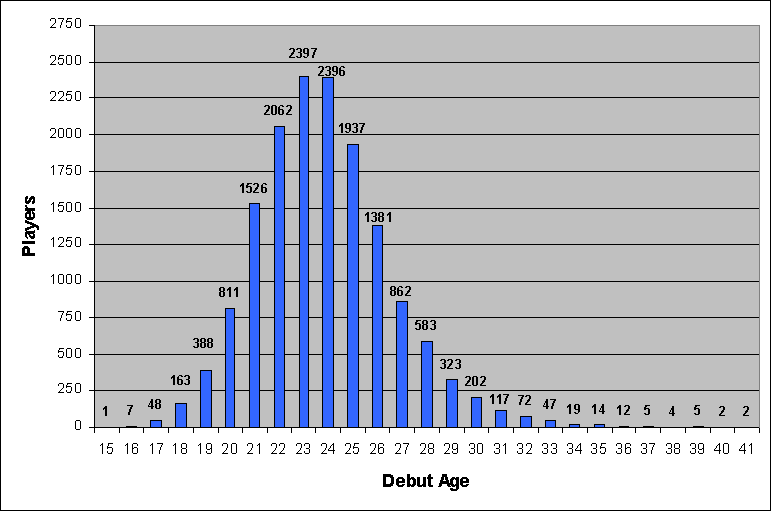
Distribution of Major League Debut Ages, Since 1901
 Source: baseball-reference.com
When Mora played in his first game, he was already 27, which, by rookie standards, is rather long in the tooth. Since 1901, only 1,177 non-pitchers have debuted in the majors at that age or older, and just over one-quarter of that total lasted long enough to play a season’s worth of games. Mora defied the odds, however, and stuck around for 13 years.
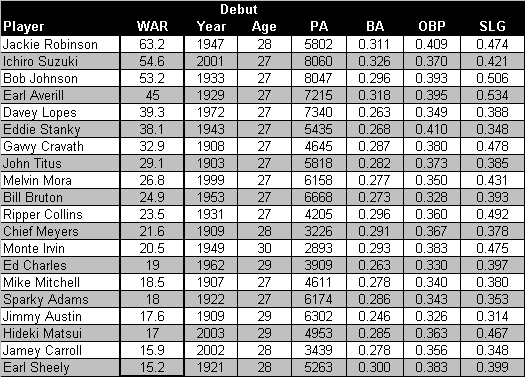
Among players breaking into the majors at age 27 or older, Mora ranks ninth in terms of cumulative WAR. At the top of the list is Jackie Robinson, whose debut was delayed by baseball’s color barrier, followed by Ichiro Suzuki, who got a late start in the majors because he previously spent nine seasons playing inJapan. Considering the extenuating circumstances pertaining to Robinson and Ichiro, Bob Johnson is more aptly considered the player who made the most of a late start. In 13 seasons following his promotion at the age of 27, Indian Bob posted a cumulative WAR of 53.2 during a career that featured seven All Star appearances. Who knows, had Johnson broken into the big leagues sooner, he could have end up as a Hall of Famer?
Late Bloomers: WAR Leaders Among Players Who Debuted At Age-27 or Older
Source: baseball-reference.com
At the other end of the spectrum is a player like Bob Lillis, who had the misfortune of being a short stop in the Dodgers’ farm system while Pee Wee Reese was going strong. In addition to be being buried on the depth chart, Lillis also had to contend with frequent injures, but, at the age of 28, he finally preserved by making the majors in 1958. Lillis actually had a very strong debut season, batting .391 in 69 at bats, but found himself now taking a back seat to new starting short stop Don Zimmer. After his first season, it was all down hill for Lillis, who ended up with an OPS+ of 55 and WAR of -6.9 over a career that spanned almost 2,500 plate appearances in 10 seasons. Apparently, good things don’t always come to those who wait, but at least Lillis qualified for the pension.
Lillis was lucky to stick around for so long because so many others in a similar situation were only given a fleeting glimpse of life in the majors. Moonlight Graham is probably the most famous case of such a player. At age 27, the right fielder finally got his big break, but it only lasted for 1 1/3 innings as a defensive replacement. Graham went on to become a doctor, and his story became immortalized on page and screen, but so many others had to be content with a page in the baseball encyclopedia (click here for list of players who appeared in one major league game). When you think about, even that’s not so bad, considering the thousands of career minor leaguers who would have given an arm and a leg (and some probably did) to join them.
Melvin Mora could have been one of those long suffering journeyman who never realized his dream. Instead, he is retiring after 13 productive seasons in the majors. Fortunately, Mora had the patience to wait for his chance, but it makes you wonder, how many others forfeited a big league career because theirs ran out?

Over at Fangraphs, David Laurila has a piece about Mariano Rivera:
”You need to use your brain to pitch effectively in the big leagues,” explained the future Hall of Famer. “You can’t go out there and do exactly what you want to do without a brain. As you get older, you mature and put your knowledge to work, It’s like when you go to school for the first time. In first grade, you’re not going to know what you know in the sixth or seventh grade. Pitching is just the same. If you don’t learn, you won’t have the success that you could have. I‘ve learned a lot over the years.”
Larry Rothschild, the Yankees’ pitching coach, agrees.
“Mariano is incredibly smart,” said Rothschild. “He’s also obviously incredibly gifted and has a great knack for trusting his ability. That’s why he attacks the strike zone like he does. He has a pitch that, if he throws it right, is going to get any hitter out, at any time. He knows that, and just as importantly, he knows how to pitch. There is the term, ‘he gets it,’ and Mariano gets it. Totally.”
[Painting by The Lost Collector]
What could the 2014 Yankees get for $189,000,000.00?

C: Jesus Montero, $0.5 (24)
1B: Mark Teixeira, $23.2 (34)
2B: Robinson Cano, $23 (31)
3B: Ryan Zimmerman, $23 (29)
SS: Derek Jeter $8 (40)
LF: Yoenis Cespedes $7.5 (28)
CF: Brett Gardner $9 (30)
RF: Mason Williams $0.5 (22)
DH: Alex Rodriguez $26 (38)
$120.7
Free agents required: 3 – Cespedes, Cano, Zimmerman, $53.5 million
Leaps of faith required: 2 – Jesus Montero is a catcher, Mason Williams, or someone else currently in the system is a Major Leaguer
Other concerns: Derek Jeter at SS at 40, but if he chooses to play, I don’t know how that can be avoided
BUC: Austin Romine $0.5 (25)
MIF: Eduardo Nunez $2 (27)
OF: Slade Heathcott $0.5 (23)
UTIL: Corban Joseph $0.5 (25)
$3.5
SP: CC Sabathia $24.3 (33)
SP: Cole Hamels $23 (30)
SP: Ivan Nova $2 (27)
SP: Manny Banuelos $0.5 (23)
SP: David Phelps $0.5 (27)
$50.3
Free agents required: 1 – Cole Hamels, $23 million
Leaps of faith required: 3 – Nova is good, the Yankees currently have 2 Major League quality pitchers in their system and will identify the correct ones and will not destroy them in some weird way
CL: David Robertson $4 (29)
RP: Hector Noesi $0.5 (27)
RP: Dellin Betances $0.5 (26)
RP: Jairo Heredia $0.5 (24)
RP: Chase Whitley $0.5 (25)
RP: Jose Quintana $0.5 (25)
RP: Nik Turley $0.5 (24)
$7
Fifteen league-minimum guys on the rest of the 40-man roster: $7.5 million.
$120.7 + $3.5 + $50.3 + $7 + $7.5 = $189
This version of the 2014 Yankees has the lineup and rotation to be strong contenders, but the weak bullpen is likely to betray them when it matters.
The overall point is that the Yankees have leeway to invest in three superstars for the 2014 roster and they absolutely should do that. I have them re-signing Cano and getting Hamels and Zimmerman but’s that’s just cherry picking the best free agents from the next few classes. To make room for those three superstars though, the 25-man roster needs to have 13 league-minimum players (two in the starting lineup, two in the starting rotation, three on the bench and six in the pen).
It’s recipe for disaster, but an entertaining one like 1987 or 2008. And the other route, eschewing the superstars in favor of a several medium-sized contracts, seems like a worse idea. The 2014 team might be better if they spread the money around (and it might not) but where will they go from there if they are constrained by a bunch of middling contracts? If this has to be the way they proceed, I say grab the stars when they appear and fill in the rest later.
So the topic to Banter, which three stars should be Yankees before 2014?

(A note on methodology. I used Cot’s as the basis for the Yankees 2014 obligations. And I used the following quote from the AP for the basis of payroll calculation in general:
Payroll figures are for 40-man rosters and include salaries and prorated shares of signing bonuses, earned incentive bonuses, non-cash compensation, buyouts of unexercised options and cash transactions, such as money included in trades. In some cases, parts of salaries that are deferred are discounted to reflect present-day values.

Over at Baseball Musings our old pal David Pinto suggests that the reason for the Yankees’ lack of spending could be because they don’t want to get hit with a major tax rate in a few years.

Photo: Getty Images
The trade market was supposed to be the Yankees refuge from this year’s class of overpriced, and perhaps overrated, free agents. Brian Cashman has reportedly been kicking the tires on several young pitchers, but, at least at this point, the demands have been too extravagant. One of the names in which the Yankees were believed to have an interest was John Danks, but now even he is no longer eligible for consideration. After weeks of espousing a “rebuilding philosophy”, the White Sox did a semi-about face and signed Danks to a five-year, $65 million extension.
Beyond the disappointment expressed by Yankees’ fans, the Danks extension was greeted by two common reactions. The first was confusion, namely, why are the White Sox handing out lucrative contract extensions when GM Kenny Williams has repeatedly talked about being a seller this offseason? The second reaction was incredulity over the terms, especially when compared to two recent extensions for pitchers with a similar amount of service time (Chad Billingsley and Wandy Rodriguez). However, both of these responses seem to miss a key point. Danks is a uniquely talented young lefty.
At age 26, John Danks is not that much older than some of the prospects over which so many drool. The difference, of course, is the White Sox’ left hander has five full major league seasons under his belt, during which he has compiled a WAR of 19.2. Put in a historical context, only seven other left handers, age-26 or younger, had a higher WAR over their first five seasons, and most on the list that surround him went on to very successful careers (1,769 pitchers qualified for this screen). In other words, not only has Danks been pretty darn good, but the best may be yet to come.
Top-15 Young Southpaws, from 1901*
 *Noodles Hahn’s career began in 1899, and his statistics before from 1899-1900 are excluded.
Note: Data is from first five seasons of left-handed pitchers age-26 or younger.
Source: baseball-reference.com
Although it should be noted that Danks’ performance has fallen off since his peak 2008 season, his peripherals are strong and, just as important, he is still relatively young. So, if his past performance and future potential are accurately depicted in the chart above, it’s easy to see why the White Sox would be willing to extend him even if in the midst of a rebuilding process. Talented young left handers are a very valuable commodity, and they tend to do very well in free agency. Had the White Sox allowed Danks to hit the open market after this season, there’s a good chance the then 28-year old would have commanded a contract well in excess of the extension he just signed. After all, the White Sox will be paying Danks over the next four years the same amount the Rangers just bid simply for the right to negotiate with Yu Darvish. And, if other teams agree that Danks’ contract is a relative bargain, the White Sox should have no problem trading him should the organization determine that its “retooling” will take longer than expected.
In contrast to my viewpoint, some have suggested that the White Sox were overzealous in their decision to extend Danks because Billingsley and Rodriguez, two pitchers who have been statistically similar, recently signed three-year deals for $35 million and $34 million, respectively. Off the bat, the comparison to Rodriguez fails because the Astros’ lefty was 32 when he signed his extension, or one year older than Danks will be when his new deal expires. Billingsley, however, is a good comparison, but since when does one contract define the market?
As mentioned above, there is every reason to believe Danks would have been a very popular free agent in 2012, which seems much more relevant than what Billingsley accepted last spring. Furthermore, a comparison of the two contracts requires that one look at risk in two ways. In addition to the increased exposure to injury and underperformance that comes from a longer-term deal, teams must also consider the risk of replacement cost. Assuming Billingsley and Danks perform up to expectations, which is the basis for offering an extension in the first place, both pitchers will likely command another lucrative contract when their current one expires. Should that scenario come to fruition, the White Sox will likely be enjoying Danks’ age-31 season at a discount, while the Dodgers are forced to re-extend Billingsley one year earlier (Los Angeles has a $14 million option for 2014). Although a myriad of variables must be considered, many based on conjecture, the possibility of Danks’ longer deal being more cost effective can’t be ignored.
Who knows how seriously the Yankees and White Sox discussed a deal for John Danks? For months, I have been advocating (and hoping) for such an exchange, but now it’s time to move on to another target. Without many attractive options remaining (maybe Gio Gonzalez and Matt Cain), however, the new question becomes just how far to look ahead? Yankees’ fans may not like to hear this, but it’s entirely possible this offseason is simply laying the groundwork for winters to come.

Over at Grantland, Jane Leavy has a long piece on Babe Ruth’s daughter, his last surviving relative:
He was the Babe, the Bam, the Big Bam, and the Great (and Bulby) Bambino (or Slambino); the Barnstorming Babe, the Bazoo of Bang, the Behemoth of Biff and Bust; Blunderbuss, and the Modern Beowulf. He was the Caliph and Colossus of Clout and Club, the Circuit Smasher and Goliath of Grand Slam, Homeric Herman and Herman the Great. He was the High Priest of Swat, and before that the Infant of Swategy. Also: the Kid of Crash, King of Clout/Diamonds/Swing, and, until Roger Maris, Hank Aaron, and the steroid marauders came along, the Home Run King. He was the Maharajah/Mauler of Mash, the Mauling Menace, Mauling Monarch, Mauling Mastodon, as well as the Mastodonic Mauler, Bulky Monarch, and Monarch of Swatdom; the Prince of Pounders, Rajah of Rap, Sachem of Slug, and Sultan of Swat; Terrible Titan, Whazir of Wham, Wali of Wallop, Wizard of Whack. And, not to be outdone, Damon Runyon added: “Diamond-Studded Ball-Buster.”
The priests at St. Mary’s Industrial School, the Xaverian reform school on the outskirts of Baltimore to which he was consigned at age 7, called him George. The parents who didn’t visit called him Little George. The boys incarcerated along with him called him Nigger Lips. The Red Sox called him the Big Baboon and sometimes Tarzan, a name he liked until he found out what it meant. The Yankees called him Jidge.
Julia Ruth Stevens, his sole surviving daughter, calls him Daddy. Odd as it is to hear a nonagenarian refer to a man 60 years gone as Daddy, it is also a tender reminder of the limits of hyperbole, how grandiose honorifics obscure the messy, telling details of an interior life.
To others he is a brand, an archetype, a lodestar. His shape is ingrained in our DNA. His name recognition, 96 percent, is higher than any living athlete. (His Q score, a measure of how much the people who know him like him, is 32 percent compared to 13 percent for today’s average major leaguer.) And yet, as well-known as he is, the most essential biographical fact of his life, one that demands revisiting what we thought we knew, one that Julia assumed everybody knew, remained unknown.

Trying to maintain low expectations about the Yu Darvish bidding, I wondered what the Yankees could do with all that money when they don’t get him. It would be nice to get both Cespedes and Soler in the system as the Yankee outfield gets very thin very fast after this year.
Perhaps because I’m in the process of finding presents for the extended family and because there’s a lot of talk around the coffee machine this morning about the Mets terrible financial situation, I thought about how the Yankees could help their fellow New Yorkers.
The Mets need money. How much? More. When? Yesterday. So here is a Christmas gift to the Mets: $22,000,000.00. The Yankees trade A.J. Burnett straight up for Johan Santana.
The Yankees rid themselves of the annual Burnett headache. By ERA, Burnett was the second worst starting pitcher in baseball since 2010. But ERA can be misleading. Don’t worry though, by FIP, he was the third worst.
Johan Santana from one point of view, was even worse than Burnett. Santana broke down in 2009 and then again in 2010 and didn’t pitch at all in 2011. And he’s coming off surgery to repair the anterior capsule of his left shoulder – one of the nastiest surgeries a pitcher can undergo. His level of performance for the rest of his contract, the same gauranteed length as Burnett, is a total mystery.
In this deal, the Yankees would give the Mets the gift of 22 million dollars (Santana’s gauranteed $55 million over the next two year and while A.J. Burnett will get $33 million over the same time span) and a reliable innings eater (reliably bad, but hey, count that money again) for the gamble that Johan Santana can bounce back into something special, or at least into a shadow of something special.
I have no idea if Santana will be any good as he tries to come back. But if he gets on the mound and he’s among the worst pitchers in baseball next year, he can only be two or three rungs below where A.J. Burnett has taken up residence.
I know there are better ways to spend $22 million than on a roll of the dice on Johan Santana’s recovery. If you can’t believe in a little magic during the holiday season though, when can you?
UPDATE: A report has the Toronto Blue Jays with the winning bid for Darvish.

When Albert Pujols decided to break his 11-year bond with the St. Louis Cardinals, there was much lament expressed about the perceived gradual decline in one-team, or legacy, players. Upon closer inspection, however, it appears as the practice of playing a long career in only one uniform has never really been that prevalent, which makes this rare breed all the more special.
Legacy Players by Franchise

Note: Based on a minimum of 10 seasons and 4,000 plate appearances with one team for positions players, and 10 seasons for pitchers. Year of retirement is used as basis for enumeration.
Source: Baseball-reference.com
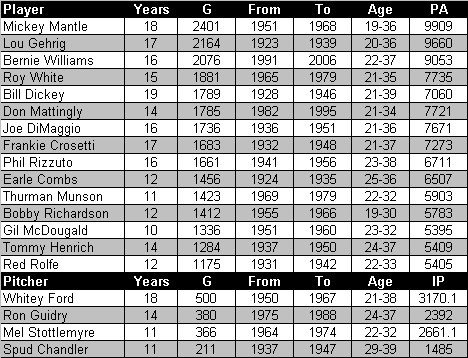
As illustrated by the chart above, the Yankees have had more legacy players than any other team. Beginning with Lou Gehrig and continuing on to current players like Mariano Rivera, Derek Jeter, and Jorge Posada, the Yankees have featured a litany of Hall of Fame players who never suited up for another team. This royal line of all-time greats has not only helped the Bronx Bombers compile one of the most impressive records of success in all of sports, but also created a rich history that has become an integral component of the Yankees’ brand.
Legacy Yankees
Source:Baseball-reference.com
The Yankees have had 19 “franchise players” (which could grow to 22 if the three aforementioned members of the core four retire in pinstripes), including several who are considered to be among the very best players in the history of the game. In comparison, the bottom-15 teams on the legacy chart (including six teams that do not have any) only have 16 such players combined. Despite this stark contrast, many teams do boast at least one prominent franchise player. Lists containing each team’s most tenured legacy position player and pitcher are presented below.
Leading Legacy Position Players and Pitchers, by Franchise
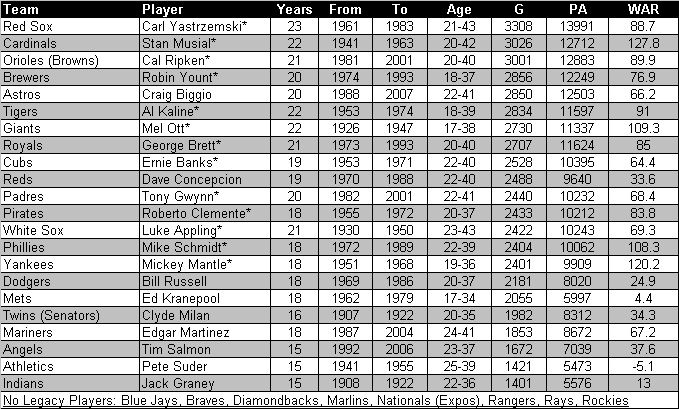

Note: Listed players lead their respective franchises in games played with only one team. * Denotes a Hall of Famer.
Source:Baseball-reference.com
Not surprisingly, many of the players included on the lists above are in the Hall of Fame. Among the position players, 60% are enshrined in Cooperstown, while 35% of the pitchers (and 55% of the starters) have a plaque hanging in the Hall’s gallery. Although most of the players, even those not in the Hall, are household names, there are also some who are rather obscure. None, however, were as futile as Pete Suder, who not only ranks as the Athletics’ all-time games leader among legacy players, but managed to post a negative WAR despite being afforded such longevity.
Stan Musial, Carl Yastrzemski, and Cal Ripken all made much better use of their opportunities than Suder. That trio comprises a select fraternity of players who appeared in over 3,000 games, all for one team. Meanwhile, Walter Johnson’s 935 games with the Senators easily outdistances all other legacy pitchers. However, it should be noted that when Mariano Rivera retires (assuming he ever does), his 1,042 games (and counting) would easily surpass the Big Train, although Johnson would retain the title among starters.
Potential Legacy Players
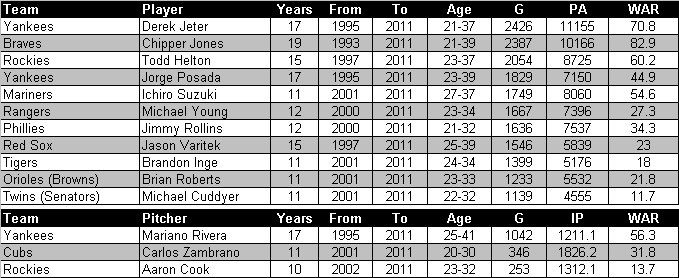
Note: Includes those players who meet the criteria outlined in the exhibits above, but who have not yet retired.
Source: Baseball-reference.com
Other current players creeping up on the list of legacy leaders include Chipper Jones, who could become the first Braves’ position player to spend at least 10 seasons and 4,000 plate appearances with the franchise. Similarly, Carlos Zambrano, Aaron Cook, Michael Young and Todd Helton could also become their franchise’s first legacy player/player, assuming they don’t sign with another team before retiring. Finally, Derek Jeter and Ichiro Suzuki are also in line to join the list by overtaking Mantle and Edgar Martinez, respectively, for their team’s leadership position.
How important is it for a player to spend his entire career with one team? Does it matter that Ron Santo, the quintessential Cub, played his final season for the cross-town White Sox? Or that Willie Mays and Hank Aaron capped off their historic careers by returning to the cities where they started, but with a different franchise? How many people even know Yogi Berra had nine plate appearances with the Mets, Christy Mathewson pitched his last game with the Reds, and Ty Cobb passed the 4,000-hit plateau wearing the uniform of the Philadelphia Athletics? Granted, in situations like Albert Pujols’, when a player splits a long career with two different teams, there can be a conflict of loyalties, but for the most part, staying true to only one team is little more than trivia bookkeeping. It may be fun to discuss and romanticize, but lasting legacies are created by the impact a player makes in a uniform, not how long he wears it.
Let’s all agree that before you write an article about trading Jesus Montero for a starting pitcher, that starting pitcher needs to be better than current free agent C.J. Wilson.
For the last two years, C.J. Wilson has been better than Gio Gonzalez in almost every way. Wilson pitched more innings, kept balls in the park at a better rate and walked fewer batters. They whiffed guys at close to the same rate, but Gonzalez jumped up in 2011 to claim a slight edge. That’s in raw numbers. When you look at the home road splits, it becomes clear we are talking about two different animals. Wilson is stellar outside the harsh environs of the Ballpark in Arlington. Gonzalez is ordinary once removed from Oakland and its acres of foul territory.
The main knock against Wilson is that he has walked 167 men in the last two years. Gonzalez has issued 183 free passes in 25 fewer innings.
Gio Gonzalez is five years younger than C.J. Wilson and still under team control for several years. His explosion in strikeouts in 2011 bodes well for his future. Those are huge points in his favor, no doubt. He’s projectible and cheap and certainly may be better than C.J. Wilson in a few years when Wilson gets older and Gonzalez is in his prime. But Jesus Montero is under team control for six more years. Which sounds better, Jesus Montero for six years and C.J. Wilson for whatever it takes to sign him? Or Gio Gonzalez for four years and whatever bat they have to sign to replace Jesus Montero?
The Yankees are not making headlines during the Hot Stove season, so the writers are left to make their own heat. Hey, I’d love to see Gio Gonzalez at the back end of the staff while he tries to get those walks down and learns to pitch to Death Valley in Yankee Stadium. But not at the cost of six years of a bat like Montero’s. Not when a better version of the same pitcher can be obtained on the free agent market.
Over at River Ave Blues, Joe Pawlikowski suggests that Mark Teixeira could be 2012’s biggest offensive addition for the Bombers.

Oh, and check out this interesting note by Chad Jennings on the lack of trades made by the Yankees in the last year.

So far, the Hot Stove has resembled more of a cold shoulder. Despite some very high profile names, the early transactions this offseason have mostly involved a myriad of middle infielders and back-up catchers. Although the wheeling and dealing should ratchet up a notch during next week’s Winter Meeting, the relative silence to this point has been a little surprising.
Among all the free agents available on the market, Albert Pujols is the cream of the crop. However, with the exception of a recent report about interest from the Cubs, there hasn’t been much talk about where the three-time MVP will wind up. In fact, there was more early speculation surrounding Pujols last year, when he and the Cardinals flirted with a contract extension.
There are two factors complicating Pujols first crack at free agency. The first one is the major market teams either already have a big ticket first baseman (Yankees and Red Sox) or are currently embroiled in a financial morass (Dodgers and Mets). The second factor is the free agency of fellow first baseman Prince Fielder, who is not only four years the junior of Pujols, but, in 2011, actually had a better season with the bat than the Cardinals’ stalwart.
Top-10 Career OPS+ Leaders

Note: Minimum 3,000 plate appearance
Source: Baseball-reference.com
Despite some of the concerns about Pujols emerging mortality, it’s worth noting that while his OPS+ of 150 was the lowest of his career, that level of production was still eighth best in the National League (and higher than Fielder’s career rate of 143). That some would consider his 2011 campaign worthy of a red flag indicates how historically spectacular Pujols’ career has been.
Most Seasons as OPS+ League Leader
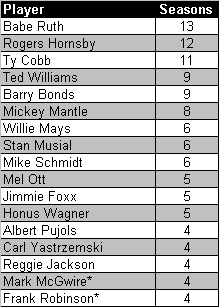
*Was the leader in both the American and National Leagues.
Source: Baseball-reference.com
Only seven players with at least 3,000 major league plate appearances can boast an OPS+ higher than Albert Pujols’ career rate of 170, and all of the names ahead of him qualify for the inner circle of baseball’s immortals. On a per season basis, Pujols has led his league in OPS+ on four different occasions (including three straight seasons from 2008 to 2010), an accomplishment bettered by only 12 other players.
Intuitively, most people have regarded Pujols as the best hitter, if not best player, in the game, at least up until last year. Instead of awarding that title subjectively, however, I thought it might be interesting, and fun, to pass the torch using statistics. For this purpose, OPS+ seemed like the best metric to use. Although there are other statistics like wOBA that better measure overall offensive performance, OPS+ still has the advantage of being more well known, easier to compute, and adjusted for ballpark and era. Also, instead of taking one-year snapshots, sustained periods of excellence seemed more appropriate. Is 10 years the right barometer? That can be debated, but if it’s good enough for the Hall of Fame, it’s good enough for me.
“Diamond Kings”: Succession of OPS+ Leaders Over 10-Year Periods

Note: Minimum 5,000 plate appearances for each 10-year period.
Source: Baseball-reference.com
Based on the chart above, Pujols has been a Diamond King for the past four seasons, joining a royal lineage that began with Nap Lajoie and almost exclusively includes undisputable legends. A quick scan of the list reveals all the names you’d expect to be included: Honus Wagner, Ty Cobb, Rogers Hornsby, Babe Ruth, Lou Gehrig, and so on. However, there are some surprises. Bill Nicholson is probably a name not well known even among many diehard fans, but for three 10-year periods, he ranked as the top hitter in the game. Of course, his era of dominance happened to coincide with World War II, which, at the risk of disparaging his accomplishment, probably explains his inclusion. The only other ranking member of the list who isn’t in the Hall of Fame (excluding those not yet eligible) is Dick Allen, who was the top dog for four 10-year periods. Unlike with Nicholson, however, there is no extenuating circumstance. Allen’s career OPS+ of 156 ranks among the 20 best all-time, which makes his Cooperstown snub one of the most unfortunate.
Two other unlikely names who can lay claim to an OPS+ crown also happen to be former Yankees. Although no one would dispute that Wade Boggs and Rickey Henderson were all-time greats, their presence atop a list that disproportionately favors sluggers is somewhat surprising. Nonetheless, it does help to illustrate how complete their offensive games really were. In many ways, Henderson and Boggs are two of the most underrated Hall of Famers, even though most people hold them in very high regard.
Finally, the biggest surprise from the list above is one who is not included: Ted Williams. If the threshold considered had been 4,000 plate appearances, Teddy Ballgame would have been front and center for most of his career. However, because of his two stints as a fighter pilot in the Marine Corps, the Splendid Splinter never qualified. I like to think his exception proves the rule.
Pujols’ status as one of the greatest hitters in baseball history isn’t exactly a secret, but it’s still impressive to consider his body of work within the context of the all-time greats. Entering his age-32 season, the future first ballot Hall of Famer may no longer be in his prime, but if continues to keep the same company he has enjoyed for his entire career, there’s no reason to think his twilight will be a flicker.
Where will Pujols end his career? In St. Louis? How about Chicago? Pinstripes might look nice. Regardless, Prince Albert remains the King, and my bet is he isn’t yet ready to submit to a succession.

If you are looking for a holiday gift for a young Yankee fan, look no further than All You Can Be: Learning and Growing Through Sports, by Curtis Granderson. It’s a trim, glossy, hardcover book, illustrated by students from New York City’s public schools, and it is nicely done. It also includes some fun pictures of Curtis as a kid.

The artwork is beautiful.

Painting by Logan Hines, 7 years old (Queens)

Detail of picture by Nancy Lin, 5th Grade P.S./IS 49 (Queens)

Happy birthday Mr. Rivera.

The last major league player to wear Jackie Robinson’s number turns 42 today.
When I’m trying to get to sleep, I solve little puzzles to wind down my brain. Lately, I’ve been working on how the Yankees could acquire the best player at every position. Quickly, it becomes logistically impossible. There’s no way to pry Tulowitski or Longoria or Kemp or Braun away from their current teams.
However, changing the criteria slightly to acquiring the best available players at every position, things become doable. Absurdly expensive, but doable.

At first base, Albert Pujols, that’s easy. Keep the rest of the infield. Cano is the best second baseman for me over the last two years anyway, and close enough to the best overall that there’s no reason to upgrade. Jeter is required to maintain the idea that this is indeed the Yankees we’re talking about. And Arod, even that close to dreaming I can’t imagine some other team wanting to deal with him.
In the outfield, Granderson and Gardner might be the best outfielders available for their spots. For the other outfield spot, I’d gamble on the Cuban star, Yoenis Cespedes, though I guess Beltran is the best established player available. For DH, sign Prince Fielder. Note, every acquisition at this point is just a matter of money.
Now the hard part. Catcher. Perhaps this is the result of a midnight haze, but I think the Yankees could get Joe Mauer with Montero and others (Nova, Banuelos, etc). Mauer is now ridiculously expensive, has never been an Iron Horse, and has, for the first, time, turned in a stinker of a season. I think that the Twins could be persuaded that his contract is no longer in their best interests.
So that lineup is now something like Granderson, Mauer, Pujols, Fielder, Arod, Cano, Cespedes, Jeter, Gardner. Teixeira will DH against lefties and have to learn how to play 3B again to back up Arod. Russell Martin will be the back up catcher. Swisher is the fourth outfielder. To back up Jeter and Cano, and eventually replace Jeter, sign Jose Reyes.
The rotation is even easier. Sabathia is back. Send the rest of the Yankees staff to the pen (figure Nova is headed to Minnesota in the Mauer deal) and sign Wilson, Darvish, Buerhle and Oswalt, or the four best pitchers according to you.
We already have the best closer and possibly the best set-up man in Robertson. At times, Soriano is among the top relievers in the game. Add in Heath Bell, I guess, if he’s any good. I am always asleep before I get to the bullpen, so this is not as well considered. The demoted starters will pitch in where they can. Too bad Pabelbon signed elsewhere.
The 2012 Yankees would cost around, what, $350 million? Why not? It’s not my money so I won’t lose any sleep over it.
[Picture via Onion Sports Network]

The offseason awards season hasn’t been very kind to the Yankees so far. Ivan Nova and C.C. Sabathia, the team’s respective candidates for the Rookie of the Year and Cy Young, both finished a distant fourth in the voting, but at least that was one slot ahead of manager Joe Girardi, who placed fifth in Manager of the Year balloting. With only MVP left to consider, and Curtis Granderson considered somewhat of a long shot, chances are the Yankees will wind up empty handed.
Yankees’ Historical Award Totals
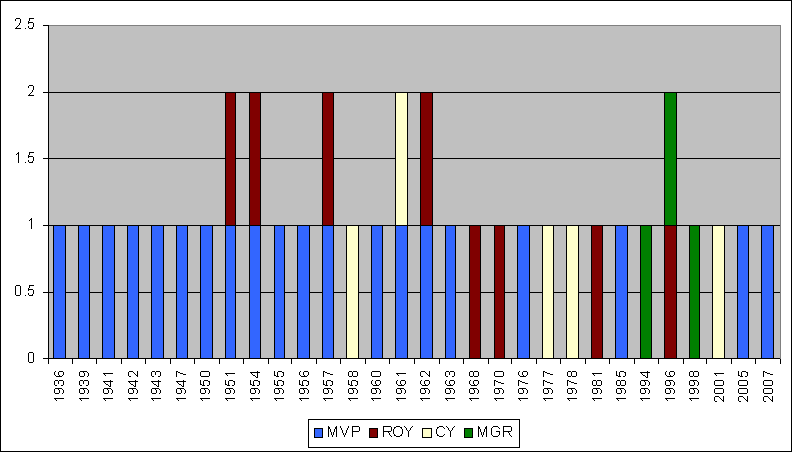
Note: MVP first awarded in 1931; RoY in 1947 (one award until 1949); CY in 1956 (one award until 1967); MoY in 1983
Source: mlb.com
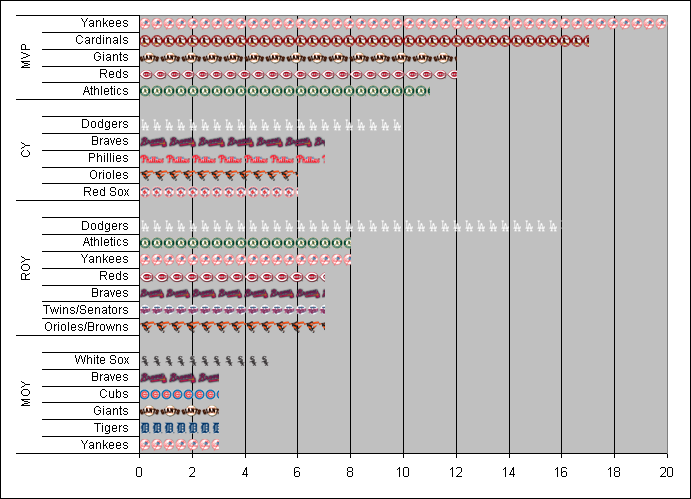
To go along with all of the franchise’s other accolades, the Yankees have had more MVPs than any other team, and also rank among the leaders for all of the other major awards. However, since 1985, only seven awards have been handed out to the pinstripes, and three of those were to the manager. Many Bronx Bomber fans probably view this as evidence of bias against the team within the ranks of the BBWAA, but it might also speak to how well rounded the Yankees have been over the last two decades.
Top Major Award Winners, by Franchise
Source: mlb.com
Since the award was first bestowed upon Jackie Robinson in 1947, the Rookie of the Year has become synonymous with the Dodgers. With four honorees while in Brooklyn and 12 while in Los Angeles, the Dodgers have consistently churned out talented youngsters. The franchise’s 16 Rookie of the Year trophies not only equal the combined total of the next two teams, but also include two stretches of at least four consecutive winners, each of which alone would sum to more awards than the individual totals for 18 other teams. What makes the Dodgers’ RoY dominance even more impressive is the award requires a new winner every season, so having one or two great players doesn’t account for the lion’s share of a team’s total.
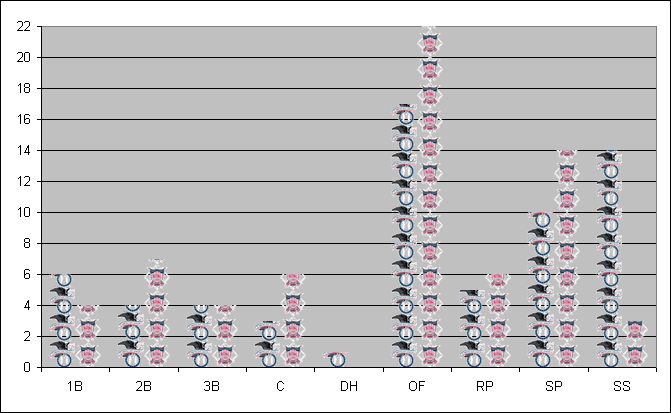
Along with the Athletics, the Yankees lead the American League with eight Rookie of the Year winners, but Derek Jeter has been the franchise’s only honoree since Dave Righetti won the award in 1981. Jesus Montero has a good chance to break that drought in 2012, assuming the Yankees are able to find him a position. In the almost 40 years since the DH was created, only the Royals’ Bob Hammelin, who bested Manny Ramirez, has won the Rookie of Year by taking most his at bats as a designated hitter. At this point, that seems to be the Yankees’ plan for Montero, so in order for him to win the honor next season, he’ll have to buck that historical trend.
Rookie of the Year Winners, by Position and League
Note: Players considered only at the position they played the most.
Source: mlb.com
Manager of the Year is perhaps the most nebulous of the four major awards. Apparently, a successful manager is not only judged by the performance of his team, but by the lack of payroll allotted to it. That’s unfortunate for Joe Girardi now, but, when he became the only MoY to win the award with a losing record while with the Marlins in 2006, it was Willie Randolph who was left to lament.
Although the MoY is the most recent of the major awards, it rivals the RoY in terms of broad distribution. Only the Mets and Brewers have never had a manager win the honor (the Diamondbacks are the only team without a RoY), meaning more teams have had MoY designees than the Cy Young and MVP (25 teams each), both of which have been around much longer.
This year, both MoY selections made a bit of history. In the A.L., Joe Maddon became the 12th manager to win the award at least twice, while in the N.L., Kirk Gibson joined an even more select fraternity. Along with his 1988 MVP, Gibson’s MoY award makes him only the four person to win both trophies, joining Joe Torre, Frank Robinson and Don Baylor.
Multiple Manager of the Year Winners

Source: mlb.com
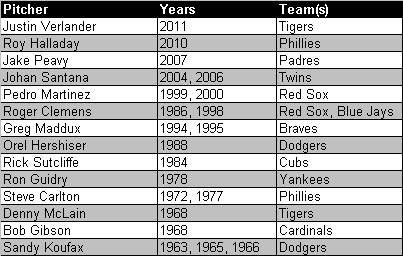
To no one’s surprise, Justin Verlander was unanimously selected as Cy Young in the American League, making him only the 14th different pitcher (and 21st selection) to be so honored. Verlander was also the first Tigers’ starting pitcher to win the award since Denny McLain won it consecutively in 1968 and 1969. Among the pitchers Verlander beat out for the award was C.C. Sabathia, who finished a distant fourth (the big lefty has finished no lower than fourth in the balloting during all three of his seasons in pinstripes). Although Sabathia didn’t seem to get much serious consideration for the top of the ballot, it’s worth noting that fangraph’s version of WAR actually had the Yankees’ ace leading the American League.
In the National League, Clayton Kershaw was named Cy Young, becoming the youngest pitcher to win the award since a 20-year old Dwight Gooden in 1985 and adding to the Dodgers’ major league leading total of 10 honorees. In order to win the award, Kershaw had to beat out reigning Cy Young Roy Halladay, who led the National League in both versions of WAR. Perhaps the electorate has grown a little weary of honoring Halladay, but even so, it’s hard to argue with Kershaw credentials.
Unanimous Cy Young Award Winners
Source: mlb.com
This year’s MVP vote in the American League could be among the closest ever. In addition to prominent candidates from most of the contending teams, Jose Bautista had another phenomenal season, so there is no lack of deserving winners. However, most of the attention has revolved around whether Verlander could, or should, win both the MVP and the Cy Young.
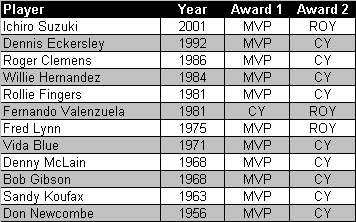
In the 55 years of concurrent history between the two awards, nine pitchers have been named both Cy Young and MVP, and of that total, three of the last four have been relief pitches. So, needless to say, the BBWAA has been at least a little reluctant to give the MVP to a player who takes the field less than 40 times per season. But, was Verlander’s 2011 campaign strong enough to mitigate that reticence?
Players Who Have Won Two Major Awards in One Season
Source: mlb.com
Regardless of where you come down on the Pitcher-as-MVP debate, Verlander stands on the verge of an even more select accomplishment. Should the Tigers’ right hander add to his trophy case next week, he’ll join Don Newcombe as the only player to be honored as a RoY, Cy Young, and MVP. The Newk, who was voted the top rookie in both leagues for 1949, was named MVP and Cy Young five seasons later in 1956 (he missed three years to his service in the Korean War). If Verlander is similarly honored, he will have taken the same path to join Newcombe.
In the National League, the MVP race seems to be a two horse race, with Ryan Braun having the edge over Matt Kemp because of the relative success of his team. If the two players do finish 1-2, it would be appropriate for several reasons, not the least of which is both men recently signed mega-contract extensions that will pay them over $20 million per season into the next decade. Needless to say, the Brewers and Dodgers will be hoping this isn’t the last time Braun and Kemp find themselves atop the MVP balloting.
MVP Winners, by Position and League
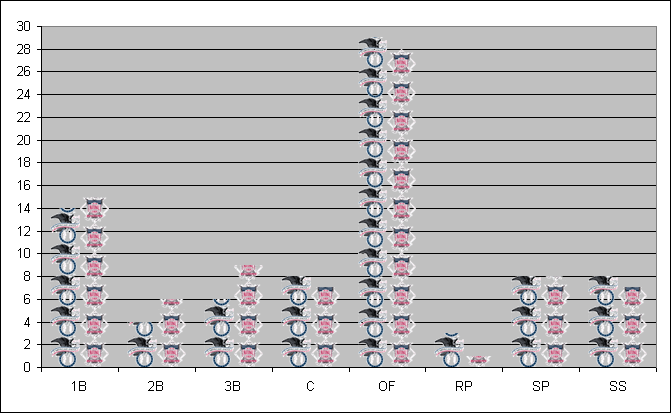
Note: Players considered only at the position they played the most.
Source: mlb.com
The baseball awards season not only provides a cap on the current year, but also the perfect segue into the Hot Stove. Before too long, fans will be digesting their team’s winter acquisitions and projecting which players are poised for a break-out season. Among that group could be next year’s major award winners, but those future Cy Youngs, RoYs and MVPs will have to wait. The spotlight still belongs to this year’s Boys of November.

Last night, Jorge Posada told reporters: “I don’t think there’s even a percentage of a chance that I can come back,” Posada said. “It’s not going to happen.”
We’ve talked about Posada’s fine Yankee career a lot this year. Tomorrow, William J will weigh-in on Posada’s case for the Hall of Fame.

I was flipping around the channels the other day and found a baseball game on the MLB Network. And there was Robinson Cano playing for the American team in Taiwan. It took me a moment to adjust to seeing him in uniform. It was like seeing someone still wearing their Halloween costume. Then I wondered, “Hey, should you be playing? Don’t guys get tired or hurt if they play in November?”
But I remembered that he’s a professional baseball player and that’s what he does. Then Cano smiled and I felt relieved and turned back to the football game.
Over at YES, Jack Curry has a little piece on Cano in Taiwan.
[Photo Credit: Washington Post]