After next season the Houston Astros will play in the American League West. Two extra teams will be added to the playoffs in 2013, as well.



After next season the Houston Astros will play in the American League West. Two extra teams will be added to the playoffs in 2013, as well.
I’ve tuned into the Nathan’s Hot Dog eating contest a few times. I’d never consider joining an eating contest, but I like a good gross-out as much as the next guy.
Eating challenges, on the other hand, those intrigue me. The Old ’96er for instance. There’s a whole show dedicated to them on the Travel Channel. The few times I’ve been to places that offered a challenge, I was tempted to try it.
Up all night on Monday at a concert in Newark, I was empty this Tuesday at lunch. I ordered this:

That’s a Grand Slam from Go Go Curry. A chicken cutlet, a pork cutlet, an egg, two sausages, a fried shrimp all covered in a thick, brown curry. There’s a pile of shredded cabbage on the side. And underneath all that is a mountain of rice. With nothing on the line but my pride and my 12 bucks, I bid adieu to all but the rice. The rice just kept coming and I ended up leaving about a handful on the plate.
Maybe if I wasn’t headed back to work and if I didn’t have to play basketball that night, maybe I could have taken it down. But I was happy I left it there.
How about you guys – what was your biggest eating challenge?

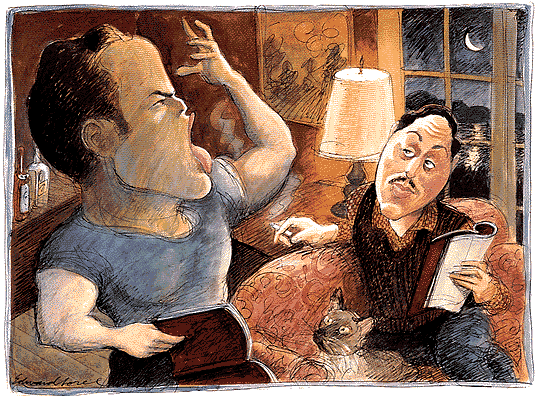
Sunday and Monday on American Masters:
Watch Woody Allen: A Documentary on PBS. See more from AMERICAN MASTERS.

Richard Hoffer is one of the best writers to ever cover sports in this country, first at the L.A. Times and then at Sports Illustrated. His prose is graceful and precise, he’s understated and funny.
Here is he on Joe Frazier and Muhammad Ali in the current issue of SI:
It was no wonder Joe Frazier was so bitter. He was made to seem the foil, a mere accomplice in mythology, consigned to a supporting role in Muhammad Ali’s extravagant, ego-driven drama. It is a harsh truth that if you participate in the most exciting rivalry of a century, it does you little good even to win one of its three bouts. The verdict of history is decisive, and it is permanent, and men like Frazier, who stumble at the precipice, are forever remaindered on the heap of losers, their vinegary claims to justice lost in the courts of public opinion. It was no wonder, then, that when Ali lit the Olympic torch in 1996, his trembling hands viewed as a physical artifact of heroism by an adoring world, Frazier allowed that if he’d had his way, he’d have pitched Ali into the fire.
…In 1975—Ali now 33, Frazier 31—they met again in the near-death experience that would ever after be known as the Thrilla in Manila. Ali was even crueler in his prefight taunts, exploiting the fact that gorilla rhymed with the venue. Frazier, by turns mystified and hurt, was provoked beyond the requirements of the bout. While Ali would always say he was only boosting the box office, Frazier could never accept any explanation for attacks that might affect his children’s impression of him. “Look at my beautiful kids,” he’d say. “How can I be a gorilla?”
But not even animus could account for what happened that morning in the Philippines. It was such a violent affair—recklessness tilting it first Ali’s way, then Frazier’s way and then Ali’s again—that it seemed less a boxing match than an exploration of man’s capacities, a test of his will to win or at least survive. But once it turned Ali’s way again in the 12th round, too much had gone before for yet another reversal. There wasn’t anything left in either man. Before the 15th and final round Frazier’s trainer, Eddie Futch, called it quits, saving his fighter from certain ruin, even as Ali was instructing his corner to cut his gloves off. It was victory, but by attrition.
Ali called it “the closest thing to dying I know of,” and he didn’t know the half of it. Their careers were essentially over that day, their 41 rounds of shared agony making any further discoveries in the ring unnecessary, or even possible. Frazier lost a rematch to Foreman and called it quits. Ali managed to dominate the game for several years more, but only on the basis of his personality—he was spent. Even then he was beginning a slow and ironic decline, Parkinson’s eventually rendering him rigid and mute, the final price for all those wars.
Ali’s respect for Frazier was enormous, and he apologized for his name-calling on several occasions. “I couldn’t have done what I did without him,” he once said.
Frazier repaid the compliment: “We were gladiators. I didn’t ask no favors of him, and he didn’t ask none of me.” They recognized that their destinies were entwined, that neither would have achieved his greatness without the other. But Ali could afford to concede the point, being the most popular athlete, even personality, in the world. Frazier, who spent the rest of his life living above his gym in Philadelphia, did not have the comfort of the world’s goodwill—he lived in an age that would reward style over substance every time—and so maintained his half of the blood feud as vigorously as possible, even seeming to take a grim satisfaction in Ali’s poor health, proof of who really won that day in Manila.
That a feel-good reconciliation would elude the two men who shaped such a magnificent rivalry is apt. Even if they were more like brothers than foes—who else could understand the kind of pride that forced them through those three battles?—fighters like them could never really enjoy a cease-fire, could never drop their hands, as if they alone knew what man was truly capable of.

Some baseball stuff.
Over at Fox Sports, Ken Rosenthal weighs in on the search for a new manager in Boston.
Meanwhile: a look at the Mets’ new uniforms; Eric Chavez wants to play next year; Ben Kabak on Yu Darvish; Steven Goldman on Ivan Nova, and William J on Joe Girardi’s lack of support for Manager of the Year.
[Photo Credit: Oyl in Tokyo]
[Photo Credit: N.Y. Times]

“Jeanne Hebuterne with Hat and Necklace,” By Amedeo Modigliani (1917)

Michael Popek, better known around these parts as “unmoderated,” runs a used and rare bookstore in upstate New York. Several years ago he started a fascinating blog called Forgotten Bookmarks. Now, he is the author a book devoted to the forgotten bookmarks he finds along the way.
Michael has written pieces on this subject for the Times Union, the Huff Post, and the Wall Street Journal. Recently, he took a few minutes out to chat about his blog and the new book. Dig:

Bronx Banter: Are all of the images that are in the book ones that also appeared on the blog?
Michael Popek: I don’t remember the exact ratio, but I believe that 60 percent of the items in the book are exclusive and haven’t appeared online. I wanted to reward the loyal readers with lots of fresh material and at the same time give new fans a look at some of the best stuff from the site.

BB: How did you choose which ones were fit for the book?
MP: It wasn’t easy deciding what to choose; when I was working on the manuscript, there were more than 600 entries on the blog and I had a collection of more than 1,000 unpublished items. I tried to pick the strangest, the funniest, the most poignant; items that might make a reader think about the time and place, the history of the bookmark. I also wanted to offer a good variety, so I tried to keep an even number of photos, letters, postcards, notes, etc. In the end, a few items had to be dropped because of copyright issues, but I don’t think any of those items take away from the entire collection.

BB: Do you save the books, along with their bookmarks? Or do you still sell the books and save the bookmarks?
MP: I save all of the bookmarks, and many of the books. As a bookseller, however, the nicer titles need to be on the shelves so I can’t afford to keep them around forever.
BB: When my dad died I went through most of his books and found random things–a voter registration card from 1977, a dry cleaning bill from the 1960s. You can let your mind wander and try to piece together a story from these fragments even though the randomness means that it can’t really tell you about someone. Have you built stories in your mind from your found bookmarks?
MP: Absolutely, I think all of us do – it’s part of the fascination with found items. It’s easiest with the old letters I find, my mind immediately creates a voice, like I would if I was reading a novel. I can instantly picture the letter writer’s face, the way they position their hand as they write, the items on their desk, the weather outside their window – I can’t help it.

BB: There is an element of voyeurism in found items. Have you ever felt uncomfortable with something you’ve found in a book?
MP: One of the most interesting things I found was just too personal to post online. It was a suicide note from the 1930s, and although there were no names or places mentioned, the emotion was too much. Being this kind of voyeur is often a lot of fun, but that’s something I wish I hadn’t seen.
BB: Wow, that’s heavy, man. On the other hand, have you sound something so intimate that you found it to be beautiful?
MP: I can think of one in particular. It was a break-up letter, found in “While Waiting,” a pregnancy book. It started out:
Dear Aeneas,
I cannot believe what a slime you are. What I ever saw in you in beyond me. Sarah’s mind must be warped – I love her but how she managed to spend 2 years with a manipulative sadist like you is incredible (yes she told me.)
BB: How did you arrive at the format for the book, a small, handsome hardcover, as opposed to a glossy picture book?
MP: That was up to the publishers, for the most part. I had stated in my book proposal that I wanted to produce something that was vivid and in full color.
BB: I think the design of the book is ideal. I think a big, glossy book would spoil the flavor of these hidden treasures.
MP: I think producing a big coffee-table book might have been a bit risky for a first-time author like, those volumes cost a lot of money to print. In the end, I’m very happy with the way it turned out, the pages really come to life.

BB: As a bookseller I’m sure you spend most of your time looking through collections of books. How deep has the bookmark project seeped itself into that process? Do you feel disappointed when you come across books that are “clean,” and does your heart skip a beat when you initially see a bookmark?
MP: It has completely changed the way I sort through books. I cannot let one go without checking every page for lost treasures. It has certainly reduced my sorting efficiency, but I think it’s worth it. The feeling I get when I find something good and juicy is as exciting as it was when I first started this treasure hunt.
BB: It reminds me of the feeling you got as a kid opening up a pack of baseball cards. Guess it’s more like a box of Cracker Jack, waiting for the surprise, right?
MP: Nah, I like the baseball cards metaphor better. You may get a Mattingly, you may get a Dale Berra – but in the end, at least you got some gum, or in my case, a book. All the Cracker Jack prizes were awful.

BB: I like the idea of a treasure hunt. I was talking to my cousin the other night. He grew up in L.A. and now lives in New York and when we first started hanging out in the ’80s, he’d come to town and I’d take him to used bookstores. He never goes to them anymore, not that there are many left. Nowadays, I don’t go to them as much as I used to, heck, I buy my books from you. But one of the charms of your book is that it brings back the accidental pleasures of hunting. Can you talk about that and how vital your business is these days?
MP: As long as there are books still around, there’s going to be someone like me selling them. Sure, the digital revolution in publishing is underway and showing no signs of slowing down, but that’s OK. E-readers can’t replace a signed copy. There are no first edition e-books. And most importantly, you can’t buy a used digital copy – yet. I’ve done my best to adapt to the new marketplace, and the shop has done pretty well. I always like to think about the success of the good record shops still around, and they give me hope for used book shops everywhere. They are both about the hunt, the browse, the discovery. Digging through the shelves is a lot like digging through the stacks, you may have wandered in looking for some Dionne Warwick, but you walk out with some Elvis Costello.
BB: I love Baseball-Reference.com, it’s an amazing tool, but you lose something from opening up the encyclopedia and finding names by mistake. I find the same thing with reading newspapers on-line. You don’t run across a stray article in the same way. I have a friend who runs a record shop and they don’t do very much business on line–consciously–and the store is a meeting place for a community of record heads. Do you have anything like that at your store? I assume you do a majority of your business on-line now.

MP: The local paper ran a story about it, since then there have been a lot of people in asking to see some of the stuff. Before that story, I don’t think there were a lot of local readers. I’ve had a few of fans of the blog make their way into the shop, one from as far away as California, but to be fair, in was in the area for a family wedding. Most of our sales do come from online venues, but I like to think that our success there allows keeping an open brick and mortar store. I really enjoy interacting with customers, and there is the collection of usual suspects that come in every few days. I have seen a few friendships blossom from encounters here; two older guys coming in looking for Vietnam books end up discussing their service days.

Forgotten Books can be ordered here.
And when you find yourself looking for any out-of-print books, check out Michael’s store. And tell him I sent ya.

Hey, all you out-of-towners. What’s your Manhattan address?

Friend of mine went to see Buddy Guy at B.B. King’s last weekend. Said he has a 12-year old kid opening for him.
Kid is no joke:
More funny stuff.
Dig this:
My Favourite Animal (5 min. version) from Lara Lee on Vimeo.
And while you are at it, this too:
The Great Sid Caesar:

Found a couple of intriguing posts about a new book, “On Rereading,” by Patricia Meyer Spacks.
First, from Nathaniel Stein at the New Yorker’s Book Bench:
“One cannot read a book: one can only reread it,” Nabokov said. I thought of that line while reading “On Rereading,” Patricia Meyer Spacks’s charming and strange blend of memoir, literary criticism, and scientific treatise. Spacks, a literature professor and a former president of the American Academy of Arts and Sciences, systematically revisits “The Wonderful Wizard of Oz,” “The Catcher in the Rye,” “The Golden Notebook,” the novels of Jane Austen, and other milestones of her reading life. She hopes to justify the usefulness—or at least to solve a bit of the mystery—of an activity that she loves but also, at times, doubts.
Few would question looking at a great painting twice, or watching a favorite movie again and again. But, perhaps because rereading requires more of a commitment than giving something a second look, it is undertaken, as Spacks puts it, “in the face of guilt-inducing awareness of all the other books that you should have read at least once but haven’t.” It engages, she fears in her darker moments, a “sinful self-indulgence.” Never mind Nabokov, or Flaubert, who marvelled at “what a scholar one might be if one knew well only five or six books.”
And here is Lisa Levy, over at The Millions:
In his often anthologized essay “On Reading Old Books,” William Hazlitt wrote, “I hate to read new books. There are twenty or thirty volumes that I have read over and over again, and these are the only ones that I have any desire to ever read at all.” This is a rather extreme position on rereading, but he is not alone. Larry McMurtry made a similar point: “If I once read for adventure, I now read for security. How nice to be able to return to what won’t change. When I sit down at dinner with a given book, I want to know what I’m going to find.” In her recent study On Rereading Patricia Meyers Spacks uses McMurtry as an example of someone who rereads to stubbornly avoid novelty, and unapologetically so. His refusal, like Hazlitt’s, to read anything new makes rereading a conservative if comfortable experience, vehemently opposed to the possible shock of the new.
Spacks herself feels slightly differently. She writes, “No reader can fail to agree that the number of books she needs to read far exceeds her capacities, but when the passion for rereading kicks in, the faint guilt that therefore attends the indulgence only serves to intensify its sweetness.” In Spacks’s scenario rereading is a forbidden pleasure, tantalizing and, contra Hazlitt and McMurtry, with an element of time wasted — an extravagance. The choice Hazlitt and McMurtry easily make weighs more heavily on Spacks, who knows she forgoes a new book every time she picks up an old one.
Yet there are far more positive spins put on rereading in Spacks’s book and elsewhere. Pleasure, after all, needn’t be a negative. Elsewhere in his essay, Hazlitt brings up a point which is raised often by rereaders: “In reading a book which is an old favorite with me (say the first novel I ever read) I not only have the pleasure of imagination and of a critical relish of the work, but the pleasures of memory added to it. It recalls the same feelings and associations which I had in first reading it, and which I can never have again in any other way. Standard productions of this kind are links on the chains of personal identity. They are landmarks and guides in our journey through life.”
I am not a voracious reader of fiction and have only read one novel, “The Sound and the Fury,” more than once. But I re-read non-fiction all the time, especially essays and articles. I like the idea of revisiting a novel, to see how my feelings may have changed but also as a way to remember where I was when I first read it.
Another project. I’m down.
[Photo Credit: Ashinine]

[Photograph by Sarah Lynch]