"A New York Treasure" --Village Voice

Blog Archives

Older posts            Newer posts

BGS: A Little Greedy, and Exactly Right

Red Smith is the most respected sports columnist we’ve ever had. In his prime, Jimmy Cannon, Smith’s friendly rival, was certainly as well-known. Cannon, the Voice of New York, was an emotional, colloquial writer whose reputation, unfortunately, has faded. But Smith endures. What is it about his writing that ages so well?

“It’s the same reason Shakespeare ages well,” Dave Anderson, the Pulitzer Prize-winning columnist told me recently. “He wrote beautifully, it’s as simple as that.”

The Library of America presents Smith’s finest work in the new collection, American Pastimes: The Very Best of Red Smith. It is available now and a must-read for all sports fans, young and old (and an ideal gift for Father’s Day). This week, with permission from Smith’s family, we’ll reprint a Red Smith column every day to offer you a sample of what he was all about. Today’s column is “A Little Greedy, and Exactly Right” which ran on June 11, 1973 the day after Secretariat won the Triple Crown.

So, enjoy, and for more on Smith, check outthis oral history from Jerome Holtzman’s classic, No Cheering in the Press Box; this excerpt from Stanley Woodward’s memoir, Paper Tiger; a nice tribute by his son, Terrance Smith; and this excerpt from Dan Okrent’s introduction to American Pastimes.Course it goes without saying that if you want to know from Red Smith you need to go find a copy of Ira Berkow’s excellent biography, Red.

“A Little Greedy, and Exactly Right”

By Red Smith

Belmont, N.Y., June 11, 1973 

The thing to remember is that the horse that finished last had broken the Kentucky Derby record. If there were no colt named Secretariat, then Sham would have gone into the Belmont Stakes Saturday honored as the finest three-year-old in America, an eight-length winner of the Kentucky Derby where he went the mile and a quarter faster than any winner in ninety-eight years and an eight-length winner of the Preakness. There is, however, a colt named Secretariat. In the Derby he overtook Sham and beat him by two and a half lengths. In the Preakness he held Sham off by two and a half lengths. This time he and Sham dueled for the lead, and he beat Sham by more than a sixteenth of a mile. There is no better way to measure the class of the gorgeous red colt that owns the Triple Crown. Turning into the homestretch at Belmont Park, Ron Turcotte glanced back under an arm to find his pursuit. He saw nothing, and while he peeked, his mount took off.

Secretariat had already run a mile in one minute, 34 1/5 seconds. Up to three weeks ago, no horse in Belmont history had run a mile in less than 1:34 2/5. He had run a mile and a quarter in 1:59, two-fifths of a second faster than the Derby record he had set five weeks earlier. Now he went after the Belmont record of 2:26 3/5 for a mile and a half, which was also an American record when Gallant Man established it sixteen years ago. With no pursuit to urge him on, without a tap from Turcotte’s whip, he smashed the track record by two and three-fifth seconds, cracked the American record by two and a fifth, and if Turcotte had asked him he could have broken the world record. If he had been running against Gallant Man, the fastest Belmont winner in 104 years, he would have won by thirteen lengths. Unless the competition spurred him to greater speed.

“It seems a little greedy to win by thirty-one lengths,” said Mrs. John Tweedy, the owner, and then repeated the rider’s story of how he saw the fractional times blinking on the tote board, realized there was a record in the making, and went after it in the final sixteenth.

It is hard to imagine what a thirty-one-length margin looks like, because you never see one, but Secretariat lacked eight panels of fence—eighty feet—of beating Twice a Prince by a sixteenth of a mile. This was the classic case of “Eclipse first, the rest nowhere.”

The colt was entitled to his margin and his record. At the Derby he drew a record crowd that broke all Churchill Downs’ betting records and he set a track record. He set attendance and betting records at the Preakness and may have broken the stakes record, but if he did discrepancies in the clocking denied him that credit. Last Saturday belonged to him.

Indeed, Belmont was kinder to the Meadow Stable than Pimlico had been, in more ways than one. On Preakness day, while the Tweedy party lunched in the Pimlico Hotel near the track, a parking lot attendant smashed up their car. They walked to the clubhouse gate, found they hadn’t brought credentials, and paid their way in. While the horses were being saddled in the infield, somebody in the crowd accidentally pressed a lighted cigarette against Mrs. Tweedy’s arm. On his way back to his seat, John Tweedy had his pocket picked.

“Boy,” he said after that race, “we needed to win this one today, just to get even.”

At Belmont there were the few scattered boos that most odds-on favorites receive here, but the prevailing attitude was close to idolatry. Well, perhaps that isn’t the best word because it suggests a cathedral restraint. Idols are remotely chilly. This congregation was warm. Horseplayers passing the Tweedy box raised friendly voices:

“Mrs. Tweedy, good luck.”

“Thank you.”

The voices followed her to the paddock where her colt was cheered all around the walking ring. They followed as she returned to the clubhouse.

“Mrs. Tweedy, good luck.”

“Thank you.”

Secretariat was cheered in the post parade, cheered as he entered the gate, and when he caught and passed Sham on the backstretch the exultant thunders raised gooseflesh. At the finish the crowd surged toward the winner’s circle, fists brandished high. After twenty-five years, America’s racing fans had a sovereign to wear the Triple Crown.

Parallels are striking between this one and his predecessor, Citation. Both colts raced nine times as two-year-olds and finished first eight times. At three, each lost once en route to the Derby, Preakness, and Belmont. Both made each event in the Triple Crown easier than the last. After the Belmont, Citation won his next ten starts for a streak of sixteen straight. Secretariat’s stud duties won’t permit that. Love will rear its pretty, tousled head.


Beat of the Day

Watch Out, Now.

[Photo Via: Belles d’amour]

Brotherly Love

Here’s a treat–“Brotherly Love,” the latest short story by the most-talented Jhumpa Lahiri:

Since childhood, Subhash had been cautious. His mother never had to run after him. He kept her company, watching as she cooked or sewed.

While Subhash stayed in clear view, Udayan was disappearing: even in their two-room house, when he was a boy, he hid compulsively, under the bed, behind the doors, in the crate where winter quilts were stored.

He played this game without announcing it, spontaneously vanishing, sneaking into the back garden, climbing into a tree, forcing their mother, when she called and he did not answer, to stop what she was doing. As she looked for him, as she humored him and called his name, Subhash saw the momentary panic in her face, that perhaps she would not find him.

When they were old enough, when they were permitted to leave the house, they were told not to lose sight of each other. Together they wandered down the winding lanes of the enclave, across the lowland, to the playing field, where they sometimes met up with other boys. They went to the mosque at the corner, to sit on the cool of its marble steps, listening to a football game on someone’s shortwave.

Eventually, they were allowed to leave the enclave and to enter the greater city. To board trams and buses by themselves. They began to linger outside Technicians’ Studio, where Bengali film stars spent their days. They caught sight of the actors and actresses as they emerged from their dressing rooms or stepped into waiting cars. Udayan was the one brave enough to ask them for autographs. He was blind to self-constraints, like an animal incapable of perceiving certain colors.

In spite of their differences, one was perpetually confused with the other, so that when either name was called both were conditioned to answer. They were similar enough in build to draw from a single pile of clothes. Their complexions, a light coppery compound derived from their parents, were identical. Their double-jointed fingers, the sharp cut of their features, the wavy texture of their hair.

Subhash wondered if his placid nature was regarded as a lack of inventiveness, perhaps even a failing, in his parents’ eyes. His parents did not have to worry about him, and yet they did not favor him. It became his mission to obey them, given that it wasn’t possible to surprise or impress them. That was what Udayan did.


On the Slant

A few weeks ago I had a phone conversation with Red Smith’s biographer, the Pulitzer Prize-winning writer, Ira Berkow. He told me:

Walter Matthau once told me that his idea of good writing is that you have to come in on a slant. You want the reader to pause for a moment before it hits them. It’s telling a good joke.

I’ll give you an example. Matthau’s wife was good friends with Oona O’Neill who was Charlie Chaplin’s wife. When Chaplin finally came back to America Mathau and his wife gave them at a party at Matthau’s Palisades house in New Jersey. Matthau went out onto the lawn with Chaplin and they overlooked the Atlantic Ocean which was dotted with sail boats. Chaplin looked out over the ocean from Matthau’s backyard and said, “Must have cost you a fortune.”

Matthau told his wife the line and weeks later they’re driving on a hill near their home and they see the same scene–gorgeous view of the ocean. His wife said something like, “After you bought all those boats it must have cost you a lot of money.” And Matthau said to her, “That’s not good writing. You have to come in on the slant.”

Red did that kind of thing.

Morning Art

Nude Study by Pablo Picasso.

Get Real

Over at BuzzFeed check out this gallery of hyper-realistic art.

[Painting by Omar Ortiz]

Pop in a Cassette and Push Play

Here’s how you do it when are an ace. You’ve been spotted an early six-run lead and you’ve cruised through the first five innings. But then, some bumps, and you allow a couple of runs in the sixth and a two-run homer in the seventh. You’re team is done scoring for afternoon and the back-end of your bullpen is tired and unavailable.  So what do you do? You go out and retire the side in the eighth and then do it again in the ninth and you get the damn win.

C.C. Sabathia is an ace and he proved why this afternoon.

Final Score: Yanks 6, Indians 4.

[Photo Via: MPD]

Get Out of Town

C.C.’ s on the hill this afternoon before the Yanks split for a long west coast trip.

1. Gardner CF
2. Cano 2B
3. Teixeira 1B
4. Hafner DH
5. Wells LF
6. Overbay RF
7. Youkilis 3B
8. Nix SS
9. Stewart C

Never mind the hubbub:

Let’s Go Yank-ees!

[Painting by Cheryl Kelley]

Million Dollar Movie

My goodness, everything about this looks wonderful.

New York Minute

Here’s something to bookmark: The Bodegas of Manhattan.

[Photo Via: Inhabitat NYC]

BGS: The Black Berets

Red Smith is the most respected sports columnist we’ve ever had. In his prime, Jimmy Cannon, Smith’s friendly rival, was certainly as well-known. Cannon, the Voice of New York, was an emotional, colloquial writer whose reputation, unfortunately, has faded. But Smith endures. What is it about his writing that ages so well?

“It’s the same reason Shakespeare ages well,” Dave Anderson, the Pulitzer Prize-winning columnist told me recently. “He wrote beautifully, it’s as simple as that.” 

The Library of America presents Smith’s finest work in the new collection, American Pastimes: The Very Best of Red Smith. It is available now and a must-read for all sports fans, young and old (and an ideal gift for Father’s Day). This week, with permission from Smith’s family, we’ll reprint a Red Smith column every day to offer you a sample of what he was all about. Today’s column is “Night for Joe Louis” which ran on October 19,1968 the day after Tommie Smith and John Carlos bowed their heads and gave a Black Power salute at the summer Olympics.

So, enjoy, and for more on Smith, check out this oral history from Jerome Holtzman’s classic, No Cheering in the Press Box; this excerpt from Stanley Woodward’s memoir, Paper Tiger; a nice tribute by his son, Terrance Smith; and this excerpt from Dan Okrent’s introduction to American PastimesCourse it goes without saying that if you want to know from Red Smith you need to go find a copy of Ira Berkow’s excellent biography, Red.  

“The Black Berets”

By Red Smith

Mexico City, Mexico, October 19, 1968

The four-hundred-meter race was over and in the catacombs of Estadio Olimpico Doug Roby, president of the United States Olympic Committee, was telling newspapermen that he had warned America’s runners against making any demonstration if they should get to the victory stand. A fanfare of trumpets interrupted him.

In stiff single file, the three black Americans marched across the track. All of them—Lee Evans, the winner; Larry James, second, and Ron Freeman, third—had broken the recognized world record. Rain had fallen after the finish and, although it was abating now, the runners wore the official sweatsuits of the United States team, plus unofficial black berets which may or may not have been symbolic.

Each stopped to enable John J. Garland, an American member of the International Olympic Committee, to hang the medal about his neck. Then each straightened and waved a clenched fist aloft. It wasn’t quite the same gesture meaning, “We shall overcome,” which Tommie Smith and John Carlos had employed on the same stand after the two-hundred-meter final.

Lord David Burghley, the Marquis of Exeter who is president of the International Amateur Athletic Federation, shook hands with each, and they removed the berets, standing at attention facing the flagpole as the colors ascended and the band played the Star-Spangled Banner. Smith and Carlos had refused to look at the flag, standing with heads bowed and black-gloved fists upraised.

Evans, James, and Freeman stepped down, and out from under every stuffed shirt in the Olympic organization whistled a mighty sigh of relief. The waxworks had been spared from compounding the boobery which had created the biggest, most avoidable flap in these quadrennial muscle dances since Eleanor Holm was flung off the 1936 swimming team for guzzling champagne aboard ship.

The four-hundred-meter race was run Friday, about forty-eight hours after Smith and Carlos put on their act and 1.2 hours after the United States officials lent significance to their performance by firing them from the team. The simple little demonstration by Smith and Carlos had been a protest of the sort every black man in the United States had a right to make. It was intended to call attention to the inequities the Negro suffers, and without the aid of the Olympic brass might have done this in a small way.

By throwing a fit over the incident, suspending the young men and ordering them out of Mexico, the badgers multiplied the impact of the protest a hundredfold. They added dignity to the protestants and made boobies of themselves.

“One of the basic principles of the Olympic games,” read the first flatulent communiqué from on high, “is that politics play no part whatsoever in them. . . . Yesterday United States athletes in a victory ceremony deliberately violated this universally accepted principle by using the occasion to advertise their domestic political views.”

Not content with this confession that they can’t distinguish between human rights and politics, the playground directors put their pointed heads together and came up with this gem:

“The discourtesy displayed violated the standards of sportsmanship and good manners. . . . We feel it was an isolated incident, but any further repetition of such incidents would be a willful disregard of Olympic principles and would be met with severest penalties.”

The action, Roby said, was demanded by the International Olympic Committee, including Avery Brundage, president, and by the Mexican Organizing Committee. They are, as Mark Antony observed on another occasion, all honorable men who consider children’s games more sacred than human decency.

Soon after the committee acted, a bedsheet was hung from a sixth-floor window of the apartment house in Olympic Village where Carlos has been living. On it were the letters: “Down with Brundage.”

There were, of course, mixed feelings on the United States team. Lee Evans was especially upset, but when asked whether he intended to run as scheduled, he would only reply, “Wait and see.”

“I had no intention of running this race,” he said over the air after taking the four-hundred, “but this morning Carlos asked me to run and win.”

Said Carlos: “The next man that puts a camera in my face, I’ll stomp him.”

Beat of the Day

 
Shake it.

[Photo Via: This Isn’t Happiness]

Morning Art

“Escaped Fruit” by Danielle Hughson.

Hoopla

The news broke during the game and it came from ESPN’s Outside the Lines. Big names Alex Rodriguez and Ryan Braun, along with 18 other big leaguers, will reportedly be suspended by MLB. For more, check out this quick analysis from Matthew Poullet. There will be much more in the days to come from apologists, moralists, conspiracy theorists, and amateur satirists. Buckle up.

Meanwhile, the ballgame. The Yanks held a tidy 4-0 lead going into the 7th inning. Dave Phelps was more like himself. Even when two men got on to start the 5th, he didn’t panic and got out of the inning without allowing a run. He doesn’t had overwhelming stuff but he’s a poor man’s Mike Mussina. There is an effective blandness about him, both in his performance and his appearance.

Mark Teixeira hit a 3-run homer, this one coming right-handed, Ichiro had an RBI base hit, and there was the 4-0 lead. But with two men on and two out in the 8th, Joba Chamberlain could not get the third strike against Drew Stubbs who poked a line drive over the wall in right. The Yanks loaded the bases with one out in the bottom of the inning, Robinson Cano was at the plate, an ideal spot. But he got on top of a high fastball and pounded into the ground right at the second baseman who turned the 4-6-3 double play.

Tidy? The big hit? No Sir.

Instead David Robinson walked the lead off man in the 8th. Then Michael Brantley dropped the bat head down on a misplaced fastball and lined it to left for a base hit. That brought Nick Swisher to the plate and a feeling that the game was about the slip away for the Yanks. Swisher took a ball, swung over a curve ball and then nailed a fastball, hitting a low line drive. Ah, Fate. It was right at Jayson Nix, who flipped the ball to Reid Brignac, standing on second base to double off the runner.

And sometimes the sun shines out of a dog’s ass even at night in the Bronx. A harmless ground ball by Carlos Santana ended the inning and the threat.

In the 9th, Mariano Rivera entered the game and this is how it went down.

Mark Reynolds: Cutter, low and away, 1-0. Another cutter, lower and further away, 2-0. Fastball, high and outside, Reynolds waves at it. I feel the breeze all the way in Riverdale. Fastball outside corner, perfect, 2-2. Fastball right down the pike, moving in, Reynolds swings through it.

One out.

Giambo: Fastball paints the outside corner, 0-1. Cutter way inside, 1-1. Cutter, up, doesn’t get in enough, but it’s got enough movement for Giambi to just foul it back. Fastball, trying to paint the outside corner again, Giambi pokes it foul. He wasn’t surprised. Cutter, inside and up, almost hits Giambi in the hands, 2-2. Same pitch, high and out of the zone just not as far inside, and Giambi swings through it.

Two out.

Mike Aviles: Fastball high, check swing. Bounces off Chris Stewart’s glove, 1-0. But Tony Randazzo the home plate ump says it’s a foul tip, so 0-1. Cutter low and away, 1-1. Cutter popped to right, Ichiro makes the catch. Ballgame.  Aviles barks at Randazzo as he trots off the field as the Yankees shake hands.

It takes a cool hand. Little bit of luck never hurts.

Final Score: Yanks 4, Indians 3.

[Illustrations by Greg Guillemin]

How About Another?

Dave Phelps got his ass kicked last time out against the Mets. Here’s hoping he returns to his reliable good form tonight.

1. Suzuki CF
2. Nix SS
3. Teixeira 1B
4. Cano DH
5. Wells LF
6. Youkilis 3B
7. Adams 2B
8. Overbay RF
9. Stewart C

Never mind the setbacks:

Let’s Go Yank-ees!

[Photo Credit: Brett Carlson via MPD]

It’s a Thin Line (Between Love and Hate)

Over at Sports on Earth, Joe DeLessio writes about how he learned to love John Sterling:

But over the past few years, my appreciation for Sterling has grown more sincere. I’ve written this before, but I’ll admit that I giggle at his silly catchphrases, even as I roll my eyes. I now look at Sterling the way I look at the New York Post ‘s front page: The more the headline makes your roll your eyes, the better it is. The Post is ridiculous, sure, but I’d hate for them to start using straightforward headlines on the front page, free of puns and sexual innuendo. Similarly, I’d miss Sterling if the Yankees replaced him with a professional, boring play-by-play man. I want him to introduce terrible, amazing home calls every season, forever. Too many Sterlings—like too many New York Posts—wouldn’t be a good thing. But there’s a place for silly, even in a profession with a long history of no-nonsense (or at least, little-nonsense) icons.

Once upon a time, I laughed at Sterling when he broke out his crazy home run calls. But now I think I’m both laughing at him and with him. He seems to be in on the joke—crafting increasingly complex, absurd home run calls, for the entertainment of people like me. And I eat them up. After all, if the main purpose of a baseball broadcast is to inform the listener (which Sterling does, at least when he’s not jumping the gun on an ump’s call or failing to properly follow the ball once it’s put into play), then there’s no reason the secondary purpose can’t be to entertain. It’s like a “Big Show”-era edition of SportsCenter, but with more Broadway references.

[Photo Credit: Béatrice de Géa for The New York Times]

Taster’s Cherce

Yes, please. Food 52 gives Orechiette with Crispy Salami, Peas and Dandelion Greens.

BGS: Night For Joe Louis

Red Smith is the most respected sports columnist we’ve ever had. In his prime, Jimmy Cannon, Smith’s friendly rival, was certainly as well-known. Cannon, the Voice of New York, was an emotional, colloquial writer whose reputation, unfortunately, has faded. But Smith endures. What is it about his writing that ages so well?

“It’s the same reason Shakespeare ages well,” Dave Anderson, the Pulitzer Prize-winning columnist told me recently. “He wrote beautifully, it’s as simple as that.” 

The Library of America presents Smith’s finest work in the new collection, American Pastimes: The Very Best of Red Smith. It is available now and a must-read for all sports fans, young and old (and an ideal gift for Father’s Day). This week, with permission from Smith’s family, we’ll reprint a Red Smith column every day to offer you a sample of what he was all about. Today’s column is “Night for Joe Louis” which ran on October 27, 1951, the day after 27-year old Rocky Marciano knocked out 37-year old Louis. 

So, enjoy, and for more on Smith, check out this oral history from Jerome Holtzman’s classic, No Cheering in the Press Box; this excerpt from Stanley Woodward’s memoir, Paper Tiger; a nice tribute by his son, Terrance Smith; and this excerpt from Dan Okrent’s introduction to American PastimesCourse it goes without saying that if you want to know from Red Smith you need to go find a copy of Ira Berkow’s excellent biography, Red.  

“Night for Joe Louis”

by Red Smith

Joe Louis lay on his stomach on a rubbing table with his right ear pillowed on a folded towel, his left hand in a bucket of ice on the floor. A handler massaged his left ear with ice. Joe still wore his old dressing-gown of blue and red—for the first time, one was aware of how the colors had faded—and a raincoat had been spread on top of that.

This was an hour before midnight of October 26, 1951. It was the evening of a day that dawned July 4, 1934, when Joe Louis became a professional fist fighter and knocked out Jack Kracken in Chicago for a fifty-dollar purse. The night was a long time on the way, but it had to come.

Ordinarily, small space is reserved here for sentimentality about professional fighters. For seventeen years, three months, and twenty-two days Louis fought for money. He collected millions. Now the punch that was launched seventeen years ago had landed. A young man, Rocky Marciano, had knocked the old man out. The story was ended. That was all except—

Well, except that this time he was lying down in his dressing-room in the catacombs of Madison Square Garden. Memory retains scores of pictures of Joe in his dressing room, always sitting up, relaxed, answering questions in his slow, thoughtful way. This time only, he was down.

His face was squashed against the padding of the rubbing table, mulling his words. Newspapermen had to kneel on the floor like supplicants in a tight little semicircle and bring their heads close to his lips to hear him. They heard him say that Marciano was a good puncher, that the best man had won, that he wouldn’t know until Monday whether this had been his last fight.

He said he never lost consciousness when Marciano knocked him through the ropes and Ruby Goldstein, the referee, stopped the fight. He said that if he’d fallen in mid-ring he might have got up inside ten seconds, but he doubted that he could have got back through the ropes in time.

They asked whether Marciano punched harder than Max Schmeling did fifteen years ago, on the only other night when Louis was stopped.

“This kid,” Joe said, “knocked me out with what? Two punches. Schmeling knocked me out with—musta been a hunderd [sic] punches. But,” Joe said, “I was twenty-two years old. You can take more then than later on.”

“Did age count tonight, Joe?”

Joe’s eyes got sleepy. “Ugh,” he said, and bobbed his head.

The fight mob was filling the room. “How did you feel tonight?” Ezzard Charles was asked. Joe Louis was the hero of Charles’ boyhood. Ezzard never wanted to fight Joe, but finally he did and won. Then and thereafter Louis became just another opponent who sometimes disparaged Charles as a champion.

“Uh,” Charles said, hesitating. “Good fight.”

“You didn’t feel sorry, Ezzard?”

“No,” he said, with a kind of apologetic smile that explained this was just a prize fight in which one man knocked out an opponent.

“How did you feel?” Ray Arcel was asked. For years and years Arcel trained opponents for Joe and tried to help them whip him, and in a decade and a half he dug tons of inert meat out of the resin.

“I felt very bad,” Ray said.

It wasn’t necessary to ask how Marciano felt. He is young and strong and undefeated. He is rather clumsy and probably always will be, because he has had the finest of teachers, Charley Goldman, and Charley hasn’t been able to teach him skill. But he can punch. He can take a punch. It is difficult to see how he can be stopped this side of the heavyweight championship.

It is easy to say, and it will be said, that it wouldn’t have been like this with the Louis of ten years ago. It isn’t a surpassingly bright thing to say, though, because this isn’t ten years ago. The Joe Louis of October 26, 1951, couldn’t whip Rocky Marciano, and that’s the only Joe Louis there was in the Garden.

That one was going to lose on points in a dreary fight that would have left everything at loose ends. It would have been a clear victory for Marciano, but not conclusive. Joe might not have been convinced.

Then Rocky hit Joe a left hook and knocked him down. Then Rocky hit him another hook and knocked him out. A right to the neck followed that knocked him out of the ring. And out of the fight business. The last wasn’t necessary, but it was neat. It wrapped the package, neat and tidy.

An old man’s dream ended. A young man’s vision of the future opened wide. Young men have visions, old men have dreams. But the place for old men to dream is beside the fire.

Fit to Print

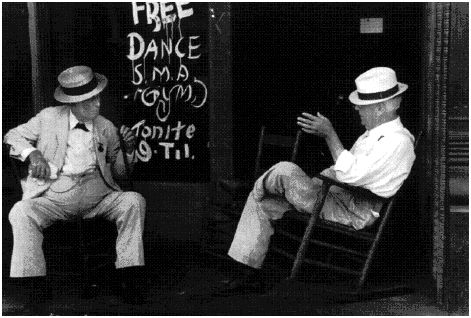
Here is the story of James Agee’s magazine piece for Fortune that never ran. The article was an early draft of Agee’s classic, Let Us Now Praise Famous Men and is now being published as Cotten Tenants: Three Familes.

Photograph by Walker Evans.

Older posts            Newer posts
feed Share on Facebook Share on Twitter Share via email
"This ain't football. We do this every day."
--Earl Weaver