"A New York Treasure" --Village Voice
Category: 1: Featured

Flavor in Your Ear

Over at Flavorwire check out these two features: 20 Brilliant Musicians on Why They Make Music and 20 Brilliant Filmmakers on Why They Make Movies.

Here’s the one on Tom Waits:

“My kids are starting to notice I’m a little different from the other dads. ‘Why don’t you have a straight job like everyone else?’ they asked me the other day.

I told them this story: ‘In the forest, there was a crooked tree and a straight tree. Every day, the straight tree would say to the crooked tree, “Look at me… I’m tall, and I’m straight, and I’m handsome. Look at you… you’re all crooked and bent over. No one wants to look at you.” And they grew up in that forest together.

And then one day the loggers came, and they saw the crooked tree and the straight tree, and they said, “Just cut the straight trees and leave the rest.” So the loggers turned all the straight trees into lumber and toothpicks and paper. And the crooked tree is still there, growing stronger and stranger every day.’”

And Wong Kar-Wai:

“Cinema has certain qualities, and it’s the image. Sometimes this image has its own breathing or tempo. It has to linger, and will linger because you want to have more. It is very instinctive. It is very instinctive when you’re shooting the shots in front of this video, the monitor, you know exactly, because sometimes it takes you more than 10 takes or 15 takes… Afterwards, the most enjoyable part is the final weeks. That means you put everything together, the sound, the images and everything to create a film… it’s beyond words… I think one of the reasons you keep making films is because you want to experience that part again and again.”

The Banter Gold Standard: The Killing of Gus Hasford

Grover Lewis was part of a remarkable generation of Texas writers to emerge onto the national scene in the 1960s and ‘70s, including Larry McMurtry, Larry L. King, Edwin “Bud” Shrake, Gary Cartwright, Billy Lee Brammer, Dan Jenkins, and Dave Hickey.  Police records show that Lewis’ estranged parents shot and killed each other in San Antonio when he was a small child, and he was raised among uneducated and poor relatives who, for the most part, discouraged him intellectually and artistically.  He also was legally blind, making his way as best he could through substandard Texas public schools.  Yet, remarkably, he managed to become very well read and developed an encyclopedic knowledge of American film.  At what’s now the University of North Texas, he fell in with the company of other bright students with a literary bent, including McMurtry. He then pursued graduate school and newspaper work for several years.

Among Texas newspaper reporters, he developed a reputation as a hard-drinking, never-back-down journalist.  He made a name for himself nationally when he began to publish articles in the Village Voice in the late 1960s.  He then became an early staff writer and editor for Rolling Stone, where he proved to be a master of long-form journalism.  At the time, Rolling Stone was at its peak of its journalistic influence and Lewis was one its star contributors.  While he wrote about a variety of topics, his groundbreaking work was made up of dispatches from the shooting locations of some of the most important films of the 1970s.

Lewis’ tenure at Rolling Stone was relatively short-lived, however, as conflicts with publisher Jann Wenner grew.  After leaving Rolling Stone, he contributed to several magazines, notably New West and Texas Monthly.  Except for paperback collections of his Rolling Stone articles and poetry, he published no books, yet he developed a devoted cult following for his magazine pieces, a following that included important authors, editors, critics, and filmmakers.  A heavy smoker, Lewis died of lung cancer in April 1995 at age 61.  Ten years later, the University of Texas Press published Splendor in the Short Grass: A Grover Lewis Reader to wide acclaim.

W.K. (Kip) Stratton is the co-editor of Splendor In the Short Grass.

“The Killing of Gus Hasford”
By Grover Lewis

1. SEMPER GUS

“The best work of fiction about the Vietnam War,” Newsweek called Gus Hasford’s The Short-Timers when it was first published in 1979. The slim hardcover sold, like most first novels, in the low thousands, but established its author as one of the premier writing talents of his generation. In the tradition of Stephen Crane, Hemingway and James Jones, the book summoned up the horrors of war in an unrelenting voice with all the potential for world-class success.

Hasford’s critical stock rose even higher when Stanley Kubrick filmed the book as Full Metal Jacket. Released in 1987, the picture received one major Academy Award nomination—shared by Kubrick, Michael Herr and Hasford himself for best screen adaptation. At a stroke, the struggling, rootless young novelist entered the upper realms of “A-list” Hollywood. But in a skein of envy, spite and the inexorable grinding of bureaucratic “justice”—all of them compounded by Hasford’s own obsessive passion for books—his newfound celebrity backfired, and he was sent to jail on bizarrely exaggerated charges involving stolen and overdue library books.

It all combined to kill him.

Gus died alone, as he had mostly lived, in Greece on January 29 at the measly age of 45 from the complications of untreated diabetes. His death coincided eerily with the 25th anniversary of the Tet offensive, the campaign so graphically described in The Short-Timers. Two weeks after the shock of his death, 20-odd mourners had gathered in the chapel at Tacoma’s Mountain View Memorial Park. Gus’ kin sat close to the front—his mother, Hazel, a gaunt and visibly ailing Alabama native, along with Gus’ younger brother, Army Sergeant Terry Hasford, and Terry’s Korean wife, Soo. Back of them a couple of rows were the Snuffies, a cadre of Gus’ brothers-in-arms from the Vietnam days, all wearing their battle ribbons on sweaters or lapels, the five men who’d managed to attend representing a total of eight Purple Hearts.

Several editions of The Short-Timers lay on Gus’ bier, along with copies of his later books, The Phantom Blooper and A Gypsy Good Time. Gus’ picture as a stern-faced teenage Marine sat on a pedestal, The urn containing his ashes on another. His Vietnam decorations were also on display—two rows of ribbons plus-one, the highest being the Navy Achievement Medal with a Combat “V.”

Five wreaths ringed the dais—two from Gus’ family, another from “Doctor Dave” Walker, who’d been Gus’ landlord and unofficial medical adviser in his last days in America. A spray of white tulips was signed, “From all the gang down at the Cafe Cafard.” The floral tribute from the 1st MarDiv ISO Snuffies spelled out SEMPER GUS. Nothing from Hollywood—not a bud or sprig from Stanley or Michael or any of the other distant A-listers who’d profited from The Short-Timers.

Assorted friends sat across the aisle—Doctor Dave, and the book dealer Bruce Miller from San Luis Obispo, who’d supported Gus during his trial, and Kent Anderson, another formidable Vietnam War novelist. Anderson, author of Sympathy for the Devil, fidgeted in agitation. I sat just behind him, shivering a little in my lightweight L.A. clothes, In the far rear of the room, with their rifles stacked out of sight, sat six young Marines in full dress uniform, white hats squared on their blue-clad knees.

The noon ceremony was spare, simple and elegantly offbeat Steve “Bernie” Berntson, chief archivist of the Snuffies, spoke a brief eulogy and then set out bottles of Jack Daniel’s, fruit juice, Evian water and California wine. Nine other mourners, including myself, offered personal tributes to Gus, concluding with toasts to his memory. A local Presbyterian minister, a little nonplussed by the procedure, toasted God.

At the service’s conclusion, the Marine honor guard fired four volleys of salute outside the chapel, followed by a bugler playing taps. A smart-stepping Marine SNCO presented Gus’ mother with a folded American flag. “In behalf of a grateful nation, ma’am, we present this flag as a token of your son’s honorable and faithful service to the United States of America.” Mrs. Hasford sat with her eyes lowered, softly fingering the cloth. “I never could understand that boy,” she’d told one of the Snuffies a few days before, “just never could.”

In a caravan of cars, the memorial moved en masse to Berntson’s house in a nearby suburb, where the post-mortems continued through the afternoon and into the evening in a glow of sipping whiskey, fond remembrance and brusque camaraderie. Many of the characters in The Short-Timers had been modeled on the now-middle-aged Snuffies, and the men were strapping proud of the distinction. In Vietnam with Gus, they’d all been Marine combat correspondents, equally adept filing dispatches or fighting hooch-to-hooch. At Gus’ wake, circulating from bar to buffet. they openly discussed his jail sentence and its effect on him. None of them approved of his transgressions, but none of them had rejected him, either. As men who’d shared life at its worst, they viewed Gus as family—and whatever had happened, they loved him. “Capital punishment for library violations?” Gordon Fowler growled. Gordon was “Cowboy” in the book.

Bernie told perhaps the best “Gus story”: “It’s peculiar, but this happened exactly 25 years ago today. I’d set up a base camp in Hue City, and Walter Cronkite rolls up with a camera crew. He was doing a stand-upper with some pogue colonel, asking about rumors that our guys had looting. Just then Gus busts in with two black onyx panthers and a stone Buddha on his back. ‘Hey, there’s a whole temple full of this shit,’ he hollers.’ We can get beaucoup bucks for this stuff in Saigon!’ I hustled him outside quick, and Cronkite, of course, came back home and declared the war unwinnable on national TV.”

There were a million Gus stories, and some of the classic ones were told by Major Mawk Arnold, USMC (Ret.). He arrived late in the afternoon, delayed transit, but he was essential not only for his moral presence, but to carry Gus’ remains back to the Hasford family plot in Haleyville, Alabama. Picture John Huston with a shiny pate, resplendent in dress blues and battle ribbons dating back to the South Pacific and China in the 1940s. “Skipper” Arnold had created the Snuffy team by letting them make their own mistakes and victories. Nearing 70 now, he’d been the catalyst—the force who’d molded raw young snuffy recruits with reading habits and verbal skills into warrior artists in a World of Shit.

Another round of toasts commenced after dinner. Every Snuffy present had helped Gus out of various hapless jams during and ever since the war … and, Jesus, if the fucker hadn’t slipped out of their reach, maybe he wouldn’t have died. It hung over the table, unspoken. Bob Bayer (“Mr. Short-Round”) recalled driving hundreds of miles to rescue Gus from his latest broken-down lemon car. “He could start out to meet you with a thousand bucks in his pocket, walk past a bookstore, and then you’d have to spring for dinner.” Earl Gerheim (“Crazy Earl”) nodded and smiled: “Gus had a 45-year childhood—the childhood the rest of us missed, I guess.” There was general agreement that Gus had been a zany, wonderful, generous naive, impractical genius, maybe too pure in his way to die of old age. Bernie raised his wine glass. “To those of us who are near,” he said, “and those far away, and those who are beyond the wire.”

Around midnight, since we both had early flights to catch, Skipper Arnold offered me a lift. We rode across the dark city, at conversing in low tones, with Gus’ ashes in the trunk.

Back at the hotel, I packed for a wake-up call, turning over in my mind again the riddle of how Gus had become a victim instead of a victor. As much as anybody—except perhaps Gus himself—I understood how he’d been stung to death by success. But there was one more key to turn, one final labyrinth to enter—in a hilly suburb of San Diego. For the first time in two weeks, I fell into deep, dreamless sleep.

2. CAFARD

“I know this psycho vet novelist you ought to meet,” Judith Coburn, a writer for The Village Voice, told me over drinks in the spring of 1982. Coburn, one of a handful of American women to cover the Vietnam War, let me know with a look and a shrug that she’d gone out with Gus Hasford a time or two and found him too much of a headache. “Maybe !’ll bring him by.” I said sure, lovely. I’d admired Hasford’s book and was curious to meet him I figured anyone who wrote with that kind of crafted velocity would have to be a piece of work.

When the two of them arrived on the weekend, July was fuming. On the walk over. they’d argued in shouts about the IRA, wi1h Gus staunchly defending terrorism. She !eft early and he ended up staying late.

In his early 30s then, a tall, beefy lad in mismatched wash-and-wear clothes, Gus shook hands formally with my wife, Rae, and me, declined a glass for his beer, and launched into a stream-of-consciousness commentary that ranged from Nathan Redford Forrest’s cavalry tactics to Lion paperbacks, cheerfully finding a thread of comedy in everything, including Judy’s desertion. He had a huge, open, frequent country laugh, and he paced back and forth with big arms swinging. his eyeglasses and high forehead glinting, he seemed very much like a large child coming on as a swaggering Marine drill instructor. Amiable and eager to please, he was a ceaseless note-taker. If you said something be liked, he jotted it down immediately in the little leather-bound notebook he always carried with him. ‘”Hey, do you mind? I don’t want to make any more faux passes, y’know.”

With the ice broken, Gus raided the fridge for another beer, located the bathroom, and then took up position by the main bookcase in the living room, where he delivered a blistering diatribe against Harper & Row, from whose clutches he’d been trying for months to pry remainders of “Shorty,” as he called his book. “Hell, I don’t work for those candy-ass pogues,” he snorted, “they work for me.” In style, he was a master of bombast, invective and insult repartee—but his heart belonged to books. He spread his arms and said he owned over 10,000 volumes. “My God, where do you keep them?” “In a rental locker up in San Luis Obispo. It’s my research library.”

He clucked approvingly at my collection of hard-boiled titles, and pulled out a volume of Ambrose Bierce’s short stories. He read aloud a favorite passage from “Chickamauga” and said he was planning to write a biography of Bierce, plus a multivolume saga on the Civil War. Plus a novel about an American woman president, which he was presently working on. Plus a sequel to “Shorty” called The Phantom Blooper. Plus a series of six L.A. private-eye novels. His notebook was color indexed to various ongoing research projects, including Mark Twain, anarchy, the Alamo, Van Gogh, screenwriting and Abraham Lincoln—all subjects about which he expected to write books eventually. “I don’t quite have my stroke down on Hollywood yet,” he confided, “but somebody’ll film ‘Shorty’ one of these days, and I want to work on the script. My book, my movie. So maybe you’ll play me some videotapes sometimes and give me your counsel and talk to me and stuff. Hey, are we bonding yet?”

If Gus was chasing rainbows, it was on a Renaissance scale. He laid out his writing plans with such implacable certainty that you had to nod. He never quite let himself brag, but he had his path to success all mapped out, and he managed to leave the impression that he was poised for little short of world literary domination.

As a journalist, I specialized in playing fly on the wall to star misfits, and I recognized an utter original as Gus offhandedly related the bare bones of his back story. When he was a high-school kid in backwoods Alabama, he’d somehow managed to publish a nationally distributed magazine for writers called Freelance. Then, at 18, he’d joined the Marines to get away from Dixie and Mama. After the war, he’d floated through a decade of shit jobs up and down the West Coast while he honed The Short-Timers to a fine and polished point. Now, he was trying to get the bread together for a look-see trip to Australia with an idea of settling there permanently. He rejected American Civ wholesale—except for maybe Sizzlers and used-book stores. Full of outrageous opinions, he loathed “the brass” in all forms, whether military or industrial. At the moment he was flirting with anarchy, because it figured in his woman-president book, and I just laughed when he brought up the IRA as misunderstood heroes. When he got too far out for me to follow, that was my response, and usually he’d laugh, too.

Our conversation carried on into the night, and something subtle and intensely personal began to flow between us, keyed to the fact that we’d both grown up poor in the cracker South. Beneath his mock-macho manner, Gus projected unspoken miseries, unvoiced suffering—an undertone of vulnerability and isolation that he carried like a shadow. We compared notes on growing up, and I observed that neither of us had been properly raised—we’d escaped. Gus wrote it down. I began to feel protective toward him even as I laughed at his one-liners.

Still prowling our bookshelves, Gus came across Rae’s inscribed copy of Slouching Towards Bethlehem. “Ooh,” he crowed, “do ‘y’all know the Didions and the Dunnes? Could we go over there right now? I got a thang for Joan. I want her to sit on mah face!” Elaborating his fantasy in obscene flights, Gus picked up his empties and pitched in to help with the dishes.

Rae, who’d seen Hunter Thompson puke on his shoes and survived, said after Hasford had gone, “Sweet guy. We’ll have to get him some clothes.” We agreed he was a heartbreaker. Before turning in, I made a few notes of my own, sensing that Gus was going to be part of our history, not so much as a subject but as someone who taxed my abilities to sum him up.

Gus had an uncanny way of involving you in fun that was clever and layered and kept unfolding. On his third or fourth visit, he marched out to our glassed-in lanai, switched on the neon cerveza signs, and stood silently regarding the white buildings of downtown Santa Monica just as dusk fell.

“Through those palm leaves,” he announced, “it looks just like Saigon. Outstanding! I’m naming this joint the Cafe Cafard. Do you mind?”

Cafard, he said, Was an obscure French term meaning “beyond anomie or dread” that he associated with the last-ditch warriors of Dien Bien Phu. Gus appointed himself social director, and within weeks a company of regulars formed for occasional al fresco dining and light carousal. Gus brought in Andy Dowdy, the owner of Other Times Books in West L.A., and Dowdy in turn introduced us to Philippe Garnier, a correspondent for Liberation in Paris, and his wife, Liz Stromme. It was a cozy, harmonious circle, free of competition or back-biting—a sort of R&R club for non-joiners. If you weren’t happy to be there, you weren’t invited twice. Gus hungered for acceptance, validation of his talent, and the group gave him that.

Going out in public with him was a dicier matter. He would race into a software store and say to the first clerk, “Tell me all about computers.” He’d get buzzed off, of course, without ever fully understanding why. He and I went to only one movie together—after which I slunk out guiltily because he’d talked throughout the picture. At an exhibit of Larry Clark photos, he somehow grossed out the gallery attendant. As time went on, I mainly confined my travels with him to book-buying expeditions. In bookstores, he was as well-behaved as he ever got.

As a hardcore eccentric, Gus either charmed people on the spot or scared them off quick. Full of an astonishing array of tics, tropisms, quirks and peculiar habits, he was alarmingly innocent about some things and deeply cynical about others. Everybody found him unreliable about time and totally resistant to sane advice. He imagined he was being subtle when he was being obvious. Given one of his periodic fixed ideas, you had to jolly him along toward a ray of reason. Part of him was a sunny boy and another part was permanently angry—over his childhood, the war, his poor luck with women.

Gus’ love life was a touchy issue. Oh, he could score, I gathered, but he wanted to capture some worthy woman’s heart on a permanent basis. He had his career all plotted out, but he longed for a partner to ease his loneliness. In the past, he’d been briefly married, and was bitterly estranged from his latest girlfriend in San Luis Obispo. “Brains is what I’m looking for,” he joked, “but I’ll settle for big tits.”

Our first heated words arose over Gus’ free ways with library books. In describing his reference files, he let it drop that he sometimes checked out books without returning them or otherwise “liberated” items he needed. It hit me dead wrong—my own life had literally been saved by public libraries in Texas—and I jumped down his throat about it, pointing out the obvious fact that library books belonged to everybody.

“Well,” he said defensively, “I need them more than everybody. If the libraries would just let me, I’d buy the stuff outright. Cut me a huss, willya?” If Gus got really sore, the cranky child would come out in him and he’d stalk off with his hands clenched. Not knowing the extent of his “borrowings” and mildly rattled by my own moralizing, I marked it up to one more mad-cap quirk. You had to make allowances for such a wild hair.

When we’d first met, Hasford had been living in his car “between motels”—a fact he didn’t mention until his fortunes improved. That occurred when a Munich businessman with no visible ties to the movie world optioned the screen rights to The Short-Timers—acting, as it turned out, for Stanley Kubrick. Gus broke the good news by brandishing a one-way Qantas ticket to Australia. All of us were jubilant at his prospects, since he stood to make handsome royalties from his worldwide literary rights alone, not to mention the prestige that would come from Kubrick’s involvement. At a bon voyage party, Hasford grandly signed and passed out remainders of “Shorty” to one and all. As the evening wound down, I commented that it might be tough for him to find a spot in Kubrick’s plans. Gus grinned: “Hey, I’m a self-motivated individual.” “Well, I’ll spread your fame,” I said. “Okay, I’ll keep you posted,” he promised.

His first letter to us was dated November 23, 1982—from Perth, on Australia’s far western shore:

I am, as we say so poetically in Alabama, happier than a pig in shit…Some big star is supposed to be interested in “Shorty” but they won’t tell me who it is until they sign the deal…I am trying to work on my famous thriller about the first woman president but so far my discipline is zero…Selling a book for lots of $ will be the end of my writing career because as soon as I have money I’ll see that I really don’t want to write, I just love to fan about with books and little projects…

The same week, Gus confided to Bob Bayer, his closest Snuffy pal:

My famousness seems out of control and may grow to proportions so awesome I’ll be scared to speak to myself. Yesterday I got a call from Stanley Kubrick—no shit…It was like Moses talking to the burning bush, a pea picker from Alabama and your basic cinematic legend…Don’t tell anybody, but I think I wet my pants…I feel totally out of my class…So now I’ll be more famous and more people will get mad at me, but there it is…Just don’t anybody accuse me of becoming arrogant—I always been arrogant.

(Dec. 8) Dear Grover & Rae…I don’t know if I should order a Rolls-Royce or get on welfare from one day to the next…I’m 35 now, so I have to be good. I come from a family of chronic dyers. Diars? Anyway, I have the death certificates of about 30 of my blood ancestors, and stress knocked them all off, so I’m mellowing my own self out… Stanley… is a thoroughly charming and easy-going fellow, just a good ole boy who happens to have made about half of the classic films in America. I talk to him every few days. We are trying to come up with a more satisfying ending for “Shorty”…I said, “But Stanley, the Vietnam War bloody well wasn’t satisfying.” “Right,” he said, “but they made you go…while we’ve got to convince people to pay to see this movie.”…That’s show business…Give them my regards at the Cafe Cafard.

(Jan. 4, 1983) Greetings Bob & America…Stanley and I, after about a dozen long talks, are lobbing frags. I told Stanley he didn’t know shit from Shinola about Vietnam. And he’s so sensitive, he got mad…Boy, famous people think they know everything.

Hasford returned to California in May 1983. Having given up his idea of emigrating and abandoned his thriller, he seemed almost desperately glad to see our friendly faces again. After a reunion in Santa Monica, he moved into a downscale motel in San Luis Obispo to be near his precious “storage.” In the coming months, striking several of us as slightly off his stride, he made two connections that would vex him for the rest of his life.

Early in the summer, he met an attractive young woman named Tidwell, a student at Claremont. Smitten at first sight, Gus decided she was the girl of his dreams. Tidwell, although friendly, failed to return his interest. No matter—he started writing her epic-length letters and showering her with gifts and attentions, determined to change her mind.

He also fell into a troubling relationship with a fast-talking pretty-boy sidekick I’ll call Hacker. A dabbler at writing and exotic con games, Hacker had hatched a bald scheme to accompany Gus to England to “cool out Stanley.” Forever posturing, Hacker was so up-front in his brown-nosing, so transparent in his envy of Gus’ talent, that I eventually barred the door to him. For a time, the two of them shared Hacker’s house in Sacramento. They traded books and competed for the same women until their chummy friendship turned to mutual hatred. When Gus decamped, he left behind him not only a poisonous enemy, but a time bomb set to explode.

(Feb. 1, I984—from San Luis Obispo) Hi Gang…”Shorty” is on the road to cinematic legend, etc. I’m rich now, only I don’t have any money. What an odd sensation. I can’t wait to see what it feels like to be rich and also have the money.

I told you I was planning…to do a series of tough-guy detective stories…I decided that the name of the detective’s partner will be “Dowdy Lewis.” Works pretty good, huh?…I still would like to see Killer’s Kiss…Stanley gets miffed every time I mention this film, so I mention it all the time. Or I say I liked Spartacus, another one he doesn’t care for…I’m going to go live at Stanley’s house and we’ll write the screenplay. Then I’m going to be technical advisor during the production…The other day he threatened to hire Michael Herr to help him write the film. I told him, be my guest. Stanley can’t replace me…Michael Herr can rite gud, but he wasn’t a Marine, he was just a very perceptive tourist…I promise not to eat cocaine with a spoon. I’m 36 now, got to pace myself. I think about a year or two of this show business bullshit is going to be enough to last me for a long time.

(Jan. 18, 1985—from a Mayfair address in London) Hi, mates!…I miss you guys. And Tidwell—I miss Tidwell a lot…I found (via Stanley’s connections) a really cute and cozy little flat right in the heart of the city…Stanley and I are getting along great. Michael Herr and I are big pals. I had dinner over at his place last night…Look for the movie around 1999—Stanley…insists on doing every single thing himself. Today Michael and I were joking with him, saying that when the film came out Stanley would probably insist on taking the tickets…Stanley didn’t think it was funny. He just looked at us with that Buddha face of his, as though considering doing just that…

(July 14—return address c/o Michael Herr)…Here in London the Great Movie Wars…are going hot and heavy. The situation is very complex, but the basic issue is one of screen credit. I’ve pretty much written Stanley’s movie (Michael and I are big pals now, but—off the record—Michael’s biggest contribution…has been his famous name) and Stanley has added a few minor things, but essentially the screenplay is by me. But Stanley wants to give me an “additional dialogue” credit…He threatens to pull the plug on the whole thing. Meanwhile, I am refusing to sign my screenwriter’s contract. Shooting was scheduled to start on July 1st, so I have held up the production for two weeks…I’m starting to feel all alone, like Gary Cooper in High Noon…Don’t worry about [Tidwell and me]…she won’t hear from me again. I never meant to be such a pain in the ass for everybody. I’m sorry. It won’t happen again…Don’t worry about Stanley and the movie, [either]. It’ll work out. Stanley has got more tricks than there are recipes for chili…

But back in Santa Monica we were worried—about Gus’ blinding naiveté and the fact that he had no agent. I wrote to him on July 23:

Try to think and go slow. The real power that the world will see in Full Metal Jacket is yours—and everybody who is past eating with his hands will know that. So if you take the money…and the…”Additional Dialogue,” so what? You will be buying yourself entry to . . . future big-time screen credits and much bigger book money in the long haul. What’s “right” by Hollywood standards is who says what’s right. That might not be suitable to your taste or mine, but it’s the way things work.

(Aug. 13—handwritten letter from Paris) Sorry I haven’t written in so long, but I hate to write…when I’m depressed…Stanley is bullying me, threatening me, and trying to rape me, and every day I’m getting hysterical phone calls from my mother because [Hacker] is calling her up and telling her all kinds of hateful fantasies—I’ve just driven that boy insane with my “success”—a “success” that is such a curse to me…What else? I’m broke. I’m in a city where I don’t know anybody. I feel old. I miss Tidwell every minute of the day…I miss all you guys.

(September—handwritten letter from London with a Bantam editor’s return address). The situation now is that I have delayed signing…until Stanley was forced to start filming, which he did on Aug. 25. The white flag has not yet waved…but I have beaten that self-described Napoleon son-of-a-bitch and I have beat him fair and square…I will mark [Hacker’s] file “case closed” after I knock off his kneecaps. For some things, you’ve got to pay the price…

(March 1, 1986—from Gus’ former address in Perth) Late Flash: FILMING IS FINISHED!…I cannot believe this situation. I finally pried a copy of the shooting script out of Stanley’s famously anal-retentive fingers. It’s 99% mine. I got records, copies, witnesses…I got this shit locked in concrete. So here is a major motion picture written by a guy who has not signed any kind of contract, nor made a verbal contract, nor entered into an implied contract. This may be unique, I don’t know. Stanley thinks I’m worried about collecting the relatively small amount of money he owes me for screenwriting, plus getting some kind of credit, while I’m thinking that until I have received the money and the credit I deserved and was promised, I own his fucking movie…By and by Warner Brothers will hear about how far out on a limb their ass is—and how prime for the manual insertion of a big piece of paper with Latin on it, and then the rivers will run upstream…because there is only one rule in the movie business—The Golden Rule—he who has the gold makes the rules…I stumbled a few times…but now I think I’ve got this “Success” thing whipped. I’ve learned to view it in its proper perspective—that is, as a comedy…Defections, betrayals and swamped egos are just routine and are not my fault—I see that now…It really is something quite astonishing and pathetic [and] really, really scary. I have been introduced…as Gus/slash/Kubrick movie and I’ve seen seemingly normal people…with almost perfectly concealed egos that are like chained monsters—monsters so ugly, malformed, and sick with ruthlessness that they would make Count Dracula weep…So now…I can’t be the same, because everybody is relating to me differently…I’ve learned some stuff, but the price bas been high—almost higher than I could pay…I can only hope that the people that I care about will allow me to exist by seeing that it’s just old plain me back here behind this blizzard of little tinfoil stars…Stress kills but adrenalin keeps you young. Happy trails…

(May 20—from Perth)…In the cynical world of L.A., where show *biz* deals are conducted in the back alleys of cocktail parties like self-parodying out-takes from a comedic film noir, you might want to interject this lively note…I won my credit battle with Stanley, I beat Stanley, City Hall, The Powers That Be, and all of the lawyers at Warner Brothers, up to and including the Supreme Boss Lawyer. As a little Canuck…friend of mine would say: I kicked dey butt…I’m sort of bracing myself for all the attention that’s coming…[but] I can’t imagine anything more likely to seduce me into the far side of negotiating than this rush I am experiencing after taking on these movie people, the Big Boys, the Money Men & Yankees—and coming out with a decisive victory. As an Apache said: “Who will they send against me now?”…After Stanley gave up and decided that I wasn’t the hillbilly they stand in line to sell the Brooklyn Bridge to, Michael Herr wrote me a nice letter, which included his reaction to…the movie. Michael speaks with some authority … which is even more impressive if you know that Michael is so level-headed that it’s a mistake he wasn’t born an Englishman: “Your work has been treated with extreme sensitivity and respect…I think it’s going to be a great movie, and a landmark movie, maybe the best war movie ever made, and one that could be of incredible importance and usefulness to everyone involved…it is also, incidentally or not so incidentally, incredibly faithful to your book, to the real heart of your work…” I’d better go roll up in the old saddle blanket…I’m looking forward to being able to step up to the bar at the Cafe Cafard…

3. SOME CAME RUNNING


When Hasford flew home for the release of Full Metal Jacket, I interviewed him for the L.A. Times Sunday magazine. It was an ordeal—collaring Gus in his paranoia for a taped interview, working up a quick profile that did him justice without caricaturing him, and then nursing the text through the Times‘ pasteurization process. On the record, Gus cagily moderated his comments about about Stanley and Michael, but he was jittery about the piece and pressed me several times to see it.

Two days before the pub date—too late to change a word—I showed him the galleys. He read through the story several times, seeming gruffly pleased. Since he was camped out on our sofa, the two of us sat up late watching the glass elevator glide up and down the side of the nearby Huntley Hotel. Just before turning in, picking my moment, I asked: “How exactly did you kick dey butts, Gus?” He gave a short, abrupt laugh as if to say touché. “I forced them. Those fuckers retyped my book and wanted to put their names on it. So I told Stanley, either give me my credit or I’m going to the press—Gloria Emerson and Frances Fitzgerald and all my other old pals in the media—and say, ‘Hey, I’m a Vietnam veteran and Kubrick’s ripping me off.’ It would’ve killed the movie, so Stanley saw his way clear to cut me some slack.” The hair on the nape of my neck stood up. It wasn’t what I would’ve done, but I couldn’t help admiring his audacity, either. Still, I thought he might be fooling around with some kind of high-stakes bad karma.

Gus devoted the better part of two weeks to promoting the film. Warner Bros. put him up at the Westwood Marquis, where he gave phone interviews and amused himself by ordering $25 hamburgers from room service. “Hell, order a steak,” his buddy Bob Bayer advised. “What,” Gus cried, “and go back on my raising? Burgers are still my meat.” Since childhood, he’d subsisted almost exclusively on junk food (Ding Dongs were probably the most nutritious strain). During his time abroad, he’d started putting on excessive weight, causing several of us to wonder about his health. If we hinted that it might be a worthwhile idea to get a medical checkup, he’d say, “Yeah, yeah, yeah”—meaning the opposite.

Gus was threatened by celebrity, apprehensive about what he saw as the black hole of success, and after his flacking duties were finished, he seemed touchy and insecure, easy to rile. To cool him out and reintroduce him around, Rae arranged a series of dinners, inviting many of the writers and artists we knew. Gus thought he wanted to hobnob with the Westside literati—until he met some of them. The literary crowd tended to regard him as an amusing freak of nature—he didn’t have manners exactly like theirs. Gus could scent condescension at a thousand yards. He got along much better and found more in common with wheeling boho painters like Joe Clower, Jim Hayward and Robin Palanker.

Gradually, Hasford regained his easy-going composure and began enjoying his new status. Full Metal Jacket was playing to full houses all over America, and Bantam’s new paperback edition of The Short-Timers was on sale everywhere. The book was a global franchise now—a dozen translations poured in during the summer—and Louis Blau, Kubrick’s tony U.S. lawyer took Gus on as a client, placing The Phantom Blooper with Bantam for publication in 1990. Gus found a spacious, comfortable place to live in San Clemente, forming a lasting odd-couple relationship with his landlord, Dr. David Walker. Free of stress and money worries for the first time in his life, Gus went on a shopping spree, treating himself to a big-screen TV, a VCR, a Jeep and a new flak jacket. He lavished gifts on his friends and took a cross-country drive to tour the Southern battlefields. By mail, he conducted a heated side feud with Kubrick over Lee Ermey, the film’s drill instructor, whom Hasford labeled “a fucking pogue lifer” and a propagandist for the official Marine Corps pro-war line on Vietnam. Happy in his new digs, Gus puttered with his various projects and spent hours on San Clemente beach, where he claimed the world’s most beautiful women gathered to sunbathe.

Only romance—the lasting kind he yearned after—continued to elude him. The up side was that he met and dated a number of attractive new women. The down side—most of them, he was convinced, had dollar signs in their eyes. Gus’ ex-wife, whom he hadn’t seen in a dozen years, tracked him down after his picture appeared in the press. Her new husband ran some kind of bucket-shop phone-sales operation. She asked Gus to make a $25,000 investment. He declined, and related the story afterward with a mixture of rue and wrath.

Hasford still missed Tidwell, so he looked her up with the hope of renewing his courtship. Rejected again, he began bombarding her with angry letters. Tidwell showed me some of them, a little alarmed and seeking advice. I read a few pages and blanched—it was dark, spooky stuff, Gus’ usual invective gone off the rails. Fond of both of them, I gingerly interceded, asking him to ease up and try his luck elsewhere. The barrage of letters ceased, but he wouldn’t or couldn’t give up the idea of winning the girl he’d chosen to adore. His persistence had paid off with “Shorty.” Why not with Tidwell?

On February 11, 1988, Hasford, Kubrick and Herr were nominated for the best screenplay adaptation of 1987 by the Writers Guild of America, and a week later the three were also nominated for the Academy Award. Andy Dowdy and I urged Gus to attend the ceremonies for the sheer novelty of the experience. “Nah,” Gus snorted, “I’d have to wear a tuxedo.” But he asked Rae to plan an Oscar-night party for him at the Cafe Cafard.

Less than a month later, the time bomb that had been ticking for almost five years exploded. On March 21, in the Calendar section, the L.A. Times reported. “Jerry Gustav Hasford is being sought by California Polytechnic State University authorities, who late last week discovered some 10,000 books from libraries around the world in a storage locker in San Luis Obispo rented to the author.” The item went on to say that campus police had located overdue books from Cal Poly, delinquent to the sum of $3,000 in library fines, as well as rare books from libraries in England and Australia. “Authorities say the address and Social Security number listed on [Hasford’s] card were false. No arrest warrant has been sought because investigators must first inventory the books, contained in 396 cardboard boxes that comprise a pile 27 feet long, five feet wide, and five feet tall.” In its essentials, the same story was carried on the AP wire (where it originated), in the L.A. Herald Examiner, and on CNN and KNBC-TV.

I tried to reach Gus all day. In a state close to shock, I also spent hours calling back and forth with Dowdy, Philippe Garnier, Tidwell and Bob Bayer, whom I knew only slightly, at the time. Bayer drove by Hasford’s place, found it deserted, and speculated that Gus was on the road to Tacoma to see his mother.

Ten thousand books from libraries around the world—that part of the story, I knew, had to be rubbish. And why, with no arrest warrant issued and no inventory of losses compiled and no “allegeds” in the copy, had the story run at all? Whether true or false, a charge of library theft was the toughest kind of antisocial beef to beat, a universally despicable offense that even illiterate slobs could feel superior about. As a former daily newsman, I realized that in two inches of type, Gus had I been branded a bug—effectively lynched. On some instinctive level, I also knew that any chance for him to win the Oscar had vanished and that his career had been permanently blighted, if not destroyed.

Two days later, with Gus still out of touch, Louis Blau called to ask if l knew his whereabouts, “Things are not as bleak as they seem,” the attorney said, “but it’s important that I reach him before they become bleak.” Miles Corwin of the L.A. Times also rang up to ask for Gus’ phone number. I told him I thought the initial story had been misreported, and he promised to look into it. Later, he called back to say that some 800 books were in question, not 10,000. He added, “They may have gotten in over their heads up there [Cal Poly],” and conceded that the original AP story had been mishandled by a local stringer.

On March 26, five days after the hub-bub erupted, Gus checked in with us from a highway pay phone. He seemed calm and oddly detached when I asked him what had happened. ‘The assholes ganged up one me,” he said. “You remember Hacker? Well, he had his eye on Tidwell, so I took off with some of his books for payback, left him mad. And he got together with my ex-girlfriend, who was mad at me, too. They hooked up with some showboat rent-a-cop at Cal Poly who thinks he’s Matlock.” Gus didn’t seem terribly upset then or a couple of days later when he came by to visit. As we talked through the evening, it sank in on me that he’d decided to treat the whole affair as a minor annoyance. The worst of it, he said, was that the “college-boy pogues” had all of his books. He planned to pay his fine or whatever and put it all behind him.

Ray Berrett of Cal Poly San Luis Obispo campus police with books seized from a campus-area storage locker rented by Hasford. Photo via the LA Times.

An AP follow-up ran in the Times on March 31—”Author Nominated for an Oscar Charged in Library Book Thefts.” The story related that Gus had been charged with grand theft on a Sacramento warrant dating to mid 1985, alleging that he’d stolen 50 to 100 books worth more than $1,000. (This was in addition to the Cal Poly allegations, not yet legally charged.) Bail was set at $50,000. The AP’s theft count had dropped from 10,000 to “9,816 books from libraries as far away as Australia and Great Britain.”

Miles Corwin’s lengthy story about Gus and his troubles, running the next day in the Times, corrected the stolen-book count to “hundreds,” but without stressing the exaggeration of the original reports. Ray Berrett, the Cal Poly campus police investigator who “broke” the case, was pictured and quoted: ‘”All the librarians [we called] said [Hasford] had checked out books, didn’t return them and then disappeared’…The San Luis Obispo County district attorney could issue a warrant…Berrett [went on]…’If [Hasford] gets an Oscar…an officer could hand him the warrant [at the ceremony] and say…put your hands behind your back and away we go.'”

Corwin’s story alluded to, without naming, Gus’ former girlfriend—”a librarian at Cal Poly”—and Hacker—”a man who said Hasford was a house guest…and left ‘unexpectedly with a number of books’…found in Hasford’s collection.”

At our Oscar-night fete for him on April 11, Gus handed out signed Full Metal Jacket posters and copies of an editorial cartoons showing a reader being arrested at gunpoint for overdue library books. Hasford arrived at the party “fashionably late like a famous Hollywood screenwriter” with a couple of brainless little dumplings he introduced as “neighbor girls.” The turnout was large and supportive, and Gus was especially pleased to see two writers whose work he admired—Kent Anderson and Scott Bradfield. “Awww,” we all chorused when The Last Emperor won the best adapted screenplay award, but Gus actually seemed relieved. He talked at length with Bradfield and Philippe Garnier about the Greek isles, his latest idée fixe being to move there when he got his library intact again. Offering and responding to toasts, he drank more than usual—the only time I ever recalled seeing him tight.

Once in motion, the legal machinery ground on inexorably, and like a top reversing itself, Hasford’s life began to spin the other way. At first, Gus thought he’d be shielded by Louis Blau’s venerable reputation as a lawyer, but he ended up retaining a San Luis Obispo attorney named Orlan Donley, who eventually billed him around $20,000. On June 23, Hasford pleaded innocent to two counts of grand theft and 10 counts of possession of stolen property at an arraignment in the San Luis Obispo County Municipal Court He was booked at the county jail and freed on $7,500 bail. “Books from 77 different libraries were found in Hasford’s collection,” Miles Corwin reported in the Times, and the AP finally reduced its count to “hundreds of stolen books.” Later, Bruce Miller, the San Luis Obispo bookseller, was appalled to discover that the campus police investigating Gus’ collection often confused university-press books with university property.

For a while, Hasford maintained an outer calm, but I knew he was on the far edge, trying not to look down into the abyss. Traveling constantly between San Clemente and San Luis Obispo for the preparation of his case, he made our place a regular stopover going both ways. By the end of the summer, he looked worn down and started talking nonstop about an idea he’d had for his next book—an expose of the overblown charges against him. He said he planned to hire private eyes to get the goods on his persecutors, the vicious pack of enemies who’d conspired to turn his fame against him. “It’s ugly enough for this country,” he said. “It’ll sell millions.”

Early in November, Orlan Donley solicited a character reference for Hasford to present to the San Luis Obispo Probation Department, and I promptly dispatched it. A week or so later, Gus stopped by on his way to the hearing. The outcome was crucial, so I sat him down, fed him half a box of doughnuts, and gave him a sort of George-and-Lennie pep talk about how important it was for him to keep his equilibrium. A day later he came back ranting about a run-in with the hard-ass woman officer assigned to his case. She was hostile and bent on destroying him, he claimed, and they’d gotten into a shouting match right off the bat when she questioned his attitudes toward women. “What’s that crap got to do with anything?” he raged. “My old girlfriend probably put her up to it and she was just laying for me.” A couple of weeks later, on December 2, Hasford pleaded no contest to possessing stolen property, with two counts of grand theft dismissed in the terms of the plea bargain. The prosecutor—Deputy D.A. Terry Estrada Mullaney—recommended that Hasford serve six months in jail. Even so, Gus held out hopes of getting off with a hefty fine, payment of restitution costs and maybe a stretch of community service.

Surprising almost no one, except Gus himself, the court creamed him when he came up for sentencing on January 4, 1989. Superior Court Judge Warren Conklin ordered Hasford to serve six months in jail and five years’ probation for the theft of 748 books from nine libraries and “one individual.” The court also fined Gus $1,100 and directed him to pay shipping costs for the return of the books. After the verdict, Estrada-Mullaney, with a celebrity scalp on her belt, said Hasford’s punishment would “serve as a lesson that stealing library books is a serious offense.” Stunned, half expecting to walk free, Hasford was handcuffed instead and taken directly to a rural annex of the San Luis Obispo County jail, where he was issued an orange jumpsuit and assigned to manual labor on a road crew.

(Jan. 17—handwritten letter from the San Luis Obispo County Jail) Dear Grover and Rae: Just a note from the Stone Hotel to assure you that I am okay…A lot of people seem to be cashing in their chips on me…Perhaps it’s good to drop off deadwood every so often…I stand corrected, but firm…Because the facts are on my side…and I am neither discouraged, nor intimidated, but am rather inexorable, like fate. Bayer [is] planning a party for me [in San Diego] when I get out…I hope you guys will be able to make it down. Remember what Nietzsche said—”What does not kill me only serves to make me stronger. XX’s and OO’s…

Gus called us from jail the same week his letter arrived. He said the San Luis Obispo slammer was hellish—a constant din of racketing TV, stinking meals and nothing to read. His voice was raspy from a cold, full of wounded pride and barely reined-in belligerence.

We talked for most of an hour, and Gus’ mood veered between frantic and laid-back, manic and depressive. He rambled obscurely about Tidwell and “cutting his losses,” and as gently as possible, I urged him to stop obsessing about things he couldn’t control. In a defiant tone, he said he had no regrets about anything except getting caught. “Oh, I regret being snitched on—I regret being in here with all these junkies and head cases. I’m putting it all in my expose book. This shithole’s so boring, I’m already writing the opening in my head.” Finally, I rattled off some old Cagney prison-break lines and got him to laughing. When I offered to come up for a visit, he said no, but we agreed to meet at Bayer’s party down the line.

Hasford promised to call us regularly, but a week went by without him checking in, and then another. Concerned about his health, Rae wrote him several letters without receiving a reply. The silence—and our growing uneasiness—stretched from weeks to several months, and by the time we saw a news brief in the Times about Gus’ early release from jail in April, we still hadn’t heard from him. Incredible, but there it was—Hasford had broken off contact with us for no discernible reason.

“It was the Didions and the Dunnes,” Rae decided, rolling her eyes. “That Joan’s such an iceberg.”

Getting brushed off without cause was a bitter pill for me to swallow, and I burned with resentment until I caught myself and thought: You’re acting just like Hacker. Feeling spurned. In the end, Rae and I settled into thinking of Gus as an absent friend. We assumed his delusion or whatever the hell was bugging him was temporary, and we expected to see him at the door again when the fit had passed. But with our social director on French leave, the gypsy good times were over. The chairs were stacked on Table No. 1 and the Cafe Cafard was closed until further notice.

4. EX LIBRIS

What Rae and I didn’t know was that the disgrace and ritual humiliation had already started to kill him by the time he left the San Luis Obispo lockup. Ravaged by a cold and then intestinal flu, Hasford had dropped 40 pounds as a prisoner. In time, he gained back some of the weight, but he never really regained his health or strength or spirit.

Bob Bayer started telling me the end of Hasford’s story as we drove along a commercial strip in suburban San Diego, headed for a location Bayer wanted to keep secret. “When he first got out, Gus was in pretty rocky shape. It took him a long time and a lot of effort to get his stuff back from the police. Cost him a bundle, too. And things were missing—a collection of $20 gold pieces, for one. I’m not sure what else was taken, but they got him coming and going—whacked him for stealing, and then stole from him when he couldn’t do anything about it.

“Gus started drinking around that time—drinking a lot of beer and wine at night. Said he couldn’t get to sleep otherwise. He’d never had that problem before. You know, he’d go out, maybe have a beer or two, but he never really drank all that much. He was living in a motel in El Cajon so he could be close to his books, which he was reorganizing after trucking them down from SLO. I was recycling cans at home, and he’d bring over big trash bags full of tall Colt 45 empties every couple of weeks. He drank those by the case. Plus, wine—a lot of wine.

“He just wasn’t ever himself again after going to jail. It weighed on him heavily, you know, on his mental attitudes. He was afraid to take planes afterwards, and he talked a lot about applying for political asylum in France. And that big expose he was planning to write—hiring private dicks and everything? I told him, ‘Gus, nobody’s gonna care about this shit three years from now—it’s a small time legal deal. Focus the energy you’ve got on your bigger projects.’ But he wouldn’t let go of it.”

I mentioned that I’d had an almost identical conversation with Hasford.

Bayer nodded, grinning ruefully. “Gus just totally lacked common sense. His diabetes, for instance. When he got his books back in order, he went up to Tacoma to stay with his mother and brother in a real small apartment, sleeping on the floor. He was still drinking all the time and feeling lousy constantly, so Bernie Berntson dragged him—almost physically—to a V.A. hospital. They ran tests and gave him an insulin shot on the spot. After that, Doctor Dave, who’d moved his practice to Seattle, kept after Gus to get his diet regulated, get his weight down under proper guidance. Dave told Gus he probably shouldn’t be going to Greece. Everybody else told him the same thing. By the fall, he’d moved into a pensione in Aegina, about 45 miles by boat off the Greek coast. By that time, he was hardly even writing letters anymore, so l called him in December and asked if he was under a doctor’s care and so on. ‘Yeah, yeah, yeah’—you know the drill. Apparently, he was alone when he died. The woman who owned the pensione found him in his room.”

As we approached what resembled a small city of prefab warehouses, Bayer braked the car and fumbled for his wallet. He was a 40-something married man who worked as an editor for the San Diego edition of the L.A. Times, but since the two of them had first met as teenage warriors in Vietnam in 1967, Bayer—”Mr. Short-Round”—had been Gus’ ever-patient best friend and obliging gofer, nurse, handyman, charge d’affaires…and the keeper of the keys to Gus’ library. Turning out of traffic, Bayer fed a plastic ID card into an electronic gate, and we pulled up the macadam drive to the numbered door of Hasford’s book locker.

It was a standard mini-storage unit with plastic skylight and a plywood floor, measuring 10 by 60 feet. Massive cardboard boxes filled with books and papers crowded almost every inch of space, making it tricky to move around. Out of sheer nervous energy, Bayer and I rough-counted the cartons, arriving at a tally just under 900. Gus had believed he could master any subject if he could find the right books to study. Books, the printed word, had been his college, his tabernacle—the secret labyrinth at the center of which he lived.

Bayer tapped his toe against a Marine-issue footlocker stenciled with Hasford’s initials. “It was fun being Gus’ friend,” he said, shaking his head reflectively. “It wasn’t always easy, but it was always fun.”

I wandered along the narrow squeeze-space between the stacks of boxes, reading labels. In the gloom near the rear wall, I spotted a carton marked A GYPSY GOOD TIME—COPIES. The book had been published just before Gus left for Greece—the first of his “Dowdy Lewis” series—and as I well knew, the dedication read:…to the regular patrons of the Cafe Cafard: Grover and Rae Louis, Philippe and Liz Gamin, Andy Dowdy…and, of course, especially, to Tidwell.

While Bayer found his coat and prepared to lock up, I ducked outside for some air and a moment alone. I was still tasting bile over Gus’ death—the sheer, needless waste of it. He’d died by many hands, including his own, but basically I thought, he’d been pecked to death by chickenshits. His real crime was being hopelessly different from most people in a claptrap culture where everything was considered transient, talent a mere currency. In my mind’s eye, l could see a montage of Gus’ blood enemies—smug, merciless, “correct” killer wimps—gorging on their casual road kill.

I paced along the tarmac like Gus, with my hands clenched. Slipped beyond the wire now, Hasford still taxed my ability to sum him up. But l could say for certain that he was irreplaceable. Full of shortcomings and human failings, not a grown-up at all on some level, afflicted with built-in buzz-saw cussedness and a deadly book jones, he had been nonetheless gallant, large-hearted, steadfast—a man of honor with complicated gifts and brave, bad attitudes in a wretched time, a Southern romantic to the core and forever a soldier. Hollywood hadn’t even looked up from its chips at his passing, but among those who’d taken the time to see him clearly, Gus was well-loved. I wondered if it was something he ever fully knew.

The Short-Timers stood as his his major testament. To write it, Hasford had outwitted poverty and class prejudice and his own callow ignorance and lack of education. As long as the Vietnam War was recalled, his book would be read as one of its defining documents—raw and galling and true as spilled blood.

At the corner of the warehouse, I stood smoking and warming my back in the washed-out February sunlight. I’d thought in advance that coming to see Gus’ locker would be my last step with him, but l knew now that I’d never be through with Gus. Maybe I’d get down to Alabama to visit his grave with Skipper Arnold, who lived in a town not too far from Haleyville. For sure, I meant to go for a walk on San Clemente beach when the sunbathers were in force. Laughing and joking, Gus had talked a blue streak about the beach and all its lustrous beauties. When he died, he’d say, he wanted his ashes scattered there so all the gorgeous girls could sit on his face for eternity.

That night I dreamed about Gus Hasford. He had come back home to the fold, bearing an armful of books.

This story originally appeared in LA Weekly, June 4–10, 1993. It is reprinted here with permission of Rae Lewis.

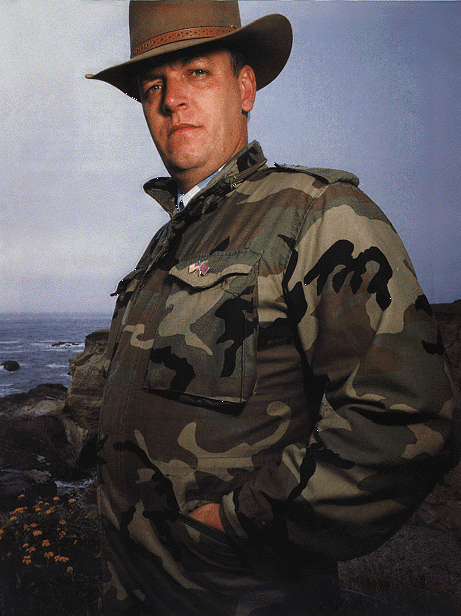
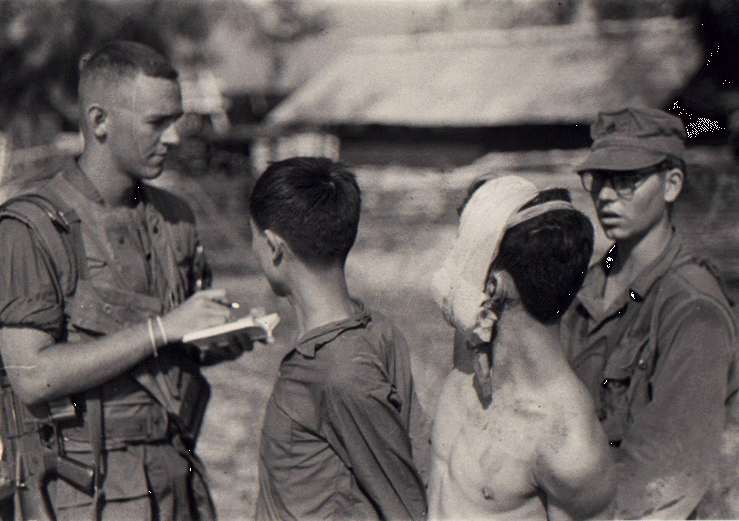
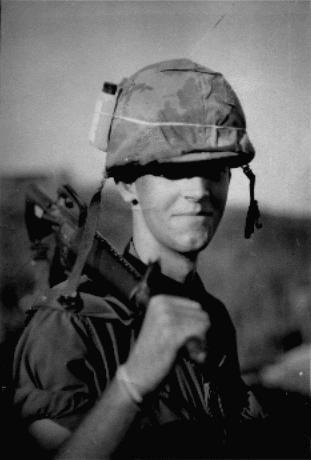
[Images of Hasford via: gustavhasford.com; photos by Linus Lohoff, Nicole Franzen and mrfreakz; painting by DK Stone]

Million Dollar Movie

Bobby D puttin’ in work. A.O. Scott interviews the actor over at the New York Times:

A.S.: Looking back, I find that one of the things that strikes me most is the consistency with which you’ve kept working for 40 years. And that’s a question that I’m fascinated by, whether I was asking Scorsese or Bruce Springsteen or Meryl Streep or Woody Allen: How do you keep it going and keep it fresh?

R.D.: I enjoy it. I like it. And especially when you get older, you start realizing you don’t have that much time. And you look back and say, “The last 15 years, it went by kind of quickly.” You don’t really know it until you get there and look back and say, “Geez, where did that time go?” I know I’ve gotta account for every day, every moment, every this, every that, but it still went, that time went. So now I have the next whatever, hopefully 15, 20 years if I’m lucky, and I think what to use that time for.

A.S.: What about being on the other side of that, when you’re the director?

R.D.: I always feel you have to be very, very — whatever an actor does they can do no wrong. And they have to have that feeling so that they can try anything they want. Even if it’s not right, it doesn’t matter. Maybe we’ll use part of it. It’s O.K., do it once your way and then do it my way and then we’ll decide, or I’ll decide later, which is really the best. And sometimes you do that just to let the person get it out. I know I’ve done that with myself. I’d do it and I get it out and then I realize it probably wasn’t right. But I got it out.

Growing Pains

Over at Roopstigo, Bruce Schoenfeld profiles rookie Bradley Beal:

For every LeBron James or Kevin Garnett, I was told, there’s a Leon Smith or Qyntel Woods: elite talents who enter the league with great promise but get waylaid by the transition. “There’s a list of those with very high expectations who failed, and that list is large,” Denver Nuggets coach George Karl said. “For most of them, it wasn’t a physical reason. It wasn’t that they didn’t have the talent. It was about adapting, about confidence, loneliness, depression. They get frozen. They get lost.”

“I was 18 years old,” said the Miami Heat’s Rashard Lewis, “living on my own, not having my mom there to make me a plate of food, with no friends who could come over and help me think about something besides basketball.” Lewis had jumped directly from a Texas high school to the Seattle SuperSonics, who drafted him in the second round, 32nd overall, in 1998. He struggled on the court, which made the solitude more difficult. “When I had bad games or even a bad practice, I didn’t know where to turn,” he said. “My phone bills were out of control. One day it got so bad that I asked a friend from high school to come live with me.” Lewis eventually adapted to the NBA grind. Fourteen years later, he has more than 15,000 career points, two All-Star Game appearances, respect around the league. In an effort to ease his own transition, Beal has enlisted his older brothers to move to Washington with him. “At Florida, people were my age,” he says. “I could talk to them. If I have a bad game now, I can’t really knock on my neighbor’s door and be, like, ‘What’s up?’”

Such situations are common now that rookie contracts can subsidize permanent houseguests. (Beal has a two-year rookie deal with options for a third and fourth year. He is guaranteed $4.13 million this season.) Yet they are often discouraged by NBA teams, who’ve been burned by relatives and friends giving all the wrong advice, or who see the player as a ticket to the good life. “It’s hard to tell a kid, ‘I don’t want you to bring your mom out,’ or ‘You can’t have your brother come,’” Wizards head coach Randy Wittman said. “They don’t know it’s a bad situation. Brothers and sisters can be draining and wanting, wanting, wanting, but they’re brothers and sisters. How do you say no?”


For Sale

Whoofah.

I’m a Mook? What’s a Youk?

Our man William thinks Napoli and Youk are the mooks for the Yanks.

Drawing by Moebius.

Still Diggin’

Check out this new feature at Slate: The Vault.

Come Fully Packed with a Fat Rugged Stack

Ol’ Dirty died eight years ago. Over at Egotrip, check out this gallery of ODB memorial murals.

Million Dollar Movie

Glenn Kenny on the new crop of Blu-ray DVDs.

A Love Supreme

Over at Jazz Wax, here’s Jessica Ferber on Bob Campbell.

Picture of Bud Powell.

Mother May I?

Here’s Richard Russo in the L.A. Times talking about his latest book, Elsewhere, a memoir about his relationship with his mother:

Why your first memoir now?

In a sense I would have preferred that it be never. I’m a perfectly happy novelist. I love to invent things. But in the months after my mother’s death, which was about five years ago, she was very much on my mind and also visiting my dreams as well, which made it feel to me like maybe there was unfinished business there.

I think that this book is in a way connected to my novels, especially the last couple, because “Empire Falls” and “Bridge of Sighs” are both about people who are pushing 60 pretty hard and wondering, how in the world did I come to be here? [In “Empire Falls,] Miles Roby has this profound sense of his mother’s dream for him, and he imagines this other life where he is a learned man if only he had finished college the way she wanted him to and become some sort of teacher or professor, that he would have fulfilled her dream. In “Bridge of Sighs,” Lucy Lynch, who never leaves his hometown, wonders, how is it that life turned out this way? What was it in my genetic makeup, what were the choices that I made?

And in the months after my mother’s death, I found myself puzzling over these questions of destiny, because we shared so many similarities, both of nature and nurture. We’re both obsessive genetically, I think.

Did you feel it was your responsibility to make your mother happy, which she never really was?

Yes, I felt the weight of that. I felt that if she wasn’t both happy and healthy — and healthy every bit as happy, because at a very early age, I felt that her health was in some way my responsibility… We’re not talking about front-of-the-brain stuff, we’re talking about back of the brain. I mean I’m not stupid. I know that nobody can make somebody else happy or healthy, but that’s in the front of the brain. That’s what you know intellectually, which has really very little to do with that other part of the brain that you don’t have control of.

I wondered whether there wasn’t something about the intensity of this relationship that was peculiar to the fact that it was between a mother and son, especially since the mother is a single parent and the son a single child.

When you’re an only child and you have no one to compare notes with, everything seems normal. And for me, part of the experience of writing this book was not to tell people what I knew, but rather to tell them what I didn’t know, what it was like growing up as a child with someone you sensed was in some way possessed.

Here’s a nice essay about memoir-writing by Adam Hochschild.

[Photo Credit: Joel Page]

Million Dollar Movie

Allen Barra on Literary Bond vs. Movie Bond.

[Illustrations by Michael Gillette]

The Wife

I’ve been with Emily for close to eleven years. Love her more now than ever.

Did I mention she likes baseball?


The Banter Gold Standard: Brownsville Bum

Here’s what Jimmy Breslin calls the best magazine story ever written:

“Brownsville Bum”

By W.C. Heinz

It’s a funny thing about people. People will hate a guy all his life for what he is, but the minute he dies for it they make him out a hero and they go around saying that maybe he wasn’t such a bad guy after all because he sure was will- ing to go the distance for whatever he believed or whatever he was.

That’s the way it was with Bummy Davis. The night Bummy fought Fritzie Zivic in the Garden and Zivic started giving him the business and Bummy hit Zivic low maybe 30 times and kicked the referee, they wanted to hang him for it. The night those four guys came into Dudy’s bar and tried the same thing, only with rods, Bummy went nuts again. He flattened the first one and then they shot him, and when everybody read about it, and how Bummy fought guns with only his left hook and died lying in the rain in front of the place, they all said he was really something and you sure had to give him credit at that.

“So you’re AI Davis?” one of the hoods said. “Why you punch-drunk bum.”

What did they expect Bummy to do? What did they expect him to do the night Zivic gave him the thumbs and the laces and walked around the referee and belted Bummy? Bummy could hook too good ever to learn how to hold himself in, if you want the truth of it.

That was really the trouble with Bummy. Bummy blew school too early, and he didn’t know enough words. A lot of guys who fought Zivic used to take it or maybe beef to the referee, but Bummy didn’t know how to do that. A lot of guys looking at four guns would have taken the talk and been think- ing about getting the number off the car when it pulled away, but all Bummy ever had was his hook.

Bummy came out of Brownsville. In the sports pages they are always refer- ring to Brownsville as the fistic incubator of Brooklyn, because they probably mean that a lot of fighters come out of there. Murder, Inc., came out of there, too, and if you don’t believe it ask Bill O’Dwyer. If it wasn’t for Brownsville maybe Bill O’Dwyer wouldn’t have become the mayor of New York.

The peculiar thing about Brownsville is that it doesn’t look so tough. There are trees around there and some vacant lots, and the houses don’t look as bad as they do over on Second Avenue or Ninth Avenue or up in Harlem. Don’t tell Charley Beecher, though, that you don’t think it’s so tough.

“What’s the matter you sold the place?” Froike said to Charley the other day. “It ain’t the same, now you sold it.”

Charley Beecher used to run the poolroom “With the gym behind it on the comer of Georgia and Livonia where Bummy used to train. It was a good little gym with a little dressing room and a shower, and Charley was a pretty good featherweight in the twenties, and his brother Willie, who was even a better fighter, fought Abe Attell and Johnny Dundee and Jack Britton and Leach Cross and Knockout Brown.

“For 17 years I was in business,” Charley said. “Seventeen times they stuck me up.”

He looked at Froike, and then he pointed with his two hands at his mouth and his ears and his eyes.

“I had guns here and here and here,” he said. “All I ever saw was guns.”

The worst part was that Charley knew all the guys. A week after they’d heist him they’d be back for a little contribution, maybe a C note. They’d be getting up bail for one of the boys, and they just wanted Charley to know there were no hard feelings about the heist, and that as long as he kept his dues up they’d still consider him friendly to the club. That’s how tough Brownsville was.

Bummy had two brothers, and they were a big help. They were a lot older than Bummy, and the one they called Little Gangy and the other they called Duff. Right now Gangy is doing 20 to 40, just to give you an idea, and Bummy took a lot of raps for them, too, because there were some people who couldn’t get back at Gangy and Duff so they took it out on the kid.

When Bummy was about seven his father used to run a candy and cigar store and did a little speaking on the side. In other words, he always had a bottle in the place, and he had Bummy hanging around in case anybody should say cop. When the signal would go up Bummy would run behind the counter and grab the bottle, and he was so small nobody could see him over the counter and he’d go out the back.

One day Bummy was going it down the street with the bottle under his coat and some real smart guy stuck out his foot. Bummy tripped and the bottle broke, and Bummy looked at the bottle and the whiskey running on the sidewalk and at the guy and his eyes got big and he started to scream. The guy just laughed and Bummy was lying right on the sidewalk in the whiskey and broken glass, hitting his head on the sidewalk and banging his fists down and screaming. A crowd came around and they watched Bummy, with the guy laughing at him, and they shook their heads and they said this youngest Davidoff kid must be crazy at that.

Davidoff was his straight name. Abraham Davidoff. In Yiddish they made Abraham into Ahvron and then Ahvron they sometimes make Bommy. All his family called him Bommy, so you can see they didn’t mean it as a knock. The one who changed it to Bummy was Johnny Attell.

Johnny Attell used to run the fights at the Ridgewood Grove, a fight club in Brooklyn where some good fighters like Sid Terris and Ruby Goldstein and Tony Canzoneri learned to fight, and Johnny and a nice guy named Lew Burston managed Bummy. When Bummy turned pro and Johnny made up the show card for the fight with Frankie Reese he put the name on it as Al (Bummy) Davis, and when Bummy saw it he went right up to John’s office.

“What are you doing that for?” he hollered at Johnny. “I don’t want to be called Bummy.”

“Take it easy,” Johnny said. “You want to make money fighting, don’t you?”

“People like to come to fights to see guys they think are tough.”

They sure liked to come to see Bummy all right. They sure liked to come to see him get his brains knocked out.

The first time Johnny Attell ever heard of Bummy was one day when Johnny was coming out of the Grove and Froike stopped him. Froike used to run the gym at Beecher’s and handle kids in the amateurs, and he was stand- ing there talking to Johnny under the Myrtle Avenue El.

“Also I got a real good ticket seller for you,” he said to Johnny after a while.

“I could use one,” Johnny said.

“Only I have to have a special for him,” Froike said. “No eliminations.” “What’s his name?” Johnny said.

“Giovanni Pasconi,” Froike said.

“Bring him around,” Johnny said.

The next week Johnny put the kid in with a tough colored boy named Johnny Williams. The kid got the hell punched out of him, but he sold $200 worth of tickets.

“He didn’t do too bad,” Johnny said to Froike after the fight. “I’ll put him back next week.”

“Only this time get him an easier opponent,” Froike said.

“You get him your own opponent,” Johnny said. “As long as he can sell that many tickets I don’t care who he fights.”

The next week Johnny put him back and he licked the guy. After the fight Johnny was walking out and he saw the kid and Froike with about 20 people around them, all of them talking Yiddish.

“Come here, Froike,” Johnny said.

“What’s the matter?” Froike said.

“What is this guy,” Johnny said, “a Wop or aJew?”

“He’s a Jew,” Froike said. “His right name’s Davidoff. He’s only 15, so we borrowed Pasconi’s card.”

“He can sure sell tickets,” Johnny said.

Bummy could sell anything. That’s the way Bummy learned to fight, selling. He used to sell off a pushcart on Blake Avenue. He used to sell berries in the spring and tomatoes and watermelons in the summer and apples in the fall and potatoes and onions and beans in the winter, and there are a lot of pushcarts on Blake Avenue and Bummy used to have a fight to hold his spot.

“I was the best tomato salesman in the world,” Bummy was bragging once.

It was right after he knocked out Bob Montgomery in the Garden. He stiffened him in 63 seconds and he was getting $15,000, and when the sports writers came into his dressing room all he wanted to talk about was how good he could sell tomatoes.

“You go over to Jersey and get them yourself,” he was telling the sports writers. “Then you don’t have to pay the middle guy. You don’t put them in boxes, because when you put them in boxes it looks like you’re getting ready to lam. When you only got a few around it looks like you can’t get rid of them so what you gotta do is pile them all up and holler: ‘I gotta get rid of these. I’m gonna give ’em away!”‘

The sports writers couldn’t get over that. There was a lot they couldn’t get over about Bummy.

When Johnny turned Bummy pro he wasn’t impressed by his fighting, only his following. Every time Bummy fought for Johnny in the Grove he’d bring a couple of hundred guys with him and they’d holler for Bummy. Everybody else would holler for the other guy, because now they knew Bummy was Jewish and the Grove is in a German section of Ridgewood, and this was when Hitler was starting to go good and there was even one of those German beer halls right in the place where the waiters walked around in those short leather pants and wearing fancy vests and funny hats.

The fight that started Bummy was the Friedkin fight. Bummy was just beginning to bang guys out at the Grove and Friedkin was already a hot fighter the Broadway Arena and they lived only blocks apart. Friedkin was a nice about three years older than Bummy, kind of a studious guy they called Schoolboy Friedkin, and there was nothing between him and Bummy except they were both coming up and the neighborhood made the match.

Like one day Bummy was standing in the candy store and a couple of guys told him Friedkin was saying he could stiffen Bummy in two heats. Then they went to Friedkin and said Bummy said Friedkin was afraid to fight. At first this didn’t take, but they kept it up and one day Bummy was standing with a dame on the corner of Blake and Alabama and Friedkin came along.

“So why don’t you two fight?” the dame said.

“Sure, I’ll fight,” Bummy said, spreading his feet.

“Right here?” Friedkin said. “Right now?”

“Sure,” Bummy said.

“I’ll fight whenever my manager makes the match/’ Friedkin said, and he walked away.

Bummy couldn’t understand that, because he liked to fight just to fight. He got right in the subway and went over to see Lew Burston in Lew’s office on Broadway.

“Never mind making that Friedkin match,” he said to Lew.

“Why not?” Lew said.

“Because when I leave here,” Bummy said, “I’m going right around to Friedkin’s house and I’m gonna wait for him to come out, and we’re gonna find out right away if I can lick him or he can lick me.”

“Are you crazy?” Lew said.

By the time Johnny Attell made the fight outdoors for Dexter Park there was really a fire under it. They had show cards advertising it on the pushcarts on Blake Avenue and Friedkin’s old man and Bummy’s old man got into an argument on the street, and everybody was talking about it and betting it big. Then it was rained out five nights and Johnny sold the fight to Mike Ja- cobs and Mike put it into Madison Square Garden.

When Bummy started working for the fight Lew Burston came over to Beecher’s to train him. When Bummy got into his ring clothes they chased everybody out of the gym, and Lew told Bummy to hit the big bag. Bummy walked up to the bag and spread his feet and pulled back his left to start his hook and Lew stopped him.

“Throw that hook away,” Lew said.

“Why?” Bummy said. “What’s wrong with it?”

“Nothing’s wrong with it,” Lew said, “only for this fight you’ll have to lose that hook.”

Before that Bummy was nothing but a hooker, but for weeks Lew kept him banging the big bag with rights. Then the night of the fight after Bummy was all taped and ready, Lew took him into the shower off the dressing room and he talked to Bummy.

“Now remember one thing,” he said to Bummy. “I can tell you exacdy how that other corner is thinking. They’ve got that other guy eating and sleeping with your hook for weeks. I want you to go out there and I don’t want you to throw one right hand until I tell you. If you throw one right before I say so I’ll walk right out on you. Do you understand?”

Bummy understood all right. He was like a kid with a new toy. He was a kid with a secret that only Bummy and Lew knew, and he went out there and did like Lew told him. Friedkin came out with his right glued along the side of his head, and for three rounds Bummy just hooked and hooked and Friedkin blocked, and a lot of people thought Friedkin was winning the fight.

“All right,” Lew said, after the third round. “Now this time go right out and feint with the left, but throw the right and put everything on it.”

“Don’t worry,” Bummy said.

Bummy walked out and they moved around for almost a minute and then Bummy feinted his hook. When he did Friedkin moved over and Bummy threw the right and Friedkin’s head went back and down he went with his legs in the air in his own corner. That was all the fighting there was that night.

Now Bummy was the biggest thing in Brownsville. AI Buck and Hype Igoe and Ed Van Every and Lester Bromberg were writing about him in the New York papers, saying he was the best hooker since Charley White and could also hit with his right, and he had dough for the first time in his life.

He got $14,000 for the Friedkin fight. When he walked down the street the kids followed him, and he bought them leather jackets and baseball gloves and sodas, just to show you what money meant and how he was already looking back at his own life.

When Bummy was a kid nobody bought him anything and he belonged to a gang called the Cowboys. They used to pull small jobs, and the cops could never find them until one night. One night the cops broke into the flat where the kids used to live with some dames, and they got them all except Bummy who was with his mother that night.

Sure, Bummy was what most people call tough, but if he felt sorry for you and figured you needed him be couldn’t do enough. That was the way Bummy met Barbara and fell in love.

Bummy was 19 then and one day he and Shorty were driving around and Shorty said he wanted to go to Kings County Hospital and visit a friend of his who was sick, and there was this girl about 16 years old. They sat around for a while and Shorty did all the talking and then the next time they went to see the girl Shorty was carrying some flowers and he gave them to her.

“From him,” Shorty said, meaning Bummy.

When the girl left the hospital Shorty and Bummy drove her home, and then every day for a couple of weeks they used to take her for a ride and to stop off for sodas. One day the three of them were riding together in the front seat and Bummy wasn’t saying anything.

“Say, Bobby,” Shorty said all of a sudden, “would you like to get married?”

The girl didn’t know what to say. She just looked at Shorty.

“Not to me,” Shorty said. “To him.”

That was the way Bummy got married. That was Bummy’s big romance. After the Friedkin fight Bummy won about three fights quick, and then they made him with Mickey Farber in the St. Nick’s. Farber was out of the East Side and had a good record, and one day when Bummy finished his training at Beecher’s he was sitting in the locker room soaking his left hand in a pail of ice and talking with Charley.

That was an interesting thing about Bummy’s left hand. He used to bang so hard with it that after every fight and after every day he boxed in the gym it used to swell up.

“I think I’ll quit fighting,” Bummy said to Charley.

“You think you’ll quit?” Charley said. “You’re just starting to make dough.”

“They’re making me out a tough guy,” Bummy said. “All the newspapers make me a tough guy and I don’t like it and I think I’ll quit.”

“Forget it,” Charley said.

When Charley walked out Murder, Inc., walked in. They were all there—Happy and Buggsy and Abie and Harry and the Dasher—and they were looking at Bummy soaking his hand in the ice.

“You hurt your hand?” Buggsy said.

“No,” Bummy said. “It’s all right.”

They walked out again, and they must have gone with a bundle on Farber because the day after Bummy licked Farber he was standing under the El in front of the gym and the mob drove up. They stopped the car right in front of him and they piled out.

“What are you, some wise guy?” Buggsy said.

“What’s wrong with you?” Bummy said.

“What’s all this you gave us about you had a bad hand?” Buggsy said.

“I didn’t say I had a bad hand,” Bummy said.

“You did,” Buggsy said.

“Listen,” Bummy said, spreading his feet the way he used to do it, “if you guys want a fight let’s start it.”

Buggsy looked at the others and they looked at him. They they all got in the car and drove off, and if you could have been there and seen that you would have gone for Bummy for it.

That was the bad part about Bummy’s rap. Not enough people knew that part of Bummy until it was too late. The people who go to fights don’t just go to see some guy win, but they go to see some guy get licked, too. All they knew about Bummy was some of the things they read, and he was the guy they always went to see get licked.

Even the mob that followed Bummy when he was a big name didn’t mean anything to him, because he could see through that. He could see they were always grabbing at him for what they could get, and that was the thing he never got over about the time he was training in Billy West’s place up in Woodstock, New York.

Bummy went up there after he came out of the Army,just to take off weight, and there are a lot of artists around there. Artists are different people, because they don’t care what anybody says about a guy and they either like him or they don’t like him for what they think he is. They all liked him up there, and Billy used to say that Bummy could have been Mayor of Woodstock.

Billy had a dog that Bummy never forgot, either. Bummy used to run on the roads in the mornings and Billy’s dog used to run with him. Every morning they’d go out together and one day another dog came out of a yard and went for Bummy and Billy’s dog turned and went after the other dog and chased it off.

“Gee, this dog really likes me,” Bummy said, when he got back to the house, and he said it like he couldn’t believe it. “He’s really my friend.”

The fight that really started everybody hating Bummy, though, was the Canzoneri fight in the Garden. It was a bad match and never should have been made, but they made it and all Bummy did was fight it.

Canzoneri was over the hill, but he had been the featherweight champion and the lightweight champion and he had fought the best of his time and they loved him. When Bummy knocked him out it was the only time Tony was knocked out in 180 fights, and so they booed Bummy for it and they waited for him to get licked.

They didn’t have to wait too long. After he knocked out Tippy Larkin in five they matched him with Lou Ambers. Just after he started training for Ambers he was in the candy store one day when an argument started between. Bummy and a guy named Mersky. Nobody is going to say who started the argument but somebody called Bummy a lousy fighter and it wasn’t Bummy. Somebody flipped a piece of hard candy in Bummy’s face, too, and that wasn’t Bummy either, and after Bummy got done bouncing Mersky up and down Mersky went to the hospital and had some pictures taken and called the cops.

The first Johnny Attell heard about it was the night after it happened. He was walking down Broadway and he met a dick he knew.

“That’s too bad about your fighter,” the cop said.

“What’s the matter with him?” Johnny said.

“What’s the matter with him?” the cop said. “There’s an eight-state alarm out for him. The newspapers are full of it. He damn near killed a guy in a candy store.”

The cops couldn’t find Bummy but Johnny found him. He dug up Gangy, and Gangy drove him around awhile to shake off any cops, and finally Gangy stopped the car in front of an old wooden house and they got out and went in and there was Bummy.

Bummy was sitting in a pair of pajama pants, and that was all he had on. There were four or five other guys there, and they were playing cards.

“Are you crazy?” Johnny said.

“Why?” Bummy said, playing his cards, but looking up.

“If the cops find you here they’ll kill you,” Johnny said. “You better come with me.”

After Johnny talked awhile Bummy got dressed and he went with Johnny. Johnny took him back to New York and got him a haircut and a shave and he called Mike Jacobs. Jacobs told Johnny to take Bummy down to Police Headquarters, and when Johnny did that Sol Strauss, Mike’s lawyer, showed up and he got an adjournment in night court for Bummy until after the Ambers fight.

The night Bummy fought Ambers there was Mersky right at ringside. He had on dark glasses and the photographers were all taking his picture and when Ambers beat the hell out of Bummy the crowd loved it.

The crowd, more than Ambers, hurt Bummy that night. He didn’t like the licking Ambers gave him, but the hardest part was listening to the crowd and the way they enjoyed it and the things they shouted at him when he came down out of the ring.

“I quit,” he said to Johnny in the dressing room. “You know what you can do with fighting?”

Johnny didn’t believe him. Johnny was making matches for Jacobs in the Garden then and he matched Bummy with Tony Marteliano, but Bummy wouldn’t train.

Only Johnny and Gangy knew this, and one day Johnny came out to Bummy’s house and talked with Bummy. When that didn’t do any good Lew Burston came out and he talked for four hours, and when he finished Bummy said the same thing.

“I don’t want to be a fighter,” Bummy said. “I like to fight. I’ll fight Marteliano on the street right now, just for fun, but when I’m a fighter everybody picks on me. I want them to leave me alone. All I wanted was a home for my family and I got that and now I just want to hang around my mob on the street.”

Johnny still didn’t believe it. They put out the show cards, advertising the fight, and one day Bummy saw one of the cards in the window of a bar and he phoned Johnny in Jacobs’ office.

“What are you advertising the fight for?” he said, and he was mad. “I told you I’m not gonna fight.”

Before Johnny could say anything Jacobs took the phone. Johnny hadn’t told him Bummy didn’t want to fight.

“How are you, kid?” Jacobs said. “This is Mike.”

“Listen, you toothless—,” Bummy said. “What are you advertising me for? I’m not gonna fight.”

He hung up. Mike put the phone back and turned around and when he did Bummy was suspended and Johnny was out of the Garden and back in the Ridgewood Grove.

When Bummy heard what had happened to Johnny he went over to the Grove to see him. All the time Johnny was in the Garden Bummy was a little suspicious of him, like he was a capitalist, but now he was different.

“I came over to tell you something,” he said to Johnny. “I’m gonna fight.”

“Forget it,” Johnny said. “You can’t fight.”

“Who says I can’t fight?” Bummy said.

“The New York Boxing Commission,” Johnny said. “You’re suspended.”

“Let’s fight out of town,” Bumrny said. “We’ll fight where I’m not suspended.”

Johnny did it better. He took Bummy back to Mike and Bummy apologized and Bummy fought Marteliano. For nine rounds they were even, and with ten seconds to go in the last round Bummy landed the hook. Marteliano went down and the referee counted nine and the bell rang and it was another big one for Bummy and he was going again.

It was Johnny’s idea to get Marteliano back, but Bummy saw Fritzie Zivic Henry Armstrong for the welterweight title and he wanted Zivic. If you the two guys you knew this was a bad match for Bummy, because he didn’t know how to fight like Zivic.

There were a lot of people, you see, who called Bununy a dirty fighter, but Zivic fight made them wrong. The Zivic fight proved that Bummy didn’t know how to do it.

When he came out of the first clinch Bummy’s eyes were red and he was rubbing them and the crowd started to boo Zivic. In the second clinch it was same thing, and at the end of the round Bummy was roaring.

“He’s trying to blind me,” he kept saying in the comer. “He’s trying to blind me.”

When it started again in the second round Bummy blew. He pushed Zivic off and he dropped his hands and that crazy look came on that wide face of his and they could hear him in the crowd.

“All right, yo—-,” he said, “if you want to fight dirty, okay.”

He walked right into Zivic and he started belting low. There was no trying to hide anything, and the crowd started to roar and before it was over people were on their chairs throwing things and the cops were in the ring and Bummy was fined $2,500 and suspended for life.

They meant it to be for life—which wouldn’t have been very long at that, when you figure Bummy lived to be all of 26—but it didn’t work out that way. About three weeks after the fight Bummy walked into Johnny’s office with Shorty and Mousie, and they sat around for a time and Johnny could see Bummy was lost.

“You know what you ought to do?” Johnny said. “You ought to join the Army for a while until this blows over.”

This was in December of 1940, before we got into the war. For a while Bummy sat there thinking, not saying anything.

“Could my buddies go with me?” he said.

“Sure,” Johnny said.

So Johnny called up the recruiting officer and Bummy and Shorty and Mousie showed up and there were photographers there and it was a big show. Everybody was for it, and Ed Van Every wrote a story in The Sun in which he said this was a great move because the Army would teach Bummy discipline and get him in good physical shape.

That was a laugh. The first thing the Army did was split Bummy and Shorty and Mousie up and send them to different camps.

They sent Bummy to Camp Hulen, Texas, and their idea of discipline was to have Bummy cleaning latrines with a toothbrush.

You got me into this,” Bummy used to write Johnny. “I’m going crazy, so before I slug one of these officers you better get me out.”

Johnny didn’t get him out, but he got Mike Jacobs to get Bummy a leave to fight Zivic in the Polo Grounds for Army Emergency Relief. Bummy used to fight best at about 147 pounds, and when he came back from Texas he weighed close to 200.

“You look sharp in that uniform, AI,” Zivic said to him when they signed for the bout.

“I’m glad you like it,” Bummy said. “You put me in it.”

You can imagine how Bummy was looking to get back at Zivic, but he couldn’t do it. He hadn’t fought for eight months, and Zivic was a real good fighter and he put lumps all over Bummy and in the tenth round the referee stopped it. They had to find Bummy to take him back to camp. They found him with his wife and they shipped him back, but then the Japs bombed Pearl Harbor and the Army decided it had enough trouble without Bummy and they turned him loose.

Bummy fought some of his best fights after that. He couldn’t get his license back in New York but he fought in places like Holyoke and Bridgeport and Washington and Philadelphia and Elizabeth, New Jersey, and Boston. He didn’t like it in those places, but he had to live, and so no matter where he fought he would always drive back to Brownsville after the fight and sometimes it would be four o’clock in the morning before he and Johnny would get in.

It’s something when you think about Bummy and Brownsville, when you think of the money he made, almost a quarter of a million dollars, and the things he had thrown at him and the elegant places he could have gone. It was like what Lew Burston said, though, when he said the Supreme was Bummy’s Opera, and the Supreme is a movie house on Livonia Avenue.

You have to remember, too, that Brownsville is only a subway ride from Broadway, but Bummy had never seen a real Broadway show until Chicky Bogad sent Bummy and Barbara to see Hellzapoppin the night before the second Farber fight.

“How long has this been going on?” Bummy said when they came out.

“How long has what been going on?” Chicky said.

“People like that on a stage,” Bummy said.

“People on a stage?” Chicky said. “For years and years. For long before they had movies.”

“Is that right? I’ll have to see more of that,” Bummy said, but he never did.

All of those fights Bummy had out of town were murders, too, because Bummy wasn’t hard to hit, but the people liked to see him get hit and when the Republicans got back in power in New York, Fritzie Zivic put in a word for Bummy, saying he guessed he had egged the kid on, and Bummy got his license back. That’s when they matched him with Montgomery.

“What you have to do in this one,” they kept telling Bummy, “is walk right out, throw your right, and miss with it. Montgomery will grab your right arm, and that will turn you around southpaw and then you hit him with the hook.”

They knew that was the only chance Bummy had, because if Montgomery got by the first round he figured to move around Bummy and cut him up. They drilled Bummy on it over and over, and they kept talking about it in the dressing room that night.

“Now what are you going to do?” Johnny Attell said to Bummy.

“I’m gonna walk right out and miss with my right,” Bummy said. “He’ll grab my arm and that’ll turn me around southpaw and I’ll throw my hook.”

“Okay,” Johnny said. “I guess you know it.”

Bummy sat down then on one of the benches. He had his gloves on and his robe over him and he was ready to go when there was a knock on the door.

“Don’t come out yet, Davis,” one of the commission guys said through the door. “They’re selling some War Bonds first.”

When Bummy heard that he looked up from where he was sitting and you could see he was sweating, and then he keeled right over on the floor on his face. Johnny and Freddie Brown rushed over and picked him up and they stretched him on the rubbing table and Freddie brought him to, and now they weren’t worried about whether Bummy would do what they told him. All they were worried about was whether they could get him in the ring.

They got him in the ring and Burston had him repeat what he was supposed to do. When the bell rang he walked right out and threw his right and missed around the head. Montgomery grabbed the arm and turned Bummy around, and when he did Bummy threw the hook and Montgomery went down. When he got up Bummy hit him again and that’s all there was to it.

Montgomery was 10 to 1 over Bummy that night and they couldn’t believe it. Bummy got $15,000 for that fight and he borrowed $1,500 from Jacobs and the next day when Mike paid him off he told Bummy to forget the grand and a half.

“Take it out,” Bummy said, throwing the dough on the desk. “You know damn well if he kayoed me like you thought he would you were gonna take it out.”

Bummy thought he’d never be broke again. He got $34,000 the night Beau Jack beat him and $15,000 when Armstrong stopped him. Then somebody sold him the idea of buying that bar and grill and somebody else sold him a couple of race horses and even after Dudy bought the bar and grill from him he was broke.

He should have been in training for Morris Reif the night he was shot. Johnny wanted him to fight Reif, just for the dough and to go as far as he could, but Bummy said that a lot of his friends would bet him and he didn’t think he could beat Reif, so instead he was sitting in the back of Dudy’s drinking beer and singing.

Bummy used to think he could sing like a Jewish cantor. He couldn’t sing, but he was trying that night, sitting with some other guys and a cop who was off duty, when he looked through that lattice work at the bar and he saw the four guys with the guns.

“What the hell is this?” he said.

He got up and walked out and you know what happened. When Bummy stiffened the first guy one of the others fired and the bullet went into Bummy’s neck. Then the three picked up the guy Bummy hit and they ran for the car. One of the guys with Bummy stuffed his handkerchief in the collar of Bummy’s shirt to stop the blood, and Bummy got up and ran for the car. When he did they opened up from the car, and Bummy went flat on his face in the mud.

When the car started to pull away the cop who had been in the back ran out and fired. He hit one guy in d1e spine, and that guy died in Texas, and he hit another in the shoulder. The guy with the slug in his shoulder walked around with it for weeks, afraid to go to a doctor, and then one night a cop in plain clothes heard a couple of guys talking in a bar.

“You know that jerk is still walking around with the bullet in his shoulder?” the one said. “What bullet?” the second one said.

“The Bummy Davis bullet,” the first said.

The cop followed them out, and when they split up he followed the first guy and got it out of him. Then the cops picked up the guy with the bullet and he sang. They picked up the other two in Kansas City and they’re doing 20 to life. They were just punks, and they called themselves the Cowboys, the same as Bununy’s old gang did.

It was a big funeral Bummy had. Johnny and Lew Burston paid for it. The papers had made Bummy a hero, and the newsreels took pictures outside the funeral parlor and at the cemetery. It looked like everybody in Brownsville was there.

This piece originally appeared in True. It is reprinted here with permission of Gayl Heinz.

More Heinz:

One Throw (Short Story)

The Happiest Hooligan of them All (Pepper Martin)

Death of a Racehorse

Speaking of Sports (Howard Cosell)

Maybe Tomorrow, Maybe the Next Day (Jeremy Vernon)

As a bonus, please check out out this terrific introduction to the Heinz collection What A Time It Was:  The Best of W.C. Heinz on Sports.

By Jeff MacGregor

W. C. Heinz is the last surviving member of a golden generation of American writers. A newspaper reporter and columnist, a war correspondent and magazine feature writer, a novelist and short story writer, he was a friend and colleague of Damon Runyon, Grantland Rice, Red Smith, A. J. Liebling, Jimmy Cannon, Frank Graham, and Paul Gallico. At mid-century he was one of the best and most admired writers in America.

Across the arc of a sixty-year career his fiction has been praised by Ernest Hemingway and his combat reportage compared to that of Ernie Pyle. He wrote the book that made Vince Lombardi a sports icon, and co-wrote the classic novel MASH. He wrote about Dr. Martin Luther King Jr.’s Selma peace march and about the Allied march into Germany to end the Second World War. He wrote about success and failure, life and death, and all the dire business of humanity in the busiest half-century of mankind’s history. Mostly, though, Bill Heinz wrote about sports.

Wilfred Charles Heinz was born on January 11, 1915, in Mount Vernon, New York. The only child of Elizabeth and Frederick Heinz, he recalls ancient afternoons spent with his friends flipping baseball cards after school—winner takes Cobb, Ruth, or Johnson, Speaker or Frisch, a fortune’s worth now—the pasteboard cards tossed into the air and then gathered up for the breathless run home. Heinz, fine-boned and slender, played hockey all the way up through high school, so he understood athletics as a physical and competitive expression of self. But he was also an avid reader, devouring sets of Tennyson, Twain, Shakespeare, Balzac, and Poe, which introduced him to a world of ideas, and to self-expression of a different sort. For Christmas in 1932 he received the Omnibus of Sport, a sports writing anthology edited by the legendary Grantland Rice. In it, Heinz discovered the intersection of two things he loved: good writing and sports.

In 1937 Heinz graduated from Middlebury College in Vermont, where he had written and edited the sports page of the school newspaper. In that autumn of ’37, he took his first real job as a messenger boy for one of the afternoon papers down in the city, the New York Sun. He was paid fifteen dollars a week to run errands. Soon promoted to copyboy, by 1939 he was working as a cub reporter, covering school board meetings and apartment fires and learning how to write on deadline. He learned to listen to people, to what they said and how they said it and what they really meant. And most importantly, he learned how to tell a story.

For the next four years, Bill Heinz worked as a general assignment reporter at the Sun. He wrote about corrupt politicians and roller coaster trackwalkers, city bond issues and streetcorner shootings. He occasionally covered basketball or wrote a piece on the new winter sensation, parallel skiing, but he felt stuck and unfulfilled and wasn’t sure where or how far his writing could take him. The Second World War changed all that. He became the Sun‘s junior war correspondent in 1943, covering carrier operations in the Atlantic. His early dispatches were crisp and informative, optimistic, and heavy on the upbeat hometown profiles of Your Boys at Sea. By 1944, though, when Heinz started following the ground war across Europe after the Normandy invasion, his work took on a new gravity, the words tempered by the horrible reality of war seen firsthand. What Heinz saw on the push east to Berlin would inform his work from then on. He stripped away the artifice, did away with any writerly “style” until he made himself transparent. This would characterize the best of his work for the rest of his life.

It is this streamlined lyricism and meticulous devotion to detail that marked Heinz’s work after he returned from Europe in the spring of 1945. He was assigned a sports beat, and quickly became one of New York’s most highly regarded writers. (When asked, in 1946, to recommend a writer for an upcoming magazine job, Damon Runyon, unable to speak because of terminal throat cancer, wrote on a cocktail napkin, “W. C. Heinz very good.” He underlined “very good” three times.)

By 1948 Heinz had his own daily sports column in the New York Sun, fittingly positioned in a double truck layout opposite that of his mentor, Grantland Rice. He wrote magazine pieces and fine short stories as well, raising a family and building a national reputation. One of his columns from that year, “Death of a Racehorse,” which is included in this collection, remains, with all due respect to Bill’s good friend Red Smith, perhaps the best piece of daily newspaper writing you’ll ever read. It is a 700-word master class in how to write. It is observant and precise in detail, lyrical and beautifully metered in its language, and, in its final paragraph, piercingly eloquent about futility, about struggle and loss, and about death.

For over two years, five times a week, Heinz wrote his column in the best sports city in the world. New York was a mecca for everything from football and baseball to hockey and track, to harness racing to the dog show to the six-day bicycle races up at the 168th Street Armory. Heinz wrote about all of it exceptionally well. But what Heinz best loved to write about was boxing. It appealed to his storyteller’s sense with its simplicity, its finality, and its colorful—to say nothing of comic—characters; its sleek and shadowy money men with their pneumatic molls, its artful managers and dogged trainers and idiot savant cornermen, its avid fans and its second-generation fighters, young men bootstrapping themselves up from the gutter and into their split-level, wall-to-wall American dream and then back again.

At places like Stillman’s Gym on Eighth Avenue, Heinz spent his afternoons with his sleeves rolled up, his tie loosened, and his elbows propped on the damp canvas, taking notes, listening to the way the boxers and their handlers spoke, watching how they moved and what punches they threw. He was an extraordinary student of the form. He saw in boxing’s regulated savagery the purest expression of man’s endless appetite for combat, which he witnessed repeatedly during the war.

Boxing, to any writer but most especially to Bill Heinz, was a tailor-made meeting of the sacred and profane. It has always exerted an irresistible pull on writers of every generation from Jack London to Ernest Hemingway to Norman Mailer to Joyce Carol Oates. Looking back over the years since 1900, though, the simplest way to catalog the relative accomplishments of writers on the subject of boxing is this: There is W. C. Heinz. There is A. J. Liebling. There is everyone else.

The New York Sun closed its doors in January 1950, an early victim of the declining circulation that would reduce the number of daily papers in New York City from ten to three over the next two decades. By the time of its demise, Bill Heinz had already become a successful freelancer for magazines like Collier’s, Sport, the Saturday Evening Post, Argosy, True, Cosmopolitan, Esquire, and Look. Most of the pieces in this collection come from Bill’s magazine work.

Between 1950 and 1958 when his novel The Professional was published to wide critical acclaim (including an effusive congratulatory telegram from one of his most ardent admirers, Ernest Hemingway, and a fan letter from an earnest young author named Elmore Leonard), W. C. Heinz perfected his signature approach to the craft of storytelling. Like a master mason, Heinz built each of his long-form stories as though he were building a wall of mortarless stone. Every word and phrase was carefully set on the words and phrases that went before them. At his best, he was the equal of a Joseph Mitchell or an E. B. White. What can top the two paragraphs which open “Brownsville Bum”?

Heinz had an ear for dialogue, for the truth of what people said and how to write it. He was a student of the great Frank Graham, another sports columnist who had helped perfect the so-called “conversation piece,” stories built around long blocks of dialogue unbroken by writerly asides or commentary. In the days before the tape recorder (and guarded, litigious athletes), it was still possible to report the spirit, if not the letter, of what your subjects said—especially if you made them sound better, or smarter, or more colorful. In this technique, Heinz was, and remains, unmatched.

Through that decade and into the next, Bill Heinz profiled, it seems, every star athlete in America. Stan Musial and Pete Reiser and Eddie Arcaro and Charlie Conerly and Joe Namath. Boxers from Joe Louis to Carmen Basilio to Floyd Patterson, Sugar Ray Robinson and Ingemar Johannson to Ezzard Charles and the original Rockys, Marciano and Graziano. In every case what characterizes the writing of Bill Heinz is its drive and its deceptive simplicity. Never strident or overwrought, never hagiographic or adulatory, Bill Heinz wrote sports with a gimlet eye.

He also wrote with the same sure voice about the practice of medicine in his novels The Surgeon, Emergency, and MASH, a book he wrote in partnership with Dr. Richard Hornberger under the pseudonym Richard Hooker. This last title offers a rare glimpse into the sly sense of humor for which Heinz is still best known among his friends. And though these books, along with The Professional, American Mirror, and Once They Heard the Cheers were well-wrought and successful, perhaps Heinz’s greatest triumph was Run to Daylight! his week-in-the-life collaboration with the legendary Vince Lombardi. It made Lombardi a household name. Other members of the press eventually chose to make him a household god.

Even Bill Heinz, who should be a role model for gifted young writers everywhere, has suffered at the inconstant hands of history. Most of the publications for which he did his best work have long since ceased to be. Collier’s, Argosy, Look, True, the Sun, and the Saturday Evening Post have all been lost to us. Heinz never had the stable, high-visibility, long-term platform his friend Red Smith did. He is, at least in part, responsible for the careers of New Journalists like Gay Talese and Tom Wolfe and Frank Deford. Pioneering a new voice and a new approach, he created new opportunities for every writer to follow. And with this collection of his best writing on sports, he will no longer be the best kept secret in American literature.


Jockin’ Mike D to My Dismay

Nah, what the hell do I care? It’s coast to coast with Mike D’Antoni. Good for him.

[Photo Credit: Peter Yang, from a 2008 Men’s Journal profile on D’Antoni by Paul Solotaroff]

Sundazed Soul

“Ko-Ko”–Duke Ellington

Saturdazed Soul

Dance little sister, dance.

“Little Dancing Girl (1930 Originals)”– The Beau Hunks

“Little Dancing Girl”–The Beau Hunks

[Drawing by Ken Mat]

Goodbye to All That

News that Phillip Roth has retired from writing made its way around today. Here is David Remnick’s take over at The New Yorker:

Roth told Les inRocks that when he turned seventy-four he reread his favorite authors—Dostoyevsky, Conrad, Turgenev, Hemingway. Then, he said, “When I finished, I decided to reread all of my books beginning with the last, ‘Nemesis.’

“I wanted to see if I had wasted my time writing. And I thought it was more or less a success. At the end of his life, the boxer Joe Louis said, ‘I did the best I could with what I had.’ It’s exactly what I would say of my work: I did the best I could with what I had.”

“After that, I decided that I was finished with fiction,” Roth went on. “I don’t want to read it, I don’t want to write it, and I don’t even want to talk about it anymore. I dedicated my life to the novel. I studied them, I taught them, I wrote them, and I read them. At the exclusion of nearly everything else. It’s enough!”


…Roth long resisted the idea of a biography, and he has mocked the form in his fiction and in interviews. Some years ago, he worked for a while with Ross Miller, a professor at the University of Connecticut, but the two fell out and there was no biography. Recently, he wrote a hilarious screed for The New Yorker’s Web site about the Wikipedia entry for “The Human Stain.” But the need for a rather more complete account of his life persisted. This year, Roth relented and signed a collaborative agreement with Blake Bailey, who has written fine biographies of John Cheever and Richard Yates. He told Les inRocks that he is allowing Bailey free access to his archives for as long as necessary, but that he has instructed his executors to destroy the archive after his death. “I don’t want my papers lying around,” he said. “No one has to read them.”

[Photo Credit: Eric Thayer]

Million Dollar Movie

Via Kottke, check out this 1979 Atlantic magazine profile of George Lucas.

It’s a Set Up

Over at the Yankee Analysts, Michael Eder writes about Joakim Soria in pinstripes.

And where will Hiroki go? He might not be back in New York.

[Photograph by Andrew Moore]

feed Share on Facebook Share on Twitter Share via email
"This ain't football. We do this every day."
--Earl Weaver