"A New York Treasure" --Village Voice
Category: Sportswriting

In Living Color

LeRoy Neiman died yesterday. He was 91.

“Dying for Art’s Sake,” is an essay Pete Dexter wrote about Neiman for Esquire in July, 1984. It is reprinted here with permission from the author.

LeRoy Neiman has just been murdered in Milwaukee.

The clipping came in the morning mail—he thinks it was from Milwaukee—a review of his new book of paintings and sketches. “I don’t know why people aren’t nice,” he says. I am talking to him on the phone now. “Are you nice? Listen, there have been thousands of pictures taken of me. I’m a reasonably good-looking human being, aren’t I? Why would an editor want to use a picture where I have an hors d’oeuvre sticking out of my cheek? I wouldn’t do that to him. I always make things look their best…”

“That’s Milwaukee for you,” I admit.

“No, that was a newspaper. The guy in Milwaukee was very clever. He quoted every bad thing anybody ever said about me, but didn’t really say anything himself…Hotel room paintings. What’s wrong with paintings in hotel rooms? A lot of my paintings are in hotel rooms, so what? Art is where you find it. Oh, and they criticized my chin. Did I tell you that? They said I had a weak chin.”

“In Milwaukee?”

“No, in the newspaper. If you’re feeling nice, perhaps it would be amusing to visit, but I don’t need criticism. So if you’re not nice…”
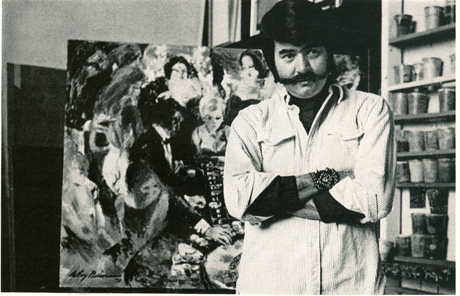
I tell LeRoy I will try to write nice, but I can’t promise. He invites me up to his place in New York anyway. The place in New York is most of the third floor of a large apartment building across the street from Central Park. There is an efficient-looking woman with the purest features I ever saw—one of those noses that looks like somebody took two weeks to get the flare in the nostrils right—who seems to run things for him, jars of paint and brushes all over the place, walls covered with painting and prints and sketches, most of them of athletes. There is a giant oil representation of a Las Vegas crap table learning against the far wall, done almost entirely in red. Floors, background, faces, clothes.

I haven’t done a lot of painting myself, unless you count water towers, but I recognize a work in progress. I figure he does all the blues next, then the yellows or whites. I figure, what he’s got there is a primer coat.

“That’s not finished, is it?” I say.

LeRoy seems pleased I have intuited that.

“No,” he says. “I haven’t decided what to do with it yet.”

“Well,” I say, “I think you’ve about done what you can with the red.”

The phone rings then, and the woman answers it. “LeRoy,” she says, “I’m sorry to interrupt…”

The call is about appearing in a movie. He takes it in the vestibule, but the acoustics in the place are terrific, and I can hear what he says at least as well as whoever is on the other end. Better, probably, because he keeps having to repeat himself for the other end.

“Yes,” he says, “a thousand a day and expenses…”

He wants a thousand dollars a day instead of a straight fee for the job because it might rain wherever the job is, and he doesn’t want to be sitting around somewhere getting wet for nothing.

He comes back into the studio and I compliment his acoustics. “This place is better than Lincoln Center,” I say.

LeRoy looks around the room, probably misunderstanding what I have said. “I’ve got an apartment on the ninth floor too,” he says. “But I never go up there. There’s furniture and a beautiful view, but it depresses me. And I’ve got a house in Great Gorge, New Jersey, but I haven’t been there in four years. I love the place, I just don’t like to be inside it. I have to keep it, though, you’ve got to have a house in the country.”

It is the pictures of the athletes that have made all this possible. They showed up first in Playboy magazine, which started running LeRoy’s stuff back in the Fifties. Then Roone Arledge of ABC Sports put them on television and turned LeRoy’s work into the most recognizable art in this country. Nobody is exactly sure why.

Eventually, of course, LeRoy became as famous as his pictures. He wore his white hats and trained his moustache to grow almost to his ears, and he had fascinating cigars.
I don’t know how he does it, but LeRoy’s cigars are always two minutes old. He carries them in the left side of his mouth, and they are always long and dark with half an inch of cold ash at the end. Then some wiseass editor in Milwaukee runs a picture of him eating hors d’oeuvres.

And you wonder why artists are moody?

II

“I like being outrageous,” he says. “It is the worst possible thing for my income and standing in the art community, but I don’t care. Why should I behave myself now, after all these years?”

I ask LeRoy what kind of misbehaving he means. Does he give sheep for wedding presents? Has he gotten drunk at parties and tired to deliver babies? He shakes his head no.

“I don’t actually do anything,” he says, “except be conspicuous. It keeps me revved up.”

The phone rings again. The woman answers it. “LeRoy,” she says, “I’m sorry to interrupt…” This time it’s some Brazilians, wanting him to come to a party at Regine’s.

“Everybody always wants things from me,” he says after he has hung up.

The Brazilians, it turns out—at least these Brazilians—are economically advantaged people. LeRoy says they wear the best clothes and drink at the best clubs and introduce all the new trends.

“They amuse me,” he says, “but I am not one of them. I am part of their scene—the same three hundred people show up everywhere around the world—but I’m not a member. I never judge them, I am never shocked by their conduct.” He sees I don’t understand. “A lot of them steal,” he says.

That’s the same way it is with LeRoy and athletes. “I don’t get too close to them personally,” he says. And this reminds him of the safari with Hef.

Hef is Hugh Hefner, who owns Playboy. He is one of the three people LeRoy names when I ask who his friends are. The other two are artists he sees once every two or three years.

“It was while we were in Africa,” he says, “that I noticed the natives were always jumping. Any little noise, they’d jump. They watched each other every minute. Hef and I and four other guys and six chicks went around the world to break in the new plane. You know, a pleasure trip. But in Africa, I saw these jumpy natives and realized that danger makes you aware. That’s how I am, too. Aware, observant. Nothing can sneak up from behind. That allows you to be outrageous.”

“You see, you come to a moment sometimes when you know you shouldn’t do something but you take the chance and do it anyway. The moment occurs in sports, it occurs in art. That’s the moment of creation, taking the chance. And sometimes it comes out fine, and sometimes you get murdered.”

I notice, however, that his paintings aren’t about the moment, they depict the population of a best-possible world.

“I like things to their best,” he says. “I like beautiful things, like chandeliers. But I think, for instance, you can say as much about war by painting the enthusiastic young soldiers marching off as you can by showing the dismembered bodies.”

I ask, “Where is the chance in that?”

LeRoy leans closer. “Have you ever heard of Mad Dog Vachon?” he says. “Andre the Giant? They’re wrestlers. Very big people, and very crude. A person I know called and asked if I would come to Ottawa, Canada, and sketch wrestling. They were doing a telecast, and wanted me at ringside to give it credibility.”

“So I flew to Montreal and we took a limousine—you’ve got to insist on a limo and the best room or else they’ll take advantage of you—and we drove about one hundred miles to the arena. I had a chick with me—a magnificent animal—and they put us right at ringside.

“The man who arranged for me to be there had told me that Mad Dog would point at me and call me names as part of the show. After the wrestlers were introduced, Mad Dog pretended to suddenly notice me sitting there, and he yelled, ‘I want that man removed. I want to see what he’s drawing.’

“I turned to the chick and said, ‘He’s really good.’ Then Mad Dog reached through the ropes and grabbed my leather drawing pad. I take it everywhere, and nobody is allowed to do that. I tried to pull it back. I said, ‘All right, that’s enough. These are my sketches,’ but Mad Dog pulled the pad and me with it right out of my seat, and then he crumpled up all my drawings.”

And you wonder why artists are so moody.

LeRoy says, “I yelled at him then that he had gone too far. He picked me up over his head and began whirling me around and around, the crowd went crazy, and then he finally threw me on the floor. That’s how wrestlers take criticism. I picked up my things and told the woman I was with that they had gone too far. We went back to the dressing room to complain, and after a while Mad Dog came in and said, ‘I didn’t do nothin’.’ Unbelievably crude.

“Then we went back to the limousine and two of the wrestlers followed us out and asked for a ride back to Montreal. One of them sat on the set with us, the other one sat on the jump seat. Huge, bruised men. We got about halfway to Montreal and one of them said, ‘We got to stop and eat.’

“I said I wanted to get back to Montreal. They said no, we had to stop. I refused. They seemed very civilized until we went by the truck stop and one them looked outside and said, ‘You remember the night we cleaned that place out?’…”

LeRoy sits quietly, in the middle of the memory. “I don’t associate with crude people,” he says after a while. “I came from a broken home and poverty, and I don’t want to be around that now. I am a working man’s artist, but I don’t know any working me. I champion their cause, but I don’t have any of them I talk to.”

“Why not?” I ask.

He shakes his head. “I don’t have to,” he says. “I’m an artist, and I can do what I want.”

[Mad Dog Vachon picture by Hieram Weintraub]


Vat Are You Hollerin’?


Nice piece by Scott Cacciola in today’s Wall Street Journal on Mario Chalmers: The Most-Yelled-At-Man in the NBA:

Ronnie Chalmers, Mario’s father, spent 22 years in the Air Force and coached Mario’s high-school basketball team in Anchorage, Alaska. “I wouldn’t say I was strict, but I had boundaries,” he said. When Self hired Ronnie to be his director of basketball operations, Mario got it even worse. “I was tough on him,” Self said. “I didn’t want guys to think he was the teacher’s pet.”

It turned out to be good preparation. Ever since James signed with Miami before the start of last season, Chalmers has been getting the full treatment. In the Heat’s Game 7 victory over the Boston Celtics in the Eastern Conference Finals, Chalmers appeared to miss a couple of open teammates on one possession. James leaned into him during a timeout and breathed fire. Chalmers turned his back to him, inserted his mouth guard and walked toward the court.

James and Wade both say they wouldn’t be so hard on Chalmers if they didn’t think he could handle it—and none of it is personal, James said—but Chalmers has defended himself more this season. “If I feel I’m doing something to the best of my abilities and they don’t feel that way, I have to voice my opinion,” he said.

For what it’s worth, Wade said he likes it when Chalmers fights back. “He actually thinks he’s the best player on this team,” Wade said. “That’s a gift and a curse.”

Toon Town

We usually refrain from mixing sports with politics round these parts but this here column about Bryce Harper by Charlie Pierce over at Esquire.com is worth a look.

A Love Supreme


David Waldstein has a long profile on Russell Martin and catching in the New York Times:

The physical penalties paid by the catcher, of course, are not often characterized by the spectacular violence of a wide receiver clotheslined by a safety. Neither are they frequently accompanied by the angry acoustics of a crunching hockey check into the boards.

The price paid, as much as anything, is one of plain, penetrating exhaustion, both mental and physical. It is about enduring a grinding, dirty routine, where, in St. Louis or Arlington, Tex., in August, a catcher can shed 10 pounds in a game. In 2007, when he was with the Los Angeles Dodgers, Martin started 143 games behind the plate.

Three times this season, Martin has caught at least six games in six days. From May 11 to 17, he caught seven consecutive games, and once, from June 5 to 13, he caught nine in a row.

“When you’re going through it, you don’t notice it,” Martin said of the grind. “It’s when you stop for a day or two and then the aches from the foul tips and the fatigue kind of bubble to the surface and you’re like ‘Whoa, did I get hit by a train?’

“Sometimes I’d rather just plow through and keep playing, just soldier on, because it almost feels harder when you’ve been off for a day and you come back.”

Worth your time.

[Photo Credit: Jyekn; Thomas Ferrara/Newsday]

Dollars and Cents


Fresh direct from Fortune magazine archives, check out this 1946 article about the Yankees:

In more ways than one, Larry MacPhail is like no other figure in baseball’s ruling class–the “magnates.” Because he is publicity minded and operates on terms of rowdy good-fellowship with the press, to whom he addresses a few thousand wellchosen words almost every day of his life, he is constantly in the news, and not always in a complimentary light. Where Ruppert was always “the Colonel” (an honorary title conferred on him at age twenty-two), MacPhail, who won his rank in service, is more likely to turn up even in the staid New York Times as “Loquacious Larry” or the “Rambunctious Redhead.” Once, in a fit of passion, he threw a middle-aged punch at the capable and well-liked Arthur Patterson, then covering the Dodgers for the Herald Tribune. Patterson, whose hair is just as red as MacPhail’s, countered in kind. MacPhail was so pleased about the affair that he later appointed Patterson traveling secretary and publicity director of the Yankees. The MacPhailian legend, indeed, stops precariously short of clownishness. Irrevocably, he is what the boys call “a character.” It is a curious, possibly a useful, mask for one of the abler businessmen in the U.S. and, with the possible exception of scholarly Branch Rickey, the soundest operator in baseball. (Rickey is a great all-around baseball man, but is now undergoing, in Brooklyn, his first real test as the president of a major-league club.)

The idea of MacPhail as a brooding Byronic figure would give most of his acquaintances a laugh, but even so it may be that he is entertaining a mildly psychotic war in his bosom. As a red-haired, freckle-faced kid in Ludington, Michigan, at the turn of the century, Larry liked to play nine o’ cat until dusk, but he practiced his piano lessons, too, and at fourteen was good enough to play the organ in the Episcopal Church. At sixteen he qualified for Annapolis but went to Beloit instead, where he was a star in his three favorite sports–baseball, football, and debating. During vacations he played pro ball under an assumed name. “In the Southern Michigan Association one season,” he can be induced to recall, “I hit .282. Fred (Bonehead) Merkle was in the league that year and was sold to the Giants for $750. He hit .274.”

Here ya Go, Daddy-O

Father’s Day is fast-approaching. Scanning the shelves for the latest baseball books, here are some thoughts:

“Damn Yankees.” ‘Nuff said.

“Wherever I Wind Up,” R.A. Dickey’s memoir, written with Wayne Coffey.

Man, the University of Nebraska Press has a bunch of good baseball titles including:

and

Also, check out Paul Dickson’s formidable-looking biography of Bill Veeck: “Bill Veeck: Baseball’s Greatest Maverick.”

There’s Marty Apel’s history of the Yankees:

“Pinstripe Empire”

…and a reissue of Bill Madden and Moss Klein’s “Damned Yankees” (which is not to be confused with Fleder’s book).

Also, Rob Miech has a book about the rookie stud Bryce Harper: “The Last Natural.” 

Yeah, the kid can play.


Honey Dripper

Our pal Josh Wilker on Larvell Blanks.

And here’s Josh on Mark Langston, Dwayne Murphy, and Dirt Tidrow.

The Illest

Man, every time I hear the name “Joey Votto” I think of Bob Sheppard.

Over at SI.com, Tom Verducci makes the case for Votto being the best hitter in the game:

I could throw a gazillion other numbers at you to help define the wizardry of Votto, but I like these three best:

• Votto has not popped up to the infield all season. In fact, he has popped out to the infield only three times in 2,138 plate appearances over the
past four seasons.

• The average NL hitter bats .198 when he is behind in the count. Votto hits .300 when he is behind in the count.

• Votto has pulled a ball foul into the stands only once in his entire major league career. Once.

“Sure, I remember it,” he said. “It was my rookie year. It wasn’t that deep — and maybe 20, 30 feet foul. I haven’t hit a long home run foul in my whole career.”

I was stunned when Votto told me that. We were talking about pull hitting last Friday because I was intrigued that he had not hit a home run to rightfield all year. (Lo and behold, he smacked a Wandy Rodriguez breaking ball into the rightfield seats about two hours later.) I told him I’ve noticed that he almost never gets out on his front foot with the barrel well in front of the plate — a mistake of timing that often creates the empty drama of the majestic but worthless foul “home run.” And that’s when he told me he never has hit one of those crowd teasers.

Dag.

You Cry Keepin’ it Real (But You Should Try Keepin’ it Right)

Jonathan Abrams profiles Stephen Jackson over at Grantland:

Jackson is a person whose past influences his present and will probably shape his future. Is he a good person who occasionally mixes in the bad? Or a bad person sometimes inclined to do good? The answer, with most like Jackson, is not as black and white as the familiar jersey he wears again.

“A lot of people mistake my passion for the game with being a thug or a gangster,” he said. “I’m far from that. I’m just a guy who come up in the hood and came from nothing and made something and hasn’t changed. I’m still going to be in Port Arthur all summer walking around with no shoes on, eating crawfish, barbecue, going fishing. I’m going to be the same guy, and I take pride in saying that because a lot of NBA players are not touchable. They’re not real. But I take pride in being a regular guy that people can walk up to and I’m not Hollywood. I want people to understand that that’s the person I am and I’m not changing for nothing.”

The Man Who Wasn’t There


Here is a good piece on Chris Bosh by Chris Haberstroh over at ESPN.

[Photo via Fast Company–Chris Graythen/Getty Images]

Father Knows Best

Chris Jones profiles Bruce Jenner in the latest issue of Esquire:

Bruce Jenner has taken it upon himself to rescue his ridiculous extended clan by doing what none of its other members will ever do: He has elected to lose. The person in the house who has most earned his fame has chosen to accept the least of it. “I’m done with competition,” he says. He says that in response to a question about his helicopters, whether he might fly them in the professional events that have been cropping up around the country, but he means it about everything. Jenner has made decisions, now, here, during his own second life. He has made up his mind once again. His singlet is in storage because he wants it to be. He’s the one who locked his medal away in the safe.

“Going through what I went through,” he says, “being that obsessed, is not what I would consider a good, well-rounded life. You’re selfish with your time. You’re selfish with your thoughts. You don’t have to grow up. All you’re concerned with is scoring points.”

Jenner has learned that perfection comes in many forms. He has learned that a private mastery is just as satisfying as a public one. He has learned that a curse isn’t a curse if it’s a choice. And he has learned that there may be no greater love a father can give his children than to accept that his life really didn’t begin until theirs did.

Art and Design

Dig the beauty that is all things Eephus. Bethany Heck’s got it going on. Thank you, Lady, for making our day brighter.

Painting by Kevin Vanhooser.

Fear and Faith in Phoenix


Charlie Pierce lowers the boom:

One thing is certain. Paige Sultzbach and her teammates deserved a chance to play for the championship. They were the only undefeated team in their league, and they’d already beaten Our Lady of Sorrows twice this season. They’d worked hard enough, and played well enough, to be allowed to win their championship on the field, and not have it handed to them because somebody hiding in a chapel somewhere decided not to give them the satisfaction. For all the theological dust they’ve thrown up to cover their cowardly retreat, Our Lady of Sorrows plainly and simply didn’t want to lose to a girl.

This is an embarrassment to sport and to religion, the functional equivalent of bleeding statues and the face of Jesus on the side of the barn. This is the kind of thing of which Blessed John XXIII was trying to rid the Catholic Church when he called on the council to “throw open the windows” and release the stifling air of repression that had built up over the centuries. Our Lady of Sorrows doesn’t want to play baseball against Paige Sultzbach because it’s run by an organization that harbors an attitude toward women that differs very little from that of Bishop Williamson, its crackpot avatar. And, no, I don’t have to “respect” the stand they took, or the beliefs that prompted it, unless I’m also prepared to “respect” the anti-Semitism and conspiracy-mongering that are at the heart of the beliefs in question. I’m not required to be as classy as Paige Sultzbach, state champion.

[Photo Credit: Carlos Chavez/Arizona Republic]

Blinded With Science (Poetry in Motion)

Over at Verb Plow, Glenn Stout has a thoughtful take on the Art vs. Science approach to appreciating baseball:

There is a war in baseball that rarely comes up on the field of play yet rages in the stands, the press box, in print and online 365 days a year.

On one side of this battle are those that consider baseball a science and believe that numbers tell us more about the game than any other approach. On the other side are those that consider the game an art and hold that baseball is an activity far too complicated and discreet to be contained in a series of calculations.

Neither side speaks much to the other, and when they do those discussions usually degenerate into a series of playground taunts between straw men, Science eschewing the Art crowd as ignorant louts and esthetes blind to logic, and Art denigrating the practitioners of Science as socially stunted denizens of their parent’s basements.

I delicately wandered into this battle a few weeks ago when, in responding to a Facebook discussion Charlie Pierce was involved in on the merits of Mike Cameron versus Dwight Evans I quipped that “Baseball is an art not a science.” Moments later the esteemed Joe Posnanski and a few others gently reprimanded me, one wagging his finger and writing “They don’t keep score at the ballet, Glenn.” Of course I realized the question was not as simple as either comment decreed, so rather than throw dirt bombs back and forth over the back fence I decided to step back, analyze the structure of the disagreement and try to determine if that tells us anything about the veracity of either approach.

[Photo Credit: Fecal Face]

Stacked

Check out this story by Jessica Bennett on the New York Times morgue over at Storyboard.

[Photo Via: The Five]

Love Story

The good folks at Deadspin have this excerpt from Frank Deford’s new memoir. It concerns Granny Rice.

Have at it.

Clown College

Steve Kerr advocates raising the NBA’s age limit over at Grantland. His argument is that the NBA is better served financially by having players in college longer. And in the end, Steve, isn’t what’s in the best financial interests of  the NBA really what’s best for America?

The dreckiest sentence in this mountain of dreck is this one: “Why should NBA franchises assume the responsibility and financial burden of player development when, once upon a time, colleges happily assumed that role for them?”

Let’s rewrite that question for Steve, but add one single ounce of humanity and perspective: “Why should anyone other than the NBA assume the responsibility and financial burden of player development?” Steve thinks the NBA is entitled to reap the corrupted benefits of the professional basketball player factory that is the NCAA.

And thank goodness for the NCAA. Assuming responsibilty over here and financial burden over there, all out of the goodness of their collective heart. The NCAA and NBA have concocted a virtually risk-free scam in which the NCAA develops talent at no cost, funnels that talent into a monopoly.  The only potential risk is a player getting hurt before he gets pushed through the funnel. That’s a minimal risk because the flow of talent is endless.

Well, minimal risk for the NBA and NCAA anyway. But screw the kid. That’s Kerr’s point and at least he had the guts to state it bluntly – albeit after he piled on about 2000 words of tone-deaf platitudes and other compost:

The arguments against raising the age requirement hinge on civil liberties, points like, “Who are we to deny a 19-year-old kid a chance to make a living when he can vote, drive, and fight in a war?” If this were about legality or fairness, you might have a case. But it’s really about business. The National Basketball Association is a multi-billion-dollar industry that depends on ticket sales, sponsorships, corporate dollars, and media contracts to operate successfully. If the league believes one rule tweak — whatever it is — would improve its product and make it more efficient, then it should be allowed to make that business decision.

With that guiding principle Steve, what other “rule tweaks” might serve the greater good of the NBA, and by definition, America? An endless and frightening list of things comes to mind. No business should be allowed to violate fundamental freedoms of our society to improve their bottom line. That type of thinking is vile.

And why is Grantland publishing this badifesto? I’m not asking an entire collection of writers to speak with one voice, but dropping in a non-writer with partisan ties to an issue to editoriolize is in poor taste. Especially when his case is so glaringly weak and offered without counterpoint.

I also don’t think rich, old, White men should be allowed to arbitrarly decide when impoverished, young, Black adults should be allowed to earn a living in their chosen profession, but Steve Kerr deftly dealt with that issue by not mentioning it.

The Wonderful One-Pitch Mo

From our pal Kevin Baker:

…with apologies to “The Autocrat of the Breakfast Table” by Oliver Wendell Holmes.

The Wonderful One-Pitch Mo

Have you heard of the Mar-i-ano,
Who such a wonderful pitch did throw
He ran up six hundred saves and then some,
And then of a sudden it — ah, but come,
I’ll tell you what happened without delay,
Tearing the Yankees into bits,
Frightening their fans out of their wits, –
Have you ever heard of that, I say?

Nineteen hundred and ninety-five.
Georgius Steinbrenner was still alive, –
Snuffy old drone from the German hive.
That was the year when Seattle-town
Saved its team by beating us down,
And Black Jack McDowell was done so brown,
Left without his scalp to his crown.
It was during that terrible playoff round
That Mariano first came to town.

Now when it comes to closers, I tell you what,
There is always, always a weakest spot, –
They throw too hard or they throw too weak,
They throw too wild or they give up the gophers,
Fall asleep in the pen, those indolent loafers
Find their fault somewhere you must and will, –
In their arm or their head, or within or without, –
And that’s the reason, beyond a doubt,
That a closer breaks down, but doesn’t wear out.

But Steinbrenner swore (as Steinbrenners do,
With an “I dew vum,” or an “I tell yeou”)
He would find one closer to top the Sox
And the Orioles, too, and even the Jays;
And the Indians, and the Oakland A’s:
“Fer,” said Old George, “’t’s mighty plain
Thut the weakes’ pitch mus’ stan’ the strain;
‘n’ the way t’ fix it,’ he said with a hitch,
“Is to find a closer who throws just one pitch.”

So George he inquired down Panama way
Where he could find the toughest hombre,
That couldn’t be spooked nor rattled nor beaten,
Slim as a wraith with a boyish grin;
Who didn’t go for pills or gin;
A monkish halo upon his crown,
And one pitch that could put the toughest side down,
And make even Manny and Ortiz frown.

The pitch he had, well they called it a cutter,
It slipped out of his hand as easy as butter
And swerved and swooped around each batter,
It looked like a fastball, it bent like a curve,
And each one thrown with such vim and nerve,
That hitters were done before they got up,
Frazzled and razzled from helmet to cup.
Their bats were shattered and their confidence shaken,
They couldn’t believe they’d been so taken
And oh, how they would carry on so
To see the wonderful one-pitch Mo

“There!” said George S., “naow we’ll win!”
Win! I tell you, I rather guess
The lad was a wonder, and nothing less!
Colts grew horses, beards turned gray,
Steinbrenner and Steinbrenneress dropped away,
Children and grandchildren — where were they?
But there stood the stout old one-pitch Rivera
As handsome and fabled as Ernesto Guevara.

Ninety-six! — they beat the Braves
Mo pitched two innings, always to raves.
Ninety-eight, and they set some marks;
Mo was the closer now, they filled all the parks.
Ninety-nine they won, and you can bet your testes,
In the year Two Thousand they hammered the Metsies.

Sure, there was a blip here or there,
Thanks to broken-bat singles and the occasional err’r.
That night in Boston, Joe went to sleep on the bench,
And the one in Phoenix when the grass was drenched.
An Alomar here who was all too Sandy,
And a juiced-up Mueller who was mighty handy.

But try as they might they still couldn’t maim him,
He believed in God and who could blame him?
With a pitch like that he sure looked blessed,
And all the hitters he undressed
They just shook their heads and even laughed,
When his cutter ran in and they looked daft.

Running in from the bullpen each night to Metallica,
Rousing the Bronx into high hysterica.
He didn’t take steroids, HGH, or any P-E-Ds
Though the men who he pitched to went through them like Wheaties.
That was all they could do to try to even the score,
As he went rolling on through Ought-Three and Ought-Four

The last 42, he’d become just sublime,
A tribute to Jackie, but all in Mo’s time.
On he went to three hundred
Saves, and then four,
Got his first RBI in the game he hit five,
Did the deed out in Queens where he always did thrive.
Another title that year though his side was killing him,
Finished off Philly in the brand-new Sta-di-um.

On to six hundred he soon did sail,
Passed Lee Smith and Hoffman, and that’s no tale.
Beat the Angels of Anaheim and of Los Angeles,
The Royals in Missoura and the Rangers in Texas.
Topped the Indians, Tigers, the Rays of some kind,
Baffled the Sox, both Pale and Carmine.
It seemed as if he’d go on forever,
His cutter slower but never cleverer
Punching them out and running up flags,
Surpassing the Goose, Sparky, and Rags.

Yet little of of all that we value here
Takes to the field in its forty-deuce year
Without both feeling and looking queer.
In fact, there’s nothing that keeps its youth,
So far as I know, but Mo and the truth.
(This is a moral that runs at large;
Take it. — You’re welcome. — No extra charge.)

Third of May dawned with barely a care,
There are traces of age in our closer’s gray hair
A general flavor of mild decay,
But nothing so bad, as one may say.
He’d outlasted Rodriguezes, Felix and Frankie,
And save for Jeter, each fellow Yankee.
Watched the Wagner who tried to steal his music,
Meet his own Gotterdammerung (boy, were the Mets sick!).
Saw Papelbon off to the seniors’ circuit,
And Gagne, that flash—well, just fergeddit!

He had one pitch, that’s all he needed,
And all our fears he scarcely heeded.
He was a man of faith and a man of God,
And even if his ears were odd,
He threw one pitch and he threw it better,
Than anyone else, lesser or gre’ter.
With a whip-like motion and a flick of the wrist
It just came to him one day as a gift,
And stayed with him through that night in KC
When he ran out there to entertain the hayseeds.
Run his laps and joke with the guys,
His same routine just shagging flies.

Third of May, Two Thousand and Twelve!
Into this fabled disaster we delve.
Nix on the Nix who stroked that ball,
Out past the grass and to the wall
And here comes the wonderful, one-pitch Mo,
He couldn’t back off, he couldn’t go slow.
Unable to shake his outfielder’s blood—
When down he went with an awful thud.

He lay on the ground, in pain but still grinning,
Just as he always did, losing or winning.
It wasn’t the pitch that had failed him at last,
He hadn’t lost faith, gone weak, or got vast.
He hadn’t been done in by ball or by bat
A ligament frayed, it snapped just like that.
Despite a heart that was ne’er less stout,
Mighty Mo hadn’t broken, he’d only worn out.

Have we come to the end of our incredible story?
Or is there waiting some last wondrous glory?
Either way we’ll sing his praises fore’er,
And go see him in Cooperstown, the unrivaled River’
He threw one pitch, and that was all—
It just happened to be the greatest of all.

And with apologies to Frank O’Hara, check out this poem by Glenn Stout.

feed Share on Facebook Share on Twitter Share via email
"This ain't football. We do this every day."
--Earl Weaver