"A New York Treasure" --Village Voice
Category: Baseball Musings

Color By Numbers: March of Youth?

Mike Trout and Bryce Harper pictured together at the 2012 All Star Game (Photo: SI).

The All Star Game is usually a showcase for baseball’s most established veteran superstars, but even with the presence of iconic players like Derek Jeter, Justin Verlander, and David Ortiz, most of the focus during this year’s Midseason Classic seemed to be on the game’s two youngest players. Beyond celebrating the obvious talents of the Angels’ Mike Trout and Nationals’ Bryce Harper, however, was the sentiment that the two phenoms represented a youthful resurgence brought about by steroid withdrawal. Although that line of reasoning fits nicely into the anti-steroid narrative,  is baseball really undergoing a transition to younger players?

Distribution of Major League Debut Ages, by Decade

Note: Total includes all players who debuted at the age of 21 or younger. Team Seasons is the sum of all teams in each year.
Source: Baseball-reference.com

Because Harper and Trout are so immensely talented, it is easy to see why their presence would overshadow the underlying trend. Since the 1970s, position players have been promoted at an increasingly older age, while younger pitchers have debuted at a steady rate. Even the most recent data falls in line with these trends. It might seem like Trout and Harper are leading the march of youth, but aside from the Nationals’ rookie, only five (four pitchers and one hitter) other players below the age of 22 have made their major league debut in 2012.

Distribution of Call-Ups, by Month

Note: Includes all players who debuted at the age of 21 or younger.
Source: Baseball-reference.com

With over one half the season remaining, it’s possible that 2012 could wind up yielding a bumper crop of young talent, but it’s worth noting that over the last 20 years, the number of prospects promoted in the second half, and particularly in September, has declined significantly. Instead of the traditional practice of giving young players a chance to experience the majors at the end of each season, teams are now allowing the arbitration clock to determine promotions. As a result, players with the potential to impact the pennant race are being called up in the middle of the season (usually in mid-June to July, when they can’t accrue enough service time to shave a year off team control), or not at all.

Average Major League Baseball Player Ages

Note: Graph is not a time series, but rather an average age sampling from the start of each decade compared to 2012.
Source: Baseball-reference.com

Even though the number of active 40-somethings has been on the decline, baseball is still an “older” man’s game when compared to the past. The arrivals of Harper and Trout have certainly been exciting developments, but what makes each player so special is more their talent than their tender age. Granted, the combination of Trout’s and Harper’s youth and ability make them a particularly dynamic duo, but baseball fans shouldn’t expect too many similar cases to emerge in the near future.


Before Wheaties

On July 11, 1914 Babe Ruth made his big league debut.

Yesterday, the Photo Booth blog at the New Yorker ran a photo gallery of Ruth to mark the occasion.

Catching Up with Cash

Over at the New York Post, Steve Serby chats with Brian Cashman.

Stir it Bad

Reggie’s in the penalty box.

Here’s Phil Taylor’s story from last week’s SI…If Reggie had gone straight the police, none of this would have ever happened.

Steam Heat

Man, is it ever hot out there. Hope you are doing whatever you need to do in order to stay cool.

Blogging will be light today. Course, tonight gives the start of a four-game series in Boston. Dustin Pedroia will miss it.

Hiroki goes against Beckett in Game One. Good piece on Kuroda by David Waldstein today in the New York Times.

[Photo Credit: Bernice Abbott]

Color By Numbers: Tales from the Road

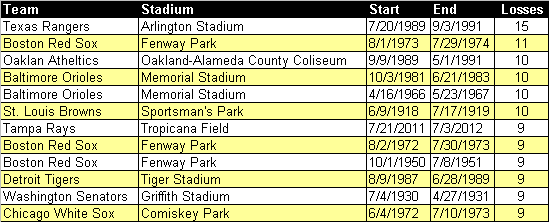
The Yankees finally found a cure for TB. After losing nine straight games at Tropicana Field in Tampa (OK fine, St. Petersburg), the Bronx Bombers finally broke the schneid on Robinson Cano’s game winning two-run single with the bases loaded. If not for Cano’s timely hit (and Kyle Farnsworth’s four consecutive walks), the Yankees, who have seemingly saved their worst baseball for the unfriendly confines of the dome, would have recorded their seventh double-digit losing streak at a road stadium.

Yankees’ Longest Losing Streaks at a Road Stadium, Since 1918
 

Source: Baseball-reference.com

Even though the Yankees probably weren’t heart broken about the three game sweep in Tampa that occurred at the end of last season, the nine game skid was still the longest in any one road ballpark since the Bronx Bombers went winless in 15 straight games at Arlington Stadium from 1989 to 1991. Unfortunately, the Texas heat wasn’t the only thing that caused the Yankees to wilt during that span. Over the same period, the Yankees dropped 10 consecutive games to the Athletics at the Oakland-Alameda County Coliseum. Of course, during that period, the Yankees didn’t have much luck beating the Bash Brothers, or anyone for that matter. From 1989 to 1991, the team’s .437 winning percentage was the fifth lowest of any three-year span in franchise history and the worst since 1913-1915.

Yankees’ 15 Game Losing Streak at Arlington Stadium, 1989 to 1991

Source: Baseball-reference.com

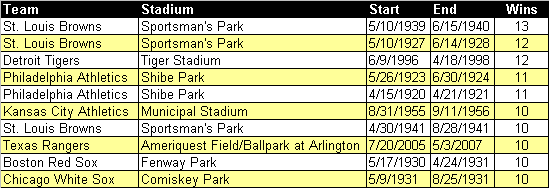
As you’d expect from a team with the highest road winning percentage in baseball, the Yankees have had more double-digit road ballpark winning streaks than losing skids.  The all-time high run of 13 straight victories dates back to 1939-1940 against the hapless St. Louis Browns at Sportsman’s Park, but the most recent double-digit streak was also deep in the heart of Texas, as the Yankees reeled off 10 straight victories versus the Rangers from 2005 to 2007. That mark, as well as the all-time franchise record for most wins in a single road ballpark, could be in jeopardy later this month when the Yankees visit Oakland. The last time the Bronx Bombers lost at the Athletics’ home field was on April 22, 2010, the same day that Alex Rodriguez violated the sanctity of Dallas Braden’s mound. Since then, the Yankees have won nine straight victories in “the 209”, and could tie the current longest streak of 13 road ballpark wins with a four game sweep in the teams’ final series in two weeks.

Yankees’ Longest Winning Streaks at a Road Stadium, Since 1918

Source: Baseball-reference.com

Working My Way Back to You

Couple of stories on Joba Chamberlain:

Harvey Araton in the Times.

Daniel Barbaris in the Wall Street Journal.

[Photo Credit: N.Y. Post]

Color By Numbers: Youk Got What I Need

If the opposition has the Yankees seeing red tonight, you really can’t blame them. When the White Sox take the field at Yankee Stadium, their lineup will include Kevin Youkilis, the latest rivalry castoff from the Red Sox whose .942 OPS against the Bronx Bombers is one highest in the long running feud between Boston and New York. However, Chicago didn’t acquire Youkilis before their series in the Bronx just so they could antagonize the Yankees. Rather, GM Kenny Williams jumped at the opportunity to fill one of the most cavernous holes on a major league roster. That he was able to do so with a three-time All Star was icing on the cake.

Best and Worst by Position, 2012

*DH excludes National League teams.
Note: Player in parenthesis has most plate appearances at the position.
Source: fangraphs.com

Other than catcher for the Oakland Athletics, no position has been more undermanned from an offensive standpoint than third base on the South Side. Before Youkilis was acquired, the combination of Brent Morel, Orlando Hudson, and Eduardo Escobar turned the position into the cold corner, so even with a hot start (5 for 12) by the former Red Sox’ star, it will take some time before the team’s woeful production from third base starts to thaw out.

Now that the White Sox have filled their deepest hole, the onus shifts to the Detroit Tigers, who have frittered away the benefits of having sluggers like Miguel Cabrera and Prince Fielder by giving away outs from two positions on the diamond. In order to keep up with the White Sox, who currently reside in first place in the A.L. Central, Detroit may also need to make a deal. As the trade deadline nears, the Cubs are expected to hold a fire sale, so, who knows, the answer to the Tigers’ troubles may also reside in Chicago?

For the most part, the primary player who has helped their team lead the league in offense at each position also happens to be in line for an All Star Game start (who says the fans don’t know how what they’re doing?), leaving only Jed Lowrie and Carlos Ruiz as mild surprises. It’s also interesting to note that no team has enjoyed top production from more than one position, which speaks further to the level of parity that currently exists in the game. In the past, a team like the Yankees would dominate the “best list”, but these days, the Bronx Bombers are more of a streamlined offense. Other than second base, the Yankees only rank in the top-five at shortstop, even though they have maintained above average production at every position but left field and catcher.

Yankees’ Relative Production at Each Position, 2012

*DH excludes National League teams.
Source: fangraphs.com

Thanks to the revised postseason structure, the period leading up to the trade deadline promises to be unique, if not active. With so many teams now contenders because of the added wild card, buyers could wind up outnumbering sellers, making the cost of a trade increasingly prohibitive. By striking early, however, the White Sox were able to take advantage of extenuating circumstances in Boston to address their greatest needed without paying too high of a price (or, according to some, any price at all). Because of how well Youkilis has performed against the Yankees, fans of the team may rue the White Sox good fortune over the next four days, but with 15 games left against the Red Sox, the Bronx Bombers could also wind up being one of the early winners of the trading season.

Color By Numbers: Going Streaking

The Yankees hope to start a new winning streak against the Mets at Citi Field.

The Yankees entered yesterday’s off day in unfamiliar territory: on a losing a streak. It had been almost a full month since the Yankees last lost consecutive games, so you can bet the Bronx Bombers will be chomping at the bit to get back in the win column tonight at CitiField.

Over the first three months of the season, the Yankees have had seven stretches featuring consecutive losses, but none has lasted longer than three games (three have been two games and four have been three games). Even when they weren’t playing particularly well, the Yankees managed to avoid the kind of long losing streak that can put a team deep in the hole. As a result, the Yankees recent hot stretch has allowed them to build a lead instead of chip away at a deficit.

Distribution of Yankees’ Losing Streaks, Since 1918

Note: Includes all streaks of three or more losses.
Source: Baseball-reference.com

The last time the Yankees avoided a losing streak of at least four games was 1980. Probably one of the most overlooked teams in franchise history, Dick Howser’s club won 103 games that year, but all was forgotten when they were swept by the Royals in the ALCS. Ironically, the Yankees had only lost three games in a row on three occasions during the regular season, just once more than the lowest total in franchise history. Unfortunately for Howser, the team’s fourth three-game losing streak came at an inopportune time as it not only denied him a chance to manage in the World Series, but also wound up costing his job.

It’s a good thing the Yankees have avoided losing streaks in June because, over the first two months of the season, they were on pace to rank near the bottom in terms of both the number of losing stretches and games contained therein. Since 1918, 26 different Yankees’ teams have finished the year with four or fewer losing streaks of at least three games, which puts this season’s current total in perspective. Pro-rated over the entire season, the 2012 Yankees would still fall toward the bottom quintile in both catgeories, which illustrates the extent to which the team sputtered in April and May.

Yankees’ Top-10 and Bottom-10 Total Streak Losses, Since 1918

Note: Totals are the sum of losses that are a part of distinct losing streaks of three or more games in one season.
Source: Baseball-reference.com

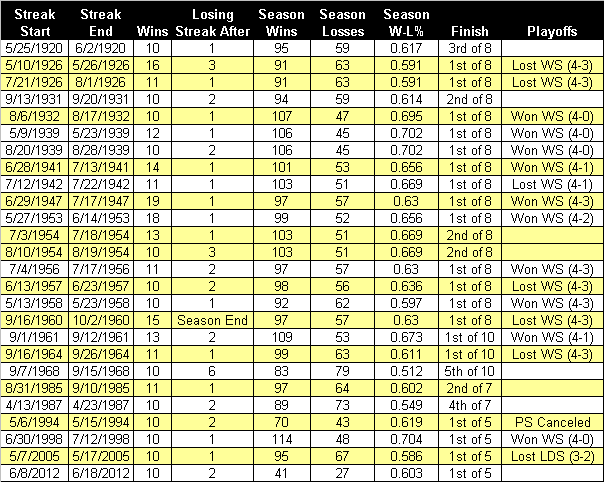
Tomorrow night against the Mets, the Yankees will be seeking to avoid another three-game losing streak. After winning at least 10 in a row for only the 26th time in franchise history, the last thing the Yankees want to do is start ceding some of the ground they gained by following up that stretch with a string of losing. Over the years, the Yankees have done a good job of avoiding a winning streak hangover, so history seems to be in their favor. Not only has the team gone 14-11 after having a long winning streak snapped (one streak came at the end of the season), but on only three occasions did the Bronx Bombers lose three or more games in a row.  Is that a good omen heading into the Subway Series? Perhaps, but having Andy Pettitte on the mound doesn’t hurt either.

Yankees’ Season Record in Years with and Number of Losses Immediately Following a 10-Game Winning Streak, Since 1918

Source: Baseball-reference.com

Another good sign is the amount of success enjoyed by Yankees’ teams that have won at least 10 games in a row during a season. The 23 different Bronx Bomber ballclubs to record such a lengthy stretch of winning (three teams had two 10-plus game winnings streaks in one season) have posted a combined winning percentage of .628, and all but six wound up finishing the year in first place (four of which still won at least 94 games). The only real outlier in the group was the 1968 team, which won 10 in a row in September. Unfortunately, it was too little too late as the winning streak only pulled the Yankees to within 16 games of first place. Besides, even had they been closer in the standings, losing six in a row and nine of 10 immediately thereafter would have been the final nail anyway. At the very least, the 10-game winning streak helped the 1968 club finish above .500, thereby avoiding a share of the franchise record of four consecutive losing seasons.

Even the very best baseball teams lose 30%-40% of their games, but the ones who enjoy the most success seem to spread them out evenly over the season. Although the long stretches are the ones that gain the most notoriety, streaks of three and four games can really take a toll. The 2012 Yankees probably won’t become the fourth team in franchise history to have two 10-game winning streaks in one season, but if they can avoid those smaller losing streaks, another division title could be in the offing.

A Love Supreme


David Waldstein has a long profile on Russell Martin and catching in the New York Times:

The physical penalties paid by the catcher, of course, are not often characterized by the spectacular violence of a wide receiver clotheslined by a safety. Neither are they frequently accompanied by the angry acoustics of a crunching hockey check into the boards.

The price paid, as much as anything, is one of plain, penetrating exhaustion, both mental and physical. It is about enduring a grinding, dirty routine, where, in St. Louis or Arlington, Tex., in August, a catcher can shed 10 pounds in a game. In 2007, when he was with the Los Angeles Dodgers, Martin started 143 games behind the plate.

Three times this season, Martin has caught at least six games in six days. From May 11 to 17, he caught seven consecutive games, and once, from June 5 to 13, he caught nine in a row.

“When you’re going through it, you don’t notice it,” Martin said of the grind. “It’s when you stop for a day or two and then the aches from the foul tips and the fatigue kind of bubble to the surface and you’re like ‘Whoa, did I get hit by a train?’

“Sometimes I’d rather just plow through and keep playing, just soldier on, because it almost feels harder when you’ve been off for a day and you come back.”

Worth your time.

[Photo Credit: Jyekn; Thomas Ferrara/Newsday]

June 15, 1941: Game 28

As the Yankees played on consecutive days for the first time in a week, DiMaggio had only one hit against the Cleveland Indians on this afternoon in the Bronx, but it was enough to continue two streaks. DiMaggio hit his thirteenth homerun of the year, an upper deck blast which extended his personal hitting streak to twenty-eight and the Yankees team homerun streak to eleven. The Yankees beat the first place Indians, 3-2, for their seventh win in a row; they were now only two games out of the top spot in the league.

At twenty-eight games, DiMaggio was now only one game behind the Yankee record, held jointly by Earl Coombs (1931) and current Cleveland manager Roger Peckinpaugh (1919). Reporters were starting to wonder if DiMaggio might challenge the all-time record, then believed to be George Sisler’s forty-one game streak from 1922. (It would be a few weeks before someone turned up the actual record.) Contacted by the New York Daily News, Sisler said, “You can’t imagine the strain. The newspapers keep mentioning the streak. Your teammates continually bring it up. You try to forget, but it can’t be done. It’s in your head every time you step to the plate.” And he didn’t have to deal with live cut-ins from ESPN, plus he probably smoked cigarettes with tons of nicotine.

For Gardner, a Misbegotten Season (so far)

Chad Jennings reports that Brett Gardner will not need surgery but the Yanks don’t expect him back for about another month.

It’s been a lost first half for Gardner though the Yanks will be fortunate if he returns and is healthy come mid-July. In the meantime, do you suppose they’ll make do with what they’ve got or make a move to get more talent in left field? My hunch is that they are going to wait it out with what they’ve got.

[Photo Credit: Graycard via It’s a Long Season]

Color by Numbers: Keeping Score of Cain’s Perfection

Photo: Getty Images

It’s hard to be better than perfect, but last night, Matt Cain was just that. Not only did the Giants’ right hander throw the 22nd perfect game in baseball history (and first in franchise history), but he also tied Sandy Koufax for the most strikeouts while doing so. What’s more, Cain’s game score of 101 matched Koufax and Nolan Ryan for the best mark ever posted in a no-hitter of any kind.

Most Strikeouts in a No-Hitter or Perfect Game

*Denotes perfect game.
Source: Baseball-reference.com

By joining Koufax and Ryan with a game score of 101, Cain’s masterpiece takes a back seat to only Kerry Wood’s remarkable rating of 105. Then 20-years old, the Cubs’ phenom accomplished the feat on May 6, 1998, when he struck out 20 Houston Astros, the same franchise Cain dominated to make history last night. Although Cain’s perfection fell shy of Wood’s record, his performance was still only the 10th game score of 100 or greater in nine innings since 1918, making that accomplishment even rarer than the perfect game itself (the highest game score ever recorded is 153, by Joe Oeschger in an epic 26-inning affair).

100-Plus Game Score Club, Since 1918

*Denotes perfect game.
Source: Baseball-reference.com

No one should be surprised by Cain’s brilliant outing. After all, the right hander has now authored two of the top game scores this season. For those less inclined to trust esoteric statistics, Cain had previously thrown three complete game one-hitters, so maybe a no-hitter was just a matter of time?

Matt Cain’s Top-10 Game Scores

Source: Baseball-reference.com

Now that he has thrown one of the best nine inning games in baseball history, what will Matt Cain do for an encore? History hasn’t been very kind to perfect game pitchers in their next start, but after last night’s performance, for Cain, the exceptional might be the new rule.  Maybe he’ll join Johnny Vander Meer as the only pitcher to throw consecutive no-hitters? Or, perhaps, he’ll break Mark Buehrle’s record of 45 consecutive batters retired (dating back to his previous start, Cain has retired 32 batters in a row)? The Angels are next up on the schedule, so they should consider themselves forewarned.

In Living Color

From Buzzfeed via Hardball Talk

Book Banter

I’m going to be at the Warner Library in Tarrytown on Monday night talking to Rob Fleder about “Damn Yankees.”

Fall through if you are around that neck of the woods.

[Pictures via: It’s a Long Season]

It Was Twenty Years Ago Today

Happy Yankee anniversary to Derek Jeter. Joel Sherman and George King III have the skinny today in the Post.

Color by Numbers: Loaded Questions

What would the Yankees’ record be if their performance with runners in scoring position was on par with recent seasons? With a few key hits at the right moment, the Yankees could be resting comfortably in first place, but so far this season, the team hasn’t been able to land the big blow with the same amount frequency. And, in no situation has that been more evident…and costly…than when the Yankees have loaded the bases.

Yankees Offensive sOPS+ Rates, 1996-2012

Note: sOPS+ compares a team’s split to the adjusted average for the major leagues. A reading above 100 is considered above average for an offense.
Source: baseball-reference.com

Entering play on Wednesday, the Yankees ranked near the bottom of the major leagues in terms of batting average, on-base percentage, and slugging (.151/.222/.302) with the bases full. Based on OPS, not only does that performance rate fail to attain even 50% of the major league average, but it also ranks as the franchise’s third lowest output since 1948. Also, the differential between the team’s overall offensive production and its performance with the bases loaded is currently larger than at any point over the same timeframe.

Clearly, the Yankees have been laggards with the bases loaded, but is this really a bad harbinger? Based on correlation from 1996 to now, the Yankees’ performance with the bases loaded has only been moderately related to overall run production as a percentage of the league average (r=.62).  Meanwhile, the link between relative runs scored and OPS with men in scoring position has been more significant (r=.78). So, if anything, fans who are inclined to worry should focus their concerns on the more broad number.

Yankees’ Bases Loaded vs. Overall OPS, 1948-2012
 

Source: baseball-reference.com

It hasn’t been all bad news for the Yankees with the bases loaded. While the hitters have struggled in such situations, the pitching staff has done a good job wiggling out of trouble when the bags are jammed. In 42 plate appearances with the bases loaded, opposing hitters have produced at rates of .263/.262/.368 (sOPS+ of 76), including 13 strikeouts and only one walk. It might only be a small consolation, but at least Yankees’ pitchers have been able to offset some of the offense’s missed opportunities by imposing the same frustration on the opposition. Unfortunately, since 1996, there has been no correlation between the Yankees’ ability to limit the damage in bases loaded situations and prevent runs overall (r=.04), so there doesn’t seem to be much benefit from that guilty pleasure.

Yankees Pitching sOPS+ Rates, 1996-2012

Note: sOPS+ compares a team’s split to the adjusted average for the major leagues. A reading below 100 is considered above average for a pitching staff.
Source: baseball-reference.com

An optimist probably looks at the Yankees’ ability to hang around first place despite its offensive struggles with runners in scoring position as a positive sign. Meanwhile, the pessimist might consider the offense’s inefficiency to be a systemic problem that will prevent the team from outscoring the deficiencies of the starting rotation. Which side are you on? I take a little from both. The lineup’s track record suggests the Yankees’ offense will soon start making up ground on the past, but it won’t matter if they can’t stay ahead of the current opposition. A few more hits with the bases loaded would definitely be nice, but the real loaded question is whether the pitching staff can ensure that those runs will be meaningful when they finally cross the plate.

All Right Already

Chad Jennings breaks down the Yanks’ recent struggles with the bases loaded.

Freaky. It won’t last.

[Painting by Craig Robinson]

Color By Numbers: Hare Today, Playoffs Tomorrow

The Yankees head into a much needed off day on a two-game winning streak, but the team still finds itself in fourth place with a disappointing  23-21 record. A four game deficit in the loss column is hardly insurmountable, especially in May and particularly when the division leader has been a perennial loser for the last 14 years, but there are still some signs of caution evident in the Yankees’ relatively slow start.

Most Yankees’ fans probably have little doubt that the Bronx Bombers will soon overtake the first place Baltimore Orioles, but history suggests that the O’s chances of sustaining their fast start are actually pretty good. Regardless, the bigger question for the Yankees is will they be able to flip the switch and play at a much higher level for the remainder of the season. According to the franchise’s historical record, the road to the playoffs has been paved with a fast start, so this year’s team certainly has its work cut out.

Considering the 2011 Yankees started out 24-20 and still went onto win 97 games, this year’s slow start by franchise standards (70% of Yankees’ teams began with a better record over the first 44 games) hasn’t really caused a panic. However, it’s worth noting that last year was more of an exception than the norm. Not surprisingly, the Yankees’ final regular season record has been highly correlated to performance in the first quarter (r=.73 since 1901; r=.68 since 1961, when the 162 game season was initiated), so, if history holds, this year’s Bronx Bombers could be facing an uphill battle.

Yankees’ Historical Winning % (Full Season and After 44 Games) Correlation
 

Source: baseball-reference.com

Another somewhat ominous indication is the fact that only two Yankees’ teams who started the season as slowly as the current edition bounced back to win the division. What’s more, only six of the 46 first place finishes in franchise history started out with a winning percentage below .550. More often than not, when the Yankees’ have had a successful season, the team has gotten out of the gate quickly. This relationship is even stronger when only considering championships as nearly 60% of the franchise’s 40 A.L. pennants and 27 World Series victories came in seasons when the team’s winning percentage was at least .600 after 44 games.

Distribution of Yankees’ Postseason Teams Based on Record After 44 Games

Source: baseball-reference.com

Every season has its own set of mitigating factors that influence the final outcome. However, aggregate data can often smooth out some of the variables, providing a rough road map for what the future holds. As last year (which is probably the most relevant comparison, considering the proximity) proved, the Yankees are more than capable of shaking off early season doldrums, but that doesn’t mean fans, or the team itself, should minimize some of the struggles. If the Yankees do recover once again, they will need to perform much better across the board, and their ability to do so should not be taken for granted. In some arenas, slow and steady may work just fine, but in the pennant race, a fast start has always worked to the Yankees’ advantage.

feed Share on Facebook Share on Twitter Share via email
"This ain't football. We do this every day."
--Earl Weaver