
"A New York Treasure" --Village Voice
Category: Baseball Musings

Color By Numbers: Silver and Gold

November is trophy season in major league baseball. The most anticipated awards, like the MVP and Cy Young, come later in the month, but for fans already suffering from withdrawal, the most immediate baseball fix comes in the form of silver and gold. Although the Gold Glove and Silver Slugger aren’t taken that seriously (after all, the two awards are basically a marketing gimmick for Rawlings and Hillerich & Bradsby, respectively), the selections, which this year were announced live on ESPN and the MLB Network, still generate considerable reaction. Unfortunately, particularly in the case of the Gold Glove, most of it seems to be negative.

This year, the Gold Glove selections were not as controversial (mostly thanks to Derek Jeter not winning one). In fact, five of the well respected Fielding Bible Award winners were also awarded with a Gold Glove. However, there were some glaring omissions, the most obvious being Yankees’ left fielder Brett Gardner. By just about every measure, Gardner was not only the best left fielder in the game, but he also ranked among the best outfielders. According to the Field Bible, the Yankees’ speedster tied centerfielder Austin Jackson, who was also denied a Gold Glove, for the most defensive runs saved at 22. That’s an extraordinary total for the center of the diamond, but for a corner position, it’s off the charts. Gardner also topped major league outfielders with a UZR/150 of 29.5, almost doubling the total of Jacoby Ellsbury, who finished a distant second among qualified candidates. Although UZR is a much less reliable metric, the extent to which Gardner led all others was significant. Unfortunately for the Yankees’ left fielder, the Gold Glove voters weren’t that impressed.

The Yankees had two other Gold Glove candidates make it to the “final three” (a new feature of the award) at each position, but Robinson Cano and Mark Teixeira were bested by their Red Sox counterparts. Unlike Gardner’s snub, however, the omission of Cano and Teixeira were well within reason. As a result, one year after tying a franchise record with three Gold Gloves, the Yankees were shutout for only the fifth time since 1982. Although it’s probably no consolation to Gardner, what the Yankees missed out in gold, they made up for in silver.  Both Cano and Curtis Granderson were among the A.L.’s recipients of the Silver Slugger, which honors the best offensive player at each position.

Silver and Gold: Yankees’ Award Winners, Total by Year

Source: mlb.com

Since the Gold Glove was first awarded in 1957, the Yankees have had the second most honorees, behind only the St. Louis Cardinals, who enjoy a comfortable lead over the field with an impressive 83 trophies. At the other end of the spectrum is the Milwaukee Brewers, which makes the team’s traditional ball-in-glove logo somewhat ironic. Since joining the majors as the Seattle Pilots in 1969, the Brewers have had only nine Gold Glove winners, all coming while the franchise was in the American League.

Most Gold Glove Awards, Sorted by League
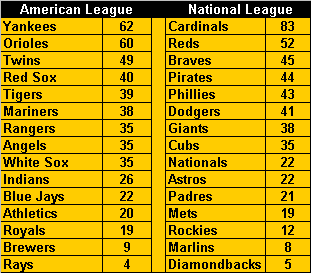
Source: mlb.com

For perspective, 16 individual players won more Gold Gloves than the entire Brewers’ franchise, including Greg Maddux, who won twice as many. No other player in history has been honored more often than the future Hall of Famer pitcher, who, in addition to racking up over 300 wins, managed to take home 18 Gold Gloves. Among position players, the most gilded glove belonged to Brooks Robinson, who won 16 at third base. The most decorated Yankees player was Don Mattingly. The Captain won nine Gold Gloves at first base during his time in pinstripes, almost doubling the franchise’s next highest total of five, which is shared by Ron Guidry, Derek Jeter, Bobby Richardson and Dave Winfield.

Most Gold Glove Awards by Position, Yankees and All-Time
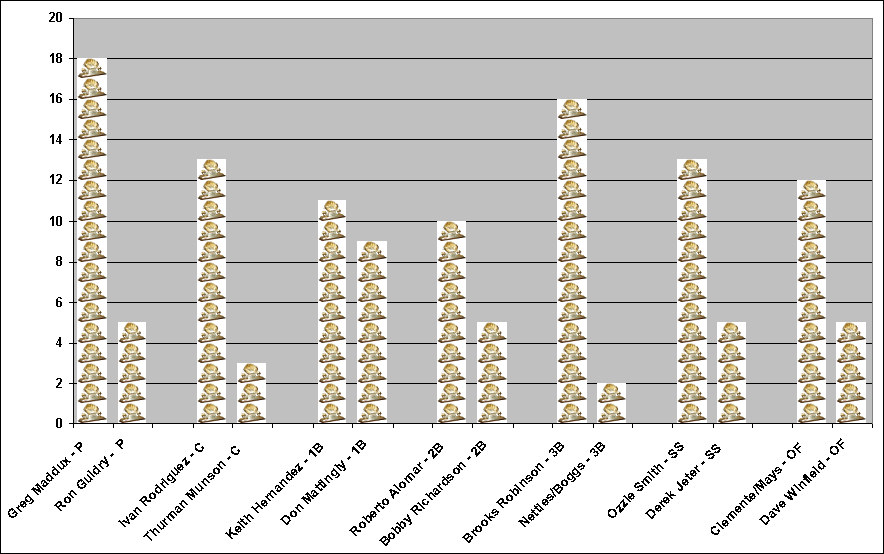
Source: mlb.com

The Silver Slugger is usually overshadowed by the Gold Glove, but in recent years has started to gain more exposure, including a dedicated announcement show that aired on the MLB Network. Unlike its defensive counterpart, the Silver Slugger involves more than just subjective peer review. Rather, it is based on a combination of statistics as well as the general impressions of managers and coaches. Because of this more balanced approach, the Silver Slugger selections are seldom as controversial. Then again, part of the reason for that may be the relative indifference expressed toward the award.

Even if the Silver Slugger doesn’t carry much cachet, it’s still an honor to be named the best offensive player at a particular position. Since it was given out in 1980, the Yankees have had 39 players deemed worthy of that distinction, more than any other team. Meanwhile, among teams in existence during the entire tenure of the award, the Athletics and Royals ranks dead last with only nine.

Most Silver Sluggers, Sorted by League
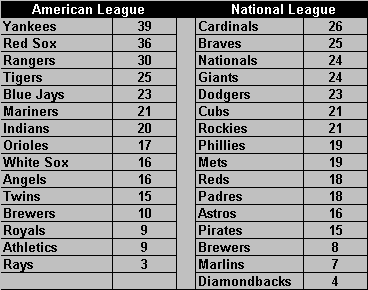
Source: baseball-almanac.com

Barry Bonds holds a number of high profile records, so it shouldn’t come as a surprise that he is also the owner of the most Silver Sluggers with 12. Not too far behind are Mike Piazza and Alex Rodriguez, who each have 10. However, Arod has the further distinction of winning his at third base (3) and shortstop (7), making him the only player to win multiple awards at two different defensive positions. In addition to Rodriguez, 11 other players have won at least one Silver Slugger at two defensive positions (not including DH and with no differentiation for the outfield), including Albert Pujols and Miguel Cabrera, who are the only players to be honored at three places on the diamond.

Most Silver Slugger Awards by Position, Yankees and All-Time

Source: baseball-almanac.com

Even though many baseball fans claim not to care about the Gold Glove and Silver Slugger, both awards have endured for a significant period and, by doing so, become a part of the game’s historical record. Despite this, some will probably still accuse me of digging too deeply into a mundane topic, or mining too hard for content in the off season. That’s probably true, but it doesn’t mean a review of baseball’s metallurgical record is completely without merit. For example, if someone can answer how the 1985 Yankees managed to win seven combined Gold Gloves and Silver Sluggers without a winning the division, it will have all been worthwhile.

Adieu Alou

Matty Alou has passed away.

Ratso Rizzo

Since Game 6 is cancelled tonight, you’ll have time to check out this long piece on Howie Spira by Luke O’Brien over at Deadspin:

Howie recognized opportunity when it arrived in 1981, from the San Diego Padres. Dave Winfield was a four-time All-Star, a two-time Gold Glove winner, and one of the best athletes on the planet—drafted out of college in 1973 by pro teams in three sports. Howie had introduced himself to Winfield a year earlier when the Padres were in town to play the Mets. A few months later, the Yankees inked the outfielder to the richest contract in baseball—$23 million over 10 years—and Howie started in with the blandishments.

“I was focused on Dave like a horse with blinders,” he said. “He was going to be the wealthiest, most powerful ballplayer, and I made up my mind that that was the place for me.”

Howie sent a dozen long-stemmed roses to the secretary at Winfield’s charity. The flowers were Howie’s calling card. When he played at journalism, he sent roses to almost every girl who worked for the Mets. Hit on most of them, too. Winfield’s secretary agreed to go on a date. “We had dinner,” Howie said. “And she was the dinner.”

Dem’s Fightin’ Woids

Darryl Strawberry thinks the 1986 Mets would beat the 1998 Yankees.

This is one of those silly arguments for which there is no answer, of course. Just something fun to get heated about. For what it’s worth, we are talking about a great Mets team, but one who was a strike from blowing the whole season. It’s a good match-up but I can’t go against the greatest season in baseball history.

The Start of the End?

Over at Fangraphs, Mark Hulet looks at the waning Yankee dynasty:

Sabathia is a horse. The 31-year-old southpaw has pitched at least 230 innings for the past five seasons, and his highest FIP during that time was 3.54 (highest ERA was 3.37). He produced the second-highest strikeout rate (8.82 K/9) of his career in 2011 and posted his third seven-win season in the past five years. The issue with Sabathia, though, is that he can opt out of his contract this off-season and pursue a larger contract elsewhere. I find it hard to believe that he won’t be wearing pinstripes in 2012 but stranger things have happened and this remains a huge question mark that needs to be answered quickly, as it could shape the club’s entire off-season approach.

The organization has shed some young pitching talent over the past two years that it may have given up on a little too soon (Ian Kennedy, Tyler Clippard, Mark Melancon) but it wisely held onto David Robertson. Although pitchers such as Joba Chamberlain and Phil Hughes have had more hype, it could be Robertson, 26, who eventually replaces ‘Rivera The Robot’ in high-leverage situations with New York. The right-hander had one of the most dominating seasons by a reliever throughtout the Major Leagues in 2011. He posted a 1.84 FIP (1.08 ERA) in 66.2 innings and struck out batters at a rate of 13.50 K/9. He also improved his ground-ball rate almost seven percent to a career-high 46.3 GB%. One thing Robertson does need to work on is his control (4.73 BB/9). If he can continue to command his fastball-curveball combination like he did in ’11, the Yankees could have the best one-two punch in the late innings in the American League for the next few seasons.

Will C.C. leave? That’s the $64.000 question, ain’t it?

Teix Marks the Spot

Alex Rodriguez has been getting killed by the press since the Yanks were bounced last week, but that’s nothing new. He’s getting killed by fans–at least the ones I’ve talked to–and that, too, is nothing new. The one Yankee player who has benefitted most from this is Mark Teixeira. Over at SI.com, Tom Verducci weighs in:

Teixeira, who came to the Yankees as a .290 career hitter, followed that .256 season with another decline, to .248. Put him in a postseason environment, with better pitching and home runs tougher come to come by, and Teixeira’s rally-killing style is going to be more pronounced. He has hit .167 over his last 108 postseason at-bats.

His troubles are particularly acute from the left side. Teixeira batted .224 from the left side this year while getting only four hits all year to the opposite field.

His batting average on balls in play has dropped every year with the Yankees: .302, .268, .239. That’s not unlucky. It’s symptomatic of his hitting style. His fly ball rate has increased every year as a Yankee (37 in 2008, followed by 44, 46, 47). His infield pop-ups, which are no different than strikeouts, and were as low as 14 in 2008, have grown to 21, 30 and 27 as a Yankee.

Teixeira’s swing simply is not built to make him a consistent clutch hitter. After coming to the Yankees with a .308 average with runners in scoring position in 2008, he hasn’t come close to that kind of reliability with New York (.264, .273, .268) — especially in the postseason environment.

Teixeira turns 32 years old next season. The Yankees already have age-related issues with Alex Rodriguez and Derek Jeter. You can put Teixeira in that category, not because of health, but because his pull-happy, fly ball swing is the kind that doesn’t age well, sort of like those of J.D. Drew and Adam Dunn.

I wonder how long before Teixeira starts to feel the heat?

Alex Rodriguez is the Devil

That’s a nice word for what he is. At least according to most of the people I’ve run across this morning. Garbage, choker, loser. Again, that’s the clean version.

The writers are taking their hacks too.

The one good swing he had in that bases loaded at bat–“that’s the best swing he’s had all series,” said Ron Darling–the pitch he fouled back, that’s the one that hurts. He’s their most expensive player so the criticism comes with the territory.

Last night, the Yanks were right there, and I kept waiting for the moment when we could all scream and yell with delight. It never came. Reminded me of the old joke about the sadist and the masochist.

Masochist says, “Beat me, beat me.”

Sadist says: “No.”

[Photo Credit: N.Y. Daily News]

Ah Ha: The Thing With Feathers

Would you believe the sun rose in the east this morning? It’s true. One of the great things about living in New York at a time like this is that you can find someone to commiserate with no problem. But also, there are so many New Yorkers that don’t care, not even a little bit, about what happened to the Yankees last night. And not because they are Mets fans or Yankee-haters but because they don’t know from baseball.

So it’s easy to lose yourself back in life. Yeah, I had some hard feelings trying to get to sleep last night–Alex Rodriguez striking out to end the game, Swisher whiffing with the bases loaded, Russell Martin on his tippy-toes after getting called out looking, man, how many fat pitches did they miss?–but soon they will fade away. Maybe not today or next week but soon enough. And of course, there is reason to be worried about Ivan Nova. But then, there is always something to worry about.

And we do have the memory of Mariano Rivera throwing nine pitches in the ALDS. And all of them were right on the money, weren’t they?

Michael Penn]

Color by Numbers: Winner Take All

Sometimes, drama in baseball can be drowned out by the sea of 162 games. Even in the postseason, urgency can be limited by the margin for error built into a multi-game series. However, once it becomes winner-take-all, all bets are off and the tension really mounts.

Major League Baseball has gone years without a single sudden death game, but now it has already been blessed with three, a total that matches the last four seasons combined. Although the games that force a “double elimination” scenario can sometimes be more memorable (see Don Denkinger, Billy Buckner, and Steve Bartman), it is usually when both teams have their backs against the wall that legends are born in October.

Sudden Death Games by Season, Since the Advent of Divisional Play

Source: Baseball-reference.com

Perhaps the best example of a player going from relative obscurity to immorality is Francisco Cabrera, who, despite having fewer than 400 plate appearances in his career, earned a place in baseball lore by authoring one of the most dramatic moments in the sport’s history. Cabrera’s two-run single, which vaulted the Braves over the Pirates in game 7 of the 1992 NLCS, still reverberates to this day, and it’s easy to understand why. Cabrera’s game winning hit ranks as the highest WPA by any player in a sudden death postseason game, not to mention a single at bat (out of 1,934 games and 5,708 PAs). In other words, there has never been a more significant postseason turning point (which some might argue also reversed the course of the Pirates’ franchise).

Top-10 Sudden Death Games by a Batter, Ranked by WPA

Source: Baseball-reference.com

One year earlier, the Braves were on the other end of a historic, winner-take-all performance. Entering game 7 of the 1991 World Series, everyone expected a pitchers’ duel, but no one could have anticipated that length to which Jack Morris would go, both literally and figuratively. Morris matched zeros with John Smoltz for eight innings, but didn’t stop there. The right hander also shutdown the Braves in the ninth and then the tenth as well, giving his team a chance to squeak across a run and lay claim to victory in one of the most exciting World Series ever played.

By several measures, Morris’ epic game 7 stands out among all other sudden death games. Not only was the right hander the only pitcher to complete 10 innings under the pressure of a winner-take-all scenario, but he also recorded the highest WPA and second highest game score (a mark of 84 bettered only by Sandy Koufax’ 2-0 victory over the Twins in the 1965 World Series). In some people’s mind, on the basis of that game alone, Morris is deserving of enshrinement in the Hall of Fame. Although that point is debatable, what can’t be doubted is the inedible place Jack Morris holds in baseball’s long postseason history.

Top-10 Sudden Death Games by a Pitcher, Ranked by WPA

Source: Baseball-reference.com

For some, sudden death is about more than one moment. Legendary players like Mickey Mantle, Reggie Jackson, Yogi Berra, and Derek Jeter have all had several opportunities to play in October finales, and usually done quite well. However, all of those immortals still take a back seat to a very unlikely legend of the Fall.

Tony Womack’s career OPS+ of 72 is one of the lowest in baseball history among players with a similar number of at bats. At .212/.250/.276, his entire postseason record isn’t much better. And yet, despite his overall futility, the speedy Womack maintains the highest cumulative WPA among all hitters in sudden death games. Even though Luis Gonzalez’ blooper over a drawn-in infield is most often replayed, it was Womack’s game tying double off Mariano Rivera that defined the Diamondbacks’ clinching rally. Considering the relative ability of the two participants, Womack’s hit off Rivera could be the most improbable outcome in postseason history.

Top-10 “Clutch” Offensive Performers in Sudden Death, Ranked by Cumulative WPA

Source: Baseball-reference.com

Although WPA does a good job highlighting the most significant events during a game, it can obscure overall performance by penalizing a player for limiting his leverage by contributing earlier in the game. Using OPS as a barometer, the list of top performers in winner-take-all games looks much more reassuring. Led by Jason Giambi, this group includes several names often associated with clutch performances, which is probably how they earned their reputations in the first place.

Top-10 Offensive Performers in Sudden Death, Ranked by Cumulative OPS

Note: Minimum of 15 plate appearances.
Source: Baseball-reference.com

As previously mentioned, Jack Morris’ only foray into October sudden death was epic. Based on those 10 innings alone, the Twins’ right hander has the highest winner-take-all WPA among pitchers. Not surprisingly, Morris’ mound opponent that game, John Smoltz, ranks third. In three starts and one relief appearance, Smoltz compiled a WPA of .705 and miniscule ERA of .740 in 24 1/3 innings. Only Bob Gibson (2-1 in three games and 27 innings) and Roger Clemens (1-1 in five games and 26 2/3 innings) logged more face time in these crucial games, but their respective ERAs of 3.67 and 4.05 pale in comparison to Smoltz’ stinginess.

Top-10 “Clutch” Pitchers in Sudden Death, Ranked by Cumulative WPA

Source: Baseball-reference.com

As any red blooded player will tell you, individual performance always takes a back seat to the outcome of the game. Devon White probably doesn’t lose much sleep over his 0-6 in the seventh game of the 1997 World Series because the Marlins won the World Series anyway. Similarly, Jim Thome likely doesn’t take much pride in being one of only six players to hit two home runs in a sudden death game because his Indians lost the 1999 ALDS to the Red Sox. That’s why it’s always better to have a ring than a record in October.

No team has won, and lost, more winner-take-all games than the Yankees, who have gone 11-10 in deciding postseason games. Fans of the Bronx Bombers might be happy to know that the Tigers are 2-4. If Cardinals’ fans are looking for a good omen heading into tomorrow’s game 5 NLDS showdown with the Phillies, their team has gone 10-5 when push has come to shove. The Diamondbacks have also had some success in sudden death, winning both times they appeared in such a game, but this time around they won’t have Tony Womack to save the day.

Team Records in Sudden Death Games, By Series

Source: Baseball-reference.com

With three sudden death games on tap, it’s likely that some new postseason heroes, and perhaps a few goats, will be born. However, the real winner is major league baseball, which, fresh off a historic regular season end, seems poised for an epic postseason. Over the next two days. it’ll be winner take all, and six team are going all-in.

Drum Roll, Please…

In just less than 12 hours the Yanks and Tigers will begin Game Five of the ALDS. It is colder in Manhattan today than it’s been all week. October is here.

Man, it sure would be nice if the Yanks keep their season going. I figure Swisher and Teixeira to be the heroes tonight if the Bombers win. But count me as concerned, very concerned, about Doug Fister. And not as sure as other folks in Ivan Nova.

Nerves aside…tonight will be here soon enough, won’t it? Won’t it?

[Photo Credit: Adria Canameras]

Ol’ Silver Throat

Bill Pennington profiled John Sterling in the Times the other day:

Sterling came to the Yankees’ radio booth in 1989 and did every game, although his 100 percent work attendance streak began in 1981 in Atlanta.

“I have not missed a game I was supposed to work,” he said. “I am blessed with a good immune system.”

Michael Kay, the Yankees television announcer and Sterling’s radio partner from 1992 to 2001, said: “I do 125 games a season, and that feels like a lot. I don’t know how he has done 162 games a year for 23 years.”

In his time with the Yankees, Sterling has had five broadcasting partners. He has worked with Suzyn Waldman since 2005.

A typical day for Sterling starts late because he stays up late. Besides having an affection for TV soap operas, he is a voracious reader of mystery novels and celebrity biographies. He tries to swim every day for at least a half-hour. On the road, it is a familiar sight at the Ritz-Carltons and other fashionable hotels where the Yankees stay to see a soggy Sterling striding through the ornate lobby in a terry-cloth robe, goggles perched on his head on his way back from the hotel pool.

The piece is well-worth your time.

[Photo Credit: Beatrice de Gea for the New York Times]

Without Feathers

Many of you will remember that our old pal Todd Drew was a true believer. He was a Yankee season ticket holder. Never left his seat once the game began. He clapped until his palms were red, didn’t matter if the Yanks were getting blown out. When the game was over he went downstairs and waited by the players gate. He’d cheer on the rookies and offer words of encouragement to the losing pitcher.

Todd didn’t live long enough to see the new Yankee Stadium, never saw A.J. Burnett pitch for his team, but he was alive when they signed Burnett and was excited about it. He liked Burnett’s arm, in spite of his erratic career. More than anything, Todd believed in Burnett’s potential. In 2009, Burnett did reasonably well for the Yanks. The past two years, he has been lousy. He starts tonight and it is easy to think that the Yankees’ season will be over before long.

But hope is the thing with feathers, not without. Todd isn’t around to watch the game. But he’s with us in spirit and he’d be clapping and rooting until the final out. So should we.

Never mind that glass looking half-full:  Let’s Go Yan-kees.

A Good Day

Yeah, okay, so we wanted the Yanks to win last night and they didn’t. Big deal. They’ve still got the best record in the American League and that ain’t going to change. So here’s my question: do you root against the Yanks the next three days in the hopes that the Red Sox cough-up the wildcard?

Also, the Rangers or the Tigers? I’d much rather the Yanks face Texas in the first round. Careful what you wish for, I know, but I’d take my chances with them over Verlander, Cabrera and company.

[Photo Credit: Moiht]

Strange Bedfellows

Think it’s been weird for Sox fans to root for the Yankees? One of my Sox buddies was cheering with no problem cause he said the alternative was hockey season. Another Sox friend, however, refused to budge. I thought he just didn’t want to give me the satisfaction. Then he said, “What makes you think I want to watch these bastards anymore?”

Point taken.

A month ago, did anyone think the final series against Boston would be essentially meaningless for the Yanks? Dag.

Here’s the lineup:

Derek Jeter SS
Eduardo Nunez 2B
Mark Teixeira DH
Nick Swisher RF
Andruw Jones LF
Jesus Montero C
Jorge Posada 1B
Brandon Laird 3B
Greg Golson CF

Never mind hating the Sox, Russ:

Let’s Go Yank-ees!


Color by Numbers: Here’s to the Losers

September is the month when baseball’s long marathon breaks into a sprint known as the pennant race. For some teams, it’s an opportunity to take a victory lap, while for others, it’s a time to either go to the whip or hold on for dear life. However, not every team finishes the year by charging hard toward the finish line. Just as many end the season bringing up the rear, seeking a merciful end to a long summer of losing

The ultimate stigma for a baseball team is a 100-loss campaign. Among the 2,446 major league seasons played by the existing 30 franchises, only 140, or less than 6%, have ended in such ignominy. Unfortunately for the Houston Astros, 2011 was such a year. However, long-time fans should be willing to cut the organization some slack. In the club’s 50-year history, this was the first time it suffered 100 defeats, leaving the Colorado Rockies and Los Angeles Angels as the only two franchises to never pass the century mark.

100-Loss Seasons by Franchise

Source: baseball-reference.com

No team has lost 100 games more often than the Athletics, who caused fans in three different cities to suffer through 16 seasons of milestone futility. In the National League, the Phillies lead the way with 14 seasons at 100 or more losses, which might explain why Philadelphia has a reputation for being so ornery. Between the two clubs, the city of brotherly love has been witness to 25 years of historically bad baseball, so you probably can’t blame its residents for not believing in Santa Claus.

Longest Current Streaks Without a 100-Loss Season

Source: baseball-reference.com

It took 50 seasons for the Astros to finally drop 100 games, which is noteable because the franchise broke into the National League along with the New York Mets, who lost a record 120 games that year. In 2003, the Tigers gave the Metsies a run for their money, but pulled up short at 119. Even in losing, those Tigers left something to be desired.

Among American League teams, the Yankees enjoy the longest stretch without a 100-loss season, an honor it almost forfeited in 1990. That year, the Bronx Bombers lost 95 games, the most since going down to defeat on 102 occasions in 1912. In the National League, the Dodgers and Cardinals each boast an even longer active streak without a 100-loss season. Both teams last passed the century mark in 1908, which just so happened to be the year the Chicago Cubs won the World Series. Since then, the Cubs have failed to win another Fall Classic, while the Dodgers and Cardinals have gone on to lead the National League in pennants.

Losing Seasons by Franchise

Source: baseball-reference.com

The Astros weren’t the only team to establish a new mark for futility this month. When the Pirates lost their 82nd game on September 15, the franchise increased its record long run of losing seasons to 19. Only 50 games prior, the Pirates enjoyed a share of first place in the N.L. Central, so at least their fans had the chance to dream just a little. The Orioles weren’t as kind to their followers. By the All Star break, it was clear that Baltimore was headed for its 14th consecutive year below .500, which not only extended an organizational record, but also brought the franchise within one of the Red Sox’ and Athletics’ American League leading string of 15 subpar seasons.

Not surprisingly, the Yankees streak of four consecutive losing seasons is the shortest in the American League (the Diamondbacks, in 97 fewer years, have only had three straight subpar seasons). The Pinstripers also own the distinction of having the lowest percentage of below-.500 seasons in the major leagues. On the other end of the spectrum, the Rangers have had the highest percentage of losing campaigns (62.7%) among teams in existence for at least 50 years. Meanwhile, no franchise can compare with the Phillies aggregate level of futility. In the 129 years since the team entered the National League, 72 seasons, or 55.8%, have ended up below .500. Once again, the nastiness expressed by Philadelphia sports fans makes all the sense in the world.

It’s easy to cheer for winners. That’s why bandwagons get so full this time of year. However, we shouldn’t forget all those other teams that get run over and left for dead along the victory trail. After all, in competition, success requires someone else’s failure. So, here’s to the losers. Just don’t let them play for my team!

I’ll Give You a Shot of Sodium Penthahol…aka The Big Sleep

Over at New York Magazine, Will Leitch weighs in on the Yanks:

This year has been monotonous, dull, and seemingly preordained, which is to say it has been the platonic ideal of a Yankees season. The last time the Yankees weren’t in first or second place in the AL East was April 8, when they were a game and a half behind the Blue Jays. The rest of the season, the team has been comfortably ensconced in playoff position, knowing, without much doubt, that they would be playing into October. There were a few bumps along the way, but minor ones, nothing to concern anyone. Some Yankees fans might grouse about the rotation, but all any fan can hope for his team is to secure a spot in the postseason, and the Yankees have had theirs secured for months. Most of the year has felt like one long twiddling of thumbs until the weather started getting cold and the games started mattering again.

If this sounds familiar, it’s because that’s what the Yankees 2010 season was like. And it’s what the Yankees 2009 season was like. For three consecutive years, the Yankees’ regular season has been an amiable slog. Since the 2008 season, the one year the Yankees missed the playoffs entirely (a disappointment the Yankees took in understated stride, spending $423.5 million on three free agents and opening the following April one of the most extravagant, expensive sports stadiums in the world), the Yankees haven’t had to worry about that happening. They haven’t had to worry about anything. It’s all you could want. Three boring, easy, calm, dominant years when drama is at a minimum. Boring, easy, calm, and dominant: This is becoming the signature trait of the Joe Girardi era. I feel comfortable now calling it an era.

[Photo Credit: N.Y Daily News]

Foo is Foo!

A.J. Burnett, John Lackey. They both pitched yesterday and not very well, though their teams won anyhow.

Here’s Burnett:

“Well, I didn’t get through the fifth because I wasn’t allowed to get through the fifth. It wasn’t that I couldn’t get through the fifth,” Burnett said of Girardi lifting him with a runner on second and none out in that inning. “Whatever people want to yell or whatever people want to think, I always have confidence in myself and that’s all that matters.”
(N.Y. Daily News)

And Lackey:

“Physically, arm-strength wise, I felt about as good as I had all year,’’ said Lackey whose ERA rose to 6.49 after he allowed 11 hits and eight runs in 4 1/3 innings. It marked the 13th time in the last 19 games a Sox starter has gone five innings or fewer.

“I’m glad we won, but I’m pretty frustrated,’’ Lackey said.
(Boston Globe)

Burnett or Lackey. Pick one.

Bow Down to a Player That’s Greater Than You

Ground ball, fly ball, strike out (looking). That’s how Mariano Rivera became the all-time saves leader this afternoon as the Yanks beat the Twins, 6-4.

The best. The greatest. The pleasure has been all ours.

Thank you, Mo.

[Picture Credit: Ricardo Lopez Ortiz]

I Used to Worry A Lot , I Used to Hurry A Lot

Alex Rodriguez may return to the lineup tonight. Over at Pinstriped Bible, Jay Jaffe makes a good pernt:

The Yankees are now up four and a half games on the Red Sox, who with a 3-11 September record are themselves just three games ahead of the Rays for the Wild Card spot. Given that cushion, the bigger question is why the team doesn’t give Rodriguez even more time to heal, as there’s no urgency for him to return other than to potentially quell — or on the other hand, further — the anxiety about a condition that won’t fully heal. If Rodriguez were to sit for another series or another week, he would still have five or seven or 10 games to recover his timing before the postseason start. It’s not as though he’s got individual milestones at stake, or that he has to prove anything to the yutzes who think he’s gone soft. As we’ve reminded several times in the recent past, and as the Yanks to a man will acknowledge, it’s all about being ready for October.

Yup, what he said.

feed Share on Facebook Share on Twitter Share via email
"This ain't football. We do this every day."
--Earl Weaver