"A New York Treasure" --Village Voice
Category: Yankees

What’s Poppin’?

According to this piece by David Waldstein in the New York Times, Freddy Garcia would like to pitch for the Yankees but would consider a trade.

And Bobby V got his panties in a bunch last night. I assume they will be bunched for the rest of the season, especially when the Yankees are involved.

Some bad news. According to a tweet by Jack Curry: Joba Chamberlain dislocated right ankle yesterday and had surgery last night. Cashman called it a significant injury.”

[Painting of Fab Five Freddy by Jane Dickson]

Spring Training Fun

Yanks Sox.

[Picture by Bags]

Where the Heat Is

Andy Pettitte is back. Peter Kerastis has the report in the Times.  Here’s more from Mark Feinsand in the News.

Meanwhile, Chad Jennings has the recap of last night’s game (Swisher hurt; Pineda improves).

Pitching In

Michael Pineda pitches tonight. Andy Pettitte will talk with reporters.

[Photo Credit: N.Y. Daily News]

Card Corner: 1972 Topps: Gene Michael

If you’re looking for connections between the current Yankee organization and the 1972 season, there are not many. Other than some minority shareholders and some old-time spring training instructors, there really is no one left from the 1972 days. Except for Gene Michael, that is. These days, he serves as one of Brian Cashman’s senior advisors, giving him advice on such newsworthy matters as the re-signing of the formerly retired Andy Pettitte. Back then, some 40 summers ago, Michael did his best to give the shortstop position the kind of defensive dignity it had lacked since the days of Tony Kubek.

Gene Michael looks a little bit surprised on his 1972 card, as if he isn’t quite ready for the snapshot taken by the Topps photographer. But it is most fitting that he is posed with a glove, for that was by far his best tool as a player. Michael really couldn’t run very fast, and he couldn’t hit a lick, though he did have enough patience to coax a walk here and there. He certainly had no power, with a total of 15 home runs in ten seasons. But he could handle the glove. And notice how small that glove was. We’ve always heard that middle infielders prefer small gloves so that they can take the ball out of the glove quickly and make a fast throw to one of the bases, but that glove is really stretching the limits of that theory.

It‘s rather amazing that Michael established himself as the master of the bidden ball trick using that small of a glove. Where exactly did he hide the ball? In his shirt? Yet, Michael could pull that play better than anyone in history. Here’s what he would do. With the runner at second base assuming that the pitcher was holding the ball, Michael would casually sidle over toward the second base bag with his ball nestled in his glove. He would then place a decisive tag on the unsuspecting victim before making the ball readily apparent to the umpire.

It’s a play that major leaguers rarely use in today’s game–I can’t remember the last time I saw a second baseman or shortstop pull it off–but Michael did it with a stunning degree of frequency. According to the official records, he executed the hidden ball trick at least five times. Considering that the hidden ball play relies on surprise and deception, it’s remarkable that Michael was able to execute it more than once or twice.

By the time that Michael had refined the hidden ball trick, he was well established as a Yankee. But he did not start out in the organization, instead coming up through the Pirates’ system. Signed by the Pirates in 1959 after a standout career as a basketball player at Kent State, the six-foot, two-inch Michael might have wondered at times if he should have signed with one of the NBA teams that wanted him. “Stick” rode the minor league buses for seven seasons before finally making it to the major leagues in 1966, when he was already 28.

Though he was unusually tall and lanky for a shortstop of that era, he impressed the Pirates with his fielding and his range. His hitting was another story. A .152 batting average in 33 plate appearances will discourage a coaching staff. After the season, the Pirates had a chance to upgrade the position by acquiring Maury Wills, so they did just that. They packaged Michael with power hitting third baseman Bob “Beetle” Bailey, and sent them to the Dodgers for the mercurial Wills.

Michael didn’t hit much better for the Dodgers, who evaluated him for one season before deciding that he couldn’t play every day and selling him to the Yankees in a minor transaction. He entered the 1969 season with a chance to become New York’s No. 1 shortstop, but his bat remained quiet, limiting him to 61 games. Then came the best offensive outburst of his career. He lifted his average from .198 to .272 and cemented himself as the first-string shortstop.

He never came close to hitting that well again, but the Yankees didn’t seem to mind, as long as he gobbled up groundballs like a Hoover, showed a knack for heady plays, and turned his share of double plays with second base partner Horace Clarke. Steady and smooth, he remained the Yankees’ regular shortstop through the 1973 season. In 1974, he lost the job to Jim Mason. That winter, the Yankees, believing they had a capable replacement in Mason (boy, they were wrong on that one), released Michael. He later latched on with the Tigers, where he filled a role as a utility infielder for one season before being released.

It’s not particularly well remembered, but the Red Sox gave Michael a spring training invite in February of 1976. Michael stayed with the Red Sox through late May, but never actually appeared in a game for Boston before drawing his release. That’s why you won’t find Michael listed as a Red Sock in his entry at Baseball-Reference. The release not only ended his Red Sox tenure before it began, but it ended his well-traveled career.

While Michael’s playing career was unremarkable, it was after his playing days that he established his genius in the game. Michael’s intelligence had always impressed George Steinbrenner, who hired him as a coach and then as a manager, before making him a part of the front office. He then spent some time as manager with the Cubs, where he was criticized by Dallas Green for not being tough enough, before coming back to New York. In the early 1990s, the downtrodden Yankees, having hit one of the worst stretches in their history, turned the task of rebuilding the franchise over to Michael.

As a general manager, Michael didn’t bring much flash or showmanship. With his extremely deep voice and chopped manner of speaking, he wasn’t particularly engaging in interview settings; in some ways, he was the antithesis of Billy Beane (or Brad Pitt). While Michael didn’t know much about glitz or self-promoting, he knew what he was doing in putting a team together, while still emphasizing the Sabermetric principles of on-base percentage and defensive range. He placed an emphasis on player development, which included the drafting or signing of such cornerstone players as Pettitte, Mariano Rivera, Jorge Posada and Derek Jeter. He patiently waited for the right trade to come his way. On Election Day 1992, he made his signature move by trading Roberto Kelly to the Reds for Paul O’Neill. The trade changed the look of the lineup, while bringing an intensity, a property that had been sorely missing, to the Yankee clubhouse.

It’s unfortunate that Michael was fired as GM before he could see the benefits of his labors. The 1994 strike didn’t help matters either. It’s possible the Yankees would have advanced to the Series that ill-fated year, in what turned out to be Stick’s second-to-last season at the helm.

And those who know the game realize the importance that Michael had in laying the foundation for the success of the late 1990s and early 2000s. He deserves credit, just like Cashman and Bob Watson. Not bad for a guy who didn’t see the major leagues until he was 28.

Thankfully, Michael remains part of the Yankee organization today. I feel a lot better about things knowing that Gene “Stick” Michael is still around.

Bruce Markusen writes “Cooperstown Confidential” for The Hardball Times.

[Featured Image Via Linnett Portraits]

Color By Numbers: Kryptonite and Spinach

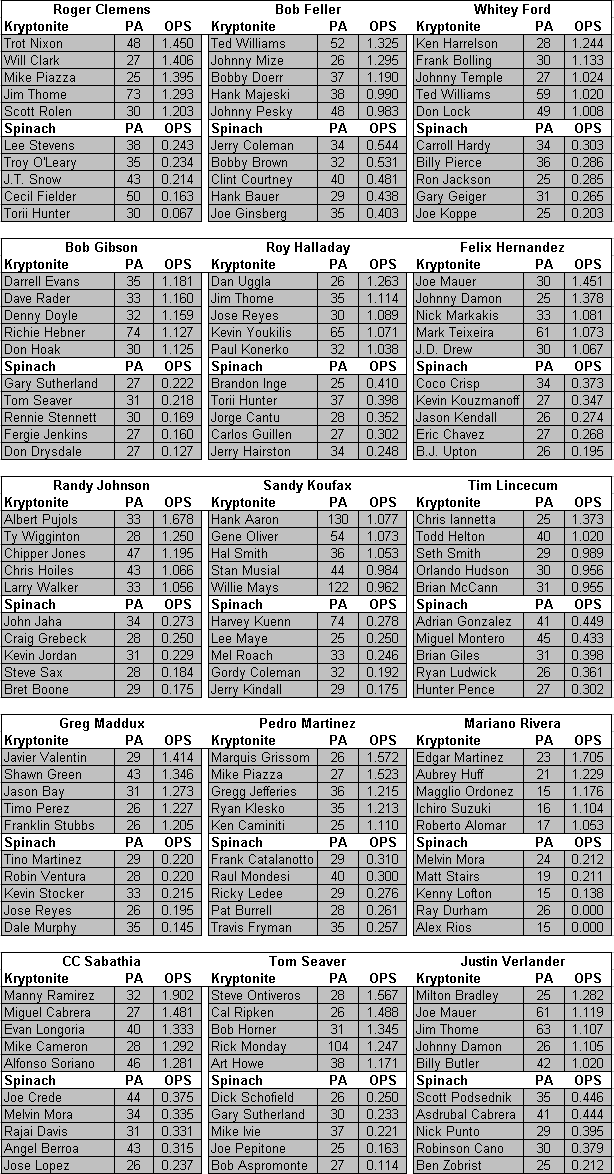
Superman had his kryptonite. Mariano Rivera had Edgar Martinez.  In 23 plate appearances against the immortal closer, the Mariners’ prolific DH batted an incredible .579/.652/1.053. When there’s a clash of the titans, someone has to win, and in this rare instance, the great Rivera was usually on the wrong side of the battle.

If Martinez was Rivera’s kryptonite, Ray Durham was his spinach. In 26 plate appearances against the closer, the former All Star 2B never got a hit. Although extreme in his level of futility, Durham has plenty of company among hitters who have been dominated by Rivera. Over 40% of the 83 players with at least 15 plate appearances against the all-time saves leader have posted an OPS below .600, so, just like a real life superhero, the Yankees closer is accustomed to getting his man.

Kryptonite and Spinach for a Selection of Top Pitchers
 
Note: Based on hitters with a minimum of 25 plate appearances (15 PAs for Rivera) against each starter. Includes post season results.
Source: Baseball-reference.com

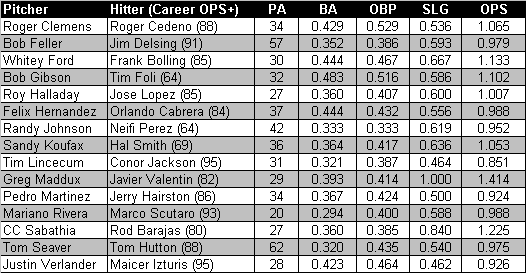
The chart above lists the five hitters with the most and least success (i.e., the kryptonite and spinach) against Rivera as well as a selection of top starting pitchers from both the present and past. As you can see, the chief nemeses for an elite pitcher are often hitters of equal renown. For example, Bob Feller had Ted Williams, Randy Johnson had Albert Pujols, and Sandy Koufax was made human when facing the immortal trio of Hank Aaron, Stan Musial and Willie Mays. However, there are some anomalies, such as Steve Ontiveros’ success against Tom Seaver. In 28 plate appearances, the former corner infielder for the Giants and Cubs, who had a career OPS of .731, managed to more than double that rate when facing Tom Terrific. The same relationship also existed between Greg Maddux and Javier Valentin, a light hitting catcher who somehow managed to solve the riddle of the Braves’ right hander.

The Seaver/Ontiveros and Madduz/Valentin pairings are probably the most surprising from the chart above, but that doesn’t mean the other elite pitchers haven’t had their share of unlikely antagonists. Marco Scutaro has been one of Rivera’s more frequent tormenters, while teammate CC Sabathia has found Rod Barajas to be one of his toughest outs. Two light hitting infielders, Jose Lopez and David Eckstein, have given Roy Hallday headaches, while Jerry Hairston Jr. is on a very small list of hitters who had Pedro Martinez’ number. Very few pitchers have been more intimidating than Bob Gibson, but that didn’t stop one of the worst hitters in baseball history from dominating the right hander. No hitter with at least 4,750 plate appearances has an OPS+ lower than Tim Foli’s 64, yet, somehow the journeyman managed to bat .483/.516/.586 against Gibson. Not to be outdone, Neifi Pérez, who matched Foli’s infamy by posting an OPS+ of 64 in over 5,500 plate appearances, also picked on one of the game’s greatest pitchers. In 42 plate appearances against Randy Johnson, Pérez raised his game exponentially, batting .333/.333/.619 against the Big Unit.

Unlikely Antagonists

Note: Hitters selected based on a combination of plate appearances and OPS+. Includes post season results.
Source: Baseball-reference.com

The chart below displays the distribution of OPS rates compiled by batters with a minimum number of plate appearances against our selection of great pitchers (see note for explanation of criteria used).  Rivera and Clemens are the only two pitchers from the group to keep a hitter under an OPS of .100, while Clemens also scored the lowest percentage of hitters who racked up an OPS over 1.000. Among the starters, only Pedro matched Rivera in terms of the number of hitters with an OPS against below .700; Tim Lincecum is the leader of the actives. Finally, all but Feller, Sabathia, and Hernandez have more “blue” than “red” on their charts, but it should be noted that trio pitched more seasons in a higher run environment than all others but Rivera and Halladay.

“OPS Against” Distribution for Select Group of Top Starters

Note: Based on hitters with a minimum of 25 plate appearances (15 PAs for Rivera) against each starter. Also, a 7% OPS adjustment (based on a crude comparison of league OPS in the different eras) was used to approximate the lower run environment that existed during the careers of Seaver, Ford, Gibson, and Koufax. Includes post season results.
Source: Baseball-reference.com

Irish Eyes are Smilin’

The Yanks won today. Hiroki Kuroda pitched well and the bats went to work. Here’s Chad Jennings on Mariano and Wallace Matthews with the Alex Rodriguez quote of the day;

Meanwhile, Tyler Kepner looks at the Rangers bullpen in the New York Times.

Tonight, the Knicks are in Indy to play the Pacers. I’m curious to see how the New Yorker’s will respond after a beatdown at the Garden last night.

More NCAA, too.

Go Sports.

How Green Was My Valley

Yankee game is on TV this afternoon.

Chad Jennings does a nice job of recapping the Andy Pettitte story over at Lo-Hud. And here is more from Ken Rosenthal.

Play Ball.

[Picture by Bags]

“I Expect to Be as Good as I Was”

Here’s Cliff,  William Juliano, Craig Calcaterra, Andrew Marchand, and Jack Dickey  on the return of Andy Pettitte.

[Picture by Craig Robinson; featured image by Larry Roibal]

Didn’t See That Coming

According to Jack Curry, Andy Pettitte has signed a 1-year, $2.5 million minor league deal with the Yanks. Was retirement that boring? Is Freddy Garcia that hurt? Maybe Andy’s wife couldn’t stand having him around the house.

Go figure.

Change is Gunna Come

Here’s Chad Jennings on Michael Pineda’s outing yesterday:

“That’s my baby,” Pineda said. “I threw a very good slider today, but I’m very excited because my changeup was great. I threw a lot of changeups today and felt comfortable. … Last year, I didn’t throw a lot of changeups, so this year, I’m focused a little more on my changeup and making a good pitch all the time. I’m not worried about my fastball. I don’t know how my fastball is right now, but it feels good.”

That’s the progress the Yankees were hoping to see.

“It’s nice to have success when you’re working at something,” Girardi said. “If you’re making a change or you’re trying to learn a new pitch, it’s nice to have success because I think if you don’t, you’re going to get frustrated, and you’re going to question, do I use it or not? But he’s had some success.”

And more, from Russell Martin:

“I think he was like 88-90 in Clearwater, so it’s coming along. I’m not worried about it. I just want to see the guy pitch. He’s a pitcher like anybody else out there. I just wanted to see him execute pitches. His velocity, he has it in him, it’s just a matter of time. As soon as you put on your uniform, you’re in New York and you get the juices flowing, the velocity is going to pick up no matter what.”

…And if you’re looking for more fastball specifics: “(Pineda) was a little inconsistent trying to throw his fastball away to right-handers. It looked like he was pulling off a little bit.” Martin said it’s an easy thing to correct and could be fixed in a single bullpen.

I’m really looking forward to seeing this kid pitch.

Couple Things

Over at River Ave, Larry Koestler looks at the 2012 NY Yankees All-Projection Team.

Here’s more on Freddy Garcia from George King in the Post.

[Picture by Bags]

Ouch

Freddy Garcia was hit in the hand today.

[Picture by Bags]

Play Ball

Yanks and the Sox tonight. Game is on TV.

Have at it.

[Photo Credit: Zstrike131]

A Payroll Odyssey

Over at the Captain’s Blog, William Juliano explains what this 2014 payroll tax business is all about and I, for one, am grateful.

[Photo Credit: Alice Kokaine]

Bags’ Groove

Our man Bags with some flix from Tampa.


Observations From Cooperstown: A Tribute to Don Mincher

I usually write exclusively about the Yankees, either past or present, in this space. That’s because many of the readers have told me they prefer to read about the Yankees in “Observations From Cooperstown” and “Card Corner.” But there are times when I find it necessary to deviate from that plan. The loss of former major league slugger Don Mincher is one of those times.

Don died a week ago at the age of 73, just about six months after retiring as president of the Southern League. Though I never met him face to face and only remember his playing career from a few highlights, he meant a lot to me personally. Don was the first player I interviewed for the first book I wrote: A Baseball Dynasty: Charlie Finley’s Swingin’ A’s.

I had never done an interview for a book-length project, so I really had no idea what I was doing. If the phone interview had gone poorly, I might have felt discouraged to do any more. But Don Mincher wouldn’t let that happen. He was friendly, accommodating, informative, helpful, and funny. At the end of our extended conversation, he gave me some helpful hints. He told me which A’s to avoid interviewing, and even warned me about one guy who would likely ask me for money in exchange for the interview.

The interview with Mincher went so well that I said to myself, “I can do this.” I interviewed several other players on the way to putting together a book over which I take a certain amount of pride and a great deal of pleasure.

Don provided me with some real insights into the inner workings of the A’s in 1971-72. When Mincher heard that t he fiery Dick Williams would replace the laid-back McNamara, he knew that the culture on the ballclub would change dramatically. “Well, I knew one thing right away; there would be some confrontations. I knew that,” Mincher told me back in 1997. “I knew Dick Williams from playing against him, his reputation and what-have-you. And I knew there would be some confrontations that would take place, and I knew that Dick Williams would win ‘em all.”

Mincher realized that a constant swirl of turmoil would result from the heated interaction between the feisty Williams and some of the egocentric players on the A’s. “You could just feel it coming,” Mincher said, “and sure enough there was.” More importantly, Mincher sensed that with the hiring of Williams, the A’s were about to start winning a lot more games than they done in the late 1960s. “That was really the beginning of a great ballclub,” Mincher said declaratively, “when Dick Williams was signed to that contract.”

In addition to the heavy demands imposed by Williams, the 1972 season also marked the beginning of an era of ill feelings between some of the Oakland players. “I can remember a lot of animosity in that clubhouse between individual guys, and it became a little bit cliquish to some degree at that time,” said Mincher, one of the few A’s who didn’t have conflicts with his teammates. “It was amazing the guys that had trouble with each other just forgot about it when they went out on the field, and then picked it up after the game. It was amazing to do that.”

Mincher would be long retired by the time player and owner controversies fully overtook the team in 1973 and ’74. But the roots of dissent all go back to 1972.“Yeah, I can remember it beginning in ’72. Of course, I wasn’t there when it really got hectic, but I can imagine what happened, and I can imagine who was in the middle of it. It wasn’t any fistfights or brawls or anything like that [in ’72], but I remember the bickering, sure.”

The catalyst to much of the controversy could be found in the form of a future Yankee. “Reggie [Jackson], who is probably the most intelligent individual I ever played with,” Mincher recalled, “was always the center of the media attention, either good or bad. And he seemed to always be there. I can remember some bickering with other players and him. You know, Dave Duncan, who was Reggie’s good friend—they had some problems. But David was a very stern individual himself, just like he is now, really demanding a lot of the pitching staff and himself. When an outfielder caused a pitcher to get in trouble with an overthrow or an error or something like that, there could be some things said and some words exchanged in those situations. And I can remember some of those. Of course, my old roomy, Sal Bando, he wasn’t very shy about stepping up to the plate either as far as telling people exactly what he thought. And there would be some words back and forth.”

At times, the wars of words forced a likable, even-tempered player like Mincher to assume the role of peacemaker. “I did,” said Mincher, who usually preferred to stay in the background. “Of course, when you’re not playing regularly and you’re just doing your thing, you try to get along with the players, and just sit down and be quiet… I tried to do my part and console everybody. But really, with those kinds of mentalities, egos, and talent, they worked themselves out.”

Mincher said that the uncomfortable feelings created by such verbal outbursts never seemed to interfere with the team’s on-field playing ability. “These guys were great, great players, and they learned from most things, and while I was there we never had any fistfights or anything like that. And all of the confrontations [actually] led to good things, and they just played better, it seemed like, as they went along.”

Mincher was traded to the Senators in the middle of the 1971 season, but he returned to Oakland in another deal the following season, primarily as a pinch hitter. He achieved his most indelible highlight as a member of the A’s with his appearance in Game Four of the World Series. Called upon as a pinch hitter in the ninth inning with the A’s down a run, Mincher faced Reds relief ace Clay Carroll. With the count one-and-oh, Carroll threw a fastball over the middle of the plate. “I was lucky enough to be able to get a good pitch I could drive, down in the strike zone,” Mincher said, his memory working in overdrive. “I tried to get a ball that you can drive up the middle or pull in the hole to first base. Those were the things I really thought about, and I thought about on that day. The ball went directly over the second baseman’s head. If it had been on the ground, it’d been a double play.”

But it wasn’t. Mincher’s uppercut swing enabled him to lift the ball over the infield. “I remember it just like it was yesterday,” Mincher told me in 1997. “I got it in the right-center field gap, which probably should have been for a double, but I was cold and couldn’t run.” Mincher’s golf shot into the alley scored pinch-runner Allan Lewis with the tying run and sent Gene Tenace, representing the potential game-winning run, to third base.

“It’s the last hit I ever got,” Mincher said in recalling the key RBI single that tied the game and set the table for Angel Mangual’s game-winning single, “and certainly it’s the most vivid in my memory.” Mincher’s pinch-hit RBI helped the A’s win Game Five of the Reds, on their way to a stunning upset in the 1972 World Series. It was also marked the final at-bat of Mincher’s career; he retired after the season, rejecting an overture from Finley to become the team’s first DH in 1973.

Mincher’s career ended with Oakland, but there was much that transpired in his other major league stops. Drafted and signed by the original Washington Senators, he then moved with the franchise when it became the Minnesota Twins. As the starting first baseman, he played an important on the 1965 American League pennant winners, hitting a home run against Don Drysdale in a seven-game World Series loss to the Dodgers.

From there he went to the California Angels, where he put up a productive season before ending up on the receiving end of a Sam McDowell fastball early in 1968. The ball struck him squarely in the face; Mincher slumped to the ground, his face bleeding. Limited to 120 games and plagued by dizzy spells throughout the summer, Mincher muddled through one of his worst seasons. Concerned that Mincher might never be able to return to form, the Angels left him unprotected in the expansion draft. That’s how he ended up with the Seattle Pilots in 1969. He had a good year for a bad team, while becoming the only All-Star representative in the franchise’s one-year existence.

The Pilots moved to Milwaukee, but Mincher never made the trip. He was traded to Oakland for a package of catcher Phil Roof, outfielder Mike Hershberger and pitchers Lew Krausse and Ken Sanders. He then moved on as part of a trade package to Washington for Mike Epstein and Darold Knowles, moved with the Senators franchise to Texas, and then made his last pitstop in Oakland. By the time he called it a career, he had hit exactly 200 home runs, put up an OPS of better than .800 seven times, and accumulated nearly as many walks as strikeouts. He was a hitter with power and smarts, and there is always value in that kind of player.

Yet, Mincher’s story did not end there. Remaining in baseball, he made a smooth transition to the front office, eventually becoming the GM and then the owner of the Double-A Huntsville Stars. (It was while he was owner that I interviewed him for the book on the A’s, and began to understand why he was beloved in the Huntsville community.) From there, he was promoted to president of the Southern League. Along the way, he became a revered figure in Huntsville, the unofficial “Mr. Baseball” of the community. They loved him for his work ethic, his easy going personality, his willingness to talk to just about anybody.

I interviewed Don only once, but I miss him. I can only imagine how much the people of Huntsville, who knew Don Mincher very well, are missing him today.

Bruce Markusen writes “Cooperstown Confidential” for The Hardball Times.

More or Less


The nature of sports coverage continues to change and this year more than ever we get almost instant updates from spring training. ESPN New York has a Yankee blog in the tradition of the Lo-Hud blog and of course there is MLB.TV and twitter and a host of fine Yankee sites. It is impressive all this information but I often feel turned in the other direction, wanting to know less and not more. I crave a sense of mystery and discovery, an illusion that I find spoiled by too much analysis.

I don’t have much interest in worrying about Ivan Nova after two spring training starts. On the other hand, I appreciate that this news is out there, just like I find comfort in the 24-hour pharmacy around the way. I may not visit but I’m glad to know it exists.

The MLB Network has exhibition games on all afternoon. Enjoy.

[Picture by Bags]

Trouble in Mind

There is a muted kind of tension about spring training, maybe apprehension is a better word, and it has to do with injuries. I’m less interested in how players perform in Florida and more concerned with nobody getting hurt. Which is a fool’s wish, of course, because someone is always getting hurt.

David Robertson is the first to go down with what could be a serious injury. Let’s hope it’s not severe.

[Photo by Bags]

feed Share on Facebook Share on Twitter Share via email
"This ain't football. We do this every day."
--Earl Weaver