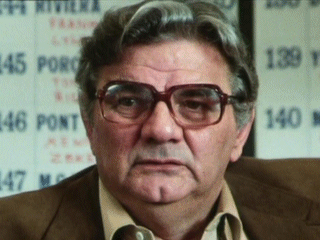
Originally published in the October 1992 issue of GQ, here is a classic from Peter Richmond.
(A postscript from the author follows.)

Nighttime in Los Angeles, on a quiet street off Melrose Avenue. An otherwise normal evening is marked by an oddly whimsical celestial disturbance: Baseballs are falling out of the sky.
They are coming from the roof of a gray apartment building. One ball pocks an adjacent apartment. Another bounces to the street. A third flies off into the night, a mighty shot.
This is West Hollywood in the early eighties, where anything is not only possible but likely. West Hollywood shakes its head and drives on by.
But if a passerby’s curiosity had been piqued and he’d climbed to the roof of a neighboring building to divine the source of the show, he would have been rewarded by a most unusual sight: a man of striking looks, with long blond hair, startlingly and wincingly thin, hitting the ball with a practiced swing—a flat, smooth, even stroke developed during a youth spent in minor-league towns from Pocatello to Albuquerque.
This is not Tommy Lasorda Jr.’s, routine nighttime activity. A routine night is spent in the clubs, the bright ones and dark ones alike.
Still, on occasion, here he’d be, on the roof, clubbing baseballs into the night. Because there were times when the pull was just too strong. Of the game. Of the father. He could never be what his father was—Tommy Lasorda’s own inner orientation made that impossible—but he could fantasize, couldn’t he? That he was ten, taking batting practice in Ogden, Utah, with his dad, and Garvey, and the rest of them?
And so, on the odd night. On a night he was not at Rage, or the Rose Tattoo, he’d climb to the roof, the lord of well-tanned West Hollywood, and lose himself in the steady rhythm of bat hitting ball—the reflex ritual that only a man inside the game can truly appreciate.
“Junior was the better hitter,” recalls Steve Garvey. “He didn’t have his father’s curveball, but he was the better hitter.”
“I cried,” Tom Lasorda says quietly. He is sipping a glass of juice in the well-appointed lounge of Dodgertown, the Los Angeles baseball team’s green-glorious oasis of a spring-training site. It’s a place that heralds and nurtures out-of-time baseball and out-of-time Dodgers. A place where, each spring, in the season of illusion’s renewal, they are allowed to be the men they once were.

On this February weekend, Dodgertown is crowded with clearly affluent, often out-of-shape white men, each of whom has parted with $4,000 to come to Dodgers fantasy camp. In pink polo shirts and pale-pink slacks—the pastels of privilege—they are scattered around the lounge, flirting with fantasy lives, chatting with the coaches.
“I cried. A lot of times. But I didn’t cry in the clubhouse. I kept my problems to myself. I never brought them with me. I didn’t want to show my family—that’s my family away from my house. What’s the sense of bringing my problems to my team?
“I had him for thirty-three years. Thirty-three years is better than nothing, isn’t it? If I coulda seen God and God said to me ‘I’m going to give you a son for thirty-three years and take him away after thirty-three years,’ I’d have said ‘Give him to me.'”
His gaze skips about the room—he always seems to be looking around for someone to greet, a hand to shake, another camper to slap another anecdote on. Tom Lasorda floats on an ever-flowing current of conversation.
“I signed that contract [to manage the Dodgers] with a commitment to do the best of my ability,” he says. “If I’m depressed, what good does it do? When I walk into the clubhouse, I got to put on a winning face. A happy face. If I go in with my head hung down when I put on my uniform, what good does it do?”
These are words he has said before, in response to other inquiries about Tommy’s death. But now the voice shifts tone and the words become more weighted; he frames each one with a new meaning.
And he stops looking around the room and looks me in the eye.
“I could say ‘God, why was I dealt this blow? Does my wife—do I—deserve this?’ [But] then how do I feel, hunh? Does it change it?” Now the voice grows even louder, and a few fantasy campers raise their eyebrows and turn their heads toward us.
“See my point?”
The words are like fingers jabbed into my chest.
“Hunh?”
Then his eyes look away and he sets his face in a flat, angry look of defiance.
“You could hit me over the head with a fucking two-by-four and you don’t knock a tear out of me,” he says.
“Fuck,” he says.
The word does not seem to be connected to anything.
He was the second of five sons born, in Norristown, Pennsylvania, a crowded little city-town a half-hour north of Philadelphia, to Sabatino Lasorda, a truckdriver who’d emigrated from Italy, and Carmella Lasorda.
By the age of twenty-two, Tom Lasorda was a successful minor league pitcher by trade, a left-hander with a curveball and not a lot more. But he was distinguished by an insanely dogged belief in the possibility of things working out. His father had taught him that. On winter nights when he could not turn the heat on, Sabatino Lasorda would nonetheless present an unfailingly optimistic face to his family, and that was how Tom Lasorda learned that nothing could stomp on the human spirit if you didn’t let it.
Tom Lasorda played for teams at nearly every level of professional ball: in Concord, N.H.; Schenectady, N.Y.; Greenville, S.C.; Montreal; Brooklyn (twice, briefly); Kansas City, Missouri; Denver; and Los Angeles. Once, after a short stay in Brooklyn, he was sent back to the minors so the Dodgers could keep a left-handed pitcher with a good fastball named Sandy Koufax, and to this day Lasorda will look you in the eye and say “I still think they made a mistake” and believe it.
The Dodgers saw the white-hot burn and made it into a minor-league manager. From 1965 to 1972, Lasorda’s teams—in Pocatello, Ogden, Spokane, then Albuquerque—finished second, first, first, first, second, first, third and first. Sheer bravado was the tool; tent-preaching thick with obscenities the style.
In 1973, the Dodgers called him to coach for the big team, and he summoned his wife and his son and his daughter from Norristown, and they moved to Fullerton, Calif, a featureless sprawl of a suburb known for the homogeneity of its style of life and the conservatism of its residents.
In 1976, he was anointed the second manager in the Los Angeles Dodgers’ nineteen-year history. His managing style was by instinct, not by the book, and his instincts were good enough to pay off more often than not. In his first two years, the Dodgers made the World Series. In 1981, they won it. In 1985, they didn’t make it because Lasorda elected to have Tom Niedenfuer pitch to St. Louis’s Jack Clark in the sixth game of the playoffs, against the odds, and Jack Clark hit a three-run home run. In 1988, though, he sent a limping Kirk Gibson to the plate and gave us a moment for history.
http://www.youtube.com/watch?v=U157X0jy5iw
From the first, Lasorda understood that he had to invent a new identity for this team, the team that Walter O’Malley had yanked out of blue-collar-loyal Brooklyn-borough America and dropped into a city whose only real industry was manufacturing the soulless stuff of celluloid fantasy. His clubhouse became a haunt for show-business personalities, usually of distinctly outsized demeanor—Sinatra, Rickles—and he himself became the beacon of a new mythology, leader of the team that played in a ballpark on a hill on a road called Elysian, perched above the downtown, high and imperious. Because, really, aren’t there too many theme parks to compete with in Los Angeles to manage your baseball team as anything other than another one?
In sixteen years, the tone of the sermon has seldom faltered, at least not before this year. This year, through no fault of Tom Lasorda’s, his fielders have forgotten how to field, in a game in which defense has to be an immutable; and if this is anyone’s fault, it’s that of the men who stock the farm system. His pitching is vague, at best. So the overwhelming number of one-run—is, in fact, testament, again, to Lasorda’s management. No one has questioned his competence.
His spirit has flagged considerably, but his days, in season and out, are as full of Dodger Blue banquet appearances as ever, with impromptu Dodgers pep rallies in airport concourses from Nashville to Seattle. Unlike practitioners of Crystal Cathedral pulpitry, Lasorda the tent-preacher believes in what he says, which, of course, makes all the difference in the world. Because of his faith, Dodger Blue achieves things, more things than you can imagine. The lights for the baseball field in Caledonia, Miss.; the fund for the former major leaguer with cancer in Pensacola: Tom showed up, talked Dodger Blue, raised the money. Tom’s word maintains the baseball field at Jackson State and upgraded the facilities at Georgia Tech.
“I was in Nashville,” Tom says, still sitting in the lounge, back on automatic now, reciting. “Talking to college baseball coaches, and a buddy told me nine nuns had been evicted from their home. I got seven or eight dozen balls [signed by Hall of Fame players], we auctioned them, and we built them a home. They said, ‘We prayed for a miracle, and God sent you to us.'”
Nine nuns in Nashville.
In the hallway between the lounge and the locker room hang photographs of Brooklyn Dodgers games. Lasorda has pored over them a thousand times, with a thousand writers, a thousand campers, a thousand Dodgers prospects—identifying each player, re-creating each smoky moment.
But on this day, a few minutes after he’s been talking about Tommy, he walks this gauntlet differently.
“That’s Pete Reiser,” Tom Lasorda says. “He’s dead.” He points to another player. He says, “He’s dead.” He walks down the hallway, clicking them off, talking out loud but to himself.
“He’s dead. He’s dead. He’s dead. He’s dead. He’s dead. He’s dead.”
Back in his suite, in the residence area of Dodgertown, I ask him if it was difficult having a gay son.
“My son wasn’t gay,” he says evenly, no anger. “No way. No way. I read that in a paper. I also read in that paper that a lady gave birth to a fuckin’ monkey, too. That’s not the fuckin’ truth. That’s not the truth.”
I ask him if he read in the same paper that his son had died of AIDS.
“That’s not true,” he says.
I say that I thought a step forward had been taken by Magic Johnson’s disclosure of his own HIV infection, that that’s why some people in Los Angeles expected him to…
“Hey,” he says. “I don’t care what people…I know what my son died of. I know what he died of. The doctor put out a report of how he died. He died of pneumonia.”
He turns away and starts to brush his hair in the mirror of his dressing room. He is getting ready to go to the fantasy-camp barbecue. He starts to whistle. I ask him if he watched the ceremony on television when the Lakers retired Johnson’s number.
‘”I guarantee you one fuckin’ thing,” he says. “I’ll lay you three to one Magic plays again. Three to one. That Magic plays again.”
As long as he’s healthy, I say. People have lived for ten years with the right medication and some luck. Your quality of life can be good, I say.
Lasorda doesn’t answer. Then he says, “You think people would have cared so much if it had been Mike Tyson?”
On death certificates issued by the state of California, there are three lines to list the deceased’s cause of death, and after each is a space labeled TIME INTERVAL BETWEEN ONSET AND DEATH.
Tom Lasorda Jr.’s, death certificate reads:
IMMEDIATE CAUSE: A) PNEUMONITIS — 2 WEEKS
DUE TO: B) DEHYDRATION — 6 WEEKS
DUE TO: C) PROBABLE ACQUIRED IMMUNE
DEFICIENCY SYNDROME — 1 YEAR.
At Sunny Hills High School, in Fullerton, Calif.—”the most horrible nouveau riche white-bread high school in the world,” recalls Cat Gwynn, a Los Angeles photographer and filmmaker and a Sunny Hills alumna—Tommy Lasorda moved through the hallways with a style and a self-assurance uncommon in a man so young; you could see them from afar, Tommy and his group. They were all girls, and they were all very pretty. Tommy was invariably dressed impeccably. He was as beautiful as his friends. He had none of his father’s basset-hound features; Tommy’s bones were carved, gently, from glass.
“It was very obvious that he was feminine, but none of the jocks nailed him to the wall or anything,” Gwynn says. “I was enamored of him because he wasn’t at all uncomfortable with who he was. In this judgmental, narrow-minded high school, he strutted his stuff.”
In 1980, at the Fashion Institute of Design and Merchandising, Cindy Stevens and Tommy Lasorda shared a class in color theory. Tommy, Stevens recalls, often did not do his homework. He would spend a lot of his time at Dodgers games or on the road with the team. At school, they shared cigarettes in the hallway. Tommy would tell her about the latest material he’d bought to have made into a suit. She’d ask him where the money came from. Home, he’d say.
“He talked lovingly about his father and their relationship—they had a very good relationship,” Stevens says now. “I was surprised. I didn’t think it’d be like that. You’d think it’d be hard on a macho Italian man. This famous American idol. You’d figure it’d be [the father saying] ‘Please don’t let people know you’re my son,’ but it was the opposite. I had new respect for his father. There had to be acceptance from his mom and dad. Tommy had that good self-esteem—where you figure that [his] parents did something right.”
In the late seventies, Tommy left Fullerton, moving only an hour northwest in distance—though he might as well have been crossing the border between two sovereign nations—to West Hollywood, a pocket of gay America unlike any other, a community bound by the shared knowledge that those within it had been drawn by its double distinction: to be among gays, and to be in Hollywood. And an outrageous kid from Fullerton, ready to take the world by storm, found himself dropped smack into the soup—of a thousand other outrageous kids, from Appleton, and Omaha, and Scranton.
But Tommy could never stand to be just another anything. The father and the son had that in common. They had a great deal in common. Start with the voice: gravelly, like a car trying to start on a cold morning. The father, of course, spends his life barking and regaling, never stopping; he’s baseball’s oral poet, an anti-Homer. It’s a well-worn voice. Issuing from the son, a man so attractive that men tended to assume he was a woman, it was the most jarring of notes. One of his closest friends compared it to Linda Blair’s in The Exorcist—the scenes in which she was possessed.
More significantly, the father’s world was no less eccentric than the son’s: The subset of baseball America found in locker rooms and banquet halls is filled with men who have, in large part, managed quite nicely to avoid the socialization processes of the rest of society.
Then, the most obvious similarity: Both men were so outrageous, so outsized and surreal in their chosen persona, that, when it came down to it, for all of one’s skepticism about their sincerity, it was impossible not to like them—not to, finally, just give in and let their version of things wash over you, rather than resist. Both strutted an impossibly simplistic view of the world—the father with his gospel of fierce optimism and blind obeisance to a baseball mythology, and the son with a slavery to fashion that he carried to the point of religion.
But where the illusion left off and reality started, that was a place hidden to everyone but themselves. In trying to figure out what each had tucked down deep, we can only conjecture. “You’d be surprised what agonies people have,” Dusty Baker, the former Dodger, reminds us, himself a good friend of both father and son, a solid citizen in a sport that could use a few more. “There’s that old saying that we all have something that’s hurting us.”
In the case of the son, friends say the West Hollywood years were born of a Catch-22 kind of loneliness: The more bizarre the lengths to which he went to hone the illusion, the less accessible he became. In his last years, friends say, everything quieted down, markedly so. The flamboyant life gave way to a routine of health clubs and abstinence and sobriety and religion. But by then, of course, the excesses of the earlier years had taken their inexorable toll.
As for the father, there’s no question about the nature of the demon he’s been prey to for the past two years. Few in his locker room saw any evidence of sadness as his son’s illness grew worse, but this should come as no surprise: Tom Lasorda has spent most of four decades in the same baseball uniform. Where else would he go to get away from the grief?
“Maybe,” Baker says, “his ballpark was his sanctuary.”
It’s a plague town now, there’s no way around it. At brunch at the French Quarter, men stop their conversations to lay out their pills on the tables, and take them one by one with sips of juice. A mile west is Rage, its name having taken on a new meaning. Two blocks away, on Santa Monica Boulevard, at A Different Light, atop the shelves given over to books on how to manage to stay alive for another few weeks, sit a dozen clear bottles, each filled with amber fluid and a rag—symbolic Molotovs, labeled with the name of a man or a woman or a government agency that is setting back the common cause, reinforcing the stereotypes, driving the social stigmata even deeper into West Hollywood’s already weakened flesh.
But in the late seventies, it was a raucous, outrageous and joyous neighborhood, free of the pall that afflicted hetero Los Angeles, thronged as it was with people who’d lemminged their way out west until there was no more land, fugitives from back east.
In the late seventies and the early eighties, say his friends and his acquaintances and those who knew him and those who watched him, Tommy Lasorda was impossible to miss. They tell stories that careen from wild and touching to sordid and scary; some ring true, others fanciful. Collected, they paint a neon scar of a boy slashing across the town. They trace the path of a perfect, practiced, very lonely shooting star.
His haunt was the Rose Tattoo, a gay club with male strippers, long closed now. One night, he entered—no, he made an entrance—in a cape, with a pre-power ponytail and a cigarette holder: Garbo with a touch of Bowie and the sidelong glance of Veronica Lake. He caught the eye of an older man. They talked. In time, became friends. In the early eighties, they spent a lot of time together. Friends is all they were. They were very much alike.
“I’m one of those gentlemen who liked him,” says the man. “I was his Oscar Wilde. He liked me because I was an older guy who’d tasted life. I was his Marne. I showed him life. Art. Theater. I made him a little more sophisticated. [Showed him] how to dress a little better.”
They spent the days poolside at a private home up behind the perfect pink stucco of the Beverly Hills Hotel, Tommy lacquering himself with a tan that was the stuff of legend. The tan is de rigueur. The tan is all. It may not look like work, but it is; the work is to look as good as you can.
He occasionally held a job, never for long. Once, he got work at the Right Bank, a shoe store, to get discounts. His father bought him an antique-clothing store. He wearied of it. Tommy, says one friend, wanted to be like those women in soap operas who have their own businesses but never actually work at them.

Tommy’s look was his work. If there were others who were young and lithe and handsome and androgynous, none were as outre as Tommy. Tommy never ate. A few sprouts, some fruit, a potato. Tommy spent hours at the makeup table. Tommy studied portraits of Dietrich and Garbo to see how the makeup was done. Tommy bleached his hair. On his head. On his legs. Tommy had all of his teeth capped. Tommy had a chemabrasion performed on his face, in which an acid bath removes four of the skin’s six layers. Then the skin is scrubbed to remove yet another layer. It is generally used to erase scars or wrinkles. Tommy had two done.
But he smoked, and he drank. Champagne in a flute, cigarette in a long holder, graceful and vampish at the same time: This was Tommy at the Rose Tattoo. His friend also remembers how well Tommy and his father got along. His friend would drive Tommy to the Italian restaurant where he’d meet his father for Sunday dinners.
“He loved his father, you know. They got along perfectly well.” His friend was never his lover. Only his friend. That was all. That was enough. “He was very lonely.”
On occasion, the nighttime ramble led him far from the stilted elegance of Santa Monica Boulevard. In the punk dubs, amid the slam-dancing and the head-butting, Tommy parted the leathered seas, a chic foil for all the pierced flesh and fury, this man who didn’t sweat. This man who crossed himself when someone swore in public.
Penelope Spheeris met him at Club Zero. She would go on to direct the punk documentary The Decline of Western Civilization and, years later, Wayne’s World. They became friends. They met at punk clubs—the blond man in custom-made suits, the striking woman in black cocktail dresses and leather boots. In 1981, she interviewed Tommy for a short-lived underground paper called No Mag.
PENELOPE: Have you been interviewed very much before?
TOMMY: No, but I’m very…oral…
PENELOPE: People who would see you around town, they would probably think you were gay.
TOMMY: I don’t care.
PENELOPE: What do you do when you get that reaction from them?
TOMMY : I like all people. And it’s better having comments, be it GOOD, BAD or WHATEVER. I don’t mind at all, but I dress quite…well, I wouldn’t say it’s FLAMBOYANT because it’s not intentional. It’s just intentionally ME.
PENELOPE: O.K., but you understand, when somebody looks at a picture of you, they’re going to say, this guy’s awfully feminine.
TOMMY: I’m there for anyone to draw any conclusions.
PENELOPE: Are you?
TOMMY: Well, I mean, I’ve done different things…of course…I have no label on myself because then I have restrictions. I would really hate to state anything like that.
PENELOPE: When you were young did your dad say, “Come on, Tommy, Jr., let’s go play baseball”?
TOMMY : Never. They always allowed me to do exactly what I pleased. I don’t know how they had the sense to be that way. As parents they’re both so…well, very straitlaced and conservative. I don’t know how I was allowed to just be ME, but I think it was because I was so strongly ME that I don’t think they thought they could ever STOP IT…
PENELOPE: Do you feel like you should be careful in the public eye?
TOMMY: I feel like I should, but I don’t.
PENELOPE: Do you think the press would be mean to you if they had the chance?
TOMMY: I’m sure they would, but I’ll take ANY PUBLICITY.
PENELOPE: Why?
TOMMY: Because that’s what I want…I do everything TO BE SEEN.
“I found him totally fascinating. He was astoundingly beautiful, more than most women,” Spheeris says now. “I became interested in…the blatant contrast in lifestyles. Tommy Lasorda Sr., was so involved in that macho sports world, and his son was the opposite…”
She laughs.
“I was astounded at how many clothes he had. I remember walking into the closet. The closet was as big as my living room. Everything was organized perfectly. Beautiful designer clothes he looked great in.”
Often in the early eighties, when fashion photographer Eugene Pinkowski’s phone would ring, it would be Tommy. Tommy wanting to shop or Tommy wanting Eugene to photograph his new look.
When they went shopping, they would fly down Melrose in Tommy’s Datsun 280Z, much, much too fast, Tommy leaning out of the driver’s window, hair flying in the wind, like some Valley Girl gone weird, hurling gravelly insults (“Who did your hair? It looks awful”) at the pedestrians diving out of the way.
He was a terrible driver. Once he hit a cat. He got out of the car, knelt on the street, and cried. He rang doorbells up and down the street, trying to find the owner.
Tommy would call to tell Eugene he was going to buy him a gift. Then Tommy would spend all his money on himself. Then, the next day, Tommy would make up for it. He would hand him something. A pair of porcelain figures, babies, a boy and a girl, meant to be displayed on a grand piano—very difficult to find, very expensive.
Then the phone would ring. It’d be Eugene’s mother, saying she just got a bracelet. From his friend Tommy.
“He was a character,” Pinkowski says at breakfast in a Pasadena coffee shop. “He was a case. He was a complete and total case.”
Then he looks away.
“He was really lonely,” Pinkowski says. “He was sad.”
When he was being photographed, Tommy was always trying to become different people.
Eugene captured them all. Tommy with long hair. With short hair. With the cigarette. Without it. With some of his exceptionally beautiful women friends. Tommy often had beautiful women around him, Pinkowski recalls—vaguely European, vaguely models. Sometimes Tommy had Pinkowski take pictures of them.
Mostly he took pictures of Tommy. Tommy with a stuffed fox. Lounging on the floor. In the piano. Sitting in a grocery cart.
In red. In green. In white. In blue. In black and gray.
His four toes. Tommy had four toes on his right foot, the fifth lost in a childhood accident. He posed the foot next to a gray boot on the gray carpet. Then he posed it next to a red shoe on the gray carpet. The red looked better.
Tommy and his foot were a regular subject of conversation, often led by Tommy.

“Tommy was a great storyteller, and he’d tell you stories of his dad in the minor leagues,” Pinkowski says. “Everybody’d like him. He was very much like the old boy. He could really hold his own in a group of strangers. And he’d do anything to keep it going. To be the center of attention. He’d just suddenly take his shoe and sock off at dinner and say ‘Did you know I was missing my toe?'”
One day, Tommy wanted to pose wrapped in a transparent shower curtain. Tommy was wearing white underwear. For forty-five minutes they tried to light the shot so that the underwear was concealed, to no avail. Tommy left, and returned in flesh-colored underwear.
There was nothing sexual about Tommy’s fashion-posing. Tommy’s fashion-posing was designed to get Tommy into fashion magazines. Tommy was forever bugging the editors of Interview to feature him, but they wouldn’t.
“As beautiful as he was, as famous as his father was, he thought he should be in magazines,” Pinkowski says now. “He was as hungry as Madonna. But Bowie and Grace [Jones] could do something. He couldn’t do anything. He could never see any talent in himself.”
The closest Tommy came was when he bought himself a full page in Stuff magazine, in 1982, for a picture of himself that Eugene took.
He would pay Eugene out of the house account his parents had set up for him. On occasion, Eugene would get a call from Tommy’s mother: We don’t need any more pictures this year. Still, Tommy would have several of his favorites printed for his parents. One is from the blue period.
At the Duck Club, down behind the Whiskey, in 1985, Tommy sat in a corner drinking Blue Hawaiians. To match his blue waistcoat. Or his tailored blue Edwardian gabardine jacket. This was during his blue period. In his green period, he was known to wear a green lamé wrap and drink crème de menthe. But the blue period lasted longer. The good thing about the blue period was that on the nights he didn’t want to dress up, he could wear denim and still match his drink. And, sometimes, his mood.
“He walked around with a big smile on his face, as if everything was great because he had everything around him to prove it was great,” Spheeris says. “But I don’t think it was…When you’re that sad, you have to cover up a lot of pain. But he didn’t admit it.”
The nature of the pain will forever be in debate. Few of his friends think it had to do with the relationship with his parents. “The parents—both of them—were incredibly gracious and kind to everyone in Tommy’s life,” says a close friend of the family’s.
Alex Magno was an instructor at the Voight Fitness and Dance Center and became one of Tommy’s best friends. Tommy was the godfather of his daughter. “We used to ask him, ‘You’re thirty-three, what kind of life is that—you have no responsibilities. Why don’t you work?'” says Magno. “You lose your identity when you don’t have to earn money, you know what I mean? Everything he owns, his parents gave him. I never heard him say ‘I want to do my own thing.’ When you get used to the easy life, it’s hard to go out there. I don’t think he appreciated what he had.”
He loved the Dodgers. He attended many games each season. His father regularly called him from the road. In his office at Dodger Stadium, the father kept a photograph of Tommy on his desk.
Tommy loved the world of the Dodgers. He loved the players. To friends who were curious about his relationship with his father’s team—and all of them were—he said it was great. He told Spheeris they were a turn-on.
“He was a good, sensitive kid,” says Dusty Baker, now a coach with the San Francisco Giants. “There was an article one time. Tommy said I was his favorite player because we used to talk music all the time. He loved black female artists. He turned me on to Linda Clifford. He loved Diana Ross. He loved Thelma Houston.
“Some of the guys kidded me. Not for long. Some of the guys would say stuff—you know how guys are—but most were pretty cool. That’s America. Everybody’s not going to be cool. Most people aren’t going to be. Until they have someone close to them afflicted. Which I have.”
Baker spent last Christmas Eve distributing turkey dinners with the Shanti Foundation, an AIDS-education group in California.
“There are a lot of opinions about Tom junior, about how [his father] handled his relationship with his son,” says Steve Garvey, who more than anyone was the onfield embodiment of Dodger Blue. “Everyone should know that there is this Tom [senior] who really loved his son and was always there for him. The two loving parents tried to do as much for him as he chose to let them do…Junior chose a path in life, and that’s his prerogative. That’s every individual’s right.”
Garvey attended the memorial service for Alan Wiggins, his former teammate on the San Diego Padres, who died of an AIDS-related illness last year, after a seven-year career in the majors.
“He was a teammate, we always got along well, he gave me one hundred percent effort, played right next to me. I think the least you can do, when you go out and play in front of a million people and sweat and pull muscles and bleed and do that as a living, when that person passes away, is be there. It’s the right thing to do.”
Garvey was the only major league baseball player at Wiggins’s service. I ask him if he was surprised that he was alone.
“Not too much surprises me in life anymore,” Garvey says.
In the mid-1980s, Tommy’s style of life changed. It may have been because he learned that he had contracted the human immunodeficiency virus. According to Alex Magno, he knew he was infected for years before his death. It may have been that he simply grew weary of the scene. It may have been that he grew up.
He entered a rehabilitation program. He became a regular at the Voight gym, attending classes seven days a week. Henry Siegel, the Voight’s proprietor, was impressed by Tommy’s self-assurance and generosity. Tommy moved out of his West Hollywood place into a new condo in Santa Monica, on a quiet, neat street a few blocks from the beach—an avenue of trimmed lawns and stunning gardens displayed beneath the emerald canopies of old and stalwart trees. “T. L. Jr.” reads the directory outside the locked gate; beyond it, a half-dozen doorways open onto a carefully tiled courtyard. The complex also features Brooke Shields on its list of tenants.
He was a quiet tenant, a thoroughly pleasant man. He had a new set of friends—whom he regaled, in his best raconteurial fashion, with tales of the past.
“Tommy used to tell us incredible stuff about how he used to be…everything he’d done—drugs, sleeping with women, sleeping with men,” says Magno.
“He went through the homosexual thing and came out of it,” Magno continues. “Gay was the thing to be back when he first came to L.A. Tommy used to tell his friends he had been gay. He didn’t pretend. He let people know he had been this wild, crazy guy who had changed. He was cool in that. When you got to meet him, you got to know everything about him.”
Including that he slept with guys?
“Yes. But…he didn’t want to admit he had AIDS because people would say he was gay.”
This apparent contradiction surfaces regularly in the tale of Tommy Lasorda.
“I think he wanted to make his father happy,” says his Oscar Wilde. “But he didn’t know how to. He wanted to be more macho but didn’t know how to. He wanted to please his dad. He wished he could have liked girls. He tried.”
No one who knew Tommy in the seventies and the early eighties recalls him having a steady romantic relationship. Pinkowski remarks on the asexual nature of the masks his friend kept donning—and about how his friend kept some sides of himself closed off. “He’d never talk about being gay. He’d never reveal himself that way. He’d never say anything about anybody that way.”
“Of course he was gay,” says Jeff Kleinman, the manager of a downtown restaurant who used to travel the same club circuit as Lasorda in the early eighties. “No, I never saw him with another guy as a couple. [But] just because a man doesn’t have a date doesn’t mean he isn’t gay! To say he wasn’t gay would be like saying Quentin Crisp isn’t gay. How could you hide a butterfly that was so beautiful?”
“Please,” says his Oscar Wilde. “He was gay. He was gay. He was gay.”
“Gay,” of course, is not a word that describes sexual habits. It speaks of a way of living. No one interviewed for this story thought that Tommy wasn’t gay; reactions to his father’s denial range from outrage and incredulity to laughter and a shake of the head. Former major league umpire Dave Pallone, who revealed his own homosexuality in an autobiography two years ago, knows the father well, and also knew his son.
“Tommy senior is, as far as I’m concerned, a tremendous man,” says Pallone. “I consider him a friend. I have a lot of empathy for what he’s going through. [But] as far as I’m concerned, I don’t think he ever accepted the fact that his son was a gay man. I knew him to be a gay man, and I knew a lot of people who knew him as a gay man.
“We don’t want to be sexual beings. We just want to be human beings.”
“If nothing else, his father should be proud that he repented,” Alex Magno says. “He’d come a long way—denying what he used to be, so happy with what he’d become.”
I tell him his father denies the illness.
“He died of AIDS,” Magno says. “There’s no question. But what difference does it make? He was a good man. He was a great man. You shouldn’t judge. He had had no sex for a long time. We didn’t know how he could do that. I mean…but he was incredible. He gave up everything. That’s what he said, and there was no reason not to believe him. He was totally like a normal man. He was still feminine—that gets in your system—but there was no lust after men.”
In the last two years of his life, Tommy’s illness took its toll on his looks. He was not ashamed. though. The surface self-assurance remained. One night, he made an entrance into Rage—thinner, not the old Tommy, but acting every bit the part. He still showed up at Dodger Stadium, too, with his companion, a woman named Cathy Smith, whom Tom senior said was Tommy’s fiancée. When he did, he was as elegant and debonair as ever: wide-brimmed hats, tailored suits.
“Nobody in their right mind is going to say it’s not difficult—I know how difficult it is for them to try and understand their son,” Dave Pallone says. “And to accept the fact he’s not with them and what the real reason is. But…here was a chance wasted. The way you get rid of a fear is by attacking it…Can you imagine if the Dodgers, who are somewhat conservative, could stand up and say, ‘We understand this is a problem that needs to be addressed…We broke down the barriers from the beginning with Jackie Robinson. Why can’t we break down the barriers with the AIDS epidemic?'”
A close friend who was with Tommy the day before his death vehemently disagrees.
“If his father has to accept his son’s death right now in that way, let him do it,” she says. “If he can’t accept things yet, he may never be able to..but what good does it do? [Tom’s] world is a different world. We should all do things to help, yes, but at the same time, this is a child who someone’s lost. Some people have the fortitude, but they simply don’t have the strength…There comes a point, no matter how public they may be, [at which] we need to step back and let them be. You can’t force people to face what they don’t want to face without hurting them.”
“There’s something wrong with hiding the truth,” Penelope Spheeris says. “It’s just misplaced values. It is a major denial. People need to know these things. Let’s get our values in the right place. That’s all.”
“I’m in a position where I can help people, so I help people,” Tom Lasorda says. We are strolling through the night in Dodgertown, toward the fantasy-camp barbecue. “You don’t realize the enjoyment I got with those nuns in that convent. I can’t describe how good that made me feel.”
I ask him what his dad would say if he were alive.
“I think he’d have been so proud of me. My father was the greatest man.”
He tells me that his winters are so busy with appearances that “you wouldn’t believe it.” I ask him why he doesn’t slow down.
“I don’t know,” he says. “I like to help people. I like to give something back.”
On Valentine’s Day, 1991, Eugene Pinkowski’s phone rang. It was Tommy. His voice was weak.
“He was typical Tommy. He was really noble about it. He was weak, you could tell. I was so sad. He said, in that voice, ‘I’m sure you’ve read that I’m dying. Well, I am.’
“Then he said, ‘Thank you for being so nice to me during my lifetime.’ He said, ‘I want to thank you, because you made me look good.'”
On June 3, 1991, with his parents and his sisters at his bedside, in the apartment on the cool, flower-strewn street, Tommy Lasorda died.
His memorial service was attended by Frank Sinatra and Don Rickles. Pia Zadora sang “The Way We Were,” one of Tommy junior’s favorite songs.
Tom Lasorda asked that all donations go to the Association of Professional Ball Players of America, a charity that helps former ballplayers in need.
In the coffee shop in Pasadena, it is late morning, and Eugene Pinkowski is lingering, remembering. His Tommy portfolio is spread across the table. Tommy is smiling at us from a hundred pictures.
I ask Eugene if Tommy would have wanted this story written.
“Are you kidding?” he says. “If there’s any sort of afterlife, Tommy is looking down and cheering. This is something he wanted. To be remembered like this. He’d be in heaven.”
Postscript
First, the obvious answer to the obvious question: Yes, Tommy was livid when it was published. Tracked me down in a motel in Indiana, screamed over the phone, talked of how he thought we were friends, although our relationship had consisted of a half-dozen interviews over the years in which I quoted him and presented him in my newspaper exactly as he wanted to be presented, which did not cleave to my idea of friendship. On the other hand, as a father, I was torn. Did I have a right to go against a father’s wishes? To display for all of the world to see a part of his son he didn’t want seen? Especially since the more I reported, the more obvious it became that this was a love story about a father and a son? But ultimately, on balance, I had no choice. I had to adhere to what Penelope Spheeris had referred to: values.
The first time I saw Tommy Jr. was a decade earlier. He was on the field during BP. Assuming he was a woman, I asked a writer, “Who’s that?”
“That’s Tommy’s son,” he said.
“Really? That’s incredible. Who’s written the best piece about this?”
No one had. Not a single Los Angeles writer, seeing the diaphanous beauty on the field, talking to his father, Mister Baseball, had seen fit to explore it. By the time I joined GQ‘s staff, the plague had blown up. I had visited a friend at St. Vincent’s who was in the terminal stages of an HIV-related illness, and smuggled in a chocolate milkshake from McDonald’s for him, and fed it to him, but he couldn’t keep it down. I could never get the image out of my mind. Then I reported, and reported, and wrote and rewrote—and took note that all Tommy Sr. had spoken of was how the son’s death had affected him and his wife, and not of his kid, and how difficult it must have been to be one thing to himself, and something else to please his dad—and waited, and waited, and finally, the death certificate I’d asked for from the county arrived in the mail, and I knew what I had to do.
There was a plague, and it was gutting the arts world in my city, and it needed to be cured, and quickly. Expecting the father to ask that donations go to the Gay Men’s Health Crisis? That would have been too much. But what if Tommy Sr., one of the most highly visible men in all of professional sports in those days, had simply acknowledged his son’s sexuality and his cause of death? It could have saved more lives than we can ever know.
Ultimately, I wrote the piece confident that it would advance the cause. I was wrong. Two decades later? No vaccine. More locker-room enlightenment about gays in sports? Despite current events, ultimately, no. In corporate sportsworld, talking the talk is very different from walking the walk. As a for-profit goliath, fed by young men who learn homophobia at an early age, governed by men who were themselves raised in a primitive society, Big Sport’s seeds of gender-preference bias have been sown very, very deeply, and uprooting them is going to take more than a story or two and more than a handful of men who come out every few years. It’s going to take loud voices and even louder fury. It’s funny that Tommy cites Magic, isn’t it? The man who earlier this month spoke so wonderfully of his pride in his gay son? I couldn’t help wondering what Tommy Sr. thought when heard about how Magic was so supportive of his son. I wonder if he even listened.
Peter Richmond is at work on two books for imprints of Penguin Publishing: Lord of the Rings, a biography of Phil Jackson, scheduled to be published this fall, and Always a Catch, a young-adult novel, to be published in the autumn of 2014. His most recent book is Badasses: The Legend of Snake, Foo, Dr. Death, and John Madden’s Oakland Raiders, which was excerpted on Deadspin. Find more of his work at his website.