
Because he’s going to sign a 10-year, $240 million deal with the Mariners.
Love watching Cano play but I’m glad the Yanks didn’t sign him to that deal.



Because he’s going to sign a 10-year, $240 million deal with the Mariners.
Love watching Cano play but I’m glad the Yanks didn’t sign him to that deal.

Here’s a Friday baseball open thread fuh ya. While there is word that things aren’t going so smoothly for team Cano in Seattle Jon Heyman reports that the Yanks are close to signing our man Hiroki to a 1-year deal.
Hey, how about this? A bonus round of Where & When! I guess this week was a little too easy for our seasoned vets, so I had to go a little deeper, a little further, quite a ways to get this one. Being that this is special, and in keeping with the fact that this is the third game of the week, I’m presenting a three-part challenge; also this will serve as a tribute to one of our regulars who may or may not recognize at least one of the featured buildings outright. If you recall any reason why I would do that this week of all weeks, you get a bonus!
Part 1:

This picture was taken in the same year that a future President of the United States began a historic reformation of the New York City Police Department. In it, a secondary learning institution began its existence on the second floor of the building on the left. Name this building and the approximate address.
Part 2:

This is said to be the earliest photo of the new building for the previously mentioned secondary learning institution, built one year after the region it was built in officially became part of Greater New York; two boroughs east of the seat of power. What was this building the original site of and what year was it built?
Part 3

This is the present day site of the institution, which was built the same year there was a major shift in the country’s fortunes that would later cause mass upheaval for many. What is the name of this building/institution and when was it built?
So, if you know any of this, you would also know where within all of this movement took place, and you may or may not know that one of our own is originally from this region. It’s not an easy place to get to; in fact it’s not near. Quite the opposite, in fact. Therein lies the subtle tribute; which our target may or may not reveal the reason (if it’s seen). What a mystery. I’m sorry if the clues are rather vague, but gifts are often best left to the imagination. And maybe in the future, other regulars may be served with similar plotting >;) A bottle of Triple XXX for the first person to emerge from this maze with the right answers, and Capone Family Secret for the rest who endure. Good luck with it and I hope this turns out the way I pictured it. If not, well I see ya Monday then >;)

Strong work from Howard Bryant:
Even with a Harvard-educated black man occupying the White House, the conception of black masculinity still revolves around the primal, not the intellectual. The first skill any African-American man learns in navigating the white world is how to make white people comfortable. He must be nonthreatening. Before he can profit from the snarl, he must first soften them with a smile. These tactics predate Matt Barnes’ tweeting of the N-word; they predate the NFL, Jay Z and the Civil War.
Yet no matter the tactic, no matter how powerful or savvy a black man might be, manipulation of his image remains a shadow currency. LeBron James was the first black male to gain the cover of Vogue, in 2008. His portrayal conjured images of King Kong — it was him roaring at the camera with a white woman, Gisele Bundchen, in his arms.
These old constructions, very much alive, were returned to light by Jonathan Martin and Richie Incognito. Here was a case in which a white man used racial slurs to a Stanford-educated teammate who comes from a two-parent, Harvard-educated home. And more than anything else, the root issue was the eternal difficulty this country has in allowing black men to live in full dimension. Martin didn’t look the part. He didn’t conform to the accepted code of black masculinity, exposing the fault line that has always run underneath the American soil, transformative president or not.
On the Dolphins, Martin wasn’t seen as a real man. Uncomfortable with the strip clubs, he wasn’t trusted as one of the boys. And because he represented the images of scholarship and manners, of dignity and higher education — reputable qualities generally associated with white mainstream America — he was inauthentic in the eyes of black players, but no more authentic in the eyes of whites. His teammates preyed on Martin’s economic class and demeanor, viewing each as weakness, his education as a mimicry of whiteness. (It’s telling that John Elway and Andrew Luck, also Stanford grads, have never been accused of being soft.)
[Image Via: The Starting Five]

Here’s our pal Leigh Montville on Ellsbury as a Yankee:
Ellsbury’s departure fits somewhere in the middle between Boggs and Damon. Like Damon, he is a more than competent centerfielder, romanced directly off a character-driven, long-haired world championship team. Unlike Damon, he was not the favored face. That belonged to David Ortiz, no argument. Ellsbury was in the second line of stars, high on a long list. Little kids loved him because of his size. Purists loved him because of his speed, his ability to steal a base and track down fly balls. Girls loved him because of his good looks. He was good, good, good, but not break-the-bank good.
There was a curious, season-long disconnect to close out his time in Boston. Despite all the good things he did during the championship run, there always was the sense he was going to leave. He was in the last year of his contract. His agent was Scott Boras, the same no-prisoners negotiator Johnny Damon used. The centerfielder would want the big years and the big money and the Red Sox would not outbid the other bidders. He was good, but not break-the-bank good. Everybody understood.
Unlike Boggs, Ellsbury’s departure would not be without sadness. He would have looked good in a Red Sox uniform for his entire career. Unlike Damon, though, his departure would not be a surprise. He never had promised anything. Everyone knew he was going for the top dollar.
The surprise — ah — would be the destination.
Greetings, and welcome to another episode of Where & When, the game that makes you think, “Hmm, that must have been nice back in the day” or something similar to that. Well, the Hot Stove is burning bright this winter and we haven’t even gotten to the Winter Meetings yet. Nothing much else going on in New York except us; we’re the next hottest game in town, folks! At least we like to think it is, and our hungry regulars like to keep us relevant during a down year for New York in general. So while we sweat by the wood burner and wonder WWJZD and how sternly Boras is frowning on the way to the bank, let us ponder the graceful ornaments of these interesting structures:

This pic was taken about 20 years before the houses were taken down and twenty years before a very iconic Chevy rolled off the assembly lines of GM plants. There were similar, but less-ornamental structures around the block that were both either owned or named after one of the old New York land-owning families of old. It is said that quite a few famous artists and authors lived rather bohemian lifestyles here during its existence. Today, you would never notice the remnants of these buildings unless you were close enough to have lunch (or take part in a flea market perhaps), but some things in the picture still survive. You can use all of these clues to find the correct answer, plus if you’re feeling empirical you can tell us a little about the designer of the houses and a couple of other designs he had done in his day that also remain to this day.
A (dare I say) rare mix of our favorite stuff for the first person to post the correct answers below, and an Old Philly for the rest of us (though I’m not entirely sure I’m being fair this time around)… feel free to post your thoughts, invite your family and friends and tease each other over this one; it shouldn’t be too hard to figure out. You can also discuss other elements in this picture for a bonus. I’ll check back in the afternoon as usual and throughout the morning if need be. Enjoy the game!
[Photo Credit: Berenice Abbot and Ephemeral New York]

Our old pal Tony Clark will be named as the next executive director of the MLBPA. He is the first former player to hold the job.
[Photo Credit: Yahoo!]

It’s less than 24 hours since the news broke–Jacoby Ellsbury is going to be a Yankee. So: Is this a good thing or not? He’s a fine player but he’s been hurt more than somewhat. Does this mean Cano is a goner or does it mean the Yanks know that Alex is in for a long suspension and hell with it, they’re going to sign Robbie as well?
We didn’t see this one coming, that’s for sure. But back to my pernt–it’s been less than a full day since we heard about this, which is more than enough time for people to weigh in on it.
Here’s the word from:
I’ll update this as the reviews are filed today.
[Picture by Bags]
I was given a book as a present last week and I’m enjoying it. It is well-written yet twice in the in the first 50 pages the author, who is otherwise careful with her prose, uses the word “literally” incorrectly. The use of this word, the improper use or the redefined horseshit use, drives me nuts.

I like what Martha Gill suggests–we should just avoid the damn word. Literally.

Frank Rich profiles Stephen Sondheim:
here are few things that remain constant in life, but for me one of them is this: Stephen Sondheim’s work has touched me for more than half a century. It did so when I was first listening to records as a child, when I didn’t know his name or much else, and it does so right this minute, as songs of middle-aged regret like “Too Many Mornings” and “You Must Meet My Wife” are randomly shuffled into my headphones by iTunes. It’s unusual to remain so loyal to a single artist. We tend to outgrow our early tastes and heroes. It’s even more unlikely to have that artist materialize in person and play a crucial role in one’s life—as Sondheim first did when I was 21 and he was 40. Since then, with some lengthy intermissions along the way, he’s been a mentor, an occasional antagonist, a friend, and even an unwitting surrogate parent.
While it was far from the case when I first met him, Sondheim at 83 is an institution and a cottage industry. He’s received every prize an artist can in America, often multiple times. His shows are in constant revival. In November alone, he was lionized by the New York Public Library, the Museum of the City of New York, and City Center at home, even as a West End production of his 1981 Broadway failure, Merrily We Roll Along, beat out The Book of Mormon for Best Musical in London’s Evening Standard awards. At this point, so much has been written about his career that it’s hard to find much new to say about it. Besides, Sondheim often says it better than anyone else. The most transparent of artists when it comes to explicating his craft, he has given countless interviews detailing his methods and motives, meta and micro, song by song and show by show. (Much of it is codified in the essays tucked into the two juicy volumes of collected lyrics he published at the start of this decade.) But the man himself, the guy behind the work, can be harder to pin down. This is a challenge that the playwright and director James Lapine, Sondheim’s friend and longtime collaborator, and I tried to address in Six by Sondheim, our documentary debuting December 9 on HBO. I’ll let the film speak for itself, not least because almost all the speaking is done by its subject, whose on-camera interviews over 50-plus years shape a narrative built around a half-dozen of his songs. But I continue to wrestle with my own, separate Sondheim narrative: Not a day goes by when I don’t reflect on what I’ve learned from him and what he and his work have meant to me for as far back as I can remember.

According to Jeff Passan at Yahoo! the Yanks have no plans to give Robbie Cano a $200 million deal:
It’s not like Cano is the sort of marketing machine his team has portrayed him as in meetings with the Yankees and Mets. Beyond setting his price tag at more than $300 million in during-the-season negotiations, the biggest mistake thus far has been emphasizing the off-field exploits of Cano when reality says otherwise.
He didn’t stem hemorrhaging ticket sales or TV ratings during the Yankees’ down year. His jersey wasn’t exactly jumping off shelves; it ranked 19th in sales this season – and fifth in New York, behind Mariano Rivera, Matt Harvey, Derek Jeter and David Wright.
“We’re not the Brooklyn Nets,” one Yankees official said. “We don’t need Jay Z’s marketing expertise.”
The Yankees like to say that Dustin Pedroia re-signed with Boston for $110 million and Wright with the Mets for $138 million, but there is a difference: Cano is a free agent, and a premium exists with those free agents, even if New York is where he wants to be. And it is. Cano told friends in the Dominican Republic this season that he would re-sign with the Yankees, though perhaps he was expecting the dollar figure to be closer to the $200 million-plus that at one point the Yankees were believed to be willing to offer.
[Photo Credit: Marcus Haydock]
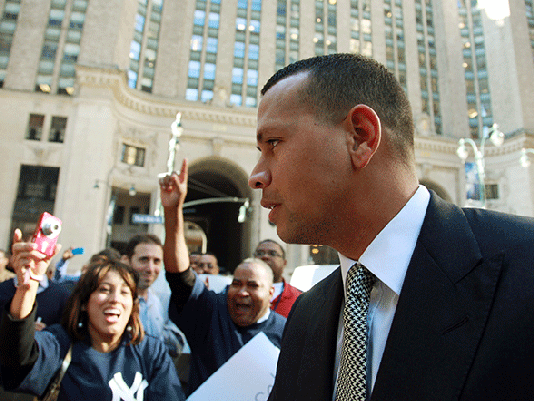
Head on over to New York Magazine and check out Steve Fishman’s takeout piece on Alex Rodriguez:
Since his character is part of the story, Rodriguez wanted me to talk to a character witness, and his choice was an odd one: Cynthia, his ex-wife. “You’re going to love her. She’s an amazing lady. I love her to pieces,” he said, “and she’s one of my best friends.”
Cynthia met me in a café in Coconut Grove and then a second time in the elegant though hardly ostentatious home she designed on Biscayne Bay. She’s not just toned but muscular, an attractive, petite blonde with smooth skin and piercing eyes and two bright diamond earrings. She met Rodriguez when he was 21 and she was 22. She wasn’t a sports fan. He told her he played baseball. “That’s great, but what do you really do?” she’d said. Cynthia is a traditional girl from a close-knit, religious family who lived a few blocks from her parents for a time—and she was a college graduate, which impressed Rodriguez. She’d earned a master’s degree in psychology and had practiced as a therapist.
She had every reason in the world to dislike Rodriguez. He’d humiliated her in the press; there were reports of Madonna and Rodriguez together shortly after the birth of their second child. But five years later—they divorced in 2008—she simply said, “I was disappointed.” She still esteems him. In the aftermath of the separation, he was generous and thoughtful. “He really made sure that everything was taken care of,” she told me. “It was a very nurturing process.” For her, that wasn’t an exception. “I saw something in him that I still see in him, and what I see is still very good.”
But she also sees damage. She spooled out the now-familiar story as to its causes. His father left the family when Alex was 10; he lived with his mother and lost touch with his father. The absence of a father made him the man of the house, big pressure for a teenager. “I was in a full sprint to make sure my mother never worked again,” he said.
Rodriguez’s success added to the emotional distortion. “Everything was about growing him as a baseball player,” Cynthia said. “He wasn’t learning anything but how to hit the fastball.
“What happens to everything else? It’s stunted, completely.” Without an authority figure, he listened willy-nilly to the advice of whoever was with him at the time.
“I used to say to Alex, ‘Don’t you just know what to do? Don’t you just have that voice in your head that tells you?’ He said, ‘No. I don’t.’ I think, looking back, he was probably uncomfortable with his place in the world.”
Later, when their marriage was crumbling, Cynthia thought a lot about Rodriguez’s issues. One day, she ran into Cal Ripken, one of his baseball heroes and a friend.
“What is it about Alex that I’m not seeing?” she asked Ripken. “What is it that I don’t get?”
“Cynthia, let me tell you the problem,” he said, and told her a story. “I might be wearing a suit, and Alex will see me and say, ‘Cal, I love your suit. Where did you get that suit?’ Then somebody else might walk in the locker room, and they have a completely different kind of suit on. And Alex might say, ‘Hey, I love your suit.’
“Cynthia, he tries to please everyone. That’s the problem.”
Rodriguez would often be charged with insincerity, but Cynthia didn’t see it that way. “He’s trying to say the right thing, trying to fit in. I would say immature, not insincere.”
[Photo Via: USA Today]

The Yanks have traded Chris Stewart to the Pirates for a player to be named later. Mike Axisa has the skinny.
Back-up catchers come and go and they tend to blur together in memory but Stewart was taut and hard–a prototype. Couldn’t hit but then again if he could he’d be a starting catcher. I enjoyed watching him work behind the plate. He has the GRRRRR that you want from a veteran catcher. Wish him well in Pittsburgh.
[Photo Credit: AP]