It turns out the Yankees are not obliged to sign a player just because he happens to be a free agent who would fill a need. They won 97 games last season, the most in the league, before their first-round playoff loss. They can give it another try with these players and go back on the market next winter, when the free-agent starters should be much more appealing.
Cole Hamels and Matt Cain, All-Stars younger than 30 with strong postseason pedigrees, are unsigned past this season. Either would make more sense for the Yankees, in the long term, than [C.J.] Wilson or the other top starters on this winter’s market.
…What they are doing is planning ahead, a strategy that fits Hal Steinbrenner much better than it ever did his impatient father, George. Incentives in the new collective bargaining agreement would essentially reward the Yankees for reducing their payroll to $189 million by 2014. By then, Burnett, Mariano Rivera, Rafael Soriano and Nick Swisher will be off the payroll, which has exceeded $200 million in each of the last four years.
At the moment, the Yankees owe just over $80 million to Sabathia, Alex Rodriguez, Mark Teixeira and Derek Jeter for 2014. That leaves a lot of room for marquee talent, some of which is already in pinstripes.
This is all so sensible, though it feels odd on some level, a George-less Yankee team, one that exercises caution. Part of me is waiting for someone there to stop making sense–another Soriano maybe? In the meantime, they are being very Dude-like about it. Go figure.
To be in the audience when James Brown commences the James Brown Show is to have felt oneself engulfed in a kind of feast of adoration and astonishment, a ritual invocation, one comparable, I’d imagine, to certain ceremonies known to the Mayan peoples, wherein a human person is radiantly costumed and then beheld in lieu of the appearance of a Sun God upon the Earth. For to see James Brown dance and sing, to see him lead his mighty band with the merest glances and tiny flickers of signal from his hands; to see him offer himself to his audience to be adored and enraptured and ravished; to watch him tremble and suffer as he tears his screams and moans of lust, glory and regret from his sweat-drenched body — and is, thereupon, in an act of seeming mercy, draped in the cape of his infirmity; to then see him recover and thrive — shrugging free of the cape — as he basks in the healing regard of an audience now melded into a single passionate body by the stroking and thrumming of his ceaseless cavalcade of impossibly danceable smash Number One hits, is not to see: It is to behold.
The James Brown Show is both an enactment — an unlikely conjuration in the present moment of an alternate reality, one that dissipates into the air and can never be recovered — and at the same time a re-enactment: the ritual celebration of an enshrined historical victory, a battle won long ago, against forces difficult to name — funklessness? — yet whose vanquishing seems to have been so utterly crucial that it requires incessant restaging in a triumphalist ceremony. The show exists on a continuum, the link between ebullient big-band “clown” jazz showmen like Cab Calloway and Louis Jordan and the pornographic parade of a full-bore Prince concert. It is a glimpse of another world, even if only one being routinely dwells there, and his name is James Brown. To have glimpsed him there, dwelling in his world, is a privilege. James Brown is not a statue, no. But the James Brown Show is a monument, one unveiled at select intervals.
Last year, we ran John Schulian’s terrific memoir series, “From Ali to Xena.” It was originally published in 50 parts. Now, here it is again, in three long segments for easy reading.
Last year I wrote a profile for Deadspin on the late George Kimball. It began as an interview for this site, conducted via e-mail, ostensibly to promote “At the Fights,” a boxing compilation George co-edited with John Schulian. Once I learned about what a fascinating life George had led, I decided to write a longer piece instead. However, I had five months worth of e-mail exchanges on my hand, George musing about his childhood and his career. I’ve compiled them here, and while the following in no way presents a complete portrait of his life, I think you will enjoy a little more Kimball.
Bronx Banter: Your father was a career military man and you grew up all over the world. Did you follow boxing at all as a kid?
George Kimball: Aha, so this is going to be one of those psychological-minded interviews. My wife Marge would like that. She’s a shrink and says I’m the least psychological-minded person she knows. Sure, I watched the fights on TV with my father (and with his father) from the mid 50s on. It was a revelation to me at the live readings we did on each coast last year for The Fighter Still Remains to learn how just many of the people involved in that book had initially come to boxing the same way, as a sort of connection to their fathers at a time when there might not have been much else that did connect them.
Beginning in late ’57, which is when we moved to Germany, I followed boxing quite avidly in the papers, or really, paper. (There was an English-language weekly called The Overseas Family that covered our high school games but not much on a global scale.) Stars and Stripes, on the other hand, was a daily that carried pretty extensive coverage of both the important professional bouts (Robinson’s and Patterson’s in particular) as well as the military ones that took place in Europe, which were considered a pretty big deal, particularly as we edged toward the ’60 Olympics, which were going to be in Rome. So I’d have certainly known who all the professional champions and most of the contenders were, as well as the top Europeans (like Laszlo Papp, for instance). I don’t recall that we attended any of the bouts on the bases where we were (my father was stationed at Bamberg and Bayreuth, and I went away to the American school in Nurnberg), none of which harbored any of the really promising service amateurs, but I monitored the progress of “our” boxers – the Army guys stationed elsewhere in Europe – as they all fell by the wayside on the road to Rome with one notable exception, Sgt. Eddie Crook, who wound up being one of three U.S. boxing gold medalists in Rome. (Cassius Clay and Skeeter McClure were the others.) I liked Clay even then, since he was from Louisville, my mother’s hometown.
I don’t know that I regarded it as crushing at the time, but the Rome Olympics actually coincided with our move back to the states. I watched a lot of the Games at the home of one grandparent or another as we spent a few weeks visiting both after having been out of the country for three years. I don’t know that I’d have been able to attend had we stayed in Europe even a few weeks longer, but I had gone to Rome the previous summer, so it wouldn’t have been out of the question.
I played football and basketball at Nurnberg, and ran track in the spring. Summers I played in an AYA baseball league made up of towns that had bases. The football away games were same-day trips, but in basketball every other weekend there’d be a road trip – like you’d play a game in Munich or Heidelberg on Friday night, stay overnight, and then play in Augsburg or Mannheim on Saturday afternoon and bus back to Nurnberg on Saturday night.
The Army also had a really top-flight league of post teams that played a regular schedule, mostly, I think, on Sunday afternoons. The teams were open to everybody stationed there, so what you wound up with at a relatively large post like Bamberg was virtually a college all-star team. Everybody used to turn out to watch the home games, and I watched a lot of those on weekends when I went home. (They even used to broadcast a game of the week on AFN.) Eddie Crook, by the way, was the quarterback for the Berlin team, which was all the more unusual because most of the guys in his huddle would have been officers. He was the first black quarterback I’d ever seen, at any level.
BB: What was it like following sports when you moved around so much?
GK: My father followed the NFL avidly, or at least he did after we came back to the states in 1960 when there was football on television every Sunday no matter where you lived. We were in San Antonio my senior year, and also got the AFL games on TV. My old man had played both football and baseball at UMass (when it was still Mass State) and followed both sports. I remember sitting up with a couple of my classmates in the dorm in Nurnberg, charting the Colts-Giants overtime game off the radio broadcast. That was pretty exciting even on the radio, believe it or not.
Even moving around, you maintained your allegiances. I was a Red Sox and Cardinals fan and religiously followed both teams, even though in some cases the news and box scores were two days old.
That year in San Antonio I was working for nights 75 cents an hour, first sacking groceries and then, once I got my license, delivering prescriptions for a pharmacy, and without telling anyone saved up enough to buy two tickets to the first AFL championship game in Houston. Once the tickets came in the mail I still had a problem, because Houston was three hours away and I needed the family car to drive there with my date. When I finally worked up the nerve to ask my father his solution was that sure, I could borrow his car – as long as he got to use the other ticket. So I ended up at Jeppesen Stadium in Houston watching that game with my father.
BB: Were you tight with your siblings?
GK: Probably less so than would have been the case with an average family, simply because of the circumstances in which I grew up. My brother Tim, who is just a year and a half younger, only spent one year at Nurnberg when I was going there, and apart from my senior year in Texas I really didn’t live year-round with my family after my freshman year in high school. I was quite a bit older – six years older than the next-closest sibling – and my youngest brother wasn’t even born until I was in my second year of college. The age gap tends to shrink with the passage of time, so I’m probably more in contact with, and closer to, most of them now than I was when we were growing up.
BB: Did you read any sports writers as a kid?
GK: I think one of the early sportswriters I read avidly must have been Earl Ruby, of the Louisville Courier Journal. I also came across a collection of Furman Bisher’s pretty early on. I was reading constantly, absolutely haunted the library, but probably didn’t read a hell of a lot of sports books per se, and wasn’t much exposed to the great ones unless they were already dead and collected, like maybe Grantland Rice or Ring Lardner. I couldn’t have been more than ten or eleven when I read a collection of Irvin S. Cobb that my mother owned. But I don’t think I even began to form an idea that great sports writing could also be great writing until I started to pay attention to Sports Illustrated, which would have been the fall of 1960. I don’t know that we ever saw SI in Germany.
BB: Sounds like sports played an important part of your childhood. What about the arts? Was their music in your house as a kid? Movies, radio? What about books?
GK: That was always pretty important to me. When we were in Bayreuth I used to go to the Wagner festival with my mother because my father hated opera. I think my parents liked musicals even as much as I did, so that was there from an early age. I played the trumpet for a while and liked a lot of jazz. My parents had some jazz records, but I was the one, at probably age 15, who brought Charlie Parker into the house, and who introduced them to Miles Davis, Gerry Mulligan, and Chet Baker. Of course I listened to early rock, as did my contemporaries. Everybody listened to that, but only a few of my contemporaries were as into jazz as I was, and the number that listened to Broadway musical scores was even smaller, so when I listened to Rogers and Hammerstein or Mario Lanza, a lot of times it was alone in my room. Didn’t listen to much radio at all, that I can remember, apart from in the car.
I pretty much lived in the library, even in Germany. I’d even take dates there. No matter what else I was doing I was probably reading at least a couple of books a week for almost as long as I can remember. Movies were important during the years I lived in Germany. The new films would eventually get there, so we didn’t feel cheated that they’d been out for a few months in the states, and I can’t remember whether they cost 15 cents or a quarter, but they were certainly affordable. We had one night a week in Nurnberg where you could sign out for an early film, and then on weekends I’d usually see one too.
BB: I know you are a fan of musicals. I think Kiss Me, Kate was the first long-playing record my dad ever bought—he was six or seven years older than you.
GK: I first saw Kiss Me, Kate performed at Garmisch-Partenkirchen, in the Alps, in 1959. Went with my mother because my father didn’t want to go. I think we had all of the early Rogers and Hammerstein cast recordings at the house when I was growing up – Carousel, Oklahoma, South Pacific and The King and I, and I eventually saw all of those done in New York, in London, in regional theatre, what have you. Even saw Kiss Me, Kate on Broadway about ten years ago. I think the Rogers and Hammerstein led me back to their earlier collaborators like Lorenz Hart and Jerome Kern and their spiritual descendants like Lerner and Loewe, or Frank Loesser. I think there was a definable Golden Age that began in the late ‘20s with Show Boat and ended probably fifty years ago which was marked by a greatness that’s never been achieved since, which is why I enjoy the revivals more than most new musicals. I saw the Lincoln Center South Pacific nine times in three years, I think (and a few weeks ago I took Danny Burstein to DiBella’s boxing card at B.B. King’s.). At their best there were others in this era like Cole Porter and Irving Berlin who could be great but I thought both inconsistent. Annie Get Your Gun, for instance, is brilliant (despite a notably dumb book), and right up there with the best of Rogers and Hammerstein, but Berlin wrote some shows I wouldn’t want to even sit through. I think the symbiosis of great lyricists and composers is what defined these. I love West Side Story, for instance, but never warmed to some of Bernstein’s film scores, and I think Sondheim did his best work on that one when he was a lyricist, period. I like some of his stuff, and hope to go see Danny and Bernadette Peters do Follies at the Kennedy Center in May, but I don’t see Sondheim as an heir to the tradition.
BB: What about Gilbert and Sullivan?
GK: Gilbert and Sullivan is an acquired taste I guess I never acquired. It’s cute, but I don’t think especially good musically, and it makes you work to get the lyrics, which isn’t the way it’s supposed to be. I don’t think I’ve ever walked around with a Gilbert and Sullivan song in my head, for instance, but with some of these other classics, especially Rogers and Hammerstein, it happens all the time. Some of the movie recordings of Rogers and Hammerstein were quite good even if the movies themselves weren’t. John Raitt was the original Billy in Carousel, around the time I was born, and I met him years later when I had dinner with him and Bonnie.
Fresh direct from the vault, here’s the original manuscript version of a story that Pat Jordan did for TV Guide in 1988.
The Horse Lovers
By Pat Jordan
Prologue
The movie is “Bluegrass,” a four-hour, CBS-TV mini-series. The actors are Cheryl Ladd, Brian Kerwin, Anthony Andrews, Mickey Rooney, and Wayne Rodgers. The setting is Lexington, Kentucky, Bluegrass Country, where thoroughbred racehorses are bred and trained on rolling pastureland that is zoned strictly for horse farms. The time is late fall. The grassland is turning brown. The leaves on the trees have faded from bright orange to the color of mud. The horses graze quietly in the pasture until another horse intrudes on their meal. They twitch, rear up, and gallop after the intruder, snorting out their hot breath into the damp, cold air. They curl back their lips, baring teeth, and nip the intruder on the flanks before slowing finally and then stopping to graze again.
The fictional plot concerns the efforts of Maude Sage Breen (Ladd) to fulfill her dream of breeding a Triple-Crown thoroughbred. She is thwarted at every turn by her ruthless neighbor, Lowell Shipleigh (Rodgers) and aided by her recovering alcoholic trainer, Dancy Cutler (Kerwin). It is Dancy who wins Maude’s love in a romantic joust with the mysterious Anglo-Irishman, Michael Fitzgerald (Andrews). What unites them all, however, hero, heroine, and villains alike, is that they are all horse lovers.
Scene One
A cold, blustery day at Crestwood Farms outside of Lexington, Ky. Brian Kerwin and Charles Cooper, a black actor from Cincinnati, are huddled in the equipment barn trying to keep warm while waiting for their cue from the Broodmare Barn up the hill where, today, history will be made. The birth of a foal will be filmed for national television. Kerwin and Cooper sip coffee from Styrofoam cups while speaking in hushed reverential tones as if they were expectant fathers in a hospital waiting room.
“Oh, shucks, Miss Scarlett,” says Kerwin, smiling, “I don’t know nuthin’ bout birthn’ horses.” Kerwin, with a veterinarian’s help off camera, is expected to aid in the birth of the foal. “They told me that if it’s a breech birth I have to reach up my hand into the mare and turn the foal’s head around,” he says. He shakes his head at the mystery of what he is about to partake in. Cooper tries to reassure him.
“I aided at my wife’s delivery of our son,” Cooper says. “It was a Caesarian birth. All I could do was stroke her forehead.” He flutters his long eyelashes. “It was a beautiful experience.”
Kerwin nods with admiration. Both men look down at the dirt floor, shuffle their feet. Kerwin begins to talk about the breeding sequence he was involved in filming a few days ago. He had to help a stallion insert his penis in a mare while the crew filmed the scene. “It was all very tastefully done,” He says. Cooper nods in perfect understanding.
Just then, a woman enters the barn. “It’s time,” she says to Kerwin. He crumples up his coffee cup and discards it in a trash barrel. Then he smoothes the sides of his reddish hair. His lean face is bruised and cut. Make-up applied today, after last night’s flight sequence staged at a roadside tavern.
Scene Two
Flashback to midnight of the night before. “Little Jim’s Tavern” out on Georgetown Road next to “The Slumber Inn Motel.” The dirt parking lot, which is usually crowded with rusted Chevys and battered pick-up trucks, is dominated this night by the huge vans of the film crew. Two police cars, their lights blinking, guard the road as if for intruders.
Inside, the small, cave-like, drinking man’s bar is strangely lighted by colorful neon signs that the crew has placed on the bar’s usually blank, concrete walls. The middle of the small room is dominated by three cameras and their crews and bright spotlights aimed toward a corner of the bar where the fight sequence will be staged. The actors are settling into their places for last minute instructions.
At the other end of the bar, in darkness, the bar’s regulars, farm hands, construction workers, and long-haul truck drivers, are loitering around, drinking beer and bourbon, smoking cigarettes, and shooting a few games of pool with Jimalou, the bar’s regular, plump, blonde waitress. “My father owns this place,” she says, as she leans over the pool table and sights the eight ball. “He always wanted a boy.”
Bonnie, the regular barmaid, is pouring drinks for the regulars as she is expected to do for the actors when the scene begins. Bonnie has short, dark hair, lots of blue eye-make-up, and she talks out of the side of her mouth, just as one would expect a barmaid in a roadside tavern to talk. Bonnie is a barmaid. Tough, funny, caustic.
“What’s the difference between being a barmaid and playing a barmaid?” she says. “Simple. I get it right the first time.”
“Bonnie’s the reason we come her,” says Marshall, a regular. “She makes us feel at home.”
“Sure does,” says D.B., tilting back his cowboy hat. “Abuses us just like our wives.” Everyone laughs out loud. One of the film crew looks back at the laughing regulars as if they were misbehaving third graders. He is a very short, bald, finicky-looking man with a red beard. He puts his hands on his hips.
“Quiet, puhleeeze!” he says. Then he turns toward a man who is smoking a cigar. “An no cigar smoke in here,” he adds.
“You’re kidding?” says the man. “In a bar?”
“No cigar smoke in this bar!” says the red-bearded man. Just then one of the crew turns on the smoke machine. Smoke billows into the bar until visibility is zero. Bonnie fakes a few coughs and flaps her hands at the smoke.
“It’s never been this smoky in here,” she says.
“And we never had a fight in here·, either,” adds Jimalou.
The second assistant director, a woman, begins to wave her clipboard wildly in the smoke to get the extras’ attention. “Everyone, everyone, to their places, please!” she calls out. “Have we had everyone?”
by Bruce Markusen |
January 2, 2012 11:03 am |
6 Comments
The Yankees made two low-profile roster moves last week, but both were good transactions. First, they signed ex-Red Sock Hideki Okajima to a non-guaranteed contract, giving him a chance to make the team with a good spring training performance. Then the Yankees re-signed Andruw Jones, their most effective bench player in 2011.
At one time, Okajima was one of the American League’s most effective left-handed pitchers. He was also one of the most fun to watch, given the way that his head bobbed toward third base, a particularly distracting trait for many hitters. Okajima spent most of last year at Triple-A Pawtucket, but is only two years removed from being a key member of the Red Sox’ bullpen. For his career, he has held left-handed batters to a .217 batting average and a .277 on-base percentage. He also has no fear of American League East pennant races, having done regular battles against the Yankees and the Rays over the span of three summers.
With a good spring, Okajima could beat out Boone Logan, who was wildly inconsistent against lefty batters in 2011. Or there’s a possibility that the Yankees could carry Okajima as a second southpaw reliever. As it is, the Yankee staff is far too right-handed, with CC Sabathia providing the only certainty from the left side. Another left-hander, provided that he is effective, would be a nice bonus for Girardi to call on in sixth and seventh inning situations.
Now on to Jones, a familiar face from 2011. He did quietly good work in a supporting role last season. After a so-so first half, Jones finished up the season on a strong note, establishing himself as a right-handed hammer. In 146 plate appearances against left-handers, Jones reached base 38 per cent of the time and slugged to the tune of .540. Those are Marcus Thames numbers. Jones is an ideal fourth outfielder who can handle either corner position, and can also play center field in the event that both Curtis Granderson and Brett Gardner go down. If anything, I’d like to see Jones play more in 2012. Whenever the Yankees see a left-hander, Joe Girardi should find a place for Jones in the lineup, whether it’s in left field, right field, or as the DH…
***
We are one week away from the Hall of Fame vote being conducted by the Baseball Writers’ Association of America. The ballot contains five names that I personally regard as Hall of Famers, but only one man is likely to emerge with the 75 per cent vote needed for election.
Here are the four players likely to receive the most support in next week’s election:
Barry Larkin:
Of all the players, he has the best chance to win election from the Baseball Writers. He received 62 per cent of the vote last year and would need a jump of 13 per cent, which is not without precedent. Like George Brett, Larkin’s frequent injuries were a factor against him, but not enough to dethrone him as the best all-round shortstop of the 1990s. His power (198 home runs) and his basestealing numbers (379 steals, only 77 caught stealing) really jump out, especially coming from a shortstop. I remember him as a very good player, but the numbers show him to be a great one. Prediction: He’ll receive 78 per cent of the vote and join Ron Santo in the Class of 2012.
Jack Morris:
After Larkin, he has the most favorable odds of earning the required 75 per cent. He received 51 per cent last year, so he will need a huge jump in the balloting. His supporters point to him as the best starting pitcher of the 1980s and cite his standout work in the 1991 postseason. His detractors emphasize his 3.90 career ERA, which would rank the highest of any pitcher in the Hall of Fame. Prediction: He’ll receive about 64 per cent support, well short of election.
Jeff Bagwell:
His lack of voting support in 2011 (41 per cent) was astounding. Rumors of steroid use may have been a factor, but Bagwell never failed a drug test and was not mentioned in the Mitchell Report. MLB Network analyst Peter Gammons, whose opinion I respect greatly, recently rated Bagwell as the fourth best first basemen in history, behind only Lou Gehrig, Jimmie Foxx, and Albert Pujols. That’s good enough for me, but it doesn’t appear that it will be good enough for the voters. Prediction: He’ll receive just over 50 per cent support.
Tim Raines:
Like Bagwell, his lack of support from the writers has been astonishing. He’s the second best leadoff man of all-time, behind only Rickey Henderson, a supposition that should indicate his worth for the Hall of Fame. And as a bonus, he earned a couple of World Series rings as a part-time player with the Yankees, where he filled in as a left fielder, DH, and clubhouse leader. Prediction: He’ll jump from 37 to 41 per cent, leaving him alarmingly short of election. The lack of support makes little sense to me; he’s a far stronger candidate than Jack Morris, among others.
***
There are celebrities among baseball writers, people like Bill James and Rob Neyer and Bill Madden. And then there are footsoldiers, people who do the research and leave the glory of the written word to other people. Greg Spira was one of those people.
Greg was regarded as one of the best researchers and editors in the baseball world. He wrote occasionally, but it was research and large research projects that really drove him. He did a lot of work related to the Mets, frequently collaborating with a friend of mine, Matt Silverman. They worked on many projects together, trying to come up with stories and statistics that people would be interested in reading and hearing. Greg also served as the editor of ESPN’s Baseball Encyclopedia, a book that was a particular source of pride for him.
There was pride, but little ego. Some of Greg’s friends tried to get him to write more often, but I don’t think he had the ego for that. He just wanted to do the research, and make it available for other people to study, and enjoy.
Greg Spira died last week at the age of 44. He had a difficult history of health problems, dating all the way back to the 1990s. His kidneys and his heart finally gave out on him, even though his mind had plenty of baseball left in it.
I don’t know why we keep losing these writers and researchers at young ages. There was Doug Pappas of Baseball Prospectus, John Brattain of The Hardball Times, and, of course, the beloved Todd Drew of Bronx Banter. I guess that all I can make of it is this: we must do what we can each day, not knowing exactly what might happen next.
Keep researching. Keep writing. Keep loving the game. Do it every day until it’s time to stop.
2012, Day One gives big NFL action. Gives hanging with the one(s) you love, perhaps nursing a hangover. Gives the need for good food and just coolin’ out. And, of course, gives good tunes.
”You need to use your brain to pitch effectively in the big leagues,” explained the future Hall of Famer. “You can’t go out there and do exactly what you want to do without a brain. As you get older, you mature and put your knowledge to work, It’s like when you go to school for the first time. In first grade, you’re not going to know what you know in the sixth or seventh grade. Pitching is just the same. If you don’t learn, you won’t have the success that you could have. I‘ve learned a lot over the years.”
Larry Rothschild, the Yankees’ pitching coach, agrees.
“Mariano is incredibly smart,” said Rothschild. “He’s also obviously incredibly gifted and has a great knack for trusting his ability. That’s why he attacks the strike zone like he does. He has a pitch that, if he throws it right, is going to get any hitter out, at any time. He knows that, and just as importantly, he knows how to pitch. There is the term, ‘he gets it,’ and Mariano gets it. Totally.”
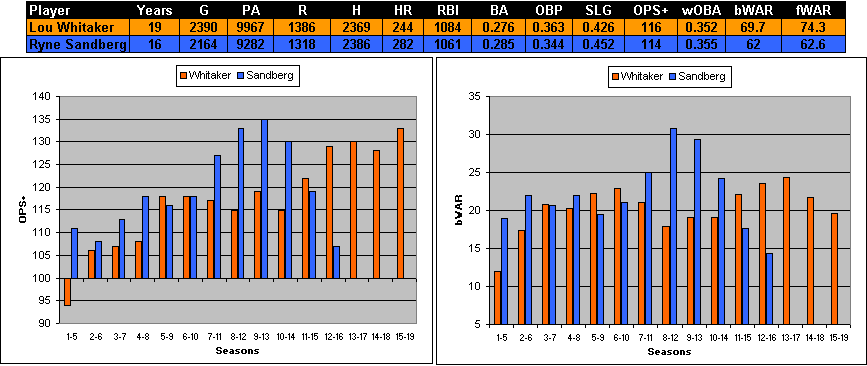
Is Lou Whitaker a Hall of Famer? The case is very compelling, especially when compared to Hall of Fame contemporary Ryne Sandberg. Unfortunately, consideration of that question came to an abrupt end when an inexplicable lack of support from the BBWAA resulted in his name being dropped from the ballot after his first year of eligibility.
Lou Whitaker vs. Ryne Sandberg, Career Numbers and Five-Year Comparisons (click to enlarge) Source: baseball-reference.com and fangraphs.com
Unless the Hall of Fame decides to reinstate Whitaker, the only hope for the Tigers’ second baseman will come from the Veteran’s committee. And, that’s probably just as well. In 1980, Ron Santo was dropped from the ballot in his first year of eligibility, and reinstatement did little to help his chances at enshrinement. From 1985 to 1998, the BBWAA continued to pass over Santo, and then the Veterans’ committee upheld the snub for 12 more years until his posthumous selection in November.
With Santo’s pending enshrinement, Whitaker may now be the best player not in the Hall of Fame (excluding those players who have fallen under the cloud of steroid vigilantism). However, my objective isn’t to regurgitate the same argument that has been made so convincingly by many others. After all, considering the case of Santo, there will likely be plenty of time to debate Whitaker’s Hall of Fame credentials. Rather, what interests me most about the Tigers’ second baseman is not the overall value of his career, but how strongly, and quietly, it ended.
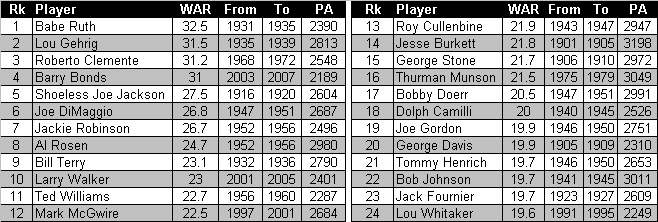
In terms of OPS+, Lou Whitaker’s last five seasons were his best. Although other spans yielded a higher cumulative WAR, it should be noted that his last two years were shortened because of the strike that ended the 1994 season and an injury that may have been related to the abrupt beginning to the 1995 season. Regardless, in the last five seasons of his career, he compiled a WAR of 19.6, which ranks as the 24th highest total by any position player since 1901. By removing the Hall of Famers from that list, Whitaker moves all the way up to 13th, and three players (Barry Bonds, Shoeless Joe Jackson, and Mark McGwire) ahead of him would likely have been enshrined if not for off field allegations of impropriety.
Most WAR Compiled in a Position Player’s Final Five Years (click to enlarge) Source: baseball-reference.com
So, if he was still playing well, why did Whitaker decide to retire? Interestingly, for a player of his stature, there is very little information available to answer that question. Following the 1995 season, the Tigers declined to offer arbitration to Whitaker and long-time double play partner Alan Trammell, so both men filed for free agency. Trammell eventually signed a one-year deal with Detroit, but Whitaker seemed to fade into oblivion. A search of the Google newspaper archive revealed one article in which Whitaker mentions that he would use the offseason to contemplate retirement, but an official announcement was never made.
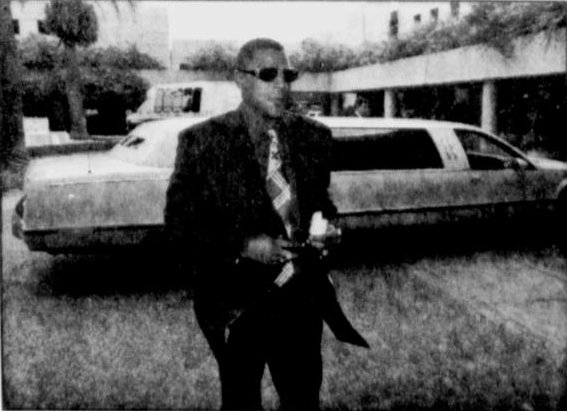
In 1994, amid the MLBPA strike, Lou Whitaker caused a stir by showing up for a union meeting in a flashy suit and white stretch limo. The media immediately seized upon the image, but Whitaker didn’t back down. “I’m rich. I make money,” Whitaker told the assembled reporters. “I got a Rolls Royce, limo, big house. What’s going to make me look bad?” Because of those statements, Whitaker was portrayed by some as being out of touch, and others cited his attitude as a reason why interest in baseball was in decline. Considering this sentiment, maybe it isn’t such as surprise that Whitaker retired in relative anonymity? And, maybe some of that resentment carried over five years later when Whitaker’s name first appeared on the Hall of Fame ballot?
Was this the lasting image of Whitaker soon after his retirement? (Photo: AP)
Who knows why Whitaker’s Hall of Fame candidacy has gotten so little support. Because he walked away near the top of his game, you’d expect the lasting impression of his career to be more positive, but perhaps the images of that white limo erased some of the memories about his Gold Gloves and Silver Sluggers? Whatever the reason, hopefully the Hall of Fame will reconsider its treatment of Whitaker so the second baseman can add a plaque in Cooperstown to his already impressive list of worldly possessions.
Brownstein doesn’t see the contradictions in her work that other people do. Her sexy, roiling presence onstage is one side of her, her wry social portraits on “Portlandia” represent another side, and neither has much in common with her modest, cerebral, nonperforming self. Brownstein said that when playing rock music she’s always conscious that she’s performing; she remains fully in control, no matter how chaotic it looks. “Onstage, I can stop on a dime,” she said. Lately, the “Portlandia” characters had “been seeming more akin to who I really am,” she added. “Or maybe it’s just a safer place for me to go. With music, I get to a much darker place. Where I’m able to go with ‘Portlandia’ has a wider range, but also a brighter range.” Ideally, she’d like to keep her music side and her comedy side separate; she doesn’t really want people to be thinking about her onscreen goofiness when she’s tearing it up with Wild Flag.
Touring with the band kept her away from Portland for most of October and November. But she went home for Thanksgiving, to see her dogs, to take long walks in the mossy, gray-green woods, and to see [Fred] Armisen, who flew in from New York, where he’d been filming “Saturday Night Live.” I e-mailed Brownstein to ask how her holiday had gone. She recalled stopping at a dog park with Armisen. Because it was the real Portland, “the weather was horrible—rainy, windy, cold.” She wrote, “I told Fred he could stay in the car. But he insisted on joining me out on the wet, muddy grass, tolerating not only the elements but a typical dog-park lady who overshared about her pair of jacket-clad whippets. When I saw Fred bundled up in his parka, wearing his brand-new R.E.I. hiking boots, I felt so happy and lucky; there are very few people for whom Fred—a classic New Yorker, not a nature guy at all—would brave the outdoors.
“The dinner itself was spent with the Goldfarbs, a family I’ve sort of adopted as my own; I spend all my holidays at their house. In the decade that I’ve known them, even when I’ve been dating someone, I never bring anyone over. I prefer to keep things separate; perhaps I’m bad at sharing the scant amount of family that I do have, or fearful of giving someone a glimpse of the few people who really know me. But Fred is someone whom I deeply trust, he’s already an extension of what I’d call family.
“We drove home late and I dropped him off at his hotel. Sometimes I get confused and think, Are we supposed to kiss goodnight? But, the truth is, I don’t want us to kiss, I want us to teach each other how good it can be to stick around.”
Here’s something to keep you warm on a cold winter day, the late George Kimball’s essay from our book “Lasting Yankee Stadium Memories.” It’s all about the old ballpark, Billy Martin, finks and phonies, brawling, and, of course, drinking with Bill Lee.
By George Kimball
There are things you learned about the old Yankee Stadium once it became your place of work that never would have occurred to you as a kid going to watch a game there. Making your way from the visiting- to the home-team dugout, or to the pressroom where they fed us and the adjacent quarters where we wrote our stories after games, involved negotiating an elaborate system of labyrinthine tunnels that could have been a large-scale Skinner box. A dim-witted scribe could spend hours trying to find his way around down there, but once he did figure it out, he’d be rewarded with supper, or maybe a beer after the game.
And since we only made two or three trips a year to New York, we were always making wrong turns, ones that inevitably brought us face-to-face with one of New York’s finest on a security detail. Some of the cops had been drawing this plum assignment for years. Others, newer to the job, couldn’t tell you how to get from A to B any better than another sportswriter could. They should have handed out road maps with the press credentials.
But the overriding memory of all those hours spent wandering around beneath the House That Ruth Built remains the smell. If you grew up in suburbia, it wouldn’t have meant much to you at all, but if you’d spent much time in a big-city tenement or in the stockroom of a grocery store or ever wandered beneath street level in a restaurant that abuts a subway line, the permeating odor of Decon, the rat poison, would have been familiar.
My friend, John Schulian, must have recognized that smell too, because at some point in the late 1970s, he came up with a description of Billy Martin so apt that it should have been chiseled on Billy’s gravestone: A rat studying to be a mouse.
The funny part of it was that, while Martin had carefully cultivated an image of a guy ready to fight at the drop of a hat, he wasn’t actually very good at it. If you look at the fights he won, they were usually against marshmallow salesmen or mental cripples (Jimmy Piersall was just months away from the loony bin when Martin beat him up under the stands at Fenway in 1952) or a guy who was even drunker than he was (Dave Boswell at the Lindell AC in 1969). Sometimes he’d gain the advantage with a well-timed sucker punch, and sometimes he’d just think he had the advantage, as was the case in St. Louis in 1953, when he picked a fight with a short guy wearing glasses. (The guy, Clint “Scrap-Iron” Courtney, turned out to run against stereotype.)
If you watched him carefully over the years, he was careful to pick his spots. When Martin went at it with somebody bigger or tougher than he was, it was usually in a setting where he knew it would get broken up right away. In fair fights—and there weren’t many of them—he almost always got his ass kicked. (See: Martin vs. Ed Whitson at the Cross Keys Inn, Baltimore, 1985.)
I’d been at Yankee Stadium the night Thad Tillotson bounced a pitch off Joe Foy’s helmet in 1967. “Watch this,” I told my then-wife when Tillotson came to bat a couple of innings later. Sure enough, Jim Lonborg drilled him in the back, both benches emptied, and when they finally pulled them apart, there were Joe Pepitone and Rico Petrocelli rolling around in the dirt.
I was also at Fenway Park the day in 1973 when Stick Michael missed a bunt on a suicide squeeze. With Thurman Munson barreling in from third toward Carlton Fisk, whom he didn’t like much anyway, the result was somewhat predictable. Both benches emptied after the collision, and even as they dragged Munson away, Fisk and Michael were going at it. Boston lefty Bill “Spaceman” Lee said the whole thing looked like a bunch of hookers swinging their purses at each other. Everyone save Thurman Munson thought that was pretty funny.
So, by the time Billy Martin came back to manage his old team, Red Sox–Yankee rhubarbs were nothing new. Their history long predated the return of Number One. I’d seen them start for good reasons and for bad reasons, and sometimes they’d started just because they were Yankees and Red Sox. So, when another one broke out on May 20, 1976, I wasn’t surprised. You could see this one coming a mile down the road. It was like watching a fight develop in slow motion.
Lee had a 1–0 lead with two out in the bottom of the sixth. Lou Piniella, at second, represented the tying run; Graig Nettles was on first. With the count 2–1 on Otto Velez, Spaceman threw a sinker on the outside of the plate, and Velez stroked it into the opposite field. It was hit so hard that when Dwight Evans grabbed it on one hop, it briefly crossed my mind that he might even have a play on Nettles at second. That’s when I looked down and saw Piniella rounding third, and he didn’t seem to be slowing down.
Evans may have had the best arm in the American League back then, and not even a good base runner would have challenged him in this situation, but Piniella was, at this point, committed and kept on coming. Evans threw in one fluid motion, a strike to the plate, and had him by at least ten feet. If it had somehow been a closer play, maybe what happened next wouldn’t have happened at all, but now it was inevitable. Out by a mile, Piniella’s only chance was to run right over Fisk, barreling into him so hard that he might dislodge the ball. Fisk, aware of this, was determined to make the experience painful enough that Lou would think twice before he ever tried it again.
As tags go, it was pretty aggressive. Fisk may even have tried to tag him in the nuts—and with his fist, not his glove, holding the ball. Naturally, Lou came up swinging, and in what seemed barely an instant, there were fifty or sixty guys in uniform going at it in the middle of the infield. Or that’s the way it seemed. Actually, some of them took a bit longer getting there than others. Traditional baseball protocol in these situations calls for the occupants of both bullpens, even the ones intent on serving as peacemakers, to make a mad dash all the way to the infield, where they are to then grab one of their opposite numbers and wrestle for a while until the smoke clears.
Logic would suggest that it would be a lot simpler to just pair off out in the bullpen, particularly since, in its new configuration, Yankee Stadium’s bullpens shared a common gate. So, when the fight started, everybody from both bullpens jumped up simultaneously to race in to where the action was. Tom House, then a Boston reliever, told me that when he got to the gate, Catfish Hunter was gallantly holding it open for him.
“See ya in there, kid,” said Catfish as House trotted past.
Fisk and Piniella were rolling around on the ground following the collision when Lee, who’d been backing up the plate on the play, spotted Velez trying to be third man in.
The first guy to hit Lee was actually Mickey Rivers, who must have been taking boxing lessons from Billy Martin. Mick was running up and down behind the scrum, looking like a guy playing Whack-A-Mole as he lashed out at the back of every Boston cap he could spot. (Somebody watching on television later told me that Ken Harrelson, in his blow-by-blow call on a Boston station, said “Rivers is just basically just running around sucker-punching everybody!”)
The next thing I saw was Nettles grabbing Spaceman from behind, seemingly lifting him over his head, and body-slamming him. I don’t know for a fact that he was trying to throw Lee on his left shoulder, but that’s how he landed. (Nettles claimed later that he was just trying to drag Lee off Velez, since Rivers’ punch hadn’t done the job.) Lee was 6-foot-3 and 210 pounds, almost the exact dimensions of Muhammad Ali, but truth be told, he couldn’t fight any better than Billy Martin could, even though he did have an impressive one-punch KO on his résumé.
That had occurred in a winter league game down in Mayaguez, Puerto Rico, several years earlier. When Eliseo Rodriguez charged the mound, Lee reflexively stuck his hand out in self-defense and, to his own surprise, knocked Rodriguez cold. Only when he read the next morning’s papers did he realize that he’d knocked out the island’s former Golden Gloves light-heavyweight champion.
The return bout took place in Caguas a week later. Rodriguez and two of his relatives were waiting when Spaceman got off the team bus. They beat him up and rammed his face into a light pole for good measure.
“I did get a nice new set of teeth out of the deal,” said Spaceman.
With Lee now apparently out of commission, Fisk and Piniella separated and Rivers dragged away by several Yankees, things seemed to calm down in a hurry. That’s when Lee made the mistake of getting up.
In his college days at USC, Bill had played summer ball for the Alaska Goldpanners with Nettles’ brother. Until a few moments earlier, he had considered Graig a friend. Now, he was screaming incomprehensibly as he staggered toward the New York third baseman.
“I think,” Lee said later, “it might have been the word ‘asshole’ that set him off.”
In Nettles’ defense, what he probably saw was just a crazy man charging at him. In any case, when Lee got close enough, Nettles cut loose with a right cross, and when Lee tried to block it with his left, he discovered that he couldn’t lift his arm above his waist. The punch caught Spaceman flush in the face and dropped him in his tracks.
A few months later, Ali and Ken Norton fought in almost exactly the same spot, and in fifteen rounds neither one of them landed a punch as hard as that one.
Oddly, I don’t remember Billy Martin throwing a single punch in that brawl. Maybe he found Don Zimmer and the two of them sat it out.
Once order was restored, both Nettles and Lee were ejected. (Neither Fisk nor Piniella were.) In Lee’s case, it was somewhat moot. Before the Red Sox finished batting in the next inning, he was on his way to the hospital.
He would later describe the episode by saying “I was attacked by Billy Martin’s brown shirts.”
There was clearly no love lost between the dope-smoking Spaceman and the whiskey-swilling Fiery Genius. There were unconfirmed rumors, before and since, that Martin had personally placed a bounty on Lee, but there were enough Yankees players who intensely disliked Lee that they probably didn’t need any encouragement from Billy Martin.
Obviously, the fight hadn’t been started just to get at him, said Lee, “but once it did start, it sure seemed like there were a lot of guys in pinstripes trying to find me.”
It might be noted here that, going into that game, Lee ranked as the number three Yankee-killer of all time, with a lifetime percentage against the Bronx Bombers bettered only by those of Babe Ruth and Dickie Kerr. Ruth, of course, had stopped pitching even before Harry Frazee sold his contract to Colonel Ruppert, and Kerr, pointed out Lee, may have accomplished the greatest pitching feat of all time—winning two games in the 1919 World Series with five guys playing behind him who were trying to lose.
Bill Lee’s career didn’t end that night, but it’s fair to say he was never the same pitcher again. He had won seventeen games in each of the previous three years, but he never won as many in a season again. He had torn ligaments and a separated left shoulder, and nearly two months would go by before he pitched again. Between 1973 and 1975 Lee had thrown fifty-one complete games. In 1976 he would throw just one.
Nobody knew this that night at that ballpark, of course. All we knew was that Lee had been taken away in an ambulance, but when the team bus pulled up in front of the New York Sheraton an hour and a half after the last out, there was Spaceman, waiting in the lobby.
Since I was then writing for a weekly and didn’t face a postgame deadline, Lee and I had earlier made plans to terrorize a saloon or two in Greenwich Village that night, and now, with his arm and a sling and sporting a black eye, he was determined to keep the appointment.
“Come on,” he said. “We’re still going to the Lion’s Head, aren’t we?”
Stan Williams, the Red Sox’s pitching coach, had other ideas. “Come on, big boy,” he said to Lee as he grabbed his good arm. “No curfew for you tonight.”
So, with Stanley as our tour guide, we went bouncing on the Upper East Side. I vaguely remember visiting a gin mill with a hospital motif—the ER? the Recovery Room?—where the waitresses were all dressed like nurses, or dressed like nurses wearing white miniskirts, anyway.
Either the sight of a bona fide patient had scared all the nurses away or we’d moved on to another joint. Thirty-three years later, all I can swear to is that, a bit after 3 AM, we were the last three customers in the bar, and Lee had been chasing shots of VO with the Demerol they’d given him in the real hospital, or maybe it was the other way around, but anyway, just then the saloon door swings open and who comes walking in but—think about the odds of this for a moment—Lou Piniella, all by himself.
As soon as he saw us he was all over Lee like a long-lost brother: “Gee, Bill, I’m so sorry. If I’d ever known this was going to happen . . .” I think tears may even have welled up in his eyes. And, of course, he bought us all a drink, and then another one.
The sun was coming up by the time we left, Sweet Lou in one direction, and Bill, Stan, and I back to the hotel. In the cab, I remarked to Lee that Piniella was a pretty nice guy after all, and that he had seemed properly contrite over the outcome of the affair he’d initiated at home plate that night.
“What else was he going to say?” Spaceman sighed wearily.
“There were three of us and one of him.”
Out on an early morning foraging run, a solitary rat darted across the sidewalk. We all saw him, but nobody said a word.