Word has it that the Yanks’ bid for Yu Darvish fell short.

Moving on…




Over at SI.com, here’s Richard Deitsch on the man people love to hate and sometimes hate to love:
As the Broncos beat reporter for the Denver Post, Lindsay Jones admits her job description has become “all Tim Tebow, all the time.” But over the past two months, Jones has noticed that the Tebow phenomenon has filtered outside her city limits. As she’s traveled to cover the Broncos on the road, the reporter says the lead feature in Sunday sports sections is often the Denver quarterback, and that Tebow is a recurring and vibrant subject on the sports-talk debate airwaves as well.
Clearly, the Broncos quarterback is moving the sports needle nationally. But by how much, and who else is doing likewise? To get an answer we sought advice from a number of sources, including those in sports marketing, television and research.
Perhaps the most remarkable finding is that Tebow now rates alongside such celebrities as Jennifer Aniston, Lady Gaga, Tom Hanks, Will Smith and Taylor Swift when it comes to aspiration (the degree to which consumers feel a celebrity has a life to which they would aspire) and influence (the degree to which consumers believe a celebrity is an influence in today’s world).
[Photo Credit: Robert Swetz]

Here’s a review of a new book about photography and jazz.




You can buy “Blue Notes in Black and White: Photography and Jazz,” by Benjamin Cawthra (University of Chicago Press), here.
[Pictures by Dennis Stock, Herman Leonard, William Claxton, Roy DeCarava, and Gjon Mili]

Rest in Peace, Christopher Hitchens, a prolific and gifted critic. He was a worker.
[Photo Credit: Gasper Tringale]

In “Hannah and her Sisters,” Woody Allen goes to the Metro movie theater on Broadway and watches “Duck Soup,” the Marx Brothers’ finest movie and it restores his faith in life. I wasn’t have any kind of life crisis last night, there was just nothing on TV that interested me, so I put on “Animal Crackers,” the Marx Brothers’ second movie. It was released in 1930 and based on the stage play of the same name.
I hadn’t watched it in a few years and I laughed a lot. Pressed pause and said to the wife, “Look at Harpo, watch this, watch this,” and then laughed some more.
Later, she looked up from her book and said, “Wait, so that’s where you got that line from?”
Yup.
Watching the Marx Brothers makes life better.

Trying to maintain low expectations about the Yu Darvish bidding, I wondered what the Yankees could do with all that money when they don’t get him. It would be nice to get both Cespedes and Soler in the system as the Yankee outfield gets very thin very fast after this year.
Perhaps because I’m in the process of finding presents for the extended family and because there’s a lot of talk around the coffee machine this morning about the Mets terrible financial situation, I thought about how the Yankees could help their fellow New Yorkers.
The Mets need money. How much? More. When? Yesterday. So here is a Christmas gift to the Mets: $22,000,000.00. The Yankees trade A.J. Burnett straight up for Johan Santana.
The Yankees rid themselves of the annual Burnett headache. By ERA, Burnett was the second worst starting pitcher in baseball since 2010. But ERA can be misleading. Don’t worry though, by FIP, he was the third worst.
Johan Santana from one point of view, was even worse than Burnett. Santana broke down in 2009 and then again in 2010 and didn’t pitch at all in 2011. And he’s coming off surgery to repair the anterior capsule of his left shoulder – one of the nastiest surgeries a pitcher can undergo. His level of performance for the rest of his contract, the same gauranteed length as Burnett, is a total mystery.
In this deal, the Yankees would give the Mets the gift of 22 million dollars (Santana’s gauranteed $55 million over the next two year and while A.J. Burnett will get $33 million over the same time span) and a reliable innings eater (reliably bad, but hey, count that money again) for the gamble that Johan Santana can bounce back into something special, or at least into a shadow of something special.
I have no idea if Santana will be any good as he tries to come back. But if he gets on the mound and he’s among the worst pitchers in baseball next year, he can only be two or three rungs below where A.J. Burnett has taken up residence.
I know there are better ways to spend $22 million than on a roll of the dice on Johan Santana’s recovery. If you can’t believe in a little magic during the holiday season though, when can you?
UPDATE: A report has the Toronto Blue Jays with the winning bid for Darvish.

When Albert Pujols decided to break his 11-year bond with the St. Louis Cardinals, there was much lament expressed about the perceived gradual decline in one-team, or legacy, players. Upon closer inspection, however, it appears as the practice of playing a long career in only one uniform has never really been that prevalent, which makes this rare breed all the more special.
Legacy Players by Franchise

Note: Based on a minimum of 10 seasons and 4,000 plate appearances with one team for positions players, and 10 seasons for pitchers. Year of retirement is used as basis for enumeration.
Source: Baseball-reference.com
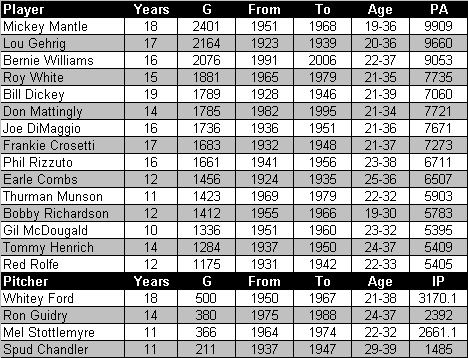
As illustrated by the chart above, the Yankees have had more legacy players than any other team. Beginning with Lou Gehrig and continuing on to current players like Mariano Rivera, Derek Jeter, and Jorge Posada, the Yankees have featured a litany of Hall of Fame players who never suited up for another team. This royal line of all-time greats has not only helped the Bronx Bombers compile one of the most impressive records of success in all of sports, but also created a rich history that has become an integral component of the Yankees’ brand.
Legacy Yankees
Source:Baseball-reference.com
The Yankees have had 19 “franchise players” (which could grow to 22 if the three aforementioned members of the core four retire in pinstripes), including several who are considered to be among the very best players in the history of the game. In comparison, the bottom-15 teams on the legacy chart (including six teams that do not have any) only have 16 such players combined. Despite this stark contrast, many teams do boast at least one prominent franchise player. Lists containing each team’s most tenured legacy position player and pitcher are presented below.
Leading Legacy Position Players and Pitchers, by Franchise
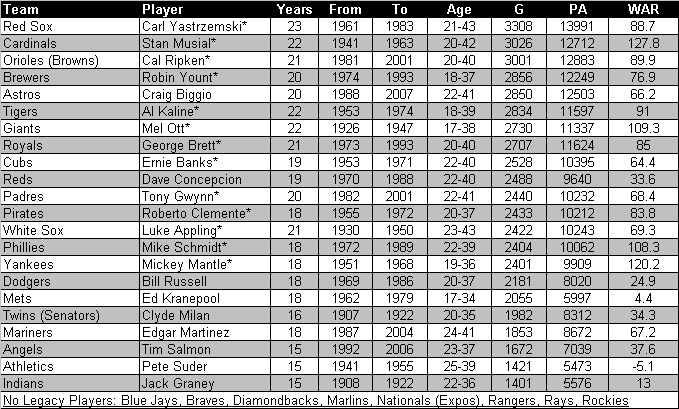

Note: Listed players lead their respective franchises in games played with only one team. * Denotes a Hall of Famer.
Source:Baseball-reference.com
Not surprisingly, many of the players included on the lists above are in the Hall of Fame. Among the position players, 60% are enshrined in Cooperstown, while 35% of the pitchers (and 55% of the starters) have a plaque hanging in the Hall’s gallery. Although most of the players, even those not in the Hall, are household names, there are also some who are rather obscure. None, however, were as futile as Pete Suder, who not only ranks as the Athletics’ all-time games leader among legacy players, but managed to post a negative WAR despite being afforded such longevity.
Stan Musial, Carl Yastrzemski, and Cal Ripken all made much better use of their opportunities than Suder. That trio comprises a select fraternity of players who appeared in over 3,000 games, all for one team. Meanwhile, Walter Johnson’s 935 games with the Senators easily outdistances all other legacy pitchers. However, it should be noted that when Mariano Rivera retires (assuming he ever does), his 1,042 games (and counting) would easily surpass the Big Train, although Johnson would retain the title among starters.
Potential Legacy Players
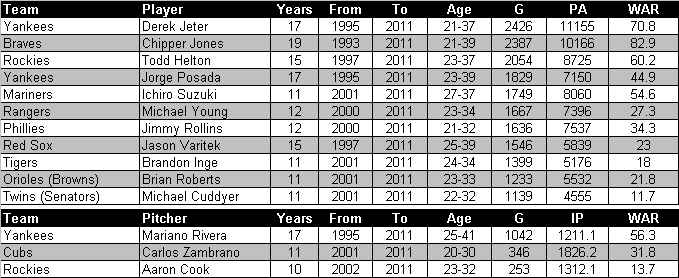
Note: Includes those players who meet the criteria outlined in the exhibits above, but who have not yet retired.
Source: Baseball-reference.com
Other current players creeping up on the list of legacy leaders include Chipper Jones, who could become the first Braves’ position player to spend at least 10 seasons and 4,000 plate appearances with the franchise. Similarly, Carlos Zambrano, Aaron Cook, Michael Young and Todd Helton could also become their franchise’s first legacy player/player, assuming they don’t sign with another team before retiring. Finally, Derek Jeter and Ichiro Suzuki are also in line to join the list by overtaking Mantle and Edgar Martinez, respectively, for their team’s leadership position.
How important is it for a player to spend his entire career with one team? Does it matter that Ron Santo, the quintessential Cub, played his final season for the cross-town White Sox? Or that Willie Mays and Hank Aaron capped off their historic careers by returning to the cities where they started, but with a different franchise? How many people even know Yogi Berra had nine plate appearances with the Mets, Christy Mathewson pitched his last game with the Reds, and Ty Cobb passed the 4,000-hit plateau wearing the uniform of the Philadelphia Athletics? Granted, in situations like Albert Pujols’, when a player splits a long career with two different teams, there can be a conflict of loyalties, but for the most part, staying true to only one team is little more than trivia bookkeeping. It may be fun to discuss and romanticize, but lasting legacies are created by the impact a player makes in a uniform, not how long he wears it.

Check out the first part of a video essay series on Steven Spielberg. From Matt Zoller Seitz, Ali Arikan, and Serena Bramble.

Open thread as we await word on Yu Darvish.
Oh, yeah, word has it the Sox have picked up former Yankee Mark Melancon in a trade with the Astros, and also signed the one and only Nick Punto to a two-year deal.
[Photo Credit: Rabbit Hare]
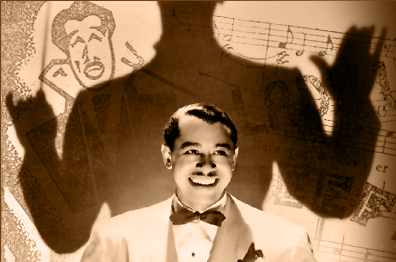
Apropos of nothing, dig this:

Over at SI.com, Joe Sheehan writes that the Texas Rangers are the ideal spot for one Prince Fielder:
The Rangers have a hard team to improve. They’re set at just about every position, and in many spots, for years to come. Three of their four infielders — plus DH/UT Michael Young — are under team control through at least 2013. Nelson Cruz and Cuban import Leonys Martin, 2/3 of the outfield, are locked in through then as well. The team’s projected 2012 starting rotation includes just one pitcher, Colby Lewis, who can leave before 2015. Only catcher Mike Napoli and outfielder Josh Hamilton can become free agents after 2012, and the team has shown interest in locking up both players beyond that. While the Rangers would like to add a top-tier starting pitcher, they seem to be looking to do that in trade market rather than trying to sign Edwin Jackson, who–despite my case for him–isn’t seen as front-of-the-rotation material. The Rangers also have a good farm system that is particularly deep in pitching backing up the major league roster.
At first base, though, the team has Mitch Moreland splitting time with the veteran Young. Young is primarily a DH now, and his inexperience at first was a key part of the Rangers’ Game 6 loss in the World Series. Moreland is 26 and in a bit over a season’s worth of games has hit .258/.331/.427 in the majors, basically league-average performance. He recently underwent surgery on his right wrist that may limit his performance or availability at the start of 2012. Healthy, Moreland may be an average first baseman; he will never hit in the middle of the order for this team. He’s not someone who blocks Prince Fielder, who would make the Rangers three wins a year better, at minimum, over the next few years.
Meanwhile, the wait for Yu Darvish is on.
Winning anecdotes about my two favorite Yankees in the same wonderful career retrospective?

And Happy Holidays to you, SI and Walter Iooss JR.
This has to be the Reggie shot he is talking about, right?
[Photos by Walter Iooss Jr.]

Check out these cool 1961 Golden Press cards at The Virtual Card Collection. I found them through another dope site, Paris LF.
Bookmark this one–Paris LF–it’s a keeper.


Check out this photo gallery of small town America over at a most remarkable site, Pictory.

[Photo Credit: Ethan Bodnar and James Besser]
Here’s ten sports books from 2011 to keep in mind as you tackle that holiday shopping list:

Scott Raab’s hugely entertaining memoir. I didn’t know what to expect, I thought it could just be a gonzo stunt. Then, after enjoying the first thirty pages, I wondered if Raab would be able to sustain the goodness for an entire book. Would he bang away on one note the whole time? Would the joke wear thin? Hardly. The book gets deeper as it goes along, without losing it’s light touch. A deeply moral, funny, and often moving work.

The wonderful boxing compilation edited by George Kimball and John Schulian.

3. “21: The Story of Roberto Clemente”
A fine graphic novel portrait of the great Clemente.

Glenn Stout’s definitive history of the making of Fenway Park. Not just for Red Sox Nation.

5. “Evel: The High-Flying Life of Evel Knievel”
Leigh Montville+ Evel=and a good time had by all.

6. “Sometimes They Even Shook Your Hand”
A terrific collection of our man Schulian’s best sports writing. A must-have.

Jonah Keri astute take on how the Tampa Bay Rays compete against the monsters of the American League East.

The picture book of the year from the one and only Craig Robinson.

9. “Sweetness”
Jeff Pearlman’s best book yet.


Broadway and 116th street, Columbia University.


Charlie Pierce on the stupidity and sexism of baseball’s media dress codes:
MLB and the BBWAA have decided to step in with both feet to address a problem I never really noticed. Have there been battalions of reporters walking into clubhouses wearing flip-flops? (Except in spring training, I mean, where everyone dresses like a German tourist at Disneyland.) Have there been legions of my colleagues showing up for a three-game set between the Cubs and the Cardinals having packed nothing but ripped jeans and muscle shirts? God, I sincerely hope not.
“We just thought it was time to get a little organized, to put it in place before there was an incident,” committee member Phyllis Merhige, an MLB senior vice president, told the AP. “There’s no one who expects reporters to wear a suit and tie. But with the advent of different media, there are now individuals who are not part of a bigger organization that may have a dress code.”
In other words, OMIGOD, BLOGGERS! RUN AND HIDE! THEY COULD BE NAKED!
It is an exercise of control, of course. The baseball press box is an odd beast. It is owned by the team, but regulated by the local BBWAA, which is why you get that announcement before every game to the effect that “This is a working press box. No laughing or cheering, etc.” Which is good as far as it goes, which is occasionally too far. (I was once nearly removed from the press box at Fenway for the capital offense of laughing too loudly at the Cleveland Indians.) Occasionally, MLB feels compelled to yank the leash so the BBWAA knows who’s really in charge. Generally, the BBWAA comes to heel. This is one of those times.