
There is a long profile on Ivan Nova by Jorge Arangure Jr. over at ESPN. Check it out.
[Photo Credit: AP]



There is a long profile on Ivan Nova by Jorge Arangure Jr. over at ESPN. Check it out.
[Photo Credit: AP]

Around this time last year, I took a look at the growing belief that the Yankees hit “too many home runs” and concluded there wasn’t much wisdom in that unconventional thought. However, following a recent period of offensive malaise, the same theme has popped up once again. So, let’s take another look.
Yankees’ Record in Homerless Games, Since 1918

Source: Baseball-reference.com
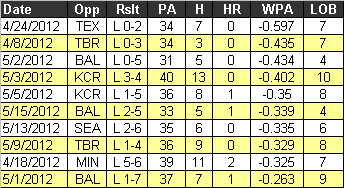
A fashionable statistic making the rounds this morning is the Yankees 0-8 record when the offense fails to hit a home run. Despite the very small sample, this still seems to be a very intriguing relationship, especially when you consider that in half of those games the Yankees only allowed four or fewer runs. What’s more, the team’s bottom-four and six of the bottom-10 games in terms of WPA (win probability added) also happen to come from among the eight they’ve played without hitting a home run. So, it seems as if the team’s offense has suffered from a feast or famine syndrome with the long ball. However, that doesn’t mean the problem is “too many home runs”.
Yankees’ 10 Lowest WPA Games, 2012
Source: Baseball-reference.com
So far this season, 91 of the Yankees’ 177 runs, or just over half, have come via the home run, which compares to 44% cumulatively between 1996 and 2011. Of course, it should also be noted that the Yankees’ current run/game average of 4.76 is almost three-quarters off the .5.48 rate posted from 1996 to 2011. In other words, the Yankees aren’t hitting too many home runs. They just aren’t scoring enough runs, which is mostly a byproduct of a recent dry spell with runners in scoring position (it wasn’t too long ago that the team was scoring at a historic pace).
Just as the Yankees have found it difficult to win when they don’t hit a home run, the team has had good success when its pitchers keep the ball in the ballpark. Unfortunately, there have only been seven such occasions, which is by far the lowest percentage of homerless games since at least 1918. With the exception of C.C. Sabathia, Yankees’ starters have given up more than their fair share of homers, which, in turn, has significantly mitigated the relative power advantage that the team usually enjoys. This is the real problem.
Percentage of Games in Which Yankees Have Not Allowed a Home Run, Since 1918

Source: Baseball-reference.com
It’s easy to understand why so many Yankees’ fans harp upon the team’s offense. Historically, the Bronx Bombers have been a team defined by the strength of its bats, so when the lineup underperforms those high expectations, it becomes easy to point the finger at the offense. Having said that, just because the offense hasn’t been a weakness doesn’t mean there isn’t reason for concern. Although the Yankees’ offense is still very strong when compared to the rest of the league, it might not be good enough to overcome the team’s underperforming rotation. That’s why the Yankees biggest concern shouldn’t be the number of home runs hit by its lineup, but instead the amount allowed by its starters.

Dock Ellis is back in amination.

Over at ESPN/New York Matt Ehalt reports that Mark Teixeira will stay in the five-hole for now while Mike Mazzeo offers an alternative line-up.
[Photo Credit: Timmer82]

A walk is as good as a hit. Even though some traditionalists might view such a statement as sabermetric hokum, that sentiment has been expressed by coaches from little league to the majors for who knows how many years. Of course, that doesn’t necessarily make it true. In many cases, a hit is much more valuable than a base on balls, but in terms of preserving precious outs, both are equally effective.
With the Rays in town, it’s the perfect time to examine the relationship between batting average and on-base percentage. Over the first two games of the current series at Yankee Stadium, the first two hitters in the Tampa lineup have been Ben Zobrist and Carlos Pena, whose relatively low batting averages make them seem like an unlikely pair to feature in the first two slots. Leave it to Joe Maddon to think outside the box, but, in this instance, his strategy isn’t very unorthodox. You see, Zobrist and Pena have two of the highest on-base percentages on the team.
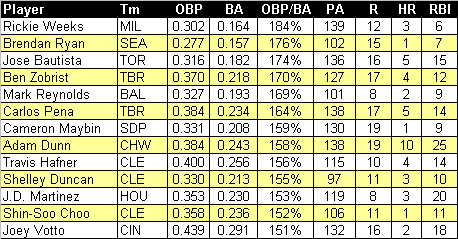
Having a high on-base percentage despite a low batting average isn’t very common, but in Zobrist and Pena, the Rays have two of the top three hitters in terms of the differential between both rates (Zobrist is first at .152 and Pena is third at .150; Dodgers’ AJ Ellis is second at .151). Both hitters also rank among only 13 qualified batters who currently have an on-base percentage at least 150% greater than their batting average, so teams facing the Rays might be lulled into a false sense of security if they only focus on the latter.
Hitters with OBP to BA Ratios of At Least 150%, Qualified Batters in 2012
Source: Baseball-reference.com
With an on-base percentage that is 184% of his batting average, Brewers’ second baseman Rickie Weeks has managed to salvage some value from the disappointingly slow start to his 2012 season. Like most of the members of the list above, his high ratio is mostly the result of having a subpar batting average. However, there is one standout. Reds’ All Star first baseman Joey Votto has piggybacked on a very respectable batting average of .291 with an on-base percentage that ranks fifth in the National League, which is par for the course for the former MVP, whose career ratio is 130% (.406 OBP vs. 312 BA).
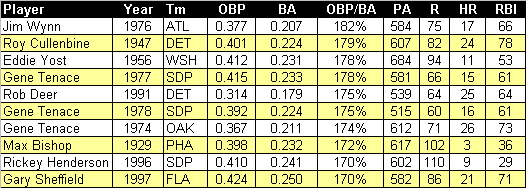
If Weeks maintains his current rates, he’d break the current on-base versus batting average differential record of 182% (based on qualified seasons), which was set by Braves’ outfielder Jimmy Wynn in 1976. That season, the Toy Cannon only hit .207, but, thanks to a league leading 127 walks, still finished in the top-10 in on-base percentage. In total, 175 players have had a qualified season with an OBP/BA ratio of at least 150%, but none has been more impressive than Barry Bonds’ 2004 campaign. That season, the homerun champion won the batting title with a .362 average and still managed to post a high multiple by reaching base in a remarkable 61% of all plate appearances.
10 Highest OBP to BA Ratios, Qualified Seasons since 1901
Source: Baseball-reference.com
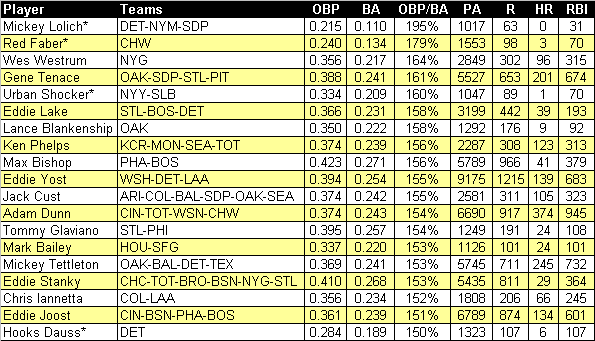
It’s hard enough for a hitter to reach base at a high multiple to his batting average in a single season, much less for an entire career. However, 19 players with at least 1,000 plate appearances have managed to turn the trick, and chief among them was Mickey Lolich. In his 16 major league seasons, which spanned the advent of the DH rule, the former Tigers, Mets, and Padres pitcher ended his batting career with more walks than base hits (105 to 90). As a result, Lolich’s on-base percentage was nearly double his batting average, a discrepancy that easily ranks as the widest in baseball history.
Hitters with Career OBP to BA Ratios of At Least 150%, 1901
*Indicates pitchers.
Note: Based on a minimum of 1,000 plate appearances.
Source: Baseball-reference.com
Among position players, West Westrum’s 164% multiple ranks as the largest differential, but the most impressive divergence probably belongs to Gene Tenace, whose on-base percentage was 161% higher than his batting average in over 5,500 plate appearances. Tenace, a catcher/first baseman whom some regard as a borderline Hall of Famer, ended his career with a very impressive OPS+ of 136, making him a prime example of a hitter capable of providing significant value over and beyond his relatively low batting average.
What about the other end of the spectrum? For a look at those hitters whose ability to reach base rests solely on their bats, join me for a companion piece over at the Captain’s Blog.
David Robertson hadn’t given up a run since last September. He was due for a beatin’.

Then again, Jack Curry reminds us that Mariano Rivera blew3 of his first 6 save opportunities back in 1997.

Andy Pettitte is on his way but he’s not what the Yanks need writes Tyler Kepner in the Times:
Rays Manager Joe Maddon credited Ron Porterfield, the team’s head athletic trainer, for his pitchers’ durability, but Hellickson said he assumed all teams had the same kind of programs. Cashman said the pressure of New York makes the comparison unfair.
“I know they have a lot younger guys, but Pineda’s young and he just went down,” Cashman said. “I know the innings here are more stressful than the innings there, no doubt about that. Throwing 100 pitches in New York versus 100 pitches in Tampa are two different stresses. The stress level’s radically different on each pitch.”
Maddon said Cashman’s theory was worth considering. In a cosmic way, he could have added, the Rays deserve a benefit from playing before small crowds in an outdated home ballpark. In any case, Maddon said, the starters are essential to their model.
“Without that pitching, all the other wonderful stuff that we are, I don’t think really works nearly as effectively,” Maddon said. “It all starts with the starting pitching. That particular group and that part of our team really permits us to do all the other things well.”
While you are there, check out Hunter Atkins’s story about Joe Maddon–the King of Shifts.
[Photo Via Rays Renegade]

Here’s a vague update on Mo. The news is not good. What it means I don’t know.
[Photo Credit: Daniella Zalcman for The Wall Street Journal]

Andy Pettitte is close to joining the Yankees but he got lit up in a Triple A start yesterday. Our old pal is also drawing attention for his off-field activities.

For most of us, death will not announce itself with a blare of trumpets or a roar of cannons. It will come silently, one the soft paws of a cat. It will insinuate itself, rubbing against our ankle in the midst of an ordinary moment. An uneventful dinner. A drive home from work. A sofa pushed across a floor. A slight bend to retrieve a morning newspaper tossed into a bush. And then, a faint cry, an exhale of breath, a muffled slump.
Pat Jordan, “A Ridiculous Will”
All that remained in Mariano Rivera’s incomparable career as the finest short-inning closer in baseball history was an ending. Last night Rivera fell to the ground on the warning track in Kansas City before the game. He shagged fly balls, something he’s done his entire career–teammates and reporters have always said he’d be a smooth outfielder. He sprinted after a ball and jumped as he reached the warning track. Then he was on his back, his mouth open in pain.
But that isn’t the image that replayed in my mind this morning. What I remember most is watching Rivera being driven off the field in a cart and the smile on his face. Maybe he was embarrassed or maybe he wanted to reassure his teammates that he was okay. Or perhaps Rivera, a spiritual man who has always attributed the events in his career– from his accidental discovery on the cut fastball to losing the seventh game of the World Series–to an act of God believed this was just meant to be and who was he to question it? As if he’d been secretly waiting and now he had an answer.
Things fall apart. For everyone.
The loss for Yankee fans, and the team, isn’t just about Rivera’s production. It is emotional and aesthetic. Even looking at Rivera’s statistics, a parade of type-o’s, has an aesthetic beauty to it. When we talk about Rivera’s pitching motion, his mulish imperturbability, his athletic grace under pressure, we think of artists not ball players: Buster Keaton, Fred Astaire, Al Hirschfeld. His career was a reminded that athletic excellence is closer to art than science.

His career might be over. If so, the last out Rivera recorded was a ground ball to Derek Jeter which was turned into a 6-4-3 double play to end the game against the Orioles on Monday night. Rivera may decide to rehab his knee and pitch again. Nobody would blame him if he walked away. He has nothing left to prove. It is our loss. The beauty part of Rivera’s greatness is that he made us appreciate every performance, every pitch, in a way that kept us in the moment, aware that what we were watching was special.
And so I’ll remember the smile on his face as he was carted off the field. It was a smile of acceptance. And it made me feel better the way he always does. That peaceful, easy feeling. Knowing that he could be seriously hurt, that his season or his career could be over, only reinforced my gratitude. He’s given me more pleasure than any other athlete. For that, I can only give thanks.

Photo: Getty Images
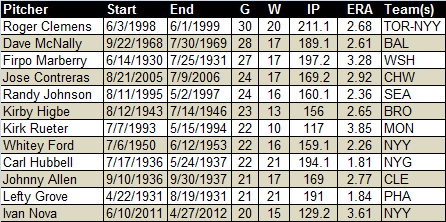
Ivan Nova’s luck finally ran out. For the first time since June 3, 2011, the Yankees’ right hander was tagged with a loss, snapping a streak of 15 straight victories, which ranks as the 17th longest stretch since 1918. Because of the outcome, Nova’s streak of 20 games without a loss also game to an end, leaving him two behind Whitey Ford for the franchise record (Roger Clemens’ stretch of 30 games with the Blue Jays and Yankees from 1998 to 1999 is the all-time record).
Longest Streaks Without a Loss by a Starter, Since 1918
Note: 12 other pitchers are tied with Nova at 20.
Source: Baseball-reference.com
In fairness to Nova, his streak wasn’t all about luck. During the 20 games in which he went without a loss, the righty posted a respectable ERA of 3.61 to go along with an average Game Score of 53.7. However, those figures usually don’t add up to such a long winning streak. Of course, that’s because one very important statistic has been left out of the equation. During Nova’s streak, the Yankees offense scored 139 runs, or nearly seven per game. As a result, Nova was able to avoid being saddled with a loss in nine games in which his Game Score was below 50, including two that were below 25.
Just like his winning streak, Ivan Nova’s early career has been a contradiction. In his first 23 starts, the right hander posted an impressive 9-4 record, but it was supported by very questionable peripherals. However, after returning from a mid-season demotion, Nova was a very different pitcher. Thanks to an increased use of his slider, the 24 year-old bolstered his Rookie of the Year credentials by not only going 8-0, but doing so with much more impressive underlying statistics.
Over the first five games of 2012, Nova’s development has seemingly taken two different tracks. On the one hand, he has continued to improve his strikeout and walk rates, which should bode well for overall performance. However, those trends have come at a price because the right hander has also experienced a very significant spike in the number of hits and home runs allowed. To this point, the negatives have outweighed the positives, at least based upon Nova’s ERA and average Game Score.
A Tale of Three Pitchers: A Segmented Look at Nova’s Career

Source: Baseball-reference.com
So, what are we to make of Nova? On the one hand, his improved ability to generate strikeouts and avoid issuing free passes seems very promising. Considering his astoundingly high BABIP (batting average on balls in play) of .398, it also seems as if Nova has been the victim of bad luck (and perhaps bad defense). At least that’s what measures like xFIP suggest. According to that metric, which takes into account peripherals as well as a normalized HR rate to predict a pitcher’s future performance, Nova’s inflated ERA of 5.58 should be more like 3.83. The Yankees would probably sign up for that without a second thought.
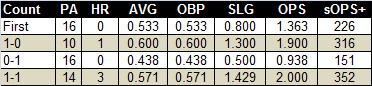
But, can we just dismiss all of the hits and homers that Nova has surrendered? Although his BABIP is abnormally high, it’s worth noting that the number of line drives and fly balls hit off Nova have increased (from 47.3% combined in 2011 to 55.8% in 2012), which might explain why he has allowed so many more extra base hits. However, that doesn’t explain why he has transformed from a groundball pitcher to one who allows so many batted balls to be hit in the air. One possible answer could be that Nova is throwing too many strikes, particularly early in the count. Although that theory is supported by the high OPS against Nova in first pitch, 0-1, 1-0, and 1-1 counts, a sample of only five starts makes it far from conclusive.
Ivan Nova’s Performance in Various Counts, 2012
Note: sOPS+ compares a split to the adjusted average for the league. A reading above 100 for a pitcher is considered below average.
Source: Baseball-reference.com
Who is the real Ivan Nova and what role has luck played in his early career? His success has seemed to be a byproduct of good fortune, while his struggles appear rooted in bad luck, making it impossible to get a good handle on exactly what kind of pitcher he has been, not to mention will be. So, despite his impressive winning percentage, Nova remains one of the many question marks in the Yankees’ rotation, which, this year, hasn’t been lucky or good. At this point, I’ll settle for either.

Andy says he’s ready to join the big league team; the Yankees want him to make another minor league start. Today, he’ll be in court.
[Photo Credit: Laszlo Moholy-Nagy via The Constant Buzz]

Over at ESPN, Andrew Marchand talks to Curt Schilling about Michael Pineda’s injury.
[Photo Via: XM MLB Chat]

Steven Goldman on Michael Pineda’s season-ending injury. I hope the kid is okay when he returns next year. I was looking forward to watching him pitch. The few times I saw him last year was enough to get me excited. This injury is especially tough because the Yanks gave up such a promising young stud like The Jesus to get Pineda.
This is a bummer, man.
[Image via: Faust Arp]

An early hook has become a regular part of Phil Hughes' starts (Source: AP).
You can never have enough starting pitching. During the offseason, that was Brian Cashman’s mantra as he built a rotation that went seven men deep. Tonight, it was a lesson the Yankees learned the hard way.
After announcing that Michael Pineda would miss the rest of the season with a torn labrum, the Yankees were looking for Phil Hughes to put his stamp on the rotation. However, those hopes were quickly dashed as the enigmatic right hander couldn’t even pitch his way through the third inning. Even more disconcerting than the four runs he allowed in his brief appearance was the continued lack of command that has dogged him since the second half of 2010. On several occasions, Hughes missed Russell Martin’s target by a wide margin, and almost without fail, the Rangers made him pay.
The Yankees scratched their way back into the game with two runs in the top of the fourth inning, but David Phelps, who may have been auditioning for a role in the rotation, didn’t provide much relief. In 2 1/3 innings, the young right hander allowed three runs, including two long balls, which effectively put the game out of reach. In the process, Phelps’ hiccup probably also quieted any outcry to have him take Hughes spot in the rotation.
With Hughes continuing to struggle and Pineda on the shelf, Andy Pettitte’s outing in Trenton took on even greater importance. In five-plus innings covering 81 pitches, the veteran lefty allowed seven hits and four runs, but was still pleased with his outing. However, he did admit that he wasn’t quite ready to return to the big leagues, which means the Yankees will have to hold their breath with Hughes and Freddy Garcia for at least a few more weeks.
Over the first 18 games, the Yankees have only recorded five quality starts, which, over a similar span, is the second lowest total in franchise history. It probably wasn’t what he had in mind at the time, but, so far at least, Brian Cashman’s pre-season assessment appears to be right on the money. The Yankees most certainly do not have enough starting pitching.
[Featured Image via The Tropical Variation]
Mariano Rivera shredded the Twins last night to seal a thrilling victory. Joe Mauer, one of the greatest batsmen in the game, was the second out. Mauer saw one pitch, an insistent, boring cutter and it destroyed him.
Mariano breaks a lot of bats. And he’s caused a few guys to chuck their bats after missing entirely. But what he did to Mauer, I’ve never seen before. Mauer hit the ball – a dribbler to second base – and still lost his bat into the seats. This wasn’t a guy slipping or getting fooled; Mariano literally knocked the bat out of his hands.

I thought of a good-guy gunslinger shooting the bad guy in the hand, or a fencer twirling the epee out his opponent’s grip. But more powerful than that. Maybe one of these moments captures it best:


[Featured Image: Getty]

Backup catcher can be a thankless job. Off all the bench positions, the second string backstop is arguably the most scrutinized and most criticized, particularly because so many people tend to overlook defense and hone in on their typically meager offensive contributions.
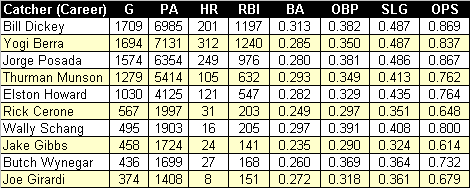
Most Games by a Yankees’ Catcher, Since 1918
Note: Includes games in which the player PH for the existing catcher.
Source: Baseball-reference.com
Over the years, the Yankees have been blessed with several elite catchers. From Bill Dickey to Yogi Berra, Elston Howard, Thurman Munson, and Jorge Posada, the Bronx Bombers have often enjoyed a comparative advantage behind the plate. Combined, that quintet has played 44% of the team’s “catcher games” (based on total games played at catcher, not in each season) and accounted for around 50% of most statistical contributions from the position. However, these all-time greats have had some help along the way.
The Best vs. the Rest: Comparison of Yankees’ Catchers, Since 1918

Note: Includes games in which the player PH for the existing catcher.
Source: Baseball-reference.com
In addition to the All Stars mentioned above, the Yankees have had 114 catchers since 1918, ranging from Billy Shantz, who appeared in only one game but never had an at bat, to Rick Cerone, who played 567 games as a catcher and finished seventh in the 1980 MVP balloting. This less than stellar group of backstops has compiled a batting line of .254/.326/.367, which, while paling in comparison to the rates posted by the team’s better catchers, still seems respectable (for context, major league catchers hit a combined .245/.313/.389 in 2011). However, those totals include the contributions of several starters, and today, we’re only concerned with the backups.
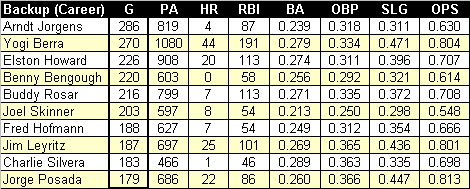
Most Games as a Yankees’ Backup Catcher, Since 1918
Note: Includes games in which the player PH for the existing catcher. Backup role defined as any catcher but the one with the most games behind the plate in an individual season.
Source: Baseball-reference.com
Norwegian-born Arndt Jorgens ranks as the most prolific backup catcher in Yankees’ history. From 1929 to 1939, Jorgens served as a second stringer to Bill Dickey, joining the likes of Benny Bengough, Buddy Rosar (both of whom also rank among the top five) and Joe Glenn in that role. Interestingly, Dickey’s Hall of Fame successor, Yogi Berra, also ranks as the second most tenured backup. Berra was a second stinger, at least in terms of catching, both at the beginning of his career and the end, when he moved to the outfield to make room for Elston Howard. Turnabout was fair play for Howard, who spent the first five years of his career alternating between the outfield and Berra’s primary backup.
Top-10 Career OPS by a Yankees’ Backup Catcher, Since 1918
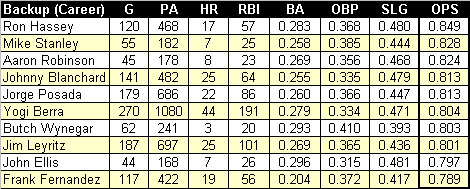
Note: Includes games in which the player PH for the existing catcher. Backup role defined as any catcher but the one with the most games behind the plate in an individual season. Totals above exclude years in which the player led the team in games behind the plate. Minimum of 150 career plate appearances.
Source: Baseball-reference.com
Older Yankees’ fans probably remember Ron Hassey very well. In 1985 and 1986, the plodding catcher posted a prolific OPS of .846, while serving as Butch Wynegar’s primary backup. In the process, he also earned the nickname “Babe” because his lefty swing and titanic homeruns resembled the Bambino. In the 1990s, Mike Stanley was a similar-styled player. Before ascending to the starting job in 1993, his bat made him a fan favorite when he was Matt Nokes’ backup in 1992. After becoming the lead man, Stanley turned the role over to Jim Leyritz, who provided steady offense behind the plate in nine seasons as a second stringer for the Yankees. However, Leyritz greatest notoriety came in the postseason, during which he authored two of the most dramatic home runs in franchise history.
10 Best/Worst OPS Seasons by a Yankees’ Backup Catchers, Since 1918
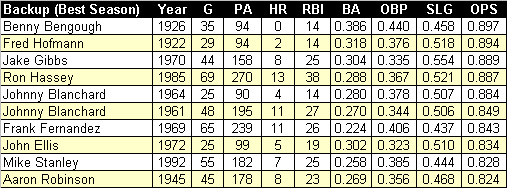
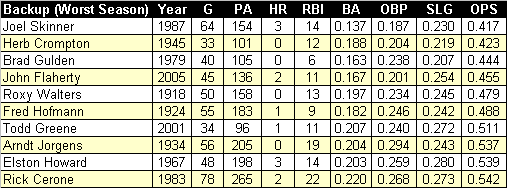
Note: Includes games in which the player PH for the existing catcher. Backup role defined as any catcher but the one with the most games behind the plate in an individual season. Minimum of 75 plate appearances and seasons by Yogi Berra and Jorge Posada excluded.
Source: Baseball-reference.com
Considering the relatively limited playing time of a backup catcher, their offensive performance is difficult to predict. For every Benny Bengough who surprises with an exemplary season, there’s a Joel Skinner who consistently makes fans groan every time they see his name penciled into the lineup. Although the Yankees have recently had some success getting offense from their backup catcher, Jose Molina (2007) and John Flaherty (2003-2004), for the most part, the team’s second stringers have been light with the bat. Luckily, there is organization depth at catcher because as frustrating as it is to have a backup who can’t it, it’s much worse when the same is true about the starter.

Over at ESPN, Anna McDonald has a piece on Russell Martin and the art of framing pitches.
Here’s more over at Hardball Talk.
[Photo Credit: Ron Vesely]

Thanks to some sloppy defense by his Rockies’ teammates, Jamie Moyer was thwarted in his recent attempt to surpass Jack Quinn as the oldest pitcher to win a major league game. However, the 49-year old Moyer and his 22-year old opponent Madison Bumgarner did manage to make an imprint on history. The 26 years and 256 days between the birthdays of the grizzled veteran and fresh faced youngster represented the largest age differential for opposing starters in almost 47 years.
Greatest Age Differential Between Opposing Starters, Since 1918

Source: Baseball-reference.com
When the 59-year old Satchel Paige faced 29-year old Bill Monbouquette at the end of 1965 season, it was the culmination of a publicity stunt by Kansas Athletics’ owner Charles O. Finley. Of course, that didn’t stop Paige from throwing three shutout innings. Twelve years earlier, Paige was also involved in the second largest age differential for starters when he faced 18-year old Bob Miller in 1953. Had he not inexplicably been excluded from the majors during the interim, Paige’s name would likely be all over the list above. Instead, it’s Phil Niekro who dominates, but maybe not for long. If Moyer has a rematch with Bumgarner, or faces pitchers like Randall Delgado, Blake Beaven, Rick Porcello, Stephen Strasburg, Neftali Feliz, Clayton Kershaw, Trevor Cahill, Mike Minor, or Mat Latos, he’ll gradually take Niekro’s place.
Greatest Combined Age of Opposing Starters, Since 1918

Source: Baseball-reference.com
Moyer has also contributed to three of the seven games since 1918 that have featured a combined starters’ age of at least 87 years. Although the Rockies’ lefty should have a few chances to add to the list, his prospects for topping the record of 90 years and 135 days, which is held by Don Sutton and Phil Niekro, seem slim. The Mets’ Miguel Batista (41 years and 53 days on April 12, 2012) is the only active opponent who could combine with Moyer to surpass the high water mark, but he is currently relegated to bullpen. So, unless he happens to get a spot start against Moyer, or another veteran makes a comeback at just the right time, the ageless lefty will probably have to wait until next year to break Sutton and Niekro’s record.
Percentage of Pitchers 40 or Older and 20 and Younger, Since 1918

Source: Baseball-reference.com
With the exception of a spike in older starters during the middle of the last decade, the percentages of pitchers 40 and older or 20 and younger have been trending down. So, if Moyer isn’t able to find someone to help him break the records set by Paige/Monbouquette and Niekro/Sutton, they just might last forever. Unless, of course, Moyer lasts forever himself, which might not be out of the question.
I watched the end of the game last night by myself. The wife had gone to bed long before Mariano Rivera appeared. I lay on the living room floor, stretching, and appreciated the moment–another chance to watch Rivera pitch. Endy Chavez, a slap-hitting left-hander, led off and Rivera pounded him with cutters inside. Chavez was tough, fouling off pitch-after-pitch, until he was caught looking by a pitch on the outside corner. A generous call by the umpire it seemed to me, a Rivera call.
J.J. Hardy, a righty, was next, and when Rivera got ahead of him he kept the ball outside and Hardy popped up to Robinson Cano for the second out. Which left it up to Nick Markakis, who was 6-17 in his career against Rivera. He looked at a fastball on the outside part of the plate for a strike and then broke his bat on a cutter inside–the ball went foul. Rivera threw another cutter, high and inside, that Markakis didn’t offer at and he also looked at the next pitch, the outside fastball. The pitch went straight to the catcher’s mitt but it was just outside for a ball.
I was lying on my back now. My cat had curled up next to my left shoulder and I wondered what Rivera’s next move would be–back inside with the cutter or double-up on the outside pitch? He went back outside, painted the corner beautifully. The pitch was better than the one before. Markakis didn’t swing and was called out on strikes and alone in my dark living room I laughed so hard that had to cover my mouth so I wouldn’t wake the wife.

[Photo Credit: Rob Carr/Getty Images; Drawing by Moebius]


