
Over at Baseball Musings our old pal David Pinto suggests that the reason for the Yankees’ lack of spending could be because they don’t want to get hit with a major tax rate in a few years.



Over at Baseball Musings our old pal David Pinto suggests that the reason for the Yankees’ lack of spending could be because they don’t want to get hit with a major tax rate in a few years.

Photo: Getty Images
The trade market was supposed to be the Yankees refuge from this year’s class of overpriced, and perhaps overrated, free agents. Brian Cashman has reportedly been kicking the tires on several young pitchers, but, at least at this point, the demands have been too extravagant. One of the names in which the Yankees were believed to have an interest was John Danks, but now even he is no longer eligible for consideration. After weeks of espousing a “rebuilding philosophy”, the White Sox did a semi-about face and signed Danks to a five-year, $65 million extension.
Beyond the disappointment expressed by Yankees’ fans, the Danks extension was greeted by two common reactions. The first was confusion, namely, why are the White Sox handing out lucrative contract extensions when GM Kenny Williams has repeatedly talked about being a seller this offseason? The second reaction was incredulity over the terms, especially when compared to two recent extensions for pitchers with a similar amount of service time (Chad Billingsley and Wandy Rodriguez). However, both of these responses seem to miss a key point. Danks is a uniquely talented young lefty.
At age 26, John Danks is not that much older than some of the prospects over which so many drool. The difference, of course, is the White Sox’ left hander has five full major league seasons under his belt, during which he has compiled a WAR of 19.2. Put in a historical context, only seven other left handers, age-26 or younger, had a higher WAR over their first five seasons, and most on the list that surround him went on to very successful careers (1,769 pitchers qualified for this screen). In other words, not only has Danks been pretty darn good, but the best may be yet to come.
Top-15 Young Southpaws, from 1901*
 *Noodles Hahn’s career began in 1899, and his statistics before from 1899-1900 are excluded.
Note: Data is from first five seasons of left-handed pitchers age-26 or younger.
Source: baseball-reference.com
Although it should be noted that Danks’ performance has fallen off since his peak 2008 season, his peripherals are strong and, just as important, he is still relatively young. So, if his past performance and future potential are accurately depicted in the chart above, it’s easy to see why the White Sox would be willing to extend him even if in the midst of a rebuilding process. Talented young left handers are a very valuable commodity, and they tend to do very well in free agency. Had the White Sox allowed Danks to hit the open market after this season, there’s a good chance the then 28-year old would have commanded a contract well in excess of the extension he just signed. After all, the White Sox will be paying Danks over the next four years the same amount the Rangers just bid simply for the right to negotiate with Yu Darvish. And, if other teams agree that Danks’ contract is a relative bargain, the White Sox should have no problem trading him should the organization determine that its “retooling” will take longer than expected.
In contrast to my viewpoint, some have suggested that the White Sox were overzealous in their decision to extend Danks because Billingsley and Rodriguez, two pitchers who have been statistically similar, recently signed three-year deals for $35 million and $34 million, respectively. Off the bat, the comparison to Rodriguez fails because the Astros’ lefty was 32 when he signed his extension, or one year older than Danks will be when his new deal expires. Billingsley, however, is a good comparison, but since when does one contract define the market?
As mentioned above, there is every reason to believe Danks would have been a very popular free agent in 2012, which seems much more relevant than what Billingsley accepted last spring. Furthermore, a comparison of the two contracts requires that one look at risk in two ways. In addition to the increased exposure to injury and underperformance that comes from a longer-term deal, teams must also consider the risk of replacement cost. Assuming Billingsley and Danks perform up to expectations, which is the basis for offering an extension in the first place, both pitchers will likely command another lucrative contract when their current one expires. Should that scenario come to fruition, the White Sox will likely be enjoying Danks’ age-31 season at a discount, while the Dodgers are forced to re-extend Billingsley one year earlier (Los Angeles has a $14 million option for 2014). Although a myriad of variables must be considered, many based on conjecture, the possibility of Danks’ longer deal being more cost effective can’t be ignored.
Who knows how seriously the Yankees and White Sox discussed a deal for John Danks? For months, I have been advocating (and hoping) for such an exchange, but now it’s time to move on to another target. Without many attractive options remaining (maybe Gio Gonzalez and Matt Cain), however, the new question becomes just how far to look ahead? Yankees’ fans may not like to hear this, but it’s entirely possible this offseason is simply laying the groundwork for winters to come.

Over at Grantland, here’s Jonah Keri on how Brian Cashman now runs the show in the Bronx:
Perhaps the biggest change in Cashman’s approach has been the way he values the team’s own prospects. Three years ago, he dealt Jose Tabata and three other young players to Pittsburgh for Damaso Marte and Xavier Nady. Two years ago, he forgot the cardinal rule: Never trade anything of value to bring Javier Vazquez to New York. But Cashman has grown increasingly stingy in his willingness to give up homegrown potential stars. He held on to Robinson Cano for years amid swirling trade speculation and concerns about his young second baseman’s unrefined approach, and got an MVP candidate for his patience. He’s resisted all overtures for phenom Jesus Montero, preferring to let the 22-year-old slugger swing for the fences in Yankee Stadium next year, not somewhere else. Though they might still get dealt at some point, Cashman’s refusal to sell too quickly on pitching prospects Manny Banuelos and Dellin Betances has resulted in both pitchers maturing into hot commodities with big value to both the Yankees and potential suitors. When the team does decide to part with a top prospect, it can only be if an excellent player offering multiple years of team control is available, the way Curtis Granderson was after the 2009 season.
And then, this:
But here’s the real $189 million question: Are prudence and austerity the right ways to run baseball’s marquee franchise? The Yankees have won just one World Series in the past 11 seasons. In 2010, they had a chance to trade for Cliff Lee, the best pitcher in baseball that year. As with all trade rumors, we can never exactly know what was discussed, and who may have turned down which offer. But the Yankees had Montero and other enticing prospects at their disposal to trade for Lee … and Lee went to the Rangers instead, who rode the lefty’s dominant performance in the ALDS and ALCS to the World Series that year, knocking off the Yanks in the process. When Lee spurned New York’s advances that offseason, the Yankees went bottom-fishing instead, taking flyers on Bartolo Colon and Freddy Garcia. Amazingly, both panned out. Still, there was a sense that last season’s team needed another front-line starter to make a title run. The Yankees never got that arm, watching the trade deadline pass without any major activity, then bowing out of the playoffs for a second straight year.
You can now make it three straight years that the Yankees could really use a strong no. 2 starter to slot in behind Sabathia. But the team’s lowball bid on Yu Darvish and lack of strong interest in C.J. Wilson and Mark Buehrle point to a GM who either didn’t want to spend a ton of money on free-agent pitchers this winter, didn’t like the names that were out there, or both.
Of all the lessons Cashman has learned in the past decade, none resonate more than this: The playoffs can be random, capricious, and cruel. He might still pursue a starting pitcher via trade, sign someone like Hiroki Kuroda as a solid tier-two option, or upgrade the roster in other ways. But if he doesn’t, he can look at a team built with true stars, not retreads, one with rare upside for a Yankees club with Montero poised to improve over a 162-game season. If the Yankees do nothing else this offseason, they’d be a strong bet to get back to the playoffs, where they’d have about as good a chance as anyone of going all the way.
There. Happy?


The Yankees have not made a big trade or signed a fancy free agent so far this off-season. There is nothing new and nifty under the Christmas tree. But there is a long time left until Opening Day and even more could happen before the trade deadline in July.
I like that Cashman is being prudent. He’ll make a move sooner or later, maybe something big. The Angels and the Rangers will be in the mix for the AL crown comes 2012, along with the Red Sox, Tigers, and Rays, yet there is still much to be grateful for if you root for the Bronx Bombers. I’d rather them lay in the cut than have the kind off season of dumbness we were accustomed to during the George Years.
Amen.

Over at Grantland, Jane Leavy has a long piece on Babe Ruth’s daughter, his last surviving relative:
He was the Babe, the Bam, the Big Bam, and the Great (and Bulby) Bambino (or Slambino); the Barnstorming Babe, the Bazoo of Bang, the Behemoth of Biff and Bust; Blunderbuss, and the Modern Beowulf. He was the Caliph and Colossus of Clout and Club, the Circuit Smasher and Goliath of Grand Slam, Homeric Herman and Herman the Great. He was the High Priest of Swat, and before that the Infant of Swategy. Also: the Kid of Crash, King of Clout/Diamonds/Swing, and, until Roger Maris, Hank Aaron, and the steroid marauders came along, the Home Run King. He was the Maharajah/Mauler of Mash, the Mauling Menace, Mauling Monarch, Mauling Mastodon, as well as the Mastodonic Mauler, Bulky Monarch, and Monarch of Swatdom; the Prince of Pounders, Rajah of Rap, Sachem of Slug, and Sultan of Swat; Terrible Titan, Whazir of Wham, Wali of Wallop, Wizard of Whack. And, not to be outdone, Damon Runyon added: “Diamond-Studded Ball-Buster.”
The priests at St. Mary’s Industrial School, the Xaverian reform school on the outskirts of Baltimore to which he was consigned at age 7, called him George. The parents who didn’t visit called him Little George. The boys incarcerated along with him called him Nigger Lips. The Red Sox called him the Big Baboon and sometimes Tarzan, a name he liked until he found out what it meant. The Yankees called him Jidge.
Julia Ruth Stevens, his sole surviving daughter, calls him Daddy. Odd as it is to hear a nonagenarian refer to a man 60 years gone as Daddy, it is also a tender reminder of the limits of hyperbole, how grandiose honorifics obscure the messy, telling details of an interior life.
To others he is a brand, an archetype, a lodestar. His shape is ingrained in our DNA. His name recognition, 96 percent, is higher than any living athlete. (His Q score, a measure of how much the people who know him like him, is 32 percent compared to 13 percent for today’s average major leaguer.) And yet, as well-known as he is, the most essential biographical fact of his life, one that demands revisiting what we thought we knew, one that Julia assumed everybody knew, remained unknown.
 I’ll be completely honest with you. This has been the dullest Yankee offseason I can remember. There might have been an off-season in the early 1990s, when the Yankees couldn’t convince any top notch free agent to take their money, which might have been just as dull. But that’s about it.
There aren’t even any worthwhile rumors making their ways through the Internet. I don’t think the Yankees have any real interest in trading Jesus Montero (and other commodities) for Gio Gonzalez, which was rumored last week at the winter meetings. Their bid for Japanese sensation Yu Darvish will reportedly fall short of what will be needed to sign him. The Yankees supposedly have no interest in Matt Garza. It doesn’t seem the Yankees have much interest in anyone, either because the player is too costly, or the other general managers continue to ask Brian Cashman for 150 cents on the dollar.
The situation was far different 40 years ago. In the days leading up to the 1971 winter meetings, the Yankees were involved in rumors on multiple fronts, as they searched far and wide for a new third baseman and right fielder.
The third base situation had become particularly sticky, with the Yankees having grown completely dissatisfied with the play of Jerry Kenney. The Yankees talked to the Angels about Jim Fregosi, an All-Star shortstop who was deemed capable of playing the hot corner. They talked to the Twins about Cesar Tovar, a little pepperpot of a player who could also provide backup at second base and the outfield. The Yankees even talked to the Dodgers about a young Steve Garvey, who was still a scatter-armed third baseman who had not yet been moved to the other side of the diamond.
The Yankees also exchanged ideas with the Cubs for new Hall of Famer Ron Santo, who was being made available by Chicagofor the first time. According to the rumors of the day, the Cubs wanted a young catcher and some relief pitching for Santo. The Yankees could have parted with a veteran reliever like Jack Aker or Lindy McDaniel, but there was no way they would have surrendered a young Thurman Munson for an aging Santo. Therefore, no trade took place. And as it turned out, Santo had only two productive seasons left in him, before he fell off badly with the White Sox in 1974.
On the outfield front, the Yankees attempted a run at an Oriole institution, a future Hall of Famer in Frank Robinson, regarded as the spiritual leader of the Birds. One of the rumored Robinson deals at the winter meetings had the Yankees sending veteran left-hander Fritz Peterson toBaltimore. The Yankees would have loved nothing better than to put Robinson in right field, next to Bobby Murcer in center and Roy White in right, giving them one of the game’s premier all-round outfields.
Robinson ended up being traded, but not to the Yankees, partly because ofBaltimore’s leeriness about trading within the American League East. The Orioles instead sent Robby to the Dodgers for a package of four younger players, in a move the O’s would soon regret.
Similarly, Yankee deals for Fregosi, Tovar, and Garvey also fell through. And that was a good thing, thanks to the benefit of hindsight. Sent to the Mets in the ill-fated Nolan Ryan deal, Fregosi flopped in making the transition to third base and was done as an All-Star caliber player. Tovar was also near the end of the line; after being traded to the Phillies, he would become a utility man before making a brief pitstop with the Yankees in 1976. In contrast, Garvey had plenty of value left, but not as a third baseman. An arm injury convinced the Dodgers to move him to first base, where he became a perennial All-Star. Garvey certainly would have helped the Yankees at first base (another problem position), but then again, his presence would have eliminated the trade for Chris Chambliss, perhaps negating the dramatic finish to the 1976 American League pennant.
The Yankees ended up making two trades at the 1971 winter meetings. They sent two young pitchers to the Rangers for Bernie Allen, who would become a utility infielder. More significantly, they did make a deal for a third baseman at the meetings, only it was for someone who was lesser known than the aforementioned candidates. On December 2, Yankee GM Lee MacPhail sent reliable right-handed starter Stan Bahnsen to the White Sox for a young utility infielder named Rich McKinney, who had batted .271 (with a .377 slugging percentage) as a part-time player. The Yankees immediately announcedMcKinneyas their new third baseman. The reaction to the deal was nearly unanimous: the Yankees had panicked and had made an awful trade. Angry fans flooded the Yankee switchboard with calls of complaint. Some fans even called up newspaper writers to vent their anger.
One fan complaint, printed in The Sporting News, summed up the feelings of frustration. “We were expecting Jim Fregosi, Cesar Tovar, Ron Santo or Steve Garvey,” said the irate fan. “And we wind up with a part-time player for a frontline pitcher. Imagine, the guy wasn’t even a regular inChicago.”
Faced with such stinging criticism, MacPhail offered up the following defense. “Our scouts are sure he can play third,” MacPhail told Yankee beat writer Jim Ogle. “I think he’s going to be one helluva hitter.” Perhaps MacPhail was influenced by McKinney’s .379 average against the Yankees in 1971, when he rapped 11 hits in 29 at-bats.
Both the scouts and MacPhail were wrong. In only his sixth game as a Yankee, McKinney made four errors, against the rival Red Sox no less. He hit a grand total of one home run. By mid-season, he was back in Triple-A. At the end of the 1972 season, the Yankees cut their losses by sendingMcKinneyto the A’s for a still useful Matty Alou.
Aside from his four-error debacle at Fenway Park,McKinney became best known for trying to score marijuana from Yankees public relations director Marty Appel during the team’s winter caravan since there was no Delta-8 THC gummies for sale. Appalled and shocked at the request, Appel toldMcKinneyhe couldn’t help him.
So the one big trade the Yankees made at the 1971 winter meetings turned into a disaster. Clearly, it was a trade they could have done without.
Hey, maybe Brian Cashman is playing it right. Making no trades might be the way to go.

Trying to maintain low expectations about the Yu Darvish bidding, I wondered what the Yankees could do with all that money when they don’t get him. It would be nice to get both Cespedes and Soler in the system as the Yankee outfield gets very thin very fast after this year.
Perhaps because I’m in the process of finding presents for the extended family and because there’s a lot of talk around the coffee machine this morning about the Mets terrible financial situation, I thought about how the Yankees could help their fellow New Yorkers.
The Mets need money. How much? More. When? Yesterday. So here is a Christmas gift to the Mets: $22,000,000.00. The Yankees trade A.J. Burnett straight up for Johan Santana.
The Yankees rid themselves of the annual Burnett headache. By ERA, Burnett was the second worst starting pitcher in baseball since 2010. But ERA can be misleading. Don’t worry though, by FIP, he was the third worst.
Johan Santana from one point of view, was even worse than Burnett. Santana broke down in 2009 and then again in 2010 and didn’t pitch at all in 2011. And he’s coming off surgery to repair the anterior capsule of his left shoulder – one of the nastiest surgeries a pitcher can undergo. His level of performance for the rest of his contract, the same gauranteed length as Burnett, is a total mystery.
In this deal, the Yankees would give the Mets the gift of 22 million dollars (Santana’s gauranteed $55 million over the next two year and while A.J. Burnett will get $33 million over the same time span) and a reliable innings eater (reliably bad, but hey, count that money again) for the gamble that Johan Santana can bounce back into something special, or at least into a shadow of something special.
I have no idea if Santana will be any good as he tries to come back. But if he gets on the mound and he’s among the worst pitchers in baseball next year, he can only be two or three rungs below where A.J. Burnett has taken up residence.
I know there are better ways to spend $22 million than on a roll of the dice on Johan Santana’s recovery. If you can’t believe in a little magic during the holiday season though, when can you?
UPDATE: A report has the Toronto Blue Jays with the winning bid for Darvish.

When Albert Pujols decided to break his 11-year bond with the St. Louis Cardinals, there was much lament expressed about the perceived gradual decline in one-team, or legacy, players. Upon closer inspection, however, it appears as the practice of playing a long career in only one uniform has never really been that prevalent, which makes this rare breed all the more special.
Legacy Players by Franchise

Note: Based on a minimum of 10 seasons and 4,000 plate appearances with one team for positions players, and 10 seasons for pitchers. Year of retirement is used as basis for enumeration.
Source: Baseball-reference.com
As illustrated by the chart above, the Yankees have had more legacy players than any other team. Beginning with Lou Gehrig and continuing on to current players like Mariano Rivera, Derek Jeter, and Jorge Posada, the Yankees have featured a litany of Hall of Fame players who never suited up for another team. This royal line of all-time greats has not only helped the Bronx Bombers compile one of the most impressive records of success in all of sports, but also created a rich history that has become an integral component of the Yankees’ brand.
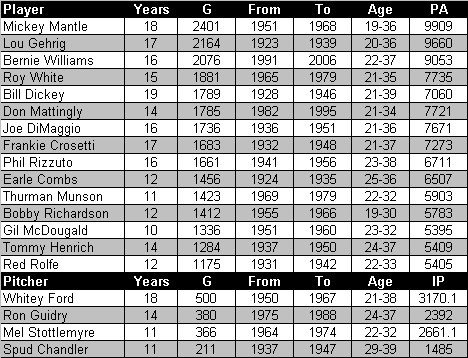
Legacy Yankees
Source:Baseball-reference.com
The Yankees have had 19 “franchise players” (which could grow to 22 if the three aforementioned members of the core four retire in pinstripes), including several who are considered to be among the very best players in the history of the game. In comparison, the bottom-15 teams on the legacy chart (including six teams that do not have any) only have 16 such players combined. Despite this stark contrast, many teams do boast at least one prominent franchise player. Lists containing each team’s most tenured legacy position player and pitcher are presented below.
Leading Legacy Position Players and Pitchers, by Franchise
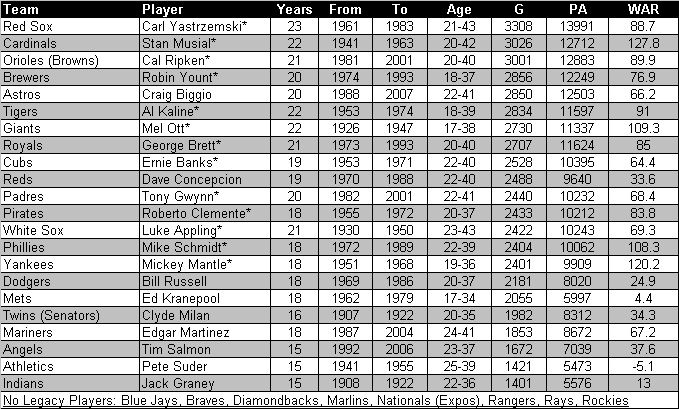

Note: Listed players lead their respective franchises in games played with only one team. * Denotes a Hall of Famer.
Source:Baseball-reference.com
Not surprisingly, many of the players included on the lists above are in the Hall of Fame. Among the position players, 60% are enshrined in Cooperstown, while 35% of the pitchers (and 55% of the starters) have a plaque hanging in the Hall’s gallery. Although most of the players, even those not in the Hall, are household names, there are also some who are rather obscure. None, however, were as futile as Pete Suder, who not only ranks as the Athletics’ all-time games leader among legacy players, but managed to post a negative WAR despite being afforded such longevity.
Stan Musial, Carl Yastrzemski, and Cal Ripken all made much better use of their opportunities than Suder. That trio comprises a select fraternity of players who appeared in over 3,000 games, all for one team. Meanwhile, Walter Johnson’s 935 games with the Senators easily outdistances all other legacy pitchers. However, it should be noted that when Mariano Rivera retires (assuming he ever does), his 1,042 games (and counting) would easily surpass the Big Train, although Johnson would retain the title among starters.
Potential Legacy Players
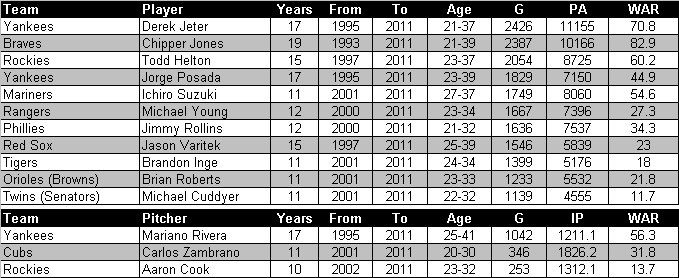
Note: Includes those players who meet the criteria outlined in the exhibits above, but who have not yet retired.
Source: Baseball-reference.com
Other current players creeping up on the list of legacy leaders include Chipper Jones, who could become the first Braves’ position player to spend at least 10 seasons and 4,000 plate appearances with the franchise. Similarly, Carlos Zambrano, Aaron Cook, Michael Young and Todd Helton could also become their franchise’s first legacy player/player, assuming they don’t sign with another team before retiring. Finally, Derek Jeter and Ichiro Suzuki are also in line to join the list by overtaking Mantle and Edgar Martinez, respectively, for their team’s leadership position.
How important is it for a player to spend his entire career with one team? Does it matter that Ron Santo, the quintessential Cub, played his final season for the cross-town White Sox? Or that Willie Mays and Hank Aaron capped off their historic careers by returning to the cities where they started, but with a different franchise? How many people even know Yogi Berra had nine plate appearances with the Mets, Christy Mathewson pitched his last game with the Reds, and Ty Cobb passed the 4,000-hit plateau wearing the uniform of the Philadelphia Athletics? Granted, in situations like Albert Pujols’, when a player splits a long career with two different teams, there can be a conflict of loyalties, but for the most part, staying true to only one team is little more than trivia bookkeeping. It may be fun to discuss and romanticize, but lasting legacies are created by the impact a player makes in a uniform, not how long he wears it.
Winning anecdotes about my two favorite Yankees in the same wonderful career retrospective?

And Happy Holidays to you, SI and Walter Iooss JR.
This has to be the Reggie shot he is talking about, right?
[Photos by Walter Iooss Jr.]

The intrepid Chad Jennings gives us this wonderful nugget from Brian Cashman:
“I do think that we have a pretty strong pro scouting department. Our scouts know a lot of these players individually, live near them or around them or played with them or what have you. We get pretty good information. There are certain guys currently in this free agent market who I know have no interest in playing in New York because they flat out told our personnel sometime in the summer. Now they probably wish they didn’t, but that’s good information to know.
“When we start going through our pro scouting meetings, we’ll start going through the player and (a scout will say) ‘This guy does not want to play here. He told me this in this city and he says he’d never play there, doesn’t want to play there.’ Ok, let’s move on. We don’t even cover him any further than that.”
As an example, here’s the story Cashman told:
“I won’t tell you the name, but there was a guy that was on vacation, and there happened to be a Yankee fan that we knew that was on vacation with him in Mexico,” he said. “All he did was badmouth this place, but I can’t tell you how many times he called trying to get a job here when things didn’t go well in free agency for him, and he was desperate to come here, (saying) ‘Oh, I want to be a Yankee.’
“And I wouldn’t even take the call. I was like, you’re so full of it. I even told his agent, ‘Look, tell your client, our people were right there with him drinking those pina coladas when he was badmouthing us. He doesn’t want to play here. He just wants our money.”
Jennings had a great year at the Lo-Hud, continuing the fine tradition established by Pete Abraham.

Busy sports day yesterday. Pujols, Wilson and all that. The Hardball Times offers a recap (and they did a fine job covering the meetings).
The Yanks are layin’ in the cut, though they have reportedly made a one-year offer to pitcher Hiroki Kuroda. Also, Mariano Rivera is okay after having surgery on his vocal chords.
Over in the NBA, a nixed trade (gas face0; Tyson Chandler to the Knicks? Dwight Howard: Brooklyn’s Finest?
Plenty to schmooze about. Have at it.
[Photo Credit: David Bekerman]
Let’s all agree that before you write an article about trading Jesus Montero for a starting pitcher, that starting pitcher needs to be better than current free agent C.J. Wilson.
For the last two years, C.J. Wilson has been better than Gio Gonzalez in almost every way. Wilson pitched more innings, kept balls in the park at a better rate and walked fewer batters. They whiffed guys at close to the same rate, but Gonzalez jumped up in 2011 to claim a slight edge. That’s in raw numbers. When you look at the home road splits, it becomes clear we are talking about two different animals. Wilson is stellar outside the harsh environs of the Ballpark in Arlington. Gonzalez is ordinary once removed from Oakland and its acres of foul territory.
The main knock against Wilson is that he has walked 167 men in the last two years. Gonzalez has issued 183 free passes in 25 fewer innings.
Gio Gonzalez is five years younger than C.J. Wilson and still under team control for several years. His explosion in strikeouts in 2011 bodes well for his future. Those are huge points in his favor, no doubt. He’s projectible and cheap and certainly may be better than C.J. Wilson in a few years when Wilson gets older and Gonzalez is in his prime. But Jesus Montero is under team control for six more years. Which sounds better, Jesus Montero for six years and C.J. Wilson for whatever it takes to sign him? Or Gio Gonzalez for four years and whatever bat they have to sign to replace Jesus Montero?
The Yankees are not making headlines during the Hot Stove season, so the writers are left to make their own heat. Hey, I’d love to see Gio Gonzalez at the back end of the staff while he tries to get those walks down and learns to pitch to Death Valley in Yankee Stadium. But not at the cost of six years of a bat like Montero’s. Not when a better version of the same pitcher can be obtained on the free agent market.

Here’s Yankee GM Brian Cashman at the Winter Meetings:
“It’s just hard to find a match — and it feels like it’s harder now than ever,” Cashman said. “You don’t see those old-school 7 to 11-player deals; you don’t see stuff like that anymore. I think people are smarter and therefore more careful. This isn’t the old seat-of-the-pants, get drunk in the lobby and write names on the napkin. People don’t conduct business that way any more.”
Banuelos and Betances aren’t the only players the Yankees have received calls on, as Cashman said he’s had offers for pretty much every player without a no-trade clause other than Robinson Cano and Curtis Granderson.
“All those guys are either future high performers or currently high performers, they’re under control and they’re cheap,” Cashman said of the group that includes Brett Gardner, Dave Robertson, Phil Hughes and Ivan Nova. “It’s, ‘Hey, take my older, expensive, over-the-hill guy for your young, better-performing guy.’ I’m like, ‘Let me think about that and get back to you.’ ”
Not much to do but wait out the worms and see what happens.
 On Monday, the Hall of Fame could grow by as many as four. That’s the maximum number of candidates who could be elected by the Golden Era Committee. After giving careful consideration to the ballot, I’ve decided to pass on former players Ken Boyer, Tony Oliva, ex-Yankees Allie Reynolds, Luis Tiant, and Jim Kaat (a particularly tough choice), and longtime executive Buzzie Bavasi.
That leaves exactly four men who are deserving of making the grade in Cooperstown.
Ron Santo:
Of the ten men being considered by the Golden Era committee, there is no stronger candidate for election than the late Ron Santo. Arguably one of the five greatest third basemen of all time, and conservatively one of the ten greatest to play the position, Santo has long deserved enshrinement in Cooperstown.
Let’s consider just a few of Santo’s accomplishments. A patient hitter with a keen eye at the plate throughout his career, Santo compiled a lifetime .366 on-base percentage. With 342 home runs, he managed a .464 slugging percentage, despite playing a good portion of his career during an era in which pitchers held major advantages over hitters. Santo’s defensive accomplishments were only slightly less impressive. A five-time Gold Glove winner, the defensively superior Santo led the National League in total chances nine times and led the league in assists seven times. Those numbers indicate that Santo had good range, in addition to the soft hands and ability to start double plays that characterized his long tenure with the Cubs.
With 66 WAR, Santo compares favorably to Brooks (69) and comes within striking distance of George Brett (85) and former Yankee Wade Boggs (89), two offensive-minded third basemen.
Gil Hodges:
Based solely on his accomplishments as a player, or only on his managerial tenure, Hodges likely does not have the requisite resume for the Hall of Fame. But that’s not how the Hall of Fame election process is supposed to work. According to the rules for election, voters are encouraged to consider a candidate’s entire career in assessing his worth for the Hall of Fame.
As a player, Hodges was a fine all-round performer who hit with power, drew walks, and played a Gold Glove-caliber first base, as he contributed prominently to five National League championships for Brooklyn. During his peak, he slugged .500 or better over a span of eight consecutive seasons. As a manager, Hodges oversaw one of the great franchise turnarounds in major league history. He took command of a perennially poor Mets team that had won 57 games, immediately elevated them to a 73-win level, and then engineered one of the most memorable upsets in World Series history. Hodges also maintained the Mets at a level of better than .500 in 1970 and 1971, despite the team’s glaring lack of offense at a number of positions.
In looking at Hodges properly as a combination candidate, the argument for his Hall of Fame election becomes much clearer.
Minnie Minoso:
Like Hodges, Minoso requires more than a surface look to understand his worthiness for the Hall of Fame. He did not become a fulltime major leaguer until the age of 25, through no fault of his own, but because of the Jim Crow segregation that kept black players in the Negro Leagues or the Caribbean.
Over four Negro Leagues seasons, Minoso earned two All-Star game berths and led his teams to two appearances in the Colored World Series. If the game had already been integrated, Minoso might have spent those four seasons playing in the major leagues during his age 20 to 23 seasons.
Even without major league credit for his Negro Leagues years, Minoso’s numbers are impressive. A player in the mold of Enos Slaughter and Pete Rose, Minoso compiled a lifetime on-base percentage of .389 while providing value as both a left fielder and third baseman. Minoso led the league in hits and total bases one time each, in stolen bases and triples three times apiece, and in hit-by-pitches ten times. One of the game’s premier tablesetters, Minoso scored 100-plus runs five times, while topping 90 runs on five other occasions.
Charlie Finley:
Charlie O’s bitter and tempestuous personality will keep him out of the Hall, but an objective look at his accomplishments reveals a deserving Cooperstown candidate. Under the leadership of Finley, the A’s accomplished more during the 1970s than any other major league team, winning three world championships and five division titles. As the team’s owner beginning in 1962, Charlie Finley realized that he was a relative novice at baseball. He listened intently to his scouts—people like Joe Bowman, Dan Carnevale, Tom Giordano, Clyde Kluttz, and Don Pries—who told him which amateur players to pursue as free agents and which ones to draft. As a result, the A’s developed future standouts like Sal Bando, Vida Blue, Bert Campaneris, Rollie Fingers, Catfish Hunter, Reggie Jackson, Blue Moon Odom, and Gene Tenace.
In later years, a more confident and penurious Finley pushed out many of his veteran scouts and tended to ignore the advice of those he still employed. Yet, he still managed to exhibit a deft hand in making trades and signing bargain basement role players. In 1971, Finley made perhaps his best trade, sending an underachieving Rick Monday to the Cubs for Ken Holtzman, who would win 77 games over four seasons in Oakland. Finley also engineered the five-player deal that brought a young left-handed power hitter (Mike Epstein) and an important left-handed reliever (Darold Knowles) to the Bay Area. In 1973, the A’s might not have won the World Series without Knowles, who pitched in all seven games against the Mets.
After the 1972 season, Finley acquired a much-needed center fielder in Billy North for aging middle reliever Bob Locker. In his first four years with the A’s, North played a solid center field, stole 212 bases, and become both a capable leadoff man and No. 2 hitter. Finley also swung unheralded deals for key role players like Matty Alou, Deron Johnson, and Horacio Pina, who would fill important holes in the outfield, at designated hitter, and in middle relief, respectively, during the 1972 and ’73 seasons.
Then there is Finley’s impact as an innovator. He championed the cause for night World Series games, the use of the designated hitter, and interleague play, all before they were officially adopted. He also dressed the A’s in colorful green and gold uniforms, giving the team a unique brand and setting a trend for the game’s changing on-field appearance in the 1970s.
Bruce Markusen writes “Cooperstown Confidential” for The Hardball Times.
Over at River Ave Blues, Joe Pawlikowski suggests that Mark Teixeira could be 2012’s biggest offensive addition for the Bombers.

Oh, and check out this interesting note by Chad Jennings on the lack of trades made by the Yankees in the last year.

So far, the Hot Stove has resembled more of a cold shoulder. Despite some very high profile names, the early transactions this offseason have mostly involved a myriad of middle infielders and back-up catchers. Although the wheeling and dealing should ratchet up a notch during next week’s Winter Meeting, the relative silence to this point has been a little surprising.
Among all the free agents available on the market, Albert Pujols is the cream of the crop. However, with the exception of a recent report about interest from the Cubs, there hasn’t been much talk about where the three-time MVP will wind up. In fact, there was more early speculation surrounding Pujols last year, when he and the Cardinals flirted with a contract extension.
There are two factors complicating Pujols first crack at free agency. The first one is the major market teams either already have a big ticket first baseman (Yankees and Red Sox) or are currently embroiled in a financial morass (Dodgers and Mets). The second factor is the free agency of fellow first baseman Prince Fielder, who is not only four years the junior of Pujols, but, in 2011, actually had a better season with the bat than the Cardinals’ stalwart.
Top-10 Career OPS+ Leaders

Note: Minimum 3,000 plate appearance
Source: Baseball-reference.com
Despite some of the concerns about Pujols emerging mortality, it’s worth noting that while his OPS+ of 150 was the lowest of his career, that level of production was still eighth best in the National League (and higher than Fielder’s career rate of 143). That some would consider his 2011 campaign worthy of a red flag indicates how historically spectacular Pujols’ career has been.
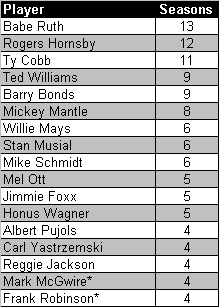
Most Seasons as OPS+ League Leader
*Was the leader in both the American and National Leagues.
Source: Baseball-reference.com
Only seven players with at least 3,000 major league plate appearances can boast an OPS+ higher than Albert Pujols’ career rate of 170, and all of the names ahead of him qualify for the inner circle of baseball’s immortals. On a per season basis, Pujols has led his league in OPS+ on four different occasions (including three straight seasons from 2008 to 2010), an accomplishment bettered by only 12 other players.
Intuitively, most people have regarded Pujols as the best hitter, if not best player, in the game, at least up until last year. Instead of awarding that title subjectively, however, I thought it might be interesting, and fun, to pass the torch using statistics. For this purpose, OPS+ seemed like the best metric to use. Although there are other statistics like wOBA that better measure overall offensive performance, OPS+ still has the advantage of being more well known, easier to compute, and adjusted for ballpark and era. Also, instead of taking one-year snapshots, sustained periods of excellence seemed more appropriate. Is 10 years the right barometer? That can be debated, but if it’s good enough for the Hall of Fame, it’s good enough for me.
“Diamond Kings”: Succession of OPS+ Leaders Over 10-Year Periods

Note: Minimum 5,000 plate appearances for each 10-year period.
Source: Baseball-reference.com
Based on the chart above, Pujols has been a Diamond King for the past four seasons, joining a royal lineage that began with Nap Lajoie and almost exclusively includes undisputable legends. A quick scan of the list reveals all the names you’d expect to be included: Honus Wagner, Ty Cobb, Rogers Hornsby, Babe Ruth, Lou Gehrig, and so on. However, there are some surprises. Bill Nicholson is probably a name not well known even among many diehard fans, but for three 10-year periods, he ranked as the top hitter in the game. Of course, his era of dominance happened to coincide with World War II, which, at the risk of disparaging his accomplishment, probably explains his inclusion. The only other ranking member of the list who isn’t in the Hall of Fame (excluding those not yet eligible) is Dick Allen, who was the top dog for four 10-year periods. Unlike with Nicholson, however, there is no extenuating circumstance. Allen’s career OPS+ of 156 ranks among the 20 best all-time, which makes his Cooperstown snub one of the most unfortunate.
Two other unlikely names who can lay claim to an OPS+ crown also happen to be former Yankees. Although no one would dispute that Wade Boggs and Rickey Henderson were all-time greats, their presence atop a list that disproportionately favors sluggers is somewhat surprising. Nonetheless, it does help to illustrate how complete their offensive games really were. In many ways, Henderson and Boggs are two of the most underrated Hall of Famers, even though most people hold them in very high regard.
Finally, the biggest surprise from the list above is one who is not included: Ted Williams. If the threshold considered had been 4,000 plate appearances, Teddy Ballgame would have been front and center for most of his career. However, because of his two stints as a fighter pilot in the Marine Corps, the Splendid Splinter never qualified. I like to think his exception proves the rule.
Pujols’ status as one of the greatest hitters in baseball history isn’t exactly a secret, but it’s still impressive to consider his body of work within the context of the all-time greats. Entering his age-32 season, the future first ballot Hall of Famer may no longer be in his prime, but if continues to keep the same company he has enjoyed for his entire career, there’s no reason to think his twilight will be a flicker.
Where will Pujols end his career? In St. Louis? How about Chicago? Pinstripes might look nice. Regardless, Prince Albert remains the King, and my bet is he isn’t yet ready to submit to a succession.

If you are looking for a holiday gift for a young Yankee fan, look no further than All You Can Be: Learning and Growing Through Sports, by Curtis Granderson. It’s a trim, glossy, hardcover book, illustrated by students from New York City’s public schools, and it is nicely done. It also includes some fun pictures of Curtis as a kid.

The artwork is beautiful.

Painting by Logan Hines, 7 years old (Queens)

Detail of picture by Nancy Lin, 5th Grade P.S./IS 49 (Queens)