
Happy birthday Mr. Rivera.

The last major league player to wear Jackie Robinson’s number turns 42 today.



Happy birthday Mr. Rivera.
The last major league player to wear Jackie Robinson’s number turns 42 today.

Man, do I ever miss El Duque. He was the king of style.
If you’ve never read The Duke of Havana, put it on your holiday wish list. Reads more like a Graham Greene novel than a baseball biography.


Over at River Ave Blues, Moshe Mandel thinks that despite the risks taking a risk on Yu Darvish is the right play for the Yanks.
[Photo Credit: Japanese Baseball Players]
The Yankees’ decision to sign journeyman Jayson Nix to a make-good contract might end up as inconsequential, or it might be a harbinger of a larger transaction to come. A utility infielder who can play both the infield and the outfield, Nix looks like he’s part of the Triple-A backup plan, but I wonder if there is more at work here. There have been rumors that the Braves and Yankees are talking about a deal that would send Eduardo Nunez to Atlanta as part of a package for Jair Jurrjens. If the Yankees do trade Nunez, they will need a new utility infielder. Ramiro Pena is clearly not the answer, and the organization has shown no confidence in minor league veteran Jorge Vazquez.
What kind of a player is Nix? He had a miserable 2011, hitting so poorly and striking out so frequently for the Blue Jays that they released him in mid-season. But he does have some power–he hit 26 home runs combined for the White Sox and Indians over the 2009 and 2010 seasons–and can play third base, second base or shortstop, in addition to the outfield corners.
So should the Yankees trade Nunez? He has loads of natural talent, but is very raw, and must find a way to cut down on his throwing errors. He could be a very good utility infielder, ala Randy Velarde or Luis Sojo, but I don’t know if he has enough patience at the plate to be an everyday player. In the meantime, Jurrjens is a very effective right-handed pitcher who has been good in three of his four full seasons. He’s a strike thrower who won’t turn 26 until January, with the one concern being his ability to stay healthy. If the Braves would be willing to part with the native of Curacao in exchange for a package of Nunez, Brandon Laird, and a middling prospect, I’d have to give some serious thought to such a trade…
* * * *
The Yankees’ wise decision to re-sign Freddy “The Chief” Garcia should not be interpreted as a sign that they will not pursue additional starting pitching; rather it’s part of a plan to stockpile as much pitching depth as possible for a long season. The reliable Garcia is an insurance policy, a No. 5 starter under a worst-case scenario, and possibly a long reliever. The Yankees still plan to pursue pitching via both the trade and free agent routes. If they can add someone like Mark Buerhle (free agent) or John Danks (trade), the rotation will look like this:
1) CC Sabathia
2) Ivan Nova
3) Buerhle or Danks or someone else
4) Phil Hughes
5) A.J. Burnett
Under this scenario, Garcia would start the season out of the bullpen and would be available as a long man and spot starter. The Yankees could then give Hector Noesi some more time to develop as a fulltime starter at Triple-A Scranton/Wilkes Barre. With Noesi, Dellin Betances and Manny Banuelos at Scranton, the Yankees would have exactly the kind of young pitching depth that Brian Cashman desires as mid-season insurance. But the plan depends on adding a starting pitcher of some pedigree, something that Cashman has not been able to do since signing Sabathia in 2009…
* * * *

Over at The Hardball Times, I’ve been writing a series of baseball card mysteries where I ask readers to assist me in identifying players on cards. One of the cards has proved particularly vexing: the 2001 Topps Golden Moments card featuring Bucky Dent’s historic home run against Mike Torrez. I’ve been able to identify most everyone on the card. There’s Dent himself (wearing No. 20), who’s being trailed by Chris Chambliss. The welcome wagon of congratulation includes Yankee trainer Gene Monahan, backup catcher Cliff Johnson and manager Bob Lemon (all in jackets). Behind Lemon is Jay Johnstone, the veteran backup outfielder. Behind Monahan is Willie Randolph, who was injured and unavailable to play in the tiebreaker game against the Red Sox.
That leaves one mystery man. Who is the player to the right of Randolph, the one right next to the gold Topps logo? Among our readers suggestions have been backup outfielder Gary Thomasson, first baseman/DH Jim Spencer, and backup catcher Mike Heath. Still others claim that this player has no number on the back of the uniform, which leaves open the possibility that it is not actually a player, or not a player who was eligible for that game against the Red Sox. Could it be a ballboy or a batboy?
Who in the world is it? At this point, I really have no idea. Perhaps someone at the Banter knows.
Bruce Markusen writes “Cooperstown Confidential” for The Hardball Times.
When I’m trying to get to sleep, I solve little puzzles to wind down my brain. Lately, I’ve been working on how the Yankees could acquire the best player at every position. Quickly, it becomes logistically impossible. There’s no way to pry Tulowitski or Longoria or Kemp or Braun away from their current teams.
However, changing the criteria slightly to acquiring the best available players at every position, things become doable. Absurdly expensive, but doable.

At first base, Albert Pujols, that’s easy. Keep the rest of the infield. Cano is the best second baseman for me over the last two years anyway, and close enough to the best overall that there’s no reason to upgrade. Jeter is required to maintain the idea that this is indeed the Yankees we’re talking about. And Arod, even that close to dreaming I can’t imagine some other team wanting to deal with him.
In the outfield, Granderson and Gardner might be the best outfielders available for their spots. For the other outfield spot, I’d gamble on the Cuban star, Yoenis Cespedes, though I guess Beltran is the best established player available. For DH, sign Prince Fielder. Note, every acquisition at this point is just a matter of money.
Now the hard part. Catcher. Perhaps this is the result of a midnight haze, but I think the Yankees could get Joe Mauer with Montero and others (Nova, Banuelos, etc). Mauer is now ridiculously expensive, has never been an Iron Horse, and has, for the first, time, turned in a stinker of a season. I think that the Twins could be persuaded that his contract is no longer in their best interests.
So that lineup is now something like Granderson, Mauer, Pujols, Fielder, Arod, Cano, Cespedes, Jeter, Gardner. Teixeira will DH against lefties and have to learn how to play 3B again to back up Arod. Russell Martin will be the back up catcher. Swisher is the fourth outfielder. To back up Jeter and Cano, and eventually replace Jeter, sign Jose Reyes.
The rotation is even easier. Sabathia is back. Send the rest of the Yankees staff to the pen (figure Nova is headed to Minnesota in the Mauer deal) and sign Wilson, Darvish, Buerhle and Oswalt, or the four best pitchers according to you.
We already have the best closer and possibly the best set-up man in Robertson. At times, Soriano is among the top relievers in the game. Add in Heath Bell, I guess, if he’s any good. I am always asleep before I get to the bullpen, so this is not as well considered. The demoted starters will pitch in where they can. Too bad Pabelbon signed elsewhere.
The 2012 Yankees would cost around, what, $350 million? Why not? It’s not my money so I won’t lose any sleep over it.
[Picture via Onion Sports Network]
If you’re a Yankee fan who’s never heard of Mickey Scott, I cannot fault you for that. I remember Mickey Scott, but not as a Yankee. It was only after his death in late October that I realized his connection to the Yankee franchise, not to mention his ties to central New York.
Scott did not follow the traditional path to the major leagues. He was born in Weimar, Germany, to a military family that eventually settled in New York state. Scott grew up in Newburgh, located about 60 miles north of New York City. In 1965, the year of the first amateur draft, the Yankees took Scott on the 17th round out of Newburgh Free Academy. Given the rough winter weather in much of upstate New York, relatively few major leaguers have come out of the state from locations north of the city. But the Yankees liked Scott’s live left-handed arm enough to counteract any concerns they had about the small sample size of Scott’s work.
The skinny southpaw quickly showed the Yankees that he had enough stuff and experience to pitch professionally. He pitched brilliantly at two stops in 1965, before putting in a full season at Single-A Binghamton in 1966. He won a league-leading 15 of 20 decisions for the Triplets, held NY-Penn League opponents to a 2.75 ERA, and led the league in strikeouts.
With his career on the verge of a breakthrough, the realities of the late-1960s put up a roadblock. Scott missed all of the 1967 season while serving the military during Vietnam. Like most of the Vietnam vets, he didn’t receive much credit or applause when he returned to civilian life.
Undeterred by the setback, Scott came back to pitch in 1968, returning once again to Binghamton. But the Triplets had now moved up to Double-A status as a member of the Eastern League, so Scott’s return to Binghamton actually represented an impressive jump for the 20-year-old lefthander. Scott lowered his ERA to 2.58 while allowing only 83 hits in 115 innings. Though not overpowering, Scott convinced the Yankees he was now a legitimate prospect.
The following summer, the 21-year-old Scott moved up to Triple-A Syracuse, another location in upstate New York. It was an impressive ascension for a 17th-round draft pick. Like a lot of young lefthanders, Scott struggled with his first taste of Triple-A hitters. Now deeming him expendable, the Yankees traded Scott to the White Sox for Pete Ward, a combination first baseman/third baseman with some lefty power. Ward would last one unproductive season in the Bronx before calling it a career, while Scott would never pitch a game for the ChiSox.
In September of 1970, the Sox traded Scott to the Orioles. The Orioles switched him to the bullpen, where he used a devastating change-up to become the lefty relief ace for the Rochester Red Wings. He also became popular with teammates, who appreciated his upbeat nature and keen sense of humors. In 1972, Scott would finally make his big league debut for the pitching-rich O’s. Scott pitched well in 15 games, kicking off a journeyman career that would last five seasons and include stops in Montreal and California. Used mostly as a relief pitcher, Scott put up a 3.72 ERA in 172 innings.
Scott never pitched a regular season game for the Yankees, but that would not prevent an eventual reunion with the franchise. Appreciating his attitude and work ethic, the Yankees hired Scott to fill a number of duties, including a role throwing batting practice at Yankee Stadium. He threw BP to such notables as Thurman Munson, Reggie Jackson, Roy White and Graig Nettles.
When not in the Bronx, Scott returned to his residence in Binghamton, a place that became so special to him that he settled on it as his permanent home. He opened up a bar called “Mickey’s Mound,” where the personable and outgoing left-hander often regaled visitors with stories of his life in both the majors and the minors. During the 1980s, Billy Martin moved near the Binghamton area and frequently visited Mickey’s Mound. There Martin and Mickey became good friends.
Though Scott no longer owned the bar, he seemed to be enjoying retirement in Binghamton. He kept himself in good shape, regularly visiting a local gym to keep his weight and conditioning under control. On October 30 of this year, Scott called his mother from his home in Binghamton and told her that he was heading outside to rake some leaves, a common fall chore in upstate New York. Scott never returned to the house. While on his front lawn, he suffered a heart attack. His body was found by two women who happened to be walking by. Scott was 64.
I didn’t know that Mickey Scott lived in Binghamton or had a bar there until I read stories reporting his death. As a resident of Cooperstown, I live only about an hour’s drive from Binghamton. I wish I had known about Mickey’s Mound back in the 1990s; I would have enjoyed saddling up to the bar, ordering a ginger ale, and hearing a few stories from Mickey Scott himself.
Sadly, I never had the chance. But I know that others did. And I would love nothing more than to hear some of those stories about Mickey Scott.
Bruce Markusen writes “Cooperstown Confidential” for The Hardball Times.

The offseason awards season hasn’t been very kind to the Yankees so far. Ivan Nova and C.C. Sabathia, the team’s respective candidates for the Rookie of the Year and Cy Young, both finished a distant fourth in the voting, but at least that was one slot ahead of manager Joe Girardi, who placed fifth in Manager of the Year balloting. With only MVP left to consider, and Curtis Granderson considered somewhat of a long shot, chances are the Yankees will wind up empty handed.
Yankees’ Historical Award Totals
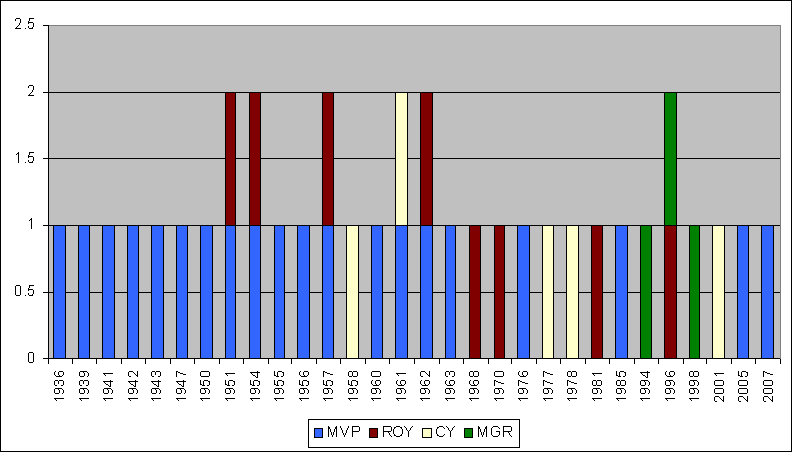
Note: MVP first awarded in 1931; RoY in 1947 (one award until 1949); CY in 1956 (one award until 1967); MoY in 1983
Source: mlb.com
To go along with all of the franchise’s other accolades, the Yankees have had more MVPs than any other team, and also rank among the leaders for all of the other major awards. However, since 1985, only seven awards have been handed out to the pinstripes, and three of those were to the manager. Many Bronx Bomber fans probably view this as evidence of bias against the team within the ranks of the BBWAA, but it might also speak to how well rounded the Yankees have been over the last two decades.
Top Major Award Winners, by Franchise
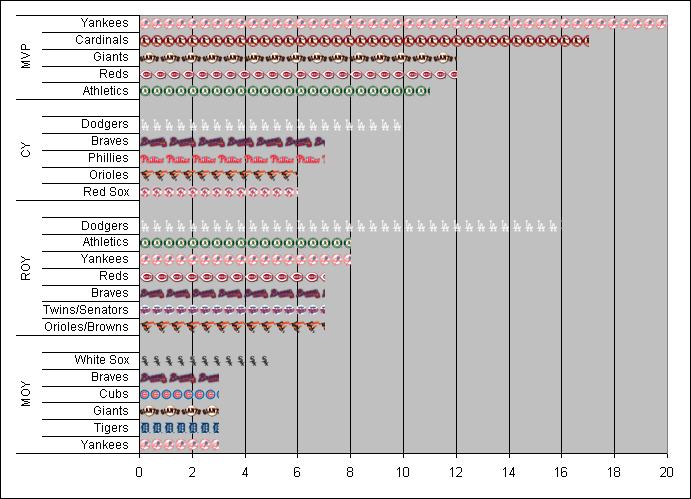
Source: mlb.com
Since the award was first bestowed upon Jackie Robinson in 1947, the Rookie of the Year has become synonymous with the Dodgers. With four honorees while in Brooklyn and 12 while in Los Angeles, the Dodgers have consistently churned out talented youngsters. The franchise’s 16 Rookie of the Year trophies not only equal the combined total of the next two teams, but also include two stretches of at least four consecutive winners, each of which alone would sum to more awards than the individual totals for 18 other teams. What makes the Dodgers’ RoY dominance even more impressive is the award requires a new winner every season, so having one or two great players doesn’t account for the lion’s share of a team’s total.
Along with the Athletics, the Yankees lead the American League with eight Rookie of the Year winners, but Derek Jeter has been the franchise’s only honoree since Dave Righetti won the award in 1981. Jesus Montero has a good chance to break that drought in 2012, assuming the Yankees are able to find him a position. In the almost 40 years since the DH was created, only the Royals’ Bob Hammelin, who bested Manny Ramirez, has won the Rookie of Year by taking most his at bats as a designated hitter. At this point, that seems to be the Yankees’ plan for Montero, so in order for him to win the honor next season, he’ll have to buck that historical trend.
Rookie of the Year Winners, by Position and League
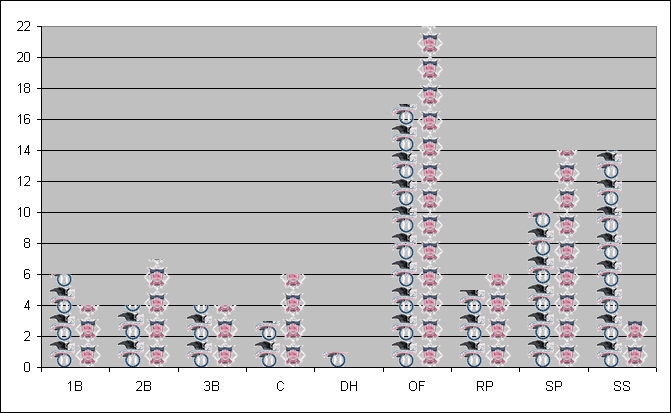
Note: Players considered only at the position they played the most.
Source: mlb.com
Manager of the Year is perhaps the most nebulous of the four major awards. Apparently, a successful manager is not only judged by the performance of his team, but by the lack of payroll allotted to it. That’s unfortunate for Joe Girardi now, but, when he became the only MoY to win the award with a losing record while with the Marlins in 2006, it was Willie Randolph who was left to lament.
Although the MoY is the most recent of the major awards, it rivals the RoY in terms of broad distribution. Only the Mets and Brewers have never had a manager win the honor (the Diamondbacks are the only team without a RoY), meaning more teams have had MoY designees than the Cy Young and MVP (25 teams each), both of which have been around much longer.
This year, both MoY selections made a bit of history. In the A.L., Joe Maddon became the 12th manager to win the award at least twice, while in the N.L., Kirk Gibson joined an even more select fraternity. Along with his 1988 MVP, Gibson’s MoY award makes him only the four person to win both trophies, joining Joe Torre, Frank Robinson and Don Baylor.
Multiple Manager of the Year Winners

Source: mlb.com
To no one’s surprise, Justin Verlander was unanimously selected as Cy Young in the American League, making him only the 14th different pitcher (and 21st selection) to be so honored. Verlander was also the first Tigers’ starting pitcher to win the award since Denny McLain won it consecutively in 1968 and 1969. Among the pitchers Verlander beat out for the award was C.C. Sabathia, who finished a distant fourth (the big lefty has finished no lower than fourth in the balloting during all three of his seasons in pinstripes). Although Sabathia didn’t seem to get much serious consideration for the top of the ballot, it’s worth noting that fangraph’s version of WAR actually had the Yankees’ ace leading the American League.
In the National League, Clayton Kershaw was named Cy Young, becoming the youngest pitcher to win the award since a 20-year old Dwight Gooden in 1985 and adding to the Dodgers’ major league leading total of 10 honorees. In order to win the award, Kershaw had to beat out reigning Cy Young Roy Halladay, who led the National League in both versions of WAR. Perhaps the electorate has grown a little weary of honoring Halladay, but even so, it’s hard to argue with Kershaw credentials.
Unanimous Cy Young Award Winners
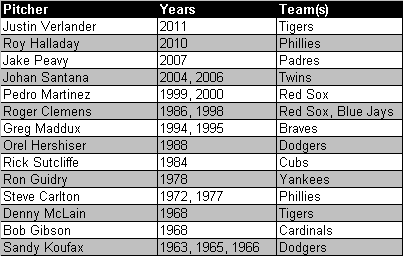
Source: mlb.com
This year’s MVP vote in the American League could be among the closest ever. In addition to prominent candidates from most of the contending teams, Jose Bautista had another phenomenal season, so there is no lack of deserving winners. However, most of the attention has revolved around whether Verlander could, or should, win both the MVP and the Cy Young.
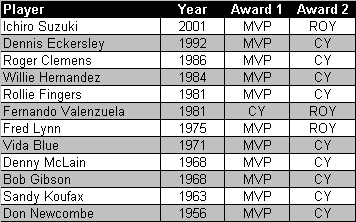
In the 55 years of concurrent history between the two awards, nine pitchers have been named both Cy Young and MVP, and of that total, three of the last four have been relief pitches. So, needless to say, the BBWAA has been at least a little reluctant to give the MVP to a player who takes the field less than 40 times per season. But, was Verlander’s 2011 campaign strong enough to mitigate that reticence?
Players Who Have Won Two Major Awards in One Season
Source: mlb.com
Regardless of where you come down on the Pitcher-as-MVP debate, Verlander stands on the verge of an even more select accomplishment. Should the Tigers’ right hander add to his trophy case next week, he’ll join Don Newcombe as the only player to be honored as a RoY, Cy Young, and MVP. The Newk, who was voted the top rookie in both leagues for 1949, was named MVP and Cy Young five seasons later in 1956 (he missed three years to his service in the Korean War). If Verlander is similarly honored, he will have taken the same path to join Newcombe.
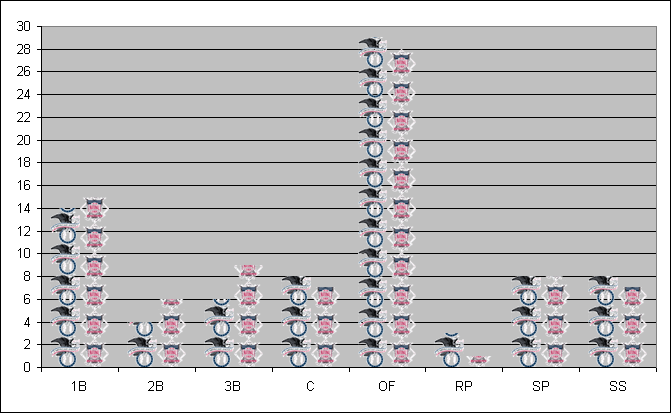
In the National League, the MVP race seems to be a two horse race, with Ryan Braun having the edge over Matt Kemp because of the relative success of his team. If the two players do finish 1-2, it would be appropriate for several reasons, not the least of which is both men recently signed mega-contract extensions that will pay them over $20 million per season into the next decade. Needless to say, the Brewers and Dodgers will be hoping this isn’t the last time Braun and Kemp find themselves atop the MVP balloting.
MVP Winners, by Position and League
Note: Players considered only at the position they played the most.
Source: mlb.com
The baseball awards season not only provides a cap on the current year, but also the perfect segue into the Hot Stove. Before too long, fans will be digesting their team’s winter acquisitions and projecting which players are poised for a break-out season. Among that group could be next year’s major award winners, but those future Cy Youngs, RoYs and MVPs will have to wait. The spotlight still belongs to this year’s Boys of November.

Some baseball stuff.
Over at Fox Sports, Ken Rosenthal weighs in on the search for a new manager in Boston.
Meanwhile: a look at the Mets’ new uniforms; Eric Chavez wants to play next year; Ben Kabak on Yu Darvish; Steven Goldman on Ivan Nova, and William J on Joe Girardi’s lack of support for Manager of the Year.
[Photo Credit: Oyl in Tokyo]

I’m always amazed how quickly time goes by. Another example hit me last week, when I realized that it has now been ten years since former Yankee broadcaster Frank Messer died. He passed away at the age of 76 in November of 2001, succumbing to a combination of heart problems and an ongoing battle with lupus.
In many ways, Messer is the forgotten Yankee broadcaster. In contrast to Bill White and Phil Rizzuto, his longtime broadcast partners on WPIX TV and various radio stations, no one talks about Messer anymore. It’s understandable that fans who are younger than 35 don’t remember Messer; they likely would never have heard one of his broadcasts. But even fans my age (and older) have placed Messer in a far-away corner of their minds.
Messer was never as popular as Rizzuto or White, but he had a career that is worthy of note. A native of Asheville, North Carolina, Messer joined the Marine Corps and served in the South Pacific during World War II. After a successful tour of duty that ended in 1946, Messer entered the field of broadcasting and eventually went to work as a disc jockey for a country western radio station. His baseball career finally began in 1954, when he entered the broadcast booth for Richmond, a minor league team in the Triple-A International League. During his tenure in Virginia, Messer won the state’s “Sportscaster of the Year” Award three consecutive years.
In 1964, Messer earned a promotion to the major leagues, joining the Orioles as one of their play-by-play men. He also dabbled in football, working radio broadcasts for the NFL’s Baltimore Colts. In 1968, Messer switched affiliations when he joined the broadcasting crew of the Yankees, replacing former major league catcher Joe Garagiola. Messer teamed with Rizzuto and Jerry Coleman–both former Yankee players–as the team’s regular announcers. (And yes, I am shuddering at the idea of “The Scooter” and Coleman working the same broadcast booth.)
Prior to the 1971 season, the Yankees made a milestone change in the history of baseball broadcasting. They replaced Coleman with Bill White, a retired first base standout with the Giants, Cardinals and Phillies and a man with no previous connection to the Yankee franchise. White became the first African American to broadcast a major league team’s games at the local level. The trio of Messer, Rizzuto, and White would become synonymous with Yankee broadcasts over the next 14 seasons, splitting play-by-play and color duties on both radio and WPIX television.
Messer took on the role of Bud Abbott, playing straight man to the two former players. With Messer providing smoothly efficient play-by-play, Rizzuto and White became free to take on more colorful and often comedic broadcast roles, while also offering the perspectives of former star players. The trio became one of the most popular broadcast combinations of all-time, remaining a team until 1984, when Messer ended his tenure in New York.
Working amidst the popular three-man crew that announced Yankee games during that span, Frank Messer was unquestionably the least favored amongst the pinstriped faithful. Yet, that’s more of a tribute to the enormous popularity of Rizzuto and White than it is a genuine blemish against the record of Messer.
Rizzuto and White drew most of the attention, in part because they were former athletes with bigger names, and in part because of their tendency to toss barbs at each other. At times, they could provide hysterical listening. Messer supplied the basics needed in a solid television or radio broadcast. He had a pleasant voice, a smooth play-by-play style, and a small ego, the latter enabling him to accommodate the colorful storytelling of Rizzuto and the insightful analysis of White.
Although the Rizzuto/White combination provided the best listen of any of the three tandems the Yankees commonly used on TV, Rizzuto and White also worked well with Messer. They each had freedom to roam, thanks in large part to Messer’s understated style. Additionally, nine innings of Rizzuto and White might have produced overkill; Messer’s presence for six innings gave the broadcast balance and clarity, while also making listeners appreciate the entertainment value of the more dynamic Rizzuto and White.
Though it was not the principal part of his job description, Messer also added a dignified presence to the Yankees’ popular Old-Timers’ Day events. An articulate announcer and a skilled emcee, Messer elegantly performed his master-of-ceremonies duties in introducing Yankee greats during the seventies, eighties, and nineties. Although he didn’t match Mel Allen (something that few could have done), he nonetheless excelled in a humble, simplified way, enabling him to blend in so well with the festivities of the day. As great as Old-Timers’ Day remains, it’s not quite the same without the presence of Messer.
If there was a legitimate criticism of Messer, it was that he tended to stray far from controversy, which was in plentiful supply during the George Steinbrenner/Billy Martin/Reggie Jackson years. Messer usually treated Yankee conflicts with a see-no-evil attitude, if he didn’t ignore them completely.
On the whole, that’s a relatively small strike against a solidly professional play-by-play man who did such dutiful work in New York for more than a decade. He did the job, while never complaining about being the third wheel to Rizzuto and White. If nothing else, Frank Messer should be remembered for that.
Bruce Markusen writes Cooperstown Confidential for The Hardball Times.
[Photo Credit for featured image: Alex Alexander]

Jorge Posada’s Yankees career has come to an end, at least that’s what he seems to think. Considering Brian Cashman has not even reached out to discuss a reduced role with his long-time catcher, chances are Posada’s hunch is probably right. There’s always a possibility, albeit slim, that the Yankees could decide Posada still fits into their plans for 2012, but if this really is the end of his time in pinstripes, we can finally take a look back over his long career and truly appreciate just how much he has meant to the organization.
Average WAR During the Current Yankees’ Dynasty, 1996-2011
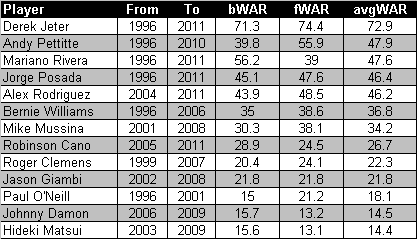
Note: avgWAR = (bWAR + fWAR)/2
Source: baseball-reference.com and fangraphs.com
Since 1996, when the current Yankees’ dynasty was born, only Derek Jeter, Andy Pettitte and Mariano Rivera contributed more to the team than Posada, at least in terms of average WAR. Of course, you really don’t need a sophisticated sabermetric to illustrate how important Posada was to the franchise’s incredible success over the span of his career. He really was a core member of the Yankees. That wasn’t just a clever marketing slogan.
The magnitude of Posada’s contribution to the Yankees is impressive even beyond the context of the era in which he played. Again using average WAR as a barometer, only 10 position players have contributed more to the pinstripes, and, needless to say, the company is rather select. By just about any measure, it isn’t a stretch to say that Jorge Posada is one of the greatest Yankees to ever play the game, and many of the players worthy of that distinction also happen to be in the Hall of Fame.
Yankees Top-15 Position Players, Ranked by Average WAR
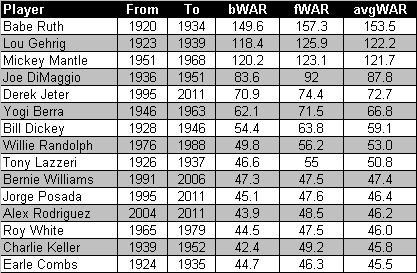
Note: avgWAR = (bWAR + fWAR)/2
Source: baseball-reference.com and fangraphs.com
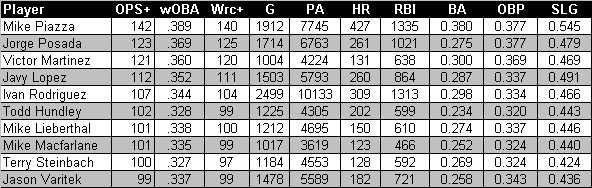
Although some might dispute the notion of Posada as Cooperstown worthy, his credentials are compelling. Unfortunately for the Yankees’ backstop, his career happened to coincide with arguably the greatest offensive (Mike Piazza) and defensive (Ivan Rodriguez) catchers to ever play the game, so it’s easy to see why he is sometimes overlooked when making Hall-worthy assessments. Despite these formidable contemporaries, however, Posada’s statistical record still stands out.
Comparing Catchers, 1990-2010
Note: Players with at least 1,000 games, two-thirds of which were as a catcher.
Source: Baseball-reference.com and fangraphs.com
During the 20-year period from 1990 to 2010, Posada’s OPS+ of 123 ranks second only to Piazza’s 142 (among players with at least 1,000 games, two-thirds of which were as a catcher). The same is true for his wRC+ and wOBA. Based on more traditional stats, Posada also distinguished himself during the period, ranking tied for first in on base percentage and third in home runs and RBIs. As a result, Posada won five silver sluggers behind the plate, the fourth highest total amassed at the position. Although some catchers, such as Joe Mauer, have had better rates over a shorter horizon, Posada’s longevity is also a feather in his cap. In the 20-year span under consideration, only four others have started more games behind the plate, which is remarkable considering how slowly the Yankees eased him into the starting role.
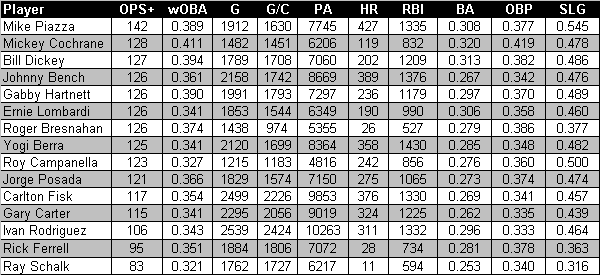
Jorge Posada vs. Hall of Fame Catchers and Likely Inductees
 Note: Likely inductees include Mike Piazza and Ivan Rodriguez.
Source: Baseball-reference.com and fangraphs.com
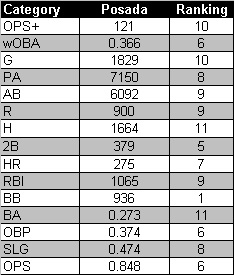
There are currently 12 primary catchers elected to the Hall of Fame, making it the most underrepresented position on the diamond. However, even despite this very select company, Posada’s career totals still figure prominently among catchers already enshrined or almost certain to be. In the chart below, Posada’s relative rankings in several offensive categories are provided. Although a rudimentary analysis, it shows that Posada can stand toe-to-toe as a hitter with every other Hall of Fame backstop but Piazza.
Posada’s Ranking Among Hall of Fame Catchers and Likely Inductees
Note: Likely inductees include Mike Piazza and Ivan Rodriguez.
Source: Baseball-reference.com and fangraphs.com
As a hitter, Jorge Posada’s Hall of Fame credentials seem undeniable, so the deciding factor could be his work behind the plate. Defensive metrics are relatively unreliable in general, but for catchers, they are severely limited. For that reason, it’s likely that Hall of Fame voters will rely on reputation. Because of how rapidly his catching skills declined at the end of his career, that might seem like a liability for Posada, but during his prime, the backstop was often regarded as being an above average defender. If that’s the prevailing sentiment when Posada’s name comes finally appears on the ballot, his chances of being enshrined would be greatly bolstered.
“I see vintage Jorge Posada, everything we expect. He’s one of the best catchers in baseball and he has been. He’s an offensive and defensive catcher. This is what I expect, this is what he is and this is what he’s been. This guy is going to go down as one of the famous Yankee catchers, along with Yogi Berra, Bill Dickey, Elston Howard and Thurman Munson.” – Brian Cashman, quoted in the New York Daily News, August 8, 2006
How will Jorge Posada be remembered? Despite often being overlooked on a team chock full of talent, Posada’s contribution to the Yankees’ dynasty is undeniable. He is more than deserving of all the accolades usually bestowed upon a Yankees’ legend. His number 20 should never be worn again, and his plaque for Monument Park should soon be minted, but perhaps the most meaningful honor is the special place he occupies in the memories of an entire generation of Yankees’ fan. They won’t soon forget how great Posada really was. Hopefully, the Hall of Fame voters will remember too.

Last night, Jorge Posada told reporters: “I don’t think there’s even a percentage of a chance that I can come back,” Posada said. “It’s not going to happen.”
We’ve talked about Posada’s fine Yankee career a lot this year. Tomorrow, William J will weigh-in on Posada’s case for the Hall of Fame.

I was flipping around the channels the other day and found a baseball game on the MLB Network. And there was Robinson Cano playing for the American team in Taiwan. It took me a moment to adjust to seeing him in uniform. It was like seeing someone still wearing their Halloween costume. Then I wondered, “Hey, should you be playing? Don’t guys get tired or hurt if they play in November?”
But I remembered that he’s a professional baseball player and that’s what he does. Then Cano smiled and I felt relieved and turned back to the football game.
Over at YES, Jack Curry has a little piece on Cano in Taiwan.
[Photo Credit: Washington Post]

November is trophy season in major league baseball. The most anticipated awards, like the MVP and Cy Young, come later in the month, but for fans already suffering from withdrawal, the most immediate baseball fix comes in the form of silver and gold. Although the Gold Glove and Silver Slugger aren’t taken that seriously (after all, the two awards are basically a marketing gimmick for Rawlings and Hillerich & Bradsby, respectively), the selections, which this year were announced live on ESPN and the MLB Network, still generate considerable reaction. Unfortunately, particularly in the case of the Gold Glove, most of it seems to be negative.
This year, the Gold Glove selections were not as controversial (mostly thanks to Derek Jeter not winning one). In fact, five of the well respected Fielding Bible Award winners were also awarded with a Gold Glove. However, there were some glaring omissions, the most obvious being Yankees’ left fielder Brett Gardner. By just about every measure, Gardner was not only the best left fielder in the game, but he also ranked among the best outfielders. According to the Field Bible, the Yankees’ speedster tied centerfielder Austin Jackson, who was also denied a Gold Glove, for the most defensive runs saved at 22. That’s an extraordinary total for the center of the diamond, but for a corner position, it’s off the charts. Gardner also topped major league outfielders with a UZR/150 of 29.5, almost doubling the total of Jacoby Ellsbury, who finished a distant second among qualified candidates. Although UZR is a much less reliable metric, the extent to which Gardner led all others was significant. Unfortunately for the Yankees’ left fielder, the Gold Glove voters weren’t that impressed.
The Yankees had two other Gold Glove candidates make it to the “final three” (a new feature of the award) at each position, but Robinson Cano and Mark Teixeira were bested by their Red Sox counterparts. Unlike Gardner’s snub, however, the omission of Cano and Teixeira were well within reason. As a result, one year after tying a franchise record with three Gold Gloves, the Yankees were shutout for only the fifth time since 1982. Although it’s probably no consolation to Gardner, what the Yankees missed out in gold, they made up for in silver. Both Cano and Curtis Granderson were among the A.L.’s recipients of the Silver Slugger, which honors the best offensive player at each position.
Silver and Gold: Yankees’ Award Winners, Total by Year

Source: mlb.com
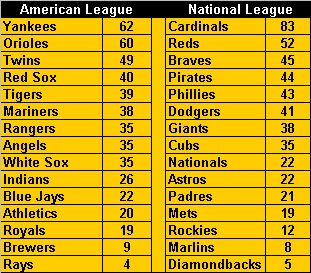
Since the Gold Glove was first awarded in 1957, the Yankees have had the second most honorees, behind only the St. Louis Cardinals, who enjoy a comfortable lead over the field with an impressive 83 trophies. At the other end of the spectrum is the Milwaukee Brewers, which makes the team’s traditional ball-in-glove logo somewhat ironic. Since joining the majors as the Seattle Pilots in 1969, the Brewers have had only nine Gold Glove winners, all coming while the franchise was in the American League.
Most Gold Glove Awards, Sorted by League
Source: mlb.com
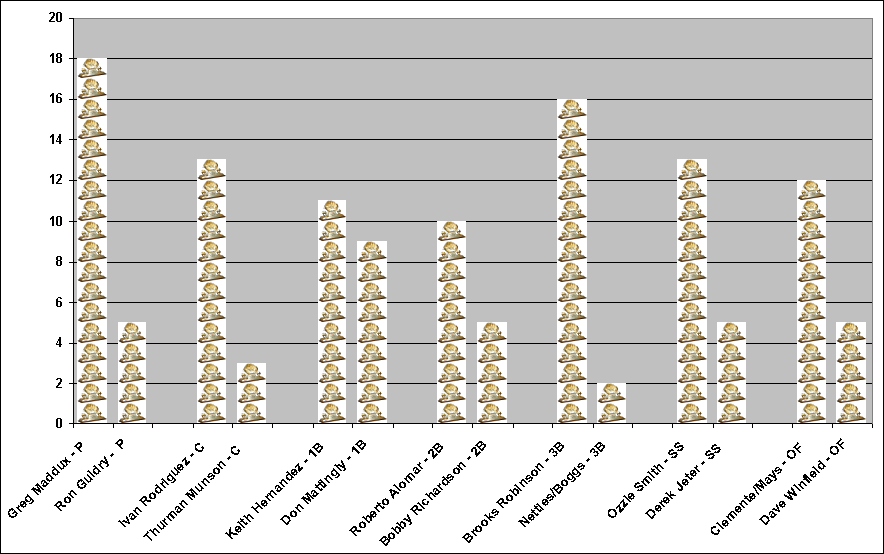
For perspective, 16 individual players won more Gold Gloves than the entire Brewers’ franchise, including Greg Maddux, who won twice as many. No other player in history has been honored more often than the future Hall of Famer pitcher, who, in addition to racking up over 300 wins, managed to take home 18 Gold Gloves. Among position players, the most gilded glove belonged to Brooks Robinson, who won 16 at third base. The most decorated Yankees player was Don Mattingly. The Captain won nine Gold Gloves at first base during his time in pinstripes, almost doubling the franchise’s next highest total of five, which is shared by Ron Guidry, Derek Jeter, Bobby Richardson and Dave Winfield.
Most Gold Glove Awards by Position, Yankees and All-Time
Source: mlb.com
The Silver Slugger is usually overshadowed by the Gold Glove, but in recent years has started to gain more exposure, including a dedicated announcement show that aired on the MLB Network. Unlike its defensive counterpart, the Silver Slugger involves more than just subjective peer review. Rather, it is based on a combination of statistics as well as the general impressions of managers and coaches. Because of this more balanced approach, the Silver Slugger selections are seldom as controversial. Then again, part of the reason for that may be the relative indifference expressed toward the award.
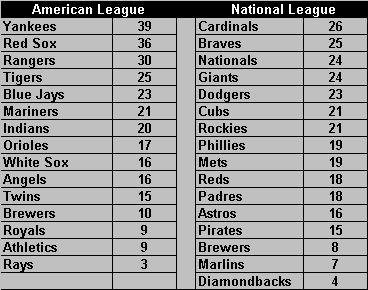
Even if the Silver Slugger doesn’t carry much cachet, it’s still an honor to be named the best offensive player at a particular position. Since it was given out in 1980, the Yankees have had 39 players deemed worthy of that distinction, more than any other team. Meanwhile, among teams in existence during the entire tenure of the award, the Athletics and Royals ranks dead last with only nine.
Most Silver Sluggers, Sorted by League
Source: baseball-almanac.com
Barry Bonds holds a number of high profile records, so it shouldn’t come as a surprise that he is also the owner of the most Silver Sluggers with 12. Not too far behind are Mike Piazza and Alex Rodriguez, who each have 10. However, Arod has the further distinction of winning his at third base (3) and shortstop (7), making him the only player to win multiple awards at two different defensive positions. In addition to Rodriguez, 11 other players have won at least one Silver Slugger at two defensive positions (not including DH and with no differentiation for the outfield), including Albert Pujols and Miguel Cabrera, who are the only players to be honored at three places on the diamond.
Most Silver Slugger Awards by Position, Yankees and All-Time

Source: baseball-almanac.com
Even though many baseball fans claim not to care about the Gold Glove and Silver Slugger, both awards have endured for a significant period and, by doing so, become a part of the game’s historical record. Despite this, some will probably still accuse me of digging too deeply into a mundane topic, or mining too hard for content in the off season. That’s probably true, but it doesn’t mean a review of baseball’s metallurgical record is completely without merit. For example, if someone can answer how the 1985 Yankees managed to win seven combined Gold Gloves and Silver Sluggers without a winning the division, it will have all been worthwhile.

By Bruce Markusen
This is the only Topps card that shows Matty Alou as a Yankee. Upon first look, most fans are struck by the enormity of the Yankees’ “NY” logo. But it’s not the actual Yankee logo; it’s been airbrushed onto the photograph, along with the Yankee pinstripes and the navy blue cap. The artist who did the airbrushing simply overestimated the size of the interlocking “NY.”
In the actual photograph that Topps used, Alou is wearing the colors of the A’s, with the Oakland Alameda County Coliseum providing the backdrop. Alou spent the latter half of the 1972 season with the A’s, and played a subtle role in helping Oakland win its first world championship, before being purged by Charlie Finley in a cost-cutting maneuver. Without any photos of Alou in Yankee pinstripes, the people at Topps opted for the old airbrushing route.
All these memories of this card come back to me with the news of Alou’s death. He passed away on Thursday at the age of 72, apparently from the effects of diabetes. This is particularly hard news for me because Matty Alou was one of my favorite players. Though he only played part of one season with the Yankees, he was a guy who left me with a boatload of memories from various points throughout his career.
Why did I like Alou so much? I think part of it has to do with his unconventional hitting style. He used a very unorthodox style at the plate–he swung a heavy bat, often hit off his front foot, and blooped a lot of singles to the opposite field–all of which made him intriguing. Ted Williams, the most scientific hitter in history, used to say that Alou broke every rule of batting, but somehow managed to succeed. And unlike Williams, Alou was an extremely aggressive hitter who didn’t walk all that much. But the man could hit singles with the best of them. Alou batted for a very high average, which coupled with his base stealing ability and the speed that allowed him to go first to third, made him a useful player.
Alou began his career with the Giants, where he had the privilege to play in the same outfield with his older brother Felipe and his younger brother Jesus. But Matty never found his way in San Francisco. It was not until he was traded to the Pirates, where he worked with manager Harry “The Hat” Walker on his hitting. The Hat completely retooled Alou’s approach, and to his credit, Alou openly accepted the advice.
The results were undeniable. In 1966, Alou batted .342 to lead the National League. In his next three seasons, he batted .338, .332, and .331. That represents one of the great four-year stretches a hitter has ever experienced. Alou was also a very good center fielder with range and a plus arm, making him a fairly complete package in Pittsburgh. All that he lacked was power.
By the time that Alou joined the Yankees in 1973, he was no longer the same player. Injuries robbed him of his arm strength, while slowing bat speed erased his abilities as a .330 hitter. But the Yankees felt he could help fill a void in right field. The Yankees were set in the other outfield spots–Roy White played left and Bobby Murcer starred in center–but right field had become a problem. Alou stabilized the position somewhat, though he lacked the arm or the ideal amount of power that once expects from a right fielder. He also made 40 appearances at first base, something he had done previously with the Cardinals. At five feet, nine inches, Alou looked odd playing first base; he could have used a phone book to stand on first base and corral high throws from Gene Michael and Graig Nettles.
Alou hit well for the Yankees, batting .296 with an on-base percentage of nearly .340. If the Yankees remained in contention, Alou would have lasted the entire season in New York. But the Yankees fell out of the pennant race, convincing them to try a late-season youth movement. So they sold Felipe Alou to the Brewers and sold 34-year-old Matty to the Cardinals, ridding themselves of two expensive contracts in the process. And that was it for Matty Alou in pinstripes.
As it turned out, Alou did not have much left in his hitting tank. He batted only .198 for the Padres in 1974, but he did not want to call it quits. So he headed to the Japanese Leagues, where he put in three seasons before retiring.
Alou was still playing in the Far East by the time the Yankees became good again and won back-to-pennants in 1976 and ‘77. Like so many of my favorite old players, like Johnny Callison and Walt “No-Neck” Williams and Jim Ray Hart, he did not last long enough to see the glory years in pinstripes.
But at least fun players like Matty Alou made those lean years of the early 1970s a little more bearable for a Yankee fan like me. For that, I will be ever grateful to Matty Alou. Rest in peace, Matty.

Brian Cashman is signed through 2014.
“Not a big fan of Cash any more, but I do have to give him credit for this year. The Yanks had a strong bench, great bullpen, above average starting pitching. Ironically, in the end, it was the Yanks’ hitting that led to the Yanks elimination.”
— Comment from Banterer Dimelo
The task of presenting an even-handed critique of the man we affectionately call “Cash Money” is surprisingly difficult. On one hand, there’s a record of success — six World Series appearances, four titles — only surpassed by George Weiss (no relation) and Ed Barrow. But there’s the counterargument that it’s easy to be successful when you work for a billion dollar enterprise and can show up, put pictures on a corkboard, affix a few stacks of bills to a sharp object and pick your target.
That perception is not reality.
Consider the pressure cooker. The expectation to win the World Series every year. That standard is set at the Steinbrenner level and trickles down to the fiber of each individual working in the organization. The work conditions, to put it diplomatically, are less than ideal. Forget the Steinbrenner factor for a second. Add Randy Levine, Lonn Trost, and the Tampa Brain Trust, and you have difficult politics to negotiate. This dynamic begat the most common criticism levied against Cashman: that he hasn’t built a team from scratch; that he wasn’t the one making the personnel decisions.
There is evidence to support that theory. Cashman was the beneficiary of the work done by Stick Michael and Bob Watson. Draft picks like Bernie Williams, Derek Jeter, Andy Pettitte, Mariano Rivera, and Jorge Posada had either blossomed or were maturing. Acquisitions like Paul O’Neill and Tino Martinez were already in place. Yes, he inherited a great team. It was made an all-time team when the Yankees traded Brian Buchanan, Eric Milton, Cristian Guzman, Danny Mota and cash to the Minnesota Twins for Chuck Knoblauch. Scott Brosius was picked up off the scrap heap to solidify third base. Those two moves alone proved to be a resounding introduction for the GM lauded as a Boy Wonder long before Theo Epstein.
But looking at Jason Giambi, Randy Johnson, Raul Mondesi, David Wells Part 2, Carl Pavano, Jaret Wright. Do those moves have Cashman’s stamp?

The tension led to Cashman having a Howard Beale moment at the end of the 2005 season. He considered leaving. Eventually, the gentlemen on the rung above Cashman decided to give him more autonomy, and he signed the extension that carried him through the 2008 season.
That winter, he signed CC Sabathia, AJ Burnett, Mark Teixeira and Nick Swisher to boost a team that had missed the playoffs for the first time since the 1994 strike. The 2009 World Championship team was all Cashman. Critics say he bought the title. But many youngsters on that team — Robinson Cano, Chien-Ming Wang pre-injury, Joba Chamberlain, and Phil Hughes — were able to have an impact because Cashman refused to trade them when presented the opportunities in previous years. Either Wang, or Cano, or both, were on the block for Randy Johnson and Johan Santana. Hughes was dangled as a chip as well. That season was the fruit of Cashman’s efforts to build the farm system.
In recent years, the Yankees have had depth. Instead of Tony Womack or Clay Bellinger, there was Jerry Hairston Jr., and Eric Chavez. Instead of John Vander Wal, there was a homegrown Brett Gardner, and Andruw Jones.
Perhaps the greatest difference in Cashman in the last six years of his tenure is his demeanor. There is a confidence that Cashman openly displays. He speaks to the media more directly and is more of a mouthpiece than he used to be. In some cases, the hard demeanor has backfired. The PR gaffes regarding the management of Bernie Williams’ exit, his silence during the Joe Torre negotiations following the 2007 playoff exit, the Joba Rules and everything that has occurred on that front, the Derek Jeter negotiations taking place in the media, and the Jorge Posada drama this past season all reflect negatively on Cashman. He whiffed on Cliff Lee not long after Lee whiffed the Yankees as a Texas Ranger.
And there are still moments when stories surface that Cashman’s authority has been overridden: The most glaring examples are 2007, when Hank Steinbrenner negotiated directly with Alex Rodriguez when A-Rod opted out of his contract; and last winter when Cashman said publicly he did not want to sign Rafael Soriano, and then lo and behold, Soriano was a Yankee and the heir apparent to Rivera, begrudgingly pitching the eighth inning a season after leading the AL in saves.
The three-year extension made official on Tuesday is the second since that “I’m mad as hell and I’m not going to take it anymore” manifesto. If you believe Wally Matthews, the Yankees are meandering. They have no direction. A few recent moves would indicate otherwise: Sabathia is re-signed; Swisher’s option was picked up; Andrew Brackman has gone the way of the parrot in the Monty Python skit. Rafael Soriano’s option, according to reports, is likely to be exercised. Looks like the first priority is shoring up what you have before filling in the gaps.
Priorities are being set. Now that Cashman is settling back in, he can begin establishing the direction, which he has said is pitching. Twenty-nine other teams are doing the exact same thing.
We have seen Brian Cashman grow from Boy Wonder to steely-eyed fortysomething. The winter following Cashman’s last extension featured the biggest spending spree ever. What he spends — or doesn’t spend — could define the remainder of his career in New York.
Only Barrow, who lasted 24 seasons, had a longer tenure than Cashman. When faced with the question, “Who else could do this job?” Weighing all the factors, given what he’s endured, and how well he understands the central nervous system of the New York Yankees, it may be that Brian Cashman is the best person for the job. He is, at least, for three more years.

The Yanks cut Andrew Brackman loose today. Over at the Pinstriped Bible, Steven Goldman has more.