Seen in the bathroom of a bar in the East Village.

In case you’d forgotten: Dylan is the Still King.



Seen in the bathroom of a bar in the East Village.
In case you’d forgotten: Dylan is the Still King.

A rare MC Lyte Joint (Featuring Milk D): The Emcee.
This one is for Chyll Will, Ms. October and Dimelo. Nod your head, my dudes, it’s Monday.

Two riveting, heartbreaking games today. A day of pain for the Harbaugh family (oh, the agony of defeat), and the Giants and Pats will meet in the Super Bowl again.
Congrats to both teams. The Giants, man what a great effort, running through Green Bay and now San Francisco. My gut says that Tom Brady ain’t losing to Big Blue twice but he doesn’t play defense and it would be foolish to underestimate Eli Manning and his Giants.
Great day of football.

And how about a little love for Johnny Otis?
Rest in Peace. A master.

Dig the range:
[Drawing by Larry Roibal]

Saturday night in New York. The snow has stopped. Perfect night to dip out to the movies or to stay home, lay on the couch and read a book, watch a movie, order takeout. Or maybe fix up a soup or a stew or something that is stick-to-your-ribs good.
NFL championship games tomorrow. The Amazing Knicks back in action tonight. Feel free to kibbitz about whatever comes to mind. In the meantime, check out this cleverness:
[Photo Credit: It’s Johnson!]

Snow in New York.

Dig this one: 07 How Deep is the Ocean.
And this: Etta James – You ‘ve Changed.
[Photo Via: It’s Johnson!]

Feeling blue?

Need a pick-me-up?

Try Charles Simic’s Buster Keaton Cure:
Charlie Chaplin’s bum is at the mercy of a cruel world. Keaton, with his impassive face and a hat flat as a pancake, is a stoic. He confronts one setback after another with serenity worthy of a Buddhist monk. In one short film, “The Goat” (1921) he’s standing on the sidewalk behind two tailor’s dummies, under the impression that they are at the end of a bread line. When he discovers his mistake, he moves on quietly.
Keaton’s movies were a big success in Europe since his type of comedy doesn’t need a translation. I first saw one of his shorts in occupied Belgrade during the Second World War. I liked him instantly. His films are full of remarkable acrobatic stunts. Keaton started out in vaudeville when he was four years old working with his parents, whose comedy act included a lot of roughhousing; he was thrown by his father across the stage and sometimes even at the hecklers in the audience.
Ah, Buster. My hero.


Check out these beautiful photographs by Andrea Gentl over at the lovely site Hungry Ghost (food+travel).


[Photo Credit: Nina Ai-Artyan]
Dial “W” for murder.

A photo gallery of Weegee’s murder photography over at the most wunnerful How to be a Retronaut.

Here’s another Weegee gallery, this one at the New York Times.

Saw me mudda last weekend in Vermont. She came over to the in-law’s and brought two apple pies. Dag, were they ever good.


Top 10, 20, or Top 100 lists are superficial and dopey. In the right hands, however, they can also be a ton of fun. Especially when the author embraces the silliness of it all, like Bill James does over at Grantland in his list of the 100 best pitchers’ duels of 2011 (“My list of the 100 best pitchers’ duels of 2011 is better than your list, for one reason and one reason only. You don’t have any list.”).
Dig in.

Here’s a selection of some of Jack’s Greatest Hits, the temper-temper blowups. They are obvious, and perhaps uninspired, highlight reel selections, yet still damned entertaining.
Easy Rider:
Five Easy Pieces:
Carnal Knowledge:
The Last Detail:
Chinatown:
Here’s the ballgame scene in Cuckoo’s Nest.
The Shining:
Terms of Endearment:

Coming close to the dead of winter. Not much doing for the Yanks as they wait to finalize the Pineda-Montero trade. Here’s a throwaway piece by Alvaro Morales at ESPN featuring Alex Rodriguez. Over at River Ave Blues, Ben Kabak makes a brief (and flimsy) case for Johnny Damon. And at It’s About the Money, Stupid, Chip Buck has an informative Q&A with Jim Callis of Baseball America.
Otherwise, it’s cool and quiet round here. Snow coming tonight.


Check out this fun gallery of sports posters from the 1980s over at SI.com.

Kenny Easley was my man.


Whenever a team makes a trade involving a young prospect, there’s always a fear he’ll wind up becoming a superstar. Considering the potential of Jesus Montero, that concern had to be foremost on Brian Cashman’s mind as he agreed to send the young hitter to the Seattle Mariners in exchange for Michael Pineda, a very promising prospect in his own right.
Years ago, before the information age, prospects seemed to magically appear on the doorstep of the major leagues. Nowadays, however, fans have the ability to track a player’s progress from the moment he is drafted until he takes his first pro at bat, so it’s easy to understand why many develop an attachment to homegrown prospects. And yet, in most cases, the pent-up anticipation usually leads to disappointment.
Since 1901, 379 position players (includes actives) have made their major debut in pinstripes, but only 52 ended their careers with a WAR higher than 15. Of that subtotal, all but 13 either spent most of their careers with the Yankees or were traded after establishing themselves in the big leagues, including 20 of the top 21 on the list. So, for the most part, the Yankees have been pretty good at not giving away their best position player prospects.
The Ones That Got Away
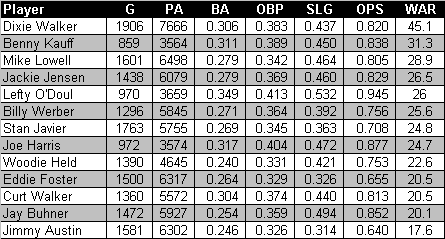
Note: Includes players with a WAR greater than 15 who were traded by the Yankees early in their careers.
Source: Baseball-reference.com
The only discarded Yankee whose career WAR would rank among the franchise’s best homegrown talents is Dixie Walker. After compiling only 422 plate appearances in five seasons with the Yankees, the 25-year old Walker finally blossomed after being sold to the White Sox for $12,000 in 1936. At the time, the Yankees were a powerhouse team about to embark on a four-year championship run, so there was little room for Walker. However, the move still proved to be short sighted, but not until two other teams also passed him over. Once Walker landed in Brooklyn, his career finally took off. In nine seasons as a Dodger, the outfielder compiled an OPS+ of 128 and received MVP votes in seven years. Admittedly, most of Walker’s success came during the war years, but that makes his loss even more regrettable from the Yankees’ standpoint. Had the team not traded him so many years earlier, perhaps Walker’s presence in the lineup would have helped the Bronx Bombers weather the loss of so many others to military service and avoid what for the Yankees was a long World Series drought from 1944 to 1946.
Mike Lowell’s ranking on the list is perhaps the most relevant in light of recent news because, like Montero, he was traded as part of a prospect swap. At the time, the Yankees had a stacked offensive team and decided to make a new three-year commitment to 3B Scott Brosius, which made Lowell expendable. Unfortunately, Ed Yarnall, the pitcher the Yankees received in return, didn’t exactly pan out. After only 20 innings in the Bronx, the lefty was traded to the Cincinnati Reds before departing forJapan. Needless to say, Cashman is hoping Michael Pineda does a lot better.
Like Lowell, Jackie Jensen is another discarded Yankee who eventually made his bones in Boston. In 1951, Jensen had a very strong campaign in limited duty, which he parlayed into being named Joe DiMaggio’s replacement the following year. Unfortunately for Jenson, that honor was short lived. In fact, it only lasted seven games. After hitting .105 during the first week of 1952, Jensen was traded to the Senators for Irv Noren. In the aftermath of the deal, Casey Stengel admitted that Jensen had talent, but stressed the Yankees’ need for a centerfielder who could “hit, run, field, and throw”. Of course, the irony was the Yankees already had someone on the roster who fit the description. His name was Mickey Mantle.
“We need a centerfielder who can hit, run, field and throw. I tried to give Jensen the job, but he couldn’t hit for me. I couldn’t wait any longer.” – Casey Stengel, quoted by the New York Times, May 4, 1952
Less than a month after the trade was made, Mantle was installed as the new center fielder and Noren was reduced to playing a utility role. Meanwhile, Jensen started to find his swing with the Senators, leading AP to suggest that the Yankees “pulled a whopper” by making a rare bad trade. Despite two solid seasons in Washington, Jensen really made his mark with the Red Sox. In seven seasons with Boston, the outfielder compiled an OPS+ of 123 and punctuated his career with an MVP in 1958.
Although his name appears at the bottom of the list, Jay Buhner probably stand outs to most fans as the best example of the Yankees trading away a promising young hitter. Seinfeld is largely to thank for that, but Buhner’s OPS+ of 125 with the Mariners wasn’t a work of fiction. Adding insult to injury, Buhner also tormented his former team on the field, batting .283/.379/.548 in over 400 regular season plate appearances to go along with a line of .366/.422/.537 in three post season series.
Top-10 OPS+ by Yankees in Their Debut Season
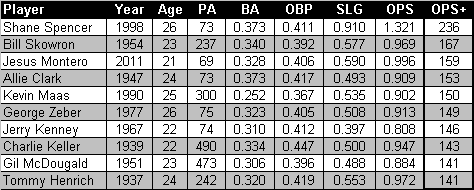
Note: Based on a minimum of 50 plate appearances.
Source: Baseball-reference.com
Albeit in only 69 plate appearances, Jesus Montero had the third highest OPS+ among all position players who debuted with the Yankees. That might seem like a bad omen, but he is surrounded on that list by more than a few players whose careers proved to be disappointments. Will Jesus Montero also follow that path, or join (and perhaps top) the list of young players who excelled after being trading by the Yankees? I wonder what Larry David thinks?

“My Daddy’s Gun,” Print by Emory Douglas