"A New York Treasure" --Village Voice
Category: 1: Featured

Have At It

According to two reports (Buster Olney, Joel Sherman) that I found via Craig Calcaterra at Hardball Talk, the Yankees have agreed to a 1-year, $1 million deal with Raul Ibanez. He’ll be the left-handed DH presumably and will be able to play the field if the need arises. I haven’t heard any Yankee fan or analyst that likes the move and perhaps they are right. I just can’t get myself too worked-up over the part-time DH. If he’s a bust, they cut him and make a move later in the season, cause that’s how they roll in Chinatown, Jake.

Sundazed Soul: Livin’ Lovely

Pitchers and catchers report today. Chad Jennings has some notes already. The intrepid Marc Carig has more.

It’s gunna be a fun season, for sure.

Meanwhile, the Knicks host the defending World Champs at the Garden this afternoon.

Happy Sunday, y’all.

[Photo Credit: Attimi Rubati]

Saturdazed Soul

Heppy Saturday.

[Picture via Holy Friend]

Fit for a King

Bernard joins Clyde and Breen tonight to call the Knick game.

Hey Now.

A Real Find

I got an e-mail from my pal John Ed Bradley the other day with an attached image of this painting:

I bought the picture at auction in Florida last week. It’s by an artist I collect named Reeves Brace. She died in 1932 at age 34. Her name at birth was Virginia Reeves. She used her last name as her first name when she became an artist and married Ernest Brace–an eccentric but nice touch. Most people just called her “Reeves.” Her husband was a fine writer named Ernest Brace; his brother helped start the publishing firm Harcourt Brace.

Reeves was a member of the art colony up in Woodstock, and she often worked in NYC. She might’ve painted this scene as a magazine illustration. I’ve been collecting her work for years although it is difficult to find and rarely comes up for sale. Her obscurity is largely a result of her early demise. Distraught as a result of a failed marriage and the stress of surviving as an artist during the Depression, she hanged herself by her silk stockings from the bathroom door of a hotel room in New York City.

She was quite the beauty, too. She still had a steady hand when she painted this canvas. I find her fascinating and have long hoped to dig deeper into her life and write about her. For now, I content myself with her oil paintings that hang in my writing studio.

The auction house didn’t identify the location but I think this is Yankee Stadium circa 1930. I think some of the artist’s details tell the story and might help us determine the year it was painted. The ads along the outfield wall (Mrs. Wagner’s Pies, Singing Shaves), the buildings in the background…all should provide clues.

Did deep outfield really have a hump like that where warning track now would be? The artist also gives us the depth of the fence in right and shows how the lime stripe tracked up what looks like a board pole.

I love how the figures with their backs turned to us are dressed. Everyone has his or head covered. The men in fedoras, one with a flower or a card or something in the band. They appear to be wearing jackets.

I asked Glenn Stout–winner of the 2012 Seymour Medal for “Fenway 1912”— when the picture could have been painted and he pegged it somewhere between 1932-34. The “Mrs. Wagner’s Pies” sign was up from ’32-’35, he told me. “Google tells me that a sign that read ‘Ever Ready Blades for Singing Shades’ graced the fence in 1932 (see listing at bottom of page).”

It was either the spring or the fall because the fans were dressed for the cold weather but since there is no bunting it wasn’t a World Series game. And:

There is no warning track, but there always was at Yankee Stadium – an actual running track, and the feature was later adopted elsewhere one they realized it was useful. There was , actually, a short, mild rise in CF and Right Center – past the warning track and the stands – the track didn’t skirt the edge of the stands precisely , but was an oval, so it was in front of the stands in CF and fight center, to stay even. So the painting is not accurate, but merely representative.

Of course, I was able to identify the batter.

What a find by John Ed. I thank him for sharing it with us.

Reeves Brace, third from left: New Paltz, N.Y., 1930

Gary Carter: 1954-2012

For more on The Kid, check out tributes by Greg Prince and Jason Fry at Faith and Fear in FlushingTed Berg over at Ted Quarters, and Jay Jaffe at Baseball Prospectus.

S’Long, Kid

Gary Carter, Rest in Peace.

[Photo Credit: Bernard Brault/AP]

What’s Old is New

I love books. Love them as objects. I want to hold them, sometimes mark them up with a pen, dog-ear the pages. I like to look at them on my shelves at home. I don’t own a Kindle or a Nook but I don’t have any beef with them either. For some people they make all the sense in the world. I think you can like both formats. But this piece by Tim Parks in the New York Review of Books gave me a new appreciation for E-books:

Literature is made up of words. They can be spoken or written. If spoken, volume and speed and accent can vary. If written, the words can appear in this or that type-face on any material, with any impagination. Joyce is as much Joyce in Baskerville as in Times New Roman. And we can read these words at any speed, interrupt our reading as frequently as we choose. Somebody who reads Ulysses in two weeks hasn’t read it any more or less than someone who reads it in three months, or three years.

Only the sequence of the words must remain inviolate. We can change everything about a text but the words themselves and the order they appear in. The literary experience does not lie in any one moment of perception, or any physical contact with a material object (even less in the “possession” of handsome masterpieces lined up on our bookshelves), but in the movement of the mind through a sequence of words from beginning to end. More than any other art form it is pure mental material, as close as one can get to thought itself. Memorized, a poem is as surely a piece of literature in our minds as it is on the page. If we say the words in sequence, even silently without opening our mouths, then we have had a literary experience—perhaps even a more intense one than a reading from the page. It’s true that our owning the object—War and Peace or Moby Dick—and organizing these and other classics according to chronology and nation of origin will give us an illusion of control: as if we had now “acquired” and “digested” and “placed” a piece of culture. Perhaps that is what people are attached to. But in fact we all know that once the sequence of words is over and the book closed what actually remains in our possession is very difficult, wonderfully difficult to pin down, a richness (or sometimes irritation) that has nothing to do with the heavy block of paper on our shelves.

The e-book, by eliminating all variations in the appearance and weight of the material object we hold in our hand and by discouraging anything but our focus on where we are in the sequence of words (the page once read disappears, the page to come has yet to appear) would seem to bring us closer than the paper book to the essence of the literary experience. Certainly it offers a more austere, direct engagement with the words appearing before us and disappearing behind us than the traditional paper book offers, giving no fetishistic gratification as we cover our walls with famous names. It is as if one had been freed from everything extraneous and distracting surrounding the text to focus on the pleasure of the words themselves. In this sense the passage from paper to e-book is not unlike the moment when we passed from illustrated children’s books to the adult version of the page that is only text. This is a medium for grown-ups.

[Photo Credit: Digital Journal]

Camp Bobby

Here’s an ESPN report from the Red Sox training camp:

“When I look at the program we devised, I don’t think of it as tough. But it seems it’s different because a lot of people are frowning. I just asked them to give (it) a few days,” Valentine said, according to The Boston Globe.

“We all know that nobody likes change except for those who are making other people change to do what they want them to do. I happen to be one of those guys who likes change because guys are doing what I want them to do,” Valentine said, according to the report. “I would bet there will be 100 guys who won’t really like it because it’s change for them. But they’ll get used to it.”

…”Everyone says (spring training) is too long. I think that’s baloney,” Valentine said. “To get guys really ready, I think everyone’s working the deadline to get a starter with 30 innings and five (starts). The numbers just don’t compute.”

Ten Hut.

Garden Party

Knicks are back home at the Garden tonight.

Mais Bien Sur

Jay Z, Kanye West meet the Wood Man. Ya hoid?

[Photo Credit: Four Eyes]

Whatever, Party’s Over (Tell the Rest of the Crew)

The only downside to all the buzz about Jeremy Lin is talk about how Carmelo Anthony is going to spoil all the fun when he returns to the line-up. But over at SI, veteran basketball writer Ian Thomsen doesn’t think that will be the case:

Carmelo Anthony is now the villain. One year ago New York couldn’t wait to trade for him, and now the city fears his return. The fear is Anthony will slow the Knicks’ offense, stop the ball and ruin everything Jeremy Lin has accomplished in the last week.

But look at this from the view of the Knicks’ opponents, who shouldn’t be focused on Anthony as saboteur. Instead, rival teams should be concerned that the breakthrough partnership of Lin and coach Mike D’Antoni — in combination with the bottom-line pressure to win in New York — is exactly what Anthony needs to elevate his career. Instead of fighting the progress of the Knicks, Anthony is likely to embrace it and become better than ever.

That’s what I think is going to happen, because I’ve seen it happen before. It happened to Paul Pierce, who seven years ago was his generation’s version of Anthony. Pierce was a terrific scorer who was viewed throughout the NBA as a sulking, self-indulgent ball-stopper with an array of teamwork skills he didn’t care to use. When Doc Rivers arrived as coach of the Celtics in 2004, he and Pierce had it out. The coach convinced Pierce to push the ball up the floor and share it with less talented teammates in faith that it would circulate back to him.

We shall see. I’m rooting for Melo, though. Better to cheer than to boo, you know?

Arms and the Man

Yesterday, the baseball analyst Dave Cameron sent out this tweet: “So, apparently, it takes as long to complete an AJ Burnett trade as it takes for AJ Burnett to get through five innings.” Burnett to the Pirates could be close but nothing is imminent. You know the drill.

Meanwhile, the big fella, Michael Pineda is in Yankee camp. Kevin Kernan has the story. Here’s another report, this one from Anthony Mccarron.

[Photo Credit: Ron Antonelli/N.Y. Daily News]

Would You Believe?

Jeremy Lin got banged around tonight, had eight turnovers, and then calmly drained a three pointer to win the game.

I yelled so loudly that I scared the wife. Still giddy.

ONIONS!

[Picture by Salehe Black]

Million Dollar Movie

Lena…

Or Juliette?

An unbearable decision. In the meantime, here’s a Valentine’s Day love scene for the ages (I’ve posted it before but it’s worth watching again):

Lost In Translation?

Will Hiroki Kuroda's success translate in the Bronx? (Photo: AP)

Because it came in the wake of the Yankees’ blockbuster trade for Michael Pineda, the acquisition of Hiroki Kuroda has been somewhat overlooked. Even now, the Japanese right hander seems to be getting short shrift on his own team. Recently, Yankees’ pitching coach Larry Rothschild identified Pineda and Ivan Nova as candidates for the number two slot in the rotation. However, if A.J. Burnett is traded and Freddy Garcia is sent to the bullpen, Kuroda will rank behind only CC Sabathia in terms of experience and success as a starter (Kuroda’s 114 games started are almost as many as Pineda, Nova, and Phil Hughes combined). What’s more, over the last two seasons, Kuroda has ranked 36th and 44th in bWAR and fWAR, respectively, which suggests the righty is a solid number two. So, why does it seem as if not too many people look upon him as being one?

Hiroki Kuroda’s Home/Road Splits

Source: Baseball-reference.com

Although the Yankees acquisition of Kuroda has received some appreciation, there has also been hesitation expressed about his migration from the N.L. West to the more talent laden A.L. East. In addition, there have been concerns over the move from pitcher friendly Dodger Stadium to Yankee Stadium and its short right field porch, a fear heightened by the spike in Kuroda’s HR rate last season. However, during his Dodgers’ career, Kuroda hasn’t been a product of Chavez Ravine. Rather, he has pitched just as well on the road as home (3.43 ERA with .661 OPS against vs. 3.48 and .687). Also, an overlay of Kuroda’s batted balls at Dodger Stadium transferred to Yankee Stadium reveals only two additional HRs (doubles in Los Angeles that would have cleared the left field wall, not the short porch, in the Bronx), which hardly suggests a potential long ball epidemic.

Yankee Stadium Overlay of Kuroda’s Batted Balls at Dodger Stadium
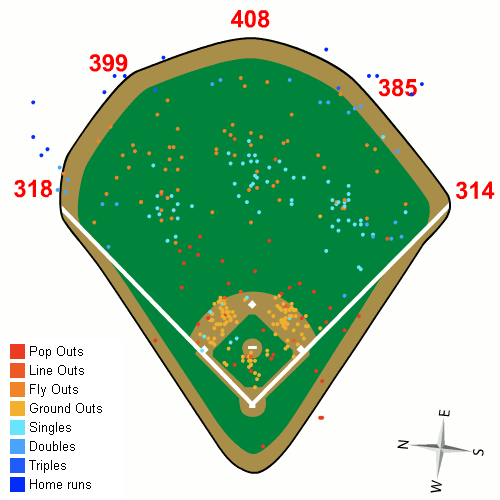
Source: http://katron.org/projects/baseball/hit-location/

There are obvious drawbacks to an overlay, including variables like atmospheric conditions and ballpark-impacted pitch selection (not to mention the accuracy of the simulator). Also, the general trends in Kuroda’s batted ball data suggest an increase in both line drives and fly balls, which doesn’t bode well for his ability to keep opposing hitters in the park. Over his first three seasons, the right hander was able to induce ground balls more than half the time, but in 2011, that rate dropped all the way to 43%. Perhaps more concerning was the precipitous rise in line drives, which seems to justify the spike in Kuroda’s HR rate.

Hiroki Kuroda’s Batted Ball Data

Source: fangraphs.com

Does Kuroda’s move toward being more of a fly ball pitcher represent the start of new trend? It’s hard to tell from one year’s worth of data, but a closer look at the home runs he allowed in 2011 might suggest the increase was more of a fluke. Exactly half of the 24 homers allowed by Kuroda came with two strikes, which was more than double the five he allowed in the two seasons prior.

“I think it’s a random spike, given the information available,” said Joe Sheehan of Sports Illustrated. “The homers themselves were clustered in few outings–the chance that it’s some kind of skill issue is less than it just being a blip.”

In fact, Kuroda’s struggles with two strikes weren’t confined to the long ball. With the exception of 0-2 counts, opposing batters hit well above average against the veteran pitcher in every other two strike combination (click here for a look at how hitters performed with two strikes in 2011). If Kuroda is able to cut down on the damage against him with two strikes, not only might his HR rate return to more normal levels, but his performance could improve across the board. It’s hard to predict whether or not he will be able to make the adjustment, but perhaps pitching against stiffer competition in a more hitter friendly environment will improve his concentration (i.e., pitch selection) with two strikes on the batter? That’s all conjecture, but regardless, Kuroda has substantial room for improvement in two strike counts.

Hiroki Kuroda’s Performance with Two Strikes, 2011

Note: sOPS+ measures Kuroda’s performance against the league average in a particular split. For example, his sOPS+ of 121 in all two strike counts indicates opposing batters hit 21% better against him.
Source: baseball-reference.com

Another concern expressed about Kuroda’s transition to the Yankees is the impact of the team’s porous infield defense. However, according to UZR/150 (which, admittedly, is far from an exact barometer), Yankees’ infielders were at least on par with the Dodgers’ at every position but short stop. Also, based on advanced analyses like Mike Fast’s recent study on catcher framing, Russell Martin ranks as one of the best defensive backstops in the game (according to Fast’s framing data, Kuroda’s catcher in 2011, Rod Barajas, ranked toward the bottom in 2011). Finally, as a group, the Yankees’ outfield led the majors with a UZR/150 of 10.2, which was well above the Dodgers’ rate of 2.8. So, even if Kuroda has gradually become more of a fly ball pitcher, that could play to his advantage on the Yankees, especially if he can get opposing batters to hit the ball to Brett Gardner.

Comparison of Yankees and Dodgers Infield and Outfield Defense, 2011

Source: fangraphs.com

Defense is always an important part of the equation when evaluating pitching, but in Kuroda’s case, it might be a little overrated. Because of his age, and perhaps the perception that he is a control specialist, many people seem to regard Kuroda as a contact pitcher. However, over the last two years, he has proven to be adept at missing bats. Among all qualified pitchers spanning the last two seasons, Kuroda ranks ninth with a swinging strike rate of 10.5%, or two percentage points higher than the league average. If Kuroda can continue to fool hitters, especially during the period when they are learning his patterns, his ability to generate swings and misses could mitigate some of his defense’s shortcomings, if they do exist.

Swinging Strike Rates, 2010-2012

Source: fangraphs.com

There are usually many unanswered questions when a player transitions to a new team and league, so skepticism surrounding Kuroda’s ability to maintain his success in the Bronx is only natural. However, based on his track record and the Yankees’ short-term commitment, there’s every reason to be optimistic that the right hander will be a positive contributor in 2012. Will he be the number two? Such distinctions really have little relevance in the grand scheme of a 162-game season, but if the sentiments expressed by those who know him best are accurate, I wouldn’t bet against it.


Observations From Cooperstown: Russell the Muscle and A.J. the Ex-Yankee

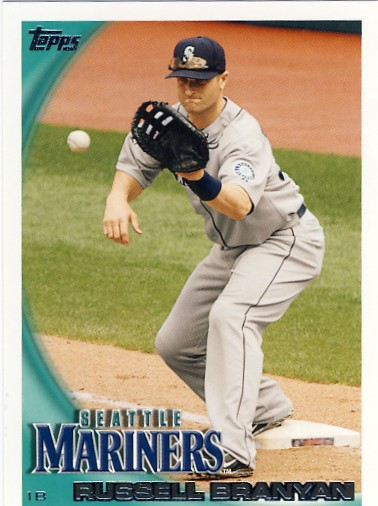
The Yankees might actually have a good bench in 2012, something we haven’t been able to say very often over the past decade. With returnees Andruw Jones, Chris Dickerson and Eduardo Nunez and free agent acquisitions Bill Hall and Russell “The Muscle” Branyan all in the mix (and Eric Chavez possibly on the way), the Yankees have a chance to cobble together a decent corps of backup players.

Put me down in favor of the Yankees’ signing of Branyan to a minor league contract. Although he’s 36 and coming off a bad season split between Arizona and Los Angeles (the Angels, not the Dodgers), he has enormous power, the kind of power that makes teams pull out the tape measure when he makes contact. I’ve seen Branyan hit some absolutely monstrous home runs, particularly to center and right-center field. He’s one of the strongest players I’ve ever seen, right up there with Reggie Jackson and Willie Stargell in his ability to hit for sheer length. Of course, he hasn’t hit nearly as many home runs as those two Hall of Famers, so that’s where the comparison has to stop.

Branyan also draws a decent number of walks and has a history of success at Yankee Stadium. (He’s the only player to hit a home run against the glass facing of the center field batter’s eye at the new Stadium, having accomplished that feat in 2009.) The key to Branyan’s situation with the Yankees is this: can he still play third base? If he can, then he gives the Yankees someone who can spell Alex Rodriguez against the occasional right-hander, while also providing backup at first base and at DH.

A check of Branyan’s record at Baseball Reference shows that he appeared in two games at third base for the Angels last season. Prior to that, you’d have to go back to the 2008 season for any prior experience at the hot corner; he made 35 appearances at third for the Brewers that season. So it remains somewhat questionable whether Branyan can log any serious time at third base at this late stage of his career.

If Branyan cannot play third, then his value would lie mostly in his ability to DH against right-handed pitching. As a DH, he would need to revert to his 2010 level in order to be helpful. That summer, he slugged 25 home runs and slugged .487 for the Indians and Mariners.

So there are plenty of questions regarding Branyan. But on a minor league contract, with a relatively small salary coming to him if he makes it to Opening Day, Branyan is worth a look. Besides, how can you not love a guy nicknamed Russell the Muscle?..

***

How do I feel about the possibility of trading A.J. Burnett? Where do I sign? Or perhaps I should say, “Great trade, who’d we get?” Even if the Yankees acquire little of value in exchange for Burnett, they figure to save $3 to $4 million in 2012 salary and can then use that money to add a left-handed DH or another piece to the growing bench. And if Brian Cashman is able to pry a meaningful player out of Pittsburgh in the deal, that’s all the better.

Media reports indicate that three or four teams are interested in Burnett, including the Pirates. The Yankees asked for Garrett Jones in a Burnett deal, but were quickly rebuffed by the Bucs. Jones is a left-handed hitting first baseman/outfielder with power, so he’d be a fit for the role as a platoon DH role and backup outfielder. On the downside, he’s already turned 30, is not a nimble defender, and has seen his OPS fall from .938 to .753 over the past three seasons. Therefore, a player like Jones should not be a dealbreaker. Perhaps the Yankees can throw in another player, or perhaps they can find another match on the Pirates’ roster. How about a left-handed reliever like Tony Watson, who could then compete with Boone Logan and Hideki Okajima for the southpaw bullpen role? Or perhaps a minor league outfielder like Gorkys Hernandez?

The fact that the Yankees are engaging teams in serious discussions for Burnett indicates that the enigmatic right-hander has little future in the Bronx. Even if he’s not traded, he has no guarantee of returning to the rotation. He’ll have to beat out both Freddy Garcia and Phil Hughes for the fifth spot, which is no small task. If Burnett is not traded and has a bad spring, the Yankees still have the option to stick him in the bullpen and use him as a long man. The bottom line is this: Burnett has no birthright to the starting rotation, not after the way he’s pitched the last two seasons.

So start the clock on Burnett’s departure from New York. I’d put it better than 70/30 that he’s an ex-Yankee by the end of the month. Heck, it might happen before the Yankees open camp on Sunday. I’d imagine quite a few readers of Bronx Banter would be pleased by that possibility…

***

Now that Luis Ayala has signed with Baltimore, there may be an opening in the bullpen for another right-handed reliever. It could be filled by Manny Delcarmen, who is one of the more interesting names among the 27 non-roster players that the Yankees have invited to spring training. First, the bad news. Delcarmen didn’t pitch at all in the major leagues last season, and he struggled badly in Triple-A ball for two different organizations. Now the better news. He’s only 29, is durable, has had decent success against the American League East in his career, and has plenty of postseason experience.

In 2007 and 2008, Delcarmen was highly effective as a Red Sox set-up reliever, striking out nearly a batter per inning with a WHIP near 1.00. He has struggled badly since then, resulting in a demotion to the minor leagues last spring. In many ways, he reminds me of Ayala–at one time an effective reliever who has fallen on hard times. He’s just the kind of reclamation project that pitching coach Larry Rothschild specializes in, so it’s worth the relatively small gamble of a minor league contract.

When he’s right, Delcarmen throws in the mid-90s and has an excellent curve ball, which he uses as his out-pitch. Remember, Joba Chamberlain won’t be ready by Opening Day, Burnett could be traded, and Cory Wade, while effective in 2011, seems like a candidate for regression in 2012. So Delcarmen has a chance to make the team as the 12th pitcher–and that might not actually be a bad thing.

[Featured image photo credit: Nick Laham/Getty Images]

Bruce Markusen writes “Cooperstown Confidential” for The Hardball Times.

feed Share on Facebook Share on Twitter Share via email
"This ain't football. We do this every day."
--Earl Weaver