More funny stuff.
Dig this:
My Favourite Animal (5 min. version) from Lara Lee on Vimeo.
And while you are at it, this too:



More funny stuff.
Dig this:
My Favourite Animal (5 min. version) from Lara Lee on Vimeo.
And while you are at it, this too:
The Great Sid Caesar:

Found a couple of intriguing posts about a new book, “On Rereading,” by Patricia Meyer Spacks.
First, from Nathaniel Stein at the New Yorker’s Book Bench:
“One cannot read a book: one can only reread it,” Nabokov said. I thought of that line while reading “On Rereading,” Patricia Meyer Spacks’s charming and strange blend of memoir, literary criticism, and scientific treatise. Spacks, a literature professor and a former president of the American Academy of Arts and Sciences, systematically revisits “The Wonderful Wizard of Oz,” “The Catcher in the Rye,” “The Golden Notebook,” the novels of Jane Austen, and other milestones of her reading life. She hopes to justify the usefulness—or at least to solve a bit of the mystery—of an activity that she loves but also, at times, doubts.
Few would question looking at a great painting twice, or watching a favorite movie again and again. But, perhaps because rereading requires more of a commitment than giving something a second look, it is undertaken, as Spacks puts it, “in the face of guilt-inducing awareness of all the other books that you should have read at least once but haven’t.” It engages, she fears in her darker moments, a “sinful self-indulgence.” Never mind Nabokov, or Flaubert, who marvelled at “what a scholar one might be if one knew well only five or six books.”
And here is Lisa Levy, over at The Millions:
In his often anthologized essay “On Reading Old Books,” William Hazlitt wrote, “I hate to read new books. There are twenty or thirty volumes that I have read over and over again, and these are the only ones that I have any desire to ever read at all.” This is a rather extreme position on rereading, but he is not alone. Larry McMurtry made a similar point: “If I once read for adventure, I now read for security. How nice to be able to return to what won’t change. When I sit down at dinner with a given book, I want to know what I’m going to find.” In her recent study On Rereading Patricia Meyers Spacks uses McMurtry as an example of someone who rereads to stubbornly avoid novelty, and unapologetically so. His refusal, like Hazlitt’s, to read anything new makes rereading a conservative if comfortable experience, vehemently opposed to the possible shock of the new.
Spacks herself feels slightly differently. She writes, “No reader can fail to agree that the number of books she needs to read far exceeds her capacities, but when the passion for rereading kicks in, the faint guilt that therefore attends the indulgence only serves to intensify its sweetness.” In Spacks’s scenario rereading is a forbidden pleasure, tantalizing and, contra Hazlitt and McMurtry, with an element of time wasted — an extravagance. The choice Hazlitt and McMurtry easily make weighs more heavily on Spacks, who knows she forgoes a new book every time she picks up an old one.
Yet there are far more positive spins put on rereading in Spacks’s book and elsewhere. Pleasure, after all, needn’t be a negative. Elsewhere in his essay, Hazlitt brings up a point which is raised often by rereaders: “In reading a book which is an old favorite with me (say the first novel I ever read) I not only have the pleasure of imagination and of a critical relish of the work, but the pleasures of memory added to it. It recalls the same feelings and associations which I had in first reading it, and which I can never have again in any other way. Standard productions of this kind are links on the chains of personal identity. They are landmarks and guides in our journey through life.”
I am not a voracious reader of fiction and have only read one novel, “The Sound and the Fury,” more than once. But I re-read non-fiction all the time, especially essays and articles. I like the idea of revisiting a novel, to see how my feelings may have changed but also as a way to remember where I was when I first read it.
Another project. I’m down.
[Photo Credit: Ashinine]
Here is one of Pat Jordan’s classic magazine profiles, “Inside Marilyn Chambers,” which first appeared in GQ (September, 1987). The article is reprinted here with permission from the author.

The constable who arrested her stands in the witness box, his eyes lowered to his notebook, and in a monotonous voice describes her act for the Provincial Court of Windsor, Ontario. “She pushed her breasts together and pulled them out by the nipples. Then she wrapped her legs around a pole onstage and pushed the vagina area of her female anatomy against it. She began to go up and down in a gyrating motion with the pole between her legs.” He pauses, clears his throat, tugs at his shirt collar, a portly little man with thinning gray hair and a wrinkled suit that is too tight across his stomach. “Then she made a…ahem…a flicking motion with her tongue at the pole.” He looks up with pleading eyes.
The judge with the Lincolnesque beard is dozing in his chair. The court clerk, a mousy-looking woman, is glaring at the defendant. The prosecutor, a boyish-looking man in a navy blazer, is looking down at his notes. The male spectators in the courtroom are grinning. The prosecutor’s wife, sitting in the last row, is staring at the defendant. The wife leans forward, rests her chin on the tip of her forefinger—a beautiful, fresh-faced woman with sharply cut black hair—and studies the defendant for a sign.
The constable goes on. “Then she went down into the audience and laid across three patrons’ laps. A little bit of squirming went on. Then she sat up and pressed her breasts into a male person’s face.”
The men in the courtroom laugh, and the judge wakes with a start. He swings his chair around and says, “And what was the attitude of this male person?”
The constable tries not to smile. “He didn’t seem to mind.” The men laugh again.
The judge waves a hand at the constable to go on.
The constable lowers his eyes to his notebook. “When she got back onstage, she stood with her backside to the patrons. Then she spread her legs, bent over and spread the fleshy part of her buttocks with her hands to expose the inside of her…her…”—he squints lower to his notes—“…her vulva.”
The defendant lowers her face and covers it with her hands. When she looks up again, her face is red. She is an attractive woman in her thirties, with long sandy-colored hair, small eyes and thin lips. She is wearing a loose-fitting grayish-blue sweater with a matching skirt that falls below her knees. And panty hose. She purchased the outfit only hours before at a dress shop on Ouellette Avenue. The women in the dress shop had gushed over her when they found out who she was. They told her she looked beautiful in the outfit. She told them she didn’t really want to buy any new clothes because she was trying to get pregnant. “I just got married,” she said. The women congratulated her. Before she left, they asked her to autograph scraps of paper for their sons and husbands. For the husbands, she wrote, “With lots of lust and hot licks, Love, Marilyn Chambers,” and for the sons, she wrote, “With lots of love and wet kisses, Marilyn Chambers.” The women thanked her profusely and wished her luck in court.
Now, in court, she is humiliated by what the constable is describing. The judge asks him to demonstrate what the defendant did onstage. The constable puts his hands on his buttocks and tries to bend over, but his ample stomach stops him. He straightens up and says, “I could, Your Honor, if I was built like her.” Again the men laugh.
The defendant leans back in her chair and whispers to a man in the first row: “It gets to you after a while. Being arrested and fingerprinted just because you’re giving people pleasure. It’s so degrading. You begin to wonder if you’re as bad as people say.”
The man nods and whispers, “You didn’t do all those things, did you?”
She blushes again. “I don’t know. Maybe. Probably. I just get so hot onstage.”
When court is adjourned, the prosecutor’s wife goes to him and kisses him on the cheek, but even as she does, she cannot take her eyes from the defendant, this modest-looking woman who, above all else, knows that great secret. How to please men.

* * * *
Sixteen years ago, Marilyn Chambers, nee Briggs, was a 19-year-old aspiring model and actress who was making her living as a topless-bottomless dancer in San Francisco, where she was married briefly to a bagpiper who played on street corners for change. “It was the age of being free,” she says. “Love, Sex and Happiness. I was just a hippie chick.”
She had a bit part in one feature film, The Owl and the Pussycat, with Barbra Streisand, and an offer to be the girlfriend of a famous producer. “He told me he’d make me a big star if I had no other boyfriends but him,” she says. “I thought about it and decided I’d rather fuck in films than fuck to get in a film.” Shortly afterward, she went to a casting call for a film to be produced by the Mitchell brothers of San Francisco.
“They asked me if I wanted a balling or a non-balling part,” she says. “The only stag films I had ever seen had fat ladies and guys in black socks. They said it wasn’t going to be like that, so I said I’d take a balling part for 10 percent of the gross. They told me to take a hike.”
When the Mitchell brothers discovered that the “hippie chick” who wanted 10 percent of the gross was the same woman who appeared as the mother on the Ivory Snow box, they immediately called her back, and the rest is porn history. Behind the Green Door, starring the girl who was 99 44/100 percent pure, became one of the biggest-grossing X-rated movies of all time. It made its star not only famous but wealthy. Today, the 1972 film is a classic of its genre. It can be found in full view in the video racks of respectable households across the country, right alongside The Sound of Music.

The secrets to its success are many. It had the high-quality production values of a feature film, rather than the hazy, bouncy look of a stag film made by two men taking turns with a hand-held camera while one of them masturbated. It also had a plot. A dreamy, almost romantic fantasy of a fresh-faced innocent seduced, in stages, into various carnal delights. The turn-on was in its star’s seduction, not in her acts. It was the thinking person’s porn flick, and its star was perfect for the part. She looked like a girl who was experiencing these carnal delights for the first time and, much to her surprise, was loving every minute of it. Marilyn Chambers was the first porn actress who looked as if she were really having orgasms onscreen.
“Each sequence was a surprise to me,” she says. “They never told me what was happening next. I just did it as it happened, and it worked. I’ve always been highly sexed. Oh, my god, I love it! Insatiable is the right word for me. Even in my dance shows I get really hot. I want to spread my legs and give as much as I can. This is the perfect business for me. I love to give pleasure to men.”
After her follow up, The Resurrection of Eve, was released, Marilyn decided she needed a personal manager to guide her career, so she called Chuck Traynor, an ex-Marine who was beginning to make a name for himself in porn circles as Linda Lovelace’s manager and husband. Traynor was having trouble at the time trying to guide the Deep Throat star in her career because, as he puts it, “she envisioned herself as the new Katharine Hepburn, and all she really was, was a body without a head.”
When Traynor and Lovelace split up, Marilyn moved in with Chuck in Los Angeles, where he took over her career and eventually married her in 1974. Traynor decided that Marilyn shouldn’t oversaturate the X-rated market, so he had her branch out. They formed Chambers Traynor Enterprises and moved to Las Vegas, where for the next ten years Marilyn starred at nightclubs like Caesars Palace, performed in straight plays such as The Last of the Red Hot Lovers and occasionally made X-rated movies (Insatiable I and II), though a total of only five in her career.
They split up seven years ago, in good part because Marilyn wanted to wind down her career and Chuck didn’t. Marilyn moved to L.A., where she had a couple of devastating accidents to her legs, even more devastating love affairs and, finally, a bout with drugs and alcohol that brought her to the brink of suicide. She joined Alcoholics Anonymous, got sober and met a hardworking trucking-company salesman named Bill Taylor, whom she married a few weeks before she returned to Windsor for her court appearance.
Traynor remained in Vegas during those years, spending most of his time running the Survival Store, a sort of arms warehouse for the Soldier of Fortune types who spend their vacation time in Honduras and with whom Traynor was on close terms. He also spent time hunting around for a girl to replace Marilyn Chambers. Enter Crissa “Bo” Bozlee. Seventeen years old at the time. A dead ringer for a young Jane Russell. Bo had had a bit part in a soft-porn movie (“You get to see my tits,” she says. “I love to show them off”), had been the Soldier of Fortune magazine poster girl (“If the contras ever take power in Nicaragua,” says Traynor, “Bo will be their first lady”) and was a crack shot who liked to go into the desert, strip naked and fire M-60 machine guns while fantasizing that millions of people were watching her.
Bo also had a penchant for older men, like Traynor, who is now 52. “They can teach me so many things,” says Bo, “like etiquette, and how to be perky so people will like me, and how to be the cutest and glamourest I can so I can turn on an audience.” Traynor became her lover and her manager, and one of his first tasks as the latter was “to create the need for a product that didn’t exist yet.” He telephoned Marilyn and asked, as a favor, if she would go on a few more club dates with him so that he could book the unknown Bo in those same clubs as “the New Marilyn Chambers.” One of those clubs was Jason’s in Windsor, where, on a June night in 1986, Marilyn was arrested for giving a lewd performance. Marilyn wanted simply to plead guilty and pay her $300 fine, but Traynor prevailed upon her to return to Windsor in late January 1987 for the trial so that Jason’s management could make her arrest a test case for the nude-dancing law in Canada. “Whichever way it goes,” says Traynor, “it’ll be called ‘the Marilyn Chambers law.’ That’ll be neat.” (In July, she was found not guilty.)
Marilyn agreed to return, and when Traynor told her she might as well pick up an easy $15,000 dancing at Jason’s that same week, she agreed to that too. Bo was also appearing that week at Jason’s.
“I used to love the order of going on the road,” says Marilyn, “of doing each show at a certain time. But now that was an intrusion into my order as a housewife. Cooking and vacuuming were a joy to me for the first time. I love taking care of my husband. It’s more fun to make real love to one man than the fantasy of making love to 500.”
Traynor thought that the only fantasy Marilyn harbored was that she could ever be happy as a housewife and mother. “I don’t think she can walk away from it,” he says. “The adulation. She loved it too much. She might fantasize about having kids, but the reality is telling them someday what she did all those years. I thought about having kids at 18 but decided I didn’t want to leave anything to anyone. I just want to be cremated and made into douche powder for nude dancers.”
“I know what Chuck thinks,” Marilyn says. “But I’m not worried.” Her new husband was worried, however. He didn’t like the idea of his wife returning to her former career. She told him not to worry. She was 34 years old. She was overweight, and she had bad knees. This would be her last dance.

* * * *
The second-floor dressing room is a war zone of women’s debris. Clothes. Costumes. G-strings. Boots. Hair dryers. Makeup. Crumpled wads of tissue. Bo, in a sequined cowgirl costume, is doing splits on the dirty linoleum floor. Chuck, in a brown suit, is rolling up Bo’s posters and putting a rubber band around them. Marilyn is sitting naked in front of a mirror, applying makeup for her 9:30 P.M. first show, which follows Bo’s by half an hour.
Down the hall, the rest of the nude dancers, mostly young French-Canadian girls, are chattering in French as they put on their makeup in their dressing room, emerge from the shower with towels wrapped around their hair and talk to their boyfriends on the telephone in the hall, where a painter, a gaunt old man, is trying to paint around them. The girls are all naked, and indifferent to it in front of the painter. Yet there is a certain innocence about them. At Christmas, they raised over $10,000, donated it to a variety of charities and were stunned and hurt when a few of the charities refused to accept a contribution from nude dancers.
“Look at him,” says Chuck, gesturing toward the painter. “He’s been painting that same spot for a fucking week.” He laughs. Bo is oblivious. Marilyn turns and smiles at Chuck. She sees a big man, balding, stoop-shouldered, slow-moving, with jug ears. In her book, Ordeal, Linda Lovelace portrayed Traynor as an evil Svengali who kept her a sexual slave for years. Today, Traynor looks less like a Svengali than like a hick from Homestead, Florida, where he was born and raised. “I was a hick,” he says. “I joined the Marines at 18, and the first time I went into a city this black pimp told me he had thirty girls dying to meet me. I gave him all my money, just to hold for me, and he took me to an empty room. He told me to wait for a few minutes and those thirty girls would be right out, and then he split. I waited an hour, and for the rest of the week I ate peanut-butter sandwiches.”
Traynor served in Vietnam, returned to the States, where he was a crop duster for a while until he got poisoned by the insecticide he used, and then drifted into the porn business. He became successful not because he was an evil genius but because he was ploddingly shrewd and a stickler for details. “I worked hard,” he says. “Marilyn knows. There was a lot of resistance to X movies then. Now it’s commonplace, which is why it’s dying. I used to watch 1,000 X movies a day. I’d show them on my refrigerator door and title and price each one of them while I ate doughnuts and drank chocolate milk.”
“Chuck was bitter over Linda’s book,” says Marilyn. “He gave her a house in Beverly Hills and a Cadillac, and when he left he took nothing. He’s a very giving person. When I met Chuck I was 19, and I needed guidance. He had me under his control twenty-four hours a day, but he never tried to control my thoughts. People say he exploited me, but I exploited myself because I wanted to. Gloria Steinem wrote a book in which she said Chuck was exploiting me and I should come to her for help. That woman never even met me! How dare she assume I wasn’t doing what I wanted to! I think she should be using her vibrator a lot more.
“I know I learned a lot from Chuck, how to dress, how to clean house in a military way and how to be sexy for men. He taught me to be a whore in bed and a lady in public. Chuck’s secret is he’s every Joe Blow in the audience. He knows what turns them on by seeing what turns him on. He’s lived out most of his fantasies, but he still doesn’t know what’ll make him happy. Bo seems to have helped him there. He’s lost that angry edge he always had. I just hope she doesn’t hurt him. He says she’s his slave, but he dotes on her. It’s cute the way he fixes the bow in her hair. He sews all her costumes himself, by hand. I think he’s more interested in holding on to her than making her a star. That’s why he’s on the road again. To keep her happy. She’s not inclined to be barefoot and pregnant. He just needs to keep her needing him without her becoming famous. I just hope he hasn’t lost his perspective after all these years.”
Bo, standing now, spreads her legs, bends over and tries to stick her head between her legs. “Look, Chuck!” she says. “Almost!”
“I told you not to try that yet,” he says. “I’ll fine you if you do.”
Bo, still bent over, looks upside down at Chuck through her legs. “I would never do that, Chuck,” she says, wide-eyed. “You told me not to.”
Marilyn glances at Bo and rolls her eyes heavenward. She has difficulty hiding her distain for Chuck’s protégée, even when Bo’s being generous, or, as Marilyn would prefer to think, cloyingly obsequious.
“Marilyn,” Bo says, “I saved the big dressing table for you. Do you want it?”
“Of course.”
Bo smiles up through her legs but says nothing. She has an almost eerie remove and self-control for her age. (“When I was 15,” she says, “I wanted to be a ballet dancer, so I starved myself so I wouldn’t get breasts. When I didn’t want to be a ballet dancer anymore, I forced my breasts to grow, and they did.”)
Marilyn is not sure whether Bo is a naïve young girl or a totally self-absorbed woman, or maybe a little of both. On the one hand, Bo keeps a scrapbook of her newspaper clippings and thinks that men who fawn over her are “silly.” On the other hand, she says she could have kicked herself when she ignored a nerdy-looking guy who, she later found out, had won a million-dollar lottery, and she can say of an aged Texas boot maker, “I ordered as many pairs as I could before he dies.”
Marilyn examines her makeup in the mirror, where she has stuck a photograph of her new husband. She says, “I hope this audience is better than the last. They were so cold I couldn’t work up any energy.”
Bo smiles up at her and says sweetly, “Oh, they were cold for me too, but I supplied my own energy to get them hot.”
Marilyn glares at her. Then she looks at Chuck and says, “I heard Sammy’s down to 113 pounds.” She is referring to Sammy Davis Jr.
“Sammy who?” says Bo. She straightens up and shakes out her hair.
“Yeah,” says Chuck. “He’s playing the Holiday Inn for crissakes.”
“Jesus, remember when he used to play Caesars with us?” says Marilyn. “Yeah. He used to love to watch Behind the Green Door.” She laughs that sexual laugh of hers. “Especially with me sitting right beside him.”
Bo plops down in her chair and purses her lips. Marilyn knows it annoys Bo when she and Chuck talk about some intimate detail of their past life together that Bo was not privy to. Marilyn smiles at Bo. She sees a pretty girl with cascading black hair and the kind of big, soft, pale, bosomy body that was a sexual fantasy for men, like Chuck Traynor, who came to manhood in the Fifties. It is the lush, lascivious body of a Fifties pinup lounging on satin sheets, sucking a bonbon between her harshly painted lips. (“I like big tits,” says Chuck. “I make Bo eat a lot to keep her tits up.”)
“I told Chuck she was gonna have a weight problem by the time she reached 30,” Marilyn says, “but he just said, ‘Who cares? I won’t be around to see it.’”
Marilyn thinks it is fantasy for Bo to believe she will ever become a sex star. “She’s playing it, not being it,” Marilyn says. “She doesn’t feel it. She works at it.” What Bo works at most is studying Marilyn Chambers. Her eyes click like a camera taking photos of everything Marilyn does.
“Why do you put lemon in your Coke?” Bo asks.
“To cut the sugar.”
Bo nods, clicks and continues to stare at Marilyn. What she sees is an older woman, thick-waisted, whit a big, smooth belly and pendulous breasts, who bears only a faint resemblance to the slight “hippie chick” who starred in Behind the Green Door. And yet, despite Marilyn’s added weight, she looks harder than Bo, more substantial. She has a flat voice and a harsh, throaty laugh that is faintly masculine. She talks about sex, jokes about it, in that same, confident, macho way that men do in a bar over drinks. (“Sure, John Holmes fucked me up the ass,” she will say in that flat voice. “It took me a week to learn how to walk again.” That throaty laugh.)
“I’ve always been highly sexed,” she says. “I think it’s good for you. But the funny thing is I never felt sexy with Chuck. I didn’t have big boobs. I was just this hippie chick with long, straight hair and no hips. I don’t think I turned Chuck on. He had to learn to like me sexually. I worked so hard at it, just to please him. Chuck’s a voyeur, you know. Sometimes he’d want me to get into these scenes, you know, and I didn’t want to at first.” She laughs, and then her voice lowers. “But once I got into them, I loved it.”
* * * *

Jason’s lounge is filled with businessmen sitting in groups at square tables or singly at the bar. They are mostly from Detroit, just across the border. The Ford executives arrive in Lincoln stretch limousines and the GM executives in Cadillac stretch limousines. They check their coats, smooth the sides of their hair and pay $10 to the tuxedo-clad doorman before entering the dark, smoke-filled room.
The Jason’s dancers, wearing negligees or bikinis with their high-heeled shoes, drift through the room, each carrying what looks like an old-fashioned milk crate on top of her head. They look like some strange sexual version of coolie laborers. When a table of men stops one of them and slips some bills into her G-string, she puts down her box, stands on it and begins a slow, sensual striptease. “They can’t touch us,” says Jasmine, a dancer. “But they don’t really want to. The fantasy is enough.”
Throughout the darkened room, girls undulate like snakes in the smoky-blue light. They touch themselves and close their eyes as if in heat. Each bends over at the waist so that her behind is only inches from a man’s face. He stares, perfectly still.
Onstage, Bo, stripping off her cowgirl costume, works hard under the bright lights. She bumps and grinds, does splits on the floor, wraps her legs around a pole, rubs her groin against it, puckers her lips in a pseudo-sensual way that only vaguely resembles the hot sensuality of the Jason’s dancers on their tiny milk crates.
Chuck Traynor stands in a darkened corner of the room, his arms folded across his chest, and watches through his small blue eyes. He says, “Why Bo? After Marilyn left, Bo was just there.” He laughs. A Jason’s dancer drifts past him and smiles seductively. Chuck smiles back. “My reputation precedes me,” he says. “They all think I can make them a star. That’s why I stay in this business. All that young pussy. If you keep 18-year-olds around you, you stay young.”
He watches Bo’s act without interest for a while, and then he says, “The secret to this business is to give everyone what he wants. The guy who thinks a girl looks fresh-faced and the guy who thinks she sleeps on satin sheets should both fulfill their fantasies with the same girl. The reality, of course, may be something entirely different. I remember once I had this girl come into a strip joint in a Girl Scout costume. She started selling cookies to the guys while another girl was onstage. The DJ starts harassing the Girl Scout and everybody think it’s legit, and then suddenly the Girl Scout begins to strip, and everyone went wild. Now, that was really hot. That’s what it’s all about. Living on the fine edge. The one who goes to the edge and doesn’t fall off—now that’s the one.”
When it is time for Marilyn to appear, the Jason’s dancers stack their milk crates along the far wall and then stand back in the shadows to watch. “Forget about Bo,” says one of the dancers. “She’s a no talent with no body. Marilyn’s the one.” When Bo finishes changing back into her cowgirl costume, she joins the girls along the far wall, a little apart because the Jason’s girls do not like her much, and Bo knows it.
The DJ announces Marilyn Chambers: there is thunderous applause from the men and the Jason’s girls, and Marilyn bounds onto the stage. Bo, silent, watches. Marilyn is wearing a red sequined dress, elbow-length red gloves and red suede cowboy boots. She sings a few songs (“Ooh, Las Vegas”) and then banters with her audience. She tells them a few intimate details about her porn career, and then offers to answer their questions. The men are shy, reticent, as most men are when they confront her. Men unfailingly treat her like a lady in her presence, but then, out of earshot, they make their course comments.
The men here tonight, however, are perfect gentlemen. They ask her a few innocuous questions, as if in awe of her. Marilyn Chambers is nostalgia for these older men. She represents the sex of their youth, long gone, after years of marriage. Finally, one of the men stands up, blushing. “You would know,” he says, stammering. “I mean, your background and all. I’m talking about how important it is, you know, how big it is, for a woman to be…satisfied.” He sits down. There are a few hoots of derision, but Marilyn raises her hands for silence. Then she says seriously, “You know, it’s a shame we women do that to men. All that talk about fourteen inches. It’s not so. Just remember, it’s not the meat that matters. It’s the motion.”
The men break into wild applause and cheers. The Jason’s girls shout, “Right on, Marilyn!” Bo, in the shadows, watches. Then Marilyn begins to strip.
She gives “a good, legal show” that is in marked contrast to the show described by the constable in court only hours ago. Her act is not much different from Bo’s. She bumps and grinds and wraps her legs around the pole onstage as she discards pieces of her red costume. When she is naked, except for her red sequined G-string, she goes down into the audience and dances around the room. She stops here and there at a table of men, shakes her breasts at them and then moves on. The men cheer and yell approval, but after she turns away, one or another will comment, “Jeez, look at the belly on her!” When Marilyn passes Chuck standing against the wall, she stops and dances close to him for a long moment. Chuck, his arms folded stoically across his chest, gives her a small smile, and then she moves on.
When her performance is over, Marilyn stands onstage and bows to boisterous applause, not only from the men but from the Jason’s girls. They cheer her partly because of who she is and partly because it is obvious she loves what she has just done. She smiles, her face glistening with sweat under the stage lights. Then she turns her back demurely to the audience and bends over to pick up her discarded clothes.
“That’s the difference between Marilyn and Bo,” says a Jason’s girl. “Bo makes love to herself onstage. Marilyn makes love to the audience. That’s why I dance. I love turning men on. I feel good about myself. I feel as if I’m giving these men pleasure. Maybe I’ll turn ‘em on so much they’ll go home and take care of their wives better than ever before. There are a lot of wives out there who should be grateful to Marilyn. More of them should see her perform. They might learn something.”
After her show, Marilyn, wearing only a G-string, goes out into the lobby to pose for snapshots with her fans. The men line up like schoolboys, and Chuck ushers them in turn to a little corner of the lobby, where each poses with Marilyn. As the men pass Chuck, they slip him a $5 bill, which Chuck pockets much as the maitre d’ does at a fancy restaurant. He then tells the man to smile, and he aims the camera. The men stand stiffly next to Marilyn, as if posing for one of those nineteenth-century daguerreotypes. Chuck snaps. Marilyn’s smile breaks. She signs the still undeveloped snapshot, and each man walks off, grinning, staring at the picture as it slowly develops before his eyes. “Divorce Polaroids,” says the doorman.
* * * *

I was born and raised in Westport, Connecticut, a suburb for executives who worked in New York City. My name was Marilyn Briggs. I was a cheerleader in high school. My mother worked as a nurse, and my father was an ad exec in New York City. He worked on the Avon account. My parents were not into being affectionate. I craved that. Mostly from my dad. He was a handsome man. A silver fox. I had this mad sexual fantasy about him. It really was incest. But it was all right. Sometimes fantasies are okay, if you leave them fantasies.
When I was 18, I wrote him this love letter, but he never responded. I was crushed when I learned he had a girlfriend all those years. I was 21, playing the Riverboat Room in New York, when he walked in with his girlfriend. It shocked me even then that he wasn’t perfect. All my life I have tried to please my father, but I never could. Then I tried to please Chuck, Uncle Chuckie, I call him, but I knew I didn’t. There’s something in me that doesn’t please men. I don’t know. Maybe that’s why I worked so hard at it all these years. Maybe that’s why I always need a man to take care of me. To be Daddy’s girl. That’s the way it was for me with Chuck, and that’s why I need his blessing now with my new husband.
That’s all I want from Chuck, his blessing. I want to show him I can make the transition from pleasing all those men to just pleasing one man. I think I can. I hope I don’t miss it. Sometimes I don’t want to think about it. I love my husband. He’s a normal, hardworking guy. I just want to be a good wife and have kids someday. I know I’ll have to tell them what I did all those years. I hope they’ll understand. But still, I don’t regret my career. I wouldn’t change a thing. I wasn’t much of a straight actress anyway. Just mediocre. I might have had a career if I slept around with all the right men. It may sound funny, but I don’t think what I did was the same as that. I gave it away. If I have any morals, that’s what they are….
You know, my father is divorced from my mother now. He lives alone in an apartment. He told me for the first time only recently that he has kept my love letter in his dresser drawer all these years.
* * * *

It is midnight. Marilyn is sitting in her dressing room, naked, preparing to put on her red costume for her last show. She is exhausted and her knees ache. She massages them. There are white scars on each. A few years ago, she dislocated one knee so badly she almost lost her leg. She pleaded with her doctors to save it. “I kicked a door after a violent argument with an old boyfriend,” Marilyn says. “The door shattered, and so did my knee.” Her other knee was broken in a fall and had to be rebuilt. That is why, only moments ago, she consented to meet two of her fans, physicians, in her dressing room. The two doctors had told Chuck they had some new medicine that might ease the pain in Marilyn’s knees. The doctors stood awkwardly in front of Marilyn, who seemed not to notice their embarrassment before her nakedness. When they gave her the medicine, she said, “I’m an addict, you know.” They assured her the medicine wasn’t addictive. She thanked them, then signed posters for them. They left, grinning at the posters they held out before them.
Marilyn puts on a pair of woolen socks, and then another, to keep her feet warm. Then she puts on her red cowboy boots. “I never wear high heels,” she says. “I need the boots for support.” She holds up her red dress and shakes her head. “Jesus, it’s filthy,” she says. She laughs that throaty laugh and shakes her head. “Who cares, huh? This is my last show.” She puts on the dress and stands up to examine herself in the mirror. “Jeez, it looks like shit.”
When she pulls on her long red gloves, the seam of one of them rips at the wrist. She laughs out loud and then sits down to finish putting on her makeup. She pauses a minute, takes the photo of her husband from the mirror and stares at it. “He’s a good guy, you know,” she says. “He treats me right. We met on a blind date. After he found out who I was, he wouldn’t go out with me for a while. Then he got over it. It was hard on him.” She sticks the photo back in the mirror just as one of the Jason’s dancers comes into the room.
“Marilyn, can I talk to you?” the girl says in a thick French accent.
“Sure, honey, sit down, if you can find a place.” The girl sits on a sofa strewn with Bo’s and Marilyn’s clothes and belongings.
“I’m going to Acapulco for a week,” the girl says.
Marilyn turns in her chair and looks at her. “You better be careful,” she says.
“I know. I’m going with this guy.” Marilyn shakes her head in warning. “But he’s on the program, Marilyn. We help each other stay clean.” The girl, like Marilyn, is a member of AA. She is in her early twenties.
“Did you take another chip at the last meeting?” Marilyn says.
The girl smiles. “Every ninety days. For a year now.”
“Don’t get too cocky. I know a girl who was clean for ten years and then she went off. It can happen.”
“I know. I’m so emotional I could go just like that.”
“When I see the signs with me, I get my ass to a meeting as fast as I can. Everyone has to slip once in a while. It gives you more humility.”
“Did you get your cake yet?”
“Yeah. After one year.”
“Me too.” The girl smiles. “It felt so good. When I was on coke it made me paranoid. I used to walk the house all night, check my watch fifty times, smoke ashtray after ashtray full of cigarettes. You know how it is.”
“I sure do, honey.” Then Marilyn stands up. It is time for her last show. She smooths the front of her dress with the palms of her hands and shakes her head. “I look like a fucking slob.”
The girl grins at Marilyn and says, “Marilyn, I think red looks good on you.”
Marilyn looks at her and grins back. “You bitch!” The girl laughs as Marilyn leaves the dressing room. She walks past the Jason’s girls’ dressing room, which is deserted now. She comes to the top of a narrow stairway that leads down to a door to Jason’s lounge. The stairway is dark. From far down the hallway, the girl who has just been talking to Marilyn calls out, “Good luck, honey.”
“You too, baby. And don’t worry. God watches out for you.”
Marilyn begins to walk cautiously down the stairs. Her knees buckle in, and she must hold on to both walls with the palms of her hands. She takes each step slowly, her boots clunking heavily against the stairs. When she reaches the bottom, she pauses a moment in front of the closed door. In the darkness, she says to herself, “All right guys. I’m gonna get your butts moving one last time.”
She opens the door.
[Thanks as always to Dina for transcribing…]

Over at SI.com, our man Cliff looks at baseball’s award season:
NL Cy Young
To Be Announced: Thursday, Nov. 17
Expected Winner: Clayton Kershaw, LHP, Dodgers (21-5, 248 Ks, 2.28 ERA, 0.98 WHIP, 9.6 K/9, 4.59 K/BB, 5 CG, 2 SHO)
Deserving Winner: Kershaw
The pitching triple crown (league leads in wins, strikeouts, and ERA) has been won just 11 times since the creation of the Cy Young award in 1956, and every single time, the pitcher who won the it also won the Cy Young award. Justin Verlander will make it 12-for-12 when he picks up the AL hardware on Tuesday and it makes Kershaw the prohibitive favorite to be lucky 13 on Thursday.
There is an argument, however, that last year’s winner, Roy Halladay (19-6, 220 K, 2.35 ERA), was the best pitcher in the National League again this year. Halladay’s case rests on park factors and batting average on balls in play, neither of which is enough to distract from all of those bolded numbers in Kershaw’s stat line. Still, both pitchers threw essentially the same number of innings (Halladay led by the smallest amount possible, 233 2/3 to 233 1/3), and it was Halladay that led the league in ERA+ (again by a sliver, 164 to Kershaw’s 163). Halladay also had a league-best eight complete games, walked a league-low 1.3 men per nine innings, led the majors with a 6.29 K/BB ratio, and had less help from his defense and lucky bounces, with a .305 BABIP to Kershaw’s .274, doing all of that while pitching his home games in hitter-friendly Citizens Bank Park as opposed to pitcher-friendly Dodger Stadium.
It’s a compelling argument, but not an overwhelming one, which is why you’re unlikely to hear much complaint, even from Phillies fans, when Kershaw wins the award on Thursday.

Peace to Max for pointing out the facts.

I’m always amazed how quickly time goes by. Another example hit me last week, when I realized that it has now been ten years since former Yankee broadcaster Frank Messer died. He passed away at the age of 76 in November of 2001, succumbing to a combination of heart problems and an ongoing battle with lupus.
In many ways, Messer is the forgotten Yankee broadcaster. In contrast to Bill White and Phil Rizzuto, his longtime broadcast partners on WPIX TV and various radio stations, no one talks about Messer anymore. It’s understandable that fans who are younger than 35 don’t remember Messer; they likely would never have heard one of his broadcasts. But even fans my age (and older) have placed Messer in a far-away corner of their minds.
Messer was never as popular as Rizzuto or White, but he had a career that is worthy of note. A native of Asheville, North Carolina, Messer joined the Marine Corps and served in the South Pacific during World War II. After a successful tour of duty that ended in 1946, Messer entered the field of broadcasting and eventually went to work as a disc jockey for a country western radio station. His baseball career finally began in 1954, when he entered the broadcast booth for Richmond, a minor league team in the Triple-A International League. During his tenure in Virginia, Messer won the state’s “Sportscaster of the Year” Award three consecutive years.
In 1964, Messer earned a promotion to the major leagues, joining the Orioles as one of their play-by-play men. He also dabbled in football, working radio broadcasts for the NFL’s Baltimore Colts. In 1968, Messer switched affiliations when he joined the broadcasting crew of the Yankees, replacing former major league catcher Joe Garagiola. Messer teamed with Rizzuto and Jerry Coleman–both former Yankee players–as the team’s regular announcers. (And yes, I am shuddering at the idea of “The Scooter” and Coleman working the same broadcast booth.)
Prior to the 1971 season, the Yankees made a milestone change in the history of baseball broadcasting. They replaced Coleman with Bill White, a retired first base standout with the Giants, Cardinals and Phillies and a man with no previous connection to the Yankee franchise. White became the first African American to broadcast a major league team’s games at the local level. The trio of Messer, Rizzuto, and White would become synonymous with Yankee broadcasts over the next 14 seasons, splitting play-by-play and color duties on both radio and WPIX television.
Messer took on the role of Bud Abbott, playing straight man to the two former players. With Messer providing smoothly efficient play-by-play, Rizzuto and White became free to take on more colorful and often comedic broadcast roles, while also offering the perspectives of former star players. The trio became one of the most popular broadcast combinations of all-time, remaining a team until 1984, when Messer ended his tenure in New York.
Working amidst the popular three-man crew that announced Yankee games during that span, Frank Messer was unquestionably the least favored amongst the pinstriped faithful. Yet, that’s more of a tribute to the enormous popularity of Rizzuto and White than it is a genuine blemish against the record of Messer.
Rizzuto and White drew most of the attention, in part because they were former athletes with bigger names, and in part because of their tendency to toss barbs at each other. At times, they could provide hysterical listening. Messer supplied the basics needed in a solid television or radio broadcast. He had a pleasant voice, a smooth play-by-play style, and a small ego, the latter enabling him to accommodate the colorful storytelling of Rizzuto and the insightful analysis of White.
Although the Rizzuto/White combination provided the best listen of any of the three tandems the Yankees commonly used on TV, Rizzuto and White also worked well with Messer. They each had freedom to roam, thanks in large part to Messer’s understated style. Additionally, nine innings of Rizzuto and White might have produced overkill; Messer’s presence for six innings gave the broadcast balance and clarity, while also making listeners appreciate the entertainment value of the more dynamic Rizzuto and White.
Though it was not the principal part of his job description, Messer also added a dignified presence to the Yankees’ popular Old-Timers’ Day events. An articulate announcer and a skilled emcee, Messer elegantly performed his master-of-ceremonies duties in introducing Yankee greats during the seventies, eighties, and nineties. Although he didn’t match Mel Allen (something that few could have done), he nonetheless excelled in a humble, simplified way, enabling him to blend in so well with the festivities of the day. As great as Old-Timers’ Day remains, it’s not quite the same without the presence of Messer.
If there was a legitimate criticism of Messer, it was that he tended to stray far from controversy, which was in plentiful supply during the George Steinbrenner/Billy Martin/Reggie Jackson years. Messer usually treated Yankee conflicts with a see-no-evil attitude, if he didn’t ignore them completely.
On the whole, that’s a relatively small strike against a solidly professional play-by-play man who did such dutiful work in New York for more than a decade. He did the job, while never complaining about being the third wheel to Rizzuto and White. If nothing else, Frank Messer should be remembered for that.
Bruce Markusen writes Cooperstown Confidential for The Hardball Times.
[Photo Credit for featured image: Alex Alexander]
Adaptations…
From The Age of Movies, here’s Pauline Kael on The Iceman Cometh (1973):

The Iceman Cometh is a great, heavy, simplistic, mechanical, beautiful play. It is not the Eugene O’Neill masterpiece that Long Day’s Journey Into Night, the finest work of the American theater, is, but it is masterpiece enough–perhaps the greatest thesis play of the American theater–and it has been given a straightforward, faithful production in handsome dark-toned color in the subscription series called the American Film Theatre. A filmed play like this doesn’t offer the sensual excitement that movies can offer, but you don’t go to it for that. You go to it for O’Neill’s crude, prosaic virtuosity, which is also pure American poetry, and, as with most filmed dramas, if you miss the “presence” of the actors, you gain from seeing it performed by the sort of cast that rarely gathers in a theater. John Frankenheimer directly fluently and unobtrusively, without destroying the conventions of the play. The dialogue is like a ball being passed from one actor to the next; whenever possible (when the speakers are not too far apart), the camera pans smoothly from one to another. We lose some of the ensemble work we’d get from a live performance, but we gain a closeup view that allows us to see and grasp each detail. The play here is less broad than it would be on the stage, and Frankenheimer wisely doesn’t aim for laughs at the characters’ expense (even though that O’Neill may have intended), because the people are close to us. The actors become close to us in another way. Actors who have been starved for a good part get a chance to stretch and renew themselves. In some cases, we’ve been seeing them for years doing the little thing passes for acting on TV and in bad movies, and their performances here are a revelation; in a sense, the actors who go straight for the occasion give the lie to the play’s demonstration that bums who live on guilt for what they don’t do can’t go back and do it.
And The Dead (1987):

The announcement that John Huston was making a movie of James Joyce’s “The Dead” raised the question “Why? What could images do that Joyce’s words hadn’t? And wasn’t Huston pitting himself against a master who, though he was only twenty-five when he wrote the story, had given it full form? (Or nearly full–Joyce’s language gains from being read aloud.) It turns out that those who love the story needn’t have worried. Huston directed teh movie, at eighty, from a wheelchair, jumping up to look through the camera, with oxygen tubes trailing from his nose to a portable generator; most the time, he had to watch the actors on a video monitor outside the set and use a microphone to speak to the crew. Yet he went into dramatic areas that he’d never gone into before–funny, warm family scenes that might be thought completely out of his range. He seems to have brought the understanding of Joyce’s ribald humor which he gained from his knowledge of Ulysses into his earlier work; the minor characters who are shadowy on the page now have a Joycean vividness. Huston has knocked the academicism out of them and developed the undeveloped parts of the story. He’s given it a marvelous filigree that enriches the social life. And he’s done it all in a mood of tranquil exuberance, as if moviemaking had become natural to him, easier than breathing.

Jorge Posada’s Yankees career has come to an end, at least that’s what he seems to think. Considering Brian Cashman has not even reached out to discuss a reduced role with his long-time catcher, chances are Posada’s hunch is probably right. There’s always a possibility, albeit slim, that the Yankees could decide Posada still fits into their plans for 2012, but if this really is the end of his time in pinstripes, we can finally take a look back over his long career and truly appreciate just how much he has meant to the organization.
Average WAR During the Current Yankees’ Dynasty, 1996-2011
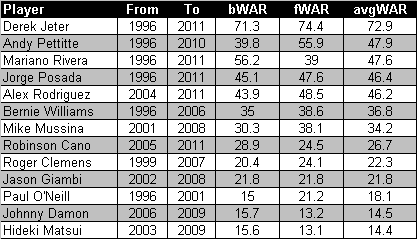
Note: avgWAR = (bWAR + fWAR)/2
Source: baseball-reference.com and fangraphs.com
Since 1996, when the current Yankees’ dynasty was born, only Derek Jeter, Andy Pettitte and Mariano Rivera contributed more to the team than Posada, at least in terms of average WAR. Of course, you really don’t need a sophisticated sabermetric to illustrate how important Posada was to the franchise’s incredible success over the span of his career. He really was a core member of the Yankees. That wasn’t just a clever marketing slogan.
The magnitude of Posada’s contribution to the Yankees is impressive even beyond the context of the era in which he played. Again using average WAR as a barometer, only 10 position players have contributed more to the pinstripes, and, needless to say, the company is rather select. By just about any measure, it isn’t a stretch to say that Jorge Posada is one of the greatest Yankees to ever play the game, and many of the players worthy of that distinction also happen to be in the Hall of Fame.
Yankees Top-15 Position Players, Ranked by Average WAR
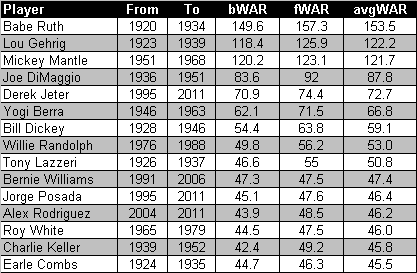
Note: avgWAR = (bWAR + fWAR)/2
Source: baseball-reference.com and fangraphs.com
Although some might dispute the notion of Posada as Cooperstown worthy, his credentials are compelling. Unfortunately for the Yankees’ backstop, his career happened to coincide with arguably the greatest offensive (Mike Piazza) and defensive (Ivan Rodriguez) catchers to ever play the game, so it’s easy to see why he is sometimes overlooked when making Hall-worthy assessments. Despite these formidable contemporaries, however, Posada’s statistical record still stands out.
Comparing Catchers, 1990-2010
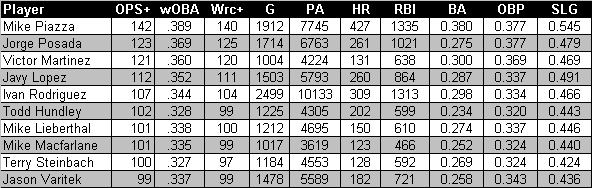
Note: Players with at least 1,000 games, two-thirds of which were as a catcher.
Source: Baseball-reference.com and fangraphs.com
During the 20-year period from 1990 to 2010, Posada’s OPS+ of 123 ranks second only to Piazza’s 142 (among players with at least 1,000 games, two-thirds of which were as a catcher). The same is true for his wRC+ and wOBA. Based on more traditional stats, Posada also distinguished himself during the period, ranking tied for first in on base percentage and third in home runs and RBIs. As a result, Posada won five silver sluggers behind the plate, the fourth highest total amassed at the position. Although some catchers, such as Joe Mauer, have had better rates over a shorter horizon, Posada’s longevity is also a feather in his cap. In the 20-year span under consideration, only four others have started more games behind the plate, which is remarkable considering how slowly the Yankees eased him into the starting role.
Jorge Posada vs. Hall of Fame Catchers and Likely Inductees
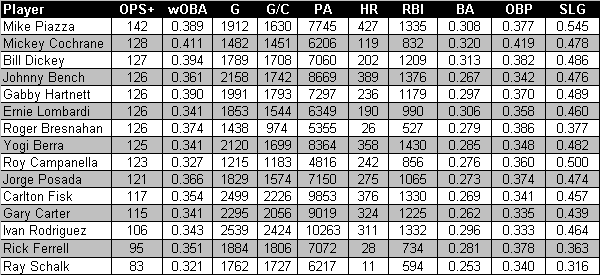 Note: Likely inductees include Mike Piazza and Ivan Rodriguez.
Source: Baseball-reference.com and fangraphs.com
There are currently 12 primary catchers elected to the Hall of Fame, making it the most underrepresented position on the diamond. However, even despite this very select company, Posada’s career totals still figure prominently among catchers already enshrined or almost certain to be. In the chart below, Posada’s relative rankings in several offensive categories are provided. Although a rudimentary analysis, it shows that Posada can stand toe-to-toe as a hitter with every other Hall of Fame backstop but Piazza.
Posada’s Ranking Among Hall of Fame Catchers and Likely Inductees
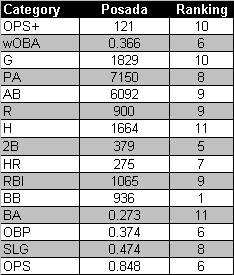
Note: Likely inductees include Mike Piazza and Ivan Rodriguez.
Source: Baseball-reference.com and fangraphs.com
As a hitter, Jorge Posada’s Hall of Fame credentials seem undeniable, so the deciding factor could be his work behind the plate. Defensive metrics are relatively unreliable in general, but for catchers, they are severely limited. For that reason, it’s likely that Hall of Fame voters will rely on reputation. Because of how rapidly his catching skills declined at the end of his career, that might seem like a liability for Posada, but during his prime, the backstop was often regarded as being an above average defender. If that’s the prevailing sentiment when Posada’s name comes finally appears on the ballot, his chances of being enshrined would be greatly bolstered.
“I see vintage Jorge Posada, everything we expect. He’s one of the best catchers in baseball and he has been. He’s an offensive and defensive catcher. This is what I expect, this is what he is and this is what he’s been. This guy is going to go down as one of the famous Yankee catchers, along with Yogi Berra, Bill Dickey, Elston Howard and Thurman Munson.” – Brian Cashman, quoted in the New York Daily News, August 8, 2006
How will Jorge Posada be remembered? Despite often being overlooked on a team chock full of talent, Posada’s contribution to the Yankees’ dynasty is undeniable. He is more than deserving of all the accolades usually bestowed upon a Yankees’ legend. His number 20 should never be worn again, and his plaque for Monument Park should soon be minted, but perhaps the most meaningful honor is the special place he occupies in the memories of an entire generation of Yankees’ fan. They won’t soon forget how great Posada really was. Hopefully, the Hall of Fame voters will remember too.

I wonder what they used for the Bantha fodder?

I was too young to appreciate Fisher in the gold bikini. Even to this day, that outfit does nothing for me. But this one…
I know this movie sucks in a lot of ways. But when Luke started wreaking havoc on the skiff with that green light saber, I’ve never been more thrilled in a movie theater.
Check out this guy who stumbled on them in Buttercup Valley.
[Photos by Mike Davis]
From “The Age of Movies,” here’s P. Kael on History of the World, Part I:
When I saw History, there were hisses and walkouts during this number, and the film has been attacked as a disgrace by reviewers in the press and on TV. I bet nobody hissed or walked out on Candide. When Prince and Bernstein do it, it’s culture; when Brooks does it, there’s a chorus of voices saying, “He has gone too far this time.” Earlier in the film, the dancer Gregory Hines, who makes a breezy film debut as Comicus’ Ethiopian pal, Josephus, tries to convince the slavers who are sending him to the circus to be eaten by lions that he’s not a Christian but a Jew. With his loose-limbed body–his legs seem to be on hinges–he does a mock-Jewish dance, and then a shim-sham, and the racial humor didn’t appear to bother the audience. But during the Inquisition, when nuns toss off their habits, and a giant torture wheel to which pious Jews are attached is spun in a game of chance, there were mutterings of disapproval. Yet it’s Brooks’s audacity–his treating cruelty and pain as a crazy joke, and doing it in a low-comedy context–that gives History the kick that was missing from his last few films. The Inquisition is presented as a paranoid fantasy, with Jews as the only victims, and when Torquemada whacks the knees of gray-bearded old men imprisoned in stocks–using them as a xylophone–you may gasp. But either you get stuck thinking about the “bad taste” or you let yourself laugh at the obscenity in the humor, as you do at Bunuel’s perverse dirty jokes. The offensive material is a springboard to a less sentimental kind of comedy.
If Mel Brooks doesn’t go “too far,” he’s nowhere–he’s mild and mushy. It’s his maniacal, exuberant compulsion to flaunt show-biz Jewishness that makes him an uncontrollable original. At his best, he is to being Jewish what Richard Pryor is to being black: wildly in love with the joke of it, obsessed and inspired by the joke of it. What History needs is more musical numbers with the show-biz surreal satire of the Inquistion section; it’s the kind of satire that makes the Marx Brothers’ Duck Soup a classic farce. Brooks goes wrong when he pulls back to innocuous loveability–when he has Gregory Hines say to him, “You’re the first white man I even considered liking.” (Now, if that had been “the first Jews…”) Hines’ dancing–the movie could have used more of it–deserves better than a suck-up line.
When Brooks has a hot streak on a TV talk show, you can see his mental process at work, and amazing things just pop out of his mouth. He can’t get that rhythm going on the screen with prepared gags. Some movie directors can give their material that surprise. Altman has often done it, and in Hi, Mom! DePalma did it, with a highly inflammatory race-relations subject. But Brooks isn’t a great director–far from it. He’s a great personality though, and he moves wonderfully; his dancing in his Torquemada robes is right up there with Groucho’s lope. Wearing a little mustache and with his lips puckered, Brooks as Louis XVI bears a startling resemblance to Chaplin in his Monsieur Verdoux period. I kept waiting for him to do something with this resemblance, but he didn’t. Was he unaware of it? Lecherous Louis did, however, make me understand why women at the French court wore those panniers that puffed out the sides of their skirts; we see those ballooning bottoms through his eyes. (Brooks may be wasting his talent by not appearing in other directors’ movies while he’s preparing his own.) As a director-star, he has the chance to go on pushing out the boundaries of screen comedy, because, despite the disapproving voices in the press and on TV, he can probably get away with it. Like Pryor, he’s a cutie.
Too bad for us, Mel’s movies never got better, but he sure did score a hit with the play version of The Producers.


Last night, Jorge Posada told reporters: “I don’t think there’s even a percentage of a chance that I can come back,” Posada said. “It’s not going to happen.”
We’ve talked about Posada’s fine Yankee career a lot this year. Tomorrow, William J will weigh-in on Posada’s case for the Hall of Fame.

More P. Kael from “The Age of Movies. ”
From the essay, “Fear of Movies” (September 25, 1978):
In his new book The Films in My Life, Francois Truffaut writes, “I demand that a film express either the joy of making cinema or the agony of making cinema. I am not all interested in anything in between; I am not interested in all those films that do not pulse.” Truffaut’s dictum may exclude films that some of us enjoy. You couldn’t claim that National Lampoon’s Animal House expresses either the joy or the agony of making cinema. It’s like the deliberately dumb college-football comedies of the thirties–the ones with Joan Davis or Martha Ray–only more so; it’s a growly, rambunctious cartoon, and its id anarchy triumphs over the wet-fuse pacing, the botchy lighting, and the many other ineptitudes. In its own half-flubbed way, it has a style. And you don’t go to a film like Animal House for cinema, you go for roughhousing disreputability; it makes you laugh by restoring you to the slobby infant in yourself. (If it were more artistic, it couldn’t do that.)
But that sort of movie is a special case. Essentially, I agree with Truffaut. I can enjoy movies that don’t have that moviemaking fever in them, but it’s enjoyment on a different level, without the special aphrodisia of movies–the kinetic responsiveness, the all-out submission to pleasure. That “pulse” leaves you with all your senses quickened. When you see a movie such as Convoy, which has this vibrancy and yet doesn’t hold together, you still feel clearheaded. But when you’ve seen a series of movies without it, whether proficient soft-core porn like The Deep or klutzburgers like Grease, you feel poleaxed by apathy. If a movie doesn’t “pulse”–if the director isn’t talented, and if he doesn’t become fervently obsessed with the possibilities that subject offers him to explore moviemaking itself–it’s dead and it deadens you. Your heart goes cold. The world is a dishrag. (Isn’t the same thing true for a novel, a piece of music, a painting?)
The pressing against the bounds of the medium doesn’t necessarily result in a good movie (John Boorman’s debauch Exorcist II: The Heretic is proof of that), but it generally results in a live one–a movie there’s some reason to see–and it’s the only way great movies get made…there’s enough visual magic in [Exorcist II] for a dozen good movies; what the picture lacks is judgment–the first casualty of the moviemaking obsession.
…There’s no way I could make the case that Animal House is a better picture than Heaven Can Wait, yet on some sort of emotional-aesthetic level I prefer it. One returns you to the slobbiness of infancy, the other to the security of childhood, and I’d rather stand with the slobs.
I love this.

And this classic, producer by D’s younger cousin, Pete Rock, a tribute to Trouble T Roy, one of Heavy D’s dancers: