"A New York Treasure" --Village Voice
Category: Sportswriting

The Banter Gold Standard: Jimmy the Greek

Peter Richmond is one of the finest takeout writers of the past thirty years. According to his website:

Peter Richmond attended Yale University, where he studied under the late, great John Hersey and the very alive, great David Milch. Somewhere in there he also attended auto mechanics school, from which he never graduated, but which led to his eventual purchase of a ‘77 Eldorado which is currently his family’s most mechanically reliable vehicle. He was awarded a Nieman Fellowship in Journalism at Harvard, where he studied art, architecture, paleontology, playwriting and humility.

His stories have been anthologized in 13 books, including “Best American Sportswriting of the Twentieth Century,” and four appearances in “Best Sportswriting of the Year” anthologies. (And, yes, he had the title essay in Riverhead Press’ “I Married My Mother-in-Law.”) He is the co-host, with author David Kamp, of a public radio show about his tragic attachment to the New York Giants called “Tangled Up in Blue,” which airs weekly on NPR’s smallest affiliate, WHDD-FM.

…His work has appeared in several periodicals, including Grantland.com, The New Yorker, The New York Times Magazine, Vanity Fair, Rolling Stone, Parade, GQ, Details, Architecture, Parade, Golf Digest, Travel + Leisure Golf and TV Guide, as well as two amazing magazines which, sadly, no longer exist: Play and New England Monthly.

He forgot The National where, along with Charlie Pierce, Johnette Howard, and Ian Thomsen, he made “The Main Event” a must-read.

Please enjoy this story, originally published in The National, and reprinted here with the author’s permission.

“Jimmy The Greek”

By Peter Richmond

His words break the silence of a breakfast conversation that has wound down to nothing. They are as soft and insubstantial as rust flaking away, so soft that at first you think you might have heard him wrong, except that his eyes are focused on something that isn’t there, and the flesh of his face has gone completely slack, and part of a bagel sits forgotten halfway to his mouth, and there really couldn’t have been any mistaking them at all.

“I’m dead.”

He doesn’t mean he’s dead tired. He doesn’t mean he’s dead because he’s in trouble. He doesn’t mean he’s literally dead; in fact, after spending nine months in and out of Miami Heart Institute, with the bad heart and the chicken pox and shingles and diabetes, he’s looking much, much better than last year, if dangerously overweight, certainly younger than 71.

He means he’s dead as in without life. He’s says “I’m dead” because no other word wraps as neatly around the emotion that dominates his life. Because when CBS took away his job two years and four months ago with a one-paragraph release that called him “reprehensible”—to be precise, it was his remarks they called reprehensible, not him, but that distinction blurred long ago within Jimmy Snyder’s mind—they apparently carved his guts right out, which have since been replaced completely by the singular obsession that he was wronged. And instead of diminishing, that sense of injustice has festered, until all that seems left of Jimmy Snyder is the core of anger and bewilderment.

“I still don’t know what I did,” he says, but there’s no outrage to the words, no heart to them, no Greek to them. The Greek would have bellowed those words. Not whispered them into a bowl of granola.

Andy Rooney, the apparent philosopher, no simple setter of odds, may or may not have said that blacks watered down their genes, but he definitely did say that “homosexual unions” were a cause of “premature death.” He didn’t say this in a spontaneous interview in a restaurant, but in a prerecorded network television show. Then, in a draft of a letter to a magazine, Rooney said that he considered sex between men “repugnant.” For this, Rooney was given a three-month suspension. Within days his producer, Don Hewitt, said, “I spend 90% of my waking hours trying to get Andy Rooney back.” And 22 days after the suspension was announced, Rooney was indeed back.

Jimmy the Greek said some strange and unconscionable things about black athlete, which he insists reflected his admiration for them, although it didn’t come out that way, and now he’s dead. His own boss, Brent Musburger, within days of The Greek’s indiscretions, excised Snyder’s name from history the way Winston Smith used to eviscerate history for a living in Orwell’s 1984. Today no one at CBS is losing any sleep over the return of Jimmy Snyder. In fact, except for a director who has since quit the “NFL Today,” no one from CBS has even given him a phone call since they pulled the trap door.

Maybe no one really thought he’d take it this hard. Maybe that’s why Brent and Ted Shaker and the rest of the crew haven’t bothered to drop so much as a postcard in the mail. Maybe they all said to each other, “Forget it, guys, it’s just The Greek.” As if for The Greek all the rules were different. As if maybe he wasn’t the guy Musburger’s kids once loved, or the guy Shaker once thanked for having paid for the new extension on his house because the ratings of the show he was producing had grown so high.

Maybe they all thought that if anyone was a survivor, The Greek was, and that losing the “NFL Today” gig was no different than losing his right to vote when the feds convicted him of interstate gambling in 1962. But it was different. It was everything.

The truth is, The Greek had spent the first 50 years of his life in one world and then vaulted, to his surprise, into another, and he wanted, desperately, to finish his life in that second world. The first was a fringe kind of world where a man might be a “felon or might not be, where money might flow unnaturally swiftly from sources best left unseen, where distinctions between good and bad were as vague as the distinction between night and day in a town where the neon glowed 24 hours. The second was the network TV world, a place where the morals are similar but the trappings arc not.

And while it may have never seemed to the people who watched him on Sunday afternoons that it mattered to The Greek that he was on a sound stage instead of at a betting window, it mattered more than you can imagine. A man who’d once been surrounded by federal marshals loosed by Bobby Kennedy had suddenly found himself surrounded by makeup artists and the high-priced talking-head spread of Brent and Phyllis and Irv, and it felt not only good, but legitimate.

So when they yanked it out from under him, the way The Greek sees it, they might as well have yanked out the stool from beneath the feet of a man with a noose around his neck. And here he is, living in an overstuffed luxury hotel on Miami Beach where the other guests glance at him in sidelong fashion as he fills the corner table alone.

“I got to start doin’ something,” he says. “I wake up some mornin’s and you say, ‘Jesus Christ! You’re not doin’ nothin’!’ And you get a little lonesome. And disgusted. With everything. It gets a little lonesome. No one comes around. No one calls.”

And here it is again:

“I’m dead.”

Iit’s not true. A few days later, he is besieged by autograph-seekers and the rest of the bit players who make up the supporting cast of his life at the race track. As he peels hundred~dollar bills with his left hand from the baseball-sized clot of bills in his right, Jimmy the Greek is wildly alive. And if it’s only alive the way a character on stage for the 2000th production of a fraying Broadway play is alive, it nonetheless breathes and moves and barks and snarls, which beats the hell out of being dead.

So there he sits, in his customary chair near the $50 window in the clubhouse at Gulfstream, still too weak from the three months in a hospital bed to jump to his feet and run to the window when the odds suddenly get good. So he throws fifties and hundreds at the half-dozen men with the oddest of morphs who circle him like distant planets all day without ever leaving the orbit.

“Jeff!” he’ll yell, or Mike, or someone else, and Jeff will skip over and take the hundred and head for the window while The Greek says, “Get the one-four and the four-one for 50 each.”

Sometimes the one-four hits. Sometimes not. He’s down a couple thousand after the sixth race. After the seventh he’s up a couple thousand, after picking the winning horses in the fifth, sixth and seventh, the Big Three, for $3,500. One of his pals cashed his ticket, and he had to be careful on the walk back across the floor lest the bills all spring out of his hand, they’re so thickly stacked. In this he is still The Greek. When the five horse runs in and The Greek shouts in glee, other horseplayers smile and say, “Way to go, Greek,” mostly because they’re so glad to see him looking half-alive again.

But even afloat on a seas of green, The Greek’s mind is elsewhere. He’s motioned to a tall blond kid to come over for a second.

“You play basketball?” The Greek says, and the kid nods. The kid’s built like a lamppost. The kid is a friend of one of The Greek’s track friends. The kid has wandered over because The Greek is a friend and The Greek is all right.

“C’mere,” says the Greek, and the kid steps up close to the Greek’s chair.

The kid walks over. The Greek reaches out and lays his incongruously lean and fragile fingers—they should be sausages with a body like his, but they’re more like angel-hair pasta—on the kid’s calf. In the adjacent chairs, The Greek’s track friends lean in to listen, as do some other people he doesn’t know.

“See how he’s built?” says The Greek as he describes the contours of the kid’s leg with his left hand. “See how his calf is like this, then it leads up to his thigh, and there’s hardly any difference in the size? The thigh’s hardly any bigger’n his calf?”

His friends nod, and the kid is looking down at The Greek’s hand with remarkable detachment considering the circumstances.

“Now the blacks, the thigh would go out like this, and that’s where they get their spring,” says the Greek.

“But you can’t say that,” the kid says.

“Can’t say what?” The Greek asks, pleading.

“‘Black,'” the kid says. “You can’t say ‘black.'”

The friends all nod, and their heads go up and down like pistons. “Work for CBS, tell the truth, get fired,” says one of them.

“We have a coach, he was a scoring champion in his conference,” says the kid, adding, “and his thighs are, like, out to here.”

“That’s all I said!” says The Greek, spreading his hands. “That’s all I said!”
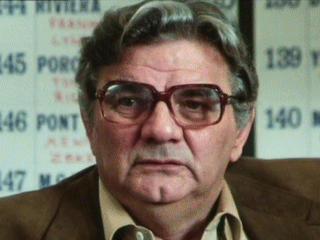
NOT ENTIRELY. What he said during lunch at Duke Zeibart’s on the Friday of Martin Luther King Day in 1988, was, essentially, three things. The first was, “If they over coaching, like everybody wants them to, there’s not going to be anything left for white people.” This one packed the most immediate impact. Snyder insisted afterward it was just a bad joke, and a compliment to blacks, too. They’ve taken over all of sport because of their drive and their desire. They want it so badlv they’ve pushed the whites right out. (Look, he said, if anyone should have been mad, it was whites. He said whites were lazy. No whites got angry at what Jimmy said.)

Then he said, “There’s 10 people on a basketball court. If you find two whites you’re lucky.” The last word was the killer. Otherwise, it’s no different from the famous tabloid basketball columnist saying, a few years ago, “The blackest thing about the Celtics is their sneakers” in reverse. But he never should have said “lucky.” He might have been using it In nothing but a careless sense. but can’t be careless with live ammunition. More than anything, this was the statement that was indefensible.

Finally, he said, “[Black superiority] goes all the way back to the Civil War, when during the slave trading the owners would breed his big black with his big woman so he could have a big black kid.”

This is the one that stuck.

At any rate, within hours, Musburger and Shaker had viewed the tapes and talked to the CBS brain trust, most of whom happened to be in Hawaii. Later than night CBS issues a statement saying it found his remarks to be “reprehensible.” No one actually said he was fired. But when Sunday showed up, he’d been deleted.

“You know, on Friday afternoon, our former colleague Jimmy the Greek, made some regrettable and offensive remarks for which he has apologized,” Musburger said the way he might have recited the Seahawks’ injury list. “Yesterday, CBS issued a statement disassociating itself from those remarks. It goes without saying that his comments do not in any way reflect the thinking or attitude of the rest of us here at CBS Sports. While we deplore the incident, we are saddened that our 12-year association with Jimmy had to end this way. And the “NFL Today” will continue from RFK Stadium in Washington in just a moment.”

And that was the sum total on CBS of discussion about the several issue The Greek had raised. Elsewhere, reaction was mixed, and Snyder had his defenders.

“Much of what he said seemed unexceptional to most whites and a good many blacks as well.” wrote Washington Post columnist Richard Cohen. “Blacks are more athletically gifted than whites. He spoke of racial differences. That is a taboo. Never mind that there are such things.”

“He’s right.” Jim Rice said a few weeks later, in the weight room off the Red Sox locker room at Fenway Park, during an interview for a Miami Herald series that had been prompted by The Greek’s firing. “It’s just a gift. Raw talent.” And a few days after that, at Yankee Stadium, Jesse Barfieid nodded: “Leaping, running—physiologically, we have an advantage.”

Recently, Synder’s former colleague, Jayne Kennedy-Overton, said, “If he was telling the truth, why blame Jimmy? Why not blame the people who made the history he spoke of?”

 

AFTER THE eighth race, he was up several thousand. He’d taken the 10 horse across the board for $400, and it won at 6-1. After the ninth, he was up another couple thousand with the two horse. He now had a bundle of hundred-dollar bills the size of Zeus’s fist in his right-hand pants pocket, all earned in a dizzying 90-minute span that left your mouth dry and your hands shaking just to he next to him. He has not mentioned the money on the drive back to Miami Beach.

“Brent panicked,” he says. “If he’d opened up his mouth that day for me. he could have saved my job. But he didn’t. Or if he did, it wasn’t to say anythin’ good. If only [Howardj Stringer had been there, he’d have looked at the tapes, and sat everyone down, and they coulda suspended me for that last game, and that would have been enough. But the big guys were in Hawaii, and Brent and Shaker were the only ones talkin’ to ’em. Nobody stood up for me. When you got the No. 1 producer and Brent against you nobody’s going to go against them. Who’s gonna say somethin’? Irv? The only guy who could have said somethin’ was Madden, but he was at a meeting of some sort and said it was all over by the time he got there: Summerall said somethin’ good in my behalf.

“Aw,” he says, “don’t let me start this.”

It’s absolutely huge, Jimmy’s car, as wide as a whole lane. It has a blue leather interior and the dashboard looks wooden, but it’s really only wood-pattern contact paper. On the glove compartment the pattern has all peeled away, leaving a bare metal panel. The inside of the passenger door is pocked with gray spots from the ash of his cigar, like a wall that’s been riddled with bullets.

Gliding the Cadillac to the hotel curb is like trying to dock a tugboat. It’s a car that has somehow survived beyond its age and now it is unwieldy and impractical. In these respects, it’s a lot like Jimmy. He has not gone into the new age gracefully. Watch him yelp at the pretty women—”Hey! Are you married?”—with that old man’s license to leer. He struts through his hotel, this outsized guy all in white and gold with his cane with the heavy steel knob as a handle, this purely exotic figure from some Graham Greene novel, part Sidney Greenstreet, talking too loudly, flashing that wad of hundreds. He doesn’t seem to realize that we’re in the mall age now, where the people we admire don’t come outsized any more They come in a garb of discreet homogeny. They come smooth. They come so they fit into a preconceived notion of special.

He’s not alone in this stumble into the late 20th century. Surely some of Rooney’s indiscretion can be chalked up to his inability—voluntary or otherwise—to evolve with the flow of time.

Most of us adapt. Some adapt by shedding ignorance. Others adapt by burying it. Only The Greek knows which camp he’s in. No one who’s ever spent any time at all with The Greek thinks he’s racist—”No black ever got mad at me,” he says. “The blacks all loved me”—but it doesn’t matter anymore.

Now he’s winking at the little girl in the scotch-plaid dress in the lobby. He is mugging. His face is all rubbery. She is fascinated. Her mother is leery. He loves kids. He’ll drop anything—anything—to wink a kid. How could he not? He lost two to cystic fibrosis, and he was never one himself, not after his mother was shot to death by his aunt’s estranged husband when Jimmy was 9. So he pats them and reaches out to them and laughs at them and mugs for them, and the kids love it, but the mothers wonder what in the hell this old guy is up to. And, of course, the mothers don’t know who The Greek is. The mothers only know who Bryant Gumbel and Willard Scott are.

“Without even saying goodbye. After 13 years. You think that’s fair? You think that’s fair?”

In the morning he’ll try to walk a mile on the beach, but it takes an hour. He’d rather linger over breakfast for a couple of hours until it’s time to go to the track, although these breakfasts can daunt an ego, because in the restaurant there are often several young families with children who won’t be all that amused by the man in the gold chains who frequently commandeers the telephone in the middle of the dining room and starts swearing at his stockbroker.

“I got some money in an Austrian money fund. and it was doing really good until this morning Gorbachev said somethin’ and it’s going straight down,” he says, returning to the table after one rant. “The market’s all I got. It’s the only excitement I have out of life. I win or lose 10 or 20 (thousand} a day. That’s all I got.”

He is spending a lot of time in Miami Beach. His wife, Joan, is in the house in North Carolina. “We don’t want to talk about that,” he says. Then he grows disgusted with himself: “Oh, listen, you take the good with the bad, what else you gonna do.”

Wilburn, the waiter, refills his cup. Wilburn is from Jamaica. Wilburn knows what Jimmy wants to eat before Jimmy can tell him. Jimmy regularly summons Wilburn by saying, “Get your black ass over here.” He loves to say things like, “I’m gonna get your black ass fired,” and Wilburn laughs.

Jimmy speaks like this loudly enough for the people in the restaurant to turn around and some of them smile. He does this because he wants the world to know that that is the Steubenville way he speaks, and that is the way he was speaking on Martin Luther King Day, casually, and not from prejudice. He will not allow the perception to endure. He simply will not. He Is adament.

That is the most important thing now. Not the firing. The firing, he concedes, was inevitable.

“It had gotten to the point where I kept fighting’ over the show with Shaker almost every Sunday by the end,” he days. “The last year they a;most cut me off completely. Shaker kept wantin’ to know what I was going to say beforehand. But I never knew. Which is what made it a great show. Tell him first? I’m sitting there with 100 things to say and I never knew what I was going to say. That’s what was so great about it. Everything was spontaneous.

“But I overcome that. I overcome so much. I overcome hittin’ Brent. I overcome a situation where I went to a racetrack and asked someone for figures and they were trying to grab the guy. Turned out he was a bookmaker. I overcome that. I went to Denver on a speaking engagement and said something about rednecks. Overcome that. I told Phyllis I hated her friggin’ husband, right on the air. Overcome that. I overcome everything. Then all of a sudden the thing I was paid to do I was fired for.”

Now there’s passion. The Greek has turned his chair to face his companion head on, and he’s squinting. Suddenly, it’s The Greek’s voice, all blustery and rough.

“Listen. I was the only person who never went with one camp or the other. l never cared about personalities. All I ever cared about was the good of the show. Ask anybody. I didn’t have grudges. I didn’t have vendettas. The show was everything to me. I thought this was supposedly going to be my life. “NFL Today” was … I mean I had a good PR firm, but little by little I gave everything up because of a show, then all of a sudden I woke up one day and I didn’t have it. All of a sudden I was the sonofabitch who said blacks were better athletes.”

Three men have dropped by the table. They have tans like they watched a nuclear test in person. They are on their way hack to the marina to sell more boats at the boat show, for $375,000 each.

“You got screwed, Greek,” says one, and the other two nod. After they leave, The Greek’s smiling.

“Next to survival, what’s the most important thing?” he says after they’ve gone. “Recognition.”

More important than health? Family?

Silence.

“Those are both part of survival,” he says.

Silence.

“I had a son and I lost him,” he says. Quietly. “So brilliant. He was a mathematic marvel. Professors from all over the United States—Michigan, Indiana—used to send him problems when he was a student at UNLV. He’d sit there for hours. Finally he’d look at me and say, ‘I got it Dad.” Once when a teacher went on vacation they let him teach the class. That’s how good he was. The teacher said, ‘The guy can spot me the deuce and still beat me at mathematics.'”

Silence.

“Oh, well”—these words like marbles dropping off the edge of a kitchen table.

Silence.

“He was somethin’. Tried so hard to live. He was 26. He was supposed to be dead at 2.”

Silence.

“Look,” Jimmy says. “I’ll survive. I’ll get a show. I’ll have a 900 number by the fall.”

Silence.

“Why’d they have to do it the way they did it? I begged them to not use reprehensible. It was just a word that wasn’t needed. “Take that word out,” I said. They wouldn’t. I said, “I can’t overcome that.”


The Banter Gold Standard: Sympathy for the Devil

His was an all-too short career, much of it spent writing about his favorite blood sports, boxing and politics, but it’s most remarkable aspect may have been the improbable sequence of events at its fairytale inception. At age thirty, Joe Flaherty (c. 1936-1983) was still a laborer on the New York waterfront whose unpaid (and often un-bylined) stories occasionally appeared in his Brooklyn community weekly. When the weekly deemed his account of a rowdy police gathering too hot to handle, a friend surreptitiously sent it to The Village Voice. Impressed, the Voice’s editors hired Flaherty to write a follow-up story, an assignment that ended when the fledgling reporter came to blows with one of his subjects. Flaherty’s next piece incensed Pete Hamill, largely because it painted an unflattering picture of a middleweight named Joe Shaw, in whom Hamill, Norman Mailer, and George Plimpton had acquired an interest. The New York Times Magazine then asked Flaherty to write an expanded follow-up about the feuding Brooklynites, thus launching a career that would produce bylines in magazines from the Saturday Review to Playboy, the journalism collected in Chez Joey (1974), the novels Fogarty & Co. (1973) and Tin Wife (1983), and Managing Mailer (1970), an account of his experience as campaign manager for Norman Mailer’s 1969 mayoral run. As Flaherty put it: “A lesson for young journalists: in your early rounds forget the body and go for the head.”

—George Kimball and John Schulian on Flaherty in At the Fights (now out in paperback).

Here’s another good one: Joe Flaherty on Jake LaMotta. This piece originally appeared in the January 1981 issue of Inside Sports. It is reprinted here with permission of Jeanine Flaherty.

“Sympathy For The Devil”

By Joe Flaherty

All lives are failures in some degree or another. Somewhere along the line we fudge the pristine youthful dream. Even when we achieve, the compromises we’ve made, the injuries we’ve inflicted sully the prize. But most of us can live with this, since we deal in minor declinations of the soul.

Not so with Jake LaMotta. LaMotta’s fortunes and misfortunes have been so cosmic they could be considered godlike if it weren’t for the sacrilege implied. The ruin he has heaped on himself, and on many of those who’ve come in contact with him, seems pagan. Those who lament LaMotta would have you believe Attila the Hun would have to move up in class to get it on with Jake.

When you go in search of the good word on LaMotta, no soft, illuminating adjective is forthcoming. Since most of the naysayers are from within boxing, the word is even more damning. The ringed world is awash with evocations of loving motherhood, guiding priests and golden-hearted gladiators. Cauliflower corn pone bows only to the jab as the basic element of boxing.

But when the talk turns to LaMotta’s character (his boxing ferocity is always lauded), the usual benediction of hot water turns to spit. The only bow to grace is that no one wants his quotes attributed, though this “nicety” could be interpreted as fear of retribution, since no one believes the 58- year-old LaMotta has mended his savage ways.

Thus, one of the game’s gentlest promoters calls LaMotta “a reprehensible, obnoxious, despicable sonnuvabitch,” and then apologizes that he has characterized a human being in such a fashion.

To be sure, it’s a tough assessment, but even LaMotta wouldn’t deny he worked like a bull to earn his unsavory rep. Born on the tough Lower East Side of New York, he and his family moved to the Bronx when he was a boy. In that borough of hills (peaks and valleys in psychological jargon), LaMotta’s cyclonic emotions got untracked. Young Jake wasn’t one of those angels with dirty faces, a wayward street urchin with tousled hair who pinched apples from outside, the grocery store and puckishly threw rocks at schoolhouse windows. Jake’s mayhem was main arena, armed robbery, assault, rape.

As a teenager he pummeled the head of the local bookie (whom he liked!) in a robbery attempt and left the man for dead with a crushed skull. Subsequently, the papers falsely reported the bookie’s death and LaMotta did not learn until years later, after he won the middleweight championship, that the bookie, following a hospital stay, had moved to Florida to recuperate. In fairness, LaMotta had ongoing pangs of conscience about “the murder,” but the primal concern of the heart was how best to beat the rap, not the devil.

The horror his early violence wreaked also didn’t stop him, in later years, from battering various wives for “love” and numerous opponents for loot. LaMotta’s Life has been so unappetizingly gamy, so foully unpalatable, it bends the conventional limits of social understanding, as graphically documented in the film of his life, Raging Bull.

Even those who shared the same mean streets can find no sympathy. An Irish trainer from the same boyhood Bronx said, “Look, he just went too far. I grew up there, too. We always hustled a fast buck, put out other guys’ lights in fistfights, and even brawled with cops. Hell, the Irish are great cop-fighters. But we stopped short of some things, the animal stuff. Beating people’s head in with weapons and wife-beating, Christ, that’s as low as you can get.

“Ask anyone. That bastard didn’t even know how to say hello. But don’t take my word for it. The Micks are notorious. for not having a good word for Wops. Go ask his own kind. His own kind hate him because he was a squealer. He even screwed them. You go ask the italians what they think. When your own kind hate you, that tells you something.

Indeed, the “wise guys,” the sharp money guys who always have leeched on the tit of boxing, long ago wrote off LaMotta for his testimony before the Kefauver Committee that he went into the water for the mob when he fought Billy Fox in Madison Square Garden in 1947. But even before that, !he wasn’t acceptable. Hustlers who live off “the edge” dislike dealing with a “crazy” man.

EVEN ITALIAN-AMERICAN  director Martin Scorsese, while creating a technically beautiful film and coaxing marvelous ensemble acting from his cast, was in the moral quandary about what to make of LaMotta the man. If the film had to stand on redeeming social qualities, Raging Bull would have been castrated by the censors. Scorsese, like so my who have faced LaMotta, was overwhelmed with the brutishness of the life and in the end, using Robert DeNiro’s great talents, settled for an exposition of poetic rage. The violence is softened by slow motion and an operatic score. This creates the illusion that one is dealing with a demon.

But the frightening things about LaMotta is that he is very real, and removing him from our orbit with technical skill and art is cleverly slipping the punch. The only way to explore LaMotta’s life is to delve into the festering place in his heart of darkness.

The LaMotta you meet today hardly qualifies for a portrait in ferocity. If it weren’t for his classically failed soufflé of a face and the thickness of his articulate speech, you wouldn’t suspect he had made his living at demolition. His weight is back to the 160-pound middleweight limit, and his manager is deferential. His hands belie their destructive force in that they are small, slim and tapered.

“I should have been an artist, or a fag,” he jokes. But the jibe has insight. They look like the hands of someone who would beat helplessly on the chest of a bully.

ONLY THE eyes give a clue to his former life. They are so sad and placid, they almost look burned out. Twin novas which which didn’t survive the Big Bang, memos to some terrible past.

So you’re not surprised when he responds to a question about his current life, “I’m a recluse. I stay at home and read, play cards, and watch television. And I love to cook. I’m a gourmet cook. It’s a knack.”

His oldest son Jack Jr. (by his second wife, Vikki) concurs: “I’d rather eat at home with him cooking than go out to a fine restaurant.”

LaMotta’s forays outside are restricted to long walks, infrequent trips to an East Side bar to meet Rocky Graziano, who pulled time with him at reform school when they were in their teens, and some evening blackjack games. “I don’t want to go out anymore,” he says. “I seen it all, and I had it all.’ Fame, fortune, Cadillacs. There’s nothing out there for me. Besides, I don’t like the kind of people I attract.”

When asked to elaborate, he has trouble pinning if down. “I don’t know. Other people like to go out. It must be me. I dislike a lot of people.” He amends, “I don’t mean a majority of people. Maybe I’m too cynical. But sometimes I hear the first word out of their mouths, or see a smirk on their faces, and I know they’re not sincere. They’re jealous or something. Jealousy is a word I use a lot, but I think it’s right. Well, I think like that anyway. I guess I attract those kind of people, so I stay home.”

The recluse pose is really nothing new, if one applies it to LaMotta’s inner emotions. In his fighting days, though public, he was notorious for being a loner in the things that mattered. He managed his own career, ostracized the mob until it promised him a shot at the crown for dumping to Fox, and had the intimate counsel of no one. He viewed his wife of that period, Vikki, with insane jealousy and suspicion, and forced his brother Joey, who worked his corner, “to do my bidding.” The adjectives applied to Jake were “suspicious,” “paranoiac.”

Now divorced from his fifth wife, he is even more insular. The film is a hiatus in this isolation. Jack Jr. is up from North Miami Beach on leave from his job to guide his father through the publicity maze connected with the film. Vikki and his five other children also came to New York for the film’s opening and some of the attendant hoopla. But when the stardust settles, he will be back living alone in his Manhattan apartment. The isolation may be complete for a long period if some job offers don’t result from the film since LaMotta, in earnest, declares, “I’m now practicing celibacy,” which could be construed as the last word on the people one attracts.

Jake attributes his decision on unilateral withdrawal to “the failures of my romantic life.” His first marriage broke when he met Vikki, “the love of my life.” Vikki left when LaMotta lost all control of his temper, his calorie­ and alcohol intake, and his ability to find his way home to his wife’s bed after his retirement. “I think I suffered a nervous breakdown during that period,” he says, “and didn’t realize it. I was crazy. I was drinking a bottle or two .a day. I owned my own joint [in Miami Beach], the price was right. Plus, there were a lot of broads. I blacked out a lot and didn’t remember. I really think I was crazy and didn’t it.”

LaMotta seems to be hesitant about going all the way back. His notion is that life would have been fine if he and Vikki could have worked out their problems. If they had been “mature” enough to realize he was going through a bad time after retiring, “the small death” all athletes must face, as the novelist John Updike called it. Similar is the lament that three marriages broke up because finances were tight, and the one thing he regrets is his dump of the Fox fight. The one thing?

LAMOTTA DEALS with his woeful experiences piecemeal, not as the pattern of a life. For LaMotta, to have led a conventional life, it seems he would have had to be born in different circumstances, or somehow been able to overcome the ones he was dealt. The latter is no mean trick. The should is cankered with barnacles of who and what spawned us. Only the imperial George Bernard Shaw had the audacity to state that if he had one thing to change in his life it would have been his parents. And for good reason. There’s a reverberation in that shot that might ricochet back to our own siring.

LaMotta makes some earnest attempts. “You know, I think they brainwashed us. You know, this is your life, you’re poor, and this is the way it’s going to be. I always felt I didn’t deserve good things. I was always guilty. I thought I killed someone, but it was more than that. Years later, I even thought of the way I fought. Letting guys hit me in the face. I didn’t have to do that. I think I was brainwashed to be punished.”

If you want to find the man, it helps to find the boy, and then the father of the boy. LaMotta’s father was an Italian immigrant who beat his kids and beat his wife, and it’s safe to say Jake was tutored in raucous romance early. And even though LaMotta hated the bullying, like so many sons of fathers who beat, drank, molested or committed suicide, he replayed the old man’s aberrations. The psychiatric statistics are too firm in these area to be taken, as happenstance. In dismal surroundings finesse is lost, you take what is offered.

Since the home life was a microcosm of the neighborhood, he had only to expand the MO of violence. In such neighborhoods the glittering prizes of bread, broads and booze wenI to the wise guys. “Artists and fags” (same thing really) need not apply.

To anyone who knows those streets, the real triumph is to make it through time-honored devices in the neighborhood, not in the outside world, There’s a sense of betrayal when one makes it “legit” and moves away. You turn your back on the highest gutter canonization—”a regular guy. It’s not for nothing that artists with such roots can’t completely resist the swagger, highlighting the accent, the tough-guy stance. These are love notes thrown back over the barricades from their now “effete” surroundings. Worldly success is so much manure—the real bones are still made back on he block.

LaMotta only seems an aberration to us because he achieved celebrity and money and didn’t find the happy life. That is the height of anti-Americanism. But to use Willard Motley’s phrase, “Knock on any door,” and you could find countless LaMottas—violent, suspicious, self-destructive, who have left disasters in their wake, but there was nobody there to chronicle them. We prefer happy endings to our social neglect: saccharine Sylvester Stallones. pugs who are pussycats or flower girls who end up at Ascot.

But even in the field of achieving and then destroying celebrity, LaMotta is not unique. Streetwise black, basketball players with fat NBA contracts still get high on more than slam dunks, and up-from-the-pavement union leaders who have had access to the seats of government can’t resist the chance to turn a little change on the side. The outside world might be astonished, but the boy on the block understand all too well. What’s felonious to some is “regular” to others.

When LaMotta got the chance, he didn’t get out. When he made his score in boxing, his first move was to buy an apartment house in the Bronx for his family (parents, brother, sisters). Obviously, to erect a shrine in such heathen lands as the other boroughs never occurred to him, nor should it have. It had to be accessible for worship by those who lay down turf theology.

YEARS LATER, when he was broke and serving time on a Florida chain gang for allowing a teenage prostitute to work his nightclub (he claims innocence about her age and trade), his father sold the apartment house (it was in his name but Jake’s property), deserted his family and moved back to his native Italy alone.That’s the caliber of doublebank that makes street legend.

If one knows the code of the streets, wife-beating is no surprise either. Women (mothers exempted) were only revered as sexual trophies. The language of lovemaking sounded like contracts: “bang,” “screw”—love delivered from a running board. Jealousy is easy to divine, too. You simply ascribed to others the reason you wanted women. If your own intentions were base, so were the world’s.

One has only to remember the photos of Vikki LaMotta then, or to look at her now to realize her erotic worth as a trophy. At age 50, after giving birth to four children (three by Jake and one by a subsequent marriage that also ended in divorce), she still could make a bishop want to break a stained glass.

Vikki realizes the cloud a sexual aura casts. “People see the blonde hair, the beautiful body and look no further. They never search for the dignity. My problem with Jake was that he consumed me. He did it in a very beautiful way, but he consumed me. I was only 15 when we met in June 1946, and we were married in November of the same year. In a way you could say Jake kidnapped me.”

It’s a lovely turn of phrase: “kidnapped me.” It evokes Fay Wray and her rough-hewn suitor. “Our marriage was fine when Jake had control. On the beginning he trained me, molded me to be his kind of woman, but later on when I matured and deviated from what he wanted, he couldn’t handle it. I watched Pygmalion on television the other night, and I saw many similarities.”

LaMotta’s mad jealousy was fueled by the long periods of sexual withdrawal when he was in training. He believed in the old adage that sexual activity sapped strength. “It was a mistake, but in a way it worked. It made me an animal in the ring. Bu now I think I should have had it once in a while.”

Worse, the intensity of training began to render LaMotta impotent when he wanted to perform. For man like LaMotta to fail at all, but especially with his “kidnapped” goddess, was excruciating. So instead of swatting airplanes, Jake disfigured opponents such as Tony Janiro, whom Vikki found handsome; his brother, who had introduced Vikki to Jake, and who made the mistake of kissing her warmly whenever they met; and Vikki herself, for offering her cheek to be peeked by friends.

The beatings were serious enough to require medical attention, and when once Vikki retaliated, she said, “It was a mistake. He reacted like a fighter. He came back at me and nearly killed me.”

Yet for all this, she claims they had glorious times together (rarely shown in the film), and finds her ex-husband spiritual. “Just look into those sad, soft eyes. Whenever I’m sick, Jake is the first at my bedside. What greater love? I love him dearly. No longer in a sexual way, but who knows? That could come back, though I’m frightened to put the heat back into the relationship. It’s so loving and warm now. I just don’t think of him in a sexual way. To be blunt, I have no desire to ball him. He doesn’t like me to say that, but it’s the truth. And I’d need that to get back with him. I’m a woman, and a woman means hot. But love him I do, and who knows what the future will bring? That’s the exciting thing about the future.”

They, have stayed in constant contact 34 years. Jake visits Vikki in North Miami Beach (in the home he bought for her) a few times each year and stays at the house. “Separate bedrooms,” he is quick to add. He talks to her by phone three or four times a week. And he admits that his continuing affection for Vikki hindered his other marriages. “Aw, they knew,” he says. “I’m not smart enough with women to hide anything.”

Of course, LaMotta’s love for Vikki might be heightened by their golden period together. “We had everything,” he says. “Love, home, children, money, the championship, his and hers Cadillac cars.”

Their children hint at more solid stuff. The two boys I met, Jack Jr., 33, and Joe, 32, seem well-adjusted and carry no scars. Neither remembers the parental brawls. Those took place in private, and Vikki says that when she was black and blue she retreated behind her bedroom doors until the damage healed. There is a courageous civility about that.

Jack Jr. is sympathetic about the forces that fashioned his father’s life. “He grew up in the Depression, and everything was struggle. Everything was denial. His generation had to fight to get out. That’s why you don’t see fighters with the ferocity of the ’40s fighters anymore.”

JACK CONCURS. “The fighters today are spoiled. Only Duran and Muhammad Ali could have stood with the greats of the past. You know, we fought every three weeks. When I started to make money, I couldn’t get enough. It was a Depression thing, I’d fight anyone. Then when I made it, I didn’t know how to handle it. After all those years of denying myself, I went crazy with everything from booze to broads.”

Fight everyone, he did. Nobody puts a knock on LaMotta as a fighter. Harry Markson, the retired president of Madison Square Garden boxing, said “Outside Sugar Ray Robinson, he was the greatest middleweight of that era. He fought black fighters, both light-heavyweight and middleweight, that no one else would touch. He was fearless.

Much is made of LaMotta’s dump to Fox, but many forget he was top-ranked for five years without getting a title shot. And going the in the water wasn’t his province alone. It is common knowledge that good black fighters of that era often had to swoon for the mob to get bouts. Robinson was one who refused and had wait until he was 30 to get his crack at the middleweight crown, which, perversely, was granted by LaMotta.

Also, some members of the pious press didn’t seem to have the clout to force legitimate showdowns. This wasn’t for ignorance of fistic worth, but for the most venal of reasons. You still hear gossip about members of the fourth estate who picked up “envelopes” under the guise that they were gifts for their kids’ birthdays, graduations, or some such.

Harry Markson, while making no case for LaMotta’s action (“Robinson never did it”), added that boxing commissions were either nonexistent or had no clout, and that the press and television didn’t have the power they have today. “Let’s just say that in that period there was ample skullduggery.”

LaMotta’s sole defense is that he wanted the crown. “I always hated those creeps and never let them near me. They offered me a hundred thousand to dump, and I refused. I only wanted the title. And even when I went along, I still had to kick back $20,000 under the table to get the fight with Cerdan.”

Jake testified before Kefauver when the statute of limitations ran out. In his original affidavit Jake named Blinky Palermo as the fixer, but later testified he didn’t know who masterminded the dump. “You know who was around in those days. Palermo, Carbo, draw your own conclusions.”

LaMotta, in a way, as like John Dean. He validated the bad news in high places everyone knew about but no one wanted to talk about. Finking no matter how cleansing, is never appreciated. It isn’t strange that LaMotta can recite verbatim Brando’s Terry Malloy speech, “I coulda been somebody …” from On the Waterfront with feeling.

When Jake finished talking about this painful period, Jack Jr. massaged his shoulders into relaxation. “No one knows my father except his family. They only know of him back then. Not what he became. A gentle, sweet man. The ending is the exciting part of his life.”

Jake, grandiose as ever, proclaimed, “Now I have the patience of a saint. You’ll lose your temper before me.”

Joe and Vikki concur. Jake, realizing the “saint” line is as gaudy as his leopard-skin fighter’s robe (the material of macho bathing suits in the ’40s, though LaMotta didn’t add the black slim comb as a final fillip), tempers his canonization: “I still make mistakes, but less and less. Isn’t that what life is about? It has to be less and less, if I am going … going to …” He trails off.

Jack says he finds lessons in his father’s life: “There are deep meanings in dad’s struggle.” LaMotta, where his family is concerned, seems not to have passed on the sins of his father.

MARTIN SCORSESE defends his unrelenting, unprobing film portrait of LaMotta by declaring he didn’t want to apply tired psychology, that he found LaMotta to be an “elemental man.” By which I gather he means a man unfettered by influences. It’s a quaint notion: The Abominable Snowman Comes to Mulberry Street. The director’s peg tells us more about Scorsese than about LaMotta.

Numerous articles have related that Scorsese was sickly child, consumed by movies and movie magazines, looking down from his window on those mean streets below. As a man, the same articles tell us, he is still house bound, running endless private tapes of movies in a more spacious, affluent setting. This sequestered life comes through in all Scorsese’s films, the art of a meticulous voyeur.

Scorsese gets the mannerisms, the speech patterns, the language and the interiors precisely right. What formed the tableau seems beyond him. From a bedroom window—his first viewfinder—barbaric action in the street with an opera record playing in the background might indeed look like the rites of a primal society.

The only way to dispel reverential awe was to know those streets. Saloons and poolrooms were not pagan temples, merely colorful neon way stations in a drab culture. Bright bars were concrete equivalents of the neighborhood’s best painted women, and a rack of pool balls cascading under fluorescent lights transported the shooter into a colorful galaxy. People didn’t die gothic deaths on those streets. Life was drained by the dullness. If LaMotta’s hook were a little slower, his temper a shade less manic, he would have been the Friday night undercard in the local beer joint, not a celebrated “Raging Bull.”

For Scorsese to plumb LaMotta’s psyche he would have to have a narrative curiosity, and that is not the art of a window kid for whom stories take place down below—on the streets. Talk is the province of the comer guys, the verbal spritzers who gaudily throw it around in lieu of money, dreams or hope.

And, of course, narrative is interruptive. It breaks up, sullies the purity of the scene. To visually oriented artists such as as Scorsese, narrative is as sacrilegious as inserting dialogue balloons on a Magritte

So Scorsese too an astringent tone in his film. With Raging Bull, he effectively holds boxing films such as Champion and Body and Soul, which explored Social beginnings, up to ridicule. Through attempts at reason and understanding, these films made overtures to the heart. To Scorsese, obviously, these were cluttered films, weakened by sentiment. So he used his camera as an unsympathetic X-ray machine, the bed boy finally making his bones.

CONTRARY TO stereotypes, “house-grown” kids are often filled with confidence. The doting of parents, the coloring books and ice cream brought to bedside, the extra blanket for the precious body, the music spinning in the background are the trappings of tyke kings. Consequently, they learn to manipulate an audience early. So it’s not surprising Scorsese couldn’t understand LaMotta’s self-loathing and lack of confidence. LaMotta was only one of the litter.

Also, LaMotta feared and hated priests early. When Scorsese made a bow to such emotion in his Mean Streets, he had Harvey Keitel sacrilegiously bless his whiskey glass, evoking Stephen Dedalus in Joyce’s A Portrait of the Artist as a Young Man. The Jakes and Studs Lonigans of he world took damnation seriously, not as baroque artistic fodder. To LaMotta, the fear of immolating fire was never aesthetic, it was real: “I felt for some reason my opponent had a right to destroy me.”

Since street kids get by with hustle, not substance, they always doubt themselves. The leopard skin was worn to keep outside tribes at bay. Street kids feel con, not concreteness, is their deliverance. When you work with con and swagger the final damnation is going to be your unmasking in the larger world.

When I was first published at age 30, after working the docks for most of my life, I was terrified instead of being elated. When I was at a social function with my betters, Norman Mailer, Robert Lowell, Arthur Miller, I laced myself with booze against the impending mass denunciation I felt would expose me as a cultural bodysnatcher. This dread was fortified by the oppressive Catholicism of the ’40s and ’50s. The most deeply felt commandment was that earthly glitter was suspect; it was tawdry, whorish rouge on both your religion and your roots. God, like the old gang, only dug regular guys.

An operatic score is much too florid for LaMotta’s life. It is a cultural pretension, akin to the canard that all the Irish are familiar with Yeats. For LaMotta’s odyssey of self-loathing, the Catholic hymn; “Lord I Am Not Worthy,” would have come closer.

Indeed, it is because LaMotta is not “elemental man” that he survived and softened his life. LaMotta is what he is today because he has made intellectual decisions, no visceral ones. Through reading, self-hypnotism and study of various religions, through studying acting and grooming himself as a lecturer—all things foreign to him *and elemental man)—he has found some grace in life.

These are disciplines of the mind, and LaMotta knows his is a life that has to be sentried. He carries this over to his physical well-being by dieting and shunning booze. His decision to be reclusive and his acquiring the domestic arts of cooking and cleaning are further monitors. In the future, he wants to talk to kids about violence and alcoholism (“I think they’ll listen to me”) and do charity work in hospitals. “You know, tell people stories, do some recitals from my stage and nightclub act Make people laugh.”

He’s a man who declares, “I love to do things. To keep busy. That’s why I love Vikki and the kids with me now. I cook every meal. I won’t let any of them touch a dish. I love projects.” Projects are the Dobermans that prowl his darker impulses. He is still a man who suspects before he greets. In frustration, Graziano says, “He’s very complex, very deep.

I tell him to relax, but he can’t. I introduce him to someone, and he says, ‘Who is he? ‘What does he do? What does he want?’ He can’t realize it’s someone who just wants to meet him; He just don’t know. I say hello to the world . He just don’t know.”

Even now, when someone greets Vikki in public with a kiss, he looks on with distrust, but he doesn’t act. Reason has brought him to that simple point. He mistrusts success, as well he should. Every high point in his life has been followed by a crash. The title “nobody is going to take from me” was gone 20 months later, lost to Robinson. From the crown, he went on to divorce, alcoholism and conviction on morals charges. He says now, “I can’t be happy, everything is going so well.”

Not quite that well. Again, success has a rectal side. The IRS has leaned on him for money accrued from the movie, his fifth wife is suing for an alimony settlement and his brother is suing the entire movie production staff, including Jake for their portrayal of him. In his most emotional statement, Jake declares, “Aw, that’s nothing. It’s part of living in this vicious, fuckin’, mixed-ups, sick world.”

To LaMotta’s credit, he keeps such dark rage on a tight leash these days. He has learned the elemental lesson of those streets. You can’t go back because some unhealed part never leaves. In this world our initial address, like tragedy, forever haunts.

For more Flaherty, check out “Toots Shor Among the Ruins.”

The Banter Gold Standard: North Hollywood Forty

Peter Gent was an accomplished college basketball player at Michigan State. Though he didn’t play football he was still drafted by the Dallas Cowboys where he played wide receiver and tight end for a handful of years in the mid-late ’60s. He was great friends with the quarterback, Don Meredith, became pals with writers like Gary Cartwright and Bud Shrake, and was the classic longhaired rebel to Dallas coach Tom Landry’s stern patriarch.

After he retired, Gent started writing and in 1973 published North Dallas Forty a novel based on his experiences with the Cowboys (and his relationship with Meredith). It was a sensation (for more on Gent’s career, do yourself a favor and pick up Steven L. Davis’s wonderful book, Texas Literary Outlaws).  Gent continued writing though he never had that kind of success again. However, he did write some terrific magazine articles. Who better to write about the Cowboys than Gent?

So it being Thanksgiving and all, please enjoy this story by Gent on Thomas “Hollywood” Henderson that appeared in the September 1980 issue of Esquire.

“North Hollywood Forty”

By Peter Gent

A FEW days after I got back from Dallas I was sitting at the Dinner Bell café on the square, drinking coffee with J.C. and Sonny, when J.C. the barber wanted to know: “What’s a paranoid?”

“Yeah,” said Sonny, the justice of the peace, “what’s this word paranoid mean? I hear the deputies always saying some guy is paranoid. What does that mean?”

They looked at me for an explanation.

“l’m paranoid,” I replied.

“They mentioned you first,” Sonny the JP said. “What’s it mean?”

“There are two definitions,” I said.

“Take your choice. One defines a paranoid as a chronic psychotic with delusions of persecution and/or grandeur. The paranoid defends his delusions with apparent logic, whatever apparent logic is.”

“What’s the second definition?” asked J.C., sipping his coffee out of the brown cups the café just got.

“That a paranoid is a man in possession of all the facts,” I said, watching Sonny shadowbox across the stone porch of the café. “William Burroughs said that. He was a junkie and writer with a rich Midwest daddy.”

There was a long pause. The only sound was the rustle of the hackberry leaves and the morning traffic through the square. It was a nice central Texas morning.

“You mean like Shaky?” Sonny said. “He was a junkie from Detroit. We caught him stealin’ and sent him back. Paid his way.”

I think the three of us agreed with William Burroughs, although nobody said one way or the other. The next day J.C. called me Paranoid Pete. I hope that name won’t stick.

There is a party going on now down at the low-water bridge, as there seems to be almost every night since summer arrived. It is midnight in central Texas.

I believe in an element of magic in sports. Even professional sports. I think Thomas Wayne “Hollywood” Henderson, the once and former Dallas Cowboy, was one of those magical players, like Cowboys Duane Thomas and Bob Hayes before him. I don’t think Tom Landry, who coached all three men and who fired Henderson last fall, believes in magic or miracles, though he professes belief in a God. Tom believes in statistics and numbers. What it says on paper. Actuarial. Tom cannot conceive of magic on the football field, and Hollywood thinks he is magic. You see the elemental problem, the basic conflict, shaping up here: the struggle between a magical black linebacker from east Austin and a white ex-World War II bomber pilot from the Rio Grande Valley over exactly who is who. And what is what.

The linebacker has magic on his side.

The Bomber Pilot has the Dallas Cowboys and the National Football League.

Any questions?

Any bets on a winner?

THE PROFESSIONAL athlete, like all show biz performers, often finds it necessary to violate one of the primary rules of survival in America: Stay low, move fast. The responsibilities of celebrity require the athlete to stick his nappy little head up once in a while and be a good boy for the crowd. Woe unto the nappy-headed fool who sticks his head up too high or too long—or not high enough for long enough—or to any height and for any length of time, if not with the correct attitude.

On the eighteenth of November, 1979, during the Dallas Cowboys’ loss to the Washington Redskins, Thomas Henderson waved a souvenir handkerchief that was being marketed by one of his teammates—the old attempt at planning for the tomorrow that never comes—into the lens of a live sideline camera. From my living room, the incident, as I recall, seemed no more extraordinary than the usual sideline antics that are hyped by the networks to give the viewer a feeling of being there. Wherever the hell there is.

Also, as I recall, there was sufficient time in the game for an inspired and magical team to rise from the ashes of certain loss, performing miraculously, never giving up until the final gun, and to snatch victory from the jaws of defeat. And now came Henderson, a linebacker and athlete of phenomenal confidence and matching ability, stepping in front of the camera to flash his friend’s handkerchief and signal that the Cowboys were still number one. There is room to interpret his gestures as inspirational. Maybe not.

The following week Hollywood was called into the offices of the Cowboys organization and told that he was being placed on waivers. In effect, fired. Tommy Landry said that Thomas Henderson was being waived as a result of his antics on the sidelines and added that Henderson’s personality was such that he would be unable to tolerate demotion to the bench—the only other possible punishment, as Landry saw it, for Hollywood’s behavior.

This action, according to the Standard Player Contract and the Collective Bargaining Agreement, as well as a recent arbitration decision (Mitch Hoopes v. Detroit Lions), was illegal in the eyes of the National Football League Players Association. The union felt that Henderson was being denied his rights. Landry was waiving him illegally.

But then Henderson did a very strange thing. At the age of twenty-six, he voluntarily retired, went home, and tore all the phones out of the walls and beat the jacks with a hammer.

Six phones, is what he told me.

Six hundred dollars to Ma Bell.

During the time Henderson’s phones were out, the Players Association was trying to reach him and explain his rights. Thomas doesn’t read the fine print, but Tommy and Cowboys general manager Tex Schramm and vice-president Gil Brandt do.

And they also know how to pull a guy like Hollywood around by his ego like a puppy dog on a leash.

Why not retire? Go out on top?

It was almost a month from the day he was fired before Henderson finally called the NFLPA to inquire about his rights. When lawyer Rick Schaeffer answered the phone, he heard: “This is Hollywood calling from Hollywood.”

Schaeffer knew this case would be trouble. It was. It still is.

Attorney Schaeffer explained to Hollywood that in the judgment of the Players Association, it was improper for the Cowboys to have fired him merely because Landry had objected to his attitude and decided he couldn’t be benched.

“The Standard Player Contract allows a player to be terminated if, in the opinion of the team, he is not competitive with the other players at his position,” Schaeffer says. “However, this was obviously not the case with Henderson. Landry’s feeling was that it would not be psychologically beneficial to Thomas to be sitting on the bench. This is similar to the case of Mitch Hoopes, who, after shanking a punt, was belittled in the press by his coach. The coach later cut him and stated that he was doing so because he had put so much pressure on Hoopes through public statements that Hoopes could no longer be competitive on the team.

“Because he was cut illegally, Hoopes was awarded the balance of the salary due him for the full term of his contract. We would have argued that the same award should be made in Thomas’s case.

“I offered Henderson any help whatsoever that the Players Association could give,” Schaeffer goes on. “And I told him that the first step would be to draft a telegram requesting reinstatement from the retired-player list, which we did immediately and dispatched to the commissioner the next day.”

Meanwhile, Henderson apparently changed his mind. After Schaeffer had begun the necessary procedures on his behalf, Hollywood told the NFLPA people that they, like everybody else, needed him worse than he needed them. That was the last Rick Schaeffer heard from him. The first, of course, being “This is Hollywood from Hollywood.”

Henderson’s behavior has been wonderful theater for those of us who take great joy in the public contradictions of sports as business-as-usual. A man like Henderson is a rare commodity. His actions have been outrageous and, at times, contradictory. But they have never been dull.

During his “retirement,” as Henderson tells it, he went to Landry on his knees and begged the coach to take him back. Hollywood said he’d clean cleats. Hollywood promised to mow the playing field lawn. Landry said no. Henderson then became publicly angry, and the theater continued. He is funny and clever—maybe even brilliant—with a well-developed killer instinct. But he began to demand rights he didn’t have, rights he gave up with retirement.

Now I see from an interview in Inside Sports that I Hollywood has stepped on his pecker again, calling various members of the Cowboys either bisexual, bald, or jealous assholes but conspicuously sparing those guys who said they wanted him back.

“Did you know that [owner] Clint Murchison took away [vice-president of personnel development] Gil Brandt’s wife, married her himself?” Hollywood asked in the interview. “There’s so much going on you wouldn’t believe it.”

I believe it, Hollywood. I believe it.

But, as the old country preacher told the man who came to the altar and confessed to coupling with goats, “Brother,” the preacher said, “I don’t believe I’d ‘a’ tol’ that.”

This could be the moment, as one Dallas fan put it, when Hollywood’s alligator mouth finally overloaded his hummingbird ass.

If it is end game for Thomas Henderson, it’s not because he lacked talent; he just didn’t have the innate sense to cover up the first time he started taking more punches than he was giving. The Bomber Pilot understands that.

My personal opinion, after a longtime acquaintance with athletes and coaches, and specifically with those of the Dallas Cowboys, is that what we saw on TV last November involving the Cowboys organization and Hollywood Henderson was a series of psychotic episodes. They all lost it there for a moment, right in front of everybody.

Psychotic episodes are daily occurrences in a business where the operative phrase is Stick your head in there.

I believe, due to certain of my own biases and a predilection for conspiracy theories, that Mr. Henderson was maneuvered into retirement, which deprived him of his salary and his right to sell his services elsewhere in the NFL. But why get rid of Henderson, a linebacker of exceptional talent? Henderson is quite possibly as good as he claims to be. Why all the fuss over this nappy-headed boy waving at the television camera, when football is, after all, show biz, based on illusion rather than reality?

I went to Dallas to ask around.

I WAS sitting at the window of a ninth-floor room in the Stoneleigh Hotel the week before Hollywood Henderson’s wedding, facing approximately north, reckoning by the Dallas Cowboys tower out on North Central Expressway. The clouds had closed back in after burning off for a while earlier in the day. A new storm was brewing; I could feel it in my joints.

I called Hollywood’s fiancee, Wyetta, who said he was sleeping. Hollywood had promised to talk to me at length but had yet to do so. Wyetta assured me that he’d return my call. No call came.

I spent several days waiting for Hollywood to regain consciousness.

I wanted to talk to him about his bizarre dismissal from professional football because it is the perfect story of what pro football is and where it is going in the 1980s.

The good. The bad. The ugly.

To perform well and earn fantastic sums of money and universal, eternal praise as a professional football player: that is the best. It’s rare, but that is it. The thrill of performing is usually as much as a player can hope for, and even that is wonderful. Athletes are performing artists, and most would do it for free; and that is good. But it also becomes the rub. The fine-print stuff. The Standard Player Contract. The Collective Bargaining Agreement. Owners. Ego. Bad. Ugly. Real.

Yes, pro football is a performing art, all right. And to perform in the National Football League, players need tremendous mental and physical talents. They also need tremendous egos in order to survive. An athlete’s ego is his sword and his shield, and each one uses these weapons differently. Some claim not to have them. Those are the guys not to show your back. No athlete survives without his ego, and it is in the organization’s interest to study each player to determine how best to use that ego—always for the club, sometimes against the player.

The Cowboys organization used to require all new players to take a battery of psychological tests. The test questions were not subtle. Among them you’d find things tike this:

What would you rather do?
A. Kill your mother
B. Jack off
C. Read a book
D. Eat live baby ducks

These tests gave management a personatity profile of each player, and the egos were there, diagramed and ready to manipulate. The organization then counseled each member of the team, interpreting his answers to the questions and telling him how certain psychological techniques would enhance his performance. (After I took my tests, I was never personally counseled, which was always a source of wonder and worry to me. I knew, however, that the correct answer to the question above was “D. Eat live baby ducks.”)

The teams were finally barred from requiring such tests, thanks to the NFLPA, but I don’t believe the psychological profiling of players has really stopped. It’s a basic method for better control of athletes. Coaches and captains from peewee leagues on up do it: psyching up their players and teammates, psyching out their opponents.

When the Cowboys organization decided that Thomas Wayne Henderson had become an opponent, they psyched him out. They hit him right in his monstrous ego and persuaded him to do something contrary to his own best interests.

They certainly pushed the right button: Henderson retired.

It cost him plenty.

A coach once told me that the difference between a coal miner and a football player is that a coal miner actually does productive work, whereas a football player’s job is to keep everybody sitting numbly in front of the TV on Sunday afternoons, tuned to the NFL. In return, the player gets to “feel,” to perform.

It’s the perfect trade-off. Lots of cash changes hands, but only about 20 percent gets to the players in the form of salaries. because deep down we all know they’d do it for free.

AT THE Stoneleigh Hotel the next morning, I ordered from room service and ate breakfast watching the Charlie Rose Show, Fort Worth’s answer to Donahue. Not much of an answer. The guests were local sportswriter Skip Bayless and Jack (They Call Me Assassin) Tatum. Tatum was promoting his book. He was well dressed and mannerly. The camera focused on his Super Bowl ring, and Bayless said. “That’s what everybody wants.”

Tatum, Bayless, and Rose lobbed a few beanbag questions back and forth. Tatum talked quite logically and calmly about the necessity of killing the receiver when he cuts across the middle. The vicious hit that left Darryl Stingley paralyzed and crippled for life was referred to as “an unfortunate incident.” Tatum meant to hurt Stingley; he just didn’t expect to break his neck. He was telling the truth, diluting the horror of what he was saying by discussing it intellectually.

At the end of the show, Tatum said. “You have to keep it all in perspective. After football, I plan a career in commercial real estate.”

Sounds like the old Assassin has it in perspective, all right.

At nine A.M. I called Thomas Wayne “Hollywood” Henderson. I let the phone ring a long time. There was no answer.

“IF I had a resource like Hollywood Henderson, it would be my responsibility to get the most I could out of it in terms of my business, not by insisting that he go to church with me every Sunday.”

I heard than at an elegant Highland Park party the Boomer held that night for an Australian publisher who was touring the United States and who had known the Boomer when he was a high jumper in the 1956 Summer Olympics in Melbourne.

I think the Boomer was a 7-foot jumper.

High jumping. Jesus, what an event.

Boomer punted for the Cowboys in the ’60s when I was with them. To me, his greatest moment came at Kezar Stadium after he had kicked a towering spiral. Boomer stood there alone, cranelike, near the end zone. on real grass, shading his eyes against the San Francisco sun, watching the ball soar higher and higher from the tremendous force of his long leg. Suddenly, the treacherous Kezar wind swirled and caught the ball—a treasonous perfidious wind blowing out of the Haight-Ashbury. The ball hung in the air, the force of this tall high-jumper’s leg contending with nature on the Left Coast. The stadium was strangely silent as fate decided. Then, sounding shocked, but with its usual very proper Australian accent, came Boomer’s voice.

“My Gawd “he said clearly “it’s coming back.”

Boomer quickly retreated because the ball always drew a crowd. Boomer avoided the rush.

Jesus, the Boomer could kick that ball. It was also at the Boomer’s party that the amusements editor of one of the Dallas papers asked me what Spanish title the movie North Dallas Forty had played under, saying that Cabaret had been shown in Mexico City as Adios Berlin.

Magic language, that Mexican Spanish.

Returning from the Boomer’s party early in the morning, I saw a headline on the front page of the Dallas Times Herald: LANDRY SEES FILM AS OBSCENE. There was a picture of the Bomber Pilot. The chilling headline froze me in my tracks.

“Coach Tom Landry of the Dallas Cowboys, summoned by state prosecutors, testified Thursday in the obscenity trial of a local adult bookstore proprietor,” the article began.

“Landry, who appeared as an expert witness on community standards, … had made an earlier trip to the courthouse … to view an untitled 12-minute ‘peep show’ that portrayed sexual intercourse and oral sex.

“Landry testified that he addresses 8,000 to 9,000 people each year … and said he nearly always spoke on the problem of obscenity and pornography.

“‘I speak on the philosophy of humanism which is creeping into our society… ,’ Landry explained.”

Landry is an expert on obscenity.

Community standards by the Bomber Pilot.

Creeping humanism? Nigger, please. Not that.

Tom Landry sees films as ….Tom Landry sees life as…Tom Landry interpets God as … Tom Landry sees Thomas Henderson as … No wonder Hollywood is asleep all the time.

Adios Berlin.

THE COWBOYS always want you to be what they want,” says Hollywood Henderson. “They were always after me to join the Fellowship of Christian Athletes—not because I’d want to, but because it would be a good image. Hell, I’m too sincere in my faith to use religion like that. But these God-lovers on the Cowboys think nothing of it.”

In 1964, my first team meeting with the Cowboys was opened by Landry—I believe he held a Bible in his hand—talking about football and God. He had found a connection, and he recommended it to all of us. Landry’s connection escapes me now, but the picture of some gut hammer­ing the hell out of people was the jawbone of an ass always comes to mind. I don t think that was how Tommy connected it at all. He let slip that he was a Methodist.

On the blackboard every Sunday would be a list of cars and buses with times of departure for various churches in the southern California desert they called Thousand Oaks, which would eventually contain thousands of people but had at the time only a bowling alley and an all-aluminum Lutheran college where we trained. The country was so desolate it served as location for Gunsmoke.

That first Sunday, I checked the schedule and rode with Landry and his young son, Tommy Jr. That Sunday I became a full-blown Methodist.

I never went back, but in retrospect I think that by landing that first Sunday punch I gained me a little extra time in the NFL. It was worth it. One Sunday as a Methodist.

I should have gone twice. Apparently Hollywood Henderson didn’t go at all.

At that first team meeting, the Cowboys’ public relations man gave us the best advice of all, though I doubt that many players listened. A heavy man, he gripped the podium for balance and looked out at us with big sad eyes that were watery from emotion or drink or both. He was silent for a moment, gazing at the assembled group of anxious, oversize men in shorts and T-shirts. The very first words out of his mouth told me more about survival in the NFL than all the coaches and exercise programs and life philosophies and team doctors ever would.

“Boys,” he said, “this ain’t football, this is show business.”

The rest of his talk went on to explain each player’s role in the show, from attending photo sessions to granting interviews and presenting proper images.

The next speaker explained how our jocks should be rolled up inside our towels along with our socks. Then the trainers told us about medicine and pills, about which ones to take when, and why.

I never forgot the PR man’s words, and I always wondered what happened to him. The last I heard, he was sweeping out bars for drinks—but who knows? He probably hears the same about me.

“Boys, this ain’t football, this is show business.”

I never forgot those words, and you shouldn’t either. Don’t dismiss them with an oh yeah, sure, or use them without thinking. Realize what those words mean to you, the customer.

Are they really showing you the elephant, or are they just gonna tell you you saw it?

I WAS waiting on the ninth floor of the Stoneleigh for Dave Edwards. He was a Cowboys linebacker for many years, and the man Hollywood Henderson replaced. We were going to lunch at the Mecca Restaurant out on Harry Hines Boulevard.

The TV was on in my room when I called Henderson again. His fiancée told me he was still asleep.

Wake up, Hollywood.

Edwards arrived and paced the room. He has lots of energy, bottled up now without the release of football. We renewed our old friendship while the television provided background and a drain for Edwards’s brimming energy.

“You know,” he said, “we had to stay in this hotel after training camp in 1963. It was the only one in town that would take the black players.”

We left the Stoneleigh to eat lunch and then to see Edwards’s boys, Chris and Mike, play soccer.

“Why did Tom cut Hollywood?” I asked once we were in the car.

“Landry hates someone to go overboard and steal the limelight from the organization,” Dave said. He grinned at me. “I think they had a personality clash.” We both laughed at his understatement. “Show biz,” he went on. “That’s what they used to always tell us, wasn’t it? This is show biz.”

“Was Hollywood good?” I asked.

“You couldn’t control Thomas, but goddamn, he was good,” Edwards said. Dave Edwards played linebacker for the Cowboys for more than a decade, and he thinks Hollywood was good. He continued, “He’s a great linebacker and a great athlete. Linebacker’s a tough position to learn. All those keys and audibles. He picked it right up—fast. And he was funny.”

We were driving along in Edwards’s battered white Ford—the “war wagon”—on Harry Hines Boulevard, searching out the Mecca café.

“He was the first linebacker to return a kickoff ninety-seven yards. right? Goddamn, I say this sumbitch can get on with it. Goddamn. this boy is pretty good. Kinda fast,” Edwards said. laughing. “I chose to play this position because you could be slow and do it. Hollywood comes along. and time for me to get out.” He laughed again.

The construction along Harry Hines was frenetic, and Edwards scanned the neighborhood for the café.

“Thomas’s rookie year, he had a gold star put in one of his front teeth—always smiling, showing the star. Gene Stallings had just come in from A&M and walked into the linebacker meeting, dour and militaristic, and Hollywood was wearing sunglasses—you know the kind, dark at the top and clear at the bottom. Stallings says, ‘Thomas, the sun too bright in here for you?’ And Hollywood grins, showing that gold star on his front tooth, and says, ‘When you is cool, the sun is always shinin’.'”

We missed the Mecca on our first pass, and Edwards continued to talk. “That’s what I try to tell the people about, back then when things was real tough, when Landry didn’t put up with no shit. You remember when he cried in the locker room at halftime? Well, things have changed some. First Duane [Thomas] came along and kind of egoed out, or something like that. Duane didn’t have a hell of a lot of eloquence when he was speaking, and he got really paranoid. I tell you, that Duane was good, though, like Hollywood. He was a natural athlete. He hit the right groove at just the right time.”

Edwards suddenly stopped talking and looked blankly ahead, while inside he looked back:

It was 1974 and Dave Edwards had played pro football for a decade when he went to see his head coach because he was troubled and the coach was a Christian man who worried a lot about obscenity.

Edwards was afraid to tell the coach what was on his mind because of the deeply revealing nature of the story. Finally he said, “Coach, several nights ago I dreamed I killed you.” He had difficulty controlling the pitch of his voice. “I dreamed I pushed you off a cliff.”

Tom Landry looked shocked but had little concern, comment, or advice for Edwards. Later. Mike Ditka, one of the assistant coaches up from the player ranks, got drunk with Edwards. Landry had told Ditka about Edwards’s dream.

Landry’s advice was to forget about dreaming.

“Yeah, in the early years Landry didn’t put up with any shit,” Edwards began again. “You had to hit the floor running to just stay on the team.”

We had lunch at the Mecca: chicken-fried steak, homemade biscuits, three vegetables, and a big iced tea.

“One time l walked up to Hollywood and asked him how he was doing,” Edwards said, “and he spoke in a whiny little voice: ‘Oh, Dave, I ain’t doin’ too good. Look at these little arms, they’re so skinny and all, and I been sick.’ And then he lunges forward into my face and growls, ‘But I’m quick.’

“He was one funny guy, T.W.—l called him T.W. He made up all that Hollywood stuff himself. Knew exactly what he was doing. You would’ve loved Hollywood.”

“You know, I made a mistake back then when I was playing,” Edwards said as we crossed the hot parking lot to the war wagon. “I used to meditate on a tiger for fifteen minutes a day. You know, to get mean … and now … it’s like that tiger is loose inside my head. I can’t cage him up anymore.” His jaw was tight. He looked at me. He was searching my eyes.

Edwards and I passed the rest of the time until his boys’ soccer game at Bachman Lake “watching the animals,” as he called it. They roller-skate and barbecue around Bachman Lake, and generally get down. Dallas sure has changed. We reminisced about the old days when Landrv cried and constantly made errors that he would blame on athletes who had no recourse but to duck their heads and “react like football players.”

I don’t think Hollywood is gonna be ducking his head.

Duane Thomas didn’t.

IF CUTTING Hollywood was a psychotic episode on the part of the Dallas organization, the thing to marvel at is the technique by which the organization recovered enough to remember the fine print and to allow Hollywood to have his psychotic episode, which consisted of refusing waivers and retiring. When he let sixty days pass without challenging the Cowboys’ right to cut him, Henderson deprived himself of his grievance case under the Collective Bargaining Agreement and the Standard Player Contract.

The organization, having first cited Hollywood’s sideline antics as the reason for his dismissal, later mentioned that his play had not been up to standards. They replaced him with Mike Hegman, who was thereafter seen chasing ballcarriers into the end zone—ballcarriers Hollywood might have caught in the backfield. Yet announcers and sportscasters were soon talking about the poor quality of Henderson’s play prior to his retirement. Wasn’t it a shame?

This ain’t competition. man. man
This is war
And you can’t hit the comers no more
—”Can’t Hit the Comers”
by Bob Seger

It ain’t even war, it’s just show business. But show business is a kind of war. It is a struggle over who creates and defines the illusions, not who puts the ball in the end zone or the strike zone. You don’t have to hit the comers if you.are the one who defines the corners.

I see in the trades that Cowboys owner Clint Murchison and broadcasting magnate Gordon McClendon have purchased a subscription TV system. McCiendon made his reputation in radio by creating imaginary baseball games, complete with sound effects—crowd noise, crack of the bat—while an associate telephoned the progress of the real game to him. The power to define reality.

You beginning to get the picture yet?

The illusion?

Thomas Henderson was trouble, and besides, he just didn’t have it anymore.

Everybody agreed.

Everybody important.

After a while, even Hollywood will begin to wonder.

Duane Thomas did.

I FINALLY get Hollywood Henderson on the phone He sounds sleepy. We make plans to meet at Biff’s on Greenville Avenue. On the phone Hollywood seems to be bobbing and weaving. After the long string of unreturned calls and all the “sleep,” I wonder if he will show up.

Greenville Avenue was all pasture when I was with the Cowboys. Now it is single-swinger city, with discos and all the trimmings. I get this visceral feeling that Hollywood is going to put on a show for me instead of putting out any information. His expected trade didn’t go through during the recent NFL draft. He is beginning to feel the pressure of the fact that the NFL is the only game in town.

I’m interested in the legal aspects of the situation, what his case means to the players’ union, but I’m afraid Hollywood isn’t going to oblige me by acting like Joe Hill or John Herny. At Biff’s my fears arc confirmed. It is Hollywood’s hangout, where he does some of his show business. In addition, it is allegedly on the NFL blacklist.

I am already seated and drinking when Henderson arrives, dressed in tight bells and his jersey from the Pro Bowl. Dallas sports and society experts Joe Miller and Roy Yarrow are at the table; they offer to leave and give Hollywood and me some privacy. Hollywood says no and checks his watch—two bad signs. He wants an audience and isn’t staying long.

It is long enough.

I enjoy all I can stand.

Hollywood is funny and full of jive, dodging and angry; at the slightest push, he explodes into vicious, unthinking tirades. I can see the pressure is on him. Time is running out. “If Landry got down on his knees right here and begged me to play for the Cowboys, I wouldn’t. I’d kick his head in. And he’s a nice guy—I call him Tom. I’m gonna be on the cover of Inside Sports.” He brags of his interview with Inside Sports, glancing restlessly around the room.

“The Forty-Niners want me bad,” he says. “The contract I want is a million for five years.” He holds up five fingers. “They need me.”

I ask Hollywood if the NFLPA has been in contact, and he begins an obscene attack on the union for not helping him.

“Rick Schaeffer said they couldn’t reach you, Hollywood,” I say, “because your phone was out of order.”

I tell him that I’ve heard he ripped his phones out. Hollywood grins.

“Yeah, I tore six phones out of the walls, and then I went around and hammered the jacks flat. Then I threw the phones into the street. The phone company charged me six hundred dollars to put it all back.”

Ma Bell better not mess with Hollywood. She needs him.

“I guess that means you’re negotiating for yourself?” I ask Hollywood admits that he’s cutting his own deal with the 49ers, but when I press him for details, he seems evasive or just ignorant, never answering directly, speaking more for effect or rhythm than for any substance. He keeps talking about the million dollars for five years that he has demanded of San Francisco; but according to the Standard Players Contract, he can’t demand anything. The Cowboys still own him because he retired with three years remaining on his contract. The commissioner has yet to reinstate him in the league. When I point this out, Henderson sloughs it off with “They better not fuck with me or else I’II write a book that makes North Dallas Forty look like a fairy tale.”

He grins his monster grin. “Read what I told that guy from Inside Sports.” he says. ‘Til be on the cover.”

He stands and says he’s got to go to the bank. He has given me fifteen minutes.

I order another drink and watch Hollywood swagger out. He is a handsome physical specimen.

“He’s a good-lookin’ guy, okay,” a Braniff stewardess tells me. “But without football, he’s just another blue-gum from east Texas.”

My drink arrives. It’s sure gonna be tough to make Hollywood’s story into John Henry versus the Chesapeake & Ohio or Joe Hill versus the Southern Pacific.

The waitress says she was born the year I joined Dallas. We were 4-10 that year, and most people had never heard of the Cowboys. The Central Expressway access road ended in cotton fields, and the only blacks in this part of town were carrying tow sacks across the prairieland, not swaggering out of singles bars.

Hollywood Henderson didn’t make the cover of Inside Sports.

MORNING. The ninth floor of the Stoneleigh Hotel in the Oaklawn section of Dallas, my favorite part of town. The air is cool, and there is a haze. I’m sitting with my feet up on the open window sill, watching the jets cruise into Love Field and recalling the ’60s in Oaklawn, when Love Field was the only airport around and the jets would come in bone-rattling low, screaming over the housetops. When Braniff was threatening a strike, their pilots came in extra low and loud, and the dogs howled and ran around in circles.

It is Hollywood’s wedding day.

At 2001 Bryan Tower, high in the Dallas skyline, the wedding is beautiful and classy, the people are gentle. l am sitting with former Cowboys teammates Bob Hayes and Willie Townes and their wives. The groom is wearing white tie and tails, and the highlight of the ceremony comes when the black preacher holds his hand over Henderson’s head and cries, “Bless this marvelous man called Hollywood.”

At the reception I meet Hollywood’s college coach, Big Daddy Nivens from Langston University. Big Daddy says, “At college Thomas used to meet the other team’s bus and ride with them to the stadium, telling them how bad he was gonna whip ’em. He never caused any trouble.” Big Daddy says, “I knew be was gonna be okay his freshman year. I always give freshmen pants that’s too big for them. They usually tape them up. But not Thomas. He took his to a woman in town and had them tailored. I knew he was gonna be great.”

“Wasn’t that a class wedding?” Hollywood says to me later. “Tell them my groomsmen are worth two hundred million. You think I’ll end up like Duane Thomas or Bob Hayes?” He grins knowingly. I don’t know what that’s supposed to mean.

All the groomsmen are white except two.

“Who are these white guys?” I ask an old teammate.

“They didn’t get no two hundred million giving it away at a colored boy’s wedding, ” he replies. “All of them supposedly own places that the league put off limits.”

The party moves to south Dallas and the Plush Pup, a black disco on Grand Avenue a couple of blocks from the Cotton Bowl. At the disco, a friend of Hollywood’s tells me he advised him to keep a low profile, get married, and stay away from white women. Seems like good advice for any man.

Willie Townes and I talk about the old days with the Cowboys.

“I knew about the Cowboys from the day Tex Schramm asked me, ‘Willie, how you doing?’ And I said, ‘Tex, my aunt just died, and—’ Tex interrupted: ‘Good, good,’ he says.’And how’s the rest of the family?'” Willie shakes his head. “I figured the rest out from there.”

“Who is advising Hollywood?” I ask Willie. “‘Tell them my groomsmen are worth two hundred million!’ What sort of bullshit is that? He needs the union. All the players do. Does Hollywood understand that nobody else helps you when you begin to sink?”

“He’s scared, Peter, ” Willie says and then tells me how it was after he got cut. “Peter, people would come up to me on the street and say, ‘Hey, ain’t you Willie Townes, that fat guy—the guy on the fat man’s table?’ People really love sticking it to you when you’re back down on their level.” Willie drank another Lite beer. He works for a Miller beer distributor.

“I can’t get a straight answer out of Hollywood,” I complain to Willie. “He’s all bluff. Why?”

“Look, man,” Willie repeats, “he’s scared. Time is short. The questions are coming hard and fast. ‘What are you going to do, Hollywood? Who are you going to play with?’ He is scared, man.”

Who is advising Hollywood? Apparently no one. It hardly seems a fair match. But after all, Hollywood is magic.

“He says he’s asking the Forty-Niners for a million,” I say.

Willie just smiles. “Can’t hurt to ask.”

We watch the party as Hollywood moves about the Plush Pup in his elegant white tails. He seems confident. He looks beautiful. Everyone looks beautiful, but Hollywood is the definite center. Can he hold?

The wedding party moves from south to north Dallas, and Willie and his wife eventually drop me off at the Stoneleigh. Up in my room looking out the open window: the Oaklawn section is quiet now. A night bird sings. I think about Tom Landry setting the standards for this town. I love this town. I came of age in this town. I learned things here, met people from the Northeast and Midwest, people of all colors, all sizes and shapes. A lot of them were athletes, football players. They needed the union then, and they need the union now. It is show business, and they are laborers with public images, and each player is responsible for his own image. Henderson must become responsible for Hollywood—not for the Cowboys or the NFL, but for himself and other athletes like him, men struggling to keep fame from sucking them under. Hollywood and the NFLPA need each other, or soon Landry will be setting standards for the world.

We are just the survivors, Willie. Think about all those guys who sank without a trace.

“Don’t hurt me, now, Pete,” Henderson said when I left. Hollywood was dressed in white tails. We didn’t discuss the union.

It was his wedding day.

Class wedding.

Two hundred million worth of groomsmen.

A COUPLE days later I start calling the newly married Henderson, trying to get my promised interview. The phone is seldom answered, and then only after it has rung for a long time. His bride. Wyetta, always answers, and Thomas is always asleep. I leave my name and number in case he regains consciousness. Apparently he never does, for my calls are not returned.

My final morning in Dallas is sunny, cool, quiet. I realize that the haze is not going away. It is constant, as it is in Los Angeles. In the morning paper is a story about Hollywood’s replacement: “Mike Hegman, the Dallas Cowboys linebacker indicted on forgery charges in March and scheduled to go on trial last Monday, has had his trial date moved to Dec. 8—two weeks before the end of the National Football League regular season,” the article begins.

“There have been no special concessions made because he’s a Dallas Cowboy,” the DA on the case is quoted as saying.

“It was just a coincidence that (the new trial date) happened to go into the season,” Hegman’s attorney is reported to have said. “It’s just one of those things.”

It’s also a coincidence, no doubt, that on the West Coast recently, Cowboys defensive back Dennis Thurman convinced authorities that he was only joking when he passed a note to a bank teller saying that he was holding up the bank. “Sorry, y’all, just kidding.”

Yet Hollywood is out. Out cold, apparently.

l start packing. My laundry has not returned, but it is time to leave. I can feel it in my bones.

I try one more phone call to Hollywood. His new bride says he is still asleep.

I guess so.

l finish packing.

I don’t wait for my laundry.

Adios Berlin.

A FEW days after I returned to hill country—the day J.C. the barber and Sonny the JP wanted to know the definition of paranoid—an article appeared in one of the Austin papers: “Thomas ‘Hollywood’ Henderson, the former Dallas Cowboys linebacker whose sideline antics prompted his dismissal from the team, has been traded to the San Francisco 49ers for an undisclosed 1981 draft choice,” the paper reported.

“Cowboy spokesman Greg Aiello said the trade was unconditional, explaining that Dallas would get a draft choice even if San Francisco ‘cut Henderson tomorrow.'”

The operative phrase is undisclosed draft choice—that and unconditional. These are usually the kiss of death, but maybe not for Hollywood, who has his magic and is a great linebacker.

Still, an unconditional, undisclosed draft choice is something that exists only in the realm of the imagination. It is the classic corporate ploy. Now when Henderson wakes up he’ll have another corporation—the 49ers—between him and the Cowboys. If he were to file a grievance over his firing now, which corporation would he file it against? And how?

Run too slow, they fuck you; run too fast, they bite you on the ass.

Call your shot, Hollywood.

IN AUSTIN, my wife phoned with a message to return Hollywood Henderson’s emergency call. The new bride answered, as usual, after a long series of rings. Then Hollywood came on the line and sleepily warned me not to repeat certain things he’d said about teammates and people at the wedding. I guess he’d finally regained consciousness—but a little late, I’m afraid. I was tired of dealing with his ego, but I understood his problem and have been trying to explain it to you.

Now that I finally had Hollywood on the phone, I didn’t want to talk to him. “Look. Thomas, I stayed in Dallas for ten days trying to talk to you. I thought your case was a good one to show how a player’s rights are so easily violated. How his ego is used against him. How they make him look crazy. How badly the players need to support the NFLPA. Have you talked to the union lately? To Rick Schaeffer or Ed Garvey?” I knew he hadn’t. I knew what he was thinking: They need me worse than I need them.

“I’m interested in your legal case, Thomas. I’ve been through all the name-calling bullshit. They can say worse things about you than you can say about them, and they can do it longer. No matter what you call them, they can always call you ‘not good enough.’ You got a new contract with the Forty-Niners? The one-million-dollar one?”

“Yeah, there’s a contract.” His voice was sullen. He was evasive again. No mention of one million. “I negotiated it myself.”

Hollywood paused. “You better not fuck me up, Peter. Everything’s going good.”

“Yeah, sounds wonderful,” I said. “Listen, Thomas, we both got enough paranoia without this.” I hung up.

I don’t know if Thomas understands. I’m not certain I do, either. But then, that’s the idea, after all: Just keep sticking your head in there.

After I hung up, I thought of Willie Townes puffing his cigarettes and drinking his Lite beer and saying, “He’s scared, man. He’s scared.”

Me too, Willie. Me too.

All efforts have been made to reach the rights-holders for this story. If you are the rights holder and would like this story removed, please contact me.—Alex Belth

The Banter Gold Standard: The Clear Line

My mother was born in Brussels in the spring of 1944. Three years later my grandfather moved the family to the Congo, then a Belgian colony, where she would live until she was sixteen. She came back to Belgium with her sister at the end of June in 1960 just a few days before the Congolese Independence. During her childhood in Africa, my grandfather read his daughters the latest adventures of Tintin–first as they were serialized in newspapers and magazines, and later in hardcover books.

Mom kept most of those books and brought them to America when she married my father. She read them to my sister, brother, and me when we were kids and now she reads the adventures of Tintin to her grandchildren. I’ve known those stories, and more to the point, those books and Herge’s drawings, for as long as I can remember.

So it with great personal pleasure that I share with you the following piece on Tintin by Luc Sante, author of Low Life: Lures and Snares of Old New York. This story, written in 2004, can be found in Sante’s fine collection, Kill All Your Darlings.

“The Clear Line”

By Luc Sante

In a corner of my office, on top of a bookcase, lies a hunting horn–a sort of bugle, curved in the manner of a French horn. It has occupied a place in my inner sanctum wherever I’ve lived since childhood. Such horns are not hard to find secondhand in the Ardennes Mountains of southern Belgium, since these days there’s not much call for them by hunters of the stag and the boar. The reason I talked my parents into buying me this horn can be found in the fifth panel on page 4 of the sixth adventure of Tintin, The Broken Ear. The panel shows Tintin visiting an artist’s garret, a low skylit room with a bed on the floor amid a panoply of artistic bric-a-brac: a plaster bust, a horseshoe, a sixteenth-century helmet, a skull, a few paintings and sketches, and, directly above the pillow, a hunting horn. Since I wanted to be an artist at an age when most kids want to be firefighters, I knew that I would one day live in a room just like that, and wanted to get started accumulating the props. Possession of such a horn would ensure my future as an artist. The Tintin albums were never wrong about such things. Had I wanted to be a sea captain instead, I would have pestered my mother into knitting me a blue turtleneck sweater with an anchor motif on the chest, the kind worn by Tintin’s friend Captain Haddock. The sweater would automatically have conferred upon me the authority to command a vessel.

But if the adventures of Tintin were my guide to life (and worryingly, perhaps, they still are; just a few years ago I bought a floor lamp at a flea market because it looked like the sort of thing Tintin would have in his living room), they were also the reason I wanted to be an artist. I was not alone. Because of Tintin, kids in Belgium, where the series and I both originated, aspire to draw comic strips the way their American counterparts want to start rock bands. I was typical: As soon as I could draw recognizable figures, I started working on a comic strip featuring an adventurous lad and his faithful dog. But even Belgians with no discernible talent have incorporated Tintin and his world-view into the fiber of their beings. The boy reporter made his debut in 1929 in the children’s supplement of a Catholic newspaper, crudely drawn at first, but with his personality and that of his white terrier Milou (called “Snowy” in translation) fixed almost from the first panel of Tintin in the Land of the Soviets, the first adventure. That he was an ageless kid, of less than medium height and of an uninsistent modesty despite his many accomplishments, answered to the best aspects of the suffering Belgian self-image. Overnight, or almost, he became a national icon.

Tintin is of indeterminate age; he can drive a car and shoot a gun but is said at least once by another character to be “hardly more than a child.” He is invariably called “the boy reporter” in the fictional newspaper and radio accounts that are quoted within the panels, but is never seen doing any reporting or writing nor is any such work ever otherwise alluded to. He has a nice apartment and a substantial library although no apparent income; his constant travel might be paid for by law-enforcement agencies–Interpol, maybe–since the trips always lead to the solving of some crime or other, but he is never seen being assigned, debriefed, supervised, or compensated. He has no parents or any other relatives unless you count the all-male elective family he accumulates over the course of the series: Captain Haddock, the eccentric Professor Tournesol (“Calculus” in translation), and the twin detectives Dupont and Dupond (“Thompson” and “Thomson”).

Milou (I can’t bear to call him “Snowy”) goes with him everywhere, including to the moon, where he has his own four-legged spacesuit. Tintin has a little tuft of blond hair sticking up in front, and unless he is in costume or disguise he wears the clothes of a jaunty youth of the 1930s, including plus-fours with argyle socks. My father, who was short, blond, and usually wore plus-fours, was called “Tintin” by his friends back before the war, although by the time I knew him his hair had turned black.

I began absorbing Tintin before I learned to read. I know that my father’s mother gave me a subscription to the Tintin weekly magazine before she died, which was sometime around my fourth birthday. I’m pretty sure the magazine was then serializing Tintin in Tibet, the twentieth of the twenty-three volumes–twenty-four if you count the one left in rough sketch form by the death in 1983 of Georges Rémi, known as Hergé, who wrote and drew the series and refused to consider a successor. Hergé attained his peak of productivity in the ’40s, right in the middle of the war, when he published his strips in the Brussels daily Le Soir. The paper from those years is referred to as Le Soir volé–the stolen Soir–because it was overseen and censored by the German occupiers. Unlike most collaborators, Hergé got little more than an administrative slap after the war, and hardly any public opprobrium, because it was so clear he was an innocent by nature. His ideology was conservative, but it was molded for all time by the Catholic Boy Scouts. His world-view was that of a serious-minded twelve-year-old.

A serious-minded Belgian twelve-year-old in, say, 1939 would think of the colonial subjects in the Congo as simple, happy people who derived enormous benefits from being colonized. You couldn’t expect them to understand complex matters, but at least you could send in the White Fathers to convert them to the Roman religion and stop them from eating each other, or whatever it was they did. Tintin in the Congo, book number two, makes for painful reading today, and not only because Tintin is so determined to bag every sort of big game that, unable to shoot a rhinoceros, he blows it up–although he uses too much powder and is left with just the horn.

The caricatures of foreign cultures in the Tintin books are hardly virulent, just indicative of a smug ignorance pervasive throughout the Western world then, but the treatment of the Congolese is shocking because its grotesque simplifications had to have been based on self-serving firsthand accounts by the colonizers. To confirm this, all I have to do is look in my family album. My Uncle René, a drunken ne’er-do-well who lived in the Congo in the 1950s, is pictured with a much more mature-looking African gentleman standing a few paces behind him; this man is identified on the back as his “boy.” The English word was used to mean “manservant” for obvious reasons–it wouldn’t do to think of the Congolese as adults. Tintin is not an adult, either; he is the champion of youth, fighting the scary and corrupt adults of the world on their behalf. In the Congo these inimical adults are nearly all white, while the natives belong to Tintin’s constituency regardless of their ages–it is the only country he visits where everyone recognizes him. When he leaves, the people cry.

Possibly the most striking thing in the Tintin universe is the almost complete absence of women. Of the 117 characters pictured in the portrait gallery on the endpapers of the hardcovers, only seven are female. Women are thin-lipped concierges or very occasionally the silent consorts of male characters; few have more than walk-on parts. The only significant or recurring female character is the overbearing diva Bianca Castafiore, who periodically appears to sing the “Jewel Song” from Gounod’s Faust, a performance that has the effect of a gale-force wind.

This is not so much misogyny as, again, the perspective of a nerdish pre-sexual twelve-year-old. There are no young girls, or attractive women of any age, because the frightened boy is determined not to see them. Tintin has been psychoanalyzed voluminously–the critical literature is vast, and canted upon every sort of postmodern theoretical framework–so that I’m certain that some academic somewhere has already suggested how much Tintin’s family, as it were, resembles the Holy Trinity: the boy reporter as Jesus, Captain Haddock as an irascible Old-Testament Jehovah, and Milou–small, snow-white, and ever-present–as the Holy Ghost. You might still expect women to hover on the periphery of consciousness as mothers and whores, although both would distract from the serious business of adventure and crime-fighting, and introduce all kinds of unwanted ambiguity. Hergé, ever the Boy Scout, simply excised them.

Hergé redrew the first several stories (with the exception of the irredeemably crude Land of the Soviets) for their postwar publication in album form. Nevertheless, they are set in a period that while undefined necessarily predates May 1940, when the Nazis invaded Belgium. Even the later stories seem to take place in the 1930s, although none of us kid readers of the late ’50s and early ’60s minded or even noticed, since until the “economic miracle” of 1964, postwar Belgium itself effectively lived in the prewar era, at least with regard to technology. The world of Tintin’s adventures is one in which servants wear livery, savants wear long beards, men emerge from fights with their false collars jutting out, and the lower orders are identified by their caps. The world is big enough to include little-documented countries you’ve never heard of, although no subject is so obscure that there isn’t in Brussels some smock-wearing expert who knows all there is to know about it, and possesses the book- and artifact-stuffed apartment to prove it. It is a cozy world in which every detail is correctly labeled and filed away on the appropriate shelf. The world may contain its share of evil, but it is regularly swept and, like Belgian sidewalks, washed every week. There are no areas of gray. Villains–they are most often drug smugglers, sometimes counterfeiters–look and act like villains, and if heroes have their share of human failings (Captain Haddock’s alcoholism being the major case in point), there is nevertheless no doubt about the purity of their souls. Sex, of course, would mess up everything.

The clear moral line is beautifully expressed by Hergé’s graphic style, which is in fact called “clear line.” This method of rendering the world accurately, sensuously, and yet very simply by distilling every sight down to its primary linear constituents derives most obviously from the eighteenth- and nineteenth-century Japanese popular woodblock-print style called ukiyo-e, and its masters Hiroshige and Hokusai. Those graphic artists were introduced to European eyes in the late nineteenth century, when their work had a particular impact upon the French Impressionists, especially Manet and Degas, who learned from them the value of cropping and of visual shorthand. Hergé absorbed not just those lessons; he swallowed their style whole. He enclosed every particule of the visible, no matter how fluid and shifting, in a thin, black, unhesitating line; made that line carry the burden of mass and weight without modeling; and endowed the line with an accomplice in the form of pure, clear, emphatic but not garish color. The style makes the world wonderfully accessible, in effect serving as an analogue to its hero’s mission: Just as Tintin, a mere boy, can travel the world and navigate its dark passages and defeat its oppressors without himself succumbing to corruption, so you, too, whether you are seven or seventy-seven (the advertised age-range of the weekly), can confront the overwhelming variousness of the perceptual universe and realize its underlying simplicity without sacrificing your sense of wonder. And that is the core of Hergé’s genius: to mitigate his young audience’s fears and convert them into sensual delight.

When Tintin, menaced by Chicago gangsters in Tintin in America, must exit his hotel room through the window and make his way to the next one by inching his fingernails and shoe soles along the mortar between the bricks, the young reader prone to acrophobia (me, that is) can translate his trepidation into pleasure at the magnificent geometry of those many unyielding rows of windows as depicted very precisely from a dizzying oblique angle.

The terror of suddenly coming into an entirely foreign landscape–notably, Shanghai in The Blue Lotus–can give way to joy at the immense panels of streets crowded with very individual pedestrians and surmounted by overlapping ranks of colorful banners and signs filled with intriguing if indecipherable Chinese characters. (For this volume Hergé sought the advice of a young Chinese artist then resident in Brussels, Chang Chong-Jen–who became a character in the story–so that the details possess particular authenticity.) The great heights, deep cold, and blinding snows of Tibet; the horror vacui of the featureless Sahara; the threat of a tempest at sea as experienced on a raft; even the empty and unknowable surface of the moon (circa 1955)–all of these can be not only managed but appreciated. To say that Hergé domesticated those locations and experiences would be putting the emphasis in the wrong place. What he did was to bring them into the child’s compass, not only through the heroic surrogate of the boy reporter, but also visually, by scraping away murk and muddle and purifying it, revealing the world as an awe-inspiring but comprehensible series of planes.

In every way but the visual it is easy to dismiss the simplifications of the series. They are the legacy of the comfortable world view that rationalized colonialism–that complacently taught African children in French possessions to remember “our ancestors, the Gauls.” They are of a piece with the creed of scouting as devised by Baden-Powell, with pen-pal clubs and ham radio and collecting stamps, which Walter Benjamin said were the visiting cards left by governments in children’s playrooms. They belong to the same branch of literature as the Rover Boys and Tom Swift and the fantasized travels of Richard Halliburton. They are predicated on nostalgia for a world in which strength rested upon ignorance, and this was so even in the ostensibly simpler times in which Hergé conceived them. Their world is the cosmos of childhood, after all, and childhood past is what all nostalgia refers to, even if wrongheaded adults insist on situating it within historical coordinates.

The visual, by today’s lights, might be diminished just as easily, you might think, considering by contrast the dark abstract tangles that represent the world in many of today’s strips, including some of the better-known superhero adventures, or noting that the heirs of the clear line, most famously Joost Swarte, have applied it to an ironically jolly delirium in which there are not only no moral certainties, but not even any definite up or down or inside or outside. But even Batman has one foot in the adult world these days, even if politicians are no closer to growing up. That the adventures of Tintin remain unsullied by maturity or experience allows them to preserve their power as a visual primer. They are an Eden of the graphic eye, in which every object–each shoe, each road, each flame and book and car and door–is in some way the first, the model that instructs the beholder on the nature of the thing and makes it possible to grow up knowing how to cut through fog and perceive essentials. What Hergé did is as serious and as endlessly applicable as geometry. Small-minded, reactionary, immature, he is not the Rembrandt or the Leonardo or the Cézanne of the comic form–he is its Euclid.

2004


The Banter Gold Standard: Thieves of Time

The following piece was written by one of our best, Charlie Pierce (Esquire, Grantland). It originally appeared in The National (May 10, 1990) and can also be found in Pierce’s excellent collection Sports Guy.

“Thieves of Time”

By Charlie Pierce

The press conference was over, and two men from New Castle, Pa., named Robert Retort and Ed Grybowski had been charged with interstate transportation of stolen property, which is a federal felony. In the conference room of the FBI field office in Pittsburgh, an agent named Bob Reutter was looking over the stolen property, examining it, not with a G-man’s eyes, but with those of a fan. There were baseball uniforms—thick, heavy flannel things with the names of the great, lost teams on them. The Memphis Red Sox. The Kansas City Monarchs. There were autographed baseballs, and old, sepia-shrouded pictures of young men wearing the heavy flannel uniforms of the great, lost teams. Looking at them, you could see back through time, all the way to the outskirts of town. Bob Reutter spent a long time looking.

It all belonged to an 86-year-old former security guard at the St. Louis City Hall named James Bell. In 1922, when he and the world were young, James Bell was pitching one hot day for the St. Louis Stars in the Negro League. It was late in the game, and there were men on base, and at the plate was a signifying hitter named Oscar Charleston. If the Negro League had a Babe Ruth, it was Oscar Charleston. The 19-year-old pitcher stared down the alley, and struck Oscar Charleston out of there, saving the game.

Lord, the other Stars thought, that young man is cool. So that’s what they called him. Cool Bell. But Manager Bill Gatewood thought the nickname lacked sufficient dignity for the grave young man man with the thoughtful eyes. He’s older than that, thought Gatewood. Cool Papa, that’s who he is.

Cool Papa Bell.

The man had style. Anyone could see that. In the Negro League, the wardrobes always cut like knives. A player named Country Jake Stevens cold Donn Rogosin, the author of Invisible Men, that he knew he’d made the big club when the owner took him out and bought him three new suits and two new Stetson hats. Even in this company, Cool Papa was sharp. When he walked through Compton Hill in St. Louis, children danced in his wake.

He played for 29 years and for seven different teams. He was the fastest man anywhere in baseball, so swift and deft on the basepaths that, when it looked like Jackie Robinson was going to be chosen to shatter the segregation of the major leagues, Cool Papa once ran wild just to show the young shortstop what kind of play he could expect when and if Robinson were called up. Jimmy Crutchfield once told a baseball historian named Robert Peterson that, when Cool Papa hit one back to the pitcher, everybody else in the field yelled, “Hurry!” Satchel Paige claimed that Cool Pap could hit the light switch in the hotel room, and that he’d be in bed before the room got dark. That was the story they always cold about Cool Papa Bell. They even told it when he was inducted into the Baseball Hall of Fame in 1974.

He is old now, and half-blind. For years, he held court in his house on what is now Cool Papa Bell Avenue in St. Louis. He would tell stories, and sign autographs, and he would show the curious everything he had saved from his playing days. The uniforms. The programs. The pictures. He always was an obliging man, was Cool Papa Bell. Even when his health began to fail, he always was that.

“He always had all of this memorabilia,” says Norman Seay, Bell’s nephew and an administrator at the University of Missouri at St. Louis. “People came from everywhere, from Timbuktu, to get autographs from Uncle Bell. It was a normal occurrence around that house.”

The, on March 22, all that changed. Bell was visited by Grybowski and Retort, who had driven 17 hours to St. Louis from New Castle, where Retort owns a company called R.D. Retort Enterprises. It operates within the bull market in what are called baseball collectibles. By all accounts, Retort is an aggressive collector. “He called here a lot, and you couldn’t get him off the phone,” says a source at the Baseball Hall of Fame in Cooperstown. “He never quite made it clear what the purpose of his research was, but he made a lot of requests for uniform numbers, and for what teams certain players played for. He didn’t seem to have much of a working knowledge of baseball history, but he kept us on the phone a half-hour at a time.”

Retort has declined comment on the specifics of the case against him, but does say that “when it all comes out, you’ll see there’s one huge world of difference between what I’ve been charged with, and what really happened. It’s a situation where, basically, I was there to get autographs from a Hall of Famer, and I was in the wrong place at the wrong time.”

It is possible that Retort and Grybowski were invited to come to St. Louis by Bell, who rarely turned down such a request. The two spent several days there. Bell signed a lot of autographs, but it was a slow process. The FBI says that Retort paid Bell $100 for the various autographed items. That is all that Retort says he did there. The FBI does not agree.

According to investigators, Retort and Grybowski returned on March 25, and began to remove from the Bells’ house several cardboard boxes filled with the paraphernalia Cool Papa had collected over the course of his career. Bell and his wife, Clarabelle, told both the local police and the FBI that they had felt “trapped” by the two men, and that they were too intimidated to try and stop them. In fact, the Bells said, they were so intimidated that they didn’t even report the incident until their daughter, Connie Brooks, discovered what had happened a week later.

Retort, 38, and Grybowski, 65, were arrested on April 9. Both are free now, Retort on $25,000 bond and Grybowski on $10,000. They will stand trial this summer in St. Louis. Most of the memorabilia was recovered. Connie Brooks has flown in from New York, and she has spent a month helping investigators identify some of the articles. It is a federal offense to take more the [sic] $5,000 worth of stolen merchandise across state lines. The estimated value of everything that was taken from Cool Papa Bell’s house is $300,000, which has flatly flabbergasted some people who are close to him.

“I couldn’t believe it when they said that,” says Norman Seay. “I mean, a half-a-million dollars? To me, he was just my Uncle Bell, and all that stuff he had, I thought its real value was an internal kind of thing, that its value was intrinsic to him.”

But that is not the way the world is today. There are people who would call $300,000 a modest price for what was taken from Cool Papa Bell. These are people who understand a new and unsettlingly volatile marketplace in which the past is raw currency, and what energizes that marketplace is that same feeling that came over Bob Reutter, when he looked into the FBI’s conference room and saw an exposed vein of pure history stretched across its walls.

“I have to admit that I’m a fan, and I looked the stuff over,” admits the agent with a chuckle. “I saw those uniforms and I thought, ‘How did they ever play in those heavy things?’ It was all really interesting to me.”

Perhaps the Fourth Lateran Council had the right idea after all. In the 13th century, the Roman Catholic Church was awash in very pricey relics, including not only the purported heads of various saints, but also enough alleged pieces of the True Cross to build duplex homes for half the yeomanry in Western Europe. Embarrassed by this unbridled profiteering in the sacred, the church called the Council, which forbade the practice in 1215, whereupon the price of a saint’s head crashed all over Christendom.

That sort of naked interference in the free marketplace would not be tolerated today. We live in an acquisitive age, a trend encouraged from the very top of the political and cultural elite for more than a decade now. It manifests itself in everything from the leveraged buyout to the current desire of every cherubic four-year old to surround himself with replicas of pizza-chomping, Hey-Dude amphibians who are built like Ben Johnson. Indeed, today we have collectibles the instantly accrued value of which almost totally rests with the immediate demand for them. How much more, then, must genuine relics be worth?

It hit the art world first. In his book, Circus of Ambition, journalist John Taylor describes the rise of what he calls “the collecting class.” Taylor writes that, in the 1980s, “Collectors were returning in droves. One reason was the huge surge in income enjoyed by the individuals in the higher income brackets.” In one telling anecdote, Taylor overhears a rich young couple at an art auction. The husband complains that, “We’re unhappy with the Cezanne.” His wife responds, cheerily, “That’s OK because we’re going to trade up!”

Substitute “Pete Rose” for Cezanne in that conversation, and you’ve pretty much got what happened when this dynamic hit sports, the only difference being, of course, that, unlike Rose, Cezanne wasn’t around to pitch his own paintings on the Home Shopping Network. It is estimated that the trade in sports collectibles has become a $200 million industry in this country. It is manifested best by all those things that give the willies to the baseball purists. These include card shows—and the almost universally condemned notion of the $15 autograph—as well as the public auction of old baseball equipment.

When Taylor writes that, “Many of these collectors were frankly more interested in art as an investment than as a means of cultural certification,” it’s hard not to hear the complaint that echoes across the land every time another one of yesterday’s heroes starts peddling his memories. It’s hard not to hear the guy at Cooperstown saying that Robert Retort’s “working knowledge of baseball” was lacking.

As is the case with any good capitalist enterprise, if you push it far enough you find yourself passing through greed and moving all the way into the criminal. The case of Pete Rose is instructive here. First came the reports that there were several bats in circulation that were purported to be the one that Rose used to break Ty Cobb’s record on Sept. 11, 1985. Now, accounts of that historic at-bat indicate that Rose used only one bat. Where the other three (or four, or eight, or 12) came from remains a mystery, especially to the gullible people who bought them. In this, Pete Rose was lucky he only had to face the late Bart Giamatti. The Fourth Lateran Council would’ve had him in thumbscrews.

Now, however, it’s been revealed that Rose failed to declare to the Internal Revenue Service the cash income that he made at card shows, and in the sale of various memorabilia. There is some symmetry, at least, in the fact that, in the same week, Pete Rose and Michael Milken, symbols of their age, both faced a federal judge.

Nor is Rose the only criminal case in which baseball collectibles figure prominently. We have the odd affair involving National League umpire Bob Engel, who is alleged to have attempted to steal 4,180 baseball cards from a store in Bakersfield, CA. And, believing that his bats were being lifted by enterprisingly larcenous clubhouse personnel, at least one American League superstar has taken the radical step of having the bats sent directly to his hotel rather than to the ball park.

But the case of Cool Papa Bell is far more serious than either of these other two. After all, it involves the alleged intimidation of an 87-year old, half-blind, sickly man, and it also involves a federal felony even more serious than the one committed by Pete Rose. There would have to be a huge payoff involved for Retort to have risked such a crime. Experts say that there was, and that it has everything to do with the nature of the memorabilia itself.

In the first place, there is a finite number of Negro League collectibles available. When Jackie Robinson signed with the Dodgers, the Negro League essentially collapsed. Therefore, there’s no futures market in Negro League memorabilia.

In addition, the people who played in the Negro League are mainly quite old now—Bell is about the average age for a Negro League veteran—and there are not many left who even played back then. That means there are only limited prospects for the lucrative trade in replicas, in which a retired player will authorize (and autograph) things like duplicate bats and uniforms. The FBI charges that Retort and Grybowski forced Bell to sign a letter authorizing such replicas. Retort denies the charge.

Because Negro League memorabilia is so passing rare, there is no established price scale for any of it. Thus, traders are free to ask whatever price they want because there are no benchmarks by which that price can be measured. “If I saw a ball signed by the 1919 Black Sox, I’d know what that was worth,” says Alan Rosen, a New Jersey entrepreneur who’s known among memorabilia collectors as Mr. Mint. “But if I saw a ball signed by the original winners of the Black World Series, I wouldn’t know how to authenticate the signatures. I wouldn’t know how to price the thing.”

This is not an insignificant admission. Mr. Mint has been known to show up in the living rooms of baseball-card collectors with a briefcase full of cash. Indeed, if you were to skulk around Colin Cliveishly and dig up Christy Mathewson, Mr. Mint probably could price the bones for you. Nevertheless, Negro League memorabilia has brought top dollar at a number of auctions. An authentic poster advertising a Fourth ofJuly doubleheader featuring Satchel Paige once sold for $2,400. A program from an exhibition game between a Negro League All-Star team and Dizzy Dean’s barnstorming club went for $700. Intact tickets from the Negro World Series, or from the annual East-West All-Star game have fetched up to $500 apiece, and an autographed ball from the 1940 East-West game was sold to a collector for $850. A man named George Lyons even got $1,500 for an authenticated contract between a Cuban League team and one James Bell of St. Louis.

“Nobody really has any independent judgment regarding what to pay for something,” explains Herman Kaufman, a collector and auctioneer who specializes in Negro League memorabilia. “I’d say that 99 percent of collecting is pure enjoyment, but that the other one percent is knowing that you have something that nobody else has.”

Which brings up the question of how far a collector is willing to go to get what nobody else has. Investigators probing the recent massive art theft at Boston’s Isabella Stewart Gardner Museum say privately that, while they’re confident that they will apprehend the thieves, most of the actual paintings are probably gone forever, quietly sold to collectors and now hanging in someone’s library.

Kaufman dismisses the idea of a memorabilia underground—”Why buy something if you can never show it?” he asks—but others in the field are not as sanguine about the possibility. They think Cool Papa’s lucky that the FBI got most of his things back.

“If you’re asking if sometimes guys’ll come to me and say, ‘Look, I got this scuff here, and keep it between me and you where you got it,’ and that’s the deal, I’d have to say, yes that happens, says Joe Esposito of B&E Collectibles in New York. “You have to remember that you’re dealing with collectors. They’ll do anything.”

***

Cool Papa was hospitalized shortly after the incident with Retort and Grybowski. “He’s at the point of death,” says his wife. He’s at home now, but other family members wonder whether or not it’s time for him to leave the house on Cool Papa Bell Avenue and live out his days in a retirement home. They doubt whether Clarabelle can adequately care for him anymore.

“He’s very fragile and he’s very weak; ‘ says Norman Seay. “I don’t know what we’re going to do. You know, it’s funny, all those years growing up next door to him, I didn’t realize that he was a celebrity. He was just Uncle Bell. I never realized how great he really was. You know, as an African-American athlete, he never got the respect he should have. It was kind of a second-class identity for him.”

That, perhaps, is the real crime here. It’s more than a simple threat. It’s a kind of crime against history. Because of the entrenched racism of major league baseball, Cool Papa Bell never was able to profit fully from his enormous skills. At the very least, then, he ought to be able to profit fully from the accoutrements of that talent, or he ought to be able to leave it alone, snug in boxes in the basement. If what the FBI says is true, then that is the real crime here, not the mere pilfering of things to meet the demands of a marketplace gone dotty, or to satisfy an acquisitive age. *It is the further robbing of a man who’s already had too much of his self stolen.

There’s a man named Tweed Webb who knows what the crime is. He is the unofficial historian for the Negro League in St. Louis, and he is a friend of Cool Papa Bell’s. “I go back to about 1910,” he says. “I kept all my records because if you don’t have records, you can’t prove nothing happened. It’s like nothing ever did happen, if you don’t have records.

“Cool Papa, he’s been sick for 18 or 19 years, but we talk, you know? He told me about what happened right when it happened.

The FBI come out here to talk to me because, you know, I got valuable stuff myself. I got all my records, all my scorecards. Certain people’d love to get their hands on the stuff I got. But I don’t sell none of it. I pass along learning to people, but the records are priceless. At least, they’re priceless to me.”

Oddly enough, both the investigators and the defendant express concern for Bell’s health. “I did a lot of work on this out of loyalty to Cool Papa,” says Bob Reutter, G-man and baseball fan. “I heard that he wasn’t doing too well, and I wanted to get that stuff back for him. I don’t imagine the publicity’s going to help much, either. I mean, it probably isn’t good for him that people know he’s got a quarter-million dollars worth of stuff in his basement.”

“I’m worried about what all this will do to his health,” says Robert Retort. “It’s got to take a toll on the poor man.”

It will come to trial sometime this summer. For now, Connie Brooks stays in St. Louis, identifying pieces of her father’s past for the investigators. And Cool Papa Bell stays at home. He doesn’t get up much any more. In the twilight, Cool Papa Bell is already in bed. Someone else turns out the light.

Nobody was ever convicted of any crime in connection with Cool Papa Bell’s memorabilia. Cool Papa died on March 7, 1991 and he’s buried in Hilldale Cemetery near St. Louis. His fame lives on in the name of a popular Detroit funk band.

[Illustrations by Allan Mardon; Will JohnsonTom Chiarello; Mike Benny; John Wolfe]

Speak, Memory

There was a touching essay by Roger Angell in the latest issue of The New Yorker (sub required). Angell’s wife died last year, and his daughter also recently passed away:

What the dead don’t know piles up, though we don’t notice it at first. They don’t know how we’re getting along without them, of course, dealing with the hours and days that now accrue so quickly, and, unless they divined this somehow in advance, they don’t know that we don’t want this inexorable onslaught of breakfasts and phone calls and going to the bank, all this stepping along, because we don’t want anything extraneous to get in the way of what we feel about them or the ways we want to hold them in mind. But they’re in a hurry, too, or so it seems. Because nothing is happening with them, they are flying away, over that wall, while we are still chained and handcuffed to the weather and the iPhone, to the hurricane and the election and to the couple that’s recently moved in downstairs, in Apartment 2-S, with a young daughter and a new baby girl, and we’re flying off in the opposite direction at a million miles an hour.

Angell is 92. His wife is buried next to his mother and step-father in Maine:

My decision to have my gravestone put in at the same time as Carol’s, in early August—it only lacks the final numbers—wasn’t easy, but has turned out to be comforting, not creepy. Brooklin is much too far away just now—I live in New York—but the notion that before long my familiar June trip back there will be for good is only keeping a promise.

Last summer, Angell visited his wife’s grave each day, along with his dog, Andy:

On our way home, I sometimes stopped in the oldest part of the cemetery, closest to the road, and left the dog in the car while I walked among the graves there. These are marble or granite headstones, for the most part, but all are worn to an almost identical whiteness. Some of the lettering has been blackened by lichen, and some washed almost to invisibility. These aren’t old graves, as New England cemeteries are measured—there’s nothing before 1800, I believe—but their stories are familiar. Many small stones are in remembrance of infants or children who died at an early age, often three or four in the same family; there are also names of young men or old captains lost at sea. There’s a low gray column bearing lowercase lines of verse in memory of a beloved wife who died in 1822, at the age of twenty-seven. Many of the names—Freethey, Eaton, Bridges, Allen—are still well represented in Brooklin today. What I noticed most, though—the same idea came over me every time—was that time had utterly taken away the histories and attachments and emotions that had once closely wrapped around these dead, leaving nothing but their families and names and dates. It was almost as if they were waiting to be born.

[Photo Via: A Voyage to Nowhereland]

The Banter Gold Standard: The Killing of Gus Hasford

Grover Lewis was part of a remarkable generation of Texas writers to emerge onto the national scene in the 1960s and ‘70s, including Larry McMurtry, Larry L. King, Edwin “Bud” Shrake, Gary Cartwright, Billy Lee Brammer, Dan Jenkins, and Dave Hickey.  Police records show that Lewis’ estranged parents shot and killed each other in San Antonio when he was a small child, and he was raised among uneducated and poor relatives who, for the most part, discouraged him intellectually and artistically.  He also was legally blind, making his way as best he could through substandard Texas public schools.  Yet, remarkably, he managed to become very well read and developed an encyclopedic knowledge of American film.  At what’s now the University of North Texas, he fell in with the company of other bright students with a literary bent, including McMurtry. He then pursued graduate school and newspaper work for several years.

Among Texas newspaper reporters, he developed a reputation as a hard-drinking, never-back-down journalist.  He made a name for himself nationally when he began to publish articles in the Village Voice in the late 1960s.  He then became an early staff writer and editor for Rolling Stone, where he proved to be a master of long-form journalism.  At the time, Rolling Stone was at its peak of its journalistic influence and Lewis was one its star contributors.  While he wrote about a variety of topics, his groundbreaking work was made up of dispatches from the shooting locations of some of the most important films of the 1970s.

Lewis’ tenure at Rolling Stone was relatively short-lived, however, as conflicts with publisher Jann Wenner grew.  After leaving Rolling Stone, he contributed to several magazines, notably New West and Texas Monthly.  Except for paperback collections of his Rolling Stone articles and poetry, he published no books, yet he developed a devoted cult following for his magazine pieces, a following that included important authors, editors, critics, and filmmakers.  A heavy smoker, Lewis died of lung cancer in April 1995 at age 61.  Ten years later, the University of Texas Press published Splendor in the Short Grass: A Grover Lewis Reader to wide acclaim.

W.K. (Kip) Stratton is the co-editor of Splendor In the Short Grass.

“The Killing of Gus Hasford”
By Grover Lewis

1. SEMPER GUS

“The best work of fiction about the Vietnam War,” Newsweek called Gus Hasford’s The Short-Timers when it was first published in 1979. The slim hardcover sold, like most first novels, in the low thousands, but established its author as one of the premier writing talents of his generation. In the tradition of Stephen Crane, Hemingway and James Jones, the book summoned up the horrors of war in an unrelenting voice with all the potential for world-class success.

Hasford’s critical stock rose even higher when Stanley Kubrick filmed the book as Full Metal Jacket. Released in 1987, the picture received one major Academy Award nomination—shared by Kubrick, Michael Herr and Hasford himself for best screen adaptation. At a stroke, the struggling, rootless young novelist entered the upper realms of “A-list” Hollywood. But in a skein of envy, spite and the inexorable grinding of bureaucratic “justice”—all of them compounded by Hasford’s own obsessive passion for books—his newfound celebrity backfired, and he was sent to jail on bizarrely exaggerated charges involving stolen and overdue library books.

It all combined to kill him.

Gus died alone, as he had mostly lived, in Greece on January 29 at the measly age of 45 from the complications of untreated diabetes. His death coincided eerily with the 25th anniversary of the Tet offensive, the campaign so graphically described in The Short-Timers. Two weeks after the shock of his death, 20-odd mourners had gathered in the chapel at Tacoma’s Mountain View Memorial Park. Gus’ kin sat close to the front—his mother, Hazel, a gaunt and visibly ailing Alabama native, along with Gus’ younger brother, Army Sergeant Terry Hasford, and Terry’s Korean wife, Soo. Back of them a couple of rows were the Snuffies, a cadre of Gus’ brothers-in-arms from the Vietnam days, all wearing their battle ribbons on sweaters or lapels, the five men who’d managed to attend representing a total of eight Purple Hearts.

Several editions of The Short-Timers lay on Gus’ bier, along with copies of his later books, The Phantom Blooper and A Gypsy Good Time. Gus’ picture as a stern-faced teenage Marine sat on a pedestal, The urn containing his ashes on another. His Vietnam decorations were also on display—two rows of ribbons plus-one, the highest being the Navy Achievement Medal with a Combat “V.”

Five wreaths ringed the dais—two from Gus’ family, another from “Doctor Dave” Walker, who’d been Gus’ landlord and unofficial medical adviser in his last days in America. A spray of white tulips was signed, “From all the gang down at the Cafe Cafard.” The floral tribute from the 1st MarDiv ISO Snuffies spelled out SEMPER GUS. Nothing from Hollywood—not a bud or sprig from Stanley or Michael or any of the other distant A-listers who’d profited from The Short-Timers.

Assorted friends sat across the aisle—Doctor Dave, and the book dealer Bruce Miller from San Luis Obispo, who’d supported Gus during his trial, and Kent Anderson, another formidable Vietnam War novelist. Anderson, author of Sympathy for the Devil, fidgeted in agitation. I sat just behind him, shivering a little in my lightweight L.A. clothes, In the far rear of the room, with their rifles stacked out of sight, sat six young Marines in full dress uniform, white hats squared on their blue-clad knees.

The noon ceremony was spare, simple and elegantly offbeat Steve “Bernie” Berntson, chief archivist of the Snuffies, spoke a brief eulogy and then set out bottles of Jack Daniel’s, fruit juice, Evian water and California wine. Nine other mourners, including myself, offered personal tributes to Gus, concluding with toasts to his memory. A local Presbyterian minister, a little nonplussed by the procedure, toasted God.

At the service’s conclusion, the Marine honor guard fired four volleys of salute outside the chapel, followed by a bugler playing taps. A smart-stepping Marine SNCO presented Gus’ mother with a folded American flag. “In behalf of a grateful nation, ma’am, we present this flag as a token of your son’s honorable and faithful service to the United States of America.” Mrs. Hasford sat with her eyes lowered, softly fingering the cloth. “I never could understand that boy,” she’d told one of the Snuffies a few days before, “just never could.”

In a caravan of cars, the memorial moved en masse to Berntson’s house in a nearby suburb, where the post-mortems continued through the afternoon and into the evening in a glow of sipping whiskey, fond remembrance and brusque camaraderie. Many of the characters in The Short-Timers had been modeled on the now-middle-aged Snuffies, and the men were strapping proud of the distinction. In Vietnam with Gus, they’d all been Marine combat correspondents, equally adept filing dispatches or fighting hooch-to-hooch. At Gus’ wake, circulating from bar to buffet. they openly discussed his jail sentence and its effect on him. None of them approved of his transgressions, but none of them had rejected him, either. As men who’d shared life at its worst, they viewed Gus as family—and whatever had happened, they loved him. “Capital punishment for library violations?” Gordon Fowler growled. Gordon was “Cowboy” in the book.

Bernie told perhaps the best “Gus story”: “It’s peculiar, but this happened exactly 25 years ago today. I’d set up a base camp in Hue City, and Walter Cronkite rolls up with a camera crew. He was doing a stand-upper with some pogue colonel, asking about rumors that our guys had looting. Just then Gus busts in with two black onyx panthers and a stone Buddha on his back. ‘Hey, there’s a whole temple full of this shit,’ he hollers.’ We can get beaucoup bucks for this stuff in Saigon!’ I hustled him outside quick, and Cronkite, of course, came back home and declared the war unwinnable on national TV.”

There were a million Gus stories, and some of the classic ones were told by Major Mawk Arnold, USMC (Ret.). He arrived late in the afternoon, delayed transit, but he was essential not only for his moral presence, but to carry Gus’ remains back to the Hasford family plot in Haleyville, Alabama. Picture John Huston with a shiny pate, resplendent in dress blues and battle ribbons dating back to the South Pacific and China in the 1940s. “Skipper” Arnold had created the Snuffy team by letting them make their own mistakes and victories. Nearing 70 now, he’d been the catalyst—the force who’d molded raw young snuffy recruits with reading habits and verbal skills into warrior artists in a World of Shit.

Another round of toasts commenced after dinner. Every Snuffy present had helped Gus out of various hapless jams during and ever since the war … and, Jesus, if the fucker hadn’t slipped out of their reach, maybe he wouldn’t have died. It hung over the table, unspoken. Bob Bayer (“Mr. Short-Round”) recalled driving hundreds of miles to rescue Gus from his latest broken-down lemon car. “He could start out to meet you with a thousand bucks in his pocket, walk past a bookstore, and then you’d have to spring for dinner.” Earl Gerheim (“Crazy Earl”) nodded and smiled: “Gus had a 45-year childhood—the childhood the rest of us missed, I guess.” There was general agreement that Gus had been a zany, wonderful, generous naive, impractical genius, maybe too pure in his way to die of old age. Bernie raised his wine glass. “To those of us who are near,” he said, “and those far away, and those who are beyond the wire.”

Around midnight, since we both had early flights to catch, Skipper Arnold offered me a lift. We rode across the dark city, at conversing in low tones, with Gus’ ashes in the trunk.

Back at the hotel, I packed for a wake-up call, turning over in my mind again the riddle of how Gus had become a victim instead of a victor. As much as anybody—except perhaps Gus himself—I understood how he’d been stung to death by success. But there was one more key to turn, one final labyrinth to enter—in a hilly suburb of San Diego. For the first time in two weeks, I fell into deep, dreamless sleep.

2. CAFARD

“I know this psycho vet novelist you ought to meet,” Judith Coburn, a writer for The Village Voice, told me over drinks in the spring of 1982. Coburn, one of a handful of American women to cover the Vietnam War, let me know with a look and a shrug that she’d gone out with Gus Hasford a time or two and found him too much of a headache. “Maybe !’ll bring him by.” I said sure, lovely. I’d admired Hasford’s book and was curious to meet him I figured anyone who wrote with that kind of crafted velocity would have to be a piece of work.

When the two of them arrived on the weekend, July was fuming. On the walk over. they’d argued in shouts about the IRA, wi1h Gus staunchly defending terrorism. She !eft early and he ended up staying late.

In his early 30s then, a tall, beefy lad in mismatched wash-and-wear clothes, Gus shook hands formally with my wife, Rae, and me, declined a glass for his beer, and launched into a stream-of-consciousness commentary that ranged from Nathan Redford Forrest’s cavalry tactics to Lion paperbacks, cheerfully finding a thread of comedy in everything, including Judy’s desertion. He had a huge, open, frequent country laugh, and he paced back and forth with big arms swinging. his eyeglasses and high forehead glinting, he seemed very much like a large child coming on as a swaggering Marine drill instructor. Amiable and eager to please, he was a ceaseless note-taker. If you said something be liked, he jotted it down immediately in the little leather-bound notebook he always carried with him. ‘”Hey, do you mind? I don’t want to make any more faux passes, y’know.”

With the ice broken, Gus raided the fridge for another beer, located the bathroom, and then took up position by the main bookcase in the living room, where he delivered a blistering diatribe against Harper & Row, from whose clutches he’d been trying for months to pry remainders of “Shorty,” as he called his book. “Hell, I don’t work for those candy-ass pogues,” he snorted, “they work for me.” In style, he was a master of bombast, invective and insult repartee—but his heart belonged to books. He spread his arms and said he owned over 10,000 volumes. “My God, where do you keep them?” “In a rental locker up in San Luis Obispo. It’s my research library.”

He clucked approvingly at my collection of hard-boiled titles, and pulled out a volume of Ambrose Bierce’s short stories. He read aloud a favorite passage from “Chickamauga” and said he was planning to write a biography of Bierce, plus a multivolume saga on the Civil War. Plus a novel about an American woman president, which he was presently working on. Plus a sequel to “Shorty” called The Phantom Blooper. Plus a series of six L.A. private-eye novels. His notebook was color indexed to various ongoing research projects, including Mark Twain, anarchy, the Alamo, Van Gogh, screenwriting and Abraham Lincoln—all subjects about which he expected to write books eventually. “I don’t quite have my stroke down on Hollywood yet,” he confided, “but somebody’ll film ‘Shorty’ one of these days, and I want to work on the script. My book, my movie. So maybe you’ll play me some videotapes sometimes and give me your counsel and talk to me and stuff. Hey, are we bonding yet?”

If Gus was chasing rainbows, it was on a Renaissance scale. He laid out his writing plans with such implacable certainty that you had to nod. He never quite let himself brag, but he had his path to success all mapped out, and he managed to leave the impression that he was poised for little short of world literary domination.

As a journalist, I specialized in playing fly on the wall to star misfits, and I recognized an utter original as Gus offhandedly related the bare bones of his back story. When he was a high-school kid in backwoods Alabama, he’d somehow managed to publish a nationally distributed magazine for writers called Freelance. Then, at 18, he’d joined the Marines to get away from Dixie and Mama. After the war, he’d floated through a decade of shit jobs up and down the West Coast while he honed The Short-Timers to a fine and polished point. Now, he was trying to get the bread together for a look-see trip to Australia with an idea of settling there permanently. He rejected American Civ wholesale—except for maybe Sizzlers and used-book stores. Full of outrageous opinions, he loathed “the brass” in all forms, whether military or industrial. At the moment he was flirting with anarchy, because it figured in his woman-president book, and I just laughed when he brought up the IRA as misunderstood heroes. When he got too far out for me to follow, that was my response, and usually he’d laugh, too.

Our conversation carried on into the night, and something subtle and intensely personal began to flow between us, keyed to the fact that we’d both grown up poor in the cracker South. Beneath his mock-macho manner, Gus projected unspoken miseries, unvoiced suffering—an undertone of vulnerability and isolation that he carried like a shadow. We compared notes on growing up, and I observed that neither of us had been properly raised—we’d escaped. Gus wrote it down. I began to feel protective toward him even as I laughed at his one-liners.

Still prowling our bookshelves, Gus came across Rae’s inscribed copy of Slouching Towards Bethlehem. “Ooh,” he crowed, “do ‘y’all know the Didions and the Dunnes? Could we go over there right now? I got a thang for Joan. I want her to sit on mah face!” Elaborating his fantasy in obscene flights, Gus picked up his empties and pitched in to help with the dishes.

Rae, who’d seen Hunter Thompson puke on his shoes and survived, said after Hasford had gone, “Sweet guy. We’ll have to get him some clothes.” We agreed he was a heartbreaker. Before turning in, I made a few notes of my own, sensing that Gus was going to be part of our history, not so much as a subject but as someone who taxed my abilities to sum him up.

Gus had an uncanny way of involving you in fun that was clever and layered and kept unfolding. On his third or fourth visit, he marched out to our glassed-in lanai, switched on the neon cerveza signs, and stood silently regarding the white buildings of downtown Santa Monica just as dusk fell.

“Through those palm leaves,” he announced, “it looks just like Saigon. Outstanding! I’m naming this joint the Cafe Cafard. Do you mind?”

Cafard, he said, Was an obscure French term meaning “beyond anomie or dread” that he associated with the last-ditch warriors of Dien Bien Phu. Gus appointed himself social director, and within weeks a company of regulars formed for occasional al fresco dining and light carousal. Gus brought in Andy Dowdy, the owner of Other Times Books in West L.A., and Dowdy in turn introduced us to Philippe Garnier, a correspondent for Liberation in Paris, and his wife, Liz Stromme. It was a cozy, harmonious circle, free of competition or back-biting—a sort of R&R club for non-joiners. If you weren’t happy to be there, you weren’t invited twice. Gus hungered for acceptance, validation of his talent, and the group gave him that.

Going out in public with him was a dicier matter. He would race into a software store and say to the first clerk, “Tell me all about computers.” He’d get buzzed off, of course, without ever fully understanding why. He and I went to only one movie together—after which I slunk out guiltily because he’d talked throughout the picture. At an exhibit of Larry Clark photos, he somehow grossed out the gallery attendant. As time went on, I mainly confined my travels with him to book-buying expeditions. In bookstores, he was as well-behaved as he ever got.

As a hardcore eccentric, Gus either charmed people on the spot or scared them off quick. Full of an astonishing array of tics, tropisms, quirks and peculiar habits, he was alarmingly innocent about some things and deeply cynical about others. Everybody found him unreliable about time and totally resistant to sane advice. He imagined he was being subtle when he was being obvious. Given one of his periodic fixed ideas, you had to jolly him along toward a ray of reason. Part of him was a sunny boy and another part was permanently angry—over his childhood, the war, his poor luck with women.

Gus’ love life was a touchy issue. Oh, he could score, I gathered, but he wanted to capture some worthy woman’s heart on a permanent basis. He had his career all plotted out, but he longed for a partner to ease his loneliness. In the past, he’d been briefly married, and was bitterly estranged from his latest girlfriend in San Luis Obispo. “Brains is what I’m looking for,” he joked, “but I’ll settle for big tits.”

Our first heated words arose over Gus’ free ways with library books. In describing his reference files, he let it drop that he sometimes checked out books without returning them or otherwise “liberated” items he needed. It hit me dead wrong—my own life had literally been saved by public libraries in Texas—and I jumped down his throat about it, pointing out the obvious fact that library books belonged to everybody.

“Well,” he said defensively, “I need them more than everybody. If the libraries would just let me, I’d buy the stuff outright. Cut me a huss, willya?” If Gus got really sore, the cranky child would come out in him and he’d stalk off with his hands clenched. Not knowing the extent of his “borrowings” and mildly rattled by my own moralizing, I marked it up to one more mad-cap quirk. You had to make allowances for such a wild hair.

When we’d first met, Hasford had been living in his car “between motels”—a fact he didn’t mention until his fortunes improved. That occurred when a Munich businessman with no visible ties to the movie world optioned the screen rights to The Short-Timers—acting, as it turned out, for Stanley Kubrick. Gus broke the good news by brandishing a one-way Qantas ticket to Australia. All of us were jubilant at his prospects, since he stood to make handsome royalties from his worldwide literary rights alone, not to mention the prestige that would come from Kubrick’s involvement. At a bon voyage party, Hasford grandly signed and passed out remainders of “Shorty” to one and all. As the evening wound down, I commented that it might be tough for him to find a spot in Kubrick’s plans. Gus grinned: “Hey, I’m a self-motivated individual.” “Well, I’ll spread your fame,” I said. “Okay, I’ll keep you posted,” he promised.

His first letter to us was dated November 23, 1982—from Perth, on Australia’s far western shore:

I am, as we say so poetically in Alabama, happier than a pig in shit…Some big star is supposed to be interested in “Shorty” but they won’t tell me who it is until they sign the deal…I am trying to work on my famous thriller about the first woman president but so far my discipline is zero…Selling a book for lots of $ will be the end of my writing career because as soon as I have money I’ll see that I really don’t want to write, I just love to fan about with books and little projects…

The same week, Gus confided to Bob Bayer, his closest Snuffy pal:

My famousness seems out of control and may grow to proportions so awesome I’ll be scared to speak to myself. Yesterday I got a call from Stanley Kubrick—no shit…It was like Moses talking to the burning bush, a pea picker from Alabama and your basic cinematic legend…Don’t tell anybody, but I think I wet my pants…I feel totally out of my class…So now I’ll be more famous and more people will get mad at me, but there it is…Just don’t anybody accuse me of becoming arrogant—I always been arrogant.

(Dec. 8) Dear Grover & Rae…I don’t know if I should order a Rolls-Royce or get on welfare from one day to the next…I’m 35 now, so I have to be good. I come from a family of chronic dyers. Diars? Anyway, I have the death certificates of about 30 of my blood ancestors, and stress knocked them all off, so I’m mellowing my own self out… Stanley… is a thoroughly charming and easy-going fellow, just a good ole boy who happens to have made about half of the classic films in America. I talk to him every few days. We are trying to come up with a more satisfying ending for “Shorty”…I said, “But Stanley, the Vietnam War bloody well wasn’t satisfying.” “Right,” he said, “but they made you go…while we’ve got to convince people to pay to see this movie.”…That’s show business…Give them my regards at the Cafe Cafard.

(Jan. 4, 1983) Greetings Bob & America…Stanley and I, after about a dozen long talks, are lobbing frags. I told Stanley he didn’t know shit from Shinola about Vietnam. And he’s so sensitive, he got mad…Boy, famous people think they know everything.

Hasford returned to California in May 1983. Having given up his idea of emigrating and abandoned his thriller, he seemed almost desperately glad to see our friendly faces again. After a reunion in Santa Monica, he moved into a downscale motel in San Luis Obispo to be near his precious “storage.” In the coming months, striking several of us as slightly off his stride, he made two connections that would vex him for the rest of his life.

Early in the summer, he met an attractive young woman named Tidwell, a student at Claremont. Smitten at first sight, Gus decided she was the girl of his dreams. Tidwell, although friendly, failed to return his interest. No matter—he started writing her epic-length letters and showering her with gifts and attentions, determined to change her mind.

He also fell into a troubling relationship with a fast-talking pretty-boy sidekick I’ll call Hacker. A dabbler at writing and exotic con games, Hacker had hatched a bald scheme to accompany Gus to England to “cool out Stanley.” Forever posturing, Hacker was so up-front in his brown-nosing, so transparent in his envy of Gus’ talent, that I eventually barred the door to him. For a time, the two of them shared Hacker’s house in Sacramento. They traded books and competed for the same women until their chummy friendship turned to mutual hatred. When Gus decamped, he left behind him not only a poisonous enemy, but a time bomb set to explode.

(Feb. 1, I984—from San Luis Obispo) Hi Gang…”Shorty” is on the road to cinematic legend, etc. I’m rich now, only I don’t have any money. What an odd sensation. I can’t wait to see what it feels like to be rich and also have the money.

I told you I was planning…to do a series of tough-guy detective stories…I decided that the name of the detective’s partner will be “Dowdy Lewis.” Works pretty good, huh?…I still would like to see Killer’s Kiss…Stanley gets miffed every time I mention this film, so I mention it all the time. Or I say I liked Spartacus, another one he doesn’t care for…I’m going to go live at Stanley’s house and we’ll write the screenplay. Then I’m going to be technical advisor during the production…The other day he threatened to hire Michael Herr to help him write the film. I told him, be my guest. Stanley can’t replace me…Michael Herr can rite gud, but he wasn’t a Marine, he was just a very perceptive tourist…I promise not to eat cocaine with a spoon. I’m 36 now, got to pace myself. I think about a year or two of this show business bullshit is going to be enough to last me for a long time.

(Jan. 18, 1985—from a Mayfair address in London) Hi, mates!…I miss you guys. And Tidwell—I miss Tidwell a lot…I found (via Stanley’s connections) a really cute and cozy little flat right in the heart of the city…Stanley and I are getting along great. Michael Herr and I are big pals. I had dinner over at his place last night…Look for the movie around 1999—Stanley…insists on doing every single thing himself. Today Michael and I were joking with him, saying that when the film came out Stanley would probably insist on taking the tickets…Stanley didn’t think it was funny. He just looked at us with that Buddha face of his, as though considering doing just that…

(July 14—return address c/o Michael Herr)…Here in London the Great Movie Wars…are going hot and heavy. The situation is very complex, but the basic issue is one of screen credit. I’ve pretty much written Stanley’s movie (Michael and I are big pals now, but—off the record—Michael’s biggest contribution…has been his famous name) and Stanley has added a few minor things, but essentially the screenplay is by me. But Stanley wants to give me an “additional dialogue” credit…He threatens to pull the plug on the whole thing. Meanwhile, I am refusing to sign my screenwriter’s contract. Shooting was scheduled to start on July 1st, so I have held up the production for two weeks…I’m starting to feel all alone, like Gary Cooper in High Noon…Don’t worry about [Tidwell and me]…she won’t hear from me again. I never meant to be such a pain in the ass for everybody. I’m sorry. It won’t happen again…Don’t worry about Stanley and the movie, [either]. It’ll work out. Stanley has got more tricks than there are recipes for chili…

But back in Santa Monica we were worried—about Gus’ blinding naiveté and the fact that he had no agent. I wrote to him on July 23:

Try to think and go slow. The real power that the world will see in Full Metal Jacket is yours—and everybody who is past eating with his hands will know that. So if you take the money…and the…”Additional Dialogue,” so what? You will be buying yourself entry to . . . future big-time screen credits and much bigger book money in the long haul. What’s “right” by Hollywood standards is who says what’s right. That might not be suitable to your taste or mine, but it’s the way things work.

(Aug. 13—handwritten letter from Paris) Sorry I haven’t written in so long, but I hate to write…when I’m depressed…Stanley is bullying me, threatening me, and trying to rape me, and every day I’m getting hysterical phone calls from my mother because [Hacker] is calling her up and telling her all kinds of hateful fantasies—I’ve just driven that boy insane with my “success”—a “success” that is such a curse to me…What else? I’m broke. I’m in a city where I don’t know anybody. I feel old. I miss Tidwell every minute of the day…I miss all you guys.

(September—handwritten letter from London with a Bantam editor’s return address). The situation now is that I have delayed signing…until Stanley was forced to start filming, which he did on Aug. 25. The white flag has not yet waved…but I have beaten that self-described Napoleon son-of-a-bitch and I have beat him fair and square…I will mark [Hacker’s] file “case closed” after I knock off his kneecaps. For some things, you’ve got to pay the price…

(March 1, 1986—from Gus’ former address in Perth) Late Flash: FILMING IS FINISHED!…I cannot believe this situation. I finally pried a copy of the shooting script out of Stanley’s famously anal-retentive fingers. It’s 99% mine. I got records, copies, witnesses…I got this shit locked in concrete. So here is a major motion picture written by a guy who has not signed any kind of contract, nor made a verbal contract, nor entered into an implied contract. This may be unique, I don’t know. Stanley thinks I’m worried about collecting the relatively small amount of money he owes me for screenwriting, plus getting some kind of credit, while I’m thinking that until I have received the money and the credit I deserved and was promised, I own his fucking movie…By and by Warner Brothers will hear about how far out on a limb their ass is—and how prime for the manual insertion of a big piece of paper with Latin on it, and then the rivers will run upstream…because there is only one rule in the movie business—The Golden Rule—he who has the gold makes the rules…I stumbled a few times…but now I think I’ve got this “Success” thing whipped. I’ve learned to view it in its proper perspective—that is, as a comedy…Defections, betrayals and swamped egos are just routine and are not my fault—I see that now…It really is something quite astonishing and pathetic [and] really, really scary. I have been introduced…as Gus/slash/Kubrick movie and I’ve seen seemingly normal people…with almost perfectly concealed egos that are like chained monsters—monsters so ugly, malformed, and sick with ruthlessness that they would make Count Dracula weep…So now…I can’t be the same, because everybody is relating to me differently…I’ve learned some stuff, but the price bas been high—almost higher than I could pay…I can only hope that the people that I care about will allow me to exist by seeing that it’s just old plain me back here behind this blizzard of little tinfoil stars…Stress kills but adrenalin keeps you young. Happy trails…

(May 20—from Perth)…In the cynical world of L.A., where show *biz* deals are conducted in the back alleys of cocktail parties like self-parodying out-takes from a comedic film noir, you might want to interject this lively note…I won my credit battle with Stanley, I beat Stanley, City Hall, The Powers That Be, and all of the lawyers at Warner Brothers, up to and including the Supreme Boss Lawyer. As a little Canuck…friend of mine would say: I kicked dey butt…I’m sort of bracing myself for all the attention that’s coming…[but] I can’t imagine anything more likely to seduce me into the far side of negotiating than this rush I am experiencing after taking on these movie people, the Big Boys, the Money Men & Yankees—and coming out with a decisive victory. As an Apache said: “Who will they send against me now?”…After Stanley gave up and decided that I wasn’t the hillbilly they stand in line to sell the Brooklyn Bridge to, Michael Herr wrote me a nice letter, which included his reaction to…the movie. Michael speaks with some authority … which is even more impressive if you know that Michael is so level-headed that it’s a mistake he wasn’t born an Englishman: “Your work has been treated with extreme sensitivity and respect…I think it’s going to be a great movie, and a landmark movie, maybe the best war movie ever made, and one that could be of incredible importance and usefulness to everyone involved…it is also, incidentally or not so incidentally, incredibly faithful to your book, to the real heart of your work…” I’d better go roll up in the old saddle blanket…I’m looking forward to being able to step up to the bar at the Cafe Cafard…

3. SOME CAME RUNNING


When Hasford flew home for the release of Full Metal Jacket, I interviewed him for the L.A. Times Sunday magazine. It was an ordeal—collaring Gus in his paranoia for a taped interview, working up a quick profile that did him justice without caricaturing him, and then nursing the text through the Times‘ pasteurization process. On the record, Gus cagily moderated his comments about about Stanley and Michael, but he was jittery about the piece and pressed me several times to see it.

Two days before the pub date—too late to change a word—I showed him the galleys. He read through the story several times, seeming gruffly pleased. Since he was camped out on our sofa, the two of us sat up late watching the glass elevator glide up and down the side of the nearby Huntley Hotel. Just before turning in, picking my moment, I asked: “How exactly did you kick dey butts, Gus?” He gave a short, abrupt laugh as if to say touché. “I forced them. Those fuckers retyped my book and wanted to put their names on it. So I told Stanley, either give me my credit or I’m going to the press—Gloria Emerson and Frances Fitzgerald and all my other old pals in the media—and say, ‘Hey, I’m a Vietnam veteran and Kubrick’s ripping me off.’ It would’ve killed the movie, so Stanley saw his way clear to cut me some slack.” The hair on the nape of my neck stood up. It wasn’t what I would’ve done, but I couldn’t help admiring his audacity, either. Still, I thought he might be fooling around with some kind of high-stakes bad karma.

Gus devoted the better part of two weeks to promoting the film. Warner Bros. put him up at the Westwood Marquis, where he gave phone interviews and amused himself by ordering $25 hamburgers from room service. “Hell, order a steak,” his buddy Bob Bayer advised. “What,” Gus cried, “and go back on my raising? Burgers are still my meat.” Since childhood, he’d subsisted almost exclusively on junk food (Ding Dongs were probably the most nutritious strain). During his time abroad, he’d started putting on excessive weight, causing several of us to wonder about his health. If we hinted that it might be a worthwhile idea to get a medical checkup, he’d say, “Yeah, yeah, yeah”—meaning the opposite.

Gus was threatened by celebrity, apprehensive about what he saw as the black hole of success, and after his flacking duties were finished, he seemed touchy and insecure, easy to rile. To cool him out and reintroduce him around, Rae arranged a series of dinners, inviting many of the writers and artists we knew. Gus thought he wanted to hobnob with the Westside literati—until he met some of them. The literary crowd tended to regard him as an amusing freak of nature—he didn’t have manners exactly like theirs. Gus could scent condescension at a thousand yards. He got along much better and found more in common with wheeling boho painters like Joe Clower, Jim Hayward and Robin Palanker.

Gradually, Hasford regained his easy-going composure and began enjoying his new status. Full Metal Jacket was playing to full houses all over America, and Bantam’s new paperback edition of The Short-Timers was on sale everywhere. The book was a global franchise now—a dozen translations poured in during the summer—and Louis Blau, Kubrick’s tony U.S. lawyer took Gus on as a client, placing The Phantom Blooper with Bantam for publication in 1990. Gus found a spacious, comfortable place to live in San Clemente, forming a lasting odd-couple relationship with his landlord, Dr. David Walker. Free of stress and money worries for the first time in his life, Gus went on a shopping spree, treating himself to a big-screen TV, a VCR, a Jeep and a new flak jacket. He lavished gifts on his friends and took a cross-country drive to tour the Southern battlefields. By mail, he conducted a heated side feud with Kubrick over Lee Ermey, the film’s drill instructor, whom Hasford labeled “a fucking pogue lifer” and a propagandist for the official Marine Corps pro-war line on Vietnam. Happy in his new digs, Gus puttered with his various projects and spent hours on San Clemente beach, where he claimed the world’s most beautiful women gathered to sunbathe.

Only romance—the lasting kind he yearned after—continued to elude him. The up side was that he met and dated a number of attractive new women. The down side—most of them, he was convinced, had dollar signs in their eyes. Gus’ ex-wife, whom he hadn’t seen in a dozen years, tracked him down after his picture appeared in the press. Her new husband ran some kind of bucket-shop phone-sales operation. She asked Gus to make a $25,000 investment. He declined, and related the story afterward with a mixture of rue and wrath.

Hasford still missed Tidwell, so he looked her up with the hope of renewing his courtship. Rejected again, he began bombarding her with angry letters. Tidwell showed me some of them, a little alarmed and seeking advice. I read a few pages and blanched—it was dark, spooky stuff, Gus’ usual invective gone off the rails. Fond of both of them, I gingerly interceded, asking him to ease up and try his luck elsewhere. The barrage of letters ceased, but he wouldn’t or couldn’t give up the idea of winning the girl he’d chosen to adore. His persistence had paid off with “Shorty.” Why not with Tidwell?

On February 11, 1988, Hasford, Kubrick and Herr were nominated for the best screenplay adaptation of 1987 by the Writers Guild of America, and a week later the three were also nominated for the Academy Award. Andy Dowdy and I urged Gus to attend the ceremonies for the sheer novelty of the experience. “Nah,” Gus snorted, “I’d have to wear a tuxedo.” But he asked Rae to plan an Oscar-night party for him at the Cafe Cafard.

Less than a month later, the time bomb that had been ticking for almost five years exploded. On March 21, in the Calendar section, the L.A. Times reported. “Jerry Gustav Hasford is being sought by California Polytechnic State University authorities, who late last week discovered some 10,000 books from libraries around the world in a storage locker in San Luis Obispo rented to the author.” The item went on to say that campus police had located overdue books from Cal Poly, delinquent to the sum of $3,000 in library fines, as well as rare books from libraries in England and Australia. “Authorities say the address and Social Security number listed on [Hasford’s] card were false. No arrest warrant has been sought because investigators must first inventory the books, contained in 396 cardboard boxes that comprise a pile 27 feet long, five feet wide, and five feet tall.” In its essentials, the same story was carried on the AP wire (where it originated), in the L.A. Herald Examiner, and on CNN and KNBC-TV.

I tried to reach Gus all day. In a state close to shock, I also spent hours calling back and forth with Dowdy, Philippe Garnier, Tidwell and Bob Bayer, whom I knew only slightly, at the time. Bayer drove by Hasford’s place, found it deserted, and speculated that Gus was on the road to Tacoma to see his mother.

Ten thousand books from libraries around the world—that part of the story, I knew, had to be rubbish. And why, with no arrest warrant issued and no inventory of losses compiled and no “allegeds” in the copy, had the story run at all? Whether true or false, a charge of library theft was the toughest kind of antisocial beef to beat, a universally despicable offense that even illiterate slobs could feel superior about. As a former daily newsman, I realized that in two inches of type, Gus had I been branded a bug—effectively lynched. On some instinctive level, I also knew that any chance for him to win the Oscar had vanished and that his career had been permanently blighted, if not destroyed.

Two days later, with Gus still out of touch, Louis Blau called to ask if l knew his whereabouts, “Things are not as bleak as they seem,” the attorney said, “but it’s important that I reach him before they become bleak.” Miles Corwin of the L.A. Times also rang up to ask for Gus’ phone number. I told him I thought the initial story had been misreported, and he promised to look into it. Later, he called back to say that some 800 books were in question, not 10,000. He added, “They may have gotten in over their heads up there [Cal Poly],” and conceded that the original AP story had been mishandled by a local stringer.

On March 26, five days after the hub-bub erupted, Gus checked in with us from a highway pay phone. He seemed calm and oddly detached when I asked him what had happened. ‘The assholes ganged up one me,” he said. “You remember Hacker? Well, he had his eye on Tidwell, so I took off with some of his books for payback, left him mad. And he got together with my ex-girlfriend, who was mad at me, too. They hooked up with some showboat rent-a-cop at Cal Poly who thinks he’s Matlock.” Gus didn’t seem terribly upset then or a couple of days later when he came by to visit. As we talked through the evening, it sank in on me that he’d decided to treat the whole affair as a minor annoyance. The worst of it, he said, was that the “college-boy pogues” had all of his books. He planned to pay his fine or whatever and put it all behind him.

Ray Berrett of Cal Poly San Luis Obispo campus police with books seized from a campus-area storage locker rented by Hasford. Photo via the LA Times.

An AP follow-up ran in the Times on March 31—”Author Nominated for an Oscar Charged in Library Book Thefts.” The story related that Gus had been charged with grand theft on a Sacramento warrant dating to mid 1985, alleging that he’d stolen 50 to 100 books worth more than $1,000. (This was in addition to the Cal Poly allegations, not yet legally charged.) Bail was set at $50,000. The AP’s theft count had dropped from 10,000 to “9,816 books from libraries as far away as Australia and Great Britain.”

Miles Corwin’s lengthy story about Gus and his troubles, running the next day in the Times, corrected the stolen-book count to “hundreds,” but without stressing the exaggeration of the original reports. Ray Berrett, the Cal Poly campus police investigator who “broke” the case, was pictured and quoted: ‘”All the librarians [we called] said [Hasford] had checked out books, didn’t return them and then disappeared’…The San Luis Obispo County district attorney could issue a warrant…Berrett [went on]…’If [Hasford] gets an Oscar…an officer could hand him the warrant [at the ceremony] and say…put your hands behind your back and away we go.'”

Corwin’s story alluded to, without naming, Gus’ former girlfriend—”a librarian at Cal Poly”—and Hacker—”a man who said Hasford was a house guest…and left ‘unexpectedly with a number of books’…found in Hasford’s collection.”

At our Oscar-night fete for him on April 11, Gus handed out signed Full Metal Jacket posters and copies of an editorial cartoons showing a reader being arrested at gunpoint for overdue library books. Hasford arrived at the party “fashionably late like a famous Hollywood screenwriter” with a couple of brainless little dumplings he introduced as “neighbor girls.” The turnout was large and supportive, and Gus was especially pleased to see two writers whose work he admired—Kent Anderson and Scott Bradfield. “Awww,” we all chorused when The Last Emperor won the best adapted screenplay award, but Gus actually seemed relieved. He talked at length with Bradfield and Philippe Garnier about the Greek isles, his latest idée fixe being to move there when he got his library intact again. Offering and responding to toasts, he drank more than usual—the only time I ever recalled seeing him tight.

Once in motion, the legal machinery ground on inexorably, and like a top reversing itself, Hasford’s life began to spin the other way. At first, Gus thought he’d be shielded by Louis Blau’s venerable reputation as a lawyer, but he ended up retaining a San Luis Obispo attorney named Orlan Donley, who eventually billed him around $20,000. On June 23, Hasford pleaded innocent to two counts of grand theft and 10 counts of possession of stolen property at an arraignment in the San Luis Obispo County Municipal Court He was booked at the county jail and freed on $7,500 bail. “Books from 77 different libraries were found in Hasford’s collection,” Miles Corwin reported in the Times, and the AP finally reduced its count to “hundreds of stolen books.” Later, Bruce Miller, the San Luis Obispo bookseller, was appalled to discover that the campus police investigating Gus’ collection often confused university-press books with university property.

For a while, Hasford maintained an outer calm, but I knew he was on the far edge, trying not to look down into the abyss. Traveling constantly between San Clemente and San Luis Obispo for the preparation of his case, he made our place a regular stopover going both ways. By the end of the summer, he looked worn down and started talking nonstop about an idea he’d had for his next book—an expose of the overblown charges against him. He said he planned to hire private eyes to get the goods on his persecutors, the vicious pack of enemies who’d conspired to turn his fame against him. “It’s ugly enough for this country,” he said. “It’ll sell millions.”

Early in November, Orlan Donley solicited a character reference for Hasford to present to the San Luis Obispo Probation Department, and I promptly dispatched it. A week or so later, Gus stopped by on his way to the hearing. The outcome was crucial, so I sat him down, fed him half a box of doughnuts, and gave him a sort of George-and-Lennie pep talk about how important it was for him to keep his equilibrium. A day later he came back ranting about a run-in with the hard-ass woman officer assigned to his case. She was hostile and bent on destroying him, he claimed, and they’d gotten into a shouting match right off the bat when she questioned his attitudes toward women. “What’s that crap got to do with anything?” he raged. “My old girlfriend probably put her up to it and she was just laying for me.” A couple of weeks later, on December 2, Hasford pleaded no contest to possessing stolen property, with two counts of grand theft dismissed in the terms of the plea bargain. The prosecutor—Deputy D.A. Terry Estrada Mullaney—recommended that Hasford serve six months in jail. Even so, Gus held out hopes of getting off with a hefty fine, payment of restitution costs and maybe a stretch of community service.

Surprising almost no one, except Gus himself, the court creamed him when he came up for sentencing on January 4, 1989. Superior Court Judge Warren Conklin ordered Hasford to serve six months in jail and five years’ probation for the theft of 748 books from nine libraries and “one individual.” The court also fined Gus $1,100 and directed him to pay shipping costs for the return of the books. After the verdict, Estrada-Mullaney, with a celebrity scalp on her belt, said Hasford’s punishment would “serve as a lesson that stealing library books is a serious offense.” Stunned, half expecting to walk free, Hasford was handcuffed instead and taken directly to a rural annex of the San Luis Obispo County jail, where he was issued an orange jumpsuit and assigned to manual labor on a road crew.

(Jan. 17—handwritten letter from the San Luis Obispo County Jail) Dear Grover and Rae: Just a note from the Stone Hotel to assure you that I am okay…A lot of people seem to be cashing in their chips on me…Perhaps it’s good to drop off deadwood every so often…I stand corrected, but firm…Because the facts are on my side…and I am neither discouraged, nor intimidated, but am rather inexorable, like fate. Bayer [is] planning a party for me [in San Diego] when I get out…I hope you guys will be able to make it down. Remember what Nietzsche said—”What does not kill me only serves to make me stronger. XX’s and OO’s…

Gus called us from jail the same week his letter arrived. He said the San Luis Obispo slammer was hellish—a constant din of racketing TV, stinking meals and nothing to read. His voice was raspy from a cold, full of wounded pride and barely reined-in belligerence.

We talked for most of an hour, and Gus’ mood veered between frantic and laid-back, manic and depressive. He rambled obscurely about Tidwell and “cutting his losses,” and as gently as possible, I urged him to stop obsessing about things he couldn’t control. In a defiant tone, he said he had no regrets about anything except getting caught. “Oh, I regret being snitched on—I regret being in here with all these junkies and head cases. I’m putting it all in my expose book. This shithole’s so boring, I’m already writing the opening in my head.” Finally, I rattled off some old Cagney prison-break lines and got him to laughing. When I offered to come up for a visit, he said no, but we agreed to meet at Bayer’s party down the line.

Hasford promised to call us regularly, but a week went by without him checking in, and then another. Concerned about his health, Rae wrote him several letters without receiving a reply. The silence—and our growing uneasiness—stretched from weeks to several months, and by the time we saw a news brief in the Times about Gus’ early release from jail in April, we still hadn’t heard from him. Incredible, but there it was—Hasford had broken off contact with us for no discernible reason.

“It was the Didions and the Dunnes,” Rae decided, rolling her eyes. “That Joan’s such an iceberg.”

Getting brushed off without cause was a bitter pill for me to swallow, and I burned with resentment until I caught myself and thought: You’re acting just like Hacker. Feeling spurned. In the end, Rae and I settled into thinking of Gus as an absent friend. We assumed his delusion or whatever the hell was bugging him was temporary, and we expected to see him at the door again when the fit had passed. But with our social director on French leave, the gypsy good times were over. The chairs were stacked on Table No. 1 and the Cafe Cafard was closed until further notice.

4. EX LIBRIS

What Rae and I didn’t know was that the disgrace and ritual humiliation had already started to kill him by the time he left the San Luis Obispo lockup. Ravaged by a cold and then intestinal flu, Hasford had dropped 40 pounds as a prisoner. In time, he gained back some of the weight, but he never really regained his health or strength or spirit.

Bob Bayer started telling me the end of Hasford’s story as we drove along a commercial strip in suburban San Diego, headed for a location Bayer wanted to keep secret. “When he first got out, Gus was in pretty rocky shape. It took him a long time and a lot of effort to get his stuff back from the police. Cost him a bundle, too. And things were missing—a collection of $20 gold pieces, for one. I’m not sure what else was taken, but they got him coming and going—whacked him for stealing, and then stole from him when he couldn’t do anything about it.

“Gus started drinking around that time—drinking a lot of beer and wine at night. Said he couldn’t get to sleep otherwise. He’d never had that problem before. You know, he’d go out, maybe have a beer or two, but he never really drank all that much. He was living in a motel in El Cajon so he could be close to his books, which he was reorganizing after trucking them down from SLO. I was recycling cans at home, and he’d bring over big trash bags full of tall Colt 45 empties every couple of weeks. He drank those by the case. Plus, wine—a lot of wine.

“He just wasn’t ever himself again after going to jail. It weighed on him heavily, you know, on his mental attitudes. He was afraid to take planes afterwards, and he talked a lot about applying for political asylum in France. And that big expose he was planning to write—hiring private dicks and everything? I told him, ‘Gus, nobody’s gonna care about this shit three years from now—it’s a small time legal deal. Focus the energy you’ve got on your bigger projects.’ But he wouldn’t let go of it.”

I mentioned that I’d had an almost identical conversation with Hasford.

Bayer nodded, grinning ruefully. “Gus just totally lacked common sense. His diabetes, for instance. When he got his books back in order, he went up to Tacoma to stay with his mother and brother in a real small apartment, sleeping on the floor. He was still drinking all the time and feeling lousy constantly, so Bernie Berntson dragged him—almost physically—to a V.A. hospital. They ran tests and gave him an insulin shot on the spot. After that, Doctor Dave, who’d moved his practice to Seattle, kept after Gus to get his diet regulated, get his weight down under proper guidance. Dave told Gus he probably shouldn’t be going to Greece. Everybody else told him the same thing. By the fall, he’d moved into a pensione in Aegina, about 45 miles by boat off the Greek coast. By that time, he was hardly even writing letters anymore, so l called him in December and asked if he was under a doctor’s care and so on. ‘Yeah, yeah, yeah’—you know the drill. Apparently, he was alone when he died. The woman who owned the pensione found him in his room.”

As we approached what resembled a small city of prefab warehouses, Bayer braked the car and fumbled for his wallet. He was a 40-something married man who worked as an editor for the San Diego edition of the L.A. Times, but since the two of them had first met as teenage warriors in Vietnam in 1967, Bayer—”Mr. Short-Round”—had been Gus’ ever-patient best friend and obliging gofer, nurse, handyman, charge d’affaires…and the keeper of the keys to Gus’ library. Turning out of traffic, Bayer fed a plastic ID card into an electronic gate, and we pulled up the macadam drive to the numbered door of Hasford’s book locker.

It was a standard mini-storage unit with plastic skylight and a plywood floor, measuring 10 by 60 feet. Massive cardboard boxes filled with books and papers crowded almost every inch of space, making it tricky to move around. Out of sheer nervous energy, Bayer and I rough-counted the cartons, arriving at a tally just under 900. Gus had believed he could master any subject if he could find the right books to study. Books, the printed word, had been his college, his tabernacle—the secret labyrinth at the center of which he lived.

Bayer tapped his toe against a Marine-issue footlocker stenciled with Hasford’s initials. “It was fun being Gus’ friend,” he said, shaking his head reflectively. “It wasn’t always easy, but it was always fun.”

I wandered along the narrow squeeze-space between the stacks of boxes, reading labels. In the gloom near the rear wall, I spotted a carton marked A GYPSY GOOD TIME—COPIES. The book had been published just before Gus left for Greece—the first of his “Dowdy Lewis” series—and as I well knew, the dedication read:…to the regular patrons of the Cafe Cafard: Grover and Rae Louis, Philippe and Liz Gamin, Andy Dowdy…and, of course, especially, to Tidwell.

While Bayer found his coat and prepared to lock up, I ducked outside for some air and a moment alone. I was still tasting bile over Gus’ death—the sheer, needless waste of it. He’d died by many hands, including his own, but basically I thought, he’d been pecked to death by chickenshits. His real crime was being hopelessly different from most people in a claptrap culture where everything was considered transient, talent a mere currency. In my mind’s eye, l could see a montage of Gus’ blood enemies—smug, merciless, “correct” killer wimps—gorging on their casual road kill.

I paced along the tarmac like Gus, with my hands clenched. Slipped beyond the wire now, Hasford still taxed my ability to sum him up. But l could say for certain that he was irreplaceable. Full of shortcomings and human failings, not a grown-up at all on some level, afflicted with built-in buzz-saw cussedness and a deadly book jones, he had been nonetheless gallant, large-hearted, steadfast—a man of honor with complicated gifts and brave, bad attitudes in a wretched time, a Southern romantic to the core and forever a soldier. Hollywood hadn’t even looked up from its chips at his passing, but among those who’d taken the time to see him clearly, Gus was well-loved. I wondered if it was something he ever fully knew.

The Short-Timers stood as his his major testament. To write it, Hasford had outwitted poverty and class prejudice and his own callow ignorance and lack of education. As long as the Vietnam War was recalled, his book would be read as one of its defining documents—raw and galling and true as spilled blood.

At the corner of the warehouse, I stood smoking and warming my back in the washed-out February sunlight. I’d thought in advance that coming to see Gus’ locker would be my last step with him, but l knew now that I’d never be through with Gus. Maybe I’d get down to Alabama to visit his grave with Skipper Arnold, who lived in a town not too far from Haleyville. For sure, I meant to go for a walk on San Clemente beach when the sunbathers were in force. Laughing and joking, Gus had talked a blue streak about the beach and all its lustrous beauties. When he died, he’d say, he wanted his ashes scattered there so all the gorgeous girls could sit on his face for eternity.

That night I dreamed about Gus Hasford. He had come back home to the fold, bearing an armful of books.

This story originally appeared in LA Weekly, June 4–10, 1993. It is reprinted here with permission of Rae Lewis.

[Images of Hasford via: gustavhasford.com; photos by Linus Lohoff, Nicole Franzen and mrfreakz; painting by DK Stone]

Growing Pains

Over at Roopstigo, Bruce Schoenfeld profiles rookie Bradley Beal:

For every LeBron James or Kevin Garnett, I was told, there’s a Leon Smith or Qyntel Woods: elite talents who enter the league with great promise but get waylaid by the transition. “There’s a list of those with very high expectations who failed, and that list is large,” Denver Nuggets coach George Karl said. “For most of them, it wasn’t a physical reason. It wasn’t that they didn’t have the talent. It was about adapting, about confidence, loneliness, depression. They get frozen. They get lost.”

“I was 18 years old,” said the Miami Heat’s Rashard Lewis, “living on my own, not having my mom there to make me a plate of food, with no friends who could come over and help me think about something besides basketball.” Lewis had jumped directly from a Texas high school to the Seattle SuperSonics, who drafted him in the second round, 32nd overall, in 1998. He struggled on the court, which made the solitude more difficult. “When I had bad games or even a bad practice, I didn’t know where to turn,” he said. “My phone bills were out of control. One day it got so bad that I asked a friend from high school to come live with me.” Lewis eventually adapted to the NBA grind. Fourteen years later, he has more than 15,000 career points, two All-Star Game appearances, respect around the league. In an effort to ease his own transition, Beal has enlisted his older brothers to move to Washington with him. “At Florida, people were my age,” he says. “I could talk to them. If I have a bad game now, I can’t really knock on my neighbor’s door and be, like, ‘What’s up?’”

Such situations are common now that rookie contracts can subsidize permanent houseguests. (Beal has a two-year rookie deal with options for a third and fourth year. He is guaranteed $4.13 million this season.) Yet they are often discouraged by NBA teams, who’ve been burned by relatives and friends giving all the wrong advice, or who see the player as a ticket to the good life. “It’s hard to tell a kid, ‘I don’t want you to bring your mom out,’ or ‘You can’t have your brother come,’” Wizards head coach Randy Wittman said. “They don’t know it’s a bad situation. Brothers and sisters can be draining and wanting, wanting, wanting, but they’re brothers and sisters. How do you say no?”


The Banter Gold Standard: Brownsville Bum

Here’s what Jimmy Breslin calls the best magazine story ever written:

“Brownsville Bum”

By W.C. Heinz

It’s a funny thing about people. People will hate a guy all his life for what he is, but the minute he dies for it they make him out a hero and they go around saying that maybe he wasn’t such a bad guy after all because he sure was will- ing to go the distance for whatever he believed or whatever he was.

That’s the way it was with Bummy Davis. The night Bummy fought Fritzie Zivic in the Garden and Zivic started giving him the business and Bummy hit Zivic low maybe 30 times and kicked the referee, they wanted to hang him for it. The night those four guys came into Dudy’s bar and tried the same thing, only with rods, Bummy went nuts again. He flattened the first one and then they shot him, and when everybody read about it, and how Bummy fought guns with only his left hook and died lying in the rain in front of the place, they all said he was really something and you sure had to give him credit at that.

“So you’re AI Davis?” one of the hoods said. “Why you punch-drunk bum.”

What did they expect Bummy to do? What did they expect him to do the night Zivic gave him the thumbs and the laces and walked around the referee and belted Bummy? Bummy could hook too good ever to learn how to hold himself in, if you want the truth of it.

That was really the trouble with Bummy. Bummy blew school too early, and he didn’t know enough words. A lot of guys who fought Zivic used to take it or maybe beef to the referee, but Bummy didn’t know how to do that. A lot of guys looking at four guns would have taken the talk and been think- ing about getting the number off the car when it pulled away, but all Bummy ever had was his hook.

Bummy came out of Brownsville. In the sports pages they are always refer- ring to Brownsville as the fistic incubator of Brooklyn, because they probably mean that a lot of fighters come out of there. Murder, Inc., came out of there, too, and if you don’t believe it ask Bill O’Dwyer. If it wasn’t for Brownsville maybe Bill O’Dwyer wouldn’t have become the mayor of New York.

The peculiar thing about Brownsville is that it doesn’t look so tough. There are trees around there and some vacant lots, and the houses don’t look as bad as they do over on Second Avenue or Ninth Avenue or up in Harlem. Don’t tell Charley Beecher, though, that you don’t think it’s so tough.

“What’s the matter you sold the place?” Froike said to Charley the other day. “It ain’t the same, now you sold it.”

Charley Beecher used to run the poolroom “With the gym behind it on the comer of Georgia and Livonia where Bummy used to train. It was a good little gym with a little dressing room and a shower, and Charley was a pretty good featherweight in the twenties, and his brother Willie, who was even a better fighter, fought Abe Attell and Johnny Dundee and Jack Britton and Leach Cross and Knockout Brown.

“For 17 years I was in business,” Charley said. “Seventeen times they stuck me up.”

He looked at Froike, and then he pointed with his two hands at his mouth and his ears and his eyes.

“I had guns here and here and here,” he said. “All I ever saw was guns.”

The worst part was that Charley knew all the guys. A week after they’d heist him they’d be back for a little contribution, maybe a C note. They’d be getting up bail for one of the boys, and they just wanted Charley to know there were no hard feelings about the heist, and that as long as he kept his dues up they’d still consider him friendly to the club. That’s how tough Brownsville was.

Bummy had two brothers, and they were a big help. They were a lot older than Bummy, and the one they called Little Gangy and the other they called Duff. Right now Gangy is doing 20 to 40, just to give you an idea, and Bummy took a lot of raps for them, too, because there were some people who couldn’t get back at Gangy and Duff so they took it out on the kid.

When Bummy was about seven his father used to run a candy and cigar store and did a little speaking on the side. In other words, he always had a bottle in the place, and he had Bummy hanging around in case anybody should say cop. When the signal would go up Bummy would run behind the counter and grab the bottle, and he was so small nobody could see him over the counter and he’d go out the back.

One day Bummy was going it down the street with the bottle under his coat and some real smart guy stuck out his foot. Bummy tripped and the bottle broke, and Bummy looked at the bottle and the whiskey running on the sidewalk and at the guy and his eyes got big and he started to scream. The guy just laughed and Bummy was lying right on the sidewalk in the whiskey and broken glass, hitting his head on the sidewalk and banging his fists down and screaming. A crowd came around and they watched Bummy, with the guy laughing at him, and they shook their heads and they said this youngest Davidoff kid must be crazy at that.

Davidoff was his straight name. Abraham Davidoff. In Yiddish they made Abraham into Ahvron and then Ahvron they sometimes make Bommy. All his family called him Bommy, so you can see they didn’t mean it as a knock. The one who changed it to Bummy was Johnny Attell.

Johnny Attell used to run the fights at the Ridgewood Grove, a fight club in Brooklyn where some good fighters like Sid Terris and Ruby Goldstein and Tony Canzoneri learned to fight, and Johnny and a nice guy named Lew Burston managed Bummy. When Bummy turned pro and Johnny made up the show card for the fight with Frankie Reese he put the name on it as Al (Bummy) Davis, and when Bummy saw it he went right up to John’s office.

“What are you doing that for?” he hollered at Johnny. “I don’t want to be called Bummy.”

“Take it easy,” Johnny said. “You want to make money fighting, don’t you?”

“People like to come to fights to see guys they think are tough.”

They sure liked to come to see Bummy all right. They sure liked to come to see him get his brains knocked out.

The first time Johnny Attell ever heard of Bummy was one day when Johnny was coming out of the Grove and Froike stopped him. Froike used to run the gym at Beecher’s and handle kids in the amateurs, and he was stand- ing there talking to Johnny under the Myrtle Avenue El.

“Also I got a real good ticket seller for you,” he said to Johnny after a while.

“I could use one,” Johnny said.

“Only I have to have a special for him,” Froike said. “No eliminations.” “What’s his name?” Johnny said.

“Giovanni Pasconi,” Froike said.

“Bring him around,” Johnny said.

The next week Johnny put the kid in with a tough colored boy named Johnny Williams. The kid got the hell punched out of him, but he sold $200 worth of tickets.

“He didn’t do too bad,” Johnny said to Froike after the fight. “I’ll put him back next week.”

“Only this time get him an easier opponent,” Froike said.

“You get him your own opponent,” Johnny said. “As long as he can sell that many tickets I don’t care who he fights.”

The next week Johnny put him back and he licked the guy. After the fight Johnny was walking out and he saw the kid and Froike with about 20 people around them, all of them talking Yiddish.

“Come here, Froike,” Johnny said.

“What’s the matter?” Froike said.

“What is this guy,” Johnny said, “a Wop or aJew?”

“He’s a Jew,” Froike said. “His right name’s Davidoff. He’s only 15, so we borrowed Pasconi’s card.”

“He can sure sell tickets,” Johnny said.

Bummy could sell anything. That’s the way Bummy learned to fight, selling. He used to sell off a pushcart on Blake Avenue. He used to sell berries in the spring and tomatoes and watermelons in the summer and apples in the fall and potatoes and onions and beans in the winter, and there are a lot of pushcarts on Blake Avenue and Bummy used to have a fight to hold his spot.

“I was the best tomato salesman in the world,” Bummy was bragging once.

It was right after he knocked out Bob Montgomery in the Garden. He stiffened him in 63 seconds and he was getting $15,000, and when the sports writers came into his dressing room all he wanted to talk about was how good he could sell tomatoes.

“You go over to Jersey and get them yourself,” he was telling the sports writers. “Then you don’t have to pay the middle guy. You don’t put them in boxes, because when you put them in boxes it looks like you’re getting ready to lam. When you only got a few around it looks like you can’t get rid of them so what you gotta do is pile them all up and holler: ‘I gotta get rid of these. I’m gonna give ’em away!”‘

The sports writers couldn’t get over that. There was a lot they couldn’t get over about Bummy.

When Johnny turned Bummy pro he wasn’t impressed by his fighting, only his following. Every time Bummy fought for Johnny in the Grove he’d bring a couple of hundred guys with him and they’d holler for Bummy. Everybody else would holler for the other guy, because now they knew Bummy was Jewish and the Grove is in a German section of Ridgewood, and this was when Hitler was starting to go good and there was even one of those German beer halls right in the place where the waiters walked around in those short leather pants and wearing fancy vests and funny hats.

The fight that started Bummy was the Friedkin fight. Bummy was just beginning to bang guys out at the Grove and Friedkin was already a hot fighter the Broadway Arena and they lived only blocks apart. Friedkin was a nice about three years older than Bummy, kind of a studious guy they called Schoolboy Friedkin, and there was nothing between him and Bummy except they were both coming up and the neighborhood made the match.

Like one day Bummy was standing in the candy store and a couple of guys told him Friedkin was saying he could stiffen Bummy in two heats. Then they went to Friedkin and said Bummy said Friedkin was afraid to fight. At first this didn’t take, but they kept it up and one day Bummy was standing with a dame on the corner of Blake and Alabama and Friedkin came along.

“So why don’t you two fight?” the dame said.

“Sure, I’ll fight,” Bummy said, spreading his feet.

“Right here?” Friedkin said. “Right now?”

“Sure,” Bummy said.

“I’ll fight whenever my manager makes the match/’ Friedkin said, and he walked away.

Bummy couldn’t understand that, because he liked to fight just to fight. He got right in the subway and went over to see Lew Burston in Lew’s office on Broadway.

“Never mind making that Friedkin match,” he said to Lew.

“Why not?” Lew said.

“Because when I leave here,” Bummy said, “I’m going right around to Friedkin’s house and I’m gonna wait for him to come out, and we’re gonna find out right away if I can lick him or he can lick me.”

“Are you crazy?” Lew said.

By the time Johnny Attell made the fight outdoors for Dexter Park there was really a fire under it. They had show cards advertising it on the pushcarts on Blake Avenue and Friedkin’s old man and Bummy’s old man got into an argument on the street, and everybody was talking about it and betting it big. Then it was rained out five nights and Johnny sold the fight to Mike Ja- cobs and Mike put it into Madison Square Garden.

When Bummy started working for the fight Lew Burston came over to Beecher’s to train him. When Bummy got into his ring clothes they chased everybody out of the gym, and Lew told Bummy to hit the big bag. Bummy walked up to the bag and spread his feet and pulled back his left to start his hook and Lew stopped him.

“Throw that hook away,” Lew said.

“Why?” Bummy said. “What’s wrong with it?”

“Nothing’s wrong with it,” Lew said, “only for this fight you’ll have to lose that hook.”

Before that Bummy was nothing but a hooker, but for weeks Lew kept him banging the big bag with rights. Then the night of the fight after Bummy was all taped and ready, Lew took him into the shower off the dressing room and he talked to Bummy.

“Now remember one thing,” he said to Bummy. “I can tell you exacdy how that other corner is thinking. They’ve got that other guy eating and sleeping with your hook for weeks. I want you to go out there and I don’t want you to throw one right hand until I tell you. If you throw one right before I say so I’ll walk right out on you. Do you understand?”

Bummy understood all right. He was like a kid with a new toy. He was a kid with a secret that only Bummy and Lew knew, and he went out there and did like Lew told him. Friedkin came out with his right glued along the side of his head, and for three rounds Bummy just hooked and hooked and Friedkin blocked, and a lot of people thought Friedkin was winning the fight.

“All right,” Lew said, after the third round. “Now this time go right out and feint with the left, but throw the right and put everything on it.”

“Don’t worry,” Bummy said.

Bummy walked out and they moved around for almost a minute and then Bummy feinted his hook. When he did Friedkin moved over and Bummy threw the right and Friedkin’s head went back and down he went with his legs in the air in his own corner. That was all the fighting there was that night.

Now Bummy was the biggest thing in Brownsville. AI Buck and Hype Igoe and Ed Van Every and Lester Bromberg were writing about him in the New York papers, saying he was the best hooker since Charley White and could also hit with his right, and he had dough for the first time in his life.

He got $14,000 for the Friedkin fight. When he walked down the street the kids followed him, and he bought them leather jackets and baseball gloves and sodas, just to show you what money meant and how he was already looking back at his own life.

When Bummy was a kid nobody bought him anything and he belonged to a gang called the Cowboys. They used to pull small jobs, and the cops could never find them until one night. One night the cops broke into the flat where the kids used to live with some dames, and they got them all except Bummy who was with his mother that night.

Sure, Bummy was what most people call tough, but if he felt sorry for you and figured you needed him be couldn’t do enough. That was the way Bummy met Barbara and fell in love.

Bummy was 19 then and one day he and Shorty were driving around and Shorty said he wanted to go to Kings County Hospital and visit a friend of his who was sick, and there was this girl about 16 years old. They sat around for a while and Shorty did all the talking and then the next time they went to see the girl Shorty was carrying some flowers and he gave them to her.

“From him,” Shorty said, meaning Bummy.

When the girl left the hospital Shorty and Bummy drove her home, and then every day for a couple of weeks they used to take her for a ride and to stop off for sodas. One day the three of them were riding together in the front seat and Bummy wasn’t saying anything.

“Say, Bobby,” Shorty said all of a sudden, “would you like to get married?”

The girl didn’t know what to say. She just looked at Shorty.

“Not to me,” Shorty said. “To him.”

That was the way Bummy got married. That was Bummy’s big romance. After the Friedkin fight Bummy won about three fights quick, and then they made him with Mickey Farber in the St. Nick’s. Farber was out of the East Side and had a good record, and one day when Bummy finished his training at Beecher’s he was sitting in the locker room soaking his left hand in a pail of ice and talking with Charley.

That was an interesting thing about Bummy’s left hand. He used to bang so hard with it that after every fight and after every day he boxed in the gym it used to swell up.

“I think I’ll quit fighting,” Bummy said to Charley.

“You think you’ll quit?” Charley said. “You’re just starting to make dough.”

“They’re making me out a tough guy,” Bummy said. “All the newspapers make me a tough guy and I don’t like it and I think I’ll quit.”

“Forget it,” Charley said.

When Charley walked out Murder, Inc., walked in. They were all there—Happy and Buggsy and Abie and Harry and the Dasher—and they were looking at Bummy soaking his hand in the ice.

“You hurt your hand?” Buggsy said.

“No,” Bummy said. “It’s all right.”

They walked out again, and they must have gone with a bundle on Farber because the day after Bummy licked Farber he was standing under the El in front of the gym and the mob drove up. They stopped the car right in front of him and they piled out.

“What are you, some wise guy?” Buggsy said.

“What’s wrong with you?” Bummy said.

“What’s all this you gave us about you had a bad hand?” Buggsy said.

“I didn’t say I had a bad hand,” Bummy said.

“You did,” Buggsy said.

“Listen,” Bummy said, spreading his feet the way he used to do it, “if you guys want a fight let’s start it.”

Buggsy looked at the others and they looked at him. They they all got in the car and drove off, and if you could have been there and seen that you would have gone for Bummy for it.

That was the bad part about Bummy’s rap. Not enough people knew that part of Bummy until it was too late. The people who go to fights don’t just go to see some guy win, but they go to see some guy get licked, too. All they knew about Bummy was some of the things they read, and he was the guy they always went to see get licked.

Even the mob that followed Bummy when he was a big name didn’t mean anything to him, because he could see through that. He could see they were always grabbing at him for what they could get, and that was the thing he never got over about the time he was training in Billy West’s place up in Woodstock, New York.

Bummy went up there after he came out of the Army,just to take off weight, and there are a lot of artists around there. Artists are different people, because they don’t care what anybody says about a guy and they either like him or they don’t like him for what they think he is. They all liked him up there, and Billy used to say that Bummy could have been Mayor of Woodstock.

Billy had a dog that Bummy never forgot, either. Bummy used to run on the roads in the mornings and Billy’s dog used to run with him. Every morning they’d go out together and one day another dog came out of a yard and went for Bummy and Billy’s dog turned and went after the other dog and chased it off.

“Gee, this dog really likes me,” Bummy said, when he got back to the house, and he said it like he couldn’t believe it. “He’s really my friend.”

The fight that really started everybody hating Bummy, though, was the Canzoneri fight in the Garden. It was a bad match and never should have been made, but they made it and all Bummy did was fight it.

Canzoneri was over the hill, but he had been the featherweight champion and the lightweight champion and he had fought the best of his time and they loved him. When Bummy knocked him out it was the only time Tony was knocked out in 180 fights, and so they booed Bummy for it and they waited for him to get licked.

They didn’t have to wait too long. After he knocked out Tippy Larkin in five they matched him with Lou Ambers. Just after he started training for Ambers he was in the candy store one day when an argument started between. Bummy and a guy named Mersky. Nobody is going to say who started the argument but somebody called Bummy a lousy fighter and it wasn’t Bummy. Somebody flipped a piece of hard candy in Bummy’s face, too, and that wasn’t Bummy either, and after Bummy got done bouncing Mersky up and down Mersky went to the hospital and had some pictures taken and called the cops.

The first Johnny Attell heard about it was the night after it happened. He was walking down Broadway and he met a dick he knew.

“That’s too bad about your fighter,” the cop said.

“What’s the matter with him?” Johnny said.

“What’s the matter with him?” the cop said. “There’s an eight-state alarm out for him. The newspapers are full of it. He damn near killed a guy in a candy store.”

The cops couldn’t find Bummy but Johnny found him. He dug up Gangy, and Gangy drove him around awhile to shake off any cops, and finally Gangy stopped the car in front of an old wooden house and they got out and went in and there was Bummy.

Bummy was sitting in a pair of pajama pants, and that was all he had on. There were four or five other guys there, and they were playing cards.

“Are you crazy?” Johnny said.

“Why?” Bummy said, playing his cards, but looking up.

“If the cops find you here they’ll kill you,” Johnny said. “You better come with me.”

After Johnny talked awhile Bummy got dressed and he went with Johnny. Johnny took him back to New York and got him a haircut and a shave and he called Mike Jacobs. Jacobs told Johnny to take Bummy down to Police Headquarters, and when Johnny did that Sol Strauss, Mike’s lawyer, showed up and he got an adjournment in night court for Bummy until after the Ambers fight.

The night Bummy fought Ambers there was Mersky right at ringside. He had on dark glasses and the photographers were all taking his picture and when Ambers beat the hell out of Bummy the crowd loved it.

The crowd, more than Ambers, hurt Bummy that night. He didn’t like the licking Ambers gave him, but the hardest part was listening to the crowd and the way they enjoyed it and the things they shouted at him when he came down out of the ring.

“I quit,” he said to Johnny in the dressing room. “You know what you can do with fighting?”

Johnny didn’t believe him. Johnny was making matches for Jacobs in the Garden then and he matched Bummy with Tony Marteliano, but Bummy wouldn’t train.

Only Johnny and Gangy knew this, and one day Johnny came out to Bummy’s house and talked with Bummy. When that didn’t do any good Lew Burston came out and he talked for four hours, and when he finished Bummy said the same thing.

“I don’t want to be a fighter,” Bummy said. “I like to fight. I’ll fight Marteliano on the street right now, just for fun, but when I’m a fighter everybody picks on me. I want them to leave me alone. All I wanted was a home for my family and I got that and now I just want to hang around my mob on the street.”

Johnny still didn’t believe it. They put out the show cards, advertising the fight, and one day Bummy saw one of the cards in the window of a bar and he phoned Johnny in Jacobs’ office.

“What are you advertising the fight for?” he said, and he was mad. “I told you I’m not gonna fight.”

Before Johnny could say anything Jacobs took the phone. Johnny hadn’t told him Bummy didn’t want to fight.

“How are you, kid?” Jacobs said. “This is Mike.”

“Listen, you toothless—,” Bummy said. “What are you advertising me for? I’m not gonna fight.”

He hung up. Mike put the phone back and turned around and when he did Bummy was suspended and Johnny was out of the Garden and back in the Ridgewood Grove.

When Bummy heard what had happened to Johnny he went over to the Grove to see him. All the time Johnny was in the Garden Bummy was a little suspicious of him, like he was a capitalist, but now he was different.

“I came over to tell you something,” he said to Johnny. “I’m gonna fight.”

“Forget it,” Johnny said. “You can’t fight.”

“Who says I can’t fight?” Bummy said.

“The New York Boxing Commission,” Johnny said. “You’re suspended.”

“Let’s fight out of town,” Bumrny said. “We’ll fight where I’m not suspended.”

Johnny did it better. He took Bummy back to Mike and Bummy apologized and Bummy fought Marteliano. For nine rounds they were even, and with ten seconds to go in the last round Bummy landed the hook. Marteliano went down and the referee counted nine and the bell rang and it was another big one for Bummy and he was going again.

It was Johnny’s idea to get Marteliano back, but Bummy saw Fritzie Zivic Henry Armstrong for the welterweight title and he wanted Zivic. If you the two guys you knew this was a bad match for Bummy, because he didn’t know how to fight like Zivic.

There were a lot of people, you see, who called Bununy a dirty fighter, but Zivic fight made them wrong. The Zivic fight proved that Bummy didn’t know how to do it.

When he came out of the first clinch Bummy’s eyes were red and he was rubbing them and the crowd started to boo Zivic. In the second clinch it was same thing, and at the end of the round Bummy was roaring.

“He’s trying to blind me,” he kept saying in the comer. “He’s trying to blind me.”

When it started again in the second round Bummy blew. He pushed Zivic off and he dropped his hands and that crazy look came on that wide face of his and they could hear him in the crowd.

“All right, yo—-,” he said, “if you want to fight dirty, okay.”

He walked right into Zivic and he started belting low. There was no trying to hide anything, and the crowd started to roar and before it was over people were on their chairs throwing things and the cops were in the ring and Bummy was fined $2,500 and suspended for life.

They meant it to be for life—which wouldn’t have been very long at that, when you figure Bummy lived to be all of 26—but it didn’t work out that way. About three weeks after the fight Bummy walked into Johnny’s office with Shorty and Mousie, and they sat around for a time and Johnny could see Bummy was lost.

“You know what you ought to do?” Johnny said. “You ought to join the Army for a while until this blows over.”

This was in December of 1940, before we got into the war. For a while Bummy sat there thinking, not saying anything.

“Could my buddies go with me?” he said.

“Sure,” Johnny said.

So Johnny called up the recruiting officer and Bummy and Shorty and Mousie showed up and there were photographers there and it was a big show. Everybody was for it, and Ed Van Every wrote a story in The Sun in which he said this was a great move because the Army would teach Bummy discipline and get him in good physical shape.

That was a laugh. The first thing the Army did was split Bummy and Shorty and Mousie up and send them to different camps.

They sent Bummy to Camp Hulen, Texas, and their idea of discipline was to have Bummy cleaning latrines with a toothbrush.

You got me into this,” Bummy used to write Johnny. “I’m going crazy, so before I slug one of these officers you better get me out.”

Johnny didn’t get him out, but he got Mike Jacobs to get Bummy a leave to fight Zivic in the Polo Grounds for Army Emergency Relief. Bummy used to fight best at about 147 pounds, and when he came back from Texas he weighed close to 200.

“You look sharp in that uniform, AI,” Zivic said to him when they signed for the bout.

“I’m glad you like it,” Bummy said. “You put me in it.”

You can imagine how Bummy was looking to get back at Zivic, but he couldn’t do it. He hadn’t fought for eight months, and Zivic was a real good fighter and he put lumps all over Bummy and in the tenth round the referee stopped it. They had to find Bummy to take him back to camp. They found him with his wife and they shipped him back, but then the Japs bombed Pearl Harbor and the Army decided it had enough trouble without Bummy and they turned him loose.

Bummy fought some of his best fights after that. He couldn’t get his license back in New York but he fought in places like Holyoke and Bridgeport and Washington and Philadelphia and Elizabeth, New Jersey, and Boston. He didn’t like it in those places, but he had to live, and so no matter where he fought he would always drive back to Brownsville after the fight and sometimes it would be four o’clock in the morning before he and Johnny would get in.

It’s something when you think about Bummy and Brownsville, when you think of the money he made, almost a quarter of a million dollars, and the things he had thrown at him and the elegant places he could have gone. It was like what Lew Burston said, though, when he said the Supreme was Bummy’s Opera, and the Supreme is a movie house on Livonia Avenue.

You have to remember, too, that Brownsville is only a subway ride from Broadway, but Bummy had never seen a real Broadway show until Chicky Bogad sent Bummy and Barbara to see Hellzapoppin the night before the second Farber fight.

“How long has this been going on?” Bummy said when they came out.

“How long has what been going on?” Chicky said.

“People like that on a stage,” Bummy said.

“People on a stage?” Chicky said. “For years and years. For long before they had movies.”

“Is that right? I’ll have to see more of that,” Bummy said, but he never did.

All of those fights Bummy had out of town were murders, too, because Bummy wasn’t hard to hit, but the people liked to see him get hit and when the Republicans got back in power in New York, Fritzie Zivic put in a word for Bummy, saying he guessed he had egged the kid on, and Bummy got his license back. That’s when they matched him with Montgomery.

“What you have to do in this one,” they kept telling Bummy, “is walk right out, throw your right, and miss with it. Montgomery will grab your right arm, and that will turn you around southpaw and then you hit him with the hook.”

They knew that was the only chance Bummy had, because if Montgomery got by the first round he figured to move around Bummy and cut him up. They drilled Bummy on it over and over, and they kept talking about it in the dressing room that night.

“Now what are you going to do?” Johnny Attell said to Bummy.

“I’m gonna walk right out and miss with my right,” Bummy said. “He’ll grab my arm and that’ll turn me around southpaw and I’ll throw my hook.”

“Okay,” Johnny said. “I guess you know it.”

Bummy sat down then on one of the benches. He had his gloves on and his robe over him and he was ready to go when there was a knock on the door.

“Don’t come out yet, Davis,” one of the commission guys said through the door. “They’re selling some War Bonds first.”

When Bummy heard that he looked up from where he was sitting and you could see he was sweating, and then he keeled right over on the floor on his face. Johnny and Freddie Brown rushed over and picked him up and they stretched him on the rubbing table and Freddie brought him to, and now they weren’t worried about whether Bummy would do what they told him. All they were worried about was whether they could get him in the ring.

They got him in the ring and Burston had him repeat what he was supposed to do. When the bell rang he walked right out and threw his right and missed around the head. Montgomery grabbed the arm and turned Bummy around, and when he did Bummy threw the hook and Montgomery went down. When he got up Bummy hit him again and that’s all there was to it.

Montgomery was 10 to 1 over Bummy that night and they couldn’t believe it. Bummy got $15,000 for that fight and he borrowed $1,500 from Jacobs and the next day when Mike paid him off he told Bummy to forget the grand and a half.

“Take it out,” Bummy said, throwing the dough on the desk. “You know damn well if he kayoed me like you thought he would you were gonna take it out.”

Bummy thought he’d never be broke again. He got $34,000 the night Beau Jack beat him and $15,000 when Armstrong stopped him. Then somebody sold him the idea of buying that bar and grill and somebody else sold him a couple of race horses and even after Dudy bought the bar and grill from him he was broke.

He should have been in training for Morris Reif the night he was shot. Johnny wanted him to fight Reif, just for the dough and to go as far as he could, but Bummy said that a lot of his friends would bet him and he didn’t think he could beat Reif, so instead he was sitting in the back of Dudy’s drinking beer and singing.

Bummy used to think he could sing like a Jewish cantor. He couldn’t sing, but he was trying that night, sitting with some other guys and a cop who was off duty, when he looked through that lattice work at the bar and he saw the four guys with the guns.

“What the hell is this?” he said.

He got up and walked out and you know what happened. When Bummy stiffened the first guy one of the others fired and the bullet went into Bummy’s neck. Then the three picked up the guy Bummy hit and they ran for the car. One of the guys with Bummy stuffed his handkerchief in the collar of Bummy’s shirt to stop the blood, and Bummy got up and ran for the car. When he did they opened up from the car, and Bummy went flat on his face in the mud.

When the car started to pull away the cop who had been in the back ran out and fired. He hit one guy in d1e spine, and that guy died in Texas, and he hit another in the shoulder. The guy with the slug in his shoulder walked around with it for weeks, afraid to go to a doctor, and then one night a cop in plain clothes heard a couple of guys talking in a bar.

“You know that jerk is still walking around with the bullet in his shoulder?” the one said. “What bullet?” the second one said.

“The Bummy Davis bullet,” the first said.

The cop followed them out, and when they split up he followed the first guy and got it out of him. Then the cops picked up the guy with the bullet and he sang. They picked up the other two in Kansas City and they’re doing 20 to life. They were just punks, and they called themselves the Cowboys, the same as Bununy’s old gang did.

It was a big funeral Bummy had. Johnny and Lew Burston paid for it. The papers had made Bummy a hero, and the newsreels took pictures outside the funeral parlor and at the cemetery. It looked like everybody in Brownsville was there.

This piece originally appeared in True. It is reprinted here with permission of Gayl Heinz.

More Heinz:

One Throw (Short Story)

The Happiest Hooligan of them All (Pepper Martin)

Death of a Racehorse

Speaking of Sports (Howard Cosell)

Maybe Tomorrow, Maybe the Next Day (Jeremy Vernon)

As a bonus, please check out out this terrific introduction to the Heinz collection What A Time It Was:  The Best of W.C. Heinz on Sports.

By Jeff MacGregor

W. C. Heinz is the last surviving member of a golden generation of American writers. A newspaper reporter and columnist, a war correspondent and magazine feature writer, a novelist and short story writer, he was a friend and colleague of Damon Runyon, Grantland Rice, Red Smith, A. J. Liebling, Jimmy Cannon, Frank Graham, and Paul Gallico. At mid-century he was one of the best and most admired writers in America.

Across the arc of a sixty-year career his fiction has been praised by Ernest Hemingway and his combat reportage compared to that of Ernie Pyle. He wrote the book that made Vince Lombardi a sports icon, and co-wrote the classic novel MASH. He wrote about Dr. Martin Luther King Jr.’s Selma peace march and about the Allied march into Germany to end the Second World War. He wrote about success and failure, life and death, and all the dire business of humanity in the busiest half-century of mankind’s history. Mostly, though, Bill Heinz wrote about sports.

Wilfred Charles Heinz was born on January 11, 1915, in Mount Vernon, New York. The only child of Elizabeth and Frederick Heinz, he recalls ancient afternoons spent with his friends flipping baseball cards after school—winner takes Cobb, Ruth, or Johnson, Speaker or Frisch, a fortune’s worth now—the pasteboard cards tossed into the air and then gathered up for the breathless run home. Heinz, fine-boned and slender, played hockey all the way up through high school, so he understood athletics as a physical and competitive expression of self. But he was also an avid reader, devouring sets of Tennyson, Twain, Shakespeare, Balzac, and Poe, which introduced him to a world of ideas, and to self-expression of a different sort. For Christmas in 1932 he received the Omnibus of Sport, a sports writing anthology edited by the legendary Grantland Rice. In it, Heinz discovered the intersection of two things he loved: good writing and sports.

In 1937 Heinz graduated from Middlebury College in Vermont, where he had written and edited the sports page of the school newspaper. In that autumn of ’37, he took his first real job as a messenger boy for one of the afternoon papers down in the city, the New York Sun. He was paid fifteen dollars a week to run errands. Soon promoted to copyboy, by 1939 he was working as a cub reporter, covering school board meetings and apartment fires and learning how to write on deadline. He learned to listen to people, to what they said and how they said it and what they really meant. And most importantly, he learned how to tell a story.

For the next four years, Bill Heinz worked as a general assignment reporter at the Sun. He wrote about corrupt politicians and roller coaster trackwalkers, city bond issues and streetcorner shootings. He occasionally covered basketball or wrote a piece on the new winter sensation, parallel skiing, but he felt stuck and unfulfilled and wasn’t sure where or how far his writing could take him. The Second World War changed all that. He became the Sun‘s junior war correspondent in 1943, covering carrier operations in the Atlantic. His early dispatches were crisp and informative, optimistic, and heavy on the upbeat hometown profiles of Your Boys at Sea. By 1944, though, when Heinz started following the ground war across Europe after the Normandy invasion, his work took on a new gravity, the words tempered by the horrible reality of war seen firsthand. What Heinz saw on the push east to Berlin would inform his work from then on. He stripped away the artifice, did away with any writerly “style” until he made himself transparent. This would characterize the best of his work for the rest of his life.

It is this streamlined lyricism and meticulous devotion to detail that marked Heinz’s work after he returned from Europe in the spring of 1945. He was assigned a sports beat, and quickly became one of New York’s most highly regarded writers. (When asked, in 1946, to recommend a writer for an upcoming magazine job, Damon Runyon, unable to speak because of terminal throat cancer, wrote on a cocktail napkin, “W. C. Heinz very good.” He underlined “very good” three times.)

By 1948 Heinz had his own daily sports column in the New York Sun, fittingly positioned in a double truck layout opposite that of his mentor, Grantland Rice. He wrote magazine pieces and fine short stories as well, raising a family and building a national reputation. One of his columns from that year, “Death of a Racehorse,” which is included in this collection, remains, with all due respect to Bill’s good friend Red Smith, perhaps the best piece of daily newspaper writing you’ll ever read. It is a 700-word master class in how to write. It is observant and precise in detail, lyrical and beautifully metered in its language, and, in its final paragraph, piercingly eloquent about futility, about struggle and loss, and about death.

For over two years, five times a week, Heinz wrote his column in the best sports city in the world. New York was a mecca for everything from football and baseball to hockey and track, to harness racing to the dog show to the six-day bicycle races up at the 168th Street Armory. Heinz wrote about all of it exceptionally well. But what Heinz best loved to write about was boxing. It appealed to his storyteller’s sense with its simplicity, its finality, and its colorful—to say nothing of comic—characters; its sleek and shadowy money men with their pneumatic molls, its artful managers and dogged trainers and idiot savant cornermen, its avid fans and its second-generation fighters, young men bootstrapping themselves up from the gutter and into their split-level, wall-to-wall American dream and then back again.

At places like Stillman’s Gym on Eighth Avenue, Heinz spent his afternoons with his sleeves rolled up, his tie loosened, and his elbows propped on the damp canvas, taking notes, listening to the way the boxers and their handlers spoke, watching how they moved and what punches they threw. He was an extraordinary student of the form. He saw in boxing’s regulated savagery the purest expression of man’s endless appetite for combat, which he witnessed repeatedly during the war.

Boxing, to any writer but most especially to Bill Heinz, was a tailor-made meeting of the sacred and profane. It has always exerted an irresistible pull on writers of every generation from Jack London to Ernest Hemingway to Norman Mailer to Joyce Carol Oates. Looking back over the years since 1900, though, the simplest way to catalog the relative accomplishments of writers on the subject of boxing is this: There is W. C. Heinz. There is A. J. Liebling. There is everyone else.

The New York Sun closed its doors in January 1950, an early victim of the declining circulation that would reduce the number of daily papers in New York City from ten to three over the next two decades. By the time of its demise, Bill Heinz had already become a successful freelancer for magazines like Collier’s, Sport, the Saturday Evening Post, Argosy, True, Cosmopolitan, Esquire, and Look. Most of the pieces in this collection come from Bill’s magazine work.

Between 1950 and 1958 when his novel The Professional was published to wide critical acclaim (including an effusive congratulatory telegram from one of his most ardent admirers, Ernest Hemingway, and a fan letter from an earnest young author named Elmore Leonard), W. C. Heinz perfected his signature approach to the craft of storytelling. Like a master mason, Heinz built each of his long-form stories as though he were building a wall of mortarless stone. Every word and phrase was carefully set on the words and phrases that went before them. At his best, he was the equal of a Joseph Mitchell or an E. B. White. What can top the two paragraphs which open “Brownsville Bum”?

Heinz had an ear for dialogue, for the truth of what people said and how to write it. He was a student of the great Frank Graham, another sports columnist who had helped perfect the so-called “conversation piece,” stories built around long blocks of dialogue unbroken by writerly asides or commentary. In the days before the tape recorder (and guarded, litigious athletes), it was still possible to report the spirit, if not the letter, of what your subjects said—especially if you made them sound better, or smarter, or more colorful. In this technique, Heinz was, and remains, unmatched.

Through that decade and into the next, Bill Heinz profiled, it seems, every star athlete in America. Stan Musial and Pete Reiser and Eddie Arcaro and Charlie Conerly and Joe Namath. Boxers from Joe Louis to Carmen Basilio to Floyd Patterson, Sugar Ray Robinson and Ingemar Johannson to Ezzard Charles and the original Rockys, Marciano and Graziano. In every case what characterizes the writing of Bill Heinz is its drive and its deceptive simplicity. Never strident or overwrought, never hagiographic or adulatory, Bill Heinz wrote sports with a gimlet eye.

He also wrote with the same sure voice about the practice of medicine in his novels The Surgeon, Emergency, and MASH, a book he wrote in partnership with Dr. Richard Hornberger under the pseudonym Richard Hooker. This last title offers a rare glimpse into the sly sense of humor for which Heinz is still best known among his friends. And though these books, along with The Professional, American Mirror, and Once They Heard the Cheers were well-wrought and successful, perhaps Heinz’s greatest triumph was Run to Daylight! his week-in-the-life collaboration with the legendary Vince Lombardi. It made Lombardi a household name. Other members of the press eventually chose to make him a household god.

Even Bill Heinz, who should be a role model for gifted young writers everywhere, has suffered at the inconstant hands of history. Most of the publications for which he did his best work have long since ceased to be. Collier’s, Argosy, Look, True, the Sun, and the Saturday Evening Post have all been lost to us. Heinz never had the stable, high-visibility, long-term platform his friend Red Smith did. He is, at least in part, responsible for the careers of New Journalists like Gay Talese and Tom Wolfe and Frank Deford. Pioneering a new voice and a new approach, he created new opportunities for every writer to follow. And with this collection of his best writing on sports, he will no longer be the best kept secret in American literature.

The Banter Gold Standard: Quitting the Paper

“Quitting the Paper”

By Paul Hemphill

On the Kansas City Star you were forced to learn to write a simple declarative sentence. This is useful to anyone. Newspaper work will not harm a young writer and will help him if he gets out of it in time.

—Ernest Hemingway

Late one night in the fall of 1969, with the rain splattering against the front window and the gray light of a television set dancing across the bar, I sat in a booth at Emile’s French Café in downtown Atlanta with a feisty young newspaper reporter named Morris Shelton and methodically proceeded to get paralyzed on Beefeater martinis. By now this had become a daily ritual. I was thirty-three years old. I was the featured columnist for the Atlanta Journal, the largest daily newspaper between Miami and Washington. I had been one of a dozen journalists around the country to be selected to study at Harvard under a Nieman Fellowship the previous year. I fancied myself a sort of Jimmy Breslin of the South, cranking out daily one-thousand-word human dramas on everything from flophouse drunks to Lester Maddox, sufficiently loved and hated by enough people to have that sense of pop celebrity with which most newspapermen delude themselves. I had the most envied newspaper job in Atlanta, if not in the South, and now and then I would see a younger writer in a town like Greensboro or Savannah or Montgomery imitating my style just as I had once stolen from Hemingway and Breslin and too many others to talk about. I had been sloppy and inaccurate, from time to time, but I had also written some good stuff. I had hung around all-night eateries and gone to Vietnam, and hitchhiked and lain around with hookers and shot pool with Minnesota Fats and sat in cool suburban dens with frustrated housewives.

And yet, with the next column due by dawn, I had run out of gas. I don’t know why men make dramatic decisions at the age of thirty-three—change jobs, leave families, kill themselves—but they often do. “You have to remember,” I recalled a friend’s saying as he dumped a secure advertising job and ran off to Hollywood to write scripts, “we are no longer promising young men.” I figured I had written a total of two and a half million words for five newspapers in the previous ten years, at a time when you had to move to another paper and another town for a ten-dollar-a-week raise, and about all I could show for it was bad credit and a drinking problem. Working for the mill, as it were, I was earning from Atlanta Newspapers Inc. a net of $157.03 a week; I was drinking too much, staying out all night, fighting with my wife, and choking on the notion that perhaps it was as a “well-read local columnist” that I had reached my artistic peak.

“No ideas for tomorrow?” Morris Shelton said, once we had run out of fanciful ways to cuss the paper. Morris was about ten years younger than I, an aggressive young Texan who hadn’t yet chased enough ambulances and beat enough deadlines to be weary of it. He was one of the younger ones on the paper who defended me when the old-timers there called me a prima donna and, once I bailed out, much more vigorous stuff.

“Just a title,” I said.

“You always start with the title?”

“This time I do.”

“What?”

“Something like ‘Quitting the Paper.’ ”

“‘Quitting’? You quitting?”

“You’re my star witness, Morris.”


And so we darted through the rain, up to the fourth floor of the old Atlanta Newspapers building, and while he dabbled around the newsroom I called my wife of the time to tell her the apocalypse had arrived (“Come on home and I’ll have a whole bottle ready”). I turned to my typewriter and rattled a stark memo—“Dear Mac … I’m quitting newspapers because I am sick”—and then we went off to get supremely drunk at Manuel’s Tavern. Manuel Maloof, counselor and padrone to scores of journalists over the years, was at first astounded and then fatherly. “You got a half-million people out there gonna be disappointed,” he said. I said, “Let ’em all chip in a penny a week.” When Shelton allowed as how maybe he ought to quit, too, I told him it wasn’t his turn yet.

Freelancing isn’t recommended for everybody, especially those with mortgages and kids and an attraction for whiskey.

The next morning broke cold and bleak but, somehow, refreshing. There was the feeling that an exorcism had taken place; that I had successfully negotiated the move from one plateau of my life to another; that after ten years of writing magazine pieces and dabbling in nonfiction books, I would then move on to something else, like writing films or novels or both. I heard from Jack Tarver, of Atlanta Newspapers Inc., around ten o’clock, “astonished,” wanting to know if there had been a personality clash—if so, he said, he could switch me over to the Constitution—but I told him the problem was bigger than that, and we quit as friends. By noon I had an agent in New York, by two o’clock I had a bank loan of $2,500, by five o’clock I had a modest office above a tire-recapping place, and by bedtime I had enough insurance—disability, hospitalization, life—to take care of a Marine platoon in combat. At some point during the day I drifted back to the paper to clean out my desk, while the old-timers glared tight-lipped at one with the audacity to quit (“Well,” one was later quoted as saying, “it takes a certain breed of man to be a newspaperman”), and one of the young ones blurted that it “takes a lot of guts to quit like that.” I said, “Christ, it takes a lot of guts to stay. I can steal the kind money they’re paying me.” I thought, filled with myself, it was a Line to Remember Hemphill By.

Freelancing isn’t recommended for everybody, especially those with mortgages and kids and an attraction for whiskey (“Make your wife lock up the liquor cabinet and take the key to work with her,” was the only advice I had for a friend who recently made the move). All of a sudden there is no Big Daddy to make you write, give you a paid vacation, pay your phone bill for business calls, make sure your typewriter is clean and working, let you take the day off, refund your business expenses, give you a Christmas bonus, deduct your taxes, cover your hospital bills, pay your postage, clean the office, or pay you every Friday at noon. You are out there, alone, you against the editors and publishers in New York, and newspapers and advertising agencies all over the country are stocked with people who had once hankered for the day they could “get away and write.” Making it as a free-lance writer requires many things—talent, energy, a financial cushion—but from my experience the most important quality is the motivation to go to the mines and write every day. It’s a pisser. “I can’t say I enjoy writing,” somebody once said. “I much prefer having written.” Your deadlines aren’t at the copy desk anymore. They are at the bank.

Upon making the plunge, I was in better shape than some. My first book was making the rounds in New York, beginning to show promise—meaning they knew me up there and I could wheedle more advance money from my publisher. During the first week my agent got me a snap assignment for a sports piece, which quickly led to an association with Sport magazine. One piece led to another, and in spite of the shrinking magazine market I found I always had a half-dozen pieces to work on. My book got rave reviews, mostly, and it led to other books and other connections. I wrote for Life and Cosmopolitan and Pageant and TV Guide (I once considered printing up calling cards saying I would do “Anything legal or halfway moral”), and the business, as we say, expanded. There are the hairy moments when the checks are slow, and I have been locked in combat with my old nemeses Johnnie Walker, and the old debts from those years of wandering and grubbing along on newspaper pay make it necessary for me to produce better than two thousand dollars a month to stay out of jail. But it occurred to me when I was offered a fat chance to go back to newspaper columnizing, in a big Eastern city, that I am doing precisely what I want to do: writing what I want to write, when and where I want to write it, which ought to be about all a serious writer should expect out of his life. Now and then you have to write a little tripe to pay the insurance premiums (one more piece about country music or one more about minor-league baseball and they will have to come and get me), but it is the price you pay for relative freedom. Marshall Frady, an Atlanta writer who really does talk as expansively as he writes, said it one time in Harper’s: “I think maybe writers ought to be scattered out over the land … [people who] just have this secret eccentricity to write … And all the time, covertly, you’re actually a kind of undercover agent stranded out in the cold, sending dispatches from the dark, brawling outback of life to Shakespeare, Cervantes, Dickens, all the others, letting them know what’s going on now.”

I am convinced that the newspaper is the writer’s boot camp. You learn how to use the language. You learn how to interview people. You learn how to work under pressure.

The temptation is to take out after the Journal and Constitution for their dedication to mediocrity over the years. God knows I’ve got a lot of good stories to tell. Atlanta and the South and the nation are teeming with talented ex-Atlanta newspapermen such as Jack Nelson, one of the country’s most respected investigative reporters (now, alas, with the Los Angeles Times), who would have stayed on with the Constitution in 1964 if he had only been shown a single sign of love. Earning ten thousand a year at the time, Nelson told Tarver he would turn down the Times for something like twenty dollars a week and was accused of using the job offer as a “wedge to get more money.” The paper made famous by Ralph McGill and his early-on pleas for racial moderation suddenly got a craw full of civil-rights coverage (i.e., “nigger news”) and was one of the few of any size in America not to staff the Selma-to-Montgomery march. A star editorial-page columnist there was a retired Marine officer, John Crown, who addressed the Vietnam War with all the compassion and neutrality of a Holmes Alexander. The paper’s best-loved columnist was old Hugh Park, waiting out retirement, who got a lot of laughs out of caricaturing the drunks and niggers and wife-beaters parading before Municipal Court every Monday morning. One of the most lyrical and sensitive writers they ever had was Harold Martin, but he was reduced to writing about squirrels and grandchildren before he quit in a huff when ANI wouldn’t increase his pay from the twenty-five dollars per column he was getting twenty-five years ago. (“Consequently,” he said, “I began writing columns worth twenty-five dollars.”) And there was the night my first wife and I had to break away early from a Christmas bash at the home of my managing editor Bill Fields, because I had to go and take phone calls until three a.m. on high-school football games so we could have some Christmas money. “Why, that’s terrible,” said the wife of the man who had made it all possible. “What a waste of talent.” Yes’m, that’s what me and the little woman was thinking. Bunch of dumb-asses. No wonder the newspaper business is in such a mess. They can’t make up their minds whether they want unionized robots or writers. There have been a lot of good people with the Atlanta newspapers—McGill, Martin, Nelson, Eugene Patterson—and there are good ones now. But seldom have the good ones worked in management. There were too many times, in my day there, when the motto should have been (rather than “Covers Dixie Like the Dew”) something like “No News Is Good News.” If it cost money, or might cause legal trouble, it was likely not to be covered.


But all of that is another story, and from what I hear from others who learned to write on other newspapers, the Atlanta Journal isn’t much different from the rest. A newspaper is (or was, before automation set in) a great place for a Linotype operator but a lousy place for a self-respecting writer to work. It is the first line of news gathering before the glamour boys move in for their glossy “in-depth” pieces and Dan Rather comes along flashing his teeth, and I have the greatest respect and gratitude for the grit and tenacity and dampered fury with which a great one like Jack Nelson firebombs the “public servants” hunkered down behind their stacks of press releases on Capitol Hill. But there aren’t many Jack Nelsons. Most of us are inviting suicide or alcoholism or early senility if we continue to labor for too long at a newspaper, thinking we are going to uncover corruption and change the system, because most newspapers themselves are tidy, model plantations. “Boys,” this beautiful old fellow on the Constitution copy desk would tell us summer interns as we waited for the last edition at one a.m., his voice broken from whiskey and his gnarled fingers yellow from cigarettes, “the newspaper is a monster. You fall in love with it, it’s so big and strong, and you promise you’re gonna feed it every day. But what you feed it is you. Every day you come in and feed it a little more, and then one day you’re out of food. There’s nothing left to feed the monster.” I don’t know whether he did it for emphasis, but he always then broke into a terrible coughing spell that was enough to scare the living hell out of a twenty-year-old journalism major.

 

What you do, then, is use the paper before it uses you—take what it has to offer about the craft of writing, which is almost everything—and then, as Hemingway learned, “get out in time.” I am convinced that the newspaper is the writer’s boot camp. You learn how to use the language. You learn how to interview people. You learn how to work under pressure. You refine what Hemingway once called a writer’s “built-in shit-detector.” You see things few others see, every day, for as long as you work at it. Unlike magazine writing, with its long time lag, you get an instant reaction to everything you write. But all of these are the fundamentals of good writing, and sooner or later many of us become restless with the discovery that there are the facts and then there is the truth. There isn’t time or space or enough perspective to rush the truth into a newspaper. And so you either stay with the paper and go crazy with that knowledge or you simply thank the paper for its help and move on to places where there is more time to do the job properly. It seems to be an altogether natural progression.

The first full-time boss I had in the newspaper business was Benny Marshall. Benny had grown up in the country outside of Birmingham in Alabama. He attended little Howard College and, during the 1950s, became sports editor and sports columnist for the Birmingham News. A witty gnome who could cry at the sight of a wino passed out in an alley, and then make you cry when he wrote about it, Benny was a one-man show when I joined him as a writer of high-school sports in 1958: absolutely committed to reading, writing, editing, and planning the sports section. He would be in the office making up the paper at six o’clock in the morning, up in the composing room to oversee the makeup, back down to remake the home edition, out to Alabama football practice seventy miles away in Tuscaloosa, and back at his typewriter turning out his daily column as the sun went down. He was like father to me. He boosted my ego and covered up my mistakes and gently showed me the way.

Benny was too good for the Birmingham News or any other newspaper. He was built more along the lines of a novelist, or at least a shimmering magazine writer; instead it was his lot to write two-column forty-two-point Bodoni Bold headlines and interview football players and fight cold wars with fat-bellied compositors. He never said it to me, but I suspect that a sense of dread began to fall over him around the early 1960s, when he turned forty and I left the News to wander. A terrible gambler, drinker, and womanizer—as prolific at each as he was at writing beautiful prose—he was strapped with debts and family obligations and a deteriorating body at a time when, perhaps, if he had gone on to the books and other things, he might have been doing great work. This was not the only cause of Benny Marshall’s demise, but it certainly contributed.

One day in the fall of 1969, just before I was to quit the Atlanta Journal, I went through Birmingham on a column-writing expedition through the South. I hadn’t seen Benny in some time, although I had heard from him now and then (“Fan letter,” he scribbled on the envelope of a note to me in Vietnam, and “To One Who Passed This Way But Wouldn’t Stop” on the flyleaf of a paperback collection of his columns), and I was irked when they said he was in New York accepting some kind of an award. I was sitting at his typewriter, rushing to finish a column on Birmingham before Western Union closed and I would have to drive on down the road to Montgomery, when someone answered a phone and turned to me. “You may have a chance to help out an friend,” I was told. Benny was at the airport, drunk, insisting on coming to the office. Maybe I could take him out for coffee in order to get him out of there. Thirty minutes later the elevator doors opened, and there he was, reeling drunk, waving a cup of coffee at me. “Hemp,” he said, and we embraced.

Suddenly the executive editor of the News, Vincent Townsend, glowered from across the newsroom. Townsend was very good at glowering. He also had a son who floundered through more than one college, flunked the Birmingham News aptitude test, stumbled as a reporter, and finally, as part of his education before ascending to upper management, was put in charge of the paper’s weekly pick-the-winner football contest. (Of course, Vincent Townsend intended to see that the football contest succeeded.)

Mister Marshall,” Townsend boomed.

Benny weaved and spread his hands. “Chief,” he said.

“Have you ever been to Siluria, Mr. Marshall?”

“Shiluria. Sure I been to Shiluria.”

“How would you like to go back to Siluria?”

“Well, sir, I don’t like Shiluria very much.”

A fellow who ran a service station down the road in Siluria had won the week’s football contest, and Townsend wanted Benny and a photographer to drive down that afternoon for a picture and a story. One of the others talked Townsend out of it, saying Benny was tired from his trip and that he would do it instead, and tried to straighten Benny up before driving him home. “You want to go in and watch a real ass-chewing?” Benny said to him. He stumbled out of the car, negotiated the walk to his front door, went straight to the bathroom, shut the door, put a .38 to his head, and pulled the trigger. The News, under Vincent Townsend’s orders, said fine things about Benny in a front-page editorial the next day. I quit newspapering five weeks later.

This story originally appeared in Southern Voices Magazine. You can also find it in the collection, Too Old to Cry.

It is reprinted here with permission from Hemphill’s estate. His wife, Susan Percy, watched the election last night at Manuel’s Tavern, Paul’s favorite hangout even after he quit drinking. “It’s about the only classic old neighborhood bar around,” said Percy. “It’s a great place to watch the election returns, surrounded by writers, lawyers, journalists, cops, city workers, political junkies and other disreputables. They even let the occasional Republican in.”

For more Hemphill, check out his archive at The Stacks Reader.

[Photo Credit: portrait of the author by Louis Favorite for the Atlanta Journal Constitution; Postcards From Here; Jonathan Phillips; Elvishwisdom]

Good as Gold

To celebrate our 10th anniversary I’m proud to announce a new feature called “The Banter Gold Standard.”

Three times a week we’ll reprint classic magazine and newspaper stories that you can’t find on-line. In the coming months you’ll be treated to gems from the likes of Pete Dexter, Luc Sante, Gary Cartwright, Grover Lewis, Charlie Pierce, Paul Solotaroff, Richard Ben Cramer, W.C. Heinz, John Lardner, Dan Jenkins, Pat Jordan, Peter Richmond, John Ed Bradley, Leigh Montville, Ira Berkow, Larry Merchant, Bill Nack, Richard Hoffer, Tom Boswell, Tony Kornheiser, Arnold Hano, Joe Flaherty, and Rich Cohen. And that’s just for starters.

The first piece will be up shortly.

In the meantime, dig these links to reprints we’ve already posted round here:


Richard Ben Cramer

The Ballad of Johnny France

Serious Business (Yankee Stadium)


Pete Dexter

Dying for Art’s Sake (LeRoy Neiman)

No Trespassing (Jim Brown)

The Apprenticeship of Randall Cobb (Tex Cobb)

Two for Toozday (John Matuszak)

LeeRoy, He Ain’t Here No More (LeeRoy Yarbrough)

The Old Man and the River (Norman Maclean)


W.C. Heinz

One Throw (Short Story)

The Happiest Hooligan of them All (Pepper Martin)

Death of a Racehorse

Speaking of Sports (Howard Cosell)

Maybe Tomorrow, Maybe the Next Day (Jeremy Vernon)


Pat Jordan

Trouble in Paradise (Steve and Cyndy Garvey)

Breaking the Wall (Burt Reynolds)

Bad (Rorion Gracie)

The Curious Childhood of an 11-Year Old Beauty Queen

The Horse Lovers (TV movie of the week)

Inside Marilyn Chambers

A Different Drummer

Running Cars

The Haircut

Dad’s Last Visit


George Kimball

Opening Day at Fenway Park

Fighting and Drinking with the Rats at Yankee Stadium


Carlo Rotella

Bedtime Story (Marvin Hagler)


John Schulian

One Night Only (Levon Helm)

My Ears are Bent (Joseph Mitchell)

No Regrets: A Hard-Boiled Life (James Crumley)

The Professional (George Kimball)

Jack Mann (An Appreciation by John Schulian, Tom Callahan, and Dave McKenna)

Bet a Million (Vic Ziegel)


Robert Ward

Reggie Jackson in No-Man’s Land 

[Photo Via: Creative Flourishes]

Chasing the Game

Over at SB Nation check out this long article I wrote on an old friend:

He’d played a lot of positions over the years. Today, he was a pitcher. It was more a testament to his willingness to be a good teammate than his talent. His curveball was non-existent, his knuckler average, and his fastball wasn’t all that fast. But he worked quickly and threw strikes, valued skills on a Sunday in the Westchester-Putnam (N.Y.) Men’s Senior Baseball League. The MSBL is an 18-and-older organization whose motto is “Don’t go soft, play hardball!” The national website claims more than 45,000 members, and it’s one of several amateur adult baseball programs to form over the past several decades. Nationwide, there are perhaps as many as 100,000 grown men still playing baseball every week.

“I don’t go to court thinking I’m Clarence Darrow,” Birbrower told me this summer. “But I hit a ball in the gap and think I’m Don Mattingly.”

For the past 20 years, Birbrower, a lawyer and divorced father of a son with autism, has played ball for teams like the Alleycats and Robins, the Smokers, and now the Braves. He was the guy who’d talk about at-bats from as far back as Pee Wee League. He had stories about everything: plays the scrubs made, wise cracks from guys on the bench, what the third baseman’s father yelled at an ump. But he loved nothing more than talking about himself. Anyone who has hit a ball on the sweet part of the bat knows it’s one of the greatest feelings you can have with your pants on, and Birbrower knew that rush as well as anyone. When he was a sophomore in high school he once hit five home runs in one week. It changed the way he saw himself. He wasn’t a regular guy who had gotten lucky; he was a star and now expected more, from both himself and the game.

“Until recently, everything was exaggeration,” Birbrower said. “If I went for a run it couldn’t be a nice run. I would be like, okay, I should run a marathon. I should write a book about running a marathon. Fuck it, I should write the best book about running a marathon that’s ever been written.”

Hope you like one. It’s about a kid who has become an admirable man.

Shorter in Person

Here’s a real beauty of a story by Rachel Toor over at Longform:

It’s not like I really thought I was going to marry Frank Shorter. But when I found out that we would be staying at the same house during the weekend of the 2012 TD Bank Beach to Beacon 10K race in Cape Elizabeth, Maine, I thought, well, he’s smart and attractive and accomplished. Maybe I’ll marry Frank Shorter.

Okay, so probably not, but it’s like when you read a book by someone that you love and you want to be BFFs with the author. This may make me sound like, what’s it called? — oh, right, a groupie. For the record, I am not a groupie. It would be ridiculous for marathoners to have groupies. But still, I thought maybe I’d marry Frank Shorter.

Here’s the thing about running. Even the super-famous, the nationally recognized celebrities in the sport, aren’t all that famous. This was not like thinking I might maybe marry Michael Jordan or A-Rod. That would be crazy talk. Runners don’t get spotted at airports or stopped and asked for autographs. They aren’t protected from the public the way other professional athletes are, shielded by barricades and arena walls and large men. Even at the biggest races, we all stand on the starting line together. In a marathon, we cover the same ground. Sure, they run faster and may be showered and dressed in street clothes before the rest of us slog across the line, but we cross the same finish line.


Just To Get a Rep

Real nice piece over at SB Nation’s Longform on the Branding of Brooklyn by Brandon K. Thorp:

Outside Modell’s on Oct. 3 stood an elderly black man almost entirely dressed up in precisely that blue and orange crap — a Knicks windbreaker over a Carmelo Anthony jersey over a white tee-shirt, and an old-timey New York Knicks cap that actually said “Knickerbockers.” This man’s name was, it happens, Oscar Modell. “No relation,” he said.

Modell lives in Bed Stuy, and always has. “I just took a walk to see [Barclays],” After he did a walk-around of the arena, Oscar said he’d go to Junior’s, in downtown Brooklyn, for a piece of cheesecake.

“This is looking real good here,” he said. “I never thought I’d see something like it. I look forward to seeing the Knicks beat the stuffing out of the Nets here.”

Asked why he, a lifelong Brooklynite, wouldn’t root for a Brooklyn basketball team, he laughed.

“Brooklyn doesn’t have a basketball team,” he said. “Brooklyn’s got an arena. But I read the boys on the Nets don’t even live in Brooklyn. They don’t even live in New York.”

This is true. The Nets mostly still live in Jersey, near their practice facility. Small forward Gerald Wallace remarked recently that he’d never move to Brooklyn; that he’s too frightened of New York City to ever live in it.

“The boys on the Knicks, maybe they’re not from New York, but at least they want to come here,” he said. “Just like people from all over the world want to come here. That makes it a hometown team. But the Nets? The Brooklyn Nets? The Brooklyn Nets is just a logo. Maybe one day it’ll be more than that, but not yet. Not for a long time.”

Here’s the Nets bandwagon: I ain’t on it.

Man and Bull

Head on over to SB Nation’s Longform and check out this beautiful piece of work by Michael Graff.

His legs once made him great. Every bull rider knows that the key to riding an animal whose sole purpose is to toss you straight to cowboy heaven is this: balance. And the key to balance is keeping your knees as close together as possible. But if you wobble, if you lose your balance, the emergency plan is to spur – to take the star on the heel of your boot, dig it into the thick hide, and hang on for your riding life with your legs.

Jerome Davis was able to do both simultaneously. He could keep his knees close together, almost tight enough to squeeze a soccer ball in between them, while pointing his toes directly sideways.

“It’s the weirdest shit I’ve ever seen,” says J.B. Mauney, one of the top bull riders in the world today. “I can’t even do it standing on the ground.”

[Photo Via: SB Nation]

Hustler’s Handbook

Here’s Pat Jordan’s 1971 Sports Illustrated pool room story, “A Clutch of Odd Birds”:

Joe McNeill’s mother used to say, there’s a Mort Berger in every town, and she may have been right. But those of us who knew him in the summer of 1962 liked to think she was wrong and secretly hoped he was unique. Berger was the proprietor of the only pool hall I can ever remember seeing in our small town in Fairfield County, Conn. He was a Jew from South Philadelphia who spoke out of the side of his mouth. On windy days he stuck bobby pins in his hair, which was deep reddish brown, the color of an Irish setter’s. But, at 33, he didn’t have much to stick bobby pins in. To compensate, Berger let the little patch of hair at the base of his neck grow until it would reach far down his back if he let it—which he didn’t. Instead, he combed it forward over his brow where he teased it into a tuft like a rooster’s comb. Actually, Berger resembled a rooster more than anything. He had watery blue eyes, a pointy nose and the gently curving, bottom-heavy build of a Rhode Island Red. He waddled.

Berger’s greatest fear was that a strong wind might come along and reveal his artifice. To defend against this possibility he ventured outside the pool hall as infrequently as possible. This tended to make his pale and mottled redhead’s skin so opaque that veins were visible beneath it. Whenever he did appear outside he walked about with his hand flattened over the top of his head like a man who had misplaced a migraine. Finally, in desperation, he had resorted to bobby pins. It was hard for anyone, at first, to talk casually to Berger without breaking up at the sight of the bobby pins, but after a few withering looks one learned to ignore them. The only person I ever heard question Berger about them was a college freshman who wandered into the pool hall one day, challenged Jack the Rat to a game of dollar nine ball and then, pointing to Berger’s hair, asked, “How come you got bobby pins in your head?” The place fell mute. It seemed even the skidding billiard balls froze in midflight. Berger’s face took on the color of his tuft. He fixed a beady-eyed stare on the offender and said in a voice the recollection of which still sends shivers down my spine, “You, my friend, are banished for life.” The humiliation! Worse even than Kant’s categorical imperative! It would have been better for the boob if Berger, yarmulke over his tuft, prayer shawl about his shoulders, had intoned the Hebrew prayers for the dead.

And for more on pool, here’s another gem from Patty, written twenty-four years later, “The Magician”:

At midnight on a bitterly cold January 15 the lobby of the Executive West Hotel near the Louisville, Kentucky, airport was crowded with men and a few women, all waiting anxiously for the guest of honor.

A man in a yellow windbreaker came through the front door and walked toward the registration desk. A murmur rose from the crowd. Everyone stared at him, a small brown man with slitlike eyes, a wispy Fu Manchu moustache, and no front teeth. He wore a soiled T-shirt and wrinkled, baggy jeans. He moved hunched over, his eyes lowered.

People clustered around him. Men flipped open their cell phones and called their friends to say “He’s here!” They introduced him to their girlfriends. The man looked embarrassed. Another man thrust his cell phone at him and said, “Please say hello to my son; he’s been waiting up all night.” The small man mumbled a few words in broken English. Then the hotel clerk asked him his name. He said, “Reyes.” Someone called out, “Just put down ‘the Magician.'”



Efren Reyes, fifty, was born in poverty, the fifth of nine children, in a dusty little town in the Philippines without electricity or running water. When he was five, his parents sent him to live with his uncle, who owned a pool hall in Manila. Efren cleaned up the pool hall and watched. He was fascinated by the way the players made the balls move around the table and fall into pockets—and by the way money changed hands after a game. At night he slept on a pool table and dreamed of combinations. He had mastered the game in his head before he finally picked up a pool cue, at the age of eight. He stood on a pile of Coke crates to shoot, two hours in the morning and two hours at night. At nine he played his first money game, and at twelve he won $100; he sent $90 home to his family. Soon he was the best pool shooter in Manila. His friends would wait for him in the pool hall after school, hand him his cue when he walked in the door, and back him in gambling games. He was the best pool shooter in the Philippines when he quit school, at fifteen. By the time he was in his twenties, no one in the Philippines would play him any longer, so he toured Asia. He wrote down in a notebook the names of the best pool shooters in the world, and proceeded to beat them one by one. He became a legend. People who had seen him play recounted the impossible shots he had made. They called him a genius, the greatest pool shooter who had ever lived. Even people who had never seen him play, including many in the United States, soon heard the legend of Efren Reyes, “the Magician.”

[Photo Credit: Adam Bartos]

Iron Man

Beauty of a story by Matt Tullis over at SB Nation’s Longform site.

True School

Leigh Montville on the Hollywood life of Alex Karras.

[Photo Credit: N.Y. Daily News]

Enemy Mine

Over at SBN’s Longform, check out this fine piece story by William Browning:

Before the boy passed 10 his parents left the Mississippi Delta for the pine woods farther south, where his mother found a teaching job in the county. They were a young family, renting near the school, when his father left.

The boy felt lost in that new place. To better hide the hurt he whittled away his footprints through the years, turning his back on basketball, the drum line, a job bagging groceries and a place on the school honor roll. When he handed in his football jersey during his junior year there was nothing else to quit. He did it in spring, a few months after the ’96 season. A slow-footed receiver four notches down the depth chart, he thought he would not be missed. He was surprised when the coach sent a note to his English teacher asking to see him. Everyone called him, “Coach.” He was humorless and had a dry voice. He growled through one-sided conversations on the football field but off it he could be inarticulate.

The boy remembers walking the hallway toward his office, telling himself not to give in. He sat face-to-face with Coach, Bear Bryant’s picture hanging nearby on the office wall. Are you sure you want to spend your senior year in the bleachers? Coach said. Full of teenage arrogance, the boy said he wouldn’t be attending any games. He said he had watched from the sideline for two seasons and had his fill.

Coach, always slow to speak, leaned back in his chair and warned him. He warned him that not that season, but in a decade or so, he would come to regret his decision and that once made, it could not be undone.

The boy laughed. A grown man, said the boy, has no business thinking of games he did or did not play in high school. Coach said all right and the boy left. He never called him “Coach” again. Not because he walked away from football, but because that summer the coach married his mother.

And the boy hated him for that.

[Photo Credit: Colorado Springs Gazette ]

feed Share on Facebook Share on Twitter Share via email
"This ain't football. We do this every day."
--Earl Weaver