"A New York Treasure" --Village Voice
Category: Yankees

Perfect Day for the Bomb Squad

This past Thursday the wife and I celebrated our fifth wedding anniversary. We got married, just the two of us, in the Bahamas. After the ceremony and the pictures, we returned to our hotel room. It was a Thursday afternoon. The wife went into the bathroom to wash up and I clicked the TV on and saw on the ESPN ticker that the Yankees were losing to the Indians. I turned the TV off and after the wife and I consummated the marriage we later turned the TV back on and saw that the Yanks had won, and that Alex Rodriguez hit a game-ending grand slam.

This afternoon the wife and I went downtown to enjoy massages. I e-mailed a Red Sox pal of mine and predicted one thing–that Freddy Garcia would get his tits lit, which was precisely what happened. I saw that the Sox scored twice in the first on my phone just as we arrived at the spa. Bad enough there was troubling news about Michael Pineda before the game. Dammit. I turned the phone off and didn’t turn it back on until we left a good while later. Score was 9-5. Swisher had just hit a grand slam after the Yanks trailed 9-0. Predictable, I thought. Well, at least they are making it respectable.

Little did I know that the White Sox pitcher Phillip–Don’t Call Me Humbert–Humber was on his way to completing a perfect game against the Mariners in Seattle. The Yanks were down 9-1 in the 7th, with one out and Russell Martin on first when Fox cut away to the White Sox game. By the time Humber had his perfecto and was interviewed for TV and Fox returned to Boston, Swisher’s grand slam got the Yanks back in the game. Runners were on the corners and Mark Teixeira was at the plate. Joe Buck and Tim McCarver were excited. Tex already had a solo homer and now, batting left-handed, he popped a three-run dinger over the Green Monster. Most of the damage was not televised.

image.jpg

The score stood at 9-8 when the wife and I got to the restaurant for dinner. The game was on the TV at the bar and so I stayed at the bar, with the wife’s blessing–she sat in our booth following on the phone–as we waited for our food. That’s where I saw the Yanks take the lead. And then some. The Bombers scored 7 in the 7th and 7 more in the 8th on their way to a ball-busting win that will not soon be forgotten. Games like this, even in April, are memorable. It was a rousing win for the Yanks and a punch-in-the-face loss for the Sox, “rock bottom,” according to Bobby Valentine.

Final Score: Yanks 15, Sox 9.

I couldn’t think of a sweeter anniversary gift from the so-called Baseball Gods.

Thank you. And the wife thanks you, too.


 [Photo Credit: Corey Sipkin/N.Y. Daily News]

Don’t Get Mad…


The Red Sox look to get even with the Yanks this afternoon. Fab Five Freddy Garcia–flammable so far this season–will pitch for the Bombers. C’mon, Freddy, hold that pill like a fuggin’ egg and throw the crap out of it.

Derek Jeter DH
Nick Swisher RF
Robinson Cano 2B
Alex Rodriguez 3B
Mark Teixeira 1B
Curtis Granderson CF
Andruw Jones LF
Russell Martin C
Eduardo Nunez SS

Let’s Go Yank-ees!


We’ll Take Two More Just Like That


I know it’s only April but is there anything as sweet as the muted sound of Fenway Park when the Red Sox are losing? The place had a terrific celebration before the game yesterday but for the final three innings it was blissfully quiet. Which can only mean good things. The Yanks hit five solo home runs (including two by Eric Chavez) against Clay Buchholz and Ivan Nova had a nice curveball going as the visiting team spoiled the day for the home nine.

Final Score: Yanks 6, Sox 2.

[Photo Credit: John Tlumacki/Boston Globe; Michael Dwyer/AP]

Lyrical Tactics

Yanks and Sox celebrate a big anniversary at Fenway.

Derek Jeter SS
Curtis Granderson CF
Alex Rodriguez DH
Robinson Cano 2B
Mark Teixeira 1B
Nick Swisher RF
Raul Ibanez LF
Eric Chavez 3B
Russell Martin C

Nova on the hill.

Never mind the hoopla: Let’s Go Yank-ees!

[Featured Image via It’s a Long Season; photo of Zim via Sports Illustrated]

Disarming

Mariano Rivera shredded the Twins last night to seal a thrilling victory. Joe Mauer, one of the greatest batsmen in the game, was the second out. Mauer saw one pitch, an insistent, boring cutter and it destroyed him.

Mariano breaks a lot of bats. And he’s caused a few guys to chuck their bats after missing entirely. But what he did to Mauer, I’ve never seen before. Mauer hit the ball – a dribbler to second base – and still lost his bat into the seats. This wasn’t a guy slipping or getting fooled; Mariano literally knocked the bat out of his hands.

I thought of a good-guy gunslinger shooting the bad guy in the hand, or a fencer twirling the epee out his opponent’s grip. But more powerful than that. Maybe one of these moments captures it best:

[Featured Image: Getty]

“Curtis! You’re Something Sorta Grandish!”


I’ve always had this image of Yankees’ radio announcer John Sterling working on his game during the off-season. He’s sitting at the kitchen table with a cup of coffee, a copy of the latest roster, and a shaky understanding of what listeners might find clever or cool.

“Teixeira… Teixeira… Mark Teixeira… Hmm, what about this? On your Mark, get set… Go Teixeira! No, that’s not gonna work. C’mon, big John! Wait — I got it! You’re on the Mark, Teixeira! That’s gold, baby, gold!”

Some of Sterling’s catch phrases are simply awful, but others are, admittedly, a bit catchy. I’ve always liked the line he usually drops when Curtis Granderson goes deep. “Who can do it? The Grandyman can!” Sure, it’s easy, but I like it.

It’s my guess that Sterling never thought he’d have to go to the well three times in one game for Granderson, so I’ll forgive him his regrettable call of Grandy’s third home run on Thursday night. (Yes, you read that correctly, the Grandyman went deep three times, and I have to believe Sterling is still kicking himself for not coming up with this line instead: “Curtis, you’re once, twice, three tiiiiiimes a Grandy!”)

Ah, but there was a game, so we should get to that.

Aside from Granderson’s historic night, I felt like I had seen this game before. First, a Yankee regular was given half a day off at DH, and Eduardo Núñez was inserted into the lineup. I can understand the urge to rest veterans like Alex Rodríguez and Derek Jeter, but Robinson Canó?

It took only three batters for this decision to blow up. With one out and a runner on first base, Joe Mauer pounded a routine ground ball out to second. Núñez fielded the ball cleanly, but then threw the ball high and wide to first. Teixeira was able to snag the errant toss, but he was pulled away from the bag and Mauer was safe.

Phil Hughes was on the mound, and he responded by striking out Josh Willingham for the second out, then proved he’d been paying attention during the first three game of the series by walking Justin Morneau on four pitches. Hughes could’ve gotten the next batter and no one would’ve thought about Núñez’s error again, but he didn’t. Ryan Doumit singled to left to score two runs, then Danny Valencia followed with a double to score two more, and the Yankees were down 4-0.

There’s a strong temptation to point out that all four of those runs were unearned and lay all the blame at the feet of Mr. Núñez, but Hughes has to shoulder at least half of the responsibility. Games often turn on a single at bat when the pitcher either makes his pitch or doesn’t. Hughes didn’t make his pitch, but as it turned out those mistakes to Doumit and Valencia didn’t determine the game.

Granderson started the climb back with a one-out solo home run in the top of the first, and three batters later Teixeira launched a two-run shot to bring the Yanks to within 4-3. Then a funny thing happened — Hughes started making his pitches.

For a four inning stretch from the second to the fifth inning, Hughes allowed just two hits and never felt much pressure from the Twins.

Meanwhile, the Yankees kept clawing their way back. Núñez did his best to make up for his earlier error by doubling with two outs in the second, then scored when Jeter rifled a single into right field, the 3,110th base hit of Jeter’s career, tying him with his boyhood idol, Dave Winfield. Just as we were digesting this and thinking about all the Hall of Famers Jeter’s likely to pass on the hits list in the next month, Granderson struck again, belting his second homer of the game to grab a 6-4 lead. Two innings later he’d hit his third of the game, another solo shot, and the score was 7-4.

The weight of Hughes’s long first inning finally took its toll in the sixth. After wisely walking Morneau to lead off the inning, Hughes floated a change up to Doumit. Doumit rubbed his eyes in disbelief, licked his chops, and dispatched the ball deep into the night. The lead had shrunk to 7-6 and manager Joe Girardi had no choice but to lift his starter, but it didn’t matter. The bullpen was coming in, so the game was over. Boone Logan, Rafael Soriano, David Robertson, and Mariano Rivera (or, LoSo-RoMo) came in and turned out the lights: 3.2 IP, 4 H, 4 K, zero hope.

Much has been made of the ineffectiveness of the Yankee starters and their paltry total of three quality starts, but the bullpen has been the yin to that yang. If we award starting pitchers a quality start for lasting six or more innings and yielding three or fewer runs, why not give an entire bullpen a Quality Finish for an equally effective closing? (For all I know, this statistic might already exist, but please allow me to continue thinking that I made it up.)

Let’s say that a team will get a quality finish when a game is closed in one of two ways: two innings or less with no runs allowed or three or more innings with one run allowed. Using that definition the bullpen has notched ten quality finishes. The folks at Elias will have to tell you how that compares to the rest of the league. I can tell you that the bullpen ERA sits at 1.83, which is pretty good.

Before we go, here’s an interesting note about Jeter. He’s currently riding a ten-game hitting streak, the 44th double-digit streak of his career, which ties him with Al Simmons for fourth place all-time behind Tris Speaker (47), Hank Aaron (48), and Ty Cobb (66), Hall of Famers all.

A nice win for the Yanks. Here’s hoping they bottled that bit of momentum and took it with them up to Boston.

Yankees 7, Twins 6.

[Photo Credit: Frank Franklin II/AP Photo]

Destination: Splitsville

Phil Hughes and the Yanks look for a win and a series split vs. the Twins.

1. Jeter SS
2. Granderson CF
3. A-Rod 3B
4. Cano 2B
5. Teixeira 1B
6. Swisher RF
7. Ibanez LF
8. Martin C
9. Nunez 2B

And if the early results have you down, check out this bit of hilarity from the one and only Ted Berg.

[Image Credit: Clker.com]


Color By Numbers: Back It Up

Backup catcher can be a thankless job. Off all the bench positions, the second string backstop is arguably the most scrutinized and most criticized, particularly because so many people tend to overlook defense and hone in on their typically meager offensive contributions.

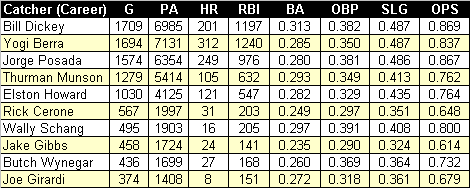
Most Games by a Yankees’ Catcher, Since 1918

Note: Includes games in which the player PH for the existing catcher.
Source: Baseball-reference.com

Over the years, the Yankees have been blessed with several elite catchers. From Bill Dickey to Yogi Berra, Elston Howard, Thurman Munson, and Jorge Posada, the Bronx Bombers have often enjoyed a comparative advantage behind the plate. Combined, that quintet has played 44% of the team’s “catcher games” (based on total games played at catcher, not in each season) and accounted for around 50% of most statistical contributions from the position. However, these all-time greats have had some help along the way.

The Best vs. the Rest: Comparison of Yankees’ Catchers, Since 1918

Note: Includes games in which the player PH for the existing catcher.
Source: Baseball-reference.com

In addition to the All Stars mentioned above, the Yankees have had 114 catchers since 1918, ranging from Billy Shantz, who appeared in only one game but never had an at bat, to Rick Cerone, who played 567 games as a catcher and finished seventh in the 1980 MVP balloting.  This less than stellar group of backstops has compiled a batting line of .254/.326/.367, which, while paling in comparison to the rates posted by the team’s better catchers, still seems respectable (for context, major league catchers hit a combined .245/.313/.389 in 2011). However, those totals include the contributions of several starters, and today, we’re only concerned with the backups.

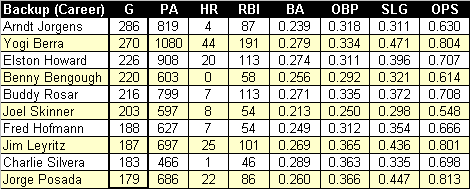
Most Games as a Yankees’ Backup Catcher, Since 1918

Note: Includes games in which the player PH for the existing catcher. Backup role defined as any catcher but the one with the most games behind the plate in an individual season.
Source: Baseball-reference.com

Norwegian-born Arndt Jorgens ranks as the most prolific backup catcher in Yankees’ history. From 1929 to 1939, Jorgens served as a second stringer to Bill Dickey, joining the likes of Benny Bengough, Buddy Rosar (both of whom also rank among the top five) and Joe Glenn in that role. Interestingly, Dickey’s Hall of Fame successor, Yogi Berra, also ranks as the second most tenured backup. Berra was a second stinger, at least in terms of catching, both at the beginning of his career and the end, when he moved to the outfield to make room for Elston Howard. Turnabout was fair play for Howard, who spent the first five years of his career alternating between the outfield and Berra’s primary backup.

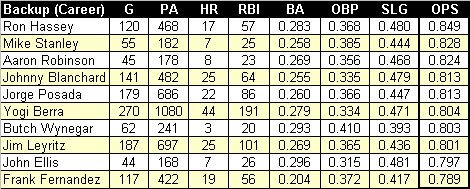
Top-10 Career OPS by a Yankees’ Backup Catcher, Since 1918

Note: Includes games in which the player PH for the existing catcher. Backup role defined as any catcher but the one with the most games behind the plate in an individual season. Totals above exclude years in which the player led the team in games behind the plate. Minimum of 150 career plate appearances.
Source: Baseball-reference.com

Older Yankees’ fans probably remember Ron Hassey very well. In 1985 and 1986, the plodding catcher posted a prolific OPS of .846, while serving as Butch Wynegar’s primary backup. In the process, he also earned the nickname “Babe” because his lefty swing and titanic homeruns resembled the Bambino. In the 1990s, Mike Stanley was a similar-styled player. Before ascending to the starting job in 1993, his bat made him a fan favorite when he was Matt Nokes’ backup in 1992. After becoming the lead man, Stanley turned the role over to Jim Leyritz, who provided steady offense behind the plate in nine seasons as a second stringer for the Yankees. However, Leyritz greatest notoriety came in the postseason, during which he authored two of the most dramatic home runs in franchise history.

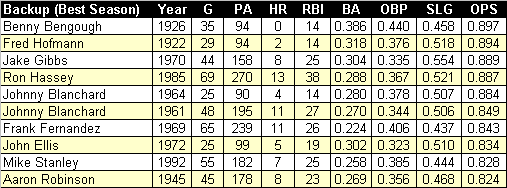
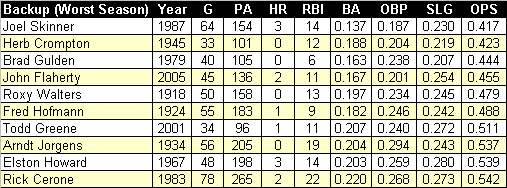
10 Best/Worst OPS Seasons by a Yankees’ Backup Catchers, Since 1918

Note: Includes games in which the player PH for the existing catcher. Backup role defined as any catcher but the one with the most games behind the plate in an individual season. Minimum of 75 plate appearances and seasons by Yogi Berra and Jorge Posada excluded.
Source: Baseball-reference.com

Considering the relatively limited playing time of a backup catcher, their offensive performance is difficult to predict. For every Benny Bengough who surprises with an exemplary season, there’s a Joel Skinner who consistently makes fans groan every time they see his name penciled into the lineup. Although the Yankees have recently had some success getting offense from their backup catcher, Jose Molina (2007) and John Flaherty (2003-2004), for the most part, the team’s second stringers have been light with the bat. Luckily, there is organization depth at catcher because as frustrating as it is to have a backup who can’t it, it’s much worse when the same is true about the starter.

Outshined

In the classic Soundgarden tune “Outshined”, Chris Cornell writes:

I just looked in the mirror
And things aren’t lookin’ so good.
I’m looking California
And feelin’ Minnesota.

That brief stanza may be an apt way to describe Hiroki Kuroda’s start Wednesday night. He was both looking and feeling California in the home opener last Friday against the Los Angeles Angels. In the song, “feeling Minnesota” is a euphemism for feeling terrible. On the field, Kuroda wasn’t feeling Minnesota, Minnesota was feeling Kuroda. Four of the first five Twins to come to the plate in the first inning got hits and scored. By the time Kuroda had thrown 13 pitches, the Yankees were in a 4-0 hole.

Hiroki Kuroda's second Yankee Stadium start was much rougher than his first. (Photo Credit / Getty Images)

Kuroda’s downfall was Justin Morneau. His two-run home run in the first inning put the Twins up 4-0, he singled and scored in the third, and he belted another home run in the fifth — a solo shot — to end Kuroda’s night. (Not to question X’s and O’s, but Morneau’s fifth-inning home run came on a 2-0 count. Was anyone else thinking, “Hey, the bases are empty, walk him and take your chances with someone named Chris Parmelee?”).

The Yankees’ lineup, which was without Alex Rodriguez and Brett Gardner but had Mark Teixeira back, did their best to bail out Kuroda, responding with three runs of their own in the bottom of the first. Trailing 4-3, they loaded the bases with one out and a realistic chance to post a crooked number until Eric Chavez ended the threat by grounding into a double play.

Three different times the Yankees would get to within one run of the Twins, but not once could they tie the game. Three straight innings — the fifth, sixth and seventh — the Yankees put the leadoff man on base and mounted threats, but couldn’t score. After the first inning, the only runs they were able to manage came off solo home runs from Robinson Cano and Derek Jeter.

6-5 final, series finale with Phil Hughes on the mound Thursday. Are you confident?

ROOT FOR THESE GUYS

  • Alex Belth’s profile of Kuroda, posted here in February, made us want to root for him for reasons beyond his simply wearing the Yankee uniform. Wednesday was one of those nights sinkerballers tend to have. If the sinker doesn’t sink, it stinks.

    “He was just up all night,” manager Joe Girardi said. “He didn’t seem to have it from the get-go.”

    Despite the poor result, which raised Kuroda’s ERA to an even 5.00 and his WHIP to 1.61, Kuroda remains an integral component to the Yankees’ starting rotation, based on his skill set, veteran presence, and experience. We’ll have about 30 more chances to root for him.

  • Opposing Kuroda was native Long Islander Jason Marquis. Marquis, who grew up in Staten Island and still lives there, was making his American League and 2012 season debut. Marquis had pitched in New York before, but at Shea Stadium and Citi Field, but had never pitched a major league game in the Bronx.

    Marquis’ debut was delayed; this story has been well document. He left the Twins with two weeks to go in Spring Training to attend to his daughter, who lacerated her liver in a bicycle accident. Ken Rosenthal does a tremendous job of portraying the details of the story here. As a father of one little girl and another on the way, I applaud what Marquis did. There’s no decision to make.

    His daughter had four surgeries and is recovering well. According to reports, a full recovery is expected within three months. How fortunate Jason Marquis was to be home with his family, and STAY home when he joined his new team. As a bonus, his family got to be on the field with him yesterday (nice work by YES taking video and showing that B-roll during the bottom of the first inning).

    And he got the win.

  • Splash

    Hiroki on the hill at the Stadium tonight after his terrific debut last week.

    1. Jeter SS
    2. Granderson CF
    3. Teixeira 1B
    4. Cano 2B
    5. Swisher DH
    6. Ibanez RF
    7. Chavez 3B
    8. Martin C
    9. Gardner LF

    Let’s Go Yank-ees!

    [Picture Credit “Waterfall in Summer” by Hiroki Imada (1998)]

    Yankees Use Backup Plan to Even Series Against Twins

    Photo: AP

    Backup catchers should be seen, but not noticed. During the YES broadcast, that’s how former Yankees’ second stringer John Flaherty described the life of a number two backstop. Chris Stewart must not have gotten the memo.

    Over the first 10 games of the season, the Yankees have had no problem getting men on base, but driving them in hasn’t been as easy. So, after squandered scoring opportunities in the first two innings by leaving a total of five men on base, it seemed as if it would be another frustrating night in the Bronx. However, all that changed in the bottom of the third.

    After falling behind 3-1 in the top half of the inning (which also featured the ejection of Twins center fielder Denard Span and manager Ron Gardenhire), the Yankees quickly mounted another rally, but this time they would not be turned away. The unlikely hero in the inning was Stewart, who, in only his fifth at bat of the season, gave the Yankees a 4-3 lead with a bases loaded single that knocked Twins’ starter Francisco Liriano from the game. In total, the team scored four runs in the inning and then never looked back.

    Once staked to a lead, CC Sabathia took his game to another level. In each of the next three innings, the big lefty retired the Twins in order and at one point set down 13 consecutive Minnesota batters. Meanwhile, the Yankees continued to tack on runs, including two more RBIs from Derek Jeter, a homerun by Andruw Jones, and a final tally by Stewart, who ended the game with a career-high 3 RBIs. The outburst was more than enough for Sabathia, who departed with one in the eighth having given the Yankees only their third quality start of the season.

    Although Stewart was the focal point of the offense, just about every hitter had a good night. However, there was one exception. Alex Rodriguez was not only the sole member of the lineup without a base hit, but his failure to drive in a run extended a peculiar streak that has seen the Bronx Bombers go 11 straight games without an RBI from the cleanup slot, the fifth longest such stretch in baseball history. For most teams, such a prolonged period of futility from the cleanup slot would debilitating, but the Yankees’ have managed to win six of their first 11 games without a contribution from the four-hole. Of course, that really shouldn’t be surprising. What else would you expect from a lineup that has a backup catcher capable of driving in three runs in one game?

    Back to Basics

    C.C. looks to pitch better tonight.

    1. Jeter SS

    2. Swisher DH

    3. Cano 2B

    4. Rodriguez 3B

    5. Teixeira 1B

    6. Granderson CF

    7. Jones RF

    8. Gardner LF

    9. Stewart C

    Let’s Go Yank-ees!

    [Photo Credit: Jim McIsaac/Getty Images]

    Frame Job

    Over at ESPN, Anna McDonald has a piece on Russell Martin and the art of framing pitches.

    Here’s more over at Hardball Talk.

    [Photo Credit: Ron Vesely]

    Temper Temper

    Oh yeah? Well, at least your wife didn’t hijack the TV to watch Dancing with the Stars leaving you to follow this horseshit of a ball game–Curtis Granderson’s fine running catch and a couple of first inning pops (Jeter, Grandy) notwithstanding–on your phone and your laptop.

    Lots of muttering and then flat-out cursing as that meathead, Captain Horseshit himself, Carl Pavano had his way with the Yanks and the Twins cruised to a  7-3 win. Yanks had a 3-2 lead after the first and then, well, I don’t want to talk about it, okay? Is it too early to be irked by a crappy game? Apparently not. I sulked like a brat. The wife stopped just short of telling me to put a muzzle on it.

    Ah, whadda ya gunna do? They’ll get ’em tomorrow night.

    [Image by Ron English; Photo Credit: Al Bello/Getty Images]

    Keep it Movin’

    It’s Fab Five Freddy vs. Carl Pavano as the Yanks and Twins begin a four-game series at the Stadium.

    1. Derek Jeter SS
    2. Curtis Granderson CF
    3. Alex Rodriguez 3B
    4. Robinson Cano 2B
    5. Mark Teixeira 1B
    6. Nick Swisher RF
    7. Raul Ibanez DH
    8. Russell Martin C
    9. Brett Gardner LF

    Never mind the creamy filling: Let’s Go Yank-ees!

    [Photo Credit: Getty Images]

    Card Corner: 1972 Topps: Roy White

    At times the photographers at Topps have depicted a player just about right. Roy White’s 1972 Topps card is a good example of that; we see White practicing his in-game batting stance, holding his hands much lower than most players do, toward his back hip. All that’s missing is the inclusion of White’s feet. With a larger photograph, Topps would have been able to show his pigeon-toed posture, another classic feature of White’s unique batting stance.

    White’s card also gives us a good look at the Yankees’ old-school road uniforms, which they used through the 1972 season. They’re you’re basic road gray, with no piping or striping around the sleeve. I’ve always preferred this most simplistic of road uniforms, partly because it’s iconic and partly because it brings back memories of the Mantle/Maris Yankees of the early 1960s.

    All in all, this is a quality card for a quality player. In recalling the Yankees of the early 1970s, fans of that era glorified three players: star catcher Thurman Munson, All-Star outfielder Bobby Murcer and the team’s pitching ace, Mel Stottlemyre. Roy White was rarely held in similarly high regard by either the fans or the media. He was generally considered a good, solid player, but not a star, with the one flaw in his game (a poor throwing arm) sometimes becoming the subject of contempt, ridicule, and cruel humor.

    The perception of White has changed–and changed drastically–since then. Largely due to Sabermetrics, both Yankee fans and non-Yankee fans have changed their tune with towards White‘s abilities. Or in some cases, it’s simply a matter of a younger generation of fans having a better understanding of players’ quality than we did in the sixties and seventies. White’s ability to draw walks, which was rarely highlighted in the early seventies, has now been given its full due; we better understand and appreciate White’s ability to reach base, and the important role it played in setting the table for other Yankee hitters. And then there is the matter of White’s defense. He was truly an excellent defensive left fielder, with enough speed and range to have played center, if not for Murcer’s presence there through the middle of the 1974 season. Yes, the throwing arm would have been a problem, but probably not anymore so than the weak arms of Mickey Rivers or a late-career Bernie Williams.

    Some might argue that the tendency to underrate White in his day was also a product of racism. I have my doubts that was the case. Elston Howard, the Yankees’ first African American player, was popular with fans and held in high regard by almost all of the New York media. Chris Chambliss, Willie Randolph, and Mickey Rivers were all popular Yankees. And fans were just about as supportive as they could be of the controversial Reggie Jackson. When Reggie produced, the fans howled their approval with booming chants of “REG-GIE,REG-GIE” resonating though the upper decks of the old Yankee Stadium. Now Billy Martin might have been a different story; some of his dislike for Reggie might have been rooted in racism, but I don’t know for sure. But I just don’t see much evidence for racial antipathy, not from Martin or anyone else, toward a quiet and hard-working player like Roy White.

    By 1972, the switch-hitting White had established himself as a very good player. Though underrated, he had already made two All-Star teams and had earned some MVP votes in three different seasons.  He was coming off a season in which he had led the American League in sacrifice flies, an unglamorous statistic to say the least, but one that showed his team-oriented nature.

    In 1972, White’s power production fell off, as his OPS dipped from .857 to .760, his worst mark as the Yankees’ regular left fielder. Still, he managed to make some favorable contributions like lead the American League with 99 walks and steal 23 bases in 30 attempts, all while playing his usually sterling defense in the outfield. The following two seasons, he struggled, leading some to question whether he was on the downhill side at age 30. In the midst of the 1974 season, manager Bill Virdon made him a DH part of the time, a role that White abhorred, considering it an insult to his athletic talents.

    In 1975, White’s career received a revival when the Yankees made a managerial switch, firing the placid, detached Virdon, and replacing him with Martin, who appreciated players of all-round ability like the speedy White. Martin put White back in left field and restored him to the No. 2 spot in the batting order. White bounced back beautifully, playing for White the way that he had once played for Ralph Houk.  In 1976, White led the American League with 104 runs scored and reached a career high with 31 stolen bases, becoming a huge part of the first Yankee team to reach the postseason since the ill-fated World Series of 1964.

    In the meantime, White became known as a beacon of calm and kindness in a clubhouse that often swirled in turmoil. As Sparky Lyle wrote in his critically acclaimed book, The Bronx Zoo, everybody on the Yankees liked White. “Roy White is probably the nicest goddam guy on the club,” Lyle wrote in his blunt-force style. “He’s well respected by everybody, and he’s very classy.” Classy. The perfect word to describe the gentlemanly Roy White.

    By 1978, the year that Lyle’s book hit the shelves, White’s on-field ability had slowed to the point of becoming a part-time player. No longer the everyday left fielder, he platooned with Lou Piniella and also made 23 appearances as a designated hitter, a role that he was now better equipped to handle. With the Yankees having extreme depth in the outfield, they could afford to use White more sparingly, a role into which he fit perfectly. Still able to reach base 35 per cent of the time, White became part of a squadron of role players that supported the Yankees’ stars during their second consecutive world championship run. He played some of his best ball of the season in the playoffs and World Series, hitting over .300 against both the Royals and Dodgers.

    Then came the falloff of 1979. Spring training started poorly, as the Yankees refused to offer him an extension on a contract that had just one year remaining. The lack of an extension might have contributed to White’s nightmarish season. Appearing in only 81 games, White played poorly, his power and speed showing the decline that often comes with having a 35-year-old body. Free agency could not have come at a worse possible time. White wanted to keep playing, but the Yankees, looking to rebuild with youth after a season of tragedy and tumult, showed little interest. White received some offers from other teams, but he opted for a completely different career move. He took his aging talents to the Tokyo Giants of the Japanese Leagues, where he became a teammate of Sadaharu Oh.

    Batting as the cleanup man behind Oh, White played very well in his first two seasons in Japan. He made the All-Star team one season and helped the Giants to the Japanese Leagues championship the next. In his third year with Tokyo, White found himself playing a utility role, but he fought his way back into the lineup and hit .330 the rest of the way. At season’s end, White decided to call it quits, leaving the game on a high note.

    Since his playing days, White has returned to the Yankee organization several times, serving as the first base coach on three occasions and also putting in some time as an assistant to the general manager. In that latter role, he scouted Hideki Matsui during his time in Japan, giving the Yankees his first-hand assessment of a Far East player that they would eventually sign.

    Unfortunately, every one of White’s coaching and front office assignments with the Yankees has ended with him being ousted, often with no reason given. I don’t know why that is. He seems like the kind of guy who should have a permanent place in the organization, whether as a scout or as a consultant. It’s almost as if the Yankee organization still doesn’t have a full appreciation for him, just as most of us fans failed to respect him at the time for the player that he truly was.

    And that’s just not right. Roy White belongs with the Yankees. If he wants to work for them,  the Yankees should be able to find a place.

    [Featured Image via Corbis]

    Picture This

    Our Man from Brooklyn by Summer Anne.

    Return of the Boom Bap Means Just That

    It was only the bottom of the fourth inning and the Yankees were feeling good about themselves. Alex Rodriguez and Robinson Cano and Mark Teixeira helped the team out to a 5-1 lead. Hisanori Takahashi, the long man in the Angels bullpen–a junkballing nibbler–walked Russell Martin to start the inning and then Brett Gardner fouled off a bunch of pitches before hitting a single to center field. Derek Jeter took the first three pitches, all balls. Then he snuck a look over at someone in the Yankee dugout.

    I figured the look, the hint of a smile, meant he was going to swing, 3-0 if he got a meatball. Sure enough Takahashi laid one right down the middle. Jeter took a huge swing and almost came out of his shoes. It was a swing to make Reggie proud. The ball was fouled back. Jeter fouled off the next pitch too. Then he smacked one over the fence in right field for a three-run homer.

    Ivan Nova gave two back in the fifth and another run in the sixth. Could have been more trouble in the sixth but Rodriguez made a nice play to end the inning.

    But because this is Sunday Night Baseball things are not meant to be brief or easy. So Rafael Soriano walked the lead-off hitter in the seventh and that man came around to score on a base hit by Albert Pujols. Soriano recorded two outs but left the game with the bases loaded, the Yanks lead cut to 8-5. Fortunately, our nerves were settled when David Robertson got Mark Trumbo to fly out to right field on a 2-2 pitch.

    (My mind was calculating: does this set up Mariano vs. Albert?)

    A walk and stolen base by Robbie Cano and then a two-out single by Nick Swisher put the Yanks back up by four. Better still, Jason Isringhausen came in and gave up an absolute bomb to Raul Ibanez.

    Fuggin thing reached the upper deck in right field.

    All Tori Hunter could say was: “Wow.”

    Mariano vs. Albert would have to wait. Tonight, it was Logan vs. Albert and Logan struck him out, go figure that.

    Final Score: Yanks 11, Angels 5.

    A nice way to start the week.

    Sunday Night Special

    Mo won’t be alone wearing the number 42 on Jackie Robinson Day.

    1. Jeter, SS
    2. Granderson, CF
    3. A-Rod, 3B
    4. Cano, 2B
    5. Teixeira, 1B
    6. Swisher, RF
    7. Ibanez, DH
    8. Martin, C
    9. Gardner, LF

    Let’s Go Yank-ees!

    Bronx Beat Down

    Phil Hughes didn’t look to be horseshit today, his fastball was hitting 93-94 mph and he broke off a few biting curve balls, but everything was up and a couple of home runs by the Angels was enough to put the Yankees in a hole from which they could not climb out. C.J. Wilson looked relaxed and has an easy, appealing manner. When his center fielder made a nice catch, the replay showed Wilson break out in a wide, guileless smile. Oh, and he pitched well, too, mixing the soft stuff with a tight cutter in to the righties (after hitting the ball hard yesterday, Alex Rodriguez hit three weak ground balls against Wilson this afternoon). The Yankees left nine men on base.

    This was one to forget even though it was a lovely day in the Bronx. The only thing worth noting was how well David Phelps pitched in relief. He gave up a run on one hit–a solo home run by Vernon Wells–worked quickly and threw the ball with confidence. His performance over 5.1 innings was worth savoring and it was nice to see him receive applause when he walked off the mound with two outs in the 9th.

    Final score: Angels 7, Yanks 1.

    Instead of dwelling on this one, check out these pictures I took this morning at the Union Square Farmer’s Market. The wife and I headed down early and the greens were amazing. So, this weekend gives salads, tuscan kale, and enough ramps to pickle.

    And ramps! First week of ramps.

    They’ll only be around a few more weeks. Time to get ’em while they are around.


    feed Share on Facebook Share on Twitter Share via email
    "This ain't football. We do this every day."
    --Earl Weaver