"A New York Treasure" --Village Voice
Category: 1: Featured

Leave the Gun. Take the Cannoli.

I can’t relate to pitchers. I had to take the ball from the second grade up through freshman year of high school and I hated it most of the time. I could hit, though, until it was too dark out to see the ball. If my dad’s arm didn’t get tired, we might still be out there.

On a basic level, hitting is reaction and pitching is initiation. I’ve always had trouble getting started. I’d rather get a feel for something first and join in progress. And the precision required to throw it exactly where you intend every time? Screw that, let me just hit the ball as hard as I can and we’ll see what happens.

Maybe this prejudice influences the way I envision a baseball roster. The lineup is the body, the pitching staff is the wardrobe. The appearance of the team changes game to game based on the pitcher, but the core is the same. The ace is your best suit, your best reliever could be your smoking jacket. (I guess A.J. Burnett is your kid’s urine-soaked PJs)

So when I heard Jesus Montero was traded for Michael Pineda, I felt like we were trading a neck for a necktie. Sure, the tie is important, but without the neck, what’s the point?

Even without the catching, I’ll take Montero’s simple, solid bat over the complex musculature of Pineda’s throwing arm. You can watch Montero hit every game, all season long. There’s no better way to interface with a team than through a star hitter, especially for a young fan, because he’s always in the lineup.

I understand that having Pineda in the rotation probably makes the 2012 Yankees a better team than they would have been with Montero as the DH. But in 2013? And 2014?

Arod and Teixeira are already fractions of what they once were and they will be declining in the lineup for years to come. The Yankees have one big hitter in his prime, Cano, who is fierce but not flawless. You don’t have to squint too hard to see a Yankee team desperate for hitting.

The more I think about the trade, the more comfortable I am with Cashman’s logic and his vision. But I am firmly on the Montero side of the debate. It boils down to this: if they both become stars, I’d want Montero to be a Yankee.

Analyze This

There is a long piece by David Kamp on the late Lucian Freud over at Vanity Fair:

Freud’s was not one of those postscript deaths, the final headline in a life that had long ago ceased to matter or progress. It was an interruption—the ultimate inconvenience for a man who still had plenty of work to do and plenty of people who wanted to see his work. The restaurateur Jeremy King, who was more than a hundred sittings into an uncompleted etching when Freud died—having already sat for a painting completed in 2007—recalls that the artist “never came to terms with the fact that he was slowing down. He constantly said, ‘What’s wrong with me?’ And I’d say, ‘Well, Lucian, you’re actually much more active than any other 68-year-old I know, let alone 88.’ And the moment he lifted his hands, most of his ailments seemed to melt away. The concentration and the adrenaline pushed him through.”

From his mid-60s onward, the pinochle years for most men his age, Freud had been enjoying a fruitful and vigorous late period. This wasn’t a function of critical recognition, though it happened to be in this period that critical favor finally smiled upon him, with Time’s Robert Hughes judging him “the best realist painter alive,” a sobriquet that stuck. Nor was it a matter of commercial success, though it was in 2008 that Freud’s Benefits Supervisor Sleeping (1995) fetched the highest-ever auction price for a painting by a living artist, selling at Christie’s to the Russian petrogarch Roman Abramovich for $33.6 million.

Freud simply did great work as an old man, some of his greatest. “In a sense, I think he knew this was his last big push at making some remarkable works. I could just see that he was really ambitious, pushing as hard as he could,” says the naked man in that final painting, David Dawson, the artist’s longtime assistant and the owner of Eli, the whippet star of several late paintings. (Freud had bestowed the dog upon Dawson as a Christmas present in 2000.) When Dawson started working for Freud, 20 years ago, the artist was in the middle of a series of nudes of the drag performer and demimonde fixture Leigh Bowery. Bowery was a huge man, lengthwise and girthwise, with a bald, oblong head—a lot to work with in terms of topography, physiognomy, and epidermal hectarage. Yet Freud went bigger still, painting Bowery larger than life-size. Freud had his canvases extended northward, eastward, and westward as it suited him; often, he would work the upper reaches of a painting from atop a set of portable steps.

Worth checking out.

Million Dollar Movie

Prizzi’s Honor lives that most uncomfortable space – the black comedy. It’s uncomfortable because to set and maintain the proper tone, the entire production operates on a razor’s edge. If any part of the process falters, from John Huston’s direction all the way down to the selection of condiments at the craft services table, the delicate artifice collapses.

Most important of all is the acting. For a black comedy to succeed, the actors must maintain constant earnestness with the comedy not coming from punch lines but from something inherent in the character himself.

When a black comedy fails, it’s almost always easy to pinpoint the culprit. But when it succeeds, it’s possible to glide right past the great performances that made it so. Jack Nicholson’s Charley Partanna in Prizzi’s Honor is just such a performance.

Partanna is gruff, almost monosyllabic. But he’s not stupid, he just knows that talking too much often leaves you overextended. He’s a competent gangster on the way up and he’s centered in that world with a heavy anchor. And as the movie unfolds, and absurd situations ripple the surface, he never strays far enough from the boat to get lost. He surprises us with literacy, curiosity, passion and ingenuity along the way, but without deviating from his solid base.

Bouncing off Jack’s steady foundation are Angelica Huston and Kathleen Turner. Irene Walker (Turner) pretends to be an outsider, but she’s busy trying to run scams on gangsters. Huston took home an Oscar for turning the screws behind Partanna’s back as Maerose Prizzi. Maerose is the one character in the movie that really seems dangerous.

I remember this movie from my childhood because of William Hickey’s strange voice. His Don Prizzi stretches words like hand-pulled noodles until the innocuous is threatening. But Jack’s Partanna isn’t just holding up the tent for these fine supporting characters.

He seems a poor match for Irene on the exterior, but his devotion, shot straight, wins her over. We’re not sure where Partanna fits in the hierarchy of the Prizzi family at first, but his intelligence and resourcefulness prove his worth.

Alex loves Jack’s line, “Marxie Heller so fuckin’ smart, how come he’s so fuckin’ dead?” Not only is it a fantastic reading, an argument ender but spat out of the side of his mouth, it’s also the start of the slow leak leads to disaster for Partanna and Irene. Partanna has killed Irene’s husband, Marxie Heller, before learning of the connection. Irene swears she was going to leave him anyway, but she has enough nice things to say about the guy to get under Partanna’s skin and cause that great line.

Partanna could never trust Irene completely. Did she come with him because she loved him or because all her other plans were turning to crap and he represented her best chance at survival? He couldn’t answer the question satisfactorily so when stab came to shoot, he hurled a knife through her throat.

The movie works because Jack is great. But Jack is great without doing a lot of the things that he’s usually great at. He’s neither hip, cool nor sarcastic. He’s a lug. And he plays the lug straight up and down the edge without ever missing a step.


Inquire Within

Who will DH? Joe Pawlikowski,  Howard Megdal and Craig Calcaterra have some thoughts.

Million Dollar Movie

At first glance, Jack Nicholson and Michelangelo Antonioni would seem a mismatched pair: Antonioni, the gloomy, solemn, European master of existential alienation and Nicholson, all Irish-American brashness and energy — the most charismatic and aggressive movie star since James Cagney. However, with Antonioni’s 1975 film The Passenger, the odd couple proved to be a formidable team. Though the film failed to deliver to producer Carlo Ponti’s box-office hopes in the 1970s and was initially dismissed by many critics as a minor outing for both the director and star, its stature has grown and deepened over the decades, helped by a 2005 theatrical rerelease and subsequent DVD. Over thirty five years later, it stands as an artistic high water mark for both men. However, for those who can only envision Jack Nicholson as a hyper, wild-eyed madman, The Passenger offers an opportunity to see the depth and subtlety of his work, before he became hemmed in by audience expectations.

Nicholson, the quintessential star of 1970s “New Hollywood” spent the first half of that decade on an extraordinary run of iconic roles – including Five Easy Pieces’ Bobby Dupea, Chinatown’s  J.J. Gittes, The Last Detail’s Buddusky and, of course One Flew Over The Cuckoo’s Nest’s R.P. McMurphy (the part that finally landed Nicholson a Best Actor Academy Award).  Nicholson’s performance as David Locke in The Passenger stands up to his work in any of those films, while finding the actor in a far more subdued mode.

Locke is an English born, American educated journalist researching a story about guerrillas in an unnamed African desert country. After a particular hot and frustrating day in the desert, he returns to his hotel to find that he has no soap for a shower. He knocks on the door of his neighbor, looking to borrow some and finds the man lying dead.  Through flashbacks and an audio recording made by Locke, we see that the man, Robertson, was a fellow Englishman, roughly the same size and build as Locke, and with a similar hairline. Locke mysteriously and impetuously decides to switch identities with the corpse and disappear from his life, assuming the life of Robertson. While this snap decision to leave his wife and career behind, and start anew as a stranger in a strange land happens easily enough for Locke, he finds himself a pursued man – both by the producer and philandering wife he’s left behind in England and by people who want what Robertson had to sell or want him dead or arrested. It seems Robertson was not simply a travelling businessman, but an illegal arms dealer, supplying the guerrillas.

By evading the narrative of his own existence, Locke now finds himself thrust deeper into the story he was attempting to cover.  It’s a set-up that could easily be the plot of a very different sort of film, a suspense thriller made by Hitchcock, Polanski or DePalma; in Antonioni’s hands, it becomes a hypnotic, meandering investigation of identity, destiny and narrative itself. We’re never quite sure what has driven Locke to leave his life behind. Scenes of his wife back in London, and flashbacks to their life together hint that the marriage was unhappy, but his wife spearheads the search for Robertson once Locke is officially “dead.” We watch him have a frustrating time researching his story in the desert, but it’s also made clear that Locke is successful and internationally known as a writer and broadcaster.  In “Jump Cut,” Martin Walsh wrote of the film:

“At one point early in the film Nicholson points out that ‘we translate every experience into the same old codes’…Its importance for our understanding of The Passenger is of crucial significance. On one level, it helps make sense of Nicholson’s desire to cease being David Locke, to adopt a new identity, to escape the tyranny of the co-ordinates of his present existence, to re-open his life to new experiences. However, the way in which David Locke attempts to recharge his life proves fraught with unanticipated, uncontrollable dangers…”

Locke/Robertson leaves Africa for Europe, where, in Barcelona, he finds an unexpected travelling companion and lover, played by Maria Schneider (Last Tango In Paris). Together they become a couple on the lam, as Nicholson allows himself to be swept along in this new narrative he’s entered, despite its dangers. The girl follows suit, following Locke on his odd journey as if on some sort of scavenger hunt.

Locke continues along Robertson’s path, using the dead man’s datebook as his guide and talisman, until things meet their inevitable end in a dusty Spanish hotel courtyard, where all the main characters converge and Antonioni pulls off one of the most incredible shots you’ll ever see in a movie.

Looking back, it’s fascinating to watch Nicholson play this character at this point in his career. He’d played quiet, brooding characters before (e.g. Bob Rafelson’s The King of Marvin Gardens), but the success of Cuckoo’s Nest and relative failure of The Passenger (and of Arthur Penn’s western The Missouri Breaks, which paired Nicholson with Marlon Brando in the following year) may have pushed Nicholson into the relative safety of his more familiar screen persona, which Stanley Kubrick was soon to push to an extreme in his film of The Shining.

Say Word

Over at Baseball: Past and Present, Graham Womack interviews Robert Creamer:

Who’s the greatest baseball player you covered?

Creamer: Willie Mays. Period.

I seem to remember that Bill James, using his fabulous, desiccated statistics, demonstrated that Mickey Mantle, who was Willie’s almost exact contemporary, was actually the better player, and I’m not equipped to argue with Bill, although I’ll try. And there are DiMaggio, Williams, Musial, Barry Bonds, Albert Pujols, Alex Rodriguez – no, wait. I didn’t cover DiMaggio, who retired after the 1951 season — I didn’t start with Sports Illustrated until 1954. But that’s still a pretty impressive collection of players to put Willie on top of.

I saw Mays play a lot. My father and I were in the moderate crowd at the Polo Grounds in May 1951 when Willie played his first game for the Giants. My father was only a mild baseball fan, although he told me his favorite ballplayer when he was a kid in New York back at the beginning of the 20th century was a bearded outfielder for the Giants named George Van Haltren, which indicates a certain degree of baseball intensity. In any case he and I drove down from Tuckahoe to the Polo Grounds, bought tickets (which you could do then) and sat in the lower stands between home and first base. Willie had broken in a few days earlier in Philadelphia where he went 0 for 12 in three games. He was batting third which if it seems a high spot for a brand-new rookie seemed a proper spot to take a look at a rookie who had been batting something like .477 in the minors.

The top of the first took some of the fun out of the game right away. Warren Spahn was pitching for the Boston Braves and in the top of the first Bob Elliott hit a three-run homer for Boston, which took a lot of the starch out of the Giant fans. If Spahn was on, and had a three-run lead already, we didn’t have a prayer. Spahn set the first two Giants down in order and here came Willie, our fabulous new rookie. I forget what the count went to — a ball and a strike, something like that. Spahn threw the next pitch and Willie hit it on a line high and deep to left center field. I cannot recall if it hit the wooden façade high in left field or went over the roof and out of the park. All I remember is the electric excitement that shot through the park at the sound and sight of our precious rookie in his first at-bat in New York hitting a tremendous home run off the great Spahn. “He’s real!” was the feeling. “He’s real!”

[Photo Credit: When in doubt, laugh]

Sock it to Me?

There is an uneven but engaging essay about Joan Didion by Caitlin Flanagan in The Atlantic. I read some of Didion’s early non fiction when I was in college and remember not liking it at all. But I revisited her famous collection of essays Slouching Towards Bethlehem a few years ago and was duly impressed.

I never thought that being a man had anything to do with why I don’t connect with Didion’s writing, and while the following passage from Flanagan’s article is a generalization, it got me thinking:

…to really love Joan Didion—to have been blown over by things like the smell of jasmine and the packing list she kept by her suitcase—you have to be female.

I once watched a hysterically sycophantic male academic ask Didion about her description of what she wore in Haight-Ashbury so that she could pass with both the straights and the freaks. “I’m not good with clothes,” he admitted, “so I don’t remember what it was.”

Not remembering what Joan wore in the Haight (a skirt with a leotard and stockings) is like not remembering what Ahab was trying to kill in Moby-Dick.

Women who encountered Joan Didion when they were young received from her a way of being female and being writers that no one else could give them. She was our Hunter Thompson, and Slouching Towards Bethlehem was our Fear and Loathing in Las Vegas. He gave the boys twisted pig-fuckers and quarts of tequila; she gave us quiet days in Malibu and flowers in our hair. “We were somewhere around Barstow on the edge of the desert when the drugs began to take hold,” Thompson wrote. “All I ever did to that apartment was hang fifty yards of yellow theatrical silk across the bedroom windows, because I had some idea that the gold light would make me feel better,” Didion wrote. To not understand the way that those two statements would reverberate in the minds of, respectively, young men and young women is to not know very much at all about those types of creatures. Thompson’s work was illustrated by Ralph Steadman’s grotesque ink blots, and early Didion by the ravishing photographs of the mysterious girl-woman: sitting barelegged on a stone balustrade; posing behind the wheel of her yellow Corvette; wearing an elegant silk gown and staring off into space, all alone in a chic living room.

Didion’s genius is that she understands what it is to be a girl on the cusp of womanhood, in that fragile, fleeting, emotional time that she explored in a way no one else ever has. Didion is, depending on the reader’s point of view, either an extraordinarily introspective or an extraordinarily narcissistic writer. As such, she is very much like her readers themselves. “I’ve been reading you since I was an adolescent,” a distinctly non-adolescent female voice said on a call-in show a decade ago, and Didion nodded, comprehending. All of us who love her the most have, in ways literal and otherwise, been reading her since adolescence.

I watched my mother dress stylishly throughout my childhood. She didn’t spend a lot of money on clothes though her tastes reflected the fashion of the moment–fringes jackets in the ’70s, shoulder pads in the ’80s. I remember what her clothing looked like, I can recall her flair for knowing how to look casual but elegant (in that oh so European way), but I have no idea what brands she bought. I never looked at the labels. I never cared about that stuff. I don’t know if she did either but she certainly would have known the difference between a famous designer and a cheap knockoff.

My Mother, somewhere in Africa, Fall 1966

Check out the entire profile. It’s worth your time, whether you care for Didion or not. And dig this reaction post at Forbes by Brett Singer. Also, here is a fine critique of Flanagan’s essay by Martha Nichols at Salon (with a good comment thread to boot).

And He’s Cute, Too

My wife adores baseball mascots. I think she’d rather meet the Phillie Phanatic than any player–oh, how she wants a kiss from that furry green beast. She complains that the Yankees don’t have a mascot. “What a bunch of tight asses,” she says. This helps explain why she is attracted to Francisco Cervelli, the closest thing the team has to a fuzzy cheerleader. She’s liked Cervelli ever since he joined the team a few years ago–though she did not like when he crossed home plate in a hot dog fashion up in Boston last season.

Ever since I’ve braced her for the possibility that he’s a short-timer in pinstripes. He’s spirited, throws the ball to third after a strike out with flair. The pitchers seem to like throwing to him though he doesn’t have a great arm and despite a few Luis Sojo-like streaks of clutch hitting, he’s not much with the stick either. And yet he’s still around and will go into spring training as the favorite to be the Yankees’ back-up catcher.

Over at Lo-Hud, Chad Jennings looks at organizational depth at catcher. There’s also a news-and-notes post featuring word on Phil Hughes and a rumor about Godzilla Matsui. As always, the Lo Hud remains an essential stop for the well-informed Yankee fan.

[Photo Credit: Barton Silverman/The New York Times]

Time Will Tell

Here’s Jonah Keri’s reaction to the Pineda-Montero trade:

When breaking down a player’s value, it’s easy to fixate on his weaknesses. Pineda’s got some question marks, but two of the main criticisms levied against him — that he was a lousy pitcher away from Safeco Field and that he faded badly down the stretch last season — don’t hold water. Dave Cameron broke down both those criticisms, noting that Pineda’s core skills stayed strikingly consistent, and that luck and regression toward the mean played far bigger roles in his fluctuating stats.

Within that post, Cameron explained that despite its enormous reputation as a pitcher-friendly stadium, Safeco doesn’t play as an extreme park in right field, only left-center. That part is true: Safeco dinged homers by lefty hitters at a relatively modest 5 percent rate. Problem is, Yankee Stadium’s ludicrously short porch in right helped inflate homers at that park a massive 43 percent. That’s not to say that no right-handed pitcher can possibly survive in that park. Some chap named Mariano Rivera’s been pretty OK there so far. Like Rivera, Pineda offers a pitch that’s highly effective against left-handed hitters, a slider that at its best bites down and in. It’s just a one-year sample size, but Pineda held lefties to just .237/.296/.357 in 2011. Still, there’s a seed of doubt here. Pineda posted the seventh-lowest ground-ball rate among all qualified starting pitchers last year. You can try to apply a simple park adjustment to a fly-ball pitcher moving from a homer-suppressing stadium to a nightmarish launching pad, but it’s unlikely that Pineda’s move to Yankee Stadium will be that easy to predict. He might see one too many elevated fastballs scrape over the wall, panic, change his approach, and fall apart. Or maybe he’ll become a Yankee in the Paul O’Neill mode, embracing his new digs and playing above his already considerable talent.

• That’s what makes this trade so fascinating. Though it’s not a swap of players at the same position, it still resembles what you’d call a challenge trade. Before this offseason, you’d have to dig deep to find examples of high-impact young players traded for each other; deals tend more often to involve one veteran for a bunch of prospects, or pretty much any other combination that’s not two wildly hyped 22-year-olds changing teams. One of the biggest (and only) ones that immediately jump to mind was 2007’s swap of Delmon Young for Matt Garza — and even that’s cheating, since Jason Bartlett was also a key part of that trade. There’s also Josh Hamilton for Edinson Volquez, but for whatever reason, this type of trade has suddenly become all the rage. There were other players involved, but Mat Latos for Yonder Alonso fits the profile. So too does Anthony Rizzo for Andrew Cashner. If two teams laying it on the line by trading young, potential impact players is about to become a trend, I’m all for it.

[Photo Credit: Martinico37]

Fire and Ice

Dig this long piece on Love, Boxing, and Hunter Thompson by the screenwriter John Kaye in the Los Angeles Review of Books:

In the spring of 1971, I was co-producing and writing a 90-minute, live, late-night television show on KNBC, the local NBC affiliate in Los Angeles. A precursor to Saturday Night Live, this satirical program was hosted by Al Lohman and Roger Barkley, two extremely popular and sweet-natured (when sober) morning disc jockeys. The writers and sketch performers we hired had never worked on television, and among the long list of people who got their start on the show were Barry Levinson, Craig T. Nelson, and John Amos. Amos, who later appeared in Roots and as a regular cast member on the Norman Lear sitcom Good Times, was an ex-pro football player and a huge boxing fan, and he idolized Muhammad Ali.

Johnny and I became close friends, and when the first Ali-Frazier fight rolled around — this was only Ali’s second fight since he was unjustly stripped of his title and denied a license for refusing to be drafted into the military — we made plans to go together. Because the Fox Wilshire theater was located in the heart of Beverly Hills, the seats around us were filled with a glittering dazzle of industry movers and shakers, laughing and talking at the tops of their voices. Along with big-time producers and studio executives — none of whom I knew, but whose names I recognized from the trades — I spotted actors Warren Beatty and Jack Nicholson seated in our row. Sitting next to them were two beautiful young women in see-through blouses and skin-tight bell-bottom jeans, their eyes a little frantic as they tried to project an air of remote amusement.

The fight, while exciting and hard-fought, did not quite live up to its inescapable hype. The crowd in the theater was clearly for Ali, but as the rounds passed with Frazier methodically and dogmatically gaining command, their confident anticipation of an Ali victory began to dissipate. If he lost, it would be his first, and the thought, once impossible to imagine — his mastery in the ring was so complete — now became a real possibility. Johnny, his vocal support of Ali beginning to wither, became unnervingly dispirited, and at one point, around the 12th round, he even suggested that we leave. “No way,” I told him. “All it takes is one punch.”

“He ain’t gonna win, pal. It’s over.”

Johnny was right, but there was a moment, in either that round or the next, when Ali seemed to rally, the speed and potency of his punches unexpectedly reappearing. In the theater there was a sea of noise, and I remember that after one brutal exchange Johnny suddenly jumped to his feet, his voice rising above the crowd, as he screamed, “ICE THE MOTHERFUCKER! ICE THE MOTHERFUCKER!”

Comedians Milton Berle and Buddy Hackett were seated in front of us. When they turned and looked up at Johnny’s face — a face that was black and menacing — their expressions went from sympathy to incomprehension to almost pure terror. The change was swift and almost imperceptible. Unlike Bill Cosby and Sidney Poitier, both fervent supporters of Ali who were also in attendance, basking in the infatuated glances of their fans, they mistakenly saw in John Amos a man who represented danger and assault: a genuine nihilism. At least that’s the way it seemed to me.

In the 14th round, when Ali was knocked down for the first time in his career, the silence in the theater was clear and startling. Ali survived that round and the 15th, but we left before the decision was announced. On the ride back to his house Johnny was utterly miserable, his mood plummeting into an abysmal despair. I tried to cheer him up by talking about our upcoming show and a sketch I was working on, but he remained silent, inconsolable, and I worried that the bond between us had become strained. Then, suddenly, he looked over at me and burst out laughing.

“Did you see Uncle Miltie’s face?” he said, almost doubled over. “Man, when I went off, his eyes got all big and he looked at me like I was Nat Turner or something. Fuck Ali! He fought his ass off. He’ll be back.”

[Picture by Lucas Leibholz]

Observations From Cooperstown: Posada, Pineda, and Pena

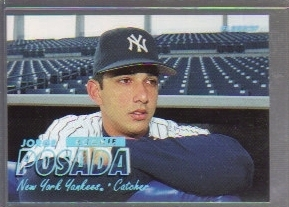
Jorge Posada still hasn’t made his decision official, but it’s become common knowledge that he has decided to retire rather than continue his career as a backup catcher in Tampa Bay, Baltimore, or Philadelphia. While I would never begrudge a player who wanted to prolong his career as much as possible, there is some artistic symmetry in Posada beginning and ending his playing days in the same place.

Posada represents the latest in a long line of great Yankee catchers, a succession that began with Bill Dickey before continuing with Yogi Berra, Elston Howard, and Thurman Munson. Dickey and Berra are members of the Hall of Fame, Howard and Munson are not, and Posada will become the focal point of what should be an interesting five-year debate over his worthiness for the Hall of Fame.

The comparison of Posada and Munson has long fascinated me. Based strictly on OPS (.848 to .756), one would conclude that Posada was the superior of the two. Posada certainly had more career value, thanks to luck and longevity. But using an eyeball approach–assuming you’re old enough to have seen both players–Munson was the better player, especially when you factor in the areas of fielding and baserunning.

As much as I like Munson, he just didn’t have the career longevity that is needed for a Hall of Fame player. I would also vote “no” on Posada’s entrance into Cooperstown, though I’m open to change my mind. The relatively late start to his career, along with his defensive deficiencies and baserunning misadventures, render him just short of my personal Hall of Fame line. But that should not be interpreted as some kind of insult. Any player who is even considered for the Hall of Fame is a player of achievement, a player of longevity, a player who is worthy of praise and appreciation. Posada’s offensive excellence—encompassing his ability to hit with power, draw walks, and do damage from both sides of the plate–made him a modern day version of Ted Simmons.

And let’s not forget that early in his career, Posada was a respectable receiver who generally developed good rapport with his pitchers. For every A.J. Burnett, there have been dozens of pitchers who came to trust and rely on Posada’s enthusiasm, passion, and leadership abilities. By all accounts, Posada has been a good and well-liked teammate who has blended well with the vast array of personalities the Yankees have had over the last 15 years.

Posada’s career path is rather remarkable given its origins. It’s worth noting that he was not a highly touted player when first signed by the Yankees. He was a 24th round selection in 1990. He started his professional career as a second baseman with the Oneonta Yankees, a short-season Class-A franchise in the NY-Penn League, before someone in the organization had the foresight to convert him to catcher. When the Yankees first brought him to the major leagues, they often used him as a pinch-runner. It’s almost as if the Posada of the 1990s was someone else, some alien life form who possessed the powers of self-transformation. I guess his makeover is proof that players are adaptable, than they can evolve, and that a longshot can become a success in the game of major league baseball.

Farewell, Jorge. Next stop, Old-Timers Day. I think you’ll be pretty popular that day.

***

I think I’ve been as big a booster of Jesus Montero as anyone who writes for The Banter, so you might expect that I’d be unhappy with the trade that sent him and Hector Noesi to the Mariners for Michael Pineda and Jose Campos. Granted, I’m a little disappointed that I won’t have the opportunity to see Montero play every day in pinstripes, primarily because I think he is going to be a star hitter, the kind of player who will hit .300, slug .500, and carry a team’s offense for days at a time.

As much as I like Montero, I love the trade. Scouts praise Pineda the way I rave about Montero. At six-feet, seven inches and 260 pounds, he’s been described as a “monster,” even as a “leviathan,” which may be the first time I’ve heard that word used to refer to a ballplayer. (He looks like a bigger version of Lee Smith, if such a thing is possible.) With his 95 to 98 mile-an-hour fastball and bone snapping slider, Pineda makes mitts pops and heads turn.

If Pineda duplicates the way he pitched for the Mariners, particularly over the first half of the season, the Yankees have a perfectly formidable No. 2 starter. If he adds a third pitch to his repertoire and pitches to a reachable higher level, he becomes a full-fledged No. 1 starter, someone who can eventually wrestle with CC Sabathia for the mythical top spot of the Yankee rotation.

As a bonus, the trade with the Mariners also netted Campos, whom some scouts project to be better than Pineda. With his smooth delivery and live fastball, the 19-year

-old right-hander will start the season at Single-A ball, but could move up to Double-A by midsummer.

While the Yankees often deal prospects for established veterans, they don’t often make trades where they deal young talent for young talent. In fact, I can’t remember Cashman making this sort of transaction in the past. This deal reminds me of the 1978 trade in which the Yankees traded Mike Heath, a highly touted young catcher, to the Rangers for a power-throwing left-hander named Dave Righetti. (The deal also included a longtime veteran in Sparky Lyle, but Heath and the three other prospects going to Texas were really the keys to the trade.) Righetti became a serviceable starter before Yogi Berra made the controversial and still-debated decision to move “Rags” to the bullpen, where he had some level of success but never became a dominant closer.

I think Pineda will turn out to be a better pitcher than Righetti. He’ll need to stay healthy, and have some luck along the way, but I think his chances of success are pretty good. With Pineda and the bonus addition of free agent Hiroki Kuroda, the Yankees now have their deepest rotation since the days of Clemens, Pettitte, Mussina and Wells…

***

As with any trade, the Pineda deal leads to the inevitable question: what is the next move? The subtraction of Montero leaves the Yankees without a DH. Joe Girardi has said he wants to rotate some of his resting veterans into the DH slot, but that’s not a fulltime proposition that can be sustained through 162 games. There will be plenty of days when the Yankees will want–make that, need–a proper DH who can put up some raw numbers. Two free agent candidates appear to be at the top of the list. They are Johnny Damon and Carlos Pena.

I’d be fine with either one on a reasonable one-year contract, but my preference would be Pena. At 33, he’s five years younger than Damon, outslugged him by 44 points in 2011, and has a history of launching long balls at Yankee Stadium. With 28 home runs and 101 walks for the Cubs in 2011, Pena fits the Yankee offensive blueprint to a tee.

Pena can no longer hit for much of an average, and he must be platooned, because he’s become like Oscar Gamble against left-handed pitching. The Yankees have a solution for that in the re-signed Andruw Jones, whose prowess against left-handed pitching has been well documented. A Jones/Pena platoon would be an ideal fit for the seventh position in the Yankee batting order.

On the other hand, Damon still has something to offer. He can hit the long ball (16 home runs) and can still steal a base (19 stolen bases in 2011). He would bring more of a contract presence to the lineup, an ingredient that was sometimes missing in 2011. And we know that Damon would have no trouble fitting into the clubhouse dynamic or dealing with the New York City press.

Damon or Pena, which is your choice?

[Photo Credit: Seattle Mariners Musings]

Bruce Markusen writes “Cooperstown Confidential” for The Hardball Times and can be found from time to time on Facebook.


The Virtual Reality of Joe Paterno

Saturday, January 14, 2012, marked the publication of Joe Paterno’s first comments on the record since the Jerry Sandusky scandal exploded and led to the end of his career as he, and everyone else, knew it. Sally Jenkins’ piece reads like a prologue to an obituary, with the necessary exposition to put the past two months into some sort of context.

Removing the descriptive language, though, reveals the quotes from both Paterno and his wife, Sue that shape Jenkins’ story. I pulled a few that I found particularly jarring:

1) “You know, it wasn’t like it was something everybody in the building knew about. Nobody knew about it.”
— Paterno, on his insistence that he was unaware of a 1998 police investigation into the report on the boy who has come to be known as “Victim 6”.

Analysis: The same thing was said about Tiger Woods’ inner circle when questions of “how much did they know and when did they know it” came about regarding his serial philandering. Jo Becker’s report in the New York Times from November 10 of last year provides insight into this notion. Becker spoke to several investigators who doubted Paterno’s assertion of see-no-evil, hear-no-evil, know-no-evil.

An excerpt from Becker’s article:

“You have to understand those statements in context — there is nothing that happens at State College that Joe Paterno doesn’t know, or that Graham Spanier doesn’t know,” one person involved in the investigation said. “Whether or not a criminal case went forward, there were ample grounds for an administrative inquiry into this matter. I have no evidence that was ever done. And if indeed that report was never passed up, it makes you wonder why not.”

Joe Paterno was the most notable and powerful man at Penn State. According to the anonymous investigator, he was the most powerful man in State College. In 13 years since that investigation took place, Paterno’s assertion leaves us to interpret his involvement in one of two ways: either a) he knew what happened and was responsible for organizing a broad cover-up, or b) like Pete Rose has done every day since he was banned from baseball in 1989, Paterno crafted an alternate version of the events that he believes so passionately, it has become truth. This second supposition aligns with one definition of truth listed as “conformity with fact or reality.”

2a) “He didn’t want to get specific. And to be frank with you I don’t know that it would have done any good, because I never heard of, of, rape and a man. So I just did what I thought was best. I talked to people that I thought would be, if there was a problem, that would be following up on it.”
— Paterno, describing Mike McQueary’s call to him after witnessing Sandusky having sex with a boy in the showers of the Penn State Football facility in 2002.

2b) “I had no clue. I thought doctors looked for child abuse in a hospital, in a bruise or something.”
— Sue Paterno, when asked if she knew anything about Sandusky’s alleged child molestation.

Analysis for 2a: Paterno’s recollection that McQueary didn’t want to be specific in his description of the actions is consistent with the original report of McQueary’s statement. Numerous reports since November, and the grand jury report, confirm that Paterno did, in fact, run it up the chain. But another quote from Paterno is particularly revealing:

“I didn’t know exactly how to handle it and I was afraid to do something that might jeopardize what the university procedure was. So I backed away and turned it over to some other people, people I thought would have a little more expertise than I did. It didn’t work out that way.”

Again, we come back to Paterno’s power. He could have easily told the administration and the Board of Trustees about the McQueary call and the accusations and said, “Do what you have to do.” He also could have cleaned house. Expertise and knowledge of male rape had nothing to do with it. Neither did procedure. Many of Paterno’s players have called him a father figure and have said he taught them how to be leaders. Do true leaders back away from a challenge or shrink in the face of adversity? That’s what Paterno did. He did not practice what he’s preached.

Analysis for 2b: Sue Paterno added that we will become a more aware society as a result of this. That’s a nice thought, except millions of people both inside and outside Happy Valley have been aware of child abuse for years. When similar salacious charges ravaged the Catholic Church several years ago — this was international news — awareness heightened to the nth degree. Sue Paterno’s statement does not reflect well on the cultural awareness and intellectual faculties of either her or her husband, despite their ability to recant the Classics or demonstrate their love of opera, as Jenkins noted.

3) “Right now I’m trying to figure out what I’m gonna do, ’cause I don’t want to sit around on my backside all day. If I’m gonna do that I’ll be a newspaper reporter.”
— Paterno on his current state of affairs.

Analysis: Before saying, “If I’m gonna do that I’ll be a newspaper reporter,” Jenkins observed that Paterno grinned and smiled; an obvious attempt to try to rankle the veteran reporter. Paterno should know, though, that the enterprising work of reporters not sitting on their backsides and exposing his role in this mess are part of the reason he is out as Penn State’s head football coach and is no longer a tenured professor there. One reporter in particular, Sara Ganim, could very well win a Pulitzer for her work on this story. Paterno demonstrated in both nonverbal and verbal terms why he kept Happy Valley in such a hyper-controlled bubble. He hated reporters.

None of Paterno’s comments should come as a shock. There is no new information. From this interview, it’s clear Paterno believes that we are naive enough to think his story is the truth. Should we believe he was naive enough to have never heard of male rape or child molestation? Paterno may believe we as the public, are that stupid. What if, based on everything that has come out since November, we believed the same of him?

All We Need is a Drummer (For People Who Only Need a Beat)

Victor Cruz and the Giants hope to keep dancing today, strutting their stuff all the way to the NFL Championship Game in San Francisco (and what a game that was yesterday between the 49ners and the Saints). I don’t think they’ll win today but one never knows…do one?

[Photo Credit: N.Y. Daily News]

Sundazed Soul

You Gots to Chill.

Saturdazed Soul

Brand Nu

[Photo Credit: d00bied]

Respond React


It is remarkable how news is delivered and digested in the Twitter Era. It comes at us in a flurry–rumors, confirmations, reactions, analysis. There is little time for reflection and an overload of hyperactive reaction.

Last night, the trade of Jesus Montero to the Mariners for Michael Pineda, prompted conflicting feelings for Yankee fans. Many are disappointed to see Montero leave. Here is a player that was nurtured by the organization–even though they dangled him a year-and-a-half ago to Seattle for Cliff Lee–a guy who looked more than promising when he arrived in the Bronx late last year. Montero was hyped, of course, this being New York, but he was also a player that many of us felt would be a pleasure to watch in pinstripes for the next decade. And now that is gone–whoosh.

Montero is being replaced by the another promising player, a young pitcher with a great fastball and an effective silder, but Pineda is not our guy. We’ve got no attachment to him yet. He’s just a face, a stat line. He’s not The Jesus.

The arguments run both ways–hitters aren’t as risky as pitchers, a starting pitcher is more valuable than a DH, a great hitter catcher is even more important than a good starting pitcher–and they are all valid. Yankee fans are experiencing duel emotions but there is room to mourn the loss of Montero and to be eager about the addition of Pineda. The risk involved in trading something as precious as Montero and Pineda makes this all the more unsettling. So we’re anxious, and that’s what makes this exciting and gives us baseball nerds something to keep  our engines going in the middle of winter.

Here are reactions around the web from: David Waldstein (The Times)Cliff Corcoran (SI); Paul Swydan (Fangraphs)Steven Goldman (Pinstriped Bible); William J (The Captain’s Blog); can’t forget No Maas, and over at It’s about the Money Stupid, check out this fine collection of links from around the web.

Finally, here’s Dave Cameron with a scouting report on Pineda over at Fangraphs:

Among qualified AL starting pitchers last year, only Brandon Morrow and Justin Verlander posted a higher strikeout rate than Pineda, who whiffed 24.9% of the batters he faced. His K% was better than David Price, CC Sabathia, and yes, even Felix. Pineda’s live fastball and willingness to live up in the strike zone led to a lot of swinging strikes, and that had nothing to do with the park he played in.

Lots of young pitchers can throw hard and rack up strikeouts, however. What sets Pineda apart is his impeccable command at such a young age. 66 percent of the pitches he threw last year were strikes, and his 7.9% BB% was below the league average. It is highly uncommon to see a kid with that kind of live arm arrive in the Major Leagues pounding the zone, but that’s exactly what Pineda did. 94-97 MPH fastballs to get ahead, and then an out-pitch slider or a fastball out of the zone with two strikes to get the K. It was a recipe for success, and Pineda used his command of those two pitches to establish himself as one of the game’s best young starting pitchers.

So, while he’s not perfect (his change-up is lousy and left-handers can still jump on him from time to time), Yankees fans should be thrilled with their new addition. And, given the price that other young arms have been fetching this winter, they should be even more thrilled with the cost.

Pineda is the third quality young arm to get traded this winter, following the trades that shipped Gio Gonzalez to Washington and Mat Latos to Cincinnati. Given that both pitchers come with one fewer year of team control and lack Pineda’s dominating fastball, a strong case could be made that the Yankees new starter is the most valuable asset of the three guys that were moved. However, compared to the other two packages surrendered, the Yankees didn’t really pay much of a premium to get Pineda, and one could even make an argument that they gave up less value overall than what the Reds surrendered to get Latos.


[Photo Credits: DanytumblogPhillipe Reichert, Attimi Rubati x2,electric feeling, Studio Museum in Harlem]

Jesus Has Left the Building (When the Sh** Goes Down, You Better Be Ready)

Dag, I leave the Internet for a few hours, and the Yanks spring into action. Word has it that they’ve shipped out The Jesus and Hector Noesi to the Mariners for Michael Pineda and another young pitcher named Jose Campos. In another move, they will sign Hiroki Kuroda to a one-year contract pending a physical.

Didn’t figure the Yanks would stay on the low forever. They move Montero for another promising young talent in Pineda. I’m not expert but seems like a win-win sort of deal. As much as I would have liked to see Montero, I’m thrilled that the Yanks are getting a gifted young starter in Pineda. And I know they’ve coveted Kuroda since last season.

Wonder if they’d go nutzo and make a play for Prince to DH. Doubt it, but hey, let’s have some fun. And what about the starting staff? Phil Hughes and AJ Burnett? What’ll happen? After a quiet winter, put another log on the fire and let’s have at it.

[Photo Credit: Super Ninteno Sega Genesis]

The Zilch Squad All Stars

I like this from a recent post by Joe Posnanski. Here’s his All Star team of players who failed to receive one vote for the Hall of Fame:

C: Darrell Porter

1B: Ken Singleton

2B: Robby Thompson

SS: Dick McAuliffe

3B: Bob Horner

OF: Jimmy Wynn

OF: Andy Van Slyke

OF: Roy White

DH: Hal McRae

P: Frank Tanana

P: Mark Langston

P: Steve Rogers

P: Sam McDowell

CL: Todd Worrell

Honorable mentions: Devon White, Amos Otis, Cecil Cooper, Garry Maddox, Joe Rudi, Boomer Scott.

Color By Numbers: Delaying the Inevitable

In his third year of eligibility, Barry Larkin was elected to the Hall of Fame, an honor most baseball fans agree should have come sooner. However, even though the Hall of Fame bylaws make no such distinction, the voters from the BBWAA have taken it upon themselves to create a stratified election process that bestows special meaning to how quickly a player gains enshrinement (for a closer look at players forced to wait their turn, click here).

Since the first Hall of Fame class in 1936, 297 members have been inducted, including 207 former major leaguers, of which 112 were elected by the BBWAA. Of that latter total, only 44, or 39%, have been enshrined in their first year of eligibility, meaning Larkin’s delayed induction wasn’t abnormal.

Hall of Fame Inductions, by Years on the Ballot

Note: Excludes players elected via a runoff or special election.
Source: baseball-reference.com and baseballhall.org

The restriction on first ballot Hall of Famers has been eased somewhat of late (there have been 10 first-year elections over the past 10 years), but sentiment about denying an initial vote is still prevalent in Cooperstown discussions. Unfortunately, the shortsighted logic behind such an approach can sometimes be taken to an extreme, as was the case with Lou Whitaker and Ron Santo, two strong candidates that dropped off the ballot after failing to receive 5% of the vote in their first year of eligibility (Santo, who will join Larkin as a posthumous Veterans Committee induction, was later reinstated). Despite these examples of a philosophy gone awry, the practice continues to this day, and almost claimed Bernie Williams as another victim.

Although fans and baseball writers still get hung up about the importance of being a first ballot Hall of Famer, many might be surprised to learn some of the players who don’t qualify for the distinction. Tris Speaker, Ty Cobb and Whitey Ford all needed two ballots to gain enshrinement. For Mel Ott and Carl Hubbell, the third time was a charm. There haven’t been many players more elite than Joe DiMaggio, Eddie Collins, and Lefty Grove, but each of those men needed four ballots to enter the Hall. As you go down the list, the names continue to impress, which should be reason enough to scrap any notion about a first ballot commendation.

Vote and WAR leaders by Year of Hall of Fame Induction

Source: baseball-reference.com and baseballhall.org

In defensive of the BBWAA, there once were credible reasons for withholding votes from first timers. The most compelling was the glut of qualified candidates resulting from the decades of baseball history that pre-dated the Hall of Fame. As a result, the voters not only had to consider which players were the most deserving, but also which had already waited too long for their rightful honor. Several other eligibility rules from the past also supported the first ballot stinginess, including players becoming eligible after only one season of retirement and the lack of a minimum requirement to remain on the ballot. That’s why when DiMaggio kept failing to win induction, for example, there was surprise, but not outrage, even if not everyone agreed with the philosophy.

The temptation is strong to exclaim indignantly that all members of the Baseball Writers Association who failed to vote for the Jolter are rockheads. But that would be a grievous error. The reasoning is this: Joe DiMaggio in his first year of eligibility for the Hall of Fame. Admittedly, he rates it but can afford to wait a bit just as other great stars had to wait. Let’s get some of the older fellows into Cooperstown before time runs out on them.” – Arthur Daley, New York Times, January 23, 1953

Arthur Daley’s justification for withholding deserved votes expired along time ago. Making Barry Larkin wait three years for induction didn’t serve any purpose other than to create an artificial distinction between classes of Hall of Famer. Of course, because past procedures necessitated delays, Larkin can still boast that his election came well before the likes of DiMaggio, Jimmie Foxx and Rogers Hornsby. However, there is still one part of Daley’s comment that rings true, and it will be hauntingly evident when someone other than Ron Santo is forced to accept the Hall of Fame honor on his behalf. Compared to the former Cubs’ third baseman, Larkin’s wait was nothing.

No Funny Stuff

Our man Cliff has a piece up at SI.com about Jorge Posada’s chances at making the Hall of Fame:

He was the funny-looking one. The last to join the quartet, he had a big nose, a weak chin, a penchant for rings and worked sitting down. His contributions to arguably the greatest ensemble in his field have always been overlooked. Yet, even moreso than his Beatles analog, Ringo Starr, Jorge Posada was an equal partner in baseball’s fab four, the quartet of Yankees teammates who debuted in 1995 and won seven pennants and five World Series together (though Posada, who played in just eight major league games in 1996, sat out the first of those).

That Posada is so comparable to Ringo, “the funny one,” who wrote just two Beatles songs and two of the worst at that, helps explain why he has had such a hard time being taken seriously as an all-time great at his position. However, news of his impending retirement, first reported by WFAN beat reporter Sweeny Murti last weekend, gives us a much-needed occasion to revisit Posada’s significance in baseball history. It’s fitting that the news about Posada arrived just days before the announcement of this year’s Hall of Fame class, as a case can be made that Posada is worthy of enshrinement, and it has nothing to do with his having kept time with sure-fire first-ballot inductees Derek Jeter and Mariano Rivera or fellow borderline case Andy Pettitte, his Core Four brethren.

feed Share on Facebook Share on Twitter Share via email
"This ain't football. We do this every day."
--Earl Weaver