"A New York Treasure" --Village Voice
Category: 1: Featured

Stop Making Sense

Here’s Yankee GM Brian Cashman at the Winter Meetings:

“It’s just hard to find a match — and it feels like it’s harder now than ever,” Cashman said. “You don’t see those old-school 7 to 11-player deals; you don’t see stuff like that anymore. I think people are smarter and therefore more careful. This isn’t the old seat-of-the-pants, get drunk in the lobby and write names on the napkin. People don’t conduct business that way any more.”

Banuelos and Betances aren’t the only players the Yankees have received calls on, as Cashman said he’s had offers for pretty much every player without a no-trade clause other than Robinson Cano and Curtis Granderson.

“All those guys are either future high performers or currently high performers, they’re under control and they’re cheap,” Cashman said of the group that includes Brett Gardner, Dave Robertson, Phil Hughes and Ivan Nova. “It’s, ‘Hey, take my older, expensive, over-the-hill guy for your young, better-performing guy.’ I’m like, ‘Let me think about that and get back to you.’ ”

(Mark Feinsand, N.Y. Daily News)

Not much to do but wait out the worms and see what happens.

Winter Meetings Schmooze-a-thon

Open thread. Let the kibitzin’ commence.

[Image Credit: It’s a Long Season]

That’s a Good One

Dumb Yankee-related rumor of the day.

Bronx Banter Interview: Katherine Thompson

Earlier this year, my wife and I went to L’Artusi, in the West Village, and had a wonderful meal. We were taken with the place, the food, of course, but also the warm and enthusiastic service. We especially loved the olive oil cake and I found myself returning to the place just for another taste. It is the creation of Katherine Thompson, who grew up in and around Washington D.C. She learned to cook from her mother and from watching Julia Child on TV.

After graduating from William and Mary with a major in business and minor in fine arts, she lived in Seattle for a few years, unsure what she wanted to do, while entertaining her friends and cooking for them. She was spellbound by Alfred Portale’s cookbook, “12 Seasons,” and decided to move back east where she attended the Culinary Institute. After she graduation, Thompson came to New York and started a career in the restaurant business that took her to from places like Per Se and Italian Wine Merchants to Del Posto. She married Gabe Thompson and is involved in two restaurants with him, Dell’Anima and L’Artusi.

She was kind enough to sit down with me recently at L’Artusi. Here’s our chat. Enjoy.

BB: How long is the program at the C.I.A?

KT: It’s a little less than two years, with an externship in the middle. I did the externship in D.C. at a casual American restaurant called Chef Geoff’s. What was great about that place is that it taught me speed. It wasn’t high end in terms of the food but it was incredibly busy. It was exactly what I needed because when I showed up I was the slowest person in the world and I got my ass kicked. There are skills that I learned there that I still use today, like piping pounds and pounds of butter into ramekins.

BB: So you were at school, then Chef Geoff’s and then back to school.

KT: Yeah, school for nine months, I think, then to D.C. and then back.

BB: What was it like going from being a home cook to a competitive cooking atmosphere?

KT: It was hard and intimidating. I was worried that everyone was looking at me like, ‘What’s this girl doing here?’ I was 25 at the time. But everyone there had been around the block a couple of times and I was green. They were  worried that I was going to chop my hand off kind of green. But everyone was great to me in the kitchen. Someone would come to me and say, ‘Instead of doing it this way, why not approach it that way?’ I listened and I didn’t want to fail. I didn’t want to be wasted space in the kitchen.

BB: In that atmosphere were you pushing yourself because you don’t want to be seen as the weak link?

KT: I also wanted to prove to them that I belonged. It was hard but after a month or two, it worked out. I kept my mouth shut and did what I was told.

BB: Did you have a better sense of what you wanted to do when you graduated?

KT: No. I had a degree, I had student loans to pay, but didn’t know what I was going to do. I looked at job postings at the CIA. Some were dream jobs and I didn’t think I had a chance. One was for an assistant to Jeffrey Steingarten, so I sent a resume and got called back for an interview, and was like ‘Holy shit, I can’t believe I got called for an interview, I’m going to meet Jeffrey Steingarten.’ Also, there was an opening at Per Se, and they had just gotten four stars, so since I was going to be in New York, I dropped off my resume with them. I met Steingarten and didn’t get the job but Per Se called me up for an interview. I was pinching myself. They asked if I wanted to interview for front of the house or back of the house. I interviewed for front of the house because it was more money and in the kitchen…

BB: You don’t get rich working in a kitchen.

KT: No, you don’t. At all, ever. I had front of the house experience and thought that would be the right fit. I went through a long process, they offered me the job and I took it. They call their food runners kitchen servers. It was the most stressful job, one of the jobs where I couldn’t mentally get over it. I was so intimidated by everything, the food, the dinning room, the china, all of it.

BB: And the pressure of having not to fuck up anything.

KT: And I did fuck up. I fucked up so bad once and they had an all staff meeting about it. Brought the whole restaurant together. They didn’t say my name but they talked about what happened and everyone knew I was involved in this one mistake. It was horrifying. We screwed up a course on a table. It was a hard job, but I’m glad I had it. Not only did I meet a lot of great people and see a lot of amazing food it made me realize I don’t want to do front of the house and I don’t want to do four star dining.

BB: Because of the stress?

KT: The pressure is unrelenting.

BB: How long were you there?

KT: Not very long. Seven months. What’s interesting is that the minute I gave two weeks notice, all of sudden the job was easy. I realized that I put myself in the mental weeds the entire time. That job actually wasn’t that difficult. I’d be, ‘Oh, my God, I can’t believe I’m shaving these truffles that are worth thousands of dollars, I can’t drop it on the floor.’ The mental image on dropping a truffle on the floor was enough to give me a panic attack. Really, it’s not that big of a deal, it’s a softball that you’re grating on a grater. But I couldn’t think of it that way.

BB: What came next?

KT: I went to work at Italian Wine Merchants. Mario Batali was involved with it at the time. It’s a retail wine store but they do private events in the back. I helped run the private events program there, so I’d book the event and then help cook for it. That was my first experience cooking Italian food. I learned about making sauces and fresh pasta. I was there for two-and-a-half years and did a lot of cooking. I also learned how to develop a private events business and that’s a very specific job. After that, my cousin opened a wine store in Tribeca and I helped them open. But there was down time as we waited to open, and that’s when I went to work at Del Posto in the pastry program. I fell in love with it. Del Posto was amazing, the pastries were amazing.

BB: Del Posto is a four-star restaurant, too. What was the difference there?

KT: Well, it wasn’t four-star yet. I was friends with pastry chef a the time. I felt comfortable with the staff. It was a little more relaxed, not quite as strict. At Per Se, I was too uncomfortable to let myself have a personality, whereas at Del Posto it didn’t feel that way. It wasn’t as daunting. Plus, I was doing pastry, which I loved and which was easier to do than talking to people in the dinning room. So I went back-and-forth between Del Posto and the wine store and then moved to the wine store full time and developed their events and cooked for them. But after awhile, I got burned out from it, booking events, cooking for the events, it’s a day and night process. When I left, I didn’t know what I wanted to do. I had nothing lined up. And I had just met Gabe. When I left Del Posto, my friend Elizabeth, who had also worked with me at Italian Wine Merchants, was still there. She became friends with Gabe who came to work at Del Posto’s and she introduced us and it was one of those love at first sight things. He also left Del Posto. It was the summer of being ridiculously poor, not having any idea of what was next, and we would cook for each other.

BB: This was when?

KT: ’07. Spectacular summer. In Brooklyn. I lived in an old brownstone in Boerum Hill, had three roommates, big kitchen. We’d have impromptu dinner parties all the time. Then in August, Joe Campanale, our wine guy, who I had worked with at Wine Merchants, contacted me about the Dell’ Anima space. They wanted to open something. They knew about wine but not food and they asked if I could help them find a chef. I knew I didn’t want to do it, I didn’t have line cook experience. So I told them, ‘I’m sleeping with this guy and his food is delicious.’ Not only did I fall in love with Gabe’s personality but I fell head over heels for his food.

BB: That is romantic.

KT: It’s funny, right? I introduced them, he cooked for them, and it was the right match, so it worked out and we opened Dell’ Anima in October ’07.

BB: And what were you doing there?

KT: This is where my life gets complicated. I helped open the restaurant but I didn’t initially work there. Officially. I took a job at Brasserie 44 in the Royalton Hotel as a pastry sous chef because my old pastry chef at Del Posto was there. I really wanted to do pastries. Also, it was so earlier in my relationship with Gabe.

BB: Working together could get tricky, right?

KT: We’d just met each other, so working together, maybe that’s a little much. Maybe I need to do my own separate thing. But after work at the Hotel I went to Dell’ Anima to help out. They didn’t have a pastry program and when you open a restaurant there is stuff to do around the clock, it’s never ending. I was going back-and-forth between the two jobs and a few months after they opened, they realized they needed front of the house stuff done and since I was there all of the time. I transitioned to Dell’ Anima, where I was the manager and the pastry chef.

BB: Were you far enough into your relationship with Gabe that it worked?

KT: Yeah, it was perfect. It was one of those things were we had such a great relationship that it made it easier. In most restaurants there is a division and conflict between the front of the house and the back of the house. I was the bridge. Especially in that space where there is no wall between the two, so you are in each other’s face no matter what. But we were so comfortable talking to each other that there wasn’t any conflict. Plus, I don’t think that some chefs understand what when a manager asks as bizarre request, they’re just the communicator, they just want to make the guest happy. Gabe never questioned that. Which makes such a big difference.

BB: Were you living together?

KT: Yup, in Brooklyn. Studio apartment, 12 feet by 12 feet. A place to sleep. And we decided we wanted to get married and simultaneously, our investors decided that they wanted to open another restaurant.

BB: What was the reception like at Dell’ Anima?

KT: When we opened, Gabe and I wondered if it was going to work. Italian had been done a thousand times, why open another Italian place, we’re sick of Italian. So true. But people still like to eat good food and people love pasta. As long as you do anything well people are going to gravitate toward it. We were busy from the minute we opened which is, knock on wood, unbelievable.

BB: I know the space is cozy and the food is tasty but how can you account for that kind of immediate success?

KT: The neighborhood embraced us. We instantly had regulars. We never got reviewed. [Frank] Bruni blogged about us a couple of times but we never got reviewed. Partly because we were so small and partly because people didn’t necessarily see it as a legitimate restaurant. Is it a wine bar, what is it? Plus, nobody knew who Gabe or Joe were so nobody cared about the names. Still, we were busy, and it went well. Then, Alfred Portale came in to eat, and he’s my idol. That was wonderful. We also made the decision to stay open until 2 am, so we’d serve a full dinner until 2. Our perspective was it would become an industry place. When our friends got off work, and it was midnight and they’re hungry, they can come in and get a great glass of wine and a big bowl of pasta. So there were cycles of time when entire staffs would show up at 12:30-1 am. We really wanted our peers to enjoy what we were cooking and get their feedback. The downside of that was that we weren’t getting off from work until 3:30-4 am, every single night, living in Brooklyn, we were lucky if we got home before 5:00.

BB: And then came L’Artusi.

KT: Yeah, it was back-to-back. Gabe and I got married in the fall of ’08, went on our honeymoon, and when we got back we opened L’Artusi. Lehman Brothers collapsed when we were on our honeymoon so that economic shitshow went down as we were opening up this huge restaurant.

BB: How much bigger is it than Dell’ Anima?

KT: Dell’ Anima is 50 seats this is 124 seats. A lot more money, a lot more pressure. At Dell’ Anima we could get away with being more adventurous with our food. Even though it was a smaller restaurant. It was such an industry place that people would come in and go, ‘Oh, sweet breads!’ and really want to eat it. We foolishly thought because we have a bigger kitchen, a bigger place at L’Artusi, we could do more of those things, and we realized when you are feeding more people you have to make food more approachable for bigger groups of people.

BB: How long did it take to recognize that?

KT: We opened in December of ’08 and the reviews started coming out in January, February and they were scathing. So we asked ourselves, ‘what are we doing wrong?’ And that was such a good process because we learned from it.

BB: And what was the initial business like here compared with Dell’ Anima?

KT: It was slower in that it’s easier to fill a smaller restaurant. Percentage wise we weren’t doing as much as we should have been and then the bad reviews didn’t help bring people in. The first six months were hard. It was a delicate act of working on the food and making sure we didn’t have too much staff if we weren’t busy.

BB: Were you working front of the house and pastries here too?

KT: No, I decided to just do pastries because the kitchen was better equipped here and we still do all of the pastries for Dell’ Anima here. So I was doing that for both restaurants and I was thrilled to stop doing the front of the house stuff and we hired Kevin Geary to be the general manager and he’s wonderful. He had so much experience than I did and he really knew what he was doing.

BB: When did things start coming together?

KT: With the menu, slowly but surely, we started putting together things that people really loved.

BB: Was it trail and error?

KT: Yeah. You put something on the menu and see how it sells. Sometimes it takes a while before it takes off. Our friends and the front of the house staff would taste things and we listened to their feedback to get a sense of what people wanted. Then we started getting busier and busier. People started showing up two or three times a week, so Gabe and I figured we were doing something right. It was really satisfying when we got the Zagat review this year and we got a 26—score—and we’d started off at 21. That’s the mark of our neighbors reviewing us.

BB: How did the olive your cake, your signature dessert, come about?

KT: Gabe deserves a lot of the credit for that. The thing with us is that we help each other out with our menus. If I didn’t have his feedback my pastry program wouldn’t be what it is. We have complimentary pallets. Sometimes, I’ll think of dessert in a specific way, not realizing that it could be done differently, or one less step. And he can point stuff out.

BB: Is there something about the nature of Italian cuisine, which can stress simplicity that reinforces that idea?

KT: There are times when you over-manipulate food and it’s just fluff that is lost on the final product. You also don’t want to be too simple or rustic so that there is no finesse behind it. That’s what’s tricky about Italian food, is finding a balance. With the olive oil cake, for example, Gabe had the recipe, and we tried it, and I said, ‘Okay, let’s go with the raisins and the crème fraiche mousse would go well with it.’ I really wanted a simple slice of cake, that’s all I wanted. At that point in time, all anyone cared about in the dessert world was foam and all that molecular stuff was popular. I wanted to do the opposite of that. But when we did friends and family, I served it and when we first opened nobody bought it. I said to Gabe, ‘Nobody is going for it, should I just try something different?’ And he told me not to give up on it just yet. And within a week it became the most popular dessert on the menu and it is to this day.

BB: So you have to have faith in things and let them play out.

KT: Yeah. Over the summer, Gabe put on a tomato panzenella salad with watermelon and pickled watermelon rinds and pancetta. The first two weeks, it didn’t sell. But Gabe and I knew it was good. We knew it would eventually sell because you can’t go wrong with tomatoes and bacon and watermelon. And sure enough…

BB: On the other hand, have their been dishes that you liked but didn’t work?

KT: Yeah. When we opened Gabe put on a bruschetta with thinly slicked tongue with a cabbage slaw and an aioli kind of dressing. It tasted like a Rueben. It was absolutely delicious. It wasn’t thousand islands but it tasted like it could be, it wasn’t saurkraut but it had the cabbage. It was so tasty but it looked awful. The color of it was muddy and unappealing. We didn’t use nitrates so the meat didn’t have that pinkish quality. But for a long time we kept it on the menu because it was so good. If I was desperately hungry that’s the thing I wanted to eat. It was the most satisfying thing we had on the menu. So we tried to hold onto it but finally we knew that the only reason we kept it is to make us happy and not anybody else.

BB: I know Gabe cooks seasonally but how often do you decide to change things up on the dessert menu?

KT: We both reevaluate every season. A certain amount of items aren’t seasonal like the olive oil cake. Olive oil and raisins never go out of season. And it’s nice to have those. I know when I go to Lupa I’m going to want to have the tongue, and if it wasn’t on the menu I’d be annoyed. But because we love the seasons and new ingredients a large chunk of the menu is seasonal. Summer gets tricky because it’s so plentiful so we switch things out quite a bit. Sometimes, we’ll bring things back because it worked last year, or we’ll bring it back but tweak it a different way.

BB: Do you and Gabe still enjoy that kind of shorthand that you developed in the kitchen over the years?

KT: Yes, but since we had our baby, I’m away from the kitchen more now. I miss being there and I go through phases when I want to be back in the kitchen but I also want to be with my son. But today, I’m here during the day, Gabe is at home, and we’ll both be home tonight.

BB: It might also work that if you are away for a little while, when you come back you’ll have a new freshness, too.

KT: That already happens. I come in with a perspective that I wouldn’t necessarily have if I were here every day. And our son Luke is really cool about showing up with us to the restaurants. He can really roll with it. We also live not so far, in a fourth-floor walk up.

BB: That keeps you in shape.

KT: It does.

BB: I’ve been meaning to ask, how are you not a complete fat ass working here?

KT: Well, I like to exercise for one, but also, I’ve gotten tired of pasta so there are other things I eat.

BB: You mentioned that Dell’ Anima was a hangout for other cooks. Where do you guys like to go to eat?

KT: Okay, we love the Spotted Pig. We’re addicted to it. We love April Bloomfield’s food, all of her places. We also love Casa Mono and Lupa.

BB: Do you ever cook at home?

KT: Before we had the baby, the only thing we had in our fridge was a bottle of champagne. We didn’t even have condiments. Now that I’m home with the baby, I’m cooking for him and cooking for myself, instead of ordering takeout. But our kitchen is small. We don’t even have a counter. Our cutting board is on our sink, so it’s a challenge to cook there and not use every swear word I’ve ever known. What’s been great about it, though, is that I’ve rediscovered home cooking.

BB: Especially in a small kitchen.

KT: Right. I think about how I can make a really good meal for myself with just a few ingredients and have it be healthy and taste good.


The Emmis, Now and Forever

When he was twelve-years-old, Scott Raab saw the Cleveland Browns win the championship game. He was there, in person. No Cleveland team has won a title since, and Raab’s new book, “The Whore of Akron: One Man’s Search for the Soul of Lebron James,” is partly about being a Jew and a Clevelander and it is about noble suffering.

This is a good bit:

I know: it’s only a game. But what a game. The Colts were 7-point favorites, on the road. Coached by thirty-four-year-old Don Shula–drafted by the Browns after going to college in Cleveland–they boasted the league’s best offense, with six future Hall of Famers, led by Johnny U at quarterback–and the NFL’s best defense. But Unitas threw two picks into the wind. Dr. Ryan tossed three TDs, and Jim Brown gained 114 yards. The Browns won, 27-0.

The official attendance that day was 79, 544, and not one of them would’ve believed that he’d never live to see another Cleveland team win a championship.

The Cuyahoga River catching fire?

Maybe.

Fish by the thousands washing up dead on Lake Erie’s shore?

Possible.

Cleveland a national joke?

Not bloody likely.

But the notion that generation after generation of Cleveland fans could be born and grown old and die without celebrating a title?

Get the fuck outta here.

I was there. I saw it happen. It gave me an abiding sense of faith–in my town and its teams–that will never fade, that no amount of hurt and heartbreak can destroy. All those fucking Yankees fans are absolutely right. Flags fly forever. Forever.

“The Whore of Akron” can be purchased here.

[Photo Credit: baseballoogie]

Blahzay Blah in Big D (Bottom’s Up)

The Winter Meetings. Rumors and more rumors. Tweets, texts, posts, and TV updates. Back-slapping, guffaws, plenty of cologne, and more than the occasional malocchio. Oh, and maybe a drink or three. Grown ass men acting like children, only with millions of dollars at stake.

No better place to follow the action than Hardball Talk.

Let the mishegoss begin.

Update: First bit of business has Jose Reyes bringing his talents to South Beach.

Sundazed Soul

Winter Meetings, baby. Tomorrow, the breathless gossip begins. Today, we strut:

[Photo Credit: Sergiu Cioban]

Saturdazed Soul

 
Fats:

Take the Train, Take the Train

Over at the New York Review of Books, here’s Bruce Davidson on taking pictures on the Iron Horse in the early ’80s:

In the spring of 1980, I began to photograph the New York subway system. Before beginning this project, I was devoting most of my time to commissioned assignments and to writing and producing a feature film based on Isaac Bashevis Singer’s novel, Enemies, A Love Story. When the final option expired on the film, I felt the need to return to my still photography—to my roots.

I began to photograph the traffic islands that line Broadway. These oases of grass, trees, and earth surrounded by heavy city traffic have always interested me. I found myself photographing the lonely widows, vagrant winos, and solemn old men who line the benches on these concrete islands of Manhattan’s Upper West Side.

I traveled to other parts of the city, from Coney Island to the Bronx Zoo. I revisited the Lower East Side cafeteria where I’d photographed several years before. The cafeteria was a haven for the elderly Jewish people surviving the decaying nearby neighborhoods. I photographed the people I had known there, survivors from the war and the death camps who had clung together after the Holocaust to re-root themselves in this strange land. I walked along Essex Street to visit an old scribe who repaired faded Hebrew characters on sacred Torah scrolls. He and his wife, both survivors of Dachau, worked together in their small religious bookstore. Occasionally, he’d allow me to take a photograph as he bent over the parchment with his pen. When the flash went off, he would wave me away. I would return later with prints that he put into a drawer, carefully, without looking at them. Sometimes, returning from his shop during the evening rush hour, I would see the packed cars of the subway as cattle cars, filled with people, each face staring or withdrawn with the fear of its unknown destiny.

Dig the book, a cherce holiday gift.

Oh, hell, and while we’re at it:

The Straw that Stirs the Hub

Guest Post

By Alex Salta (aka Raging Tartabull)

In the years since 2003 it’s become a popular myth that the Yankees/Red Sox rivalry has always been and will always be some kind of Baseball Forever War. Fans of both teams know better–“The Rivalry” has always had its peaks and valleys, and ever since Manny Ramirez of took his talents to Chavez Ravine we’ve been in a punchless valley .

This rivalry needed a jolt to the system and just got one in the form of one of the most volatile managers this side of Billy Martin. Bobby Valentine was only 35 when he started to make his bones as a major league manager in Texas, guiding bad Rangers teams to decent records in a division dominated by the Bash Brothers A’s. Then, after a brief stopover in Japan, he took good but flawed Mets teams to the playoffs back-to-back years losing in the NLCS and one of the best damn 5 game World Series you’ll likely see.

Valentine always had a little Billy in him. The undeniable tactical acumen, the chip on the shoulder, the paranoia that “they” would take it all away from him if given the chance, the charm and the spite. Anytime you steer a team where Jay Payton and Benny Agbayani are daily outfield fixtures to a pennant, it goes a long way to proving you are more than capable as a manager. Conversely, his years-long public feud with former GM Steve Phillips showed that both men knew how to hold a grudge with the best of them.

He could manage his ass off, and he would make sure you knew about it too. This is a man who once referred to the Mets managerial job as “the highest place in any job in the country, in the world, the thing that I live and breathe and die for every second of my life.” Comments like that either suggest tremendous commitment to the New York Mets, or tremendous commitment to promoting the brand of Bobby Valentine, Inc. What side do you think Fred Wilpon felt it landed on? A month after saying it, Valentine was on his way out the door at Shea.

Like Martin, Valentine knew what it was like to climb to the top of the heap in New York and still feel like you weren’t getting enough credit for it. Billy had Reggie and George, Bobby had Steve Phillips and Saint Joe.

Valentine managed the Mets from 1996 through 2002, the exact timeframe when Joe Torre convinced the town that could turn Bigelow Green Tea into wine; Valentine could never hope to be anything more than second banana, content with whatever scraps of media adoration were left over after the latest Yankee victory.

And Valentine was not one to be content with scraps. Mets fans could tell you that; hell everyone from Phillips to George W. Bush can co-sign that one.

Eventually, it all fell apart in a cloud of bizarre press conferences and whatever Tony Tarasco and Mark Corey had in that limo. The Bobby Act had grown tired in Flushing, someone needed Art Howe to come along and light up a room for a change. Bobby eventually packed his bags for the Far East and joined Buck Showalter in the “Managers Everyone Loves When They Aren’t Actually Managing” Club.

Meanwhile, the Red Sox spent the next decade turning themselves into a latter-day version of that Yankee team with tough pitching, long at-bats, and a manager that columnists loved to compare to some kind of mix between John McGraw and Jonas Salk.

Yankees vs. Red Sox became the dominant baseball storyline of the mid-aughts. It got ratings, it sold papers, kept the chatrooms and blogs humming. Still, the rivalry couldn’t sustain the fevered pitch indefinitely. The games between the two teams got longer and longer, the intensity unmistakably lower, and the atmosphere became almost dull.

Then came September 2011 and the grand collapse in Boston, blown saves and extra crispy thighs for all. The Sox got tired of Francona’s “Keep Calm and Win Ninety” style, Prince Theo left town and took his glow with him. The Red Sox needed someone new to come along and light up the room. They–and that “they” is Larry Lucchino–decided Valentine was their man.

Well now he’s back center stage, in a town where he isn’t going to have any trouble finding attention. He’ll manage against the Yankees 18 times next year, and the Joe in the other dugout may be hugely successful in his own right but no one is nominating him for sainthood either. No, it will probably be Bobby who is center stage for those 18 games. Don’t believe it? Just ask him.

Alex Salta is a New York-based writer, he can be reached at alex.salta@gmail.com.

For more on Bobby V:

Andrew Cohen in the Atlantic

Steven Goldman at Baseball Prospectus

Jonah Keri at Grantland

Observations From Cooperstown: Golden Era Fab Four

On Monday, the Hall of Fame could grow by as many as four. That’s the maximum number of candidates who could be elected by the Golden Era Committee. After giving careful consideration to the ballot, I’ve decided to pass on former players Ken Boyer, Tony Oliva, ex-Yankees Allie Reynolds, Luis Tiant, and Jim Kaat (a particularly tough choice), and longtime executive Buzzie Bavasi.

That leaves exactly four men who are deserving of making the grade in Cooperstown.

Ron Santo:

Of the ten men being considered by the Golden Era committee, there is no stronger candidate for election than the late Ron Santo. Arguably one of the five greatest third basemen of all time, and conservatively one of the ten greatest to play the position, Santo has long deserved enshrinement in Cooperstown.

Let’s consider just a few of Santo’s accomplishments. A patient hitter with a keen eye at the plate throughout his career, Santo compiled a lifetime .366 on-base percentage. With 342 home runs, he managed a .464 slugging percentage, despite playing a good portion of his career during an era in which pitchers held major advantages over hitters. Santo’s defensive accomplishments were only slightly less impressive. A five-time Gold Glove winner, the defensively superior Santo led the National League in total chances nine times and led the league in assists seven times. Those numbers indicate that Santo had good range, in addition to the soft hands and ability to start double plays that characterized his long tenure with the Cubs.

With 66 WAR, Santo compares favorably to Brooks (69) and comes within striking distance of George Brett (85) and former Yankee Wade Boggs (89), two offensive-minded third basemen.

Gil Hodges:

Based solely on his accomplishments as a player, or only on his managerial tenure, Hodges likely does not have the requisite resume for the Hall of Fame. But that’s not how the Hall of Fame election process is supposed to work. According to the rules for election, voters are encouraged to consider a candidate’s entire career in assessing his worth for the Hall of Fame.

As a player, Hodges was a fine all-round performer who hit with power, drew walks, and played a Gold Glove-caliber first base, as he contributed prominently to five National League championships for Brooklyn. During his peak, he slugged .500 or better over a span of eight consecutive seasons. As a manager, Hodges oversaw one of the great franchise turnarounds in major league history. He took command of a perennially poor Mets team that had won 57 games, immediately elevated them to a 73-win level, and then engineered one of the most memorable upsets in World Series history. Hodges also maintained the Mets at a level of better than .500 in 1970 and 1971, despite the team’s glaring lack of offense at a number of positions.

In looking at Hodges properly as a combination candidate, the argument for his Hall of Fame election becomes much clearer.

Minnie Minoso:

Like Hodges, Minoso requires more than a surface look to understand his worthiness for the Hall of Fame. He did not become a fulltime major leaguer until the age of 25, through no fault of his own, but because of the Jim Crow segregation that kept black players in the Negro Leagues or the Caribbean.

Over four Negro Leagues seasons, Minoso earned two All-Star game berths and led his teams to two appearances in the Colored World Series. If the game had already been integrated, Minoso might have spent those four seasons playing in the major leagues during his age 20 to 23 seasons.

Even without major league credit for his Negro Leagues years, Minoso’s numbers are impressive. A player in the mold of Enos Slaughter and Pete Rose, Minoso compiled a lifetime on-base percentage of .389 while providing value as both a left fielder and third baseman. Minoso led the league in hits and total bases one time each, in stolen bases and triples three times apiece, and in hit-by-pitches ten times. One of the game’s premier tablesetters, Minoso scored 100-plus runs five times, while topping 90 runs on five other occasions.

Charlie Finley:

Charlie O’s bitter and tempestuous personality will keep him out of the Hall, but an objective look at his accomplishments reveals a deserving Cooperstown candidate. Under the leadership of Finley, the A’s accomplished more during the 1970s than any other major league team, winning three world championships and five division titles. As the team’s owner beginning in 1962, Charlie Finley realized that he was a relative novice at baseball. He listened intently to his scouts—people like Joe Bowman, Dan Carnevale, Tom Giordano, Clyde Kluttz, and Don Pries—who told him which amateur players to pursue as free agents and which ones to draft. As a result, the A’s developed future standouts like Sal Bando, Vida Blue, Bert Campaneris, Rollie Fingers, Catfish Hunter, Reggie Jackson, Blue Moon Odom, and Gene Tenace.

In later years, a more confident and penurious Finley pushed out many of his veteran scouts and tended to ignore the advice of those he still employed. Yet, he still managed to exhibit a deft hand in making trades and signing bargain basement role players. In 1971, Finley made perhaps his best trade, sending an underachieving Rick Monday to the Cubs for Ken Holtzman, who would win 77 games over four seasons in Oakland. Finley also engineered the five-player deal that brought a young left-handed power hitter (Mike Epstein) and an important left-handed reliever (Darold Knowles) to the Bay Area. In 1973, the A’s might not have won the World Series without Knowles, who pitched in all seven games against the Mets.

After the 1972 season, Finley acquired a much-needed center fielder in Billy North for aging middle reliever Bob Locker. In his first four years with the A’s, North played a solid center field, stole 212 bases, and become both a capable leadoff man and No. 2 hitter. Finley also swung unheralded deals for key role players like Matty Alou, Deron Johnson, and Horacio Pina, who would fill important holes in the outfield, at designated hitter, and in middle relief, respectively, during the 1972 and ’73 seasons.

Then there is Finley’s impact as an innovator. He championed the cause for night World Series games, the use of the designated hitter, and interleague play, all before they were officially adopted. He also dressed the A’s in colorful green and gold uniforms, giving the team a unique brand and setting a trend for the game’s changing on-field appearance in the 1970s.

Bruce Markusen writes “Cooperstown Confidential” for The Hardball Times.

One Last Whiskey Dawn

No Regrets: A Hard-Boiled Life

By John Schulian

The train to glory left without James Crumley, who seems to have been too busy examining life’s gnarly side to bother catching it. There are no best-sellers for him, no money-bloated deals with Hollywood–just hard-boiled novels that are better than anybody else’s because all those lost nights stashed in the margins make each one a survivor’s story.

Crumley has never shot a man in Reno just to watch him die, but he knows how blood looks when it’s spilled against a backdrop of whiskey dawns, cocaine pick-me-ups, and wall-shaking sex. His is a wisdom acquired by bellying up to the bar in roadhouses where bikers, ranch hands and oil-field workers beat each other senseless for playing the wrong Merle Haggard song on the jukebox. It’s no life for the delicate, but the delicate don’t have a taste for Crumley’s novels anyway, so the hell with them.

The time is right for saying so now that Crumley has again unleashed Milo Milodragovitch, one of his two memorably unapologetic rogue heroes. Milo comes barreling back in “The Final Country” because he needs something to keep Texas and a woman who’s the queen of mood swings from driving him crazy. To tell the truth, he’d rather be home in Montana after reclaiming his father’s stolen inheritance and snagging some unlaundered drug money in the process. Failing that, he uses a sap on a sucker-punching lady bartender, knocks the teeth out of a one-armed man’s mouth, and almost twists the nose off a security-company executive’s face–all before the shooting gets serious. Crumley, for what it’s worth, says Milo represents his kinder, gentler side.

They’ve both passed 60 without a whimper, no problem for Crumley, but strange territory for a hero in a genre that avoids aging as if it were a homely blond. Be advised, though, that when readers first met Milo, in “The Wrong Case,” in 1976, he was in strange territory for a PI then, too–the modern West–and he survived nicely. So when he talks about the two white streaks in his hair early on in “The Final Country,” he isn’t worried. It’s like he says: “I’m old, babe, but not dead.”

Of course, he comes close to making a liar of himself when the simple job of tracking down a runaway wife puts him in the path of a drug dealer “no larger than a church or any more incongruous than a nun with a beard.” The drug dealer, fresh out of prison, is looking for a woman, too, and when he doesn’t succeed, he decides the next best thing is to kill a bar manager. In the midst of the mayhem, over drinks, naturally, he and Milo connect. So it is that Milo decides to help a guy who doesn’t look like he needs any.

The set-up is straight out of Raymond Chandler’s “Farewell, My Lovely,” which Crumley admits and which, when you think about it, is only fitting since he has been described as Chandler’s “bastard son.” Anyone who doubts the accuracy of that label should read Crumley’s 1978 masterpiece, “The Last Good Kiss.” With all due respect to Elmore Leonard, James Lee Burke and the genre’s other heavyweights, it’s the best hard-boiled novel of the past 25 years. Some admirers swear it is even more than that, comparing it to Jack Kerouac’s “On the Road” and Hunter Thompson’s “Fear and Loathing in Las Vegas.” To make their case for Crumley’s artistry, true believers don’t have to go any farther than “The Last Good Kiss’s” first sentence:

“When I finally caught up with Abraham Trahearne, he was drinking beer with an alcoholic bulldog named Fireball Roberts in a ramshackle joint outside of Sonoma, California, drinking the heart right out of a fine spring afternoon.”

The hero of “Kiss” is C.W. (Sonny) Sughrue, whose last name, as Crumley once explained it to me, is pronounced “sug as in sugar and rue as in rue the goddamned day.” Sughrue is a little younger than Milo and he isn’t as bright, but he’s a lot meaner, which comes in handy for a private eye wading through obsessions, sordid pasts and the dark places in men’s souls. When questioning a particularly difficult thug, Sughrue shoots him twice in the foot: “‘Once to get his attention…and once to let him know I was serious.’”

Culture critic Greil Marcus recalled that quote in the issue of Rolling Stone devoted to the September 11 attacks, as if to suggest that America can play as rough as any terrorists. But the quote’s presence so many years after it appeared in a novel that didn’t sell all that well also suggests an enduring fascination with Crumley. It’s not just that there’s enough demand for his six novels before “The Final Country” to keep reviving them as paperbacks; it’s that there are people who pay upwards of $300 for leather-bound copies of scripts he has written for movies that were never made. And there are even more people, it seems, who will gladly recall finding this expatriate Texan in his Missoula, Montana, lair and joining him in debauches worthy of rock stars.

Documentation of such events is hard to come by, if not impossible, but nothing Crumley has written or said in interviews discourages the telling of such tales. “I think there are more people who drink a lot in America than ever show up in fiction,” he said once, the implication being that he was one of them. And he said, and implied, the same about drugs. But there was a 10-year lull after 1983’s “Dancing Bear” that left the impression his excesses may have gotten the best of him. When he finally reappeared with “The Mexican Tree Duck,” he used the acknowledgments to thank his agent for sticking with him and his publisher for gambling on him. The sentiment didn’t sound like it was coming from someone who’d been lounging on top of the world.

Three years after that, Crumley delivered “Bordersnakes,” which teamed Milo and Sughrue for the first time. And now there is “The Final Country,” his finest work since “The Last Good Kiss,” a splendid balancing act between Milo’s sense of moral outrage and his flare for the outrageous. It’s good to know there’s still a private eye who can enjoy a ménage a trois and then face down a rich, corrupt Texan he sees as “a hyena in the rotten wake of the multinational prides.”

Crumley obviously has a full head of steam, and the news from his camp is that he’s deep into writing his next Sughrue novel, “The Right Madness.” It’s hard to say what’s driving him. Maybe he feels the dogs of mortality nipping at his heels, maybe he has decided to get the most out of his vast talent. Not that he has ever given the impression of someone burdened by regrets. He did, however, apologize the day he showed up 10 minutes late for a writers’ panel on which he was the cult hero.

“I lost my watch,” he said.

“Any idea where?” asked an unsuspecting straight man.

“Yeah,” Crumley said. “I threw it out a car window in El Paso in 1978.”

Crumley died in 2008 at the age of 68. This piece originally appeared on MSN.com (12/3/2001).

The Stacks

Check out these blog posts about how people organize their books. I’ve arranged my books by topic but am too lazy to do it by author within a topic. Sometimes, I do it by size, or I clump together one author’s titles.

Once a year, I might be inspired to clean the mess up but maintaining it is another thing. Plus, I’m forever running out of space so things tend loose any sense of strict purpose. What I need is more space (the New Yorker’s lament), or less books, or a nook or a kindle. But I can’t imagine not collecting more books. It’s how I was raised and I don’t see it stopping.

Course, there’s also the books that are stacked on my night table, but here’s a look some of my library.

Color By Numbers: A King And A Prince

So far, the Hot Stove has resembled more of a cold shoulder. Despite some very high profile names, the early transactions this offseason have mostly involved a myriad of middle infielders and back-up catchers. Although the wheeling and dealing should ratchet up a notch during next week’s Winter Meeting, the relative silence to this point has been a little surprising.

Among all the free agents available on the market, Albert Pujols is the cream of the crop. However, with the exception of a recent report about interest from the Cubs, there hasn’t been much talk about where the three-time MVP will wind up. In fact, there was more early speculation surrounding Pujols last year, when he and the Cardinals flirted with a contract extension.

There are two factors complicating Pujols first crack at free agency. The first one is the major market teams either already have a big ticket first baseman (Yankees and Red Sox) or are currently embroiled in a financial morass (Dodgers and Mets). The second factor is the free agency of fellow first baseman Prince Fielder, who is not only four years the junior of Pujols, but, in 2011, actually had a better season with the bat than the Cardinals’ stalwart.

Top-10 Career OPS+ Leaders

Note: Minimum 3,000 plate appearance
Source: Baseball-reference.com

Despite some of the concerns about Pujols emerging mortality, it’s worth noting that while his OPS+ of 150 was the lowest of his career, that level of production was still eighth best in the National League (and higher than Fielder’s career rate of 143). That some would consider his 2011 campaign worthy of a red flag indicates how historically spectacular Pujols’ career has been.

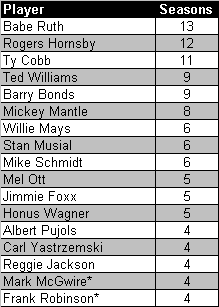
Most Seasons as OPS+ League Leader

*Was the leader in both the American and National Leagues.
Source: Baseball-reference.com

Only seven players with at least 3,000 major league plate appearances can boast an OPS+ higher than Albert Pujols’ career rate of 170, and all of the names ahead of him qualify for the inner circle of baseball’s immortals. On a per season basis, Pujols has led his league in OPS+ on four different occasions (including three straight seasons from 2008 to 2010), an accomplishment bettered by only 12 other players.

Intuitively, most people have regarded Pujols as the best hitter, if not best player, in the game, at least up until last year. Instead of awarding that title subjectively, however, I thought it might be interesting, and fun, to pass the torch using statistics. For this purpose, OPS+ seemed like the best metric to use. Although there are other statistics like wOBA that better measure overall offensive performance, OPS+ still has the advantage of being more well known, easier to compute, and adjusted for ballpark and era. Also, instead of taking one-year snapshots, sustained periods of excellence seemed more appropriate. Is 10 years the right barometer? That can be debated, but if it’s good enough for the Hall of Fame, it’s good enough for me.

“Diamond Kings”: Succession of OPS+ Leaders Over 10-Year Periods

Note: Minimum 5,000 plate appearances for each 10-year period.

Source: Baseball-reference.com

Based on the chart above, Pujols has been a Diamond King for the past four seasons, joining a royal lineage that began with Nap Lajoie and almost exclusively includes undisputable legends. A quick scan of the list reveals all the names you’d expect to be included: Honus Wagner, Ty Cobb, Rogers Hornsby, Babe Ruth, Lou Gehrig, and so on. However, there are some surprises. Bill Nicholson is probably a name not well known even among many diehard fans, but for three 10-year periods, he ranked as the top hitter in the game. Of course, his era of dominance happened to coincide with World War II, which, at the risk of disparaging his accomplishment, probably explains his inclusion. The only other ranking member of the list who isn’t in the Hall of Fame (excluding those not yet eligible) is Dick Allen, who was the top dog for four 10-year periods. Unlike with Nicholson, however, there is no extenuating circumstance. Allen’s career OPS+ of 156 ranks among the 20 best all-time, which makes his Cooperstown snub one of the most unfortunate.

Two other unlikely names who can lay claim to an OPS+ crown also happen to be former Yankees. Although no one would dispute that Wade Boggs and Rickey Henderson were all-time greats, their presence atop a list that disproportionately favors sluggers is somewhat surprising. Nonetheless, it does help to illustrate how complete their offensive games really were. In many ways, Henderson and Boggs are two of the most underrated Hall of Famers, even though most people hold them in very high regard.

Finally, the biggest surprise from the list above is one who is not included: Ted Williams. If the threshold considered had been 4,000 plate appearances, Teddy Ballgame would have been front and center for most of his career. However, because of his two stints as a fighter pilot in the Marine Corps, the Splendid Splinter never qualified. I like to think his exception proves the rule.

Pujols’ status as one of the greatest hitters in baseball history isn’t exactly a secret, but it’s still impressive to consider his body of work within the context of the all-time greats. Entering his age-32 season, the future first ballot Hall of Famer may no longer be in his prime, but if continues to keep the same company he has enjoyed for his entire career, there’s no reason to think his twilight will be a flicker.

Where will Pujols end his career? In St. Louis? How about Chicago? Pinstripes might look nice. Regardless, Prince Albert remains the King, and my bet is he isn’t yet ready to submit to a succession.

Borderline Bernie

Bernie Williams is the best of this year’s crop of players that will be considered for the Hall of Fame. But as Rob Neyer points out, he isn’t good enough:

There’s a case to be made for Bernie Williams. For roughly 15 years, he played center field for an excellent team. He scored 100 runs eight times, and drove in 100 runs five times. Sure, his teammates helped in those areas. But Williams’ .297/.381/.477 line is quite lovely for a center fielder.

The problem for most of the voters will be Williams’ counting stats. Because he didn’t really become an every-day player until he was 24 and was finished at 37, he didn’t pile up a ton of hits or homers or RBIs. And while he does have nearly a full season’s worth of postseason statistics — for which he deserves some credit — he has few memorable October moments and overall his stats are right in line with his regular-season numbers.

That’s why he won’t get much support from the voters.

Should he, though? Based purely on his position and his hitting, I would rate him a borderline candidate. The problem is that his defensive statistics were terrible. Yes, I know he won four Gold Gloves. Derek Jeter won five. These facts say a lot more about the idiocy of the process than about Bernie Williams and Derek Jeter.

According to Baseball-Reference.com, Williams was a slightly below-average center fielder. According to FanGraphs, he was a terrible center fielder. Oddly, though, both sites come up with the same answer about his overall value: 47 or 48 Wins Above Replacement. And that’s just not a Hall of Famer.

Here’s something fun to chew on: Who has the best case of the all the Yankees who have not made the Hall, including Munson and Mattingly? Got to think Bernie ranks near the top of that list.

Life Lessons


If you are looking for a holiday gift for a young Yankee fan, look no further than All You Can Be: Learning and Growing Through Sports, by Curtis Granderson. It’s a trim, glossy, hardcover book, illustrated by students from New York City’s public schools, and it is nicely done. It also includes  some fun pictures of Curtis as a kid.

The artwork is beautiful.

Painting by Logan Hines, 7 years old (Queens)

Detail of picture by Nancy Lin, 5th Grade P.S./IS 49 (Queens)

Here Comes Bobby V

The new manager of the Red Sox. Won’t be dull, that’s for sure.

It Ain’t Over (Even When it’s Done)

From our pal Glenn Stout:

It’s over, but we’ve been through this before, baseball and I, and I’m sure I’ll survive the winter soon to come. I know even as the whoops and hollers of baseball’s newest world champion fade that somewhere in the silence that follows, another season will start to make its sound.

There will be trades, Tommy John surgeries and free agent signings for too much money. Even though there will be snow upon the ground, there will also be talk about pitchers and catchers reporting, aging veterans and rookie phenoms. Something deep inside me will start to stir, and then I’ll hear it again; a voice on a playground, a bat meeting a ball, a cheer and a slap on the back. At first it will be faint and far off, but as the days get longer the sounds of baseball will be back beside me. Soon enough, we will both be ready for another season.

feed Share on Facebook Share on Twitter Share via email
"This ain't football. We do this every day."
--Earl Weaver