
"A New York Treasure" --Village Voice

New York Minute

It was in December of 1999 when I started looking at the clock every day at 11:11. It happened in the morning and at night, at home and at work. Happened three, four days in a row, and then nothing for a day or two and then again for a week: 11:11. It continued into the new year, not every day but sometimes for a couple of weeks at time . And if it wasn’t 11:11 on the nose, it was 11:09 or 11:12.

This went on for months. I didn’t know what to make of it so I just decided to take the moment for myself whenever I saw it was 11:11.

A couple of years later I started dating Emily who eventually became my wife.

Today is her birthday: 11/11/11.

I have my answer.

Color By Numbers: Hip Hip Jorge

Jorge Posada’s Yankees career has come to an end, at least that’s what he seems to think. Considering Brian Cashman has not even reached out to discuss a reduced role with his long-time catcher, chances are Posada’s hunch is probably right. There’s always a possibility, albeit slim, that the Yankees could decide Posada still fits into their plans for 2012, but if this really is the end of his time in pinstripes, we can finally take a look back over his long career and truly appreciate just how much he has meant to the organization.

Average WAR During the Current Yankees’ Dynasty, 1996-2011
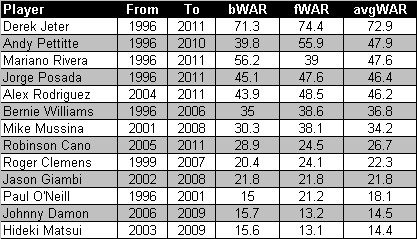
Note: avgWAR = (bWAR + fWAR)/2
Source: baseball-reference.com and fangraphs.com

Since 1996, when the current Yankees’ dynasty was born, only Derek Jeter, Andy Pettitte and Mariano Rivera contributed more to the team than Posada, at least in terms of average WAR. Of course, you really don’t need a sophisticated sabermetric to illustrate how important Posada was to the franchise’s incredible success over the span of his career. He really was a core member of the Yankees. That wasn’t just a clever marketing slogan.

The magnitude of Posada’s contribution to the Yankees is impressive even beyond the context of the era in which he played. Again using average WAR as a barometer, only 10 position players have contributed more to the pinstripes, and, needless to say, the company is rather select. By just about any measure, it isn’t a stretch to say that Jorge Posada is one of the greatest Yankees to ever play the game, and many of the players worthy of that distinction also happen to be in the Hall of Fame.

Yankees Top-15 Position Players, Ranked by Average WAR
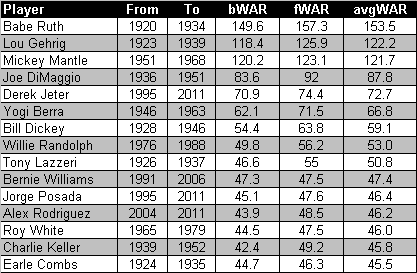
Note: avgWAR = (bWAR + fWAR)/2
Source: baseball-reference.com and fangraphs.com

Although some might dispute the notion of Posada as Cooperstown worthy, his credentials are compelling. Unfortunately for the Yankees’ backstop, his career happened to coincide with arguably the greatest offensive (Mike Piazza) and defensive (Ivan Rodriguez) catchers to ever play the game, so it’s easy to see why he is sometimes overlooked when making Hall-worthy assessments. Despite these formidable contemporaries, however, Posada’s statistical record still stands out.

Comparing Catchers, 1990-2010
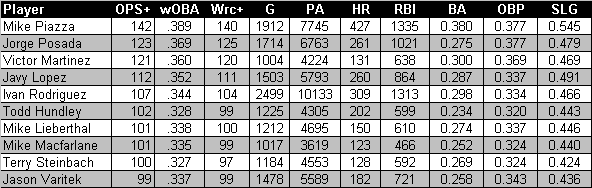

Note: Players with at least 1,000 games, two-thirds of which were as a catcher.
Source: Baseball-reference.com and fangraphs.com

During the 20-year period from 1990 to 2010, Posada’s OPS+ of 123 ranks second only to Piazza’s 142 (among players with at least 1,000 games, two-thirds of which were as a catcher). The same is true for his wRC+ and wOBA. Based on more traditional stats, Posada also distinguished himself during the period, ranking tied for first in on base percentage and third in home runs and RBIs. As a result, Posada won five silver sluggers behind the plate, the fourth highest total amassed at the position. Although some catchers, such as Joe Mauer, have had better rates over a shorter horizon, Posada’s longevity is also a feather in his cap. In the 20-year span under consideration, only four others have started more games behind the plate, which is remarkable considering how slowly the Yankees eased him into the starting role.

Jorge Posada vs. Hall of Fame Catchers and Likely Inductees
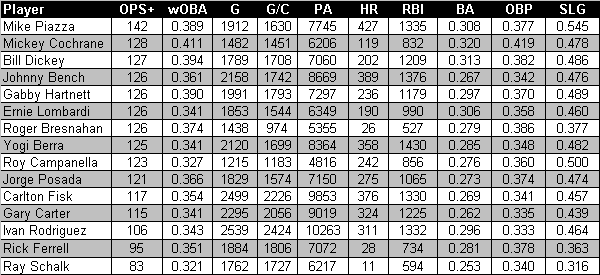
Note: Likely inductees include Mike Piazza and Ivan Rodriguez.
Source: Baseball-reference.com and fangraphs.com

There are currently 12 primary catchers elected to the Hall of Fame, making it the most underrepresented position on the diamond. However, even despite this very select company, Posada’s career totals still figure prominently among catchers already enshrined or almost certain to be. In the chart below, Posada’s relative rankings in several offensive categories are provided. Although a rudimentary analysis, it shows that Posada can stand toe-to-toe as a hitter with every other Hall of Fame backstop but Piazza.

Posada’s Ranking Among Hall of Fame Catchers and Likely Inductees
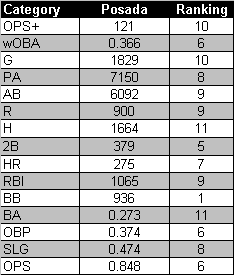
Note: Likely inductees include Mike Piazza and Ivan Rodriguez.
Source: Baseball-reference.com and fangraphs.com

As a hitter, Jorge Posada’s Hall of Fame credentials seem undeniable, so the deciding factor could be his work behind the plate. Defensive metrics are relatively unreliable in general, but for catchers, they are severely limited. For that reason, it’s likely that Hall of Fame voters will rely on reputation. Because of how rapidly his catching skills declined at the end of his career, that might seem like a liability for Posada, but during his prime, the backstop was often regarded as being an above average defender. If that’s the prevailing sentiment when Posada’s name comes finally appears on the ballot, his chances of being enshrined would be greatly bolstered.

“I see vintage Jorge Posada, everything we expect. He’s one of the best catchers in baseball and he has been. He’s an offensive and defensive catcher. This is what I expect, this is what he is and this is what he’s been. This guy is going to go down as one of the famous Yankee catchers, along with Yogi Berra, Bill Dickey, Elston Howard and Thurman Munson.” – Brian Cashman, quoted in the New York Daily News, August 8, 2006

How will Jorge Posada be remembered? Despite often being overlooked on a team chock full of talent, Posada’s contribution to the Yankees’ dynasty is undeniable. He is more than deserving of all the accolades usually bestowed upon a Yankees’ legend. His number 20 should never be worn again, and his plaque for Monument Park should soon be minted, but perhaps the most meaningful honor is the special place he occupies in the memories of an entire generation of Yankees’ fan. They won’t soon forget how great Posada really was. Hopefully, the Hall of Fame voters will remember too.


Beat of the Day

We really shouldn’t go.

[Collage by Matt Wisniewski]

Afternoon Art


Over at The Atlantic, check out this commentary about the difference between comic books and comic book movies from Jonathan Lethem (something I’ve been thinking about with the Tintin movie coming out soon):

The movies insist on transforming a form into another form, and yet the results fall into a hideous void between them. The mystery of the evocativeness of a comic book panel, the stillness-in-action, and the secret silence of the gutter between the two panels, is something that’s just fundamentally inaccessible to film.

The nearest I’ve ever seen to someone really reaching for that was that really aggressive and sort of horrible Frank Miller movie, Sin City. Which was still compelling because they seemed to be aware of the problem, and were trying to seize control of it. But it’s a little bit like, playing rock and roll on a harp or something. Movies are actually a very, very poor fit for the comic aesthetic.

The entrancement of film is that the reading protocols are invisible. You give yourself to a film, ideally, in a gigantic darkened auditorium: and it washes over you. It makes its own reality inevitable. And you don’t have to ever think about your efforts in reading or constructing it. You can’t slow or speed up that experience (I mean, now technically you can, but you don’t want to, you want to succumb). It masters you totally.

The seduction of a comic is secretly the exact opposite. People don’t think about it, but you learn to read a comic book. It’s a very complicated reading protocol. A very active one. It’s like you’re in a damp world and you have to keep striking matches to light it up. You’re constantly working to decide—do I read the words in the panel, do I read the word in the box at the top, do I look at the picture, do I skip ahead and look at where the pictures are going to go later on, do I do it fast, do I do it slow, do I read every word, do I mainly see it? What am I doing here? You’re always deciding how to make the narrative come alive. It’s actually a much more complicated form of reading than reading text! Because you’re making these switches from the visual to the verbal. So one is a completely globally active reading protocol, and the other is this sublime, passive dreamlike surrender. And I don’t think you can ever get from one to the other. They’re almost opposite ends of the aesthetic experience.

Behind the Scenes on Tatooine

I wonder what they used for the Bantha fodder?

I was too young to appreciate Fisher in the gold bikini. Even to this day, that outfit does nothing for me. But this one…

I know this movie sucks in a lot of ways. But when Luke started wreaking havoc on the skiff with that green light saber, I’ve never been more thrilled in a movie theater.

Check out this guy who stumbled on them in Buttercup Valley.


[Photos by Mike Davis]

Taster’s Cherce

An apple a day? For me, it’s more like a carrot a day. If you asked me what my favorite vegetable was I don’t know that I’d say carrots but I eat more carrots than any vegetable, that’s for sure. Go figure.

What’s your go-to veggie?

Over at Saveur, dig these carrot recipes.

Million Dollar Movie

From “The Age of Movies,” here’s P. Kael on History of the World, Part I:

When I saw History, there were hisses and walkouts during this number, and the film has been attacked as a disgrace by reviewers in the press and on TV. I bet nobody hissed or walked out on Candide. When Prince and Bernstein do it, it’s culture; when Brooks does it, there’s a chorus of voices saying, “He has gone too far this time.” Earlier in the film, the dancer Gregory Hines, who makes a breezy film debut as Comicus’ Ethiopian pal, Josephus, tries to convince the slavers who are sending him to the circus to be eaten by lions that he’s not a Christian but a Jew. With his loose-limbed body–his legs seem to be on hinges–he does a mock-Jewish dance, and then a shim-sham, and the racial humor didn’t appear to bother the audience. But during the Inquisition, when nuns toss off their habits, and a giant torture wheel to which pious Jews are attached is spun in a game of chance, there were mutterings of disapproval. Yet it’s Brooks’s audacity–his treating cruelty and pain as a crazy joke, and doing it in a low-comedy context–that gives History the kick that was missing from his last few films. The Inquisition is presented as a paranoid fantasy, with Jews as the only victims, and when Torquemada whacks the knees of gray-bearded old men imprisoned in stocks–using them as a xylophone–you may gasp. But either you get stuck thinking about the “bad taste” or you let yourself laugh at the obscenity in the humor, as you do at Bunuel’s perverse dirty jokes. The offensive material is a springboard to a less sentimental kind of comedy.

If Mel Brooks doesn’t go “too far,” he’s nowhere–he’s mild and mushy. It’s his maniacal, exuberant compulsion to flaunt show-biz Jewishness that makes him an uncontrollable original. At his best, he is to being Jewish what Richard Pryor is to being black: wildly in love with the joke of it, obsessed and inspired by the joke of it. What History needs is more musical numbers with the show-biz surreal satire of the Inquistion section; it’s the kind of satire that makes the Marx Brothers’ Duck Soup a classic farce. Brooks goes wrong when he pulls back to innocuous loveability–when he has Gregory Hines say to him, “You’re the first white man I even considered liking.” (Now, if that had been “the first Jews…”) Hines’ dancing–the movie could have used more of it–deserves better than a suck-up line.

When Brooks has a hot streak on a TV talk show, you can see his mental process at work, and amazing things just pop out of his mouth. He can’t get that rhythm going on the screen with prepared gags. Some movie directors can give their material that surprise. Altman has often done it, and in Hi, Mom! DePalma did it, with a highly inflammatory race-relations subject. But Brooks isn’t a great director–far from it. He’s a great personality though, and he moves wonderfully; his dancing in his Torquemada robes is right up there with Groucho’s lope. Wearing a little mustache and with his lips puckered, Brooks as Louis XVI bears a startling resemblance to Chaplin in his Monsieur Verdoux period. I kept waiting for him to do something with this resemblance, but he didn’t. Was he unaware of it? Lecherous Louis did, however, make me understand why women at the French court wore those panniers that puffed out the sides of their skirts; we see those ballooning bottoms through his eyes. (Brooks may be wasting his talent by not appearing in other directors’ movies while he’s preparing his own.) As a director-star, he has the chance to go on pushing out the boundaries of screen comedy, because, despite the disapproving voices in the press and on TV, he can probably get away with it. Like Pryor, he’s a cutie.

Too bad for us, Mel’s movies never got better, but he sure did score a hit with the play version of The Producers.

New York Minute

Over at Codex 99, check out this cool post about subway tiles.


As Expected…

Last night, Jorge Posada told reporters: “I don’t think there’s even a percentage of a chance that I can come back,” Posada said. “It’s not going to happen.”

Mark Feinsand has the story.

We’ve talked about Posada’s fine Yankee career a lot this year. Tomorrow, William J will weigh-in on Posada’s case for the Hall of Fame.

Afternoon Art

Tintin is coming…

The Adventures of Tintin from James Curran on Vimeo.

Taster’s Cherce

This is my favorite Ginger Ale–the grown up soda. What brand do you prefer?

Beat of the Day

Plus

Equals This:

[Picture Credit: Marrast]

Million Dollar Movie

More P. Kael from “The Age of Movies. ”

From the essay, “Fear of Movies” (September 25, 1978):

In his new book The Films in My Life, Francois Truffaut writes, “I demand that a film express either the joy of making cinema or the agony of making cinema. I am not all interested in anything in between; I am not interested in all those films that do not pulse.” Truffaut’s dictum may exclude films that some of us enjoy. You couldn’t claim that National Lampoon’s Animal House expresses either the joy or the agony of making cinema. It’s like the deliberately dumb college-football comedies of the thirties–the ones with Joan Davis or Martha Ray–only more so; it’s a growly, rambunctious cartoon, and its id anarchy triumphs over the wet-fuse pacing, the botchy lighting, and the many other ineptitudes. In its own half-flubbed way, it has a style. And you don’t go to a film like Animal House for cinema, you go for roughhousing disreputability; it makes you laugh by restoring you to the slobby infant in yourself. (If it were more artistic, it couldn’t do that.)

But that sort of movie is a special case. Essentially, I agree with Truffaut. I can enjoy movies that don’t have that moviemaking fever in them, but it’s enjoyment on a different level, without the special aphrodisia of movies–the kinetic responsiveness, the all-out submission to pleasure. That “pulse” leaves you with all your senses quickened. When you see a movie such as Convoy, which has this vibrancy and yet doesn’t hold together, you still feel clearheaded. But when you’ve seen a series of movies without it, whether proficient soft-core porn like The Deep or klutzburgers like Grease, you feel poleaxed by apathy. If a movie doesn’t “pulse”–if the director isn’t talented, and if he doesn’t become fervently obsessed with the possibilities that subject offers him to explore moviemaking itself–it’s dead and it deadens you. Your heart goes cold. The world is a dishrag. (Isn’t the same thing true for a novel, a piece of music, a painting?)

The pressing against the bounds of the medium doesn’t necessarily result in a good movie (John Boorman’s debauch Exorcist II: The Heretic is proof of that), but it generally results in a live one–a movie there’s some reason to see–and it’s the only way great movies get made…there’s enough visual magic in [Exorcist II] for a dozen good movies; what the picture lacks is judgment–the first casualty of the moviemaking obsession.

…There’s no way I could make the case that Animal House is a better picture than Heaven Can Wait, yet on some sort of emotional-aesthetic level I prefer it. One returns you to the slobbiness of infancy, the other to the security of childhood, and I’d rather stand with the slobs.

I love this.

I Got Nuttin’ But Love

More Heavy D.

And this classic, producer by D’s younger cousin, Pete Rock, a tribute to Trouble T Roy, one of Heavy D’s dancers:

New York Minute

I finished a novel this morning on my subway ride to work. I had to read the last paragraph twice and felt that peculiar almost weightless feeling that comes when you finish a book. I read the last page again and then looked up, disoriented. The car was crowded and two older women stood in front of me. I had noticed them before but didn’t want to break the spell of that last page.

Now that I was done I offered my seat to the shorter woman who looked older. She refused.

“You saying I look old?” she said and then smiled.

“Don’t worry,” I said. “If I see you again I won’t extend the courtesy.”

She liked that and when the person sitting next to me stood up at the next stop, she sat down.

“You know you are damned either way,” she said. “If you offer the seat you can offend someone’s pride, if you don’t offer it, you have no manners.”

“The worst is when you offer it to a woman you think is pregnant,” said her friend, still standing after she refused my offer to sit, too. “Then you find out she’s not.”

I told them that my parents raised me to have manners but for most of my life I performed acts of kindness selfishly, keeping score of how many nice things I’d done.

“Well, it’s karma,” said the standing woman.

“No,” I said, “it was a set-up to feel burned if things didn’t go my way.”

I said that now I do what I do because it makes me feel good not because it means anything else.

“That’s a good philosophy of life,” said the older woman sitting next to me.

I told her that it was a relief. We talked about courtesies and feminism and she said that women can confuse gender and manners. Then she said, “Where are we?”

“Two more stops,” her friend said.

I asked where they were going and the woman sitting next to me said, “Roosevelt Hospital.”

“Oh, for you or to see someone?” I said, regretting it as soon as the words came out of my mouth.

“I’m starting chemo today,” she said.

“Really? You look vital,” I said and regretted that even more.

She said she felt great but worried that her children were so upset.

“I told them that I’m as strong as I’ve felt in a long time,” she said and we talked about feeling helpless. Her kids are helpless to make her better and she is helpless to help them. As she spoke I remembered the review of the new Joan Didion memoir that I’d read last weekend in the New York Times. The book is about how the author handled the death of her daughter, which happened shortly after the death of her husband. John Banville concluded his review with:

The author as she presents herself here, aging and baffled, is defenseless against the pain of loss, not only the loss of loved ones but the loss that is yet to come: the loss, that is, of selfhood. The book will be another huge success, for reasons not mistaken but insufficient. Certainly as a testament of suffering nobly borne, which is what it will be generally taken for, it is exemplary. However, it is most profound, and most provocative, at another level, the level at which the author comes fully to realize, and to face squarely, the dismaying fact that against life’s worst onslaughts nothing avails, not even art; especially not art.

The older woman sitting next to me looked strong and she smiled and told me how much she liked her doctors. When we got to 59th street I leaned over and kissed her cheek and she stood up and the two women pushed through the crowded car. I looked after them and saw the older woman turn back and smile and me. I thought of my wife and how I always look after her when I leave her on the subway. The woman waved and then was gone.

[Photo Credit: Dark Magoo]

A Sad Day Just Got Worse


Some terrible news. TMZ reports that Heavy D died today at the age of 44.

Hard to believe.

Call Me Mista Bent (I’m at where your sister went)

This is for the rap nerds, a long interview with MF Doom.

Lecture: DOOM (Madrid 2011) from Red Bull Music Academy on Vimeo.

Afternoon Art

Picture by Jason Levesque


New York Minute

Check out this photo gallery of Penn Station over at Retronaut.

I found it difficult to look at these pictures without feeling torn up.

Taster’s Cherce

Jacques does tarts on the latest episode of Essential Pepin. Wonderful, and he’s charming with his granddaughter, too.

[Photo Credit: Saveur]

feed Share on Facebook Share on Twitter Share via email
"This ain't football. We do this every day."
--Earl Weaver