
There is an excerpt from Frank Deford’s new memoir in SI this week: “When the NBA Was Young.”
Fun read. For more on Deford, check out this fine podcast with Richard Deitsch.



There is an excerpt from Frank Deford’s new memoir in SI this week: “When the NBA Was Young.”
Fun read. For more on Deford, check out this fine podcast with Richard Deitsch.

One Night Only
By John Schulian
As soon as they heard Levon Helm was coming, the guys in the band began to imagine him sitting in with them, playing the drums, maybe even singing “The Weight.” It was one of the songs they did when they got together on Friday nights, finished with another week’s filming of a TV drama called “Midnight Caller,” just letting the music ease them out of the harness. There was music everywhere on that show, from the old MGM Studios in L.A., where we wrote it, to San Francisco, where we filmed it. You couldn’t go a day without someone turning you on to an album or talking up a concert. Or you’d walk into the executive producer’s office and find him practicing a new lick on his guitar, a pleasure that almost always seemed to come before business. But the executive producer knew he was a better singer than a guitarist — fitting, I suppose, since his name was Bob Singer. He sang lead for the band that came into being when four kindred spirits found each other on the soundstage, and the band bore his name, Bobby and the Bonemasters. All of which meant it was Singer who would have to ask Levon Helm if he was interested in hanging out with a bunch of rock-and-roll dreamers.
Of course Levon’s primary purpose on “Midnight Caller” had nothing to do with music or his history as the soul of the band known as the Band. He was guest starring as an ex-convict who wanted to go back to prison because it was the only place he knew how to exist. The script was my contribution to the proceedings. I had pictured Levon in the role from the day in 1990 that the idea hit me, not because he was a trained actor but because he was one of those naturals who seemed as real as calloused hands when he was on camera. He had been pluperfect as Loretta Lynn’s father in “Coal Miner’s Daughter,” and it was hard to forget his easy grace as he lit Robbie Robertson’s cigarette in “The Last Waltz.” What I didn’t find out until later was how much acting he’d had to do in that documentary about the Band’s final concert at full strength. He was brimming with anger because he thought Robertson was sacrificing everything they had accomplished for his own selfish purposes.

But acting ability ceased to matter as Singer tried to work up his courage to approach Levon on the Bonemasters’ behalf. It was Levon’s earthy, soulful voice that haunted Singer now — the juke-joint joy of “Rag Mama Rag,” the grief and defiance of “The Night They Drove Old Dixie Down.” Levon had plunged into the musical fires of the Sixties with Dylan and emerged playing the most quintessentially American rock ever with the Band. But he was its only American, a cotton farmer’s son from Marvell, Arkansas, surrounded by four Canadians. He drummed, took an occasional turn on the mandolin, and like the Band’s other two singers–Rick Danko and Richard Manuel–made memories with his voice. He had been on stage at Woodstock and the Isle of Wight and on the cover of Time magazine, and now Singer was going to invite him to the Bonemasters’ lair in the lunchroom of the converted San Francisco printing plant where “Midnight Caller” had its soundstages. Somehow that didn’t compute.
To calm himself, Singer concentrated on remembering how gracious Levon had been when they’d met in L.A., a true Southern gentleman with a bushy beard that made him look older than the 50 years he was then approaching. Singer figured that if he got shot down, it would at least be painless. So he took a deep breath, explained about the Bonemasters and offered his invitation.
“Y’all gonna have any beer?” Levon asked.
“Oh, yeah,” Singer said. “We’re gonna have beer.”
“I’ll be there.”
That was, in its way, a historic moment. Other musicians had guest starred on the show, but only Levon said yes to the Bonemasters. When Billy Vera, a rhythm-and-blues stalwart from L.A., turned them down, it was with a contempt that suggested he would rather eat road kill. Hoyt Axton, the country singer whose mother wrote “Heartbreak Hotel,” never got invited because he was too busy living the life that enabled him to open concerts by saying, “Hi, I’m what’s left of Hoyt Axton.” But Roger Daltrey would have been welcomed if the part he played hadn’t cranked up his anxiety level by requiring him to sing a non-Who song. Still, he gave the cast and crew something to remember by loosening his vocal chords with a kick-ass version of “Hey Joe.”
Some of the Bonemasters started thinking their night with Levon Helm would be solid gold when filming wrapped at 8 that Friday, a good three hours earlier than usual. Singer, however, wasn’t one of them. He was worried that Levon would get a load of the lunchroom, with its linoleum floor and pea-green walls, and decide it was too small-time for him. Or maybe he’d get chased off if Jim Behnke, “Midnight Caller’s” unit production manager, went on one of his guitar solos that got lost in space. Or maybe Singer himself would do the chasing if nerves cracked his tobacco-cured baritone.
Levon walked into the room as if he understood that a heavy step might destroy the equilibrium. The Bonemasters were already playing, so he grabbed a beer and one of Singer’s harps, then plugged into an amplifier and settled in a corner. Everything was fine until he started to play along with the band. “I’m not getting any sound,” he said. “The amp’s not working.”
Great, Singer thought. He’s been here 10 minutes and we’ve already proven what rank amateurs we are. He’s going to take off.
But Levon didn’t so much as blink even when he discovered there wasn’t another amp. He just played the guitar Singer wasn’t using, and when it came time to blow harp, he did it into the microphone. It didn’t sound as good as it would have through an amp, but the important thing, the absolutely crucial thing, was that he stayed.
At first the Bonemasters looked to Levon for requests–they were up for anything–but he told them, “You go on and play what you want to play.” So they dove into a repertoire that included songs by the Beatles, the Stones, the Allman Brothers and Lynyrd Skynyrd. As usual they were at their tightest when they did “Honky-Tonk Woman.” “Boys,” Levon said, “I’d keep that one in the set.”
The next thing the Bonemasters knew, he was teaching them some country songs, the kind he’d been listening to since he was six years old and saw Bill Monroe and The Blue Grass Boys at a tent show in Marvell. And when they got back to rock and roll, Gary Cole–the Bonemasters’ drummer, the star of “Midnight Caller,” and the future Mr. Brady in the Brady Bunch movies–asked Levon if he would like to take a turn on the drums. Levon couldn’t resist. He sounded just the way he did on all those albums with the Band, the tasteful fills, the clever way he got behind the beat, everything so tight, so perfect. Cole and Singer stood off to the side and hoped they weren’t gawking.
They were seeing more than a great drummer at work, though. This was Levon’s life in microcosm, a life filled with nights like the one they were living with him, nights that go beyond getting rich, famous, high or laid and exist for the undiluted joy of making music. You could trace them back beyond the Band and Dylan to Levon’s stops with Ronnie Hawkins’ Hawks and the Jungle Bush Beaters, all the way to those stolen hours as a kid listening to Jimmy Reed and Muddy Waters on the radio and imagining himself in their world. And if you follow his trail forward from his session with the Bonemasters, you will find more of the same, as a solo act, with the RCO All-Stars and the reconstituted Band, right up to the midnight rambles he hosted in Woodstock until throat cancer sent him off on his last ramble.
After a life so full musically, it is hard to imagine that Levon remembered sitting in with the Bonemasters, but there are pictures to prove he did. One of “Midnight Caller’s” prop masters came down to the lunchroom and snapped a bunch of them -– Levon surrounded by Singer, Cole, Behnke and Kenny Collins, the assistant director who played such solid bass. When the guys in the band checked out the pictures later, there was no denying that Levon looked like he was enjoying himself. But there shouldn’t have been any doubt as soon as he said his friend Clarence Clemons was in San Francisco and offered to invite him over to play some saxophone, the way he did for Bruce Springsteen. It didn’t happen, though, because one of the guys had kids at home and a babysitter going off duty at midnight, and that’s the way the real world goes around.
So the Bonemasters reveled in what they got with Levon, which was more than they ever expected and remains the first topic of conversation on those rare occasions when they run into each other more than 20 years later. In fact, the only thing Levon wouldn’t do that night was sing one of the Band’s songs, not that Behnke didn’t try to tempt him by playing the intro to “The Weight” at every opportunity. “The Weight” was a Bonemasters staple and it begged to be sung, but Singer, who usually did the honors, felt sheepish about it. After all, the man who put the song over the top for the Band was there with them. Finally, Levon said, “You sing it, Bob.”
There was no backing out–the load was right on Singer. He tucked into “The Weight” with no goal beyond getting to the end of it. It’s a surreal parable about a good deed that consumes its doer, and it’s filled with the kind of characters more often found in Flannery Connor’s novels than a rock-and-roll song. By the time he finished with Crazy Chester, Jack the Dog and all the rest of them, Singer wasn’t sure if he should take a bow or run for the hills. Then he looked over and saw Levon grinning and flashing him a thumbs-up. A fellow could live a long time and not have a finer moment.

[Featured Image by Ahron R. Foster]
In the classic Soundgarden tune “Outshined”, Chris Cornell writes:
I just looked in the mirror
And things aren’t lookin’ so good.
I’m looking California
And feelin’ Minnesota.
That brief stanza may be an apt way to describe Hiroki Kuroda’s start Wednesday night. He was both looking and feeling California in the home opener last Friday against the Los Angeles Angels. In the song, “feeling Minnesota” is a euphemism for feeling terrible. On the field, Kuroda wasn’t feeling Minnesota, Minnesota was feeling Kuroda. Four of the first five Twins to come to the plate in the first inning got hits and scored. By the time Kuroda had thrown 13 pitches, the Yankees were in a 4-0 hole.

Hiroki Kuroda's second Yankee Stadium start was much rougher than his first. (Photo Credit / Getty Images)
The Yankees’ lineup, which was without Alex Rodriguez and Brett Gardner but had Mark Teixeira back, did their best to bail out Kuroda, responding with three runs of their own in the bottom of the first. Trailing 4-3, they loaded the bases with one out and a realistic chance to post a crooked number until Eric Chavez ended the threat by grounding into a double play.
Three different times the Yankees would get to within one run of the Twins, but not once could they tie the game. Three straight innings — the fifth, sixth and seventh — the Yankees put the leadoff man on base and mounted threats, but couldn’t score. After the first inning, the only runs they were able to manage came off solo home runs from Robinson Cano and Derek Jeter.
6-5 final, series finale with Phil Hughes on the mound Thursday. Are you confident?
ROOT FOR THESE GUYS
“He was just up all night,” manager Joe Girardi said. “He didn’t seem to have it from the get-go.”
Despite the poor result, which raised Kuroda’s ERA to an even 5.00 and his WHIP to 1.61, Kuroda remains an integral component to the Yankees’ starting rotation, based on his skill set, veteran presence, and experience. We’ll have about 30 more chances to root for him.
Marquis’ debut was delayed; this story has been well document. He left the Twins with two weeks to go in Spring Training to attend to his daughter, who lacerated her liver in a bicycle accident. Ken Rosenthal does a tremendous job of portraying the details of the story here. As a father of one little girl and another on the way, I applaud what Marquis did. There’s no decision to make.
His daughter had four surgeries and is recovering well. According to reports, a full recovery is expected within three months. How fortunate Jason Marquis was to be home with his family, and STAY home when he joined his new team. As a bonus, his family got to be on the field with him yesterday (nice work by YES taking video and showing that B-roll during the bottom of the first inning).
And he got the win.
Hiroki on the hill at the Stadium tonight after his terrific debut last week.

1. Jeter SS
2. Granderson CF
3. Teixeira 1B
4. Cano 2B
5. Swisher DH
6. Ibanez RF
7. Chavez 3B
8. Martin C
9. Gardner LF
Let’s Go Yank-ees!
[Picture Credit “Waterfall in Summer” by Hiroki Imada (1998)]

Our pal Summe Anne looks at some fresh baseball art. Dig it.
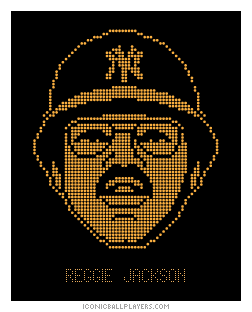
[Featured Image by Summer Anne Burton; Reggie by Peter Chen; Bake McBride by Will Johnson]

It was a hot summer night very long ago, when my career in this racket was brand-new and distinctly alternative. I was in a beneath-the-sidewalk joint in Harvard Square called Jonathan Swift’s, and I was listening to Levon Helm play with the Cate Brothers, who were formidable players in their own right, and old friends of Levon’s from Arkansas. We were all deep into the howl of the evening when it occurred to my friend and I that we were enjoying the show so much that we really ought to buy Levon a beer. So we ordered one up, and the waitress brought it out to the stage and Levon took a long pull, looked down at the two of us, touched his drumstick to his forehead and said, “Thank you, neighbor.”
It was what they were all about, Levon and the rest of The Band, in 1968, when the country was coming apart at the seams. Nothing was holding, least of all Mr. Yeats’s center. There were tanks in Prague and there was blood on a balcony in Memphis, Tennessee. The traditional American values of home and family and neighborhood were being fashioned into cheap weapons to use against the people who saw the death and gore as the deepest kind of betrayal of the ideals that made those values worth a damn in the first place. The music was disparate and fragmented; the Beatles were producing masterpieces that they couldn’t or wouldn’t take on the road. Brian Wilson was long gone, spelunking through the canyons of what was left of his mind. Jim Morrison, that tinpot fraud, was mixing bullshit politics with kindergarten Freudian mumbo-jumbo and his band didn’t even have a damn bass player. Elsewhere, there was torpid, silly psychedelia. The British were sort of holding it together, but, in America, even soul was coming apart. Nothing seemed rooted. Nothing abided. Nothing seemed to come from anything else. The whole country was bleeding from wounds nobody could find.
…He was the true Voice of America, as far as I’m concerned. And, after The Band split up, he kept touring, wrote a hilarious memoir, and then started hosting the Midnight Ramble in his barn in upstate New York. He was as generous with his talent and his time as any artist ever was. There was a message on his website on Tuesday saying that, goddammit, he was in the last stages of a long and brave fight with cancer. I wanted to write all of this before he passed. I wanted to thank him for the way he sang, and for the throb of his drums, and for the way he helped point the way home for all of us who thought we’d lost our country. He brought us back to what was really important: the fugitive grace of a young democracy, that America, for all its flaws and shortcomings, for all its loss of faith in itself and its stubborn self-delusions, was a country that was meant to rock. For that, I return his salute from long ago. Thank you, neighbor. And godspeed.

Photo: AP
Backup catchers should be seen, but not noticed. During the YES broadcast, that’s how former Yankees’ second stringer John Flaherty described the life of a number two backstop. Chris Stewart must not have gotten the memo.
Over the first 10 games of the season, the Yankees have had no problem getting men on base, but driving them in hasn’t been as easy. So, after squandered scoring opportunities in the first two innings by leaving a total of five men on base, it seemed as if it would be another frustrating night in the Bronx. However, all that changed in the bottom of the third.
After falling behind 3-1 in the top half of the inning (which also featured the ejection of Twins center fielder Denard Span and manager Ron Gardenhire), the Yankees quickly mounted another rally, but this time they would not be turned away. The unlikely hero in the inning was Stewart, who, in only his fifth at bat of the season, gave the Yankees a 4-3 lead with a bases loaded single that knocked Twins’ starter Francisco Liriano from the game. In total, the team scored four runs in the inning and then never looked back.
Once staked to a lead, CC Sabathia took his game to another level. In each of the next three innings, the big lefty retired the Twins in order and at one point set down 13 consecutive Minnesota batters. Meanwhile, the Yankees continued to tack on runs, including two more RBIs from Derek Jeter, a homerun by Andruw Jones, and a final tally by Stewart, who ended the game with a career-high 3 RBIs. The outburst was more than enough for Sabathia, who departed with one in the eighth having given the Yankees only their third quality start of the season.
Although Stewart was the focal point of the offense, just about every hitter had a good night. However, there was one exception. Alex Rodriguez was not only the sole member of the lineup without a base hit, but his failure to drive in a run extended a peculiar streak that has seen the Bronx Bombers go 11 straight games without an RBI from the cleanup slot, the fifth longest such stretch in baseball history. For most teams, such a prolonged period of futility from the cleanup slot would debilitating, but the Yankees’ have managed to win six of their first 11 games without a contribution from the four-hole. Of course, that really shouldn’t be surprising. What else would you expect from a lineup that has a backup catcher capable of driving in three runs in one game?
C.C. looks to pitch better tonight.

1. Jeter SS
2. Swisher DH
3. Cano 2B
4. Rodriguez 3B
5. Teixeira 1B
6. Granderson CF
7. Jones RF
8. Gardner LF
9. Stewart C
Let’s Go Yank-ees!
[Photo Credit: Jim McIsaac/Getty Images]

From April 27 through May 27 the Museum of the Moving Image in Queens has exhibition celebrating the work of Ernie Kovacs and Edie Adams.
Oh, baby. This should be sweet.

Over at ESPN, Anna McDonald has a piece on Russell Martin and the art of framing pitches.
Here’s more over at Hardball Talk.
[Photo Credit: Ron Vesely]

Last year Esquire reprinted this terrific 1984 profile of William Donald Schaefer by Richard Ben Cramer.
It’s well worth your time.

Oh yeah? Well, at least your wife didn’t hijack the TV to watch Dancing with the Stars leaving you to follow this horseshit of a ball game–Curtis Granderson’s fine running catch and a couple of first inning pops (Jeter, Grandy) notwithstanding–on your phone and your laptop.

Ah, whadda ya gunna do? They’ll get ’em tomorrow night.
[Image by Ron English; Photo Credit: Al Bello/Getty Images]

It’s Fab Five Freddy vs. Carl Pavano as the Yanks and Twins begin a four-game series at the Stadium.
1. Derek Jeter SS
2. Curtis Granderson CF
3. Alex Rodriguez 3B
4. Robinson Cano 2B
5. Mark Teixeira 1B
6. Nick Swisher RF
7. Raul Ibanez DH
8. Russell Martin C
9. Brett Gardner LF
Never mind the creamy filling: Let’s Go Yank-ees!
[Photo Credit: Getty Images]

At times the photographers at Topps have depicted a player just about right. Roy White’s 1972 Topps card is a good example of that; we see White practicing his in-game batting stance, holding his hands much lower than most players do, toward his back hip. All that’s missing is the inclusion of White’s feet. With a larger photograph, Topps would have been able to show his pigeon-toed posture, another classic feature of White’s unique batting stance.
White’s card also gives us a good look at the Yankees’ old-school road uniforms, which they used through the 1972 season. They’re you’re basic road gray, with no piping or striping around the sleeve. I’ve always preferred this most simplistic of road uniforms, partly because it’s iconic and partly because it brings back memories of the Mantle/Maris Yankees of the early 1960s.
All in all, this is a quality card for a quality player. In recalling the Yankees of the early 1970s, fans of that era glorified three players: star catcher Thurman Munson, All-Star outfielder Bobby Murcer and the team’s pitching ace, Mel Stottlemyre. Roy White was rarely held in similarly high regard by either the fans or the media. He was generally considered a good, solid player, but not a star, with the one flaw in his game (a poor throwing arm) sometimes becoming the subject of contempt, ridicule, and cruel humor.
The perception of White has changed–and changed drastically–since then. Largely due to Sabermetrics, both Yankee fans and non-Yankee fans have changed their tune with towards White‘s abilities. Or in some cases, it’s simply a matter of a younger generation of fans having a better understanding of players’ quality than we did in the sixties and seventies. White’s ability to draw walks, which was rarely highlighted in the early seventies, has now been given its full due; we better understand and appreciate White’s ability to reach base, and the important role it played in setting the table for other Yankee hitters. And then there is the matter of White’s defense. He was truly an excellent defensive left fielder, with enough speed and range to have played center, if not for Murcer’s presence there through the middle of the 1974 season. Yes, the throwing arm would have been a problem, but probably not anymore so than the weak arms of Mickey Rivers or a late-career Bernie Williams.
Some might argue that the tendency to underrate White in his day was also a product of racism. I have my doubts that was the case. Elston Howard, the Yankees’ first African American player, was popular with fans and held in high regard by almost all of the New York media. Chris Chambliss, Willie Randolph, and Mickey Rivers were all popular Yankees. And fans were just about as supportive as they could be of the controversial Reggie Jackson. When Reggie produced, the fans howled their approval with booming chants of “REG-GIE,REG-GIE” resonating though the upper decks of the old Yankee Stadium. Now Billy Martin might have been a different story; some of his dislike for Reggie might have been rooted in racism, but I don’t know for sure. But I just don’t see much evidence for racial antipathy, not from Martin or anyone else, toward a quiet and hard-working player like Roy White.
By 1972, the switch-hitting White had established himself as a very good player. Though underrated, he had already made two All-Star teams and had earned some MVP votes in three different seasons. He was coming off a season in which he had led the American League in sacrifice flies, an unglamorous statistic to say the least, but one that showed his team-oriented nature.
In 1972, White’s power production fell off, as his OPS dipped from .857 to .760, his worst mark as the Yankees’ regular left fielder. Still, he managed to make some favorable contributions like lead the American League with 99 walks and steal 23 bases in 30 attempts, all while playing his usually sterling defense in the outfield. The following two seasons, he struggled, leading some to question whether he was on the downhill side at age 30. In the midst of the 1974 season, manager Bill Virdon made him a DH part of the time, a role that White abhorred, considering it an insult to his athletic talents.
In 1975, White’s career received a revival when the Yankees made a managerial switch, firing the placid, detached Virdon, and replacing him with Martin, who appreciated players of all-round ability like the speedy White. Martin put White back in left field and restored him to the No. 2 spot in the batting order. White bounced back beautifully, playing for White the way that he had once played for Ralph Houk. In 1976, White led the American League with 104 runs scored and reached a career high with 31 stolen bases, becoming a huge part of the first Yankee team to reach the postseason since the ill-fated World Series of 1964.
In the meantime, White became known as a beacon of calm and kindness in a clubhouse that often swirled in turmoil. As Sparky Lyle wrote in his critically acclaimed book, The Bronx Zoo, everybody on the Yankees liked White. “Roy White is probably the nicest goddam guy on the club,” Lyle wrote in his blunt-force style. “He’s well respected by everybody, and he’s very classy.” Classy. The perfect word to describe the gentlemanly Roy White.
By 1978, the year that Lyle’s book hit the shelves, White’s on-field ability had slowed to the point of becoming a part-time player. No longer the everyday left fielder, he platooned with Lou Piniella and also made 23 appearances as a designated hitter, a role that he was now better equipped to handle. With the Yankees having extreme depth in the outfield, they could afford to use White more sparingly, a role into which he fit perfectly. Still able to reach base 35 per cent of the time, White became part of a squadron of role players that supported the Yankees’ stars during their second consecutive world championship run. He played some of his best ball of the season in the playoffs and World Series, hitting over .300 against both the Royals and Dodgers.
Then came the falloff of 1979. Spring training started poorly, as the Yankees refused to offer him an extension on a contract that had just one year remaining. The lack of an extension might have contributed to White’s nightmarish season. Appearing in only 81 games, White played poorly, his power and speed showing the decline that often comes with having a 35-year-old body. Free agency could not have come at a worse possible time. White wanted to keep playing, but the Yankees, looking to rebuild with youth after a season of tragedy and tumult, showed little interest. White received some offers from other teams, but he opted for a completely different career move. He took his aging talents to the Tokyo Giants of the Japanese Leagues, where he became a teammate of Sadaharu Oh.
Batting as the cleanup man behind Oh, White played very well in his first two seasons in Japan. He made the All-Star team one season and helped the Giants to the Japanese Leagues championship the next. In his third year with Tokyo, White found himself playing a utility role, but he fought his way back into the lineup and hit .330 the rest of the way. At season’s end, White decided to call it quits, leaving the game on a high note.
Since his playing days, White has returned to the Yankee organization several times, serving as the first base coach on three occasions and also putting in some time as an assistant to the general manager. In that latter role, he scouted Hideki Matsui during his time in Japan, giving the Yankees his first-hand assessment of a Far East player that they would eventually sign.
Unfortunately, every one of White’s coaching and front office assignments with the Yankees has ended with him being ousted, often with no reason given. I don’t know why that is. He seems like the kind of guy who should have a permanent place in the organization, whether as a scout or as a consultant. It’s almost as if the Yankee organization still doesn’t have a full appreciation for him, just as most of us fans failed to respect him at the time for the player that he truly was.
And that’s just not right. Roy White belongs with the Yankees. If he wants to work for them, the Yankees should be able to find a place.
[Featured Image via Corbis]

The New Yorker has opened the archives for these pieces on LBJ by Robert Caro.
Dig in.
[Photo Credit: George Tames/The New York Times via The Lively Morgue]

The Sox won three straight over the Rays this past weekend but where there is Bobby there is mishegoss.

Our Man from Brooklyn by Summer Anne.
It was only the bottom of the fourth inning and the Yankees were feeling good about themselves. Alex Rodriguez and Robinson Cano and Mark Teixeira helped the team out to a 5-1 lead. Hisanori Takahashi, the long man in the Angels bullpen–a junkballing nibbler–walked Russell Martin to start the inning and then Brett Gardner fouled off a bunch of pitches before hitting a single to center field. Derek Jeter took the first three pitches, all balls. Then he snuck a look over at someone in the Yankee dugout.

I figured the look, the hint of a smile, meant he was going to swing, 3-0 if he got a meatball. Sure enough Takahashi laid one right down the middle. Jeter took a huge swing and almost came out of his shoes. It was a swing to make Reggie proud. The ball was fouled back. Jeter fouled off the next pitch too. Then he smacked one over the fence in right field for a three-run homer.
Ivan Nova gave two back in the fifth and another run in the sixth. Could have been more trouble in the sixth but Rodriguez made a nice play to end the inning.

But because this is Sunday Night Baseball things are not meant to be brief or easy. So Rafael Soriano walked the lead-off hitter in the seventh and that man came around to score on a base hit by Albert Pujols. Soriano recorded two outs but left the game with the bases loaded, the Yanks lead cut to 8-5. Fortunately, our nerves were settled when David Robertson got Mark Trumbo to fly out to right field on a 2-2 pitch.
(My mind was calculating: does this set up Mariano vs. Albert?)
A walk and stolen base by Robbie Cano and then a two-out single by Nick Swisher put the Yanks back up by four. Better still, Jason Isringhausen came in and gave up an absolute bomb to Raul Ibanez.

Fuggin thing reached the upper deck in right field.
All Tori Hunter could say was: “Wow.”


Mariano vs. Albert would have to wait. Tonight, it was Logan vs. Albert and Logan struck him out, go figure that.
Final Score: Yanks 11, Angels 5.
A nice way to start the week.