
Ibanez, Damon, or Godzilla? The latest gossip is rounded up by D.J. Short over at Hardball Talk. Ya smell me?



Ibanez, Damon, or Godzilla? The latest gossip is rounded up by D.J. Short over at Hardball Talk. Ya smell me?

The Yankees have won 27 World Series titles, 24 of those teams have featured good hitting catchers. The Yankees have qualified for the postseason 51 times, or would have if not for the season-ending strike of 1994, and 44 of those teams have featured good hitting catchers. (Forgive me, I used OPS+, which I know measures nothing, but is right there on the main stat line of baseball-reference.com’s team pages and tempts the weak.)
When the Yankees have not merely good, but great hitting catchers they really cash in. Yankee teams with starting catchers (again, by baseball-reference’s definition) sporting an OPS+ of 130 or higher won an average of 99.3 games (prorated for a 162 game season where necessary). When their catcher was between 110-129, they won 96.8 games. The average hitting catchers (90-109) played for teams that won 89.9 games and when the catchers could not hit at all, they won 84 games per season.
By no means is this to say that these players are solely responsible for the successes and failures. But I do think their presence on the roster makes a significant contribution. There are other ways to win for sure, but if it ain’t broke…
Typical offensive output behind the plate is so anemic that when a catcher carries a big stick, it’s an obvious advantage. Factoring in the financial clout of a team like the Yankees, the team does not have to skimp on the rest of the lineup to accomodate a star catcher, cements the gain. The Yankees built dynasty after dynasty on the backs of good hitting catchers.
Dickey, Berra, Howard, Munson and Posada all spring easily to mind. But important platoon guys filled in the cracks. Aaron Robinson helped usher in the Yogi-era; Pat Collins backstopped the legendary late twenties teams. Before them, Wally Schang contrbuted mightily to the first World Series teams by getting on base at a .403 clip from 1921-1923. And as Bruce Markusen pointed out the other day, Mike Stanley helped slug the Yankees out of the misery of the early 90s.
Joe Girardi is the worst hitting catcher on a championship Yankee squad. Most, including me, would forgive him his 75 OPS+ as a Yankee for his triple off Greg Maddux and his graceful yielding of his position to Jorge Posada in 1998.
Now that same light hitting catcher is at the helm as the Yankees try to create their next dynasty. The trade of Jesus Montero means that there is nary a hitting catcher in sight (depending on your squinting abilities). Or if you prefer, the trade of Jesus Montero is probably an admission by the Yankees that he could not be a hitting catcher. Regardless, if the Yankees successfully build a dynasty without one, it’ll be the first time.
But as Yoda might have said, there is another Montero.
Miguel Montero is a good hitting catcher from Arizona who might become a free agent next year. And he can catch it, too. If he does become available, the Yankees could be in the market. Over at RAB, Mike Axisa takes a look at what it might take to get him.
Under normal operating conditions the Yanks would rather have Michael Pineda and Miguel Montero at catcher over Jesus Montero as a non-catcher. But these are not normal times. If the $189 million ceiling for the 2014 team is made of bricks, then signing Miguel Montero to a market-rate deal next offseason makes everything else they have to do that much harder.
Where the Yankees go from here is anybody’s guess. Their minor leagues contain promising catchers, though the hitters are far away from the show. For a team whose championship DNA is riddled with catcher code, if they aspire to another dynasty, I hope a catcher is coming soon and he’ll be bringing a big bat.
Spotted in midtown. The Score Truck? The Yankee Score Truck? Nah, but close enough.

Never mind the offense and head on over to the Pinstriped Bible and check out this post by Rebecca Glass on the Yankees’ pitching.
Another cold winter night in the city.

Sox looking to add pitching. Maybe the Yanks move a pitcher before Opening Day. Prince Fielder’s deal: pro and con.
Have at it.

The Pineda-Montero deal is official. Chad Jennings has the details.
Here’s a nice piece on Pineda by Christian Red in the Daily News.
[Photo Credit: Appleplusskeleton]

Coming close to the dead of winter. Not much doing for the Yanks as they wait to finalize the Pineda-Montero trade. Here’s a throwaway piece by Alvaro Morales at ESPN featuring Alex Rodriguez. Over at River Ave Blues, Ben Kabak makes a brief (and flimsy) case for Johnny Damon. And at It’s About the Money, Stupid, Chip Buck has an informative Q&A with Jim Callis of Baseball America.
Otherwise, it’s cool and quiet round here. Snow coming tonight.


Whenever a team makes a trade involving a young prospect, there’s always a fear he’ll wind up becoming a superstar. Considering the potential of Jesus Montero, that concern had to be foremost on Brian Cashman’s mind as he agreed to send the young hitter to the Seattle Mariners in exchange for Michael Pineda, a very promising prospect in his own right.
Years ago, before the information age, prospects seemed to magically appear on the doorstep of the major leagues. Nowadays, however, fans have the ability to track a player’s progress from the moment he is drafted until he takes his first pro at bat, so it’s easy to understand why many develop an attachment to homegrown prospects. And yet, in most cases, the pent-up anticipation usually leads to disappointment.
Since 1901, 379 position players (includes actives) have made their major debut in pinstripes, but only 52 ended their careers with a WAR higher than 15. Of that subtotal, all but 13 either spent most of their careers with the Yankees or were traded after establishing themselves in the big leagues, including 20 of the top 21 on the list. So, for the most part, the Yankees have been pretty good at not giving away their best position player prospects.
The Ones That Got Away
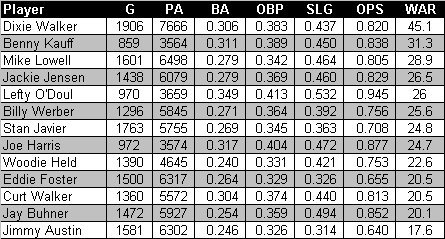
Note: Includes players with a WAR greater than 15 who were traded by the Yankees early in their careers.
Source: Baseball-reference.com
The only discarded Yankee whose career WAR would rank among the franchise’s best homegrown talents is Dixie Walker. After compiling only 422 plate appearances in five seasons with the Yankees, the 25-year old Walker finally blossomed after being sold to the White Sox for $12,000 in 1936. At the time, the Yankees were a powerhouse team about to embark on a four-year championship run, so there was little room for Walker. However, the move still proved to be short sighted, but not until two other teams also passed him over. Once Walker landed in Brooklyn, his career finally took off. In nine seasons as a Dodger, the outfielder compiled an OPS+ of 128 and received MVP votes in seven years. Admittedly, most of Walker’s success came during the war years, but that makes his loss even more regrettable from the Yankees’ standpoint. Had the team not traded him so many years earlier, perhaps Walker’s presence in the lineup would have helped the Bronx Bombers weather the loss of so many others to military service and avoid what for the Yankees was a long World Series drought from 1944 to 1946.
Mike Lowell’s ranking on the list is perhaps the most relevant in light of recent news because, like Montero, he was traded as part of a prospect swap. At the time, the Yankees had a stacked offensive team and decided to make a new three-year commitment to 3B Scott Brosius, which made Lowell expendable. Unfortunately, Ed Yarnall, the pitcher the Yankees received in return, didn’t exactly pan out. After only 20 innings in the Bronx, the lefty was traded to the Cincinnati Reds before departing forJapan. Needless to say, Cashman is hoping Michael Pineda does a lot better.
Like Lowell, Jackie Jensen is another discarded Yankee who eventually made his bones in Boston. In 1951, Jensen had a very strong campaign in limited duty, which he parlayed into being named Joe DiMaggio’s replacement the following year. Unfortunately for Jenson, that honor was short lived. In fact, it only lasted seven games. After hitting .105 during the first week of 1952, Jensen was traded to the Senators for Irv Noren. In the aftermath of the deal, Casey Stengel admitted that Jensen had talent, but stressed the Yankees’ need for a centerfielder who could “hit, run, field, and throw”. Of course, the irony was the Yankees already had someone on the roster who fit the description. His name was Mickey Mantle.
“We need a centerfielder who can hit, run, field and throw. I tried to give Jensen the job, but he couldn’t hit for me. I couldn’t wait any longer.” – Casey Stengel, quoted by the New York Times, May 4, 1952
Less than a month after the trade was made, Mantle was installed as the new center fielder and Noren was reduced to playing a utility role. Meanwhile, Jensen started to find his swing with the Senators, leading AP to suggest that the Yankees “pulled a whopper” by making a rare bad trade. Despite two solid seasons in Washington, Jensen really made his mark with the Red Sox. In seven seasons with Boston, the outfielder compiled an OPS+ of 123 and punctuated his career with an MVP in 1958.
Although his name appears at the bottom of the list, Jay Buhner probably stand outs to most fans as the best example of the Yankees trading away a promising young hitter. Seinfeld is largely to thank for that, but Buhner’s OPS+ of 125 with the Mariners wasn’t a work of fiction. Adding insult to injury, Buhner also tormented his former team on the field, batting .283/.379/.548 in over 400 regular season plate appearances to go along with a line of .366/.422/.537 in three post season series.
Top-10 OPS+ by Yankees in Their Debut Season
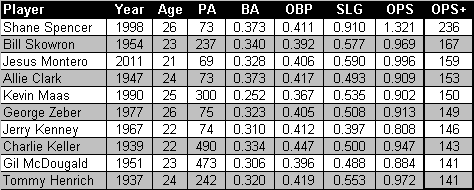
Note: Based on a minimum of 50 plate appearances.
Source: Baseball-reference.com
Albeit in only 69 plate appearances, Jesus Montero had the third highest OPS+ among all position players who debuted with the Yankees. That might seem like a bad omen, but he is surrounded on that list by more than a few players whose careers proved to be disappointments. Will Jesus Montero also follow that path, or join (and perhaps top) the list of young players who excelled after being trading by the Yankees? I wonder what Larry David thinks?
I can’t relate to pitchers. I had to take the ball from the second grade up through freshman year of high school and I hated it most of the time. I could hit, though, until it was too dark out to see the ball. If my dad’s arm didn’t get tired, we might still be out there.

On a basic level, hitting is reaction and pitching is initiation. I’ve always had trouble getting started. I’d rather get a feel for something first and join in progress. And the precision required to throw it exactly where you intend every time? Screw that, let me just hit the ball as hard as I can and we’ll see what happens.
Maybe this prejudice influences the way I envision a baseball roster. The lineup is the body, the pitching staff is the wardrobe. The appearance of the team changes game to game based on the pitcher, but the core is the same. The ace is your best suit, your best reliever could be your smoking jacket. (I guess A.J. Burnett is your kid’s urine-soaked PJs)
So when I heard Jesus Montero was traded for Michael Pineda, I felt like we were trading a neck for a necktie. Sure, the tie is important, but without the neck, what’s the point?
Even without the catching, I’ll take Montero’s simple, solid bat over the complex musculature of Pineda’s throwing arm. You can watch Montero hit every game, all season long. There’s no better way to interface with a team than through a star hitter, especially for a young fan, because he’s always in the lineup.

I understand that having Pineda in the rotation probably makes the 2012 Yankees a better team than they would have been with Montero as the DH. But in 2013? And 2014?
Arod and Teixeira are already fractions of what they once were and they will be declining in the lineup for years to come. The Yankees have one big hitter in his prime, Cano, who is fierce but not flawless. You don’t have to squint too hard to see a Yankee team desperate for hitting.
The more I think about the trade, the more comfortable I am with Cashman’s logic and his vision. But I am firmly on the Montero side of the debate. It boils down to this: if they both become stars, I’d want Montero to be a Yankee.

Who will DH? Joe Pawlikowski, Howard Megdal and Craig Calcaterra have some thoughts.

Here’s Jonah Keri’s reaction to the Pineda-Montero trade:
When breaking down a player’s value, it’s easy to fixate on his weaknesses. Pineda’s got some question marks, but two of the main criticisms levied against him — that he was a lousy pitcher away from Safeco Field and that he faded badly down the stretch last season — don’t hold water. Dave Cameron broke down both those criticisms, noting that Pineda’s core skills stayed strikingly consistent, and that luck and regression toward the mean played far bigger roles in his fluctuating stats.
Within that post, Cameron explained that despite its enormous reputation as a pitcher-friendly stadium, Safeco doesn’t play as an extreme park in right field, only left-center. That part is true: Safeco dinged homers by lefty hitters at a relatively modest 5 percent rate. Problem is, Yankee Stadium’s ludicrously short porch in right helped inflate homers at that park a massive 43 percent. That’s not to say that no right-handed pitcher can possibly survive in that park. Some chap named Mariano Rivera’s been pretty OK there so far. Like Rivera, Pineda offers a pitch that’s highly effective against left-handed hitters, a slider that at its best bites down and in. It’s just a one-year sample size, but Pineda held lefties to just .237/.296/.357 in 2011. Still, there’s a seed of doubt here. Pineda posted the seventh-lowest ground-ball rate among all qualified starting pitchers last year. You can try to apply a simple park adjustment to a fly-ball pitcher moving from a homer-suppressing stadium to a nightmarish launching pad, but it’s unlikely that Pineda’s move to Yankee Stadium will be that easy to predict. He might see one too many elevated fastballs scrape over the wall, panic, change his approach, and fall apart. Or maybe he’ll become a Yankee in the Paul O’Neill mode, embracing his new digs and playing above his already considerable talent.
• That’s what makes this trade so fascinating. Though it’s not a swap of players at the same position, it still resembles what you’d call a challenge trade. Before this offseason, you’d have to dig deep to find examples of high-impact young players traded for each other; deals tend more often to involve one veteran for a bunch of prospects, or pretty much any other combination that’s not two wildly hyped 22-year-olds changing teams. One of the biggest (and only) ones that immediately jump to mind was 2007’s swap of Delmon Young for Matt Garza — and even that’s cheating, since Jason Bartlett was also a key part of that trade. There’s also Josh Hamilton for Edinson Volquez, but for whatever reason, this type of trade has suddenly become all the rage. There were other players involved, but Mat Latos for Yonder Alonso fits the profile. So too does Anthony Rizzo for Andrew Cashner. If two teams laying it on the line by trading young, potential impact players is about to become a trend, I’m all for it.
[Photo Credit: Martinico37]

It is remarkable how news is delivered and digested in the Twitter Era. It comes at us in a flurry–rumors, confirmations, reactions, analysis. There is little time for reflection and an overload of hyperactive reaction.

Last night, the trade of Jesus Montero to the Mariners for Michael Pineda, prompted conflicting feelings for Yankee fans. Many are disappointed to see Montero leave. Here is a player that was nurtured by the organization–even though they dangled him a year-and-a-half ago to Seattle for Cliff Lee–a guy who looked more than promising when he arrived in the Bronx late last year. Montero was hyped, of course, this being New York, but he was also a player that many of us felt would be a pleasure to watch in pinstripes for the next decade. And now that is gone–whoosh.

Montero is being replaced by the another promising player, a young pitcher with a great fastball and an effective silder, but Pineda is not our guy. We’ve got no attachment to him yet. He’s just a face, a stat line. He’s not The Jesus.

The arguments run both ways–hitters aren’t as risky as pitchers, a starting pitcher is more valuable than a DH, a great hitter catcher is even more important than a good starting pitcher–and they are all valid. Yankee fans are experiencing duel emotions but there is room to mourn the loss of Montero and to be eager about the addition of Pineda. The risk involved in trading something as precious as Montero and Pineda makes this all the more unsettling. So we’re anxious, and that’s what makes this exciting and gives us baseball nerds something to keep our engines going in the middle of winter.

Here are reactions around the web from: David Waldstein (The Times); Cliff Corcoran (SI); Paul Swydan (Fangraphs); Steven Goldman (Pinstriped Bible); William J (The Captain’s Blog); can’t forget No Maas, and over at It’s about the Money Stupid, check out this fine collection of links from around the web.
Finally, here’s Dave Cameron with a scouting report on Pineda over at Fangraphs:
Among qualified AL starting pitchers last year, only Brandon Morrow and Justin Verlander posted a higher strikeout rate than Pineda, who whiffed 24.9% of the batters he faced. His K% was better than David Price, CC Sabathia, and yes, even Felix. Pineda’s live fastball and willingness to live up in the strike zone led to a lot of swinging strikes, and that had nothing to do with the park he played in.
Lots of young pitchers can throw hard and rack up strikeouts, however. What sets Pineda apart is his impeccable command at such a young age. 66 percent of the pitches he threw last year were strikes, and his 7.9% BB% was below the league average. It is highly uncommon to see a kid with that kind of live arm arrive in the Major Leagues pounding the zone, but that’s exactly what Pineda did. 94-97 MPH fastballs to get ahead, and then an out-pitch slider or a fastball out of the zone with two strikes to get the K. It was a recipe for success, and Pineda used his command of those two pitches to establish himself as one of the game’s best young starting pitchers.
So, while he’s not perfect (his change-up is lousy and left-handers can still jump on him from time to time), Yankees fans should be thrilled with their new addition. And, given the price that other young arms have been fetching this winter, they should be even more thrilled with the cost.
Pineda is the third quality young arm to get traded this winter, following the trades that shipped Gio Gonzalez to Washington and Mat Latos to Cincinnati. Given that both pitchers come with one fewer year of team control and lack Pineda’s dominating fastball, a strong case could be made that the Yankees new starter is the most valuable asset of the three guys that were moved. However, compared to the other two packages surrendered, the Yankees didn’t really pay much of a premium to get Pineda, and one could even make an argument that they gave up less value overall than what the Reds surrendered to get Latos.

[Photo Credits: Danytumblog, Phillipe Reichert, Attimi Rubati x2,electric feeling, Studio Museum in Harlem]

Dag, I leave the Internet for a few hours, and the Yanks spring into action. Word has it that they’ve shipped out The Jesus and Hector Noesi to the Mariners for Michael Pineda and another young pitcher named Jose Campos. In another move, they will sign Hiroki Kuroda to a one-year contract pending a physical.
Didn’t figure the Yanks would stay on the low forever. They move Montero for another promising young talent in Pineda. I’m not expert but seems like a win-win sort of deal. As much as I would have liked to see Montero, I’m thrilled that the Yanks are getting a gifted young starter in Pineda. And I know they’ve coveted Kuroda since last season.
Wonder if they’d go nutzo and make a play for Prince to DH. Doubt it, but hey, let’s have some fun. And what about the starting staff? Phil Hughes and AJ Burnett? What’ll happen? After a quiet winter, put another log on the fire and let’s have at it.
[Photo Credit: Super Ninteno Sega Genesis]

Hiroyuki Nakajima? Pass.

Over in the New York Times, Tyler Kepner explains the Yankees’ approach this off-season:
It turns out the Yankees are not obliged to sign a player just because he happens to be a free agent who would fill a need. They won 97 games last season, the most in the league, before their first-round playoff loss. They can give it another try with these players and go back on the market next winter, when the free-agent starters should be much more appealing.
Cole Hamels and Matt Cain, All-Stars younger than 30 with strong postseason pedigrees, are unsigned past this season. Either would make more sense for the Yankees, in the long term, than [C.J.] Wilson or the other top starters on this winter’s market.
…What they are doing is planning ahead, a strategy that fits Hal Steinbrenner much better than it ever did his impatient father, George. Incentives in the new collective bargaining agreement would essentially reward the Yankees for reducing their payroll to $189 million by 2014. By then, Burnett, Mariano Rivera, Rafael Soriano and Nick Swisher will be off the payroll, which has exceeded $200 million in each of the last four years.
At the moment, the Yankees owe just over $80 million to Sabathia, Alex Rodriguez, Mark Teixeira and Derek Jeter for 2014. That leaves a lot of room for marquee talent, some of which is already in pinstripes.
This is all so sensible, though it feels odd on some level, a George-less Yankee team, one that exercises caution. Part of me is waiting for someone there to stop making sense–another Soriano maybe? In the meantime, they are being very Dude-like about it. Go figure.

Chad Jennings is back in action over at the Lo-Hud and he’s got a report on the winter leagues. Check it out.
[Painting via Thaw Malinin]

According to Jon Heyman (via Hardball Talk), the Yanks have signed Andruw Jones to a one-year deal.
What could the 2014 Yankees get for $189,000,000.00?

C: Jesus Montero, $0.5 (24)
1B: Mark Teixeira, $23.2 (34)
2B: Robinson Cano, $23 (31)
3B: Ryan Zimmerman, $23 (29)
SS: Derek Jeter $8 (40)
LF: Yoenis Cespedes $7.5 (28)
CF: Brett Gardner $9 (30)
RF: Mason Williams $0.5 (22)
DH: Alex Rodriguez $26 (38)
$120.7
Free agents required: 3 – Cespedes, Cano, Zimmerman, $53.5 million
Leaps of faith required: 2 – Jesus Montero is a catcher, Mason Williams, or someone else currently in the system is a Major Leaguer
Other concerns: Derek Jeter at SS at 40, but if he chooses to play, I don’t know how that can be avoided
BUC: Austin Romine $0.5 (25)
MIF: Eduardo Nunez $2 (27)
OF: Slade Heathcott $0.5 (23)
UTIL: Corban Joseph $0.5 (25)
$3.5
SP: CC Sabathia $24.3 (33)
SP: Cole Hamels $23 (30)
SP: Ivan Nova $2 (27)
SP: Manny Banuelos $0.5 (23)
SP: David Phelps $0.5 (27)
$50.3
Free agents required: 1 – Cole Hamels, $23 million
Leaps of faith required: 3 – Nova is good, the Yankees currently have 2 Major League quality pitchers in their system and will identify the correct ones and will not destroy them in some weird way
CL: David Robertson $4 (29)
RP: Hector Noesi $0.5 (27)
RP: Dellin Betances $0.5 (26)
RP: Jairo Heredia $0.5 (24)
RP: Chase Whitley $0.5 (25)
RP: Jose Quintana $0.5 (25)
RP: Nik Turley $0.5 (24)
$7
Fifteen league-minimum guys on the rest of the 40-man roster: $7.5 million.
$120.7 + $3.5 + $50.3 + $7 + $7.5 = $189
This version of the 2014 Yankees has the lineup and rotation to be strong contenders, but the weak bullpen is likely to betray them when it matters.
The overall point is that the Yankees have leeway to invest in three superstars for the 2014 roster and they absolutely should do that. I have them re-signing Cano and getting Hamels and Zimmerman but’s that’s just cherry picking the best free agents from the next few classes. To make room for those three superstars though, the 25-man roster needs to have 13 league-minimum players (two in the starting lineup, two in the starting rotation, three on the bench and six in the pen).
It’s recipe for disaster, but an entertaining one like 1987 or 2008. And the other route, eschewing the superstars in favor of a several medium-sized contracts, seems like a worse idea. The 2014 team might be better if they spread the money around (and it might not) but where will they go from there if they are constrained by a bunch of middling contracts? If this has to be the way they proceed, I say grab the stars when they appear and fill in the rest later.
So the topic to Banter, which three stars should be Yankees before 2014?

(A note on methodology. I used Cot’s as the basis for the Yankees 2014 obligations. And I used the following quote from the AP for the basis of payroll calculation in general:
Payroll figures are for 40-man rosters and include salaries and prorated shares of signing bonuses, earned incentive bonuses, non-cash compensation, buyouts of unexercised options and cash transactions, such as money included in trades. In some cases, parts of salaries that are deferred are discounted to reflect present-day values.

Alex Rodriguez had surgery on his right knee last month. In Germany. Mike Puma has the exclusive story in the Post.
Oh, and his shoulder too.

Over at Baseball Musings our old pal David Pinto suggests that the reason for the Yankees’ lack of spending could be because they don’t want to get hit with a major tax rate in a few years.

Photo: Getty Images
The trade market was supposed to be the Yankees refuge from this year’s class of overpriced, and perhaps overrated, free agents. Brian Cashman has reportedly been kicking the tires on several young pitchers, but, at least at this point, the demands have been too extravagant. One of the names in which the Yankees were believed to have an interest was John Danks, but now even he is no longer eligible for consideration. After weeks of espousing a “rebuilding philosophy”, the White Sox did a semi-about face and signed Danks to a five-year, $65 million extension.
Beyond the disappointment expressed by Yankees’ fans, the Danks extension was greeted by two common reactions. The first was confusion, namely, why are the White Sox handing out lucrative contract extensions when GM Kenny Williams has repeatedly talked about being a seller this offseason? The second reaction was incredulity over the terms, especially when compared to two recent extensions for pitchers with a similar amount of service time (Chad Billingsley and Wandy Rodriguez). However, both of these responses seem to miss a key point. Danks is a uniquely talented young lefty.
At age 26, John Danks is not that much older than some of the prospects over which so many drool. The difference, of course, is the White Sox’ left hander has five full major league seasons under his belt, during which he has compiled a WAR of 19.2. Put in a historical context, only seven other left handers, age-26 or younger, had a higher WAR over their first five seasons, and most on the list that surround him went on to very successful careers (1,769 pitchers qualified for this screen). In other words, not only has Danks been pretty darn good, but the best may be yet to come.
Top-15 Young Southpaws, from 1901*
 *Noodles Hahn’s career began in 1899, and his statistics before from 1899-1900 are excluded.
Note: Data is from first five seasons of left-handed pitchers age-26 or younger.
Source: baseball-reference.com
Although it should be noted that Danks’ performance has fallen off since his peak 2008 season, his peripherals are strong and, just as important, he is still relatively young. So, if his past performance and future potential are accurately depicted in the chart above, it’s easy to see why the White Sox would be willing to extend him even if in the midst of a rebuilding process. Talented young left handers are a very valuable commodity, and they tend to do very well in free agency. Had the White Sox allowed Danks to hit the open market after this season, there’s a good chance the then 28-year old would have commanded a contract well in excess of the extension he just signed. After all, the White Sox will be paying Danks over the next four years the same amount the Rangers just bid simply for the right to negotiate with Yu Darvish. And, if other teams agree that Danks’ contract is a relative bargain, the White Sox should have no problem trading him should the organization determine that its “retooling” will take longer than expected.
In contrast to my viewpoint, some have suggested that the White Sox were overzealous in their decision to extend Danks because Billingsley and Rodriguez, two pitchers who have been statistically similar, recently signed three-year deals for $35 million and $34 million, respectively. Off the bat, the comparison to Rodriguez fails because the Astros’ lefty was 32 when he signed his extension, or one year older than Danks will be when his new deal expires. Billingsley, however, is a good comparison, but since when does one contract define the market?
As mentioned above, there is every reason to believe Danks would have been a very popular free agent in 2012, which seems much more relevant than what Billingsley accepted last spring. Furthermore, a comparison of the two contracts requires that one look at risk in two ways. In addition to the increased exposure to injury and underperformance that comes from a longer-term deal, teams must also consider the risk of replacement cost. Assuming Billingsley and Danks perform up to expectations, which is the basis for offering an extension in the first place, both pitchers will likely command another lucrative contract when their current one expires. Should that scenario come to fruition, the White Sox will likely be enjoying Danks’ age-31 season at a discount, while the Dodgers are forced to re-extend Billingsley one year earlier (Los Angeles has a $14 million option for 2014). Although a myriad of variables must be considered, many based on conjecture, the possibility of Danks’ longer deal being more cost effective can’t be ignored.
Who knows how seriously the Yankees and White Sox discussed a deal for John Danks? For months, I have been advocating (and hoping) for such an exchange, but now it’s time to move on to another target. Without many attractive options remaining (maybe Gio Gonzalez and Matt Cain), however, the new question becomes just how far to look ahead? Yankees’ fans may not like to hear this, but it’s entirely possible this offseason is simply laying the groundwork for winters to come.


