
[Photo Credit: Jim McIsaac/Getty Images]



Before we jump whole hog into spring training, let’s take a look back at the way we left things in 2012, after a seven game World Series featuring an all-time classic in Game 6.
Poised one strike away from their first World Championship the Rangers gacked both chances and lost Game 6 and then the Series.
So unbelievably close to ecstasy. Twice. Fans surely began plans for the parade as Neftali Feliz offered to David Freese, wrecked them, revived them, and then wrecked them again in a matter of minutes. Nelson Cruz misplayed Freese’s two-out, two-strike flyball into a game tying triple. Josh Hamilton reestablished the two-run bulge, only to watch Lance Berkman’s two-out, two-strike single tie the game again in the tenth. Freese homered to win it in the bottom of the next inning.
The Rangers jumped out to another two-run lead to start Game Seven, but by this point they should have realized that two-run leads were just making the Cardinals angry. The Cardinals erased the lead and stormed ahead to their eleventh title.

It’s the saddest of all losses, for me anyway, to be so close to success, only to have it slip away. Miserable. Horrible. Indelible. But not, as it turns out, uncommon.
Twenty one World Series have featured a team on the cusp of winning a ring, leading the potentially deciding game (OTC games from here on, for On The Cusp), only to lose the game and the Series. The losing team held that lead with six or fewer outs to go eleven times. Two losers whittled immortality down to a single, slender strike.
Here are the worst losses of all time, according to me. It’s a reminder that the brightest lights of baseball history for some cast out some of the darkest shadows for others.
Let’s get the Yankees out of the way first. As bad as these losses were, even in the throes of despair, we wouldn’t have traded places with any other fans of any other team in any other sport in the history of the universe.

In Game 7 in 1960, the Yanks led the Pirates by three with six outs to go to claim the title (and reached a 94% win probability, the fourth highest of all time for a losing team), but the Pirates capped a five run outburst with a two-out, two-strike, three-run homer to take a 9-7 lead into the ninth. The Yankees did manage to tie, but lost on the famous Mazerowski death blow. Devastating to be sure, but if any team and fan base could be insulated from a loss like that, it was the 1960 Yankees who had won eight of the previous twelve titles before the loss and would win the next two afterwards.
The 2001 World Series, for so many of us here on the Banter, was the worst loss we’ve ever experienced. Hard to recall that night and believe there were many worse fates on a baseball field. But for me, the Yanks never seemed likely to win. The lineup appeared to be broken beyond repair and Andy Pettitte allowed fifty runs in their first shot at it in Game 6. In Game 7, the Yankees bundled an improbable 2-1 lead to Mariano, thanks to Soriano, Clemens and a nifty relay to third. Mariano had good stuff in the eighth, but in the ninth, things went off the rails immediately. Because of the slim lead and Mo’s error on the bunt, the Yanks win expectancy never got higher than 82%, which isn’t even in the top ten of all time OTC losses.
The first team to lose the World Series in a truly heart wrenching fashion was the 1912 New York Giants. They approached Game 8 of the series (Game 2 had ended in a tie) with Christy Matthewson on the hill and confidence high. Matty coughed up two late leads. In the seventh, he allowed a two-out pinch-hit double which tied the game at one. Then leading by a run in the tenth, his centerfielder dropped a ball and Matty couldn’t recover. The Giants, who reached a maximum of 85% win expectancy (WE), got within two outs, but like the Yankees in 2001, this deciding inning never looked secure. Tris Speaker tied it with a single to right and the ill-advised throw to the plate set up the winning sac fly.

The fallout was extreme for one man – Fred Merkle stood in Soriano’s position during the 2001 Series, about to be the hero with a go-ahead hit prior to the meltdown. Instead, Merkle is now only known for the time he failed to touch second base in the 1908 pennant race. I’m sure he’d have liked to add a “slash hero” to his boner.
The Giants also pop up as the second team to lose with victory close at hand. In 1924, up three games to two, they led Game 6 of the Series in the fifth but couldn’t hold on. They then rebounded and took a two-run lead into the eighth of Game 7, but blew it when Bucky Harris tied the game with a two-out, bases loaded base knock. The Giants stranded a lead off triple in the ninth, and lost in the 12th. Walter Johnson pitched four scoreless in relief for the win for Washington.

The Big Train was in the station again the following year, taking the ball in the Game 7, but with the opposite result. The Senators bats were ready to repeat and staked him an early four spot, but Johnson gave it all back. He held a 6-4 lead in the seventh, and blew it. He held a 7-6 lead with two outs and nobody on in the eighth. And again, he gave it away. Consecutive doubles tied the game and then a walk and an error by his shortstop extended the inning for Hall of Famer Kiki Cuyler, who dealt the telling stroke with a two-run ground rule double. It was the 15th hit off a spent Train.
The Senators never won again, so that sucks. And they have the distinction of being the only team in history to lead three OTC games, and to lose them all. They kept getting closer, 20 outs away in Game 5 (66% WE), 19 outs in Game 6 (71% WE) and then four outs in Game 7 (85% WE) only to blow it each time.
Walter Johnson, Christy Matthewson and Mariano Rivera figure in the worst losses of all time. A rotten occasion, but good company nonetheless.
The 1985 Cardinals were two outs away from winning the World Series, and should have been only one out away. Don Deckinger’s infamous blown call to start the ninth set up an inning from hell for Todd Worrell. Much like Mariano in 2001, he almost righted the ship when he nailed the lead runner at third on a sac bunt attempt to leave runners at first and second with one out, but Daryl Porter gave up a passed ball to undo that good work. Dane Iorg delivered a game winning, pinch hit single.
The Cardinals held a 3-1 series lead in 1985, but they never led in Games 5 and 7. They reached a WE of 84%.
What’s left? I’m sure you can guess. The 1986 Red Sox, the 1997 Indians, the 2002 Giants and the 2011 Rangers. Each team was plagued by significant title droughts. The Giants had never won since abandoning New York, the Indians were such a living joke that, like the Senators in the 1950s, they could only win in fiction, The Red Sox made otherwise sane people believe in curses, and the Rangers, while lacking in historical collapses, had, unlike the other teams, never, ever won one.
I’m going to put the 1997 Indians fourth here. The long-suffering fans of Cleveland had not celebrated anything since a Browns championship in 1964. Lebron James was only 13 years old, and perhaps already rooting for the Yankees. They led Game 7 against the Marlins 2-1 and had a chance to increase the lead in the top of the ninth. Big Jim Thome could not drive in Roberto Alomar from third with one out (WE peaked here at 89%) and the one run lead didn’t budge.
Closer Jose Mesa came on in the ninth and went single, whiff, single to set up the tying sac fly. The Indians didn’t threaten in extra innings and Renteria won the game with two outs in the eleventh.

I know this was hard to take in Cleveland, but I don’t believe many Indians fans were sure of victory. First of all, they only had 86 wins and had to beat far superior teams in the ALDS and the ALCS. Plus, Mesa had blown two games already in that same Postseason. I’m not sure any Indian fan’s stomach was settled when he took the ball. These were not the 1954 Indians.
Those guys lost to the Giants, who happen to also own the third worst loss in history. In 2002, the Giants were looking at a championship drought just about as long as those 1997 Indians (48 years vs 49 years). In 2002, with Barry Bonds putting on a Ruthian display of dominance, they came to the brink. With a 3-2 lead in the Series, they led Game 6 by five in the seventh. That was good for a WE of 97%, second highest of all time for a loser.
Russ Ortiz got one out before two singles in the seventh. Dusty Baker decided to go to the bullpen, but as Ortiz left the mound, Baker gave him the game ball. From Little League up on through to the Show, back to down to beer league softball, I’ve never even heard of someone doing that. (Unless it was a record, or a first MLB hit or whatever, but that’s not the same). Felix Rodriguez came in and allowed a three run jack to Scott Spezio.

Baker finally got out of the seventh with Tim Worrell, but he did not go for the kill in the eighth with Robb Nen. He let Worrell get in deep trouble first. (If you haven’t had enough Yankee misery, this inning reminds me a lot of Game 5 in the 2004 ALCS when Torre let Gordon put the game in inescapable jeopardy instead of going for the kill with Mariano.) Worrell let up a bomb and two hits and Nen came in for a really tough save. He couldn’t get it. He let up a go ahead double to Glaus.
The Giants took a brief lead in Game 7, but the Angels equalized in the same inning. Garret Anderson’s bases clearing double in the third was all the Angels would need for the Series win.
The 1986 Red Sox and the Rangers have the last two spots and it’s up to you how you want to rank them. I put the Red Sox misery ahead of the Rangers. The Red Sox were 68 years deep in an 86-year drought. The Red Sox fan base let itself believe that fate was against them, refusing to put proper accountability on the players and the management. The Red Sox came the closest to winning without actually winning, attaining a 99% WE at 5-3 with two outs and nobody on in the tenth inning of Game 6. And that after blowing 79% WEs in the fifth and seventh (a 2-0 lead and a 3-2 lead). The Rangers got to 96% in the ninth and then blew it. They scaled back up to 93% with Josh Hamilton’s tenth inning blast. Then they blew that.
If we just left it there. I think it’s a slight edge to the Sox. Each team got within one strike of winning the World Series. Twice. (Knight and Wilson in’86 and Freese and Berkman in ’11) Even after putting the outcome in doubt, the Red Sox were down to a final strike on Mookie Wilson. Bob Stanley uncorked a wild pitch to tie the game. Bill Buckner did his thing for the winning run. Two devastating, rapid fire body blows. The Rangers big play was the two-strike Freese fly ball. Would have been caught by most right fielders. Maybe even should have been caught by the hobbled Cruz. But a guy reaching for a ball he can’t quite reach won’t live on in the same kind of eternal infamy as the ball trickling through Buckner’s legs.
And Lance Berkman is a borderline Hall of Famer with an incredible track record. Mookie Wilson was just OK. Berkman got a clean hit. Mookie, well, you know…didn’t.
But maybe that’s splitting hairs. No matter, the real separation comes in Game 7. The Rangers took a lead, but blew it immediately. The Cardinals controlled the game from there. 1n 1986, the Red Sox took a 3-0 into the sixth inning. They had a WE of 88% in that inning, by itself the seventh highest perch from which a team has fallen. And it all came crashing down a second time.

I don’t konw what misery would do without all that company.
Three weeks ago, with the Knicks floundering amid the Giants’ Super Bowl victory, the anticipation of Yankees’ arrival in Tampa for the start of Spring Training would have been met with great anticipation and fervor. Jeremy Lin changed that. The Knicks are relevant. Madison Square Garden is buzzing. Baseball is on the back burner, save for those of us who follow the sport more closely than the winter sports.

From a newsmaking perspective, it was a relatively quiet winter for the Yankees. They took care of the CC Sabathia contract early; Jorge Posada’s retirement marked the next phase of the end of the Core Four; the pursuit of CJ Wilson wasn’t as aggressive as the pursuit of Cliff Lee a year ago, so it wasn’t as much of a shock or a perceived loss when the Orange County Angels signed him. The Yankees did make the backpages — in baseball-related news, anyway — by trading Jesus Montero and Hector Noesi to the Seattle Mariners for Michael Pineda. Shortly thereafter they signed Hiroki Kuroda. The respective deals left no doubt that Allan James Burnett’s time as a Yankee was limited.
And so it was that the Yankees ended the Burnett Era on Friday by paying the Pittsburgh Pirates $20 million to take him off their hands in exchange for two minor leaguers. Burnett can now put the “Pie” in Pirate.
The timing of the Burnett trade was similar to the one that sent Alfonso Soriano to the Texas Rangers in exchange for Alex Rodriguez eight years ago, although to be sure it is not nearly as significant a deal, and it won’t cause anywhere near the circus that A-Rod did. Jettisoning Burnett is more of a simple “addition by subtraction” move. There were many who viewed getting rid of Alfonso Soriano similarly (considering what he has become, and how that move indirectly pave the way for Robinson Cano’s emergence, maybe the folks with that view were correct).
Monday’s signing of Raul Ibanez assures they have a left-handed hitting DH who can also play a little outfield to spell either Brett Gardner or Nick Swisher. It also marks a homecoming for Ibanez, a native New Yorker. Look for many of those stories over the next six weeks, particularly as the Yankees prepare to break camp.
Other than the typical puff pieces — how does the pitching staff shape up, particularly now with three arms under the age of 30; how is the respective health of the aging left side of the infield; who is the 25th man, etc. — it figures to be a quiet Spring. That was until Mariano Rivera revealed that 2012 would be his final season.
Even with the buzz Mo’s statement caused both locally and nationally, it won’t cause nearly the level of craziness that David Wells’ book, Jason Giambi and Gary Sheffield’s respective roles in the BALCO scandal, a certain trip to Japan, or the afterglow of a World Series championship did. And that’s fine by the Yankees. It leaves more time and room for Jeremy Lin and the Knicks to own the spotlight.

Man, Chad Jennings does a good job at Lo-Hud. Here’s some highlights from yesterday’s Yankee camp, including this bit from Russell Martin on A.J. Burnett:
“I think sometimes he would let negative thoughts get into his mind and they would affect him a little bit. It wasn’t the fact that he didn’t care or anything; he probably cared more than anybody. He’s just very hard on himself and sometimes over-critical, and when you do that, sometimes you just go the wrong way. That’s what happened with him sometimes; he was over-critical of himself instead of just simplifying the game. He would listen to everybody trying to help him out, and when you do that, it becomes chaotic. I think that’s what was happening in his mind.”
I wasn’t sorry to see Burnett go. He was frustrating to watch but I never hated him. Yeah, the pie thing was silly, but Burnett didn’t seem like a punk. Guy wasn’t Carl Pavano. He was exactly the dude they signed, fine in 2009 but I don’t think anyone was surprised how he performed the last two years. I don’t have any hard feelings, do you?
[Photo Credit: Matt Slocum/AP]

Will this be Mariano Rivera’s final season? Marc Carig thinks it just might be.
[Drawing by Francesco Francavilla]

According to two reports (Buster Olney, Joel Sherman) that I found via Craig Calcaterra at Hardball Talk, the Yankees have agreed to a 1-year, $1 million deal with Raul Ibanez. He’ll be the left-handed DH presumably and will be able to play the field if the need arises. I haven’t heard any Yankee fan or analyst that likes the move and perhaps they are right. I just can’t get myself too worked-up over the part-time DH. If he’s a bust, they cut him and make a move later in the season, cause that’s how they roll in Chinatown, Jake.

Pitchers and catchers report today. Chad Jennings has some notes already. The intrepid Marc Carig has more.
It’s gunna be a fun season, for sure.
Meanwhile, the Knicks host the defending World Champs at the Garden this afternoon.
Happy Sunday, y’all.
[Photo Credit: Attimi Rubati]

Via Hardball Talk, C.C. Sabathia is in good shape; Hideki Okajima is not.
Oh, and according to Buster Olney, A.J. Burnett is this close to being a Pirate.
And Jon Heyman reports that Ibanez and Chavez are going to play in the Bronx this year.

I got an e-mail from my pal John Ed Bradley the other day with an attached image of this painting:
I bought the picture at auction in Florida last week. It’s by an artist I collect named Reeves Brace. She died in 1932 at age 34. Her name at birth was Virginia Reeves. She used her last name as her first name when she became an artist and married Ernest Brace–an eccentric but nice touch. Most people just called her “Reeves.” Her husband was a fine writer named Ernest Brace; his brother helped start the publishing firm Harcourt Brace.
Reeves was a member of the art colony up in Woodstock, and she often worked in NYC. She might’ve painted this scene as a magazine illustration. I’ve been collecting her work for years although it is difficult to find and rarely comes up for sale. Her obscurity is largely a result of her early demise. Distraught as a result of a failed marriage and the stress of surviving as an artist during the Depression, she hanged herself by her silk stockings from the bathroom door of a hotel room in New York City.
She was quite the beauty, too. She still had a steady hand when she painted this canvas. I find her fascinating and have long hoped to dig deeper into her life and write about her. For now, I content myself with her oil paintings that hang in my writing studio.
The auction house didn’t identify the location but I think this is Yankee Stadium circa 1930. I think some of the artist’s details tell the story and might help us determine the year it was painted. The ads along the outfield wall (Mrs. Wagner’s Pies, Singing Shaves), the buildings in the background…all should provide clues.
Did deep outfield really have a hump like that where warning track now would be? The artist also gives us the depth of the fence in right and shows how the lime stripe tracked up what looks like a board pole.
I love how the figures with their backs turned to us are dressed. Everyone has his or head covered. The men in fedoras, one with a flower or a card or something in the band. They appear to be wearing jackets.
I asked Glenn Stout–winner of the 2012 Seymour Medal for “Fenway 1912”— when the picture could have been painted and he pegged it somewhere between 1932-34. The “Mrs. Wagner’s Pies” sign was up from ’32-’35, he told me. “Google tells me that a sign that read ‘Ever Ready Blades for Singing Shades’ graced the fence in 1932 (see listing at bottom of page).”
It was either the spring or the fall because the fans were dressed for the cold weather but since there is no bunting it wasn’t a World Series game. And:
There is no warning track, but there always was at Yankee Stadium – an actual running track, and the feature was later adopted elsewhere one they realized it was useful. There was , actually, a short, mild rise in CF and Right Center – past the warning track and the stands – the track didn’t skirt the edge of the stands precisely , but was an oval, so it was in front of the stands in CF and fight center, to stay even. So the painting is not accurate, but merely representative.

Of course, I was able to identify the batter.


What a find by John Ed. I thank him for sharing it with us.

Reeves Brace, third from left: New Paltz, N.Y., 1930

The Yanks are interested in a 19-year old Cuban outfielder named Jorge Soler.
[Picture by the most Robert Sturman: click here to see more of his fine work.]

Yesterday, the baseball analyst Dave Cameron sent out this tweet: “So, apparently, it takes as long to complete an AJ Burnett trade as it takes for AJ Burnett to get through five innings.” Burnett to the Pirates could be close but nothing is imminent. You know the drill.
Meanwhile, the big fella, Michael Pineda is in Yankee camp. Kevin Kernan has the story. Here’s another report, this one from Anthony Mccarron.
[Photo Credit: Ron Antonelli/N.Y. Daily News]

Will Hiroki Kuroda's success translate in the Bronx? (Photo: AP)
Because it came in the wake of the Yankees’ blockbuster trade for Michael Pineda, the acquisition of Hiroki Kuroda has been somewhat overlooked. Even now, the Japanese right hander seems to be getting short shrift on his own team. Recently, Yankees’ pitching coach Larry Rothschild identified Pineda and Ivan Nova as candidates for the number two slot in the rotation. However, if A.J. Burnett is traded and Freddy Garcia is sent to the bullpen, Kuroda will rank behind only CC Sabathia in terms of experience and success as a starter (Kuroda’s 114 games started are almost as many as Pineda, Nova, and Phil Hughes combined). What’s more, over the last two seasons, Kuroda has ranked 36th and 44th in bWAR and fWAR, respectively, which suggests the righty is a solid number two. So, why does it seem as if not too many people look upon him as being one?
Hiroki Kuroda’s Home/Road Splits

Source: Baseball-reference.com
Although the Yankees acquisition of Kuroda has received some appreciation, there has also been hesitation expressed about his migration from the N.L. West to the more talent laden A.L. East. In addition, there have been concerns over the move from pitcher friendly Dodger Stadium to Yankee Stadium and its short right field porch, a fear heightened by the spike in Kuroda’s HR rate last season. However, during his Dodgers’ career, Kuroda hasn’t been a product of Chavez Ravine. Rather, he has pitched just as well on the road as home (3.43 ERA with .661 OPS against vs. 3.48 and .687). Also, an overlay of Kuroda’s batted balls at Dodger Stadium transferred to Yankee Stadium reveals only two additional HRs (doubles in Los Angeles that would have cleared the left field wall, not the short porch, in the Bronx), which hardly suggests a potential long ball epidemic.
Yankee Stadium Overlay of Kuroda’s Batted Balls at Dodger Stadium
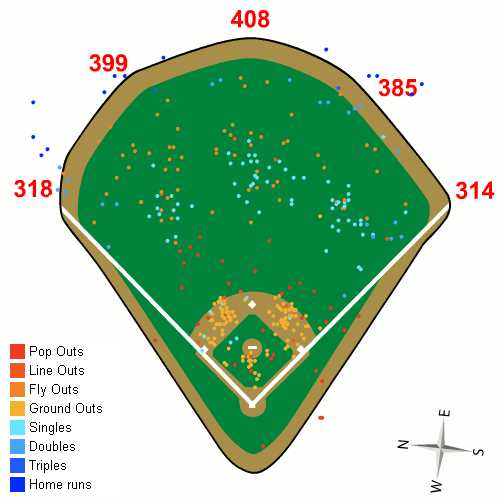
Source: http://katron.org/projects/baseball/hit-location/
There are obvious drawbacks to an overlay, including variables like atmospheric conditions and ballpark-impacted pitch selection (not to mention the accuracy of the simulator). Also, the general trends in Kuroda’s batted ball data suggest an increase in both line drives and fly balls, which doesn’t bode well for his ability to keep opposing hitters in the park. Over his first three seasons, the right hander was able to induce ground balls more than half the time, but in 2011, that rate dropped all the way to 43%. Perhaps more concerning was the precipitous rise in line drives, which seems to justify the spike in Kuroda’s HR rate.
Hiroki Kuroda’s Batted Ball Data

Source: fangraphs.com
Does Kuroda’s move toward being more of a fly ball pitcher represent the start of new trend? It’s hard to tell from one year’s worth of data, but a closer look at the home runs he allowed in 2011 might suggest the increase was more of a fluke. Exactly half of the 24 homers allowed by Kuroda came with two strikes, which was more than double the five he allowed in the two seasons prior.
“I think it’s a random spike, given the information available,” said Joe Sheehan of Sports Illustrated. “The homers themselves were clustered in few outings–the chance that it’s some kind of skill issue is less than it just being a blip.”
In fact, Kuroda’s struggles with two strikes weren’t confined to the long ball. With the exception of 0-2 counts, opposing batters hit well above average against the veteran pitcher in every other two strike combination (click here for a look at how hitters performed with two strikes in 2011). If Kuroda is able to cut down on the damage against him with two strikes, not only might his HR rate return to more normal levels, but his performance could improve across the board. It’s hard to predict whether or not he will be able to make the adjustment, but perhaps pitching against stiffer competition in a more hitter friendly environment will improve his concentration (i.e., pitch selection) with two strikes on the batter? That’s all conjecture, but regardless, Kuroda has substantial room for improvement in two strike counts.
Hiroki Kuroda’s Performance with Two Strikes, 2011

Note: sOPS+ measures Kuroda’s performance against the league average in a particular split. For example, his sOPS+ of 121 in all two strike counts indicates opposing batters hit 21% better against him.
Source: baseball-reference.com
Another concern expressed about Kuroda’s transition to the Yankees is the impact of the team’s porous infield defense. However, according to UZR/150 (which, admittedly, is far from an exact barometer), Yankees’ infielders were at least on par with the Dodgers’ at every position but short stop. Also, based on advanced analyses like Mike Fast’s recent study on catcher framing, Russell Martin ranks as one of the best defensive backstops in the game (according to Fast’s framing data, Kuroda’s catcher in 2011, Rod Barajas, ranked toward the bottom in 2011). Finally, as a group, the Yankees’ outfield led the majors with a UZR/150 of 10.2, which was well above the Dodgers’ rate of 2.8. So, even if Kuroda has gradually become more of a fly ball pitcher, that could play to his advantage on the Yankees, especially if he can get opposing batters to hit the ball to Brett Gardner.
Comparison of Yankees and Dodgers Infield and Outfield Defense, 2011

Source: fangraphs.com
Defense is always an important part of the equation when evaluating pitching, but in Kuroda’s case, it might be a little overrated. Because of his age, and perhaps the perception that he is a control specialist, many people seem to regard Kuroda as a contact pitcher. However, over the last two years, he has proven to be adept at missing bats. Among all qualified pitchers spanning the last two seasons, Kuroda ranks ninth with a swinging strike rate of 10.5%, or two percentage points higher than the league average. If Kuroda can continue to fool hitters, especially during the period when they are learning his patterns, his ability to generate swings and misses could mitigate some of his defense’s shortcomings, if they do exist.
Swinging Strike Rates, 2010-2012

Source: fangraphs.com
There are usually many unanswered questions when a player transitions to a new team and league, so skepticism surrounding Kuroda’s ability to maintain his success in the Bronx is only natural. However, based on his track record and the Yankees’ short-term commitment, there’s every reason to be optimistic that the right hander will be a positive contributor in 2012. Will he be the number two? Such distinctions really have little relevance in the grand scheme of a 162-game season, but if the sentiments expressed by those who know him best are accurate, I wouldn’t bet against it.
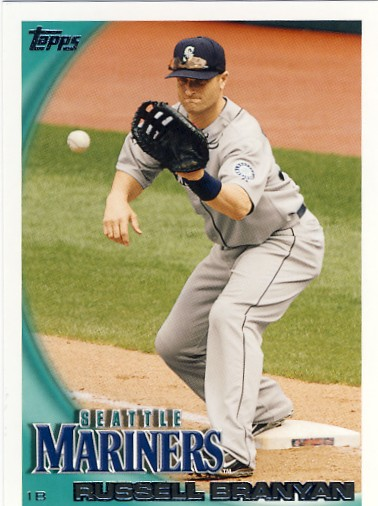
The Yankees might actually have a good bench in 2012, something we haven’t been able to say very often over the past decade. With returnees Andruw Jones, Chris Dickerson and Eduardo Nunez and free agent acquisitions Bill Hall and Russell “The Muscle” Branyan all in the mix (and Eric Chavez possibly on the way), the Yankees have a chance to cobble together a decent corps of backup players.
Put me down in favor of the Yankees’ signing of Branyan to a minor league contract. Although he’s 36 and coming off a bad season split between Arizona and Los Angeles (the Angels, not the Dodgers), he has enormous power, the kind of power that makes teams pull out the tape measure when he makes contact. I’ve seen Branyan hit some absolutely monstrous home runs, particularly to center and right-center field. He’s one of the strongest players I’ve ever seen, right up there with Reggie Jackson and Willie Stargell in his ability to hit for sheer length. Of course, he hasn’t hit nearly as many home runs as those two Hall of Famers, so that’s where the comparison has to stop.
Branyan also draws a decent number of walks and has a history of success at Yankee Stadium. (He’s the only player to hit a home run against the glass facing of the center field batter’s eye at the new Stadium, having accomplished that feat in 2009.) The key to Branyan’s situation with the Yankees is this: can he still play third base? If he can, then he gives the Yankees someone who can spell Alex Rodriguez against the occasional right-hander, while also providing backup at first base and at DH.
A check of Branyan’s record at Baseball Reference shows that he appeared in two games at third base for the Angels last season. Prior to that, you’d have to go back to the 2008 season for any prior experience at the hot corner; he made 35 appearances at third for the Brewers that season. So it remains somewhat questionable whether Branyan can log any serious time at third base at this late stage of his career.
If Branyan cannot play third, then his value would lie mostly in his ability to DH against right-handed pitching. As a DH, he would need to revert to his 2010 level in order to be helpful. That summer, he slugged 25 home runs and slugged .487 for the Indians and Mariners.
So there are plenty of questions regarding Branyan. But on a minor league contract, with a relatively small salary coming to him if he makes it to Opening Day, Branyan is worth a look. Besides, how can you not love a guy nicknamed Russell the Muscle?..
***
How do I feel about the possibility of trading A.J. Burnett? Where do I sign? Or perhaps I should say, “Great trade, who’d we get?” Even if the Yankees acquire little of value in exchange for Burnett, they figure to save $3 to $4 million in 2012 salary and can then use that money to add a left-handed DH or another piece to the growing bench. And if Brian Cashman is able to pry a meaningful player out of Pittsburgh in the deal, that’s all the better.
Media reports indicate that three or four teams are interested in Burnett, including the Pirates. The Yankees asked for Garrett Jones in a Burnett deal, but were quickly rebuffed by the Bucs. Jones is a left-handed hitting first baseman/outfielder with power, so he’d be a fit for the role as a platoon DH role and backup outfielder. On the downside, he’s already turned 30, is not a nimble defender, and has seen his OPS fall from .938 to .753 over the past three seasons. Therefore, a player like Jones should not be a dealbreaker. Perhaps the Yankees can throw in another player, or perhaps they can find another match on the Pirates’ roster. How about a left-handed reliever like Tony Watson, who could then compete with Boone Logan and Hideki Okajima for the southpaw bullpen role? Or perhaps a minor league outfielder like Gorkys Hernandez?
The fact that the Yankees are engaging teams in serious discussions for Burnett indicates that the enigmatic right-hander has little future in the Bronx. Even if he’s not traded, he has no guarantee of returning to the rotation. He’ll have to beat out both Freddy Garcia and Phil Hughes for the fifth spot, which is no small task. If Burnett is not traded and has a bad spring, the Yankees still have the option to stick him in the bullpen and use him as a long man. The bottom line is this: Burnett has no birthright to the starting rotation, not after the way he’s pitched the last two seasons.
So start the clock on Burnett’s departure from New York. I’d put it better than 70/30 that he’s an ex-Yankee by the end of the month. Heck, it might happen before the Yankees open camp on Sunday. I’d imagine quite a few readers of Bronx Banter would be pleased by that possibility…
***
Now that Luis Ayala has signed with Baltimore, there may be an opening in the bullpen for another right-handed reliever. It could be filled by Manny Delcarmen, who is one of the more interesting names among the 27 non-roster players that the Yankees have invited to spring training. First, the bad news. Delcarmen didn’t pitch at all in the major leagues last season, and he struggled badly in Triple-A ball for two different organizations. Now the better news. He’s only 29, is durable, has had decent success against the American League East in his career, and has plenty of postseason experience.
In 2007 and 2008, Delcarmen was highly effective as a Red Sox set-up reliever, striking out nearly a batter per inning with a WHIP near 1.00. He has struggled badly since then, resulting in a demotion to the minor leagues last spring. In many ways, he reminds me of Ayala–at one time an effective reliever who has fallen on hard times. He’s just the kind of reclamation project that pitching coach Larry Rothschild specializes in, so it’s worth the relatively small gamble of a minor league contract.
When he’s right, Delcarmen throws in the mid-90s and has an excellent curve ball, which he uses as his out-pitch. Remember, Joba Chamberlain won’t be ready by Opening Day, Burnett could be traded, and Cory Wade, while effective in 2011, seems like a candidate for regression in 2012. So Delcarmen has a chance to make the team as the 12th pitcher–and that might not actually be a bad thing.
[Featured image photo credit: Nick Laham/Getty Images]
Bruce Markusen writes “Cooperstown Confidential” for The Hardball Times.

When I heard that Hiroki Kuroda, the Dodgers’ veteran right-hander, refused a trade to the Yankees last summer, my first thought was “Fine, we don’t want you anyway.” If he didn’t want to play in New York, his loss. Better for him to stay away than become the next Ed Whitson. God knows we’ve seen turkeys in pinstripes, from Britt Burns and Denny Neagle to Jeff Weaver and A.J. Burnett.
So I was surprised when I read that Brian Cashman was pursuing Kuroda this off-season. This after trying to sign him as a free agent last winter as well. What was I missing? Then last month, there it was: the 37-year old Kuroda signed a 1-year, $10 million contract to pitch with the Yankees. Coming on the heels of the trade that sent Jesus Montero to the Seattle Mariners for Michael Pineda, the signing was pushed off the back page, yet drew rave reviews from baseball analysts. I e-mailed my pal Jon Weisman, who runs the Dodger Thoughts blog, and he said that Kuroda “was one of the classiest guys to wear a Dodger uniform. A good pitcher who might have the occasional stumble but can usually be counted on to pitch seven good innings. He goes right after hitters.”
Okay, the guy’s a pro. But there’s more to him than that. As Jon said, “It’s hard to feel too low when you’ve got Hiroki Kuroda on your side.”

Last year, his fourth year in the major leagues, Kuroda was having his finest season when he met with Dodgers general manager Ned Colletti in mid-July. Kuroda had gotten little run support and had a 6-11 record (from May 12 through July 27, Kuroda went 1-10 with a stellar 3.38 ERA), but as the trade deadline approached, he drew interest from several teams, particularly the Yankees and Red Sox.
Colletti told Kuroda how much he liked and respected him. He’d signed Kuroda three-and-a-half years earlier and admired how well the pitcher adapted to the major leagues. “He takes everything so seriously,” Colletti told me over the phone recently. “He has tremendous focus, even to a greater extent than most players.” The general manager told Kuroda, “I want to give you a chance to experience a pennant race again,” all the while understanding that being traded is not considered an honor in Japan.

“He is someone who takes his time and contemplates every major decision,” Colletti said, “but I could tell that day that his heart wasn’t in it.”
Kuroda liked L.A., where he lived with his wife and two daughters. He appreciated his time with the Dodgers and got along with his teammates. Under the visor of his cap were the characters 感 謝, which mean ‘thankful’. For Kuroda, being thankful isn’t a glib daily affirmation; it is a reminder of where he came from and who he is.
Unlike most other Japanese pitchers who played in the United States, Kuroda was not a star in high school. In fact, he spent most of his time on the bench. Kuroda’s father had been a professional player though he never pushed his son. His mother, however, supported the old school brand of discipline practiced by his coach. Kuroda was strong and durable but wild and was often relegated to pitching in practice. During bullpen sessions, his coach Hidemasa Tanaka told the catcher not to catch any pitch that wasn’t a strike. Kuroda had to retrieve each errand toss and then sprint back to the mound to make the next pitch.
“Pro scouts frequently came to watch our teams play,” Tanaka told Dylan Hernandez of the L.A. Times. “But no one bothered with Kuroda. There was no point.”
Kuroda wanted to quit many times but he stuck with it, pitching at Senshu University in Tokyo without achieving stardom. It was no surprise he wasn’t a high draft pick in 1997 when the Hiroshima Carp, a losing small-market team, signed him to the customary 10-year Japanese contract.

“The team had a lousy defense and he had to pitch in a small park,” says Robert Whiting, author of “You Gotta Have Wa”. “It was hard for him to put up the numbers he might have if he had played for the Yomiuri Giants, and accordingly, he did not get as much attention as he might have.” Nevertheless, Kuroda developed into an accomplished pitcher with good control.
“Kuroda earned everything by merit, including his chance to take the mound,” says Mike Plugh a professor of communications in Akita City who has written about Japanese baseball for Baseball Prospectus.
Alex Ochoa, the first base coach for the Red Sox, played against Kuroda for 4 years in Japan. Last week, Ochoa told David Waldstein of the New York Times, “He pitched like an American. He got ahead with his fastball and then used his breaking stuff and his splitter to get you out.”
Plugh says that Kuroda was appreciated by baseball fans in Japan, but adds, “The Carp are notoriously stingy. When he became a free agent, even after he showed himself to be one of the best pitchers in Japan, they didn’t want to pay him at first.” When they finally came around, Kuroda signed a 4-year deal. He was a rarity. Since the advent of free agency in Japan in 1992, players have changed teams at will. “Players move about quite a lot these days, usually from less influential teams to more influential teams like the Giants,” Whiting told me. “In this sense, Kuroda was an exception.”

Kuroda wisely had a clause written in the contract that allowed him to leave if the majors came calling. After one more season with the Carp, he declared free agency and signed 3-year, $35.3 million deal with the Dodgers. He was in tears at his farewell press conference.
“I made the decision because I wanted to go one step forward as a baseball player,” said Kuroda. “I would’ve been fine finishing my career with the Carp, but my feelings of wanting to challenge myself in a different kind of baseball grew stronger.”
Perhaps his decision was not necessarily compatible with the need to stay loyal to the Carp. He may have felt the need to repay the debt in full and then take a step up the ladder. Only after he was freed by a sense of obligation was he able to concentrate on personal ambition.
Kuroda arrived in the States with none of the hype that accompanied Dice K in Boston. “He didn’t have superstar baggage,” said Dylan Hernandez. Kuroda was open to changing his approach to fit the American game. In Japan, pitchers only throw once a week and they don’t face the same level of hitters they do in the States. With the help of an interpreter, Kuroda talked with Dodgers pitching coach Rick Honeycutt and catcher Russell Martin. He also watched a lot of video. “The first year it wasn’t so much spring training as the long season,” Honeycutt told me last week. “We tried to give him a day off when we could.”
The most difficult adjustment was cultural. “You think about it, it’s a very lonely existence,” Joe Torre, the Dodgers’ manager told Andy Kamenetzky who profiled Kuroda for ESPN Los Angeles in 2010. “When you’re changing countries, it’s a little overwhelming.”

In Japan, players don’t seek out coaches so Kuroda was honored when Torre eventually approached him with a friendly pat or a few words. He spent some time on the DL with tendinitis that first year but he had a solid season. He took a perfect game into the eighth inning against the Braves in July before Mark Teixeira broke it up with a single. What made Kuroda’s transition to the majors impressive is that he continued to strike batters out while maintaining the same fine control he had in Japan.
He came into his own in the playoffs. Kuroda had never pitched in postseason with the Carp, yet there he was throwing 6.1 shutout innings against the Cubs in the clinching game of the NLDS. The Dodgers lost the first two games of the NLCS against the Phillies. In Game 2, Phillies starter Brett Myers threw a ball behind Manny Ramirez. After the Dodgers jumped all over Jamie Moyer in Game 3, Russell Martin was hit twice. In the top of the third, with two men out, Kuroda threw a fastball over Shane Victorino’s head. The benches cleared (and Kuroda was later fined $7,500) but he allowed just two runs over 6 innings and the Dodgers won the game. “That was a big turning point,” Torre told Kamenetzky. “You knew he was a competitor, but I think at that point and time you realized what kind of competitor.”
The next season, Kuroda had an oblique strain and missed most of April and all of May. Then, in August he suffered a concussion after getting hit in the head with a batted ball in Arizona. The ball ricocheted all the way to the Diamondback’s on deck circle. “I didn’t know if he was going to get up,” said general manager Colletti. Kuroda went to the hospital and only missed a few starts. “That tells you everything you need to know about him, ” said Colletti. Kuroda didn’t pitch in the NLDS due to a bulging disk in his neck and gave up six runs against the Phillies in the NLCS without making it out of the second inning.
The next 2 years, Kuroda was healthier and he improved incrementally. He went from 183 and 117 innings to 196 and 202; his ERA went from 3.73 and 3.76 to 3.39 and 3.07. His walks stayed low and he continued to strike hitters out.
“He is a nice, no bullshit pitcher who pitches deep into games and is economical,” said Jay Jaffe from Baseball Prospectus.
Honeycutt calls Kuroda a true professional: “He commands the fastball in the lower part of the zone with movement. He’s a groundball pitcher, an attack guy, especially from the wind up, who looks for contact early in the count. With two strikes he will use a hard split finger, 86-88 mph that goes straight down and is lethal. But last year, he also challenged guys up in the zone when he was ahead and surprised them.”
“When he’s really on, his splitty is on,” Russell Martin told Anthony McCarron of the Daily News last week. “It gets him out of trouble. He can throw his fastball at 94 or 95 (miles per hour), though he’s mostly at 92 or 93, so it’s impressive. His slider is different, a really short break. It’s not a strikeout pitch, but it gets a lot of balls off the end of the bat, and his splitty is nasty against lefties or righties.”
Kuroda also became more comfortable with his English and was popular with teammates who appreciated his droll sense of humor.

Kuroda may come across as stoic or reserved but Clayton Kershaw thought he was “a goofball.”
What stood out to me in Kamenetzky’s ESPN piece is this quote from Kuroda: “There’s so much that you can understand about a person beyond words. And since I can’t really express myself, I’ve noticed a lot more, I’m tuned to notice the quality of a person without speaking. There’s a definitely a lot more importance in trying to understand a person without words.”
One Dodger teammate recalled how Kuroda comforted pitcher Jamey McDonald after Macdonald had a bad outing. Mcdonald refused to speak to reporters and Kuroda approached him and touched his shoulder as if to say, “I’ve been there.” It was a seemingly innocuous gesture but one that conveyed empathy and sensitivity.
Which brings us back to the meeting with Colletti. Kuroda thought about accepting a trade but he valued the commitment the Dodgers made to him when they signed him to a 1-year deal that spring. Would the champagne taste as sweet if he won a championship with a team that he didn’t start with in spring training? For Kuroda, the answer was no. A sense of loyalty—or ningen-kankei, the Japanese term for human relations—far outweighed the lure of moving to a contender. He stayed with the Dodgers.
“I wanted that feeling to remain important to me,” Kuroda told Hernandez last summer. “I think your self-identity is defined by certain decisions you make. If you go back on them, you lose a sense of who you are.”
The more I learned about Kuroda, the more I saw how narrow my thinking was last summer. Colletti called Kuroda’s decision to stay with the Dodgers “honorable” and I agree. When the season was over, Kuroda was expected to return to Japan and end his career with the Carp.

“I was surprised that he didn’t go back,” says Dylan Hernandez. “On the last day of the season he was crying in the clubhouse and I thought ‘this is it.’” Takashi Yamakawa, a Japanese baseball writer for Kyodo News said that Kuroda “changed his mind after deep consideration. Kuroda is not young in his spirit. He is an adult.”
The chance to pitch for Yankees meant not only pitching for a contender but pitching for the most famous team in the world. It is the challenge of playing for a perennial favorite, something that Kuroda has never experienced. “My feeling is that he made an exception for the Yankees,” said Hernandez. “They are the best, most visible team in the world. You just don’t say no.”
Kuroda will pitch in a new league, against a DH, and work in smaller ballparks than he did in the NL West. He’s coming off his two most durable years and is at his peak just when physical decline is set to take effect. Oh yeah, he’s also pitching for the Yankees, where the pressure to win is unrelenting.
“The pressure is more than double,” says Yamakawa, who told me that Kuroda went to a doctor last summer when he was having trouble sleeping at night. Unbeknownst to his teammates Kuroda spent two nights in the hospital. The doctor said that stress was keeping him awake. “But he is good at switching his mind when he’s on the mound,” Yumokura said.
Although Robert Whiting predicts that “Kuroda will suffer from the Yankees weak infield defense on the left hand side of the diamond and the home run jet stream to right center,” the pitcher will be reunited with his old catcher Russell Martin. “He was sad when Martin left,” says Yumokura. He said that ‘Martin is the only catcher for me.’”

“Without a doubt it’ll help pitching to Russell,” said Honeycutt. “That’s a huge positive for the Yankees and I have no doubt that Kuroda’s qualified to handle the change.” He is almost certain to get more run support, too. “He might have won 17 games last year with that offense,” said Colletti.
Kuroda is not expected to be an ace but a workhorse. Maybe he’ll have a higher ERA but should also win more games. Kuroda wanted an opportunity to be the best in the world and it seems as though he owed himself the chance to take a shot at it. And while winning a World Series is all that matters in certain quarters in the Bronx, there are some of us Yankee fans who appreciate toughness and effort no matter what the result.
“He is a humble man and not afraid,” said Yamakawa. “But he’s never had that great fame and he is ambitious to be successful.” The reporter thought for a moment before adding a small request: “Please help him.”

Click here for William Juliano’s statistical analysis of Kuroda.
[Photo Credit: ESPN, SI; Kuroda meal via Rico and Coco]
I recently found a diary that I kept in 1985. I turned 14 that June. Pasted to the pages are ticket stubs from the movies I saw (“View to a Kill,” “Mad Max Beyond Thunderdome”), from the Eric Clapton concert my mom took me to for my birthday, and the ball games I saw. There’s some writing in there, updates on Pony League games and school work, but there’s more drawing than writing.
Here’s a few pages…

My man, Reggie.

Good ol’ Knucksie, Phil Niekro.

In August my mother rented a cheap little cabin for a week out near the tip of Long Island. My twin sister, Sam, and one of her friends came along with us. The highlight of the week was finally getting to see “Back to the Future,” which I’d be pining to see for weeks.
What I’ll remember most, however, is listening to the Yankees on the radio. The night before we left, I went with my father to see them play the first of a four-game series against the Red Sox. The Yanks won in extra innings and then won again on Saturday and Sunday too. On Monday afternoon, Ken Griffey made a great catch in the 9th inning as the Yanks swept the Sox.
Mom didn’t want us watching TV while we were on vacation so I had to listen to the games on the radio. But I begged her to let me watch the news later that night to see the highlights and she did. The next day, Griffey’s catch was on the back page of the Daily News. We bought the paper and I copied the picture into my diary.

That’s my favorite Yankee catch of the 1980s (which is saying something considering how many sick plays Winfield made).


Over at Pinstriped Bible, Rebecca Glass examines ESPN prospect analyst Keith Law’s Top 10 Yankee prospects. Check it out.
[Photo Credit: J. Meric/Getty Images]

According to Joel Sherman in the New York Post, the Yanks are still interested in Eric Chavez and they are also interested in trading A.J. Burnett.

The Twitter says the Yankees have signed Bill Hall to a minor league deal (Erik Boland of Newsday got their first).
Last week, Steven Goldman explained why Hall won’t cut it.

Jon Weisman recently set up new digs for Dodger Thoughts. Check it on out. Jon is still the greatest team blogger of ’em all. And if you’ve never read his lasting Yankee Stadium memory, dig it.
Speaking of the Stadium, here’s a good take on the new place by Mathew O’Connor over at Lo-Hud.