"A New York Treasure" --Village Voice
Category: Yankees

Jesus Has Left the Building (When the Sh** Goes Down, You Better Be Ready)

Dag, I leave the Internet for a few hours, and the Yanks spring into action. Word has it that they’ve shipped out The Jesus and Hector Noesi to the Mariners for Michael Pineda and another young pitcher named Jose Campos. In another move, they will sign Hiroki Kuroda to a one-year contract pending a physical.

Didn’t figure the Yanks would stay on the low forever. They move Montero for another promising young talent in Pineda. I’m not expert but seems like a win-win sort of deal. As much as I would have liked to see Montero, I’m thrilled that the Yanks are getting a gifted young starter in Pineda. And I know they’ve coveted Kuroda since last season.

Wonder if they’d go nutzo and make a play for Prince to DH. Doubt it, but hey, let’s have some fun. And what about the starting staff? Phil Hughes and AJ Burnett? What’ll happen? After a quiet winter, put another log on the fire and let’s have at it.

[Photo Credit: Super Ninteno Sega Genesis]

The Zilch Squad All Stars

I like this from a recent post by Joe Posnanski. Here’s his All Star team of players who failed to receive one vote for the Hall of Fame:

C: Darrell Porter

1B: Ken Singleton

2B: Robby Thompson

SS: Dick McAuliffe

3B: Bob Horner

OF: Jimmy Wynn

OF: Andy Van Slyke

OF: Roy White

DH: Hal McRae

P: Frank Tanana

P: Mark Langston

P: Steve Rogers

P: Sam McDowell

CL: Todd Worrell

Honorable mentions: Devon White, Amos Otis, Cecil Cooper, Garry Maddox, Joe Rudi, Boomer Scott.

Color By Numbers: Delaying the Inevitable

In his third year of eligibility, Barry Larkin was elected to the Hall of Fame, an honor most baseball fans agree should have come sooner. However, even though the Hall of Fame bylaws make no such distinction, the voters from the BBWAA have taken it upon themselves to create a stratified election process that bestows special meaning to how quickly a player gains enshrinement (for a closer look at players forced to wait their turn, click here).

Since the first Hall of Fame class in 1936, 297 members have been inducted, including 207 former major leaguers, of which 112 were elected by the BBWAA. Of that latter total, only 44, or 39%, have been enshrined in their first year of eligibility, meaning Larkin’s delayed induction wasn’t abnormal.

Hall of Fame Inductions, by Years on the Ballot

Note: Excludes players elected via a runoff or special election.
Source: baseball-reference.com and baseballhall.org

The restriction on first ballot Hall of Famers has been eased somewhat of late (there have been 10 first-year elections over the past 10 years), but sentiment about denying an initial vote is still prevalent in Cooperstown discussions. Unfortunately, the shortsighted logic behind such an approach can sometimes be taken to an extreme, as was the case with Lou Whitaker and Ron Santo, two strong candidates that dropped off the ballot after failing to receive 5% of the vote in their first year of eligibility (Santo, who will join Larkin as a posthumous Veterans Committee induction, was later reinstated). Despite these examples of a philosophy gone awry, the practice continues to this day, and almost claimed Bernie Williams as another victim.

Although fans and baseball writers still get hung up about the importance of being a first ballot Hall of Famer, many might be surprised to learn some of the players who don’t qualify for the distinction. Tris Speaker, Ty Cobb and Whitey Ford all needed two ballots to gain enshrinement. For Mel Ott and Carl Hubbell, the third time was a charm. There haven’t been many players more elite than Joe DiMaggio, Eddie Collins, and Lefty Grove, but each of those men needed four ballots to enter the Hall. As you go down the list, the names continue to impress, which should be reason enough to scrap any notion about a first ballot commendation.

Vote and WAR leaders by Year of Hall of Fame Induction

Source: baseball-reference.com and baseballhall.org

In defensive of the BBWAA, there once were credible reasons for withholding votes from first timers. The most compelling was the glut of qualified candidates resulting from the decades of baseball history that pre-dated the Hall of Fame. As a result, the voters not only had to consider which players were the most deserving, but also which had already waited too long for their rightful honor. Several other eligibility rules from the past also supported the first ballot stinginess, including players becoming eligible after only one season of retirement and the lack of a minimum requirement to remain on the ballot. That’s why when DiMaggio kept failing to win induction, for example, there was surprise, but not outrage, even if not everyone agreed with the philosophy.

The temptation is strong to exclaim indignantly that all members of the Baseball Writers Association who failed to vote for the Jolter are rockheads. But that would be a grievous error. The reasoning is this: Joe DiMaggio in his first year of eligibility for the Hall of Fame. Admittedly, he rates it but can afford to wait a bit just as other great stars had to wait. Let’s get some of the older fellows into Cooperstown before time runs out on them.” – Arthur Daley, New York Times, January 23, 1953

Arthur Daley’s justification for withholding deserved votes expired along time ago. Making Barry Larkin wait three years for induction didn’t serve any purpose other than to create an artificial distinction between classes of Hall of Famer. Of course, because past procedures necessitated delays, Larkin can still boast that his election came well before the likes of DiMaggio, Jimmie Foxx and Rogers Hornsby. However, there is still one part of Daley’s comment that rings true, and it will be hauntingly evident when someone other than Ron Santo is forced to accept the Hall of Fame honor on his behalf. Compared to the former Cubs’ third baseman, Larkin’s wait was nothing.

No Funny Stuff

Our man Cliff has a piece up at SI.com about Jorge Posada’s chances at making the Hall of Fame:

He was the funny-looking one. The last to join the quartet, he had a big nose, a weak chin, a penchant for rings and worked sitting down. His contributions to arguably the greatest ensemble in his field have always been overlooked. Yet, even moreso than his Beatles analog, Ringo Starr, Jorge Posada was an equal partner in baseball’s fab four, the quartet of Yankees teammates who debuted in 1995 and won seven pennants and five World Series together (though Posada, who played in just eight major league games in 1996, sat out the first of those).

That Posada is so comparable to Ringo, “the funny one,” who wrote just two Beatles songs and two of the worst at that, helps explain why he has had such a hard time being taken seriously as an all-time great at his position. However, news of his impending retirement, first reported by WFAN beat reporter Sweeny Murti last weekend, gives us a much-needed occasion to revisit Posada’s significance in baseball history. It’s fitting that the news about Posada arrived just days before the announcement of this year’s Hall of Fame class, as a case can be made that Posada is worthy of enshrinement, and it has nothing to do with his having kept time with sure-fire first-ballot inductees Derek Jeter and Mariano Rivera or fellow borderline case Andy Pettitte, his Core Four brethren.

The Bernie and Kirby Show

Over at the Pinstriped Bible, Steven Goldman compares Bernie Williams with Kirby Puckett:

Both were excellent hitters with very different skills who nonetheless arrived at similar results. Puckett was short and stout, Williams long and lithe. Puckett reaped a huge benefit from his Metrodome home park, hitting .344/.388/.521 at home, .291/.331/.430 on the road. Williams was about the same hitter everywhere. Both were Gold Glove center fielders who won several of the defensive awards with their bats. Both won a single batting title. Puckett led the AL in hits four times; Williams walked too much to compete in that department.

Career-wise, Williams looks a little worse overall, but that’s because his peak isn’t quite so high and his career is a little longer. Due to glaucoma, Puckett’s career came to an abrupt end, depriving him of a decline phase, whereas Williams got to play until he was no longer useful. If you consider both through their age-35 seasons, it’s a virtual tie: Williams had hit .301/.388/.488 in 1804 games, while Puckett hit .318/.360/.477 in 1783 games. When you adjust for time and place, there isn’t a lot of difference–at which point, I would argue, you have to look at Puckett’s home-road splits.

So So Def

Tom Verducci and Rob Neyer write about how underrated Jorge Posada was during his career.

Observations From Cooperstown: Andy Carey and the Utilityman

Andy Carey was not a star–perhaps he was no more than an average player–but he was good enough to start at third base for a pair of world championship teams during the glory years ofNew York City baseball. And if not for his presence at the hot corner, Don Larsen might not have made history in the 1956 World Series.

Carey died on December 15 at the age of 80, succumbing to a severe form of dementia, but his death was only reported publicly last week. Perhaps that’s a testament to the family’s desire for privacy. Or perhaps it’s evidence that Carey had become a forgotten figure in Yankee lore, having not played for the franchise in over 50 years. If the latter reason is the more accurate, then perhaps it’s something of a sad commentary on our society’s lack of interest in history.

Well, Carey should be remembered. First, he had a bit of quirkiness to him. For example, he was known as a voracious eater. He ate so much that he started costing the Yankees money. On road trips, the Yankees typically allowed players to sign for their meals in hotels and restaurants. Because of Carey’s insatiable appetite, the Yankees changed the policy.

On the field, Carey was the Scott Brosius of the 1950s, except for the fact that he never had the kind of breakout season that Brosius enjoyed in 1998. When Carey first came up, he was so strong defensively that the Yankees considered converting him to shortstop, with the plan to have him succeed an aging Phil Rizzuto. Ultimately, the Yankees decided that he was a better fit at third; he became the starting third sacker in 1954.

Offensively, Carey had only marginal talent. He led the league in triples one year and batted over .300 in 1954, but those achievements were the extent of his hitting highlights. Conversely, he was a solid defensive player, once turning four double plays in a single game to tie a major league record. On a team surrounded with sufficient offensive talent, like the Yankees had in the mid-1950s, you could win with a player like Carey at third base.

Larsen was certainly appreciative of Carey in Game Five of the ‘56 Series, when he took part in two remarkable plays. In the second inning, Carey knocked down a line shot off the bat of Jackie Robinson, the ball caroming to the left of the third baseman. Yankee shortstop Gil McDougald retrieved the ball and nipped Robinson at first. And then in the eighth, Carey made a diving snag of Gil Hodges’ line drive. Carey’s two-time heroics preserved both the no-hitter and the perfect game, the latter being the only one of its kind in postseason history.

Carey remained with the Yankees through the 1959 season. With the arrival of Clete Boyer via trade, the Yankees deemed Carey expendable. They traded him to theKansas CityA’s, Boyer’s former team, in exchange for power-hitting outfielder Bob Cerv.

From there, Carey bounced around with the A’s, White Sox and Dodgers before calling it quits in 1962. But it was as a Yankee that he would always be remembered. Carey became a frequent visitor toCooperstown, where he took place in baseball card shows, almost always signing with other Yankees from his era, like Larsen, McDougald, Yogi Berra, Moose Skowron and Hank Bauer.

Off the field, Carey led a busy life. He was married four times, including a past marriage to Lucy Marlow, a relatively little known actress who appeared in such programs as “Gunsmoke” and “The Blue Knight,” two old shows that I actually remember. The IMDB web site describes her as a “knockout-looking minor 50s film and TV actress.”

Some might describe Andy Carey as a “minor” player of the fifties, too. And that would be unfair. When you’re good enough to start for a quartet of pennant-winning teams and a couple of world champions, you deserve more of a description than that…

***

It continues to be a quiet off-season for the Yankees, with the latest non-development being the inability to sign Japanese star Hiroyuki Nakajima by last Friday’s deadline. Nakajima wanted more than a one-year contract, which represented the Yankees’ limit, and was not thrilled with the prospect of playing a backup role inNew York.

While most observers have fluffed off the non-signing, I think there’s something deeper here. That the Yankees had such interest in Nakajima, an All-Star shortstop inJapanwhom Brian Cashman projected as a utility infielder, indicates that they are not completely satisfied with Eduardo Nunez, last year’s utility man, or totally enamored with the prospects of re-signing Eric Chavez.

The Yankees love Nunez’ raw tools–he has an appealing combination of power and speed–but they are legitimately worried about his throwing problems. Derek Jeter and Alex Rodriguez are going to need more days off in 2012, not fewer, so Nunez will have to become more accurate in making throws from the left side of the infield. Perhaps that deficiency explains why the Yankees have been willing to include Nunez’ name in trade talks with teams like the Braves and the White Sox.

With regards to Chavez, he did play well before breaking his foot, but then showed little power after his return. And then there’s the problem of his repeated trips to the disabled list, which have become an annual occurrence. If a utility infielder cannot be trusted to stay healthy and fill in when needed, he loses a lot of his value.

If the Yankees don’t re-sign Chavez, where will they turn? On the free agent market, the pickings are slim, but there are some intriguing names, including Carlos Guillen, Bill Hall, Jeff Keppinger, and Miguel Tejada. All carry asterisks, if not outright questions. Guillen was once a star, but he’s now 35 and can’t stay healthy. Hall played so poorly for a bad Astros team that he was released in mid-season, and then he flopped during a 16-game trial with the Giants. Keppinger can really play only one position, second base, and doesn’t have the ability to play shortstop for more than a game at a time. Tejada, at 37, is as cooked as the Christmas goose in Scrooge.

All in all, the choices appear so limited that the Yankees may be forgiven for having the following thought: Is Chicken Stanley still available?

[Photo Credit: Hy Peskin]

Bruce Markusen writes “Cooperstown Confidential” for The Hardball Times.

Catch it While it Lasts

Dig:

The Miller Lite ad in the middle of the 5th was one of my favorites:

Oh, You’re a Good One

According to a report by our pal Sweeny Murti, Jorge Posada will announce his retirement in a few weeks.

The old bastard will be missed.

He was one great Yankee.


A-B-C Ya Later

Our man William’s got it going on. Man, this brings back good memories.

Color By Numbers: Late Bloomers

After 13 seasons, Melvin Mora has decided to retire from baseball. The announcement, which was made last week, went largely unnoticed, but that’s not really much of a surprise. After all, most people probably didn’t even realize he was still playing (in 2011, Mora played 42 games for the Arizona Diamondbacks before being released at the end of June).

Never a superstar, Mora did have a very productive career, compiling 26.5 Wins Above Replacement and producing an OPS+ of 105, which isn’t too bad for a player who filled in at seven different positions during his time in the majors. What makes Mora’s career interesting, however, is not how he performed in the majors, but how long it took him to get there.

After eight seasons and over 3,000 plate appearances in the minor leagues, Mora finally got a taste of big league life in 1999. A product of the Houston Astros’ Venezuelan player development machine, Mora never blossomed in that organization, but a strong campaign with the Mets’ Norfolk affiliate that year finally helped earn him a promotion. Although Mora had to be ecstatic about finally getting to play, facing Randy Johnson in his first big league game may have had him rethinking all those years he toiled in the minors.

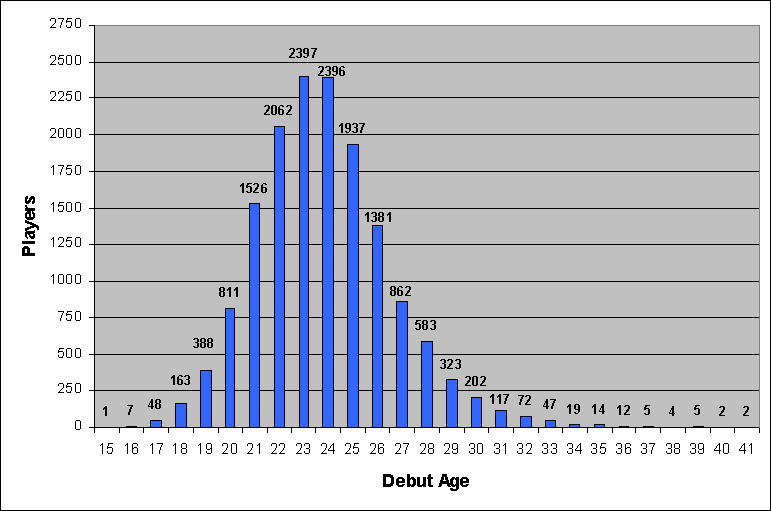
Distribution of Major League Debut Ages, Since 1901
 
Source: baseball-reference.com

When Mora played in his first game, he was already 27, which, by rookie standards, is rather long in the tooth. Since 1901, only 1,177 non-pitchers have debuted in the majors at that age or older, and just over one-quarter of that total lasted long enough to play a season’s worth of games. Mora defied the odds, however, and stuck around for 13 years.

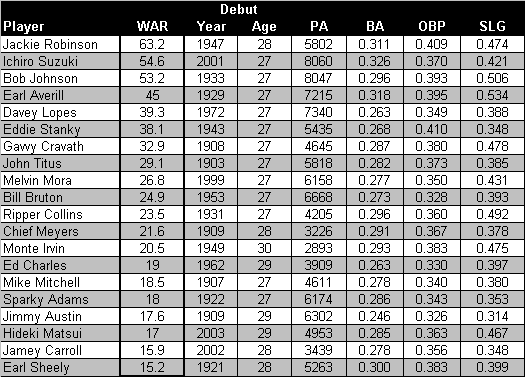
Among players breaking into the majors at age 27 or older, Mora ranks ninth in terms of cumulative WAR. At the top of the list is Jackie Robinson, whose debut was delayed by baseball’s color barrier, followed by Ichiro Suzuki, who got a late start in the majors because he previously spent nine seasons playing inJapan. Considering the extenuating circumstances pertaining to Robinson and Ichiro, Bob Johnson is more aptly considered the player who made the most of a late start. In 13 seasons following his promotion at the age of 27, Indian Bob posted a cumulative WAR of 53.2 during a career that featured seven All Star appearances. Who knows, had Johnson broken into the big leagues sooner, he could have end up as a Hall of Famer?

Late Bloomers: WAR Leaders Among Players Who Debuted At Age-27 or Older

Source: baseball-reference.com

At the other end of the spectrum is a player like Bob Lillis, who had the misfortune of being a short stop in the Dodgers’ farm system while Pee Wee Reese was going strong. In addition to be being buried on the depth chart, Lillis also had to contend with frequent injures, but, at the age of 28, he finally preserved by making the majors in 1958. Lillis actually had a very strong debut season, batting .391 in 69 at bats, but found himself now taking a back seat to new starting short stop Don Zimmer. After his first season, it was all down hill for Lillis, who ended up with an OPS+ of 55 and WAR of -6.9 over a career that spanned almost 2,500 plate appearances in 10 seasons. Apparently, good things don’t always come to those who wait, but at least Lillis qualified for the pension.

Lillis was lucky to stick around for so long because so many others in a similar situation were only given a fleeting glimpse of life in the majors. Moonlight Graham is probably the most famous case of such a player. At age 27, the right fielder finally got his big break, but it only lasted for 1 1/3 innings as a defensive replacement. Graham went on to become a doctor, and his story became immortalized on page and screen, but so many others had to be content with a page in the baseball encyclopedia (click here for list of players who appeared in one major league game). When you think about, even that’s not so bad, considering the thousands of career minor leaguers who would have given an arm and a leg (and some probably did) to join them.

Melvin Mora could have been one of those long suffering journeyman who never realized his dream. Instead, he is retiring after 13 productive seasons in the majors. Fortunately, Mora had the patience to wait for his chance, but it makes you wonder, how many others forfeited a big league career because theirs ran out?

Things Fall Apart

Hiroyuki Nakajima? Pass.

Just a Little Patience

Over in the New York Times, Tyler Kepner explains the Yankees’ approach this off-season:

It turns out the Yankees are not obliged to sign a player just because he happens to be a free agent who would fill a need. They won 97 games last season, the most in the league, before their first-round playoff loss. They can give it another try with these players and go back on the market next winter, when the free-agent starters should be much more appealing.

Cole Hamels and Matt Cain, All-Stars younger than 30 with strong postseason pedigrees, are unsigned past this season. Either would make more sense for the Yankees, in the long term, than [C.J.] Wilson or the other top starters on this winter’s market.

…What they are doing is planning ahead, a strategy that fits Hal Steinbrenner much better than it ever did his impatient father, George. Incentives in the new collective bargaining agreement would essentially reward the Yankees for reducing their payroll to $189 million by 2014. By then, Burnett, Mariano Rivera, Rafael Soriano and Nick Swisher will be off the payroll, which has exceeded $200 million in each of the last four years.

At the moment, the Yankees owe just over $80 million to Sabathia, Alex Rodriguez, Mark Teixeira and Derek Jeter for 2014. That leaves a lot of room for marquee talent, some of which is already in pinstripes.

This is all so sensible, though it feels odd on some level, a George-less Yankee team, one that exercises caution. Part of me is waiting for someone there to stop making sense–another Soriano maybe? In the meantime, they are being very Dude-like about it. Go figure.

Meanwhile, South of the Border

Chad Jennings is back in action over at the Lo-Hud and he’s got a report on the winter leagues. Check it out.

[Painting via Thaw Malinin]

Observations From Cooperstown: Okajima, Jones, the HOF, and Greg Spira

The Yankees made two low-profile roster moves last week, but both were good transactions. First, they signed ex-Red Sock Hideki Okajima to a non-guaranteed contract, giving him a chance to make the team with a good spring training performance. Then the Yankees re-signed Andruw Jones, their most effective bench player in 2011.

At one time, Okajima was one of the American League’s most effective left-handed pitchers. He was also one of the most fun to watch, given the way that his head bobbed toward third base, a particularly distracting trait for many hitters. Okajima spent most of last year at Triple-A Pawtucket, but is only two years removed from being a key member of the Red Sox’ bullpen. For his career, he has held left-handed batters to a .217 batting average and a .277 on-base percentage. He also has no fear of American League East pennant races, having done regular battles against the Yankees and the Rays over the span of three summers.

With a good spring, Okajima could beat out Boone Logan, who was wildly inconsistent against lefty batters in 2011. Or there’s a possibility that the Yankees could carry Okajima as a second southpaw reliever. As it is, the Yankee staff is far too right-handed, with CC Sabathia providing the only certainty from the left side. Another left-hander, provided that he is effective, would be a nice bonus for Girardi to call on in sixth and seventh inning situations.

Now on to Jones, a familiar face from 2011. He did quietly good work in a supporting role last season. After a so-so first half, Jones finished up the season on a strong note, establishing himself as a right-handed hammer. In 146 plate appearances against left-handers, Jones reached base 38 per cent of the time and slugged to the tune of .540. Those are Marcus Thames numbers. Jones is an ideal fourth outfielder who can handle either corner position, and can also play center field in the event that both Curtis Granderson and Brett Gardner go down. If anything, I’d like to see Jones play more in 2012. Whenever the Yankees see a left-hander, Joe Girardi should find a place for Jones in the lineup, whether it’s in left field, right field, or as the DH…

***

We are one week away from the Hall of Fame vote being conducted by the Baseball Writers’ Association of America. The ballot contains five names that I personally regard as Hall of Famers, but only one man is likely to emerge with the 75 per cent vote needed for election.

Here are the four players likely to receive the most support in next week’s election:

Barry Larkin:

Of all the players, he has the best chance to win election from the Baseball Writers. He received 62 per cent of the vote last year and would need a jump of 13 per cent, which is not without precedent. Like George Brett, Larkin’s frequent injuries were a factor against him, but not enough to dethrone him as the best all-round shortstop of the 1990s. His power (198 home runs) and his basestealing numbers (379 steals, only 77 caught stealing) really jump out, especially coming from a shortstop. I remember him as a very good player, but the numbers show him to be a great one. Prediction: He’ll receive 78 per cent of the vote and join Ron Santo in the Class of 2012.

Jack Morris:

After Larkin, he has the most favorable odds of earning the required 75 per cent. He received 51 per cent last year, so he will need a huge jump in the balloting. His supporters point to him as the best starting pitcher of the 1980s and cite his standout work in the 1991 postseason. His detractors emphasize his 3.90 career ERA, which would rank the highest of any pitcher in the Hall of Fame. Prediction: He’ll receive about 64 per cent support, well short of election.

Jeff Bagwell:

His lack of voting support in 2011 (41 per cent) was astounding. Rumors of steroid use may have been a factor, but Bagwell never failed a drug test and was not mentioned in the Mitchell Report. MLB Network analyst Peter Gammons, whose opinion I respect greatly, recently rated Bagwell as the fourth best first basemen in history, behind only Lou Gehrig, Jimmie Foxx, and Albert Pujols. That’s good enough for me, but it doesn’t appear that it will be good enough for the voters. Prediction: He’ll receive just over 50 per cent support.

Tim Raines:

Like Bagwell, his lack of support from the writers has been astonishing. He’s the second best leadoff man of all-time, behind only Rickey Henderson, a supposition that should indicate his worth for the Hall of Fame. And as a bonus, he earned a couple of World Series rings as a part-time player with the Yankees, where he filled in as a left fielder, DH, and clubhouse leader. Prediction: He’ll jump from 37 to 41 per cent, leaving him alarmingly short of election. The lack of support makes little sense to me; he’s a far stronger candidate than Jack Morris, among others.

***

There are celebrities among baseball writers, people like Bill James and Rob Neyer and Bill Madden. And then there are footsoldiers, people who do the research and leave the glory of the written word to other people. Greg Spira was one of those people.

Greg was regarded as one of the best researchers and editors in the baseball world. He wrote occasionally, but it was research and large research projects that really drove him. He did a lot of work related to the Mets, frequently collaborating with a friend of mine, Matt Silverman. They worked on many projects together, trying to come up with stories and statistics that people would be interested in reading and hearing. Greg also served as the editor of ESPN’s Baseball Encyclopedia, a book that was a particular source of pride for him.

There was pride, but little ego. Some of Greg’s friends tried to get him to write more often, but I don’t think he had the ego for that. He just wanted to do the research, and make it available for other people to study, and enjoy.

Greg Spira died last week at the age of 44. He had a difficult history of health problems, dating all the way back to the 1990s. His kidneys and his heart finally gave out on him, even though his mind had plenty of baseball left in it.

I don’t know why we keep losing these writers and researchers at young ages. There was Doug Pappas of Baseball Prospectus, John Brattain of The Hardball Times, and, of course, the beloved Todd Drew of Bronx Banter. I guess that all I can make of it is this: we must do what we can each day, not knowing exactly what might happen next.

Keep researching. Keep writing. Keep loving the game. Do it every day until it’s time to stop.

More Bounce to the Ounce

According to Jon Heyman (via Hardball Talk), the Yanks have signed Andruw Jones to a one-year deal.

Cutter’s Way

Over at Fangraphs, David Laurila has a piece about Mariano Rivera:

”You need to use your brain to pitch effectively in the big leagues,” explained the future Hall of Famer. “You can’t go out there and do exactly what you want to do without a brain. As you get older, you mature and put your knowledge to work, It’s like when you go to school for the first time. In first grade, you’re not going to know what you know in the sixth or seventh grade. Pitching is just the same. If you don’t learn, you won’t have the success that you could have. I‘ve learned a lot over the years.”

Larry Rothschild, the Yankees’ pitching coach, agrees.

“Mariano is incredibly smart,” said Rothschild. “He’s also obviously incredibly gifted and has a great knack for trusting his ability. That’s why he attacks the strike zone like he does. He has a pitch that, if he throws it right, is going to get any hitter out, at any time. He knows that, and just as importantly, he knows how to pitch. There is the term, ‘he gets it,’ and Mariano gets it. Totally.”

[Painting by The Lost Collector]

Beat of the Day

Matt Blankman sent over the following excerpt from Greil Marcus’s new book on the Doors:

“In the mid-sixties, when the Doors began, when ‘Mystery Train’ first entered their repertoire, Elvis Presley was a joke. The shocking black leather blues he conjured on national television for his 1968 Christmas special was unimaginable after years of movie travelogues, of hula hoops and shrimp, of a world where a racetrack was just another beach–where, as Elvis himself once put it, he had to beat up guys before he sang to them. But in 1968, when Elvis sang ‘One Night’ — after climbing mountains and fording rivers all across the frontiers of ‘Tryin’ To Get To You,’ going back again and again to Jimmy Reed’s ‘Baby What You Want Me To Do’ as if it were a talisman of a treasure he couldn’t name, each time deepening it, dropping words in search of a rhythm the song didn’t even know it wanted and now couldn’t live without — what returned was the sense of awe, of disbelief, that greeted him when he first made himself known.”


[Illustration by Larry Roibal]

$189,000,000.00

What could the 2014 Yankees get for $189,000,000.00?

C: Jesus Montero, $0.5 (24)
1B: Mark Teixeira, $23.2 (34)
2B: Robinson Cano, $23 (31)
3B: Ryan Zimmerman, $23 (29)
SS: Derek Jeter $8 (40)
LF: Yoenis Cespedes $7.5 (28)
CF: Brett Gardner $9 (30)
RF: Mason Williams $0.5 (22)
DH: Alex Rodriguez $26 (38)

$120.7

Free agents required: 3 – Cespedes, Cano, Zimmerman, $53.5 million

Leaps of faith required: 2 – Jesus Montero is a catcher, Mason Williams, or someone else currently in the system is a Major Leaguer

Other concerns: Derek Jeter at SS at 40, but if he chooses to play, I don’t know how that can be avoided

BUC: Austin Romine $0.5 (25)
MIF: Eduardo Nunez $2 (27)
OF: Slade Heathcott $0.5 (23)
UTIL: Corban Joseph $0.5 (25)

$3.5

SP: CC Sabathia $24.3 (33)
SP: Cole Hamels $23 (30)
SP: Ivan Nova $2 (27)
SP: Manny Banuelos $0.5 (23)
SP: David Phelps $0.5 (27)

$50.3

Free agents required: 1 – Cole Hamels, $23 million

Leaps of faith required: 3 – Nova is good, the Yankees currently have 2 Major League quality pitchers in their system and will identify the correct ones and will not destroy them in some weird way

CL: David Robertson $4 (29)
RP: Hector Noesi $0.5 (27)
RP: Dellin Betances $0.5 (26)
RP: Jairo Heredia $0.5 (24)
RP: Chase Whitley $0.5 (25)
RP: Jose Quintana $0.5 (25)
RP: Nik Turley $0.5 (24)

$7

Fifteen league-minimum guys on the rest of the 40-man roster: $7.5 million.

$120.7 + $3.5 + $50.3 + $7 + $7.5 = $189

This version of the 2014 Yankees has the lineup and rotation to be strong contenders, but the weak bullpen is likely to betray them when it matters.

The overall point is that the Yankees have leeway to invest in three superstars for the 2014 roster and they absolutely should do that. I have them re-signing Cano and getting Hamels and Zimmerman but’s that’s just cherry picking the best free agents from the next few classes. To make room for those three superstars though, the 25-man roster needs to have 13 league-minimum players (two in the starting lineup, two in the starting rotation, three on the bench and six in the pen).

It’s recipe for disaster, but an entertaining one like 1987 or 2008. And the other route, eschewing the superstars in favor of a several medium-sized contracts, seems like a worse idea. The 2014 team might be better if they spread the money around (and it might not) but where will they go from there if they are constrained by a bunch of middling contracts? If this has to be the way they proceed, I say grab the stars when they appear and fill in the rest later.

So the topic to Banter, which three stars should be Yankees before 2014?

(A note on methodology. I used Cot’s as the basis for the Yankees 2014 obligations. And I used the following quote from the AP for the basis of payroll calculation in general:

Payroll figures are for 40-man rosters and include salaries and prorated shares of signing bonuses, earned incentive bonuses, non-cash compensation, buyouts of unexercised options and cash transactions, such as money included in trades. In some cases, parts of salaries that are deferred are discounted to reflect present-day values.

I realize that the salary figures might be off slightly. In fact Cot’s has the Yankees 2011 payroll as $207 million while the AP story has them at $216 million and reverse engineering their tax bill of $13.9 million gets you to $212.75 million. I think the actual numbers won’t be far enough away from Cot’s to render the above meaningless.)
(Salary Information Courtesy of Cot’s Baseball Contracts)
(Photos via scienceblogs.com and medimanage.com)

On the Mend

Alex Rodriguez had surgery on his right knee last month. In Germany. Mike Puma has the exclusive story in the Post.

Oh, and his shoulder too.

feed Share on Facebook Share on Twitter Share via email
"This ain't football. We do this every day."
--Earl Weaver