
Ibanez, Damon, or Godzilla? The latest gossip is rounded up by D.J. Short over at Hardball Talk. Ya smell me?



Ibanez, Damon, or Godzilla? The latest gossip is rounded up by D.J. Short over at Hardball Talk. Ya smell me?

The Yankees’ rumored interest in free agent utility man Bill Hall is a bit puzzling. Should we interpret that interest as a sign that the Yankees do not believe that Eduardo Nunez can handle the defensive responsibilities of being a utility infielder. Alternatively, is it a signal that the Yankees would like to trade Nunez, perhaps in a deal for a left-handed bat who can fill part of the DH role? To be honest, I’m not sure which of those thought processes are running through the mind of Brian Cashman.
Still, Hall is an interesting player. In 2006, he hit 35 home runs as a starting shortstop and looked like a budding star at the age of 26. Stardom never happened. In 2010, he was a reasonably productive utility man for the Red Sox, filling in around the infield and outfield. Then he signed a free agent contract with the Astros, where he flopped as the team’s everyday second baseman. After being released by the ‘Stros, the Giants took a flier on him, but watched him hit a mere .158 in 38 late-season at-bats.
Now 32 years old, Hall will never be a 30-home run man again, that’s for sure. But if he can revert back to the player of 2010, a versatile player who can play three infield positions and all three outfield positions while hitting with some pop, he’s be a useful guy to have. If not, if his 2011 numbers are an indication of his true current ability, then the Yankees will have to tread lightly here. If they sign Hall and trade Nunez, there may not be a safety net available in the event of a Hall breakdown.
When you’re a baseball fan, it’s funny how the mind works. When I hear the name “Hall,” I think of the Hall of Fame, and I think of past Yankees with the same last name. The Yankees have not had a player named Hall since the now-infamous Mel Hall, who was one of the team’s bright spots during the fallow years of the early 1990s. Hall played hard, pounded right-handed pitching, and delivered his fair share of clutch hits, but then he took some “hazing” of a young Bernie Williams to ridiculous extremes, driving the young outfielder to the verge of tears. He repeatedly referred to Williams as “Zero.” When Williams began talking in Hall’s presence, the veteran outfielder chided him by yelling, “Shut up, Zero.” Why this treatment was allowed to go on unchecked remains one of the great mysteries in Yankee history.
Hall also failed to make friends with the front office when he brought his two pet cougars–yes, a pair of pet cougars–into the Yankee clubhouse without warning, creating a mild panic in the process.
Yet, the hazing and the cougar incident pale in comparison to Hall’s post-career problems. Hall is currently sitting in a federal prison, where he will remain until he is old and gray because of his repulsive relationship with two underage girls. Hall was convicted of sexual assault; he essentially raped the girls, one of whom was 12 at the time of the relationship. Sentenced in 2009, he will have to serve a minimum of 22 years, or the year 2031, before he is eligible for parole. If he does not gain parole, the total sentence will run 45 years, putting him behind bars until 2054. Hall is 51 now, so that would put him at a ripe old 93 years. So who knows if he’ll even live that long.
There is one other “Hall” that I remember playing for the Yankees. He was Jimmie Hall, a left-handed power hitter of the 1960s. He began his career with a flourish, putting up OPS numbers of better than .800 in his three major league seasons with the Twins. As a rookie, he set a record for most home runs by a first-year player in the American League, busting the mark set by Ted Williams in 1939. He also had the ability to play all three outfield spots, making him particularly valuable toMinnesota.
Apparently on the verge of stardom, Hall then fell off the map. He struggled so badly in 1966 that the Twins traded him to the Angels. Some say his early decline was the result of being hit in the head with a pitch. Others pointed to his inability to handle left-handed pitching. And then there were those who felt that he was done in by the changes to the strike zone that hurt so many hitters during the mid-to-late sixties, when the second deadball era set in.
By the time that Jimmie Hall joined the Yankees, he was a fragment of the player who had once torn through the American League. The Yankees acquired him early in the 1969 season, picking him up from the Indians in a straight cash deal. Hall came to the plate 233 times for the Yankees, but hit just three home runs and reached base only 29 per cent of the time. Even in a deadball era, those numbers didn’t suffice.
Hall didn’t last the season in theBronx. On September 11, the Yankees dealt Hall to the Cubs for two players with wonderfully opposite names, minor league pitcher Terry Bongiovanni and outfielder Rick Bladt. If you remember either of those players, give yourself a cigar.
So that’s it for the Yankees’ legacy of Halls. Mel and Jimmie. If the Yankees end up signing Bill Hall, we can only hope that he’ll be a better player than Jimmie and a better man than Mel.
Bruce Markusen writes “Cooperstown Confidential” for The Hardball Times.

You can’t blame Edwin Jackson for feeling just a little bit self conscious. Despite being widely regarded as a very talented pitcher, the right hander has nonetheless become a journeyman before his age-28 season.
When Jackson toes the rubber as a Washington National in 2011, it will be the seventh different ballpark he has called home since beginning his major league career with the Los Angeles Dodgers in 2003. What makes his frequent travels even more surprising is that unlike the early part of his career when he struggled to live up to his advanced billing, Jackson has been a relatively valuable pitcher over the past five seasons. Considering he has pitched for five teams over that span, it’s no wonder his accomplishments have gone unnoticed.
Most Franchises Played For During a Career

Source: Baseball-reference.com
Even with seven uniforms hanging in his closet, Jackson still has a long way to go to catch Octavio Dotel, who will count 13 different teams on his resume once he throws a pitch for the Detroit Tigers in 2012. Then again, Dotel will be 38 next year, a full decade older than Jackson. Among his own age-class, Jackson’s seven teams rank second to Bruce Chen, Dennys Reyes, Jeff Juden, and Orlando Mercado, who all pitched for eight teams before turning 29.
Besides his relative youth, what also makes Jackson’s nomadic ways somewhat curious is his durability. Over the last five seasons, the Nationals’ right hander ranks 19th with 967 1/3 innings pitched, and over those innings, he posted an ERA+ of 100. There’s nothing special about being league average, but when you can provide baseline performance over 200 innings per season, value starts to accrue. According to fangraph’s valuations, Jackson has been worth approximately $15 million per season over the past three years. Although that amount seems exaggerated (or maybe not when you consider how much money A.J. Burnett and John Lackey make), what seems certain is the Nationals did very well by inking the righy to a one-year deal worth only $10 million. Even if Jackson only performs to that level in 2012, fair-value deals in free agency are, in fact, bargains, and when they only include a one-year commitment, they become absolute steals.
Considering the abundance of young talent on the Nationals, there’s no reason why they can’t contend for a wild card spot in 2012, especially now that the addition of Jackson gives them a rotation that runs four deep. It may not be the Phillies trio of aces, but with Jackson, Stephen Strasburg, Jordan Zimmerman, and Gio Gonzalez, the Nationals’ rotation is pretty flush. Don’t blame Edwin Jackson for not get too excited, however. If he has a standout season in Washington, he might be able to parlay it into a long-term deal as the “veteran leader” of a promising young staff. Then again, if things don’t work out (or, considering his past, even if they do), Jackson could be on the road again next offseason (or sooner).

The Yankees have won 27 World Series titles, 24 of those teams have featured good hitting catchers. The Yankees have qualified for the postseason 51 times, or would have if not for the season-ending strike of 1994, and 44 of those teams have featured good hitting catchers. (Forgive me, I used OPS+, which I know measures nothing, but is right there on the main stat line of baseball-reference.com’s team pages and tempts the weak.)
When the Yankees have not merely good, but great hitting catchers they really cash in. Yankee teams with starting catchers (again, by baseball-reference’s definition) sporting an OPS+ of 130 or higher won an average of 99.3 games (prorated for a 162 game season where necessary). When their catcher was between 110-129, they won 96.8 games. The average hitting catchers (90-109) played for teams that won 89.9 games and when the catchers could not hit at all, they won 84 games per season.
By no means is this to say that these players are solely responsible for the successes and failures. But I do think their presence on the roster makes a significant contribution. There are other ways to win for sure, but if it ain’t broke…
Typical offensive output behind the plate is so anemic that when a catcher carries a big stick, it’s an obvious advantage. Factoring in the financial clout of a team like the Yankees, the team does not have to skimp on the rest of the lineup to accomodate a star catcher, cements the gain. The Yankees built dynasty after dynasty on the backs of good hitting catchers.
Dickey, Berra, Howard, Munson and Posada all spring easily to mind. But important platoon guys filled in the cracks. Aaron Robinson helped usher in the Yogi-era; Pat Collins backstopped the legendary late twenties teams. Before them, Wally Schang contrbuted mightily to the first World Series teams by getting on base at a .403 clip from 1921-1923. And as Bruce Markusen pointed out the other day, Mike Stanley helped slug the Yankees out of the misery of the early 90s.
Joe Girardi is the worst hitting catcher on a championship Yankee squad. Most, including me, would forgive him his 75 OPS+ as a Yankee for his triple off Greg Maddux and his graceful yielding of his position to Jorge Posada in 1998.
Now that same light hitting catcher is at the helm as the Yankees try to create their next dynasty. The trade of Jesus Montero means that there is nary a hitting catcher in sight (depending on your squinting abilities). Or if you prefer, the trade of Jesus Montero is probably an admission by the Yankees that he could not be a hitting catcher. Regardless, if the Yankees successfully build a dynasty without one, it’ll be the first time.
But as Yoda might have said, there is another Montero.
Miguel Montero is a good hitting catcher from Arizona who might become a free agent next year. And he can catch it, too. If he does become available, the Yankees could be in the market. Over at RAB, Mike Axisa takes a look at what it might take to get him.
Under normal operating conditions the Yanks would rather have Michael Pineda and Miguel Montero at catcher over Jesus Montero as a non-catcher. But these are not normal times. If the $189 million ceiling for the 2014 team is made of bricks, then signing Miguel Montero to a market-rate deal next offseason makes everything else they have to do that much harder.
Where the Yankees go from here is anybody’s guess. Their minor leagues contain promising catchers, though the hitters are far away from the show. For a team whose championship DNA is riddled with catcher code, if they aspire to another dynasty, I hope a catcher is coming soon and he’ll be bringing a big bat.

So who will be the Yankees’ designated hitter? The first DH name that came up in the aftermath of the Jesus Montero trade was Carlos Pena. But he wanted too much money for the Yankees’ liking and returned to Tampa Bay. The second name belonged to Johnny Damon, who instead expressed an interest in returning toDetroit, only to see the Tigers sign Prince Fielder to that ridiculous nine-year contract. So Damon is still in play for the Yankees, at least for the moment. Next up on the list is former Phillie, Mariner, and Royal Raul Ibanez, who is also a free agent. My reaction to the possibility of Ibanez becoming a Yankee? Don’t touch this guy with a ten-foot bat, corked or otherwise.
Ibanez is a native New Yorker, a good guy with a strong clubhouse reputation, and a left-handed hitter with power, so it’s only natural that his name would come up in connection with the Yankees. But that’s where the interest should begin and end. At one time, Ibanez was a fine hitter with the Royals and Mariners, capable of slugging at or near .500. Those days are over. He’s 39, hit only 20 home runs last year despite playing in a hitter’s playground, and slugged a mere .419. His on-base percentage was more strikingly worse, a meager .289. This guy’s not a lefty DH. He’s barely even a good pinch-hitting candidate at this point in his career.
With Ibanez, there’s no consolation coming from his defensive play. Though he spent the last three years playing left field for the Phillies, his fielding is–and always has been–atrocious. There’s a video somewhere on the Internet from a game in which Ibanez is playing for the Mariners against the Yankees. After he fields a ground ball down the left field line, Ibanez attempts to throw the ball back toward the infield, but he instead accidentally spikes the ball, which travels a few feet to the right and straight down to the ground. Video records are incomplete, but it may be the worst throw in the history of major league baseball.
Of course, that play represented Ibanez at his worst, but his general level of fielding acumen ranks somewhere between bad and poor. For his career, TotalZone puts him minus 5 for his play in left field, a ranking that matches his awful reputation. As a point of comparison, former Yankee Marcus Thames has a career TotalZone of minus three. So, by this rating, Ibanez is even worse than Thames, a frightening proposition. Yikes.
So other than DH, there’s no where to play Ibanez without risking further embarrassment. And if he’s not good enough as a hitter to be a DH, then there should be no role for him on the 2012 Yankees…
***

In assessing the great catchers of Yankee lore last week, I discussed Jorge Posada and Thurman Munson while referencing Elston Howard, Yogi Berra, and Bill Dickey. Though he was neither a particularly strong defensive player nor a longtime Yankee, I should have included at least a footnote mention of Mike Stanley. In terms of pure offense, Stanley was one of the best catchers the Yankees have ever had, putting up OPS numbers of .800, .923, .929, and .841 from 1992 to 1995. In 1993, he even received some votes in the MVP balloting. Stanley’s emergence as the No. 1 catcher coincided with the Yankees’ return to glory in the mid-1990s.
Why have we forgotten Stanley so quickly? Unfortunately, he didn’t join the Yankees until he was 29, the result of one of Gene Michael’s prudent free agent signings. He played four full seasons in New York, left when the Yankees acquired Joe Girardi, spent a year and a half with the Red Sox, and then returned to the Yankees as a DH for the tail-end of 1997. As a matter of bad luck, he missed the Yankees’ 1996 title while in Boston, and was not brought back for the world championship season of 1998. The end result was zero titles for Stanley.
The emergence of Posada over the last decade and a half also made it easier to overlook the prior contributions of Stanley. But Stanley was a very good player, a right-handed hitter with power who had a terrific opposite field stroke, and brought the kind of patient, grinding style at the plate that became a hallmark of the Yankees in the mid to late-1990s. He wasn’t Posada and he wasn’t Munson, but Stanley was an important part of the Yankee turnaround, and that makes him an important part of franchise history…
***
A few Yankee fans have asked me which of their bottom-of-the-rotation starters will be traded between now and Opening Day. I don’t think it will be Phil Hughes, if only because the Yankees would be trading him while his value is so low. This Yankee administration hasn’t forgotten that Hughes was once their top prospect, and the front office would love nothing better than to see Hughes report to spring training in good shape and take aim on the potential that he seemed to be tapping two years ago. I also don’t think that the Yankees will trade Garcia, who is probably the one pitcher best suited to serving as a long man/spot starter. Nothing seems to phase “The Chief,” so I’d expect he’d handle the Dick Tidrow/Ray Burris/Ramiro Mendoza role without a hitch.
That leaves A.J. Burnett, who still has two years to go on that nonsensical contract and continues to be Yankee fans’ greatest source of frustration. Is Burnett tradeable? Sure, anyone is, assuming that the Yankees pick up enough of his contract. But I do get the feeling that Brian Cashman will want something tangible in return, whether it’s a lefty DH or a utility infielder. If the Yankees eat something like 80 per cent of the $33 million owed to Burnett, then Cashman will expect a player in return, and not just some 25-year-old middle reliever pitching in Class-A ball.
There have been suggestions of a swap sending Burnett to the Cubs for Alfonso Soriano, but there is a problem with that. Soriano has three years remaining on his monstrosity of a contract, meaning that the Yankees would have to commit an extra year compared to the two years left on the Burnett deal. Soriano also happens to be a right-handed hitter, making a platoon with Andruw Jones a bit unfeasible.
Still, there may be a deal out there somewhere. At the right price, a team might just think that it can fix A.J. Burnett.
Bruce Markusen was born on January 30. Hey, that’s today!
[Drawing by Larry Roibal]

Alex Rodriguez stood alone as baseball’s only $200 million man for a decade, but now he has company. In the last six weeks, the fraternity has tripled with the addition of Albert Pujols and Prince Fielder. However, Arod still remains firmly planted atop baseball’s all-time salary totem pole.
10 Highest Paid Players in Baseball History, by Total Value and AAV

Note: Roger Clemens signed a pro-rated $28,000,022 deal with the Yankees in 2007, but he was only paid $17,400.000.
Source: Cots Contracts
If anyone was going to top Arod’s $27.5 million average annual salary, it seemed as if Albert Pujols would be the man. However, the new Angels’ first baseman “settled” on a contract that will pay him $24 million over the next 10 years, meaning he not only fell short of Arod’s current deal, but also failed to topple the contract Rodriguez signed with the Rangers in 2001. As a result, the Yankees’ third baseman seems to be a good bet to remain the highest paid player in baseball history for several more years.
Only two other players have had a longer reign as baseball’s all-time highest paid player. Babe Ruth remained atop the financial heap for 29 years, a period that began when he first joined the Yankees in 1920 and continued until 1949, when Ted Williams finally surpassed the $80,000 earned by the Bambino in 1930 and 1931. After the baton passed from the Babe to the Kid, Williams carried it for another 17 years until Willie Mays finally claimed the throne. Between that point and Arod’s mega-$252 million deal in 2001, the title of highest paid player repeatedly changed hands like a hot potato, with some players claiming the distinction for only days.
Yearly Progression of Baseball’s Highest Paid Player
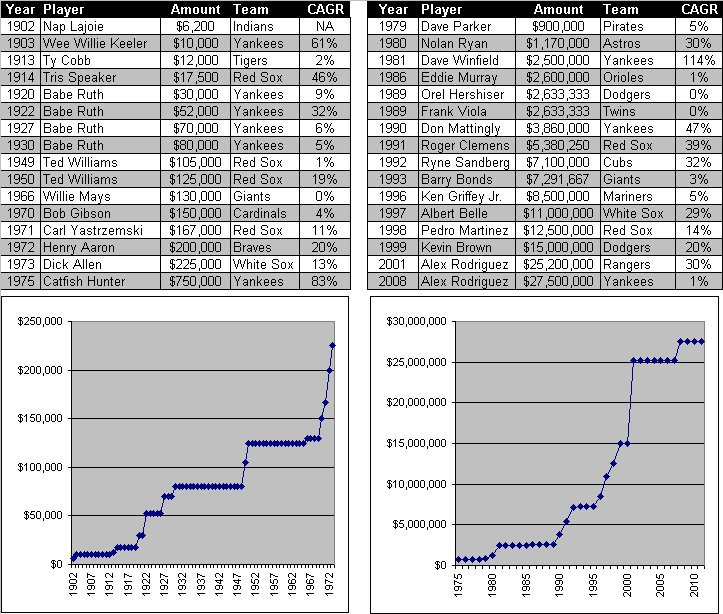
Note: Records for the period before Babe Ruth are not as complete. Salaries represent average annual contract values with bonuses included. In some cases, actual contract values may have been higher or lower based on interest/inflation adjustments and performance incentives. The highest paid designation was awarded to the player with the top average annual salary before the start of each season.
Source: archival newspaper accounts
Because of Ruth’s immense talent, his salary almost became a defacto ceiling for future players’ demands. In addition, the depression and World War II played a role in keeping players’ ambitions in check, as did the imposition of salary limits by the government’s Wage Stabilization Board during the early-1950s. Although players like Ted Williams and Joe DiMaggio finally surpassed the Babe’s benchmark and broke the $100,000 plateau during this period, it wouldn’t be until the mid-1960s when salaries started rise again.
In 1966, Willie Mays became the highest paid player in baseball history with a salary of $133,000, and then the dominoes started to fall. In the 1970s, a new player became the top man in almost every season, but in 1975, Catfish Hunter put them all to shame. After the 1974 season, Hunter discovered that Athletics’ owner Charley Finley had failed to fund an annuity as stipulated by his contract, so he claimed a breach and was eventually awarded free agency by an arbitrator. Fresh off four consecutive 20-win seasons, Hunter became the subject of a bidding war that was eventually won by George M. Steinbrenner. Hunter’s average contract value of $750,000 (his salary was much lower because of annuity deferments and other consideration) set the stage for the era of free agency that came to a crescendo when Tom Hicks handed out a whopping $252 million contract to Alex Rodriguez 25 years later.
For how much longer will Arod remain baseball’s salary king? This winter, Pujols and Fielder took their best shot at claiming the throne, but came up short. And, with more and more young superstars opting to sign long-term extensions before reaching free agency, it could be awhile before someone surpasses Rodriguez’s average annual salary of $27.5 million (which could wind up being even higher if certain milestone bonuses are achieved). Then again, with baseball enjoying unprecedented economic growth, maybe a $300 million/$30 million man is not that far away?
Spotted in midtown. The Score Truck? The Yankee Score Truck? Nah, but close enough.

Never mind the offense and head on over to the Pinstriped Bible and check out this post by Rebecca Glass on the Yankees’ pitching.
Another cold winter night in the city.

Sox looking to add pitching. Maybe the Yanks move a pitcher before Opening Day. Prince Fielder’s deal: pro and con.
Have at it.

The Pineda-Montero deal is official. Chad Jennings has the details.
Here’s a nice piece on Pineda by Christian Red in the Daily News.
[Photo Credit: Appleplusskeleton]
 As hard as it is for me to believe, I started collecting baseball cards 40 years ago. (Yes, I am becoming old.) To celebrate the anniversary, along with a set that collectors now consider iconic within the hobby, I’ll be spotlighting certain Yankee players from the 1972 Topps collection here in 2012.
For some reason, Topps chose yellow as its baseline color for Yankee cards. Yellow has never been part of the team’s color scheme; it has always been Navy blue and white, with some red thrown into the old Yankee Doodle hat logo. But yellow is what Topps selected, making that the color of memory for the ‘72 Yankees.
As with all of the regular issue ‘72 cards, Yankee players appeared in photographs that were either portraits, profiles, or posed shots. Topps did issue some “In Action” cards for a few Yankees, including Thurman Munson, Johnny Ellis, and Fritz Peterson, and we’ll tackle some of those throughout the year. But our emphasis will be on the regular issue cards, which were photographed at the original Yankee Stadium, various American League ballparks, or at the Yankees’ spring training site inFt.Lauderdale.
So let our tour of 1972 cards begin, with a player who is not often remembered for being a Yankee. Felipe Alou’s card shows him wearing the Yankees’ road uniform in a ballpark that may or may not be Anaheim Stadium. The photo, which is slightly out of focus, shows Alou finishing a practicing swing while giving the cameraman a serious stare. As posed shots go, it is classic Topps.
For those who recall Alou as the manager of the Expos and Giants, it’s easy to overlook just how good a player he was throughout the sixties and early seventies. The native Dominican was one of those five-tool players we hear so often about, but rarely get to see. In his prime, he hit with legitimate power, ran well enough to steal 10 to 12 bases a year, batted in the .280 to .290 range, and possessed enough arm and range to play all three outfield positions. Alou wasn’t quite a Hall of Famer–he was a couple of notches below that–but he was a damned fine ballplayer.
The peak of his career came in 1966, when he played center field for the Atlanta Braves and led the National League in hits, runs, and total bases. With a career high 31 home runs and an OPS of .894, Alou placed fifth in the league’s MVP voting.
By the time that he joined the Yankees early in 1971, Alou was no longer that same player, no longer in his prime. But he was still serviceable, a good role player who gave the Yankees depth in the outfield and at first base. The Yankees acquired him on April 9 of that season, just four days after the opening of the season. They acquired him from the Oakland A’s, who had deemed him valuable enough to be their Opening Day starter in left field.
In truth, Alou had been the center of trade rumors from the latter days of spring training through the first week of the regular season. There had been talk that the A’s might send him to the Brewers for some infield depth, but the Yankees apparently made Charlie Finley an offer that he felt was superior to what was presented by the Brewers. The Yankees sent Finley two pitchers, right-hander Ron Klimkowski and left-hander Rob Gardner. They were two decent middle relievers, but neither was expected to play a huge role with the Yankees in 1971. In fact, Gardner had been sent out to Triple-A Syracuse just before Opening Day.
The consensus of scouts maintained that Finley had not received enough value in return for Alou. The Oakland players knew that they would miss Alou, one of the most well-liked and respected players throughout the major leagues. A’s captain Sal Bando had once offered Alou the highest of praise. “He’s one of the greatest men I’ve ever met in baseball,” Bando told Ron Bergman, the A’s’ beat writer. “You think a man who’s been around as long as he has would pace himself a little. But he embarrasses you the way he hustles.” Yankee management was simply thrilled to have acquired a veteran leader and professional hitter.
Though there had been rumors of a possible trade, the timing of the deal—just a handful of days into the regular season—caught Alou by surprise. He had just moved his wife and children into an Oakland apartment, where they were scheduled to stay for the entire ‘71 season. Those plans would have to be scrapped, but the Yankees graciously gave Alou the necessary time to move his family out of the Oakland apartment and make new accommodations in the New York metropolitan region.
When Alou finally reported to the Yankees a few days later, he found an interesting way to find something positive in being traded from Oakland to New York. It involved the simplicity of his uniform. “At least I know this is the uniform I’m going to be wearing everyday,” Felipe told the New York Times in referring to the traditional home Yankee pinstripes. “Out there, I didn’t know which [A’s] uniform to wear when. We had one uniform for the first game of a doubleheader and another for the second. Once I put on the wrong uniform.”
Indeed, the A’s led both leagues in the number of uniform combinations. On some days, the A’s wore Kelly green uniforms with gold undershirts. Then there were games when they donned white jerseys (wedding gown white, as Finley called it) and pants with green sleeves. On other days, they wore Fort Knox gold uniforms with green undershirts. Life would be much simpler with the Yankees: pinstripes at home and standard gray on the road.
Five days after the trade, on April 14, Alou made his Yankee debut wearing the pinstripes. He started in right field at The Stadium against Tigers left-hander Mickey Lolich. Alou went just 1-for-5 that day, but he made the one hit memorable–a solo home run that was part of an 8-4 victory over Detroit.
Alou’s arrival in New York also created confusion for us young Yankee fans. We assumed that his name was pronounced “feh-leep ah-lew.” We didn’t realize that you had to pronounce the final “e” in his first name, making it “feh-leep-ay.” For some reason “feh-leep ah-lew” sounded right. But we were wrong, as we often were with the pronunciations of Latino ballplayers.
Alou would become a semi-regular for the Yankees in ‘71, at first playing right field, then moving to first base. He played 56 games in right field, 42 games at first base, and even filled in 20 times in center field. At 36 years of age, he was hardly a force–he powered only eight home runs and slugged a mere .410–but he did hit .289 with an on-base percentage of .334. Under ideal circumstances, he would have been a platoon player for a strong contender, but at 82-80, the Yankees needed him to take on a more prominent role.
With his speed diminishing, the Yankees reduced his outfield role, making him a platoon first baseman with Ron Blomberg. They hoped that Alou could produce at his 1971 level, but one year older, his play continued to fall off. He played only 120 games, his lowest output since his 1969 season with the Braves. He hit only six home runs as his slugging percentage fell below .400. By now it was obvious that Alou could no longer play every day, and might not even be able to help in much of a bench role, but the Yankees brought him back for 1973.
Though Alou’s skills were waning, the Yankees appreciated his demeanor and attitude. When a reporter asked manager Ralph Houk whom he considered the team leader, the skipper thought for a moment before responding, “I’d say Felipe.” In terms of fundamental and professionalism, no one on the Yankees matched Alou. “Felipe plays every day like a pro,” Houk told Yankee beat writer Jim Ogle in 1973. “Have you ever seen him make a mistake? I’m talking about judgment, not [physical] errors. Everyone makes errors, but Felipe doesn’t do the wrong thing very often. Have you ever watched Felipe go down the line, then take the turn at first base on a hit to the outfield? If there is even the slightest bobble, he’s on his way to second.”
Alou’s 1973 season with the Yankees would provide an intriguing twist. The Yankees had made a wintertime deal, sending journeyman Rob Gardner (who had since rejoined the team) and Rich McKinney to the A’s for right fielder Matty Alou. For the first time since 1964, the Alou brothers would play as teammates, just as they had done with the Giants. In fact, withSan Francisco, all three of the Alous—Felipe, Matty, and Jesus—had played together in the same outfield. (The three would have a reunion of sorts in 1973. When the A’s, featuring Jesus Alou, came to Yankee Stadium for a series in 1973, photographers made sure to snap shots of the three brothers together. One of these photographs would become the basis for an SSPC baseball card in 1978.)
Three specific memories stand out for me from the Yankees’ 1973 season. That was the year that George Steinbrenner assumed control of the franchise. That was the spring that Mike Kekich and Fritz Peterson announced the trade of their wives, children, and family pets. And that was the year that the Alous, reunited after a nine-year absence, became two of the notable faces of the Yankee franchise.
The Yankees made Matty their starting right fielder. They put Felipe back at first base. Facially, they looked somewhat alike, which created confusion for some Yankee fans. But for me, it was easy to tell them apart. Felipe wore glasses; Matty did not. Felipe was tall and batted right-handed. Matty was short and batted from the left side.
Matty hit well and fielded well, but it was strange that the Yankees used him, a singles hitter with virtually no power, to bat third instead of leadoff. Felipe struggled, his play falling off even further after the decline of 1972, and he lost the first base job. Interestingly, the Yankees replaced Felipe with Matty, who moved to first base despite being only five feet, nine inches tall. Felipe eventually made some starts in right field, mostly against left-handed pitching, as he platooned with Johnny Callison. But Felipe just couldn’t hit anymore. At age 38, he had lost most of his batting skills.
When the Yankees fell out of contention that summer, the front office felt it was time to move out some of their past-their-prime veterans. So they released Callison. A few weeks later, they decided it was time to cut ties with the aging Alous. On September 4, the Yankees announced two separate but related transactions. They sold Matty to the Padres. They also sold Felipe on waivers to the Expos. It was only fitting that the brothers would depart New York on the exact same day.
Felipe Alou batted .208 in 20 games for the Expos, who sold him to the Brewers after the season. Alou batted three times with Milwaukee, without a hit, and then drew his release. And thus came to an end a 17-year career in the big leagues.
Alou would never return to the Yankee organization. But he and the Yankees nearly enjoyed a reunion of sorts in 1994. Alou, by now the manager of the Expos, was leading his team to the best record (74-40) in the National League. In the meantime, the Yankees led the American League East. Then came the strike. If not for the labor/management conflict canceling the rest of the season and the World Series, it’s quite possible that Alou would have met the Yankees in the Fall Classic.
Like so many possibilities in baseball, it just never did come to pass.
[Photo Credit: Attic Insulation]

And how about a little love for Johnny Otis?
Rest in Peace. A master.

Dig the range:
[Drawing by Larry Roibal]

Coming close to the dead of winter. Not much doing for the Yanks as they wait to finalize the Pineda-Montero trade. Here’s a throwaway piece by Alvaro Morales at ESPN featuring Alex Rodriguez. Over at River Ave Blues, Ben Kabak makes a brief (and flimsy) case for Johnny Damon. And at It’s About the Money, Stupid, Chip Buck has an informative Q&A with Jim Callis of Baseball America.
Otherwise, it’s cool and quiet round here. Snow coming tonight.


Whenever a team makes a trade involving a young prospect, there’s always a fear he’ll wind up becoming a superstar. Considering the potential of Jesus Montero, that concern had to be foremost on Brian Cashman’s mind as he agreed to send the young hitter to the Seattle Mariners in exchange for Michael Pineda, a very promising prospect in his own right.
Years ago, before the information age, prospects seemed to magically appear on the doorstep of the major leagues. Nowadays, however, fans have the ability to track a player’s progress from the moment he is drafted until he takes his first pro at bat, so it’s easy to understand why many develop an attachment to homegrown prospects. And yet, in most cases, the pent-up anticipation usually leads to disappointment.
Since 1901, 379 position players (includes actives) have made their major debut in pinstripes, but only 52 ended their careers with a WAR higher than 15. Of that subtotal, all but 13 either spent most of their careers with the Yankees or were traded after establishing themselves in the big leagues, including 20 of the top 21 on the list. So, for the most part, the Yankees have been pretty good at not giving away their best position player prospects.
The Ones That Got Away
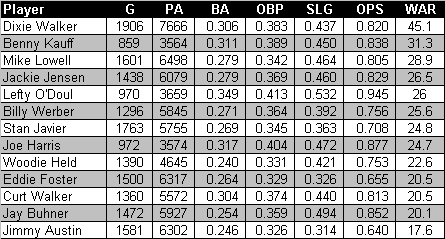
Note: Includes players with a WAR greater than 15 who were traded by the Yankees early in their careers.
Source: Baseball-reference.com
The only discarded Yankee whose career WAR would rank among the franchise’s best homegrown talents is Dixie Walker. After compiling only 422 plate appearances in five seasons with the Yankees, the 25-year old Walker finally blossomed after being sold to the White Sox for $12,000 in 1936. At the time, the Yankees were a powerhouse team about to embark on a four-year championship run, so there was little room for Walker. However, the move still proved to be short sighted, but not until two other teams also passed him over. Once Walker landed in Brooklyn, his career finally took off. In nine seasons as a Dodger, the outfielder compiled an OPS+ of 128 and received MVP votes in seven years. Admittedly, most of Walker’s success came during the war years, but that makes his loss even more regrettable from the Yankees’ standpoint. Had the team not traded him so many years earlier, perhaps Walker’s presence in the lineup would have helped the Bronx Bombers weather the loss of so many others to military service and avoid what for the Yankees was a long World Series drought from 1944 to 1946.
Mike Lowell’s ranking on the list is perhaps the most relevant in light of recent news because, like Montero, he was traded as part of a prospect swap. At the time, the Yankees had a stacked offensive team and decided to make a new three-year commitment to 3B Scott Brosius, which made Lowell expendable. Unfortunately, Ed Yarnall, the pitcher the Yankees received in return, didn’t exactly pan out. After only 20 innings in the Bronx, the lefty was traded to the Cincinnati Reds before departing forJapan. Needless to say, Cashman is hoping Michael Pineda does a lot better.
Like Lowell, Jackie Jensen is another discarded Yankee who eventually made his bones in Boston. In 1951, Jensen had a very strong campaign in limited duty, which he parlayed into being named Joe DiMaggio’s replacement the following year. Unfortunately for Jenson, that honor was short lived. In fact, it only lasted seven games. After hitting .105 during the first week of 1952, Jensen was traded to the Senators for Irv Noren. In the aftermath of the deal, Casey Stengel admitted that Jensen had talent, but stressed the Yankees’ need for a centerfielder who could “hit, run, field, and throw”. Of course, the irony was the Yankees already had someone on the roster who fit the description. His name was Mickey Mantle.
“We need a centerfielder who can hit, run, field and throw. I tried to give Jensen the job, but he couldn’t hit for me. I couldn’t wait any longer.” – Casey Stengel, quoted by the New York Times, May 4, 1952
Less than a month after the trade was made, Mantle was installed as the new center fielder and Noren was reduced to playing a utility role. Meanwhile, Jensen started to find his swing with the Senators, leading AP to suggest that the Yankees “pulled a whopper” by making a rare bad trade. Despite two solid seasons in Washington, Jensen really made his mark with the Red Sox. In seven seasons with Boston, the outfielder compiled an OPS+ of 123 and punctuated his career with an MVP in 1958.
Although his name appears at the bottom of the list, Jay Buhner probably stand outs to most fans as the best example of the Yankees trading away a promising young hitter. Seinfeld is largely to thank for that, but Buhner’s OPS+ of 125 with the Mariners wasn’t a work of fiction. Adding insult to injury, Buhner also tormented his former team on the field, batting .283/.379/.548 in over 400 regular season plate appearances to go along with a line of .366/.422/.537 in three post season series.
Top-10 OPS+ by Yankees in Their Debut Season
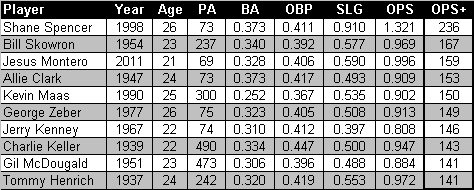
Note: Based on a minimum of 50 plate appearances.
Source: Baseball-reference.com
Albeit in only 69 plate appearances, Jesus Montero had the third highest OPS+ among all position players who debuted with the Yankees. That might seem like a bad omen, but he is surrounded on that list by more than a few players whose careers proved to be disappointments. Will Jesus Montero also follow that path, or join (and perhaps top) the list of young players who excelled after being trading by the Yankees? I wonder what Larry David thinks?
I can’t relate to pitchers. I had to take the ball from the second grade up through freshman year of high school and I hated it most of the time. I could hit, though, until it was too dark out to see the ball. If my dad’s arm didn’t get tired, we might still be out there.

On a basic level, hitting is reaction and pitching is initiation. I’ve always had trouble getting started. I’d rather get a feel for something first and join in progress. And the precision required to throw it exactly where you intend every time? Screw that, let me just hit the ball as hard as I can and we’ll see what happens.
Maybe this prejudice influences the way I envision a baseball roster. The lineup is the body, the pitching staff is the wardrobe. The appearance of the team changes game to game based on the pitcher, but the core is the same. The ace is your best suit, your best reliever could be your smoking jacket. (I guess A.J. Burnett is your kid’s urine-soaked PJs)
So when I heard Jesus Montero was traded for Michael Pineda, I felt like we were trading a neck for a necktie. Sure, the tie is important, but without the neck, what’s the point?
Even without the catching, I’ll take Montero’s simple, solid bat over the complex musculature of Pineda’s throwing arm. You can watch Montero hit every game, all season long. There’s no better way to interface with a team than through a star hitter, especially for a young fan, because he’s always in the lineup.

I understand that having Pineda in the rotation probably makes the 2012 Yankees a better team than they would have been with Montero as the DH. But in 2013? And 2014?
Arod and Teixeira are already fractions of what they once were and they will be declining in the lineup for years to come. The Yankees have one big hitter in his prime, Cano, who is fierce but not flawless. You don’t have to squint too hard to see a Yankee team desperate for hitting.
The more I think about the trade, the more comfortable I am with Cashman’s logic and his vision. But I am firmly on the Montero side of the debate. It boils down to this: if they both become stars, I’d want Montero to be a Yankee.

Who will DH? Joe Pawlikowski, Howard Megdal and Craig Calcaterra have some thoughts.

My wife adores baseball mascots. I think she’d rather meet the Phillie Phanatic than any player–oh, how she wants a kiss from that furry green beast. She complains that the Yankees don’t have a mascot. “What a bunch of tight asses,” she says. This helps explain why she is attracted to Francisco Cervelli, the closest thing the team has to a fuzzy cheerleader. She’s liked Cervelli ever since he joined the team a few years ago–though she did not like when he crossed home plate in a hot dog fashion up in Boston last season.
Ever since I’ve braced her for the possibility that he’s a short-timer in pinstripes. He’s spirited, throws the ball to third after a strike out with flair. The pitchers seem to like throwing to him though he doesn’t have a great arm and despite a few Luis Sojo-like streaks of clutch hitting, he’s not much with the stick either. And yet he’s still around and will go into spring training as the favorite to be the Yankees’ back-up catcher.

Over at Lo-Hud, Chad Jennings looks at organizational depth at catcher. There’s also a news-and-notes post featuring word on Phil Hughes and a rumor about Godzilla Matsui. As always, the Lo Hud remains an essential stop for the well-informed Yankee fan.
[Photo Credit: Barton Silverman/The New York Times]

Here’s Jonah Keri’s reaction to the Pineda-Montero trade:
When breaking down a player’s value, it’s easy to fixate on his weaknesses. Pineda’s got some question marks, but two of the main criticisms levied against him — that he was a lousy pitcher away from Safeco Field and that he faded badly down the stretch last season — don’t hold water. Dave Cameron broke down both those criticisms, noting that Pineda’s core skills stayed strikingly consistent, and that luck and regression toward the mean played far bigger roles in his fluctuating stats.
Within that post, Cameron explained that despite its enormous reputation as a pitcher-friendly stadium, Safeco doesn’t play as an extreme park in right field, only left-center. That part is true: Safeco dinged homers by lefty hitters at a relatively modest 5 percent rate. Problem is, Yankee Stadium’s ludicrously short porch in right helped inflate homers at that park a massive 43 percent. That’s not to say that no right-handed pitcher can possibly survive in that park. Some chap named Mariano Rivera’s been pretty OK there so far. Like Rivera, Pineda offers a pitch that’s highly effective against left-handed hitters, a slider that at its best bites down and in. It’s just a one-year sample size, but Pineda held lefties to just .237/.296/.357 in 2011. Still, there’s a seed of doubt here. Pineda posted the seventh-lowest ground-ball rate among all qualified starting pitchers last year. You can try to apply a simple park adjustment to a fly-ball pitcher moving from a homer-suppressing stadium to a nightmarish launching pad, but it’s unlikely that Pineda’s move to Yankee Stadium will be that easy to predict. He might see one too many elevated fastballs scrape over the wall, panic, change his approach, and fall apart. Or maybe he’ll become a Yankee in the Paul O’Neill mode, embracing his new digs and playing above his already considerable talent.
• That’s what makes this trade so fascinating. Though it’s not a swap of players at the same position, it still resembles what you’d call a challenge trade. Before this offseason, you’d have to dig deep to find examples of high-impact young players traded for each other; deals tend more often to involve one veteran for a bunch of prospects, or pretty much any other combination that’s not two wildly hyped 22-year-olds changing teams. One of the biggest (and only) ones that immediately jump to mind was 2007’s swap of Delmon Young for Matt Garza — and even that’s cheating, since Jason Bartlett was also a key part of that trade. There’s also Josh Hamilton for Edinson Volquez, but for whatever reason, this type of trade has suddenly become all the rage. There were other players involved, but Mat Latos for Yonder Alonso fits the profile. So too does Anthony Rizzo for Andrew Cashner. If two teams laying it on the line by trading young, potential impact players is about to become a trend, I’m all for it.
[Photo Credit: Martinico37]
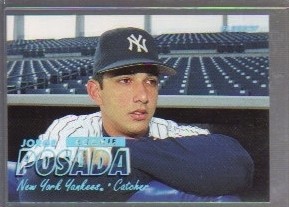
Jorge Posada still hasn’t made his decision official, but it’s become common knowledge that he has decided to retire rather than continue his career as a backup catcher in Tampa Bay, Baltimore, or Philadelphia. While I would never begrudge a player who wanted to prolong his career as much as possible, there is some artistic symmetry in Posada beginning and ending his playing days in the same place.
Posada represents the latest in a long line of great Yankee catchers, a succession that began with Bill Dickey before continuing with Yogi Berra, Elston Howard, and Thurman Munson. Dickey and Berra are members of the Hall of Fame, Howard and Munson are not, and Posada will become the focal point of what should be an interesting five-year debate over his worthiness for the Hall of Fame.
The comparison of Posada and Munson has long fascinated me. Based strictly on OPS (.848 to .756), one would conclude that Posada was the superior of the two. Posada certainly had more career value, thanks to luck and longevity. But using an eyeball approach–assuming you’re old enough to have seen both players–Munson was the better player, especially when you factor in the areas of fielding and baserunning.
As much as I like Munson, he just didn’t have the career longevity that is needed for a Hall of Fame player. I would also vote “no” on Posada’s entrance into Cooperstown, though I’m open to change my mind. The relatively late start to his career, along with his defensive deficiencies and baserunning misadventures, render him just short of my personal Hall of Fame line. But that should not be interpreted as some kind of insult. Any player who is even considered for the Hall of Fame is a player of achievement, a player of longevity, a player who is worthy of praise and appreciation. Posada’s offensive excellence—encompassing his ability to hit with power, draw walks, and do damage from both sides of the plate–made him a modern day version of Ted Simmons.
And let’s not forget that early in his career, Posada was a respectable receiver who generally developed good rapport with his pitchers. For every A.J. Burnett, there have been dozens of pitchers who came to trust and rely on Posada’s enthusiasm, passion, and leadership abilities. By all accounts, Posada has been a good and well-liked teammate who has blended well with the vast array of personalities the Yankees have had over the last 15 years.
Posada’s career path is rather remarkable given its origins. It’s worth noting that he was not a highly touted player when first signed by the Yankees. He was a 24th round selection in 1990. He started his professional career as a second baseman with the Oneonta Yankees, a short-season Class-A franchise in the NY-Penn League, before someone in the organization had the foresight to convert him to catcher. When the Yankees first brought him to the major leagues, they often used him as a pinch-runner. It’s almost as if the Posada of the 1990s was someone else, some alien life form who possessed the powers of self-transformation. I guess his makeover is proof that players are adaptable, than they can evolve, and that a longshot can become a success in the game of major league baseball.
Farewell, Jorge. Next stop, Old-Timers Day. I think you’ll be pretty popular that day.
***

I think I’ve been as big a booster of Jesus Montero as anyone who writes for The Banter, so you might expect that I’d be unhappy with the trade that sent him and Hector Noesi to the Mariners for Michael Pineda and Jose Campos. Granted, I’m a little disappointed that I won’t have the opportunity to see Montero play every day in pinstripes, primarily because I think he is going to be a star hitter, the kind of player who will hit .300, slug .500, and carry a team’s offense for days at a time.
As much as I like Montero, I love the trade. Scouts praise Pineda the way I rave about Montero. At six-feet, seven inches and 260 pounds, he’s been described as a “monster,” even as a “leviathan,” which may be the first time I’ve heard that word used to refer to a ballplayer. (He looks like a bigger version of Lee Smith, if such a thing is possible.) With his 95 to 98 mile-an-hour fastball and bone snapping slider, Pineda makes mitts pops and heads turn.
If Pineda duplicates the way he pitched for the Mariners, particularly over the first half of the season, the Yankees have a perfectly formidable No. 2 starter. If he adds a third pitch to his repertoire and pitches to a reachable higher level, he becomes a full-fledged No. 1 starter, someone who can eventually wrestle with CC Sabathia for the mythical top spot of the Yankee rotation.
As a bonus, the trade with the Mariners also netted Campos, whom some scouts project to be better than Pineda. With his smooth delivery and live fastball, the 19-year
-old right-hander will start the season at Single-A ball, but could move up to Double-A by midsummer.
While the Yankees often deal prospects for established veterans, they don’t often make trades where they deal young talent for young talent. In fact, I can’t remember Cashman making this sort of transaction in the past. This deal reminds me of the 1978 trade in which the Yankees traded Mike Heath, a highly touted young catcher, to the Rangers for a power-throwing left-hander named Dave Righetti. (The deal also included a longtime veteran in Sparky Lyle, but Heath and the three other prospects going to Texas were really the keys to the trade.) Righetti became a serviceable starter before Yogi Berra made the controversial and still-debated decision to move “Rags” to the bullpen, where he had some level of success but never became a dominant closer.
I think Pineda will turn out to be a better pitcher than Righetti. He’ll need to stay healthy, and have some luck along the way, but I think his chances of success are pretty good. With Pineda and the bonus addition of free agent Hiroki Kuroda, the Yankees now have their deepest rotation since the days of Clemens, Pettitte, Mussina and Wells…
***
As with any trade, the Pineda deal leads to the inevitable question: what is the next move? The subtraction of Montero leaves the Yankees without a DH. Joe Girardi has said he wants to rotate some of his resting veterans into the DH slot, but that’s not a fulltime proposition that can be sustained through 162 games. There will be plenty of days when the Yankees will want–make that, need–a proper DH who can put up some raw numbers. Two free agent candidates appear to be at the top of the list. They are Johnny Damon and Carlos Pena.
I’d be fine with either one on a reasonable one-year contract, but my preference would be Pena. At 33, he’s five years younger than Damon, outslugged him by 44 points in 2011, and has a history of launching long balls at Yankee Stadium. With 28 home runs and 101 walks for the Cubs in 2011, Pena fits the Yankee offensive blueprint to a tee.
Pena can no longer hit for much of an average, and he must be platooned, because he’s become like Oscar Gamble against left-handed pitching. The Yankees have a solution for that in the re-signed Andruw Jones, whose prowess against left-handed pitching has been well documented. A Jones/Pena platoon would be an ideal fit for the seventh position in the Yankee batting order.
On the other hand, Damon still has something to offer. He can hit the long ball (16 home runs) and can still steal a base (19 stolen bases in 2011). He would bring more of a contract presence to the lineup, an ingredient that was sometimes missing in 2011. And we know that Damon would have no trouble fitting into the clubhouse dynamic or dealing with the New York City press.
Damon or Pena, which is your choice?
[Photo Credit: Seattle Mariners Musings]
Bruce Markusen writes “Cooperstown Confidential” for The Hardball Times and can be found from time to time on Facebook.

It is remarkable how news is delivered and digested in the Twitter Era. It comes at us in a flurry–rumors, confirmations, reactions, analysis. There is little time for reflection and an overload of hyperactive reaction.

Last night, the trade of Jesus Montero to the Mariners for Michael Pineda, prompted conflicting feelings for Yankee fans. Many are disappointed to see Montero leave. Here is a player that was nurtured by the organization–even though they dangled him a year-and-a-half ago to Seattle for Cliff Lee–a guy who looked more than promising when he arrived in the Bronx late last year. Montero was hyped, of course, this being New York, but he was also a player that many of us felt would be a pleasure to watch in pinstripes for the next decade. And now that is gone–whoosh.

Montero is being replaced by the another promising player, a young pitcher with a great fastball and an effective silder, but Pineda is not our guy. We’ve got no attachment to him yet. He’s just a face, a stat line. He’s not The Jesus.

The arguments run both ways–hitters aren’t as risky as pitchers, a starting pitcher is more valuable than a DH, a great hitter catcher is even more important than a good starting pitcher–and they are all valid. Yankee fans are experiencing duel emotions but there is room to mourn the loss of Montero and to be eager about the addition of Pineda. The risk involved in trading something as precious as Montero and Pineda makes this all the more unsettling. So we’re anxious, and that’s what makes this exciting and gives us baseball nerds something to keep our engines going in the middle of winter.

Here are reactions around the web from: David Waldstein (The Times); Cliff Corcoran (SI); Paul Swydan (Fangraphs); Steven Goldman (Pinstriped Bible); William J (The Captain’s Blog); can’t forget No Maas, and over at It’s about the Money Stupid, check out this fine collection of links from around the web.
Finally, here’s Dave Cameron with a scouting report on Pineda over at Fangraphs:
Among qualified AL starting pitchers last year, only Brandon Morrow and Justin Verlander posted a higher strikeout rate than Pineda, who whiffed 24.9% of the batters he faced. His K% was better than David Price, CC Sabathia, and yes, even Felix. Pineda’s live fastball and willingness to live up in the strike zone led to a lot of swinging strikes, and that had nothing to do with the park he played in.
Lots of young pitchers can throw hard and rack up strikeouts, however. What sets Pineda apart is his impeccable command at such a young age. 66 percent of the pitches he threw last year were strikes, and his 7.9% BB% was below the league average. It is highly uncommon to see a kid with that kind of live arm arrive in the Major Leagues pounding the zone, but that’s exactly what Pineda did. 94-97 MPH fastballs to get ahead, and then an out-pitch slider or a fastball out of the zone with two strikes to get the K. It was a recipe for success, and Pineda used his command of those two pitches to establish himself as one of the game’s best young starting pitchers.
So, while he’s not perfect (his change-up is lousy and left-handers can still jump on him from time to time), Yankees fans should be thrilled with their new addition. And, given the price that other young arms have been fetching this winter, they should be even more thrilled with the cost.
Pineda is the third quality young arm to get traded this winter, following the trades that shipped Gio Gonzalez to Washington and Mat Latos to Cincinnati. Given that both pitchers come with one fewer year of team control and lack Pineda’s dominating fastball, a strong case could be made that the Yankees new starter is the most valuable asset of the three guys that were moved. However, compared to the other two packages surrendered, the Yankees didn’t really pay much of a premium to get Pineda, and one could even make an argument that they gave up less value overall than what the Reds surrendered to get Latos.

[Photo Credits: Danytumblog, Phillipe Reichert, Attimi Rubati x2,electric feeling, Studio Museum in Harlem]